13/04/2023 General Connections In Steel Structures 2
What Will You Gain From This Presentation?
2
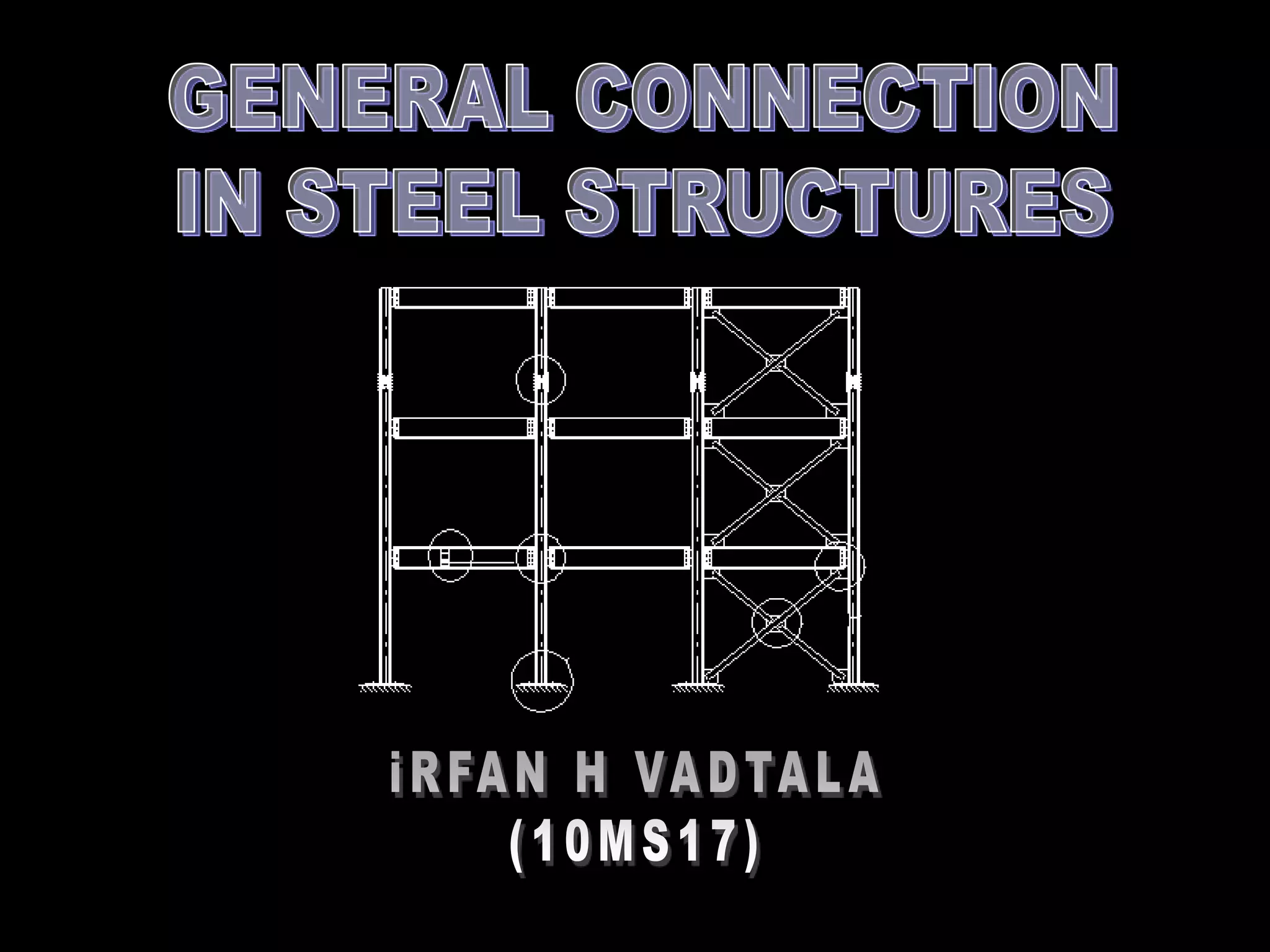
• Why steel structures?
• What is connections?
• Components of connections
• Design philosophy
• Classification criteria of connections
• Understanding different types of connections
• Special connections
13/04/2023 General Connections In Steel Structures 3
Why Steel?
• Steel allows for reduced frame construction time and the
ability to construct in all seasons
• Steel makes large spans and bay sizes possible, providing
more flexibility
• Steel is easier to modify and change to an extent facility over
its life
• Steel is lightweight and can reduce foundation costs
• Steel is durable, long-lasting and recyclable
‘There is always a solution in steel’ -AISC
13/04/2023 General Connections In Steel Structures 4
Connections
• Connects different inter/intra-elements
• Load transmission medium – top to foundation
• Decide behavior of structure – Rigid / Flexible
• Brittle failure
• Cost of connections > steel work (60 – 40)
• All chores – Analysis & Design - Appropriate
- Drawings – Sufficient
- Execution - Practical
‘A structure is only strong as its weakest link’ –N Subramanian
13/04/2023 General Connections In Steel Structures 5
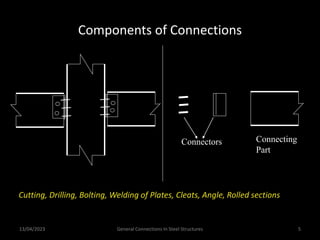
Components of Connections
Connectors Connecting
Part
Cutting, Drilling, Bolting, Welding of Plates, Cleats, Angle, Rolled sections
13/04/2023 General Connections In Steel Structures 6
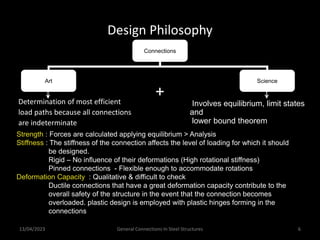
Design Philosophy
Connections
Art Science
Involves equilibrium, limit states
and
lower bound theorem
+
Determination of most efficient
load paths because all connections
are indeterminate
Strength : Forces are calculated applying equilibrium > Analysis
Stiffness : The stiffness of the connection affects the level of loading for which it should
be designed.
Rigid – No influence of their deformations (High rotational stiffness)
Pinned connections - Flexible enough to accommodate rotations
Deformation Capacity : Qualitative & difficult to check
Ductile connections that have a great deformation capacity contribute to the
overall safety of the structure in the event that the connection becomes
overloaded. plastic design is employed with plastic hinges forming in the
connections
13/04/2023 General Connections In Steel Structures 7
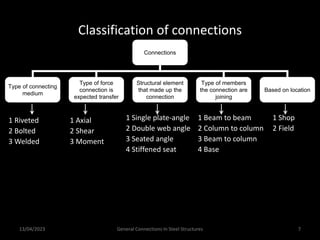
Classification of connections
Connections
Type of connecting
medium
Type of force
connection is
expected transfer
Structural element
that made up the
connection
Type of members
the connection are
joining
Based on location
1 Riveted
2 Bolted
3 Welded
1 Axial
2 Shear
3 Moment
1 Single plate-angle
2 Double web angle
3 Seated angle
4 Stiffened seat
1 Beam to beam
2 Column to column
3 Beam to column
4 Base
1 Shop
2 Field
13/04/2023 General Connections In Steel Structures 8
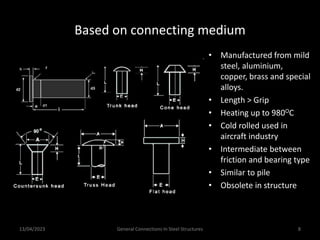
Based on connecting medium
• Manufactured from mild
steel, aluminium,
copper, brass and special
alloys.
• Length > Grip
• Heating up to 980OC
• Cold rolled used in
aircraft industry
• Intermediate between
friction and bearing type
• Similar to pile
• Obsolete in structure
13/04/2023 General Connections In Steel Structures 9
Based on connecting medium
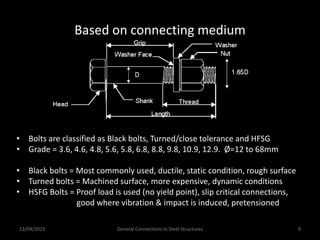
• Bolts are classified as Black bolts, Turned/close tolerance and HFSG
• Grade = 3.6, 4.6, 4.8, 5.6, 5.8, 6.8, 8.8, 9.8, 10.9, 12.9. Ø=12 to 68mm
• Black bolts = Most commonly used, ductile, static condition, rough surface
• Turned bolts = Machined surface, more expensive, dynamic conditions
• HSFG Bolts = Proof load is used (no yield point), slip critical connections,
good where vibration & impact is induced, pretensioned
13/04/2023 General Connections In Steel Structures 10
Based on connecting medium
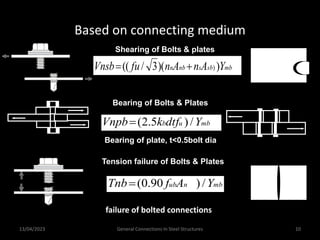
failure of bolted connections
Shearing of Bolts & plates
Bearing of Bolts & Plates
Tension failure of Bolts & Plates
mb
sb
s
nb
n Y
A
n
A
n
fu
Vnsb )
)(
3
/
(( )


mb
n
ub Y
A
f
Tnb /
)
90
.
0
(

mb
u
b Y
dtf
k
Vnpb /
)
5
.
2
(

Bearing of plate, t<0.5bolt dia
13/04/2023 General Connections In Steel Structures 11
Based on connecting medium
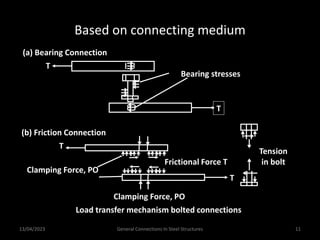
Load transfer mechanism bolted connections
(a) Bearing Connection
(b) Friction Connection
T
Frictional Force T
Clamping Force, PO
Bearing stresses
Tension
in bolt
T
T
T
Clamping Force, PO
13/04/2023 General Connections In Steel Structures 12
Based on connecting medium
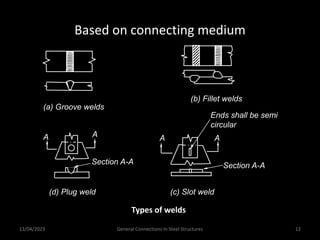
Types of welds
A
Ends shall be semi
circular
A
Section A-A
(c) Slot weld
(a) Groove welds
(b) Fillet welds
A
A
Section A-A
(d) Plug weld
13/04/2023 General Connections In Steel Structures 13
Based on connecting medium
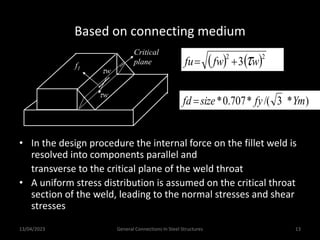
• In the design procedure the internal force on the fillet weld is
resolved into components parallel and
transverse to the critical plane of the weld throat
• A uniform stress distribution is assumed on the critical throat
section of the weld, leading to the normal stresses and shear
stresses
f1
w
w
Critical
plane    2
2
3 w
fw
fu 


)
*
3
/(
*
707
.
0
* Ym
fy
size
fd 
13/04/2023 General Connections In Steel Structures 14
Type of force connection is expected transfer
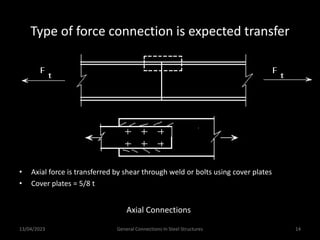
• Axial force is transferred by shear through weld or bolts using cover plates
• Cover plates = 5/8 t
Axial Connections
13/04/2023 General Connections In Steel Structures 15
Type of force connection is expected transfer
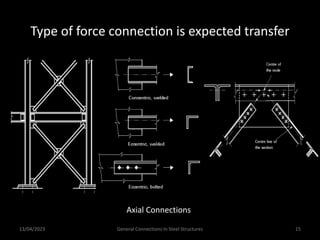
Axial Connections
13/04/2023 General Connections In Steel Structures 16
Type of force connection is expected transfer
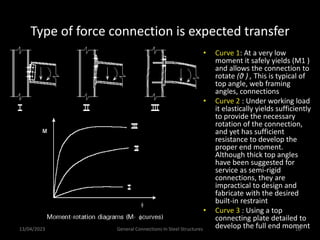
• Curve 1: At a very low
moment it safely yields (M1 )
and allows the connection to
rotate (θ ) , This is typical of
top angle, web framing
angles, connections
• Curve 2 : Under working load
it elastically yields sufficiently
to provide the necessary
rotation of the connection,
and yet has sufficient
resistance to develop the
proper end moment.
Although thick top angles
have been suggested for
service as semi-rigid
connections, they are
impractical to design and
fabricate with the desired
built-in restraint
• Curve 3 : Using a top
connecting plate detailed to
develop the full end moment
13/04/2023 General Connections In Steel Structures 17
Type of force connection is expected transfer
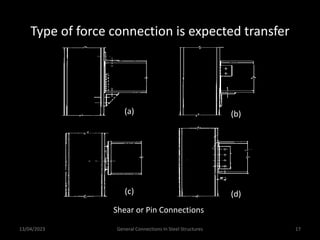
Shear or Pin Connections
(a) (b)
(c) (d)
13/04/2023 General Connections In Steel Structures 18
Type of force connection is expected transfer
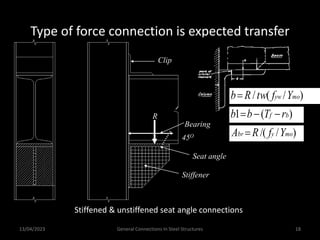
Stiffened & unstiffened seat angle connections
R
Seat angle
Stiffener
45O
Clip
Bearing
)
/
(
/ mo
yw Y
f
tw
R
b
)
(
1 b
f r
T
b
b 


)
/
/( mo
y
br Y
f
R
A 
13/04/2023 General Connections In Steel Structures 19
Type of force connection is expected transfer
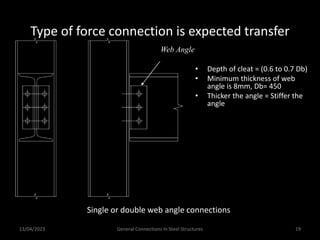
Single or double web angle connections
Web Angle
• Depth of cleat = (0.6 to 0.7 Db)
• Minimum thickness of web
angle is 8mm, Db= 450
• Thicker the angle = Stiffer the
angle
13/04/2023 General Connections In Steel Structures 20
Type of force connection is expected transfer
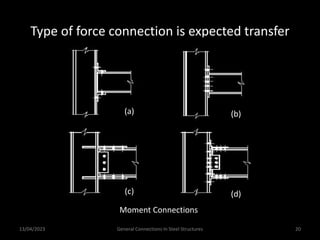
Moment Connections
(a) (b)
(c) (d)
13/04/2023 General Connections In Steel Structures 21
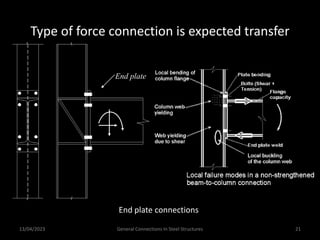
Type of force connection is expected transfer
End plate connections
End plate
13/04/2023 General Connections In Steel Structures 22
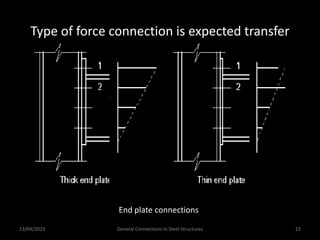
Type of force connection is expected transfer
End plate connections
13/04/2023 General Connections In Steel Structures 23
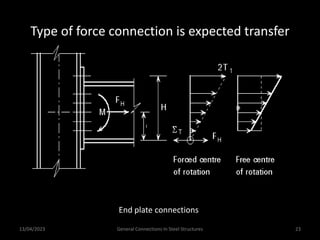
Type of force connection is expected transfer
End plate connections
13/04/2023 General Connections In Steel Structures 24
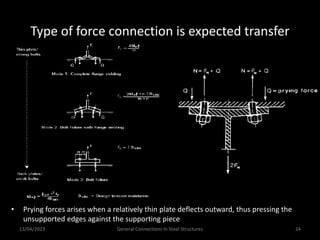
Type of force connection is expected transfer
• Prying forces arises when a relatively thin plate deflects outward, thus pressing the
unsupported edges against the supporting piece
13/04/2023 General Connections In Steel Structures 25
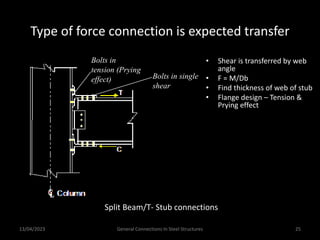
Type of force connection is expected transfer
Split Beam/T- Stub connections
Bolts in single
shear
Bolts in
tension (Prying
effect)
• Shear is transferred by web
angle
• F = M/Db
• Find thickness of web of stub
• Flange design – Tension &
Prying effect
13/04/2023 General Connections In Steel Structures 26
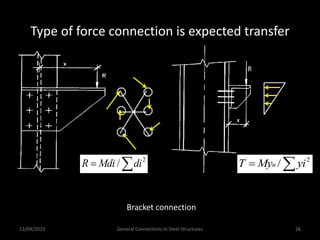
Type of force connection is expected transfer
Bracket connection

 2
/ di
Mdi
R 
 2
/ yi
My
T n
13/04/2023 General Connections In Steel Structures 27
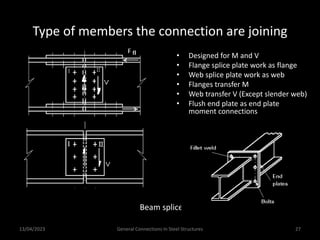
Type of members the connection are joining
Beam splice
• Designed for M and V
• Flange splice plate work as flange
• Web splice plate work as web
• Flanges transfer M
• Web transfer V (Except slender web)
• Flush end plate as end plate
moment connections
13/04/2023 General Connections In Steel Structures 28
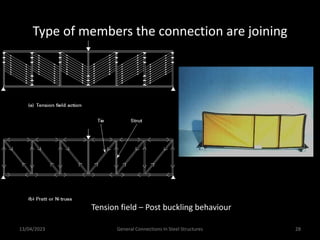
Type of members the connection are joining
Tension field – Post buckling behaviour
13/04/2023 General Connections In Steel Structures 29
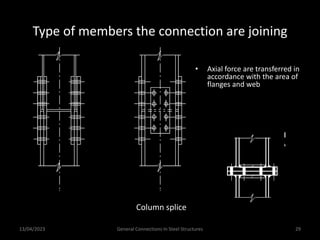
Type of members the connection are joining
Column splice
• Axial force are transferred in
accordance with the area of
flanges and web
13/04/2023 General Connections In Steel Structures 30
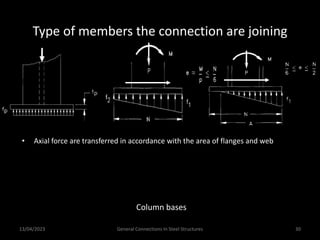
Type of members the connection are joining
Column bases
• Axial force are transferred in accordance with the area of flanges and web
13/04/2023 General Connections In Steel Structures 31
References
• Owens & Cheal – Structural Steel Work Connections
• Euro code -3
• AISC Connection Manual
• Akbar Tamboli – Handbook of Connection Design
• Subramanian – Design of Steel Structures
• INSDAG – Teaching Resources
• ESDEP Notes -European Steel Design Education Programme
13/04/2023 General Connections In Steel Structures 32
13/04/2023 General Connections In Steel Structures 33

106769120-General-Connection-in-Steel-Structures.ppt

  • 2.
    13/04/2023 General ConnectionsIn Steel Structures 2 What Will You Gain From This Presentation? 2 • Why steel structures? • What is connections? • Components of connections • Design philosophy • Classification criteria of connections • Understanding different types of connections • Special connections
  • 3.
    13/04/2023 General ConnectionsIn Steel Structures 3 Why Steel? • Steel allows for reduced frame construction time and the ability to construct in all seasons • Steel makes large spans and bay sizes possible, providing more flexibility • Steel is easier to modify and change to an extent facility over its life • Steel is lightweight and can reduce foundation costs • Steel is durable, long-lasting and recyclable ‘There is always a solution in steel’ -AISC
  • 4.
    13/04/2023 General ConnectionsIn Steel Structures 4 Connections • Connects different inter/intra-elements • Load transmission medium – top to foundation • Decide behavior of structure – Rigid / Flexible • Brittle failure • Cost of connections > steel work (60 – 40) • All chores – Analysis & Design - Appropriate - Drawings – Sufficient - Execution - Practical ‘A structure is only strong as its weakest link’ –N Subramanian
  • 5.
    13/04/2023 General ConnectionsIn Steel Structures 5 Components of Connections Connectors Connecting Part Cutting, Drilling, Bolting, Welding of Plates, Cleats, Angle, Rolled sections
  • 6.
    13/04/2023 General ConnectionsIn Steel Structures 6 Design Philosophy Connections Art Science Involves equilibrium, limit states and lower bound theorem + Determination of most efficient load paths because all connections are indeterminate Strength : Forces are calculated applying equilibrium > Analysis Stiffness : The stiffness of the connection affects the level of loading for which it should be designed. Rigid – No influence of their deformations (High rotational stiffness) Pinned connections - Flexible enough to accommodate rotations Deformation Capacity : Qualitative & difficult to check Ductile connections that have a great deformation capacity contribute to the overall safety of the structure in the event that the connection becomes overloaded. plastic design is employed with plastic hinges forming in the connections
  • 7.
    13/04/2023 General ConnectionsIn Steel Structures 7 Classification of connections Connections Type of connecting medium Type of force connection is expected transfer Structural element that made up the connection Type of members the connection are joining Based on location 1 Riveted 2 Bolted 3 Welded 1 Axial 2 Shear 3 Moment 1 Single plate-angle 2 Double web angle 3 Seated angle 4 Stiffened seat 1 Beam to beam 2 Column to column 3 Beam to column 4 Base 1 Shop 2 Field
  • 8.
    13/04/2023 General ConnectionsIn Steel Structures 8 Based on connecting medium • Manufactured from mild steel, aluminium, copper, brass and special alloys. • Length > Grip • Heating up to 980OC • Cold rolled used in aircraft industry • Intermediate between friction and bearing type • Similar to pile • Obsolete in structure
  • 9.
    13/04/2023 General ConnectionsIn Steel Structures 9 Based on connecting medium • Bolts are classified as Black bolts, Turned/close tolerance and HFSG • Grade = 3.6, 4.6, 4.8, 5.6, 5.8, 6.8, 8.8, 9.8, 10.9, 12.9. Ø=12 to 68mm • Black bolts = Most commonly used, ductile, static condition, rough surface • Turned bolts = Machined surface, more expensive, dynamic conditions • HSFG Bolts = Proof load is used (no yield point), slip critical connections, good where vibration & impact is induced, pretensioned
  • 10.
    13/04/2023 General ConnectionsIn Steel Structures 10 Based on connecting medium failure of bolted connections Shearing of Bolts & plates Bearing of Bolts & Plates Tension failure of Bolts & Plates mb sb s nb n Y A n A n fu Vnsb ) )( 3 / (( )   mb n ub Y A f Tnb / ) 90 . 0 (  mb u b Y dtf k Vnpb / ) 5 . 2 (  Bearing of plate, t<0.5bolt dia
  • 11.
    13/04/2023 General ConnectionsIn Steel Structures 11 Based on connecting medium Load transfer mechanism bolted connections (a) Bearing Connection (b) Friction Connection T Frictional Force T Clamping Force, PO Bearing stresses Tension in bolt T T T Clamping Force, PO
  • 12.
    13/04/2023 General ConnectionsIn Steel Structures 12 Based on connecting medium Types of welds A Ends shall be semi circular A Section A-A (c) Slot weld (a) Groove welds (b) Fillet welds A A Section A-A (d) Plug weld
  • 13.
    13/04/2023 General ConnectionsIn Steel Structures 13 Based on connecting medium • In the design procedure the internal force on the fillet weld is resolved into components parallel and transverse to the critical plane of the weld throat • A uniform stress distribution is assumed on the critical throat section of the weld, leading to the normal stresses and shear stresses f1 w w Critical plane    2 2 3 w fw fu    ) * 3 /( * 707 . 0 * Ym fy size fd 
  • 14.
    13/04/2023 General ConnectionsIn Steel Structures 14 Type of force connection is expected transfer • Axial force is transferred by shear through weld or bolts using cover plates • Cover plates = 5/8 t Axial Connections
  • 15.
    13/04/2023 General ConnectionsIn Steel Structures 15 Type of force connection is expected transfer Axial Connections
  • 16.
    13/04/2023 General ConnectionsIn Steel Structures 16 Type of force connection is expected transfer • Curve 1: At a very low moment it safely yields (M1 ) and allows the connection to rotate (θ ) , This is typical of top angle, web framing angles, connections • Curve 2 : Under working load it elastically yields sufficiently to provide the necessary rotation of the connection, and yet has sufficient resistance to develop the proper end moment. Although thick top angles have been suggested for service as semi-rigid connections, they are impractical to design and fabricate with the desired built-in restraint • Curve 3 : Using a top connecting plate detailed to develop the full end moment
  • 17.
    13/04/2023 General ConnectionsIn Steel Structures 17 Type of force connection is expected transfer Shear or Pin Connections (a) (b) (c) (d)
  • 18.
    13/04/2023 General ConnectionsIn Steel Structures 18 Type of force connection is expected transfer Stiffened & unstiffened seat angle connections R Seat angle Stiffener 45O Clip Bearing ) / ( / mo yw Y f tw R b ) ( 1 b f r T b b    ) / /( mo y br Y f R A 
  • 19.
    13/04/2023 General ConnectionsIn Steel Structures 19 Type of force connection is expected transfer Single or double web angle connections Web Angle • Depth of cleat = (0.6 to 0.7 Db) • Minimum thickness of web angle is 8mm, Db= 450 • Thicker the angle = Stiffer the angle
  • 20.
    13/04/2023 General ConnectionsIn Steel Structures 20 Type of force connection is expected transfer Moment Connections (a) (b) (c) (d)
  • 21.
    13/04/2023 General ConnectionsIn Steel Structures 21 Type of force connection is expected transfer End plate connections End plate
  • 22.
    13/04/2023 General ConnectionsIn Steel Structures 22 Type of force connection is expected transfer End plate connections
  • 23.
    13/04/2023 General ConnectionsIn Steel Structures 23 Type of force connection is expected transfer End plate connections
  • 24.
    13/04/2023 General ConnectionsIn Steel Structures 24 Type of force connection is expected transfer • Prying forces arises when a relatively thin plate deflects outward, thus pressing the unsupported edges against the supporting piece
  • 25.
    13/04/2023 General ConnectionsIn Steel Structures 25 Type of force connection is expected transfer Split Beam/T- Stub connections Bolts in single shear Bolts in tension (Prying effect) • Shear is transferred by web angle • F = M/Db • Find thickness of web of stub • Flange design – Tension & Prying effect
  • 26.
    13/04/2023 General ConnectionsIn Steel Structures 26 Type of force connection is expected transfer Bracket connection   2 / di Mdi R   2 / yi My T n
  • 27.
    13/04/2023 General ConnectionsIn Steel Structures 27 Type of members the connection are joining Beam splice • Designed for M and V • Flange splice plate work as flange • Web splice plate work as web • Flanges transfer M • Web transfer V (Except slender web) • Flush end plate as end plate moment connections
  • 28.
    13/04/2023 General ConnectionsIn Steel Structures 28 Type of members the connection are joining Tension field – Post buckling behaviour
  • 29.
    13/04/2023 General ConnectionsIn Steel Structures 29 Type of members the connection are joining Column splice • Axial force are transferred in accordance with the area of flanges and web
  • 30.
    13/04/2023 General ConnectionsIn Steel Structures 30 Type of members the connection are joining Column bases • Axial force are transferred in accordance with the area of flanges and web
  • 31.
    13/04/2023 General ConnectionsIn Steel Structures 31 References • Owens & Cheal – Structural Steel Work Connections • Euro code -3 • AISC Connection Manual • Akbar Tamboli – Handbook of Connection Design • Subramanian – Design of Steel Structures • INSDAG – Teaching Resources • ESDEP Notes -European Steel Design Education Programme
  • 32.
    13/04/2023 General ConnectionsIn Steel Structures 32
  • 33.
    13/04/2023 General ConnectionsIn Steel Structures 33