International Research Journal of Engineering and Technology (IRJET) e-ISSN: 2395-0056
Volume: 04 Issue: 08 | Aug -2017 www.irjet.net p-ISSN: 2395-0072
© 2017, IRJET | Impact Factor value: 5.181 | ISO 9001:2008 Certified Journal | Page 2076
ANALYSIS OF COLD FORMED STEEL CONNECTIONS USING FEM
Poornima M Pol1, Mamata Mogali2
1P.G student, Dept. of Civil Engineering, SDMCET Dharwad, Karnataka, India
2Assistant Professor, SDMCET Dharwad, Karnataka, India
---------------------------------------------------------------------***---------------------------------------------------------------------
Abstract - The main aim of the study is to increase the use
of cold form steel in steel structure by studying cold form
steel connections. Cold formed steel sections are used as
secondary structural members, Usually cold form steel is
used only in purlins of truss non load bearing walls floor
deck system etc. But now day’s cold formed structural steel
tubular sections are being used in many developing
countries like Canada, India, Hong Kong and Australia.
These are offering light weight to high strength and width
to thickness ratio is very less. In this paper the attempt
have been made to study the application of cold form steel
beam-column screwed connection using beam column
connector by determining its load carrying capacity of
various connection configuration .In this project
Experimental results are compared with Analytical results
.Models in analytical method are analysed through FEM
Software ANSYS.
Key Words: Cold Formed steel, Ansys, Finit element
analysis, Hypermesh.
1. INTRODUCTION
The use of steel structure in now a day’s
construction being very popular as compared to RCC
structures because of the fact that they provide high
strength, very fast in construction, they are light in
weight so easy erection and installation etc.
Based on the manufacturing process structural
steel is classified into two types; hot rolled sections and
cold formed light gauge steel structures. There are
mainly two meth0ds 0f f0rming light gauge steel
secti0ns, c0ld r0lling for use in mass production formed
at room temperature and pressing in press-brakes use in
small quantities also for producing some special shapes.
These members are then connected by bolts, rivets,
screws, welds or by special fasteners. Cold formed light
gauge steels are very thin and thickness varies from 0.75
to 4 mm and having yield strength of 230 to 420 Mpa.
The steel is coated with zinc or a mixture of zinc and
aluminum to protect it from decay of material. Thickness
of this coating depends on environmental condition and
marine environments require more protection. Cold
formed light gauge members are divided into (i) framing
members such as studs, joists, beams etc (ii) long span
roof deck, floor and wall panels (iii) wall claddings and
standard roof deck. The cold form light gauge steel
structure are used as a secondary members such as side
rails, roof purlins and wall cladding, and they are
connected to the primary members through web cleats.
1.1. Advantages of light gauge steel sections
1. Cold formed sections are light in weight therefore it is
easy to handle; also it reduces cost of construction.
2. Steel provides higher strength and stiffness compared
to other building material.
3. Like RCC structures it does not require any formwork,
hence fast and easy erecti0n and installation
4. Required shapes can be produced, ease of pre-
fabrication and mass production.
5. It is easy to remodel this construction at any point in
its lifespan.
6. Cold formed light gauge sections can also be used in
flooring, wall cladding and roofing.
1.2. Disadvantages of cold formed light gauge steel
sections
1. Height of structural system is restricted to 3.6m
due to less thickness of sections; modified sections
are used for the system having higher height.
2. It will lose its strength in case of fire; adequate fire
protection must be used.
2. Objectives
 The major objective our study is to increase the use
of cold formed steel in steel structures by studying
cold form steel connections.
 Cold formed steel is typically used in purlins of
truss, non load bearing wall, partition walls, floor
deck system etc.
 Here we have made an effort to study the
application of cold form steel in partially restrained
beam-column bolted connection by determining its
load carrying capacity of various connection
configurations.
 Initially the connection is designed as per British
code BS 5950-5:1998 (part 5 code of practice for
design of cold formed thin gauge sections) based on
the semi-rigid criteria.
 The models are fabricated and experimental
analysis is carried out. Later FEM analysis is done.
Results from both the studies are compared.
Depending on these results conclusion is being
done.
International Research Journal of Engineering and Technology (IRJET) e-ISSN: 2395-0056
Volume: 04 Issue: 08 | Aug -2017 www.irjet.net p-ISSN: 2395-0072
© 2017, IRJET | Impact Factor value: 5.181 | ISO 9001:2008 Certified Journal | Page 2077
3. Modeling
3.1. Modeling of connection
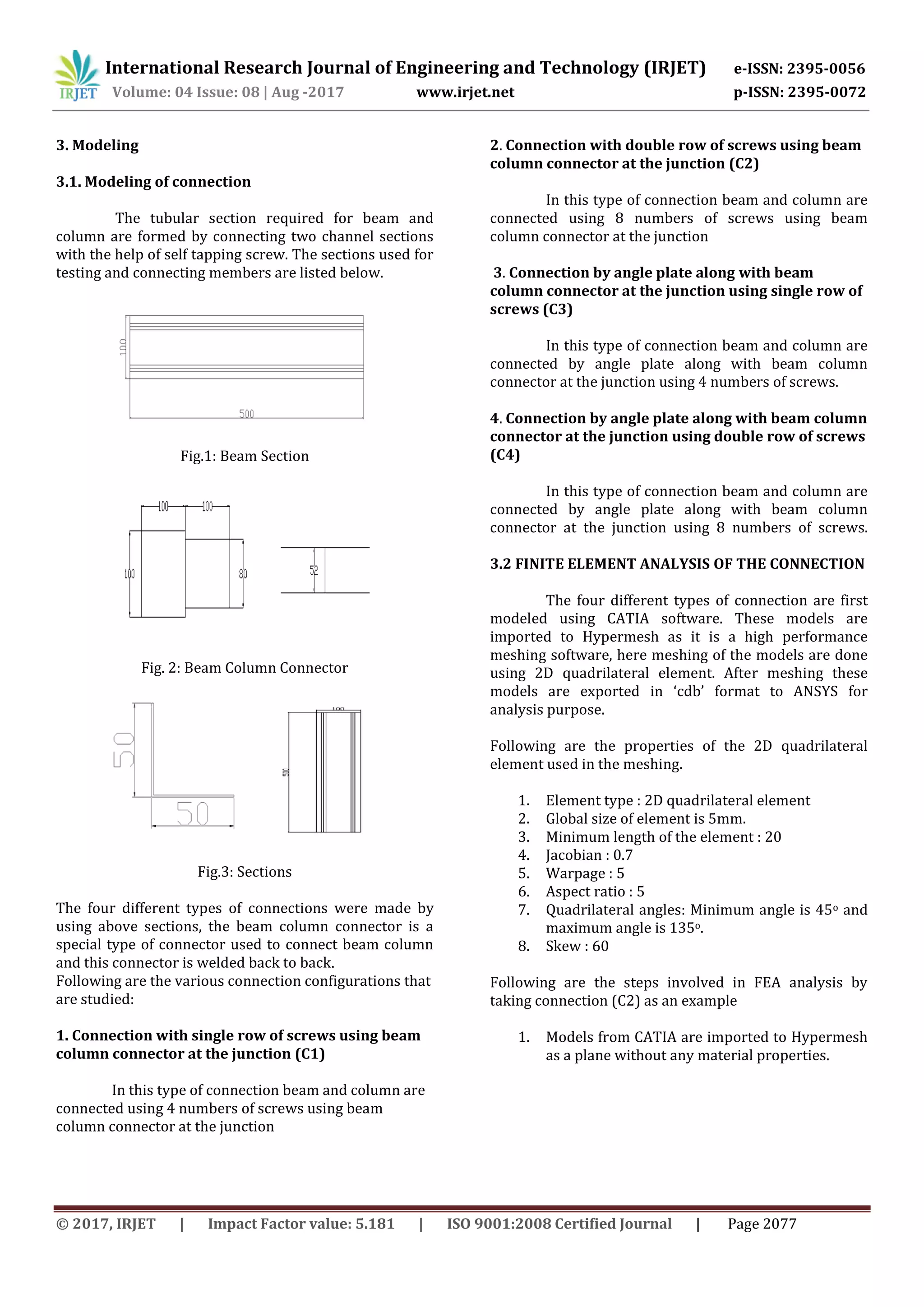
The tubular section required for beam and
column are formed by connecting two channel sections
with the help of self tapping screw. The sections used for
testing and connecting members are listed below.
Fig.1: Beam Section
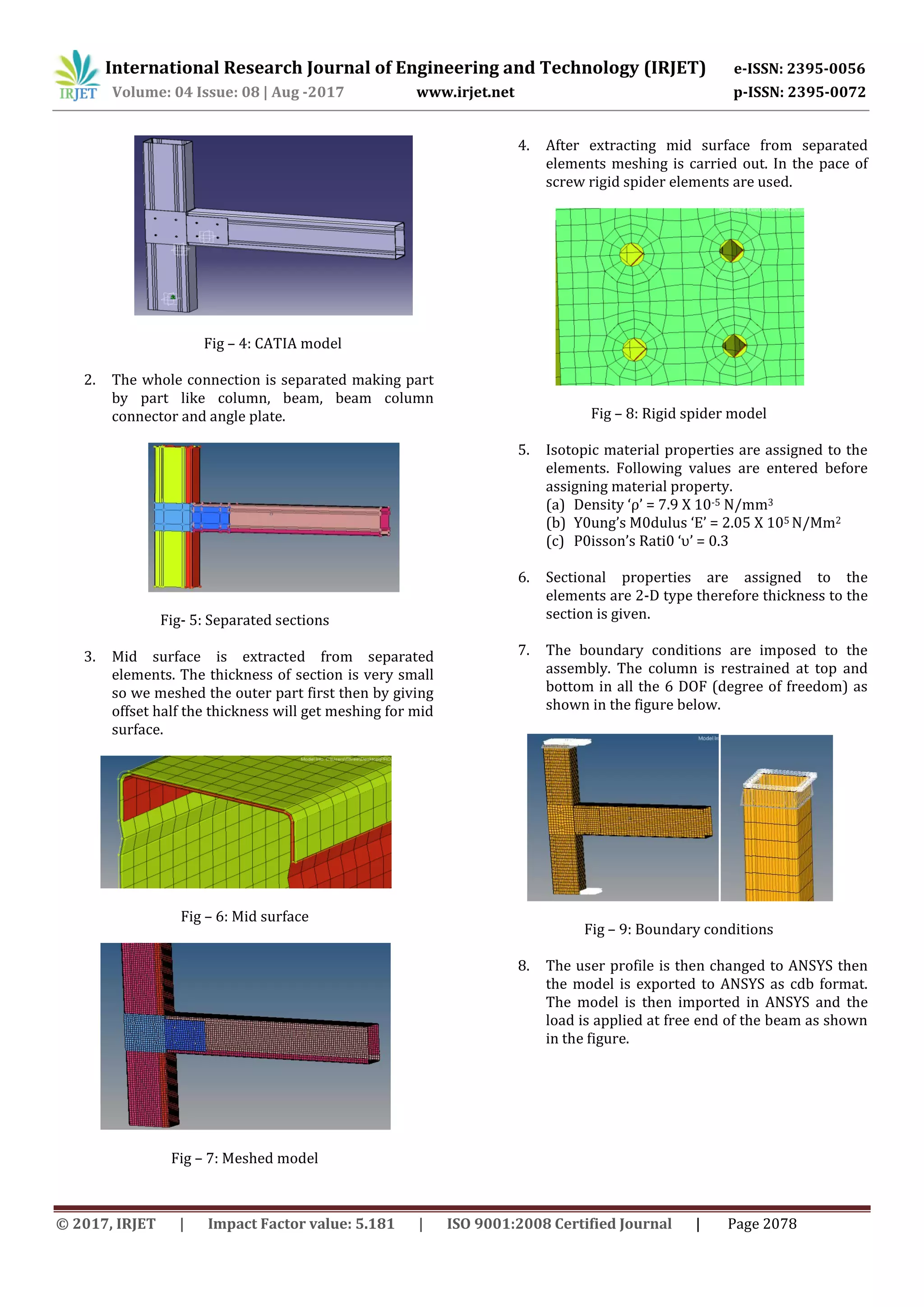
Fig. 2: Beam Column Connector
Fig.3: Sections
The four different types of connections were made by
using above sections, the beam column connector is a
special type of connector used to connect beam column
and this connector is welded back to back.
Following are the various connection configurations that
are studied:
1. Connection with single row of screws using beam
column connector at the junction (C1)
In this type of connection beam and column are
connected using 4 numbers of screws using beam
column connector at the junction
2. Connection with double row of screws using beam
column connector at the junction (C2)
In this type of connection beam and column are
connected using 8 numbers of screws using beam
column connector at the junction
3. Connection by angle plate along with beam
column connector at the junction using single row of
screws (C3)
In this type of connection beam and column are
connected by angle plate along with beam column
connector at the junction using 4 numbers of screws.
4. Connection by angle plate along with beam column
connector at the junction using double row of screws
(C4)
In this type of connection beam and column are
connected by angle plate along with beam column
connector at the junction using 8 numbers of screws.
3.2 FINITE ELEMENT ANALYSIS OF THE CONNECTION
The four different types of connection are first
modeled using CATIA software. These models are
imported to Hypermesh as it is a high performance
meshing software, here meshing of the models are done
using 2D quadrilateral element. After meshing these
models are exported in ‘cdb’ format to ANSYS for
analysis purpose.
Following are the properties of the 2D quadrilateral
element used in the meshing.
1. Element type : 2D quadrilateral element
2. Global size of element is 5mm.
3. Minimum length of the element : 20
4. Jacobian : 0.7
5. Warpage : 5
6. Aspect ratio : 5
7. Quadrilateral angles: Minimum angle is 45o and
maximum angle is 135o.
8. Skew : 60
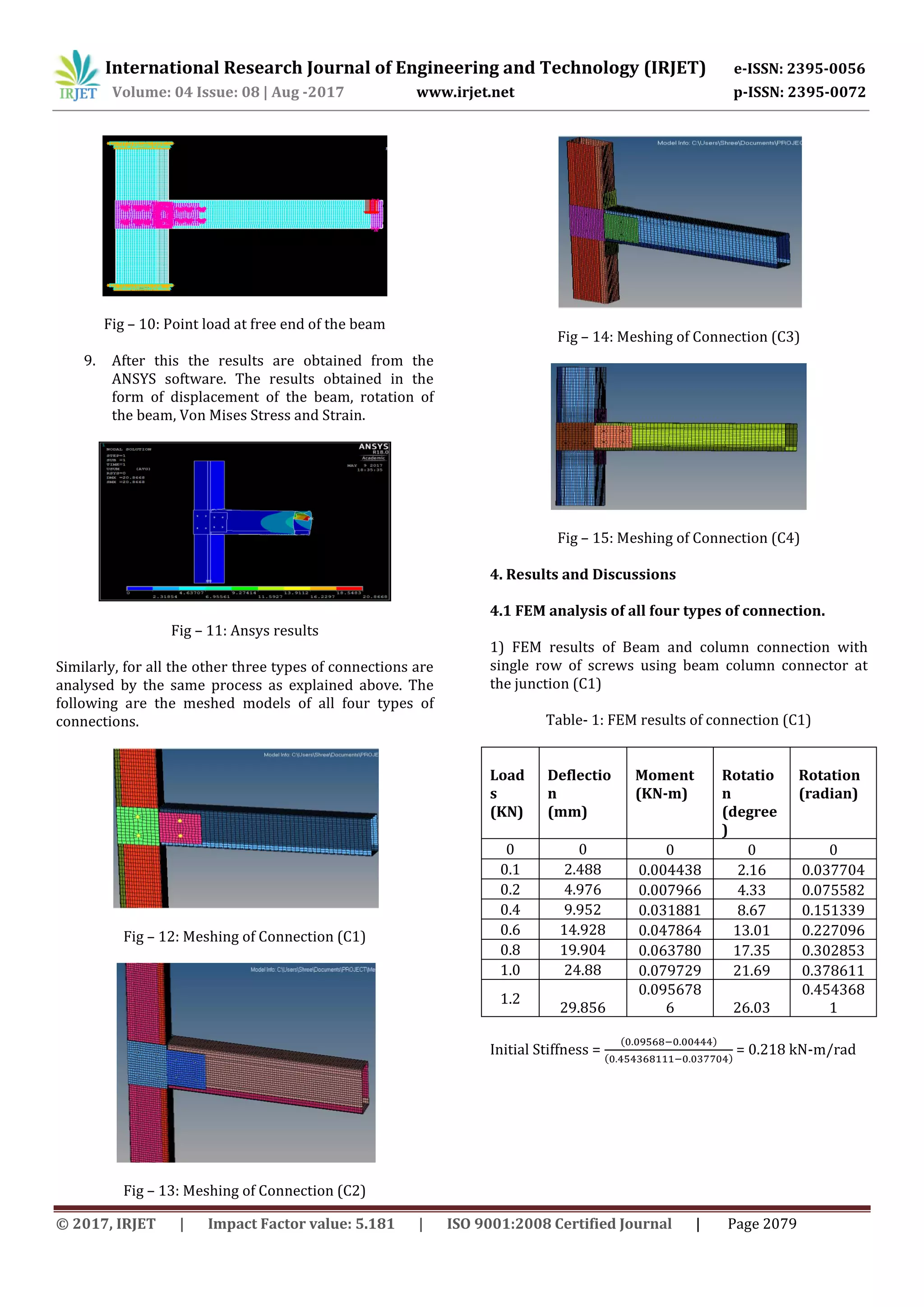
Following are the steps involved in FEA analysis by
taking connection (C2) as an example
1. Models from CATIA are imported to Hypermesh
as a plane without any material properties.
International Research Journal of Engineering and Technology (IRJET) e-ISSN: 2395-0056
Volume: 04 Issue: 08 | Aug -2017 www.irjet.net p-ISSN: 2395-0072
© 2017, IRJET | Impact Factor value: 5.181 | ISO 9001:2008 Certified Journal | Page 2078
Fig – 4: CATIA model
2. The whole connection is separated making part
by part like column, beam, beam column
connector and angle plate.
Fig- 5: Separated sections
3. Mid surface is extracted from separated
elements. The thickness of section is very small
so we meshed the outer part first then by giving
offset half the thickness will get meshing for mid
surface.
Fig – 6: Mid surface
Fig – 7: Meshed model
4. After extracting mid surface from separated
elements meshing is carried out. In the pace of
screw rigid spider elements are used.
Fig – 8: Rigid spider model
5. Isotopic material properties are assigned to the
elements. Following values are entered before
assigning material property.
(a) Density ‘ρ’ = 7.9 X 10⁻⁵ N/mm3
(b) Y0ung’s M0dulus ‘E’ = 2.05 X 10⁵ N/Mm2
(c) P0isson’s Rati0 ‘υ’ = 0.3
6. Sectional properties are assigned to the
elements are 2-D type therefore thickness to the
section is given.
7. The boundary conditions are imposed to the
assembly. The column is restrained at top and
bottom in all the 6 DOF (degree of freedom) as
shown in the figure below.
Fig – 9: Boundary conditions
8. The user profile is then changed to ANSYS then
the model is exported to ANSYS as cdb format.
The model is then imported in ANSYS and the
load is applied at free end of the beam as shown
in the figure.
International Research Journal of Engineering and Technology (IRJET) e-ISSN: 2395-0056
Volume: 04 Issue: 08 | Aug -2017 www.irjet.net p-ISSN: 2395-0072
© 2017, IRJET | Impact Factor value: 5.181 | ISO 9001:2008 Certified Journal | Page 2079
Fig – 10: Point load at free end of the beam
9. After this the results are obtained from the
ANSYS software. The results obtained in the
form of displacement of the beam, rotation of
the beam, Von Mises Stress and Strain.
Fig – 11: Ansys results
Similarly, for all the other three types of connections are
analysed by the same process as explained above. The
following are the meshed models of all four types of
connections.
Fig – 12: Meshing of Connection (C1)
Fig – 13: Meshing of Connection (C2)
Fig – 14: Meshing of Connection (C3)
Fig – 15: Meshing of Connection (C4)
4. Results and Discussions
4.1 FEM analysis of all four types of connection.
1) FEM results of Beam and column connection with
single row of screws using beam column connector at
the junction (C1)
Table- 1: FEM results of connection (C1)
Load
s
(KN)
Deflectio
n
(mm)
Moment
(KN-m)
Rotatio
n
(degree
)
Rotation
(radian)
0 0 0 0 0
0.1 2.488 0.004438 2.16 0.037704
0.2 4.976 0.007966 4.33 0.075582
0.4 9.952 0.031881 8.67 0.151339
0.6 14.928 0.047864 13.01 0.227096
0.8 19.904 0.063780 17.35 0.302853
1.0 24.88 0.079729 21.69 0.378611
1.2
29.856
0.095678
6 26.03
0.454368
1
Initial Stiffness =
( )
( )
= 0.218 kN-m/rad
International Research Journal of Engineering and Technology (IRJET) e-ISSN: 2395-0056
Volume: 04 Issue: 08 | Aug -2017 www.irjet.net p-ISSN: 2395-0072
© 2017, IRJET | Impact Factor value: 5.181 | ISO 9001:2008 Certified Journal | Page 2080
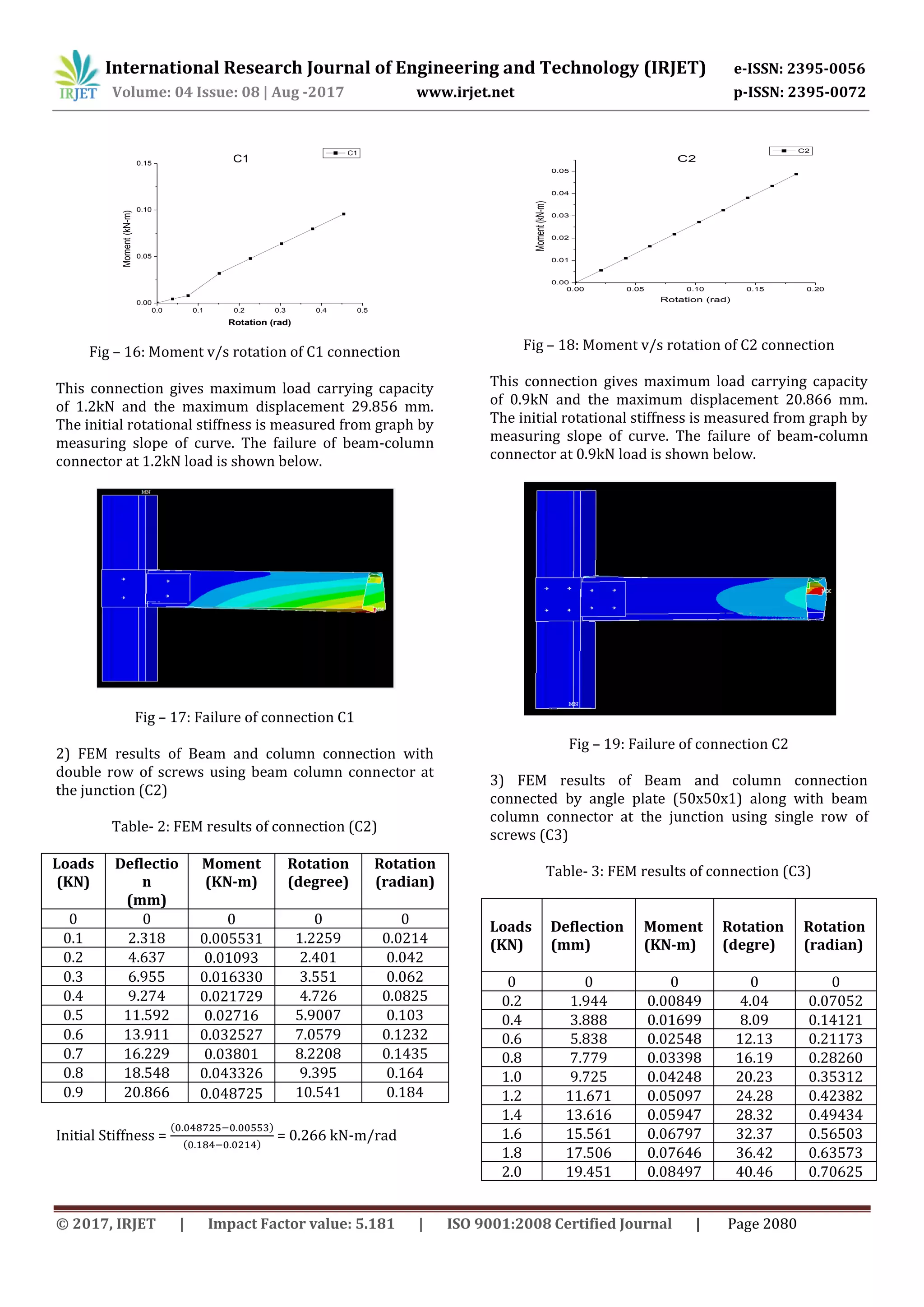
Fig – 16: Moment v/s rotation of C1 connection
This connection gives maximum load carrying capacity
of 1.2kN and the maximum displacement 29.856 mm.
The initial rotational stiffness is measured from graph by
measuring slope of curve. The failure of beam-column
connector at 1.2kN load is shown below.
Fig – 17: Failure of connection C1
2) FEM results of Beam and column connection with
double row of screws using beam column connector at
the junction (C2)
Table- 2: FEM results of connection (C2)
Loads
(KN)
Deflectio
n
(mm)
Moment
(KN-m)
Rotation
(degree)
Rotation
(radian)
0 0 0 0 0
0.1 2.318 0.005531 1.2259 0.0214
0.2 4.637 0.01093 2.401 0.042
0.3 6.955 0.016330 3.551 0.062
0.4 9.274 0.021729 4.726 0.0825
0.5 11.592 0.02716 5.9007 0.103
0.6 13.911 0.032527 7.0579 0.1232
0.7 16.229 0.03801 8.2208 0.1435
0.8 18.548 0.043326 9.395 0.164
0.9 20.866 0.048725 10.541 0.184
Initial Stiffness =
( )
( )
= 0.266 kN-m/rad
Fig – 18: Moment v/s rotation of C2 connection
This connection gives maximum load carrying capacity
of 0.9kN and the maximum displacement 20.866 mm.
The initial rotational stiffness is measured from graph by
measuring slope of curve. The failure of beam-column
connector at 0.9kN load is shown below.
Fig – 19: Failure of connection C2
3) FEM results of Beam and column connection
connected by angle plate (50x50x1) along with beam
column connector at the junction using single row of
screws (C3)
Table- 3: FEM results of connection (C3)
Loads
(KN)
Deflection
(mm)
Moment
(KN-m)
Rotation
(degre)
Rotation
(radian)
0 0 0 0 0
0.2 1.944 0.00849 4.04 0.07052
0.4 3.888 0.01699 8.09 0.14121
0.6 5.838 0.02548 12.13 0.21173
0.8 7.779 0.03398 16.19 0.28260
1.0 9.725 0.04248 20.23 0.35312
1.2 11.671 0.05097 24.28 0.42382
1.4 13.616 0.05947 28.32 0.49434
1.6 15.561 0.06797 32.37 0.56503
1.8 17.506 0.07646 36.42 0.63573
2.0 19.451 0.08497 40.46 0.70625
0.0 0.1 0.2 0.3 0.4 0.5
0.00
0.05
0.10
0.15 C1
Moment(kN-m)
Rotation (rad)
C1
0.00 0.05 0.10 0.15 0.20
0.00
0.01
0.02
0.03
0.04
0.05
C2
Moment(kN-m)
Rotation (rad)
C2
International Research Journal of Engineering and Technology (IRJET) e-ISSN: 2395-0056
Volume: 04 Issue: 08 | Aug -2017 www.irjet.net p-ISSN: 2395-0072
© 2017, IRJET | Impact Factor value: 5.181 | ISO 9001:2008 Certified Journal | Page 2081
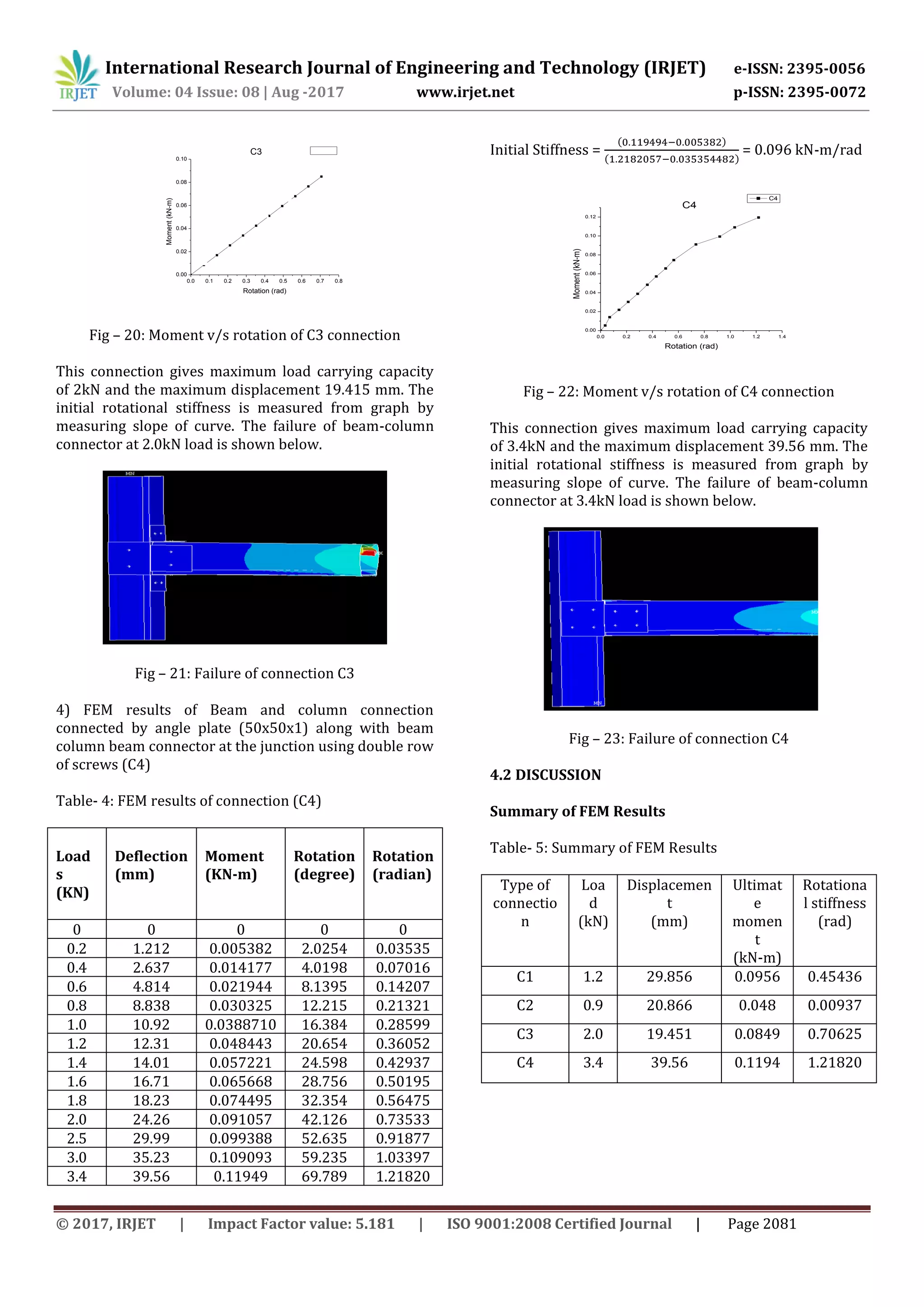
Fig – 20: Moment v/s rotation of C3 connection
This connection gives maximum load carrying capacity
of 2kN and the maximum displacement 19.415 mm. The
initial rotational stiffness is measured from graph by
measuring slope of curve. The failure of beam-column
connector at 2.0kN load is shown below.
Fig – 21: Failure of connection C3
4) FEM results of Beam and column connection
connected by angle plate (50x50x1) along with beam
column beam connector at the junction using double row
of screws (C4)
Table- 4: FEM results of connection (C4)
Load
s
(KN)
Deflection
(mm)
Moment
(KN-m)
Rotation
(degree)
Rotation
(radian)
0 0 0 0 0
0.2 1.212 0.005382 2.0254 0.03535
0.4 2.637 0.014177 4.0198 0.07016
0.6 4.814 0.021944 8.1395 0.14207
0.8 8.838 0.030325 12.215 0.21321
1.0 10.92 0.0388710 16.384 0.28599
1.2 12.31 0.048443 20.654 0.36052
1.4 14.01 0.057221 24.598 0.42937
1.6 16.71 0.065668 28.756 0.50195
1.8 18.23 0.074495 32.354 0.56475
2.0 24.26 0.091057 42.126 0.73533
2.5 29.99 0.099388 52.635 0.91877
3.0 35.23 0.109093 59.235 1.03397
3.4 39.56 0.11949 69.789 1.21820
Initial Stiffness =
( )
( )
= 0.096 kN-m/rad
Fig – 22: Moment v/s rotation of C4 connection
This connection gives maximum load carrying capacity
of 3.4kN and the maximum displacement 39.56 mm. The
initial rotational stiffness is measured from graph by
measuring slope of curve. The failure of beam-column
connector at 3.4kN load is shown below.
Fig – 23: Failure of connection C4
4.2 DISCUSSION
Summary of FEM Results
Table- 5: Summary of FEM Results
Type of
connectio
n
Loa
d
(kN)
Displacemen
t
(mm)
Ultimat
e
momen
t
(kN-m)
Rotationa
l stiffness
(rad)
C1 1.2 29.856 0.0956 0.45436
C2 0.9 20.866 0.048 0.00937
C3 2.0 19.451 0.0849 0.70625
C4 3.4 39.56 0.1194 1.21820
0.0 0.2 0.4 0.6 0.8 1.0 1.2 1.4
0.00
0.02
0.04
0.06
0.08
0.10
0.12
C4
Moment(kN-m)
Rotation (rad)
C4
C3
Rotation (rad)
kN-m)t(Momen
C3
0.10
0.08
0.06
0.04
0.02
0.0 0.1 0.2 0.3 0.4 0.5 0.6 0.7 0.8
0.00
International Research Journal of Engineering and Technology (IRJET) e-ISSN: 2395-0056
Volume: 04 Issue: 08 | Aug -2017 www.irjet.net p-ISSN: 2395-0072
© 2017, IRJET | Impact Factor value: 5.181 | ISO 9001:2008 Certified Journal | Page 2082
Fig – 24: FEM results of all connections
The graphs are plotted against moment v/s rotation
based on the results obtained for each connection. The
failure of a connection in FEM analysis is considered
when the stress reaches the yield strength of the section,
the yield strength of the section used is 550 N/mm2.
The failure of connections in FEM analysis is due to the
buckling of the beam at the point of application of
load.The failure of connection C3 and C4 is at a higher
load as compared to that of connections C1 and C2, this
is due to the presence of angle plate.
5. CONCLUSION
1. Connection C1 and C2 have more rotation at less
amount of load than the connections C3 and C4,
therefore it is not recommended.
2. The failure of connection in FEM analysis is due
to the torsional buckling of the beam at the
point of load applied.
3. The failure of the connection C3 and C4 is due to
the distortion of angle plates as well as
distortion of beam-column connector.
4. The connections C3 and C4 have high ultimate
moment capacity than connections C1 and C2.
6. REFERENCE
[1]British standards institution. 1998. BS 5950:
structural use o steel works in buildings: part 5: code of
practice for the design of cold formed sections: London
UK.
[2]Alireza Bagheri Sabbagha, Mihail Petkovski et al
[3]Kypros Pilakoutas , Rasoul Mirghaderi et al
[4]K.F. Chung and K.H. Ip
[5]Bhavitha E B, Rosemol K George and Teena Joy
[6]Bayan Anwer Ali, Sariffuddin Saad and Mohd Hanim
Osman “Cold-formed steel joints and structures- A
review” International Journal of Civil and Structural
Engineering Volume 2, No.2,2011.
[7]M.F. Wong and K.F. Chung “Experimental
investigation of cold-formed steel beam-column sub-
frames: enhanced performance” Structural Engineering,
Mechanics and Computation (Vol. 2), 2001
0.0 0.1 0.2 0.3 0.4 0.5 0.6 0.7 0.8 0.9 1.0 1.1 1.2 1.3
0.00
0.02
0.04
0.06
0.08
0.10
0.12
0.14
0.16
0.18
0.20 FEM Results
Moment(kN-m)
Rotations (Rad)
C1
C2
C3
C4

Analysis of Cold Formed Steel Connections using FEM

  • 1.
    International Research Journalof Engineering and Technology (IRJET) e-ISSN: 2395-0056 Volume: 04 Issue: 08 | Aug -2017 www.irjet.net p-ISSN: 2395-0072 © 2017, IRJET | Impact Factor value: 5.181 | ISO 9001:2008 Certified Journal | Page 2076 ANALYSIS OF COLD FORMED STEEL CONNECTIONS USING FEM Poornima M Pol1, Mamata Mogali2 1P.G student, Dept. of Civil Engineering, SDMCET Dharwad, Karnataka, India 2Assistant Professor, SDMCET Dharwad, Karnataka, India ---------------------------------------------------------------------***--------------------------------------------------------------------- Abstract - The main aim of the study is to increase the use of cold form steel in steel structure by studying cold form steel connections. Cold formed steel sections are used as secondary structural members, Usually cold form steel is used only in purlins of truss non load bearing walls floor deck system etc. But now day’s cold formed structural steel tubular sections are being used in many developing countries like Canada, India, Hong Kong and Australia. These are offering light weight to high strength and width to thickness ratio is very less. In this paper the attempt have been made to study the application of cold form steel beam-column screwed connection using beam column connector by determining its load carrying capacity of various connection configuration .In this project Experimental results are compared with Analytical results .Models in analytical method are analysed through FEM Software ANSYS. Key Words: Cold Formed steel, Ansys, Finit element analysis, Hypermesh. 1. INTRODUCTION The use of steel structure in now a day’s construction being very popular as compared to RCC structures because of the fact that they provide high strength, very fast in construction, they are light in weight so easy erection and installation etc. Based on the manufacturing process structural steel is classified into two types; hot rolled sections and cold formed light gauge steel structures. There are mainly two meth0ds 0f f0rming light gauge steel secti0ns, c0ld r0lling for use in mass production formed at room temperature and pressing in press-brakes use in small quantities also for producing some special shapes. These members are then connected by bolts, rivets, screws, welds or by special fasteners. Cold formed light gauge steels are very thin and thickness varies from 0.75 to 4 mm and having yield strength of 230 to 420 Mpa. The steel is coated with zinc or a mixture of zinc and aluminum to protect it from decay of material. Thickness of this coating depends on environmental condition and marine environments require more protection. Cold formed light gauge members are divided into (i) framing members such as studs, joists, beams etc (ii) long span roof deck, floor and wall panels (iii) wall claddings and standard roof deck. The cold form light gauge steel structure are used as a secondary members such as side rails, roof purlins and wall cladding, and they are connected to the primary members through web cleats. 1.1. Advantages of light gauge steel sections 1. Cold formed sections are light in weight therefore it is easy to handle; also it reduces cost of construction. 2. Steel provides higher strength and stiffness compared to other building material. 3. Like RCC structures it does not require any formwork, hence fast and easy erecti0n and installation 4. Required shapes can be produced, ease of pre- fabrication and mass production. 5. It is easy to remodel this construction at any point in its lifespan. 6. Cold formed light gauge sections can also be used in flooring, wall cladding and roofing. 1.2. Disadvantages of cold formed light gauge steel sections 1. Height of structural system is restricted to 3.6m due to less thickness of sections; modified sections are used for the system having higher height. 2. It will lose its strength in case of fire; adequate fire protection must be used. 2. Objectives  The major objective our study is to increase the use of cold formed steel in steel structures by studying cold form steel connections.  Cold formed steel is typically used in purlins of truss, non load bearing wall, partition walls, floor deck system etc.  Here we have made an effort to study the application of cold form steel in partially restrained beam-column bolted connection by determining its load carrying capacity of various connection configurations.  Initially the connection is designed as per British code BS 5950-5:1998 (part 5 code of practice for design of cold formed thin gauge sections) based on the semi-rigid criteria.  The models are fabricated and experimental analysis is carried out. Later FEM analysis is done. Results from both the studies are compared. Depending on these results conclusion is being done.
  • 2.
    International Research Journalof Engineering and Technology (IRJET) e-ISSN: 2395-0056 Volume: 04 Issue: 08 | Aug -2017 www.irjet.net p-ISSN: 2395-0072 © 2017, IRJET | Impact Factor value: 5.181 | ISO 9001:2008 Certified Journal | Page 2077 3. Modeling 3.1. Modeling of connection The tubular section required for beam and column are formed by connecting two channel sections with the help of self tapping screw. The sections used for testing and connecting members are listed below. Fig.1: Beam Section Fig. 2: Beam Column Connector Fig.3: Sections The four different types of connections were made by using above sections, the beam column connector is a special type of connector used to connect beam column and this connector is welded back to back. Following are the various connection configurations that are studied: 1. Connection with single row of screws using beam column connector at the junction (C1) In this type of connection beam and column are connected using 4 numbers of screws using beam column connector at the junction 2. Connection with double row of screws using beam column connector at the junction (C2) In this type of connection beam and column are connected using 8 numbers of screws using beam column connector at the junction 3. Connection by angle plate along with beam column connector at the junction using single row of screws (C3) In this type of connection beam and column are connected by angle plate along with beam column connector at the junction using 4 numbers of screws. 4. Connection by angle plate along with beam column connector at the junction using double row of screws (C4) In this type of connection beam and column are connected by angle plate along with beam column connector at the junction using 8 numbers of screws. 3.2 FINITE ELEMENT ANALYSIS OF THE CONNECTION The four different types of connection are first modeled using CATIA software. These models are imported to Hypermesh as it is a high performance meshing software, here meshing of the models are done using 2D quadrilateral element. After meshing these models are exported in ‘cdb’ format to ANSYS for analysis purpose. Following are the properties of the 2D quadrilateral element used in the meshing. 1. Element type : 2D quadrilateral element 2. Global size of element is 5mm. 3. Minimum length of the element : 20 4. Jacobian : 0.7 5. Warpage : 5 6. Aspect ratio : 5 7. Quadrilateral angles: Minimum angle is 45o and maximum angle is 135o. 8. Skew : 60 Following are the steps involved in FEA analysis by taking connection (C2) as an example 1. Models from CATIA are imported to Hypermesh as a plane without any material properties.
  • 3.
    International Research Journalof Engineering and Technology (IRJET) e-ISSN: 2395-0056 Volume: 04 Issue: 08 | Aug -2017 www.irjet.net p-ISSN: 2395-0072 © 2017, IRJET | Impact Factor value: 5.181 | ISO 9001:2008 Certified Journal | Page 2078 Fig – 4: CATIA model 2. The whole connection is separated making part by part like column, beam, beam column connector and angle plate. Fig- 5: Separated sections 3. Mid surface is extracted from separated elements. The thickness of section is very small so we meshed the outer part first then by giving offset half the thickness will get meshing for mid surface. Fig – 6: Mid surface Fig – 7: Meshed model 4. After extracting mid surface from separated elements meshing is carried out. In the pace of screw rigid spider elements are used. Fig – 8: Rigid spider model 5. Isotopic material properties are assigned to the elements. Following values are entered before assigning material property. (a) Density ‘ρ’ = 7.9 X 10⁻⁵ N/mm3 (b) Y0ung’s M0dulus ‘E’ = 2.05 X 10⁵ N/Mm2 (c) P0isson’s Rati0 ‘υ’ = 0.3 6. Sectional properties are assigned to the elements are 2-D type therefore thickness to the section is given. 7. The boundary conditions are imposed to the assembly. The column is restrained at top and bottom in all the 6 DOF (degree of freedom) as shown in the figure below. Fig – 9: Boundary conditions 8. The user profile is then changed to ANSYS then the model is exported to ANSYS as cdb format. The model is then imported in ANSYS and the load is applied at free end of the beam as shown in the figure.
  • 4.
    International Research Journalof Engineering and Technology (IRJET) e-ISSN: 2395-0056 Volume: 04 Issue: 08 | Aug -2017 www.irjet.net p-ISSN: 2395-0072 © 2017, IRJET | Impact Factor value: 5.181 | ISO 9001:2008 Certified Journal | Page 2079 Fig – 10: Point load at free end of the beam 9. After this the results are obtained from the ANSYS software. The results obtained in the form of displacement of the beam, rotation of the beam, Von Mises Stress and Strain. Fig – 11: Ansys results Similarly, for all the other three types of connections are analysed by the same process as explained above. The following are the meshed models of all four types of connections. Fig – 12: Meshing of Connection (C1) Fig – 13: Meshing of Connection (C2) Fig – 14: Meshing of Connection (C3) Fig – 15: Meshing of Connection (C4) 4. Results and Discussions 4.1 FEM analysis of all four types of connection. 1) FEM results of Beam and column connection with single row of screws using beam column connector at the junction (C1) Table- 1: FEM results of connection (C1) Load s (KN) Deflectio n (mm) Moment (KN-m) Rotatio n (degree ) Rotation (radian) 0 0 0 0 0 0.1 2.488 0.004438 2.16 0.037704 0.2 4.976 0.007966 4.33 0.075582 0.4 9.952 0.031881 8.67 0.151339 0.6 14.928 0.047864 13.01 0.227096 0.8 19.904 0.063780 17.35 0.302853 1.0 24.88 0.079729 21.69 0.378611 1.2 29.856 0.095678 6 26.03 0.454368 1 Initial Stiffness = ( ) ( ) = 0.218 kN-m/rad
  • 5.
    International Research Journalof Engineering and Technology (IRJET) e-ISSN: 2395-0056 Volume: 04 Issue: 08 | Aug -2017 www.irjet.net p-ISSN: 2395-0072 © 2017, IRJET | Impact Factor value: 5.181 | ISO 9001:2008 Certified Journal | Page 2080 Fig – 16: Moment v/s rotation of C1 connection This connection gives maximum load carrying capacity of 1.2kN and the maximum displacement 29.856 mm. The initial rotational stiffness is measured from graph by measuring slope of curve. The failure of beam-column connector at 1.2kN load is shown below. Fig – 17: Failure of connection C1 2) FEM results of Beam and column connection with double row of screws using beam column connector at the junction (C2) Table- 2: FEM results of connection (C2) Loads (KN) Deflectio n (mm) Moment (KN-m) Rotation (degree) Rotation (radian) 0 0 0 0 0 0.1 2.318 0.005531 1.2259 0.0214 0.2 4.637 0.01093 2.401 0.042 0.3 6.955 0.016330 3.551 0.062 0.4 9.274 0.021729 4.726 0.0825 0.5 11.592 0.02716 5.9007 0.103 0.6 13.911 0.032527 7.0579 0.1232 0.7 16.229 0.03801 8.2208 0.1435 0.8 18.548 0.043326 9.395 0.164 0.9 20.866 0.048725 10.541 0.184 Initial Stiffness = ( ) ( ) = 0.266 kN-m/rad Fig – 18: Moment v/s rotation of C2 connection This connection gives maximum load carrying capacity of 0.9kN and the maximum displacement 20.866 mm. The initial rotational stiffness is measured from graph by measuring slope of curve. The failure of beam-column connector at 0.9kN load is shown below. Fig – 19: Failure of connection C2 3) FEM results of Beam and column connection connected by angle plate (50x50x1) along with beam column connector at the junction using single row of screws (C3) Table- 3: FEM results of connection (C3) Loads (KN) Deflection (mm) Moment (KN-m) Rotation (degre) Rotation (radian) 0 0 0 0 0 0.2 1.944 0.00849 4.04 0.07052 0.4 3.888 0.01699 8.09 0.14121 0.6 5.838 0.02548 12.13 0.21173 0.8 7.779 0.03398 16.19 0.28260 1.0 9.725 0.04248 20.23 0.35312 1.2 11.671 0.05097 24.28 0.42382 1.4 13.616 0.05947 28.32 0.49434 1.6 15.561 0.06797 32.37 0.56503 1.8 17.506 0.07646 36.42 0.63573 2.0 19.451 0.08497 40.46 0.70625 0.0 0.1 0.2 0.3 0.4 0.5 0.00 0.05 0.10 0.15 C1 Moment(kN-m) Rotation (rad) C1 0.00 0.05 0.10 0.15 0.20 0.00 0.01 0.02 0.03 0.04 0.05 C2 Moment(kN-m) Rotation (rad) C2
  • 6.
    International Research Journalof Engineering and Technology (IRJET) e-ISSN: 2395-0056 Volume: 04 Issue: 08 | Aug -2017 www.irjet.net p-ISSN: 2395-0072 © 2017, IRJET | Impact Factor value: 5.181 | ISO 9001:2008 Certified Journal | Page 2081 Fig – 20: Moment v/s rotation of C3 connection This connection gives maximum load carrying capacity of 2kN and the maximum displacement 19.415 mm. The initial rotational stiffness is measured from graph by measuring slope of curve. The failure of beam-column connector at 2.0kN load is shown below. Fig – 21: Failure of connection C3 4) FEM results of Beam and column connection connected by angle plate (50x50x1) along with beam column beam connector at the junction using double row of screws (C4) Table- 4: FEM results of connection (C4) Load s (KN) Deflection (mm) Moment (KN-m) Rotation (degree) Rotation (radian) 0 0 0 0 0 0.2 1.212 0.005382 2.0254 0.03535 0.4 2.637 0.014177 4.0198 0.07016 0.6 4.814 0.021944 8.1395 0.14207 0.8 8.838 0.030325 12.215 0.21321 1.0 10.92 0.0388710 16.384 0.28599 1.2 12.31 0.048443 20.654 0.36052 1.4 14.01 0.057221 24.598 0.42937 1.6 16.71 0.065668 28.756 0.50195 1.8 18.23 0.074495 32.354 0.56475 2.0 24.26 0.091057 42.126 0.73533 2.5 29.99 0.099388 52.635 0.91877 3.0 35.23 0.109093 59.235 1.03397 3.4 39.56 0.11949 69.789 1.21820 Initial Stiffness = ( ) ( ) = 0.096 kN-m/rad Fig – 22: Moment v/s rotation of C4 connection This connection gives maximum load carrying capacity of 3.4kN and the maximum displacement 39.56 mm. The initial rotational stiffness is measured from graph by measuring slope of curve. The failure of beam-column connector at 3.4kN load is shown below. Fig – 23: Failure of connection C4 4.2 DISCUSSION Summary of FEM Results Table- 5: Summary of FEM Results Type of connectio n Loa d (kN) Displacemen t (mm) Ultimat e momen t (kN-m) Rotationa l stiffness (rad) C1 1.2 29.856 0.0956 0.45436 C2 0.9 20.866 0.048 0.00937 C3 2.0 19.451 0.0849 0.70625 C4 3.4 39.56 0.1194 1.21820 0.0 0.2 0.4 0.6 0.8 1.0 1.2 1.4 0.00 0.02 0.04 0.06 0.08 0.10 0.12 C4 Moment(kN-m) Rotation (rad) C4 C3 Rotation (rad) kN-m)t(Momen C3 0.10 0.08 0.06 0.04 0.02 0.0 0.1 0.2 0.3 0.4 0.5 0.6 0.7 0.8 0.00
  • 7.
    International Research Journalof Engineering and Technology (IRJET) e-ISSN: 2395-0056 Volume: 04 Issue: 08 | Aug -2017 www.irjet.net p-ISSN: 2395-0072 © 2017, IRJET | Impact Factor value: 5.181 | ISO 9001:2008 Certified Journal | Page 2082 Fig – 24: FEM results of all connections The graphs are plotted against moment v/s rotation based on the results obtained for each connection. The failure of a connection in FEM analysis is considered when the stress reaches the yield strength of the section, the yield strength of the section used is 550 N/mm2. The failure of connections in FEM analysis is due to the buckling of the beam at the point of application of load.The failure of connection C3 and C4 is at a higher load as compared to that of connections C1 and C2, this is due to the presence of angle plate. 5. CONCLUSION 1. Connection C1 and C2 have more rotation at less amount of load than the connections C3 and C4, therefore it is not recommended. 2. The failure of connection in FEM analysis is due to the torsional buckling of the beam at the point of load applied. 3. The failure of the connection C3 and C4 is due to the distortion of angle plates as well as distortion of beam-column connector. 4. The connections C3 and C4 have high ultimate moment capacity than connections C1 and C2. 6. REFERENCE [1]British standards institution. 1998. BS 5950: structural use o steel works in buildings: part 5: code of practice for the design of cold formed sections: London UK. [2]Alireza Bagheri Sabbagha, Mihail Petkovski et al [3]Kypros Pilakoutas , Rasoul Mirghaderi et al [4]K.F. Chung and K.H. Ip [5]Bhavitha E B, Rosemol K George and Teena Joy [6]Bayan Anwer Ali, Sariffuddin Saad and Mohd Hanim Osman “Cold-formed steel joints and structures- A review” International Journal of Civil and Structural Engineering Volume 2, No.2,2011. [7]M.F. Wong and K.F. Chung “Experimental investigation of cold-formed steel beam-column sub- frames: enhanced performance” Structural Engineering, Mechanics and Computation (Vol. 2), 2001 0.0 0.1 0.2 0.3 0.4 0.5 0.6 0.7 0.8 0.9 1.0 1.1 1.2 1.3 0.00 0.02 0.04 0.06 0.08 0.10 0.12 0.14 0.16 0.18 0.20 FEM Results Moment(kN-m) Rotations (Rad) C1 C2 C3 C4