
OPTIMIZING LAYERS IN A
PV DEVICE
LESSONS TO BE LEARNT
FROM CDTE?
WMD JC 14th March 2017
Suzanne Wallace
MOTIVATION…THE USUAL!
Underperformance of CZTS solar cells!
 Low open circuit voltage (Voc) relative to the band gap
+ An excuse to learn what various terminologies related to interfaces
actually mean!
MOTIVATION
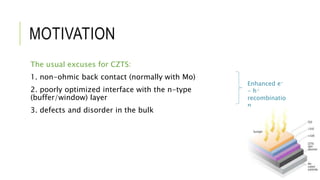
The usual excuses for CZTS:
1. non-ohmic back contact (normally with Mo)
2. poorly optimized interface with the n-type
(buffer/window) layer
3. defects and disorder in the bulk
Enhanced e-
- h+
recombinatio
n
MOTIVATION
The usual excuses for CZTS :
1. non-ohmic back contact (normally with Mo)
2. poorly optimized interface with the n-type
(buffer/window) layer
3. defects and disorder in the bulk
Enhanced e-
- h+
recombinatio
n
Measurements for high-
performance devices generally
suggest this is okay …if we trust
the measurements!
MOTIVATION
The usual excuses for CZTS :
1. non-ohmic back contact (normally with Mo)
2. poorly optimized interface with the n-type
(buffer/window) layer
3. defects and disorder in the bulk
Enhanced e-
- h+
recombinatio
n
What we normally care about:
• point defect calculations
• Eris MC large-scale antisite disorder
simulations
• Usually interface recombination only
becomes a significant limitation for
devices with good bulk properties
MOTIVATION
The usual excuses for CZTS :
1. non-ohmic back contact (normally with Mo)
2. poorly optimized interface with the n-type
(buffer/window) layer
3. defects and disorder in the bulk
Enhanced e-
- h+
recombinatio
n
But…could we make significant
improvements with CZTS by improving the
CdS-CZTS interface?
Can we learn useful lessons from studies on
other PV technologies?
Plus… learning what ‘spikes’, ‘cliffs’ etc.
actually mean!
ALTERNATIVE N-TYPE LAYERS FOR
CZTS?
CdTe CZTS CIGS
• Largely borrowed architecture from CIGS
• Also many similarities with CdTe  CZTS, CdTe, CIGS all p-type in contact with n-type CdS
KEITH’S SETUP: INTERFACE
PREDICTION
Slides:
https://www.dropbox.com/s/vv
p4nfq9n54estz/IoP_Advancesin
PV_KTB.pptx.pdf?dl=0#
Python script:
https://github.com/keeeto/Elec
tronicLatticeMatch
Poor
interface:
rapid e--h+
recombinati
N.B. we assume no interface mixing and
also note that IPs and EAs are often
surface-dependent
LESSONS TO BE LEARNT FROM
CDTE?
Emitter here = n-type material in contact with p-type absorber layer
(also referred to as buffer layer, window later, etc. …a little confusing!)
Choosing contact materials for defect-
tolerant p-n junction interfaces
 Reduce interface recombination in PV
devices
LESSONS TO BE LEARNT FROM
CDTE?
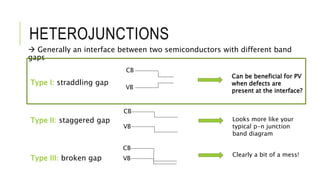
HETEROJUNCTIONS
 Generally an interface between two semiconductors with different band
gaps
Type I: straddling gap
Type II: staggered gap
Type III: broken gap
CB
VB
CB
VB
CB
VB
Clearly a bit of a mess!
Looks more like your
typical p-n junction
band diagram
Can be beneficial for PV
when defects are
present at the interface?
HETEROJUNCTIONS
 Generally an interface between two semiconductors with different band
gaps
Type I: straddling gap
Type II: staggered gap
Type III: broken gap
CB
VB
CB
VB
CB
VB
Clearly a bit of a mess!
Looks more like your
typical p-n junction
band diagram
Can be beneficial for PV
when defects are
present at the interface?
HETEROJUNCTIONS
 Generally an interface between two semiconductors with different band
gaps
Type I: straddling gap
p n
Type II: staggered gap
Type III: broken gap
CB
VB
CB
VB
CB
VB
Clearly a bit of a mess!
Looks more like your
typical p-n junction
band diagram
arrows for conduction of
photoexcited minority carriers
(swept across junction by in-
built E-field)
Can be beneficial for PV
when defects are
present at the interface?
e-
- - -
h+ +++
HETEROJUNCTIONS
 Generally an interface between two semiconductors with different band
gaps
Type I: straddling gap
Type II: staggered gap
Type III: broken gap
CB
VB
CB
VB
CB
VB
Clearly a bit of a mess!
Looks more like your
typical p-n junction
band diagram
Can be beneficial for PV
when defects are
present at the interface?
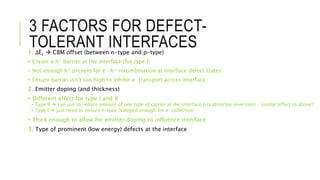
3 FACTORS FOR DEFECT-
TOLERANT INTERFACES1. ∆Ec  CBM offset (between n-type and p-type)
Create a h+ barrier at the interface
Not enough h+ present for e--h+ recombination at interface defect states
Ensure barrier isn’t too high to inhibit e- transport across interface
2. Emitter doping (and thickness)
Different effect for type I and II
Type II  can use to reduce amount of one type of carrier at the interface (via absorber inversion)
Type I  just need to ensure n-type is doped enough for e- collection
Thick enough to allow for emitter doping to influence interface
3. Type of prominent (low energy) defects at the interface
Seems to be the hardest one to tune!
Mid-gap acceptors are the worst
Shallow better
n-type enhances absorber inversion
3 FACTORS FOR DEFECT-
TOLERANT INTERFACES1. ∆Ec  CBM offset (between n-type and p-type)
• Create a h+ barrier at the interface
• Not enough h+ present for e--h+ recombination at interface defect states
• Ensure barrier isn’t too high to inhibit e- transport across interface
2. Emitter doping (and thickness)
Different effect for type I and II
Type II  can use to reduce amount of one type of carrier at the interface (via absorber inversion)
Type I  just need to ensure n-type is doped enough for e- collection
Thick enough to allow for emitter doping to influence interface
3. Type of prominent (low energy) defects at the interface
Seems to be the hardest one to tune!
Mid-gap acceptors are the worst
Shallow better
n-type enhances absorber inversion
3 FACTORS FOR DEFECT-
TOLERANT INTERFACES1. ∆Ec  CBM offset (between n-type and p-type)
• Create a h+ barrier at the interface (for type I)
• Not enough h+ present for e--h+ recombination at interface defect states
• Ensure barrier isn’t too high to inhibit e- transport across interface
2. Emitter doping (and thickness)
• Different effect for type I and II
• Type II  can use to reduce amount of one type of carrier at the interface (via absorber inversion) – similar effect to above?
• Type I  just need to ensure n-type is doped enough for e- collection
• Thick enough to allow for emitter doping to influence interface
3. Type of prominent (low energy) defects at the interface
Seems to be the hardest one to tune!
Mid-gap acceptors are the worst
Shallow better
n-type enhances absorber inversion
3 FACTORS FOR DEFECT-
TOLERANT INTERFACES1. ∆Ec  CBM offset (between n-type and p-type)
• Create a h+ barrier at the interface (for type I)
• Not enough h+ present for e--h+ recombination at interface defect states
• Ensure barrier isn’t too high to inhibit e- transport across interface
2. Emitter doping (and thickness)
• Different effect for type I and II
• Type II  can use to reduce amount of one type of carrier at the interface (via absorber inversion)
• Type I  just need to ensure n-type is doped enough for e- collection
• Thick enough to allow for emitter doping to influence interface
3. Type of prominent (low energy) defects at the interface
Seems to be the hardest one to tune!
Mid-gap acceptors are the worst
Shallow better
n-type enhances absorber inversion
Aside: ‘absorber inversion’
*I think* this means h+ become
minority carriers at the surface of
a p-type absorber material at p-
n junction
Caused by:
• Highly doped n-type layer
• n-type interface defects
Often mentioned along with the
‘potential distribution across the
junction’ and ‘amount of band
bending’ at the interface
3 FACTORS FOR DEFECT-
TOLERANT INTERFACES1. ∆Ec  CBM offset (between n-type and p-type)
• Create a h+ barrier at the interface
• Not enough h+ present for e--h+ recombination at interface defect states
• Ensure barrier isn’t too high to inhibit e- transport across interface
2. Emitter doping (and thickness)
• Different effect for type I and II
• Type II  can use to reduce amount of one type of carrier at the interface (via absorber inversion) – similar effect to
above?
• Type I  just need to ensure n-type is doped enough for e- collection
• Thick enough to allow for emitter doping to influence interface
3. Type of prominent (low energy) defects at the interface
• Seems to be the hardest one to tune! – predict surface defects from theory? Treat/ passivate surfaces
before making junction?
• Mid-gap acceptors are the worst
• Shallow defects better
• n-type enhances absorber inversion
3 FACTORS FOR DEFECT-
TOLERANT INTERFACES1. ∆Ec  CBM offset (between n-type and p-type)
• Create a h+ barrier at the interface
• Not enough h+ present for e--h+ recombination at interface defect states
• Ensure barrier isn’t too high to inhibit e- transport across interface
2. Emitter doping (and thickness)
• Different effect for type I and II
• Type II  can use to reduce amount of one type of carrier at the interface (via absorber inversion) – similar effect to
above?
• Type I  just need to ensure n-type is doped enough for e- collection
• Thick enough to allow for emitter doping to influence interface
3. Type of prominent (low energy) defects at the interface
• Seems to be the hardest one to tune! – predict surface defects from theory? Treat/ passivate surfaces
before making junction?
• Mid-gap acceptors are the worst
• Shallow defects better
• n-type enhances absorber inversion
Relates to Keith’s
prediction setup
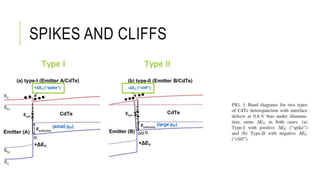
SPIKES AND CLIFFS – BASED ON
CBM OFFSET
(ESSENTIALLY STEP 1 OF KEITH’S SETUP)
Type I interface:
For a good spike: 0.1 eV ≤ ∆EC ≤ 0.3 eV
Creates absorber inversion
Large barrier to h+ adjacent to interface
e--h+ recombination suppressed due to insufficient h+ and interface (even when electron
transport delayed by interface defects)
When the spike gets too big: ∆EC ≥ 0.4 eV
Impedes e- transport  reduces photocurrent and FF
Type II interface:
Cliff: ∆EC < 0
 Allows h+ in high concentrations at interface, allowing for e--h+ recombination
at defect trap states
SPIKES AND CLIFFS
Type I Type II
SPIKES AND CLIFFS
Type I Type II
CB
VB
e-
- - -
h+ +++
p-n junction (other way around!)
e-
- - -
h+
+++
SPIKES AND CLIFFS
Type I Type IIe- transport
reduced if spike
is too large
h+ transport hindered?
BAND BENDING & HOLE BARRIER
• Position of e- fermi energy w.r.t p-
type CBM makes it easy for e- to go
into p-type?
‘absorber inversion’?
• Related to ‘potential distribution’
which makes it difficult for h+ to
enter interface region?
Easy for e-
to move
into p-type?
closer than what?
ADDED COMPLICATIONS
(Possibly what Prof Jim Matthews at York would have bundled into his ‘+c’
parameter…)
• Mixing at interface, evidence of this for CdTe:  something we don’t account for
with Keith’s setup
Reduces lattice strain… but could modify band diagram in ways we can’t measure
accurately?
• For CZTS  some people think that the surface is actually not CZTS!
VERDICT…
+ Explains ‘spikes’, ‘cliffs’ and associated impacts on device
performance well (ish)
- But you have to look elsewhere for type I, II, II explanations and
‘absorber inversion’ … although it wasn’t actually intended as a
tutorial!
+ Interesting to think about how to engineer ‘defect-tolerant’
junctions (going beyond the standard p-n junction diagram!)
+ Lots of principles to apply to other p-type PV absorber materials!
But relating one PV device to another definitely requires some thought
(how they mix, how surfaces reconstruct), careful measurements (if
feasible) …and a lot of trial and error it seems!
VERDICT…
+ Explains ‘spikes’, ‘cliffs’ and associated impacts on device
performance well (ish)
- But you have to look elsewhere for type I, II, II explanations and
‘absorber inversion’ … although it wasn’t actually intended as a
tutorial!
+ Interesting to think about how to engineer ‘defect-tolerant’
junctions (going beyond the standard p-n junction diagram!)
+ Lots of principles to apply to other p-type PV absorber materials!
But relating one PV device to another definitely requires some thought
(how they mix, how surfaces reconstruct), careful measurements (if
feasible) …and a lot of trial and error it seems!

Band alignment JC talk

  • 1.
    OPTIMIZING LAYERS INA PV DEVICE LESSONS TO BE LEARNT FROM CDTE? WMD JC 14th March 2017 Suzanne Wallace
  • 2.
  • 3.
    MOTIVATION…THE USUAL! Underperformance ofCZTS solar cells!  Low open circuit voltage (Voc) relative to the band gap + An excuse to learn what various terminologies related to interfaces actually mean!
  • 4.
    MOTIVATION The usual excusesfor CZTS: 1. non-ohmic back contact (normally with Mo) 2. poorly optimized interface with the n-type (buffer/window) layer 3. defects and disorder in the bulk Enhanced e- - h+ recombinatio n
  • 5.
    MOTIVATION The usual excusesfor CZTS : 1. non-ohmic back contact (normally with Mo) 2. poorly optimized interface with the n-type (buffer/window) layer 3. defects and disorder in the bulk Enhanced e- - h+ recombinatio n Measurements for high- performance devices generally suggest this is okay …if we trust the measurements!
  • 6.
    MOTIVATION The usual excusesfor CZTS : 1. non-ohmic back contact (normally with Mo) 2. poorly optimized interface with the n-type (buffer/window) layer 3. defects and disorder in the bulk Enhanced e- - h+ recombinatio n What we normally care about: • point defect calculations • Eris MC large-scale antisite disorder simulations • Usually interface recombination only becomes a significant limitation for devices with good bulk properties
  • 7.
    MOTIVATION The usual excusesfor CZTS : 1. non-ohmic back contact (normally with Mo) 2. poorly optimized interface with the n-type (buffer/window) layer 3. defects and disorder in the bulk Enhanced e- - h+ recombinatio n But…could we make significant improvements with CZTS by improving the CdS-CZTS interface? Can we learn useful lessons from studies on other PV technologies? Plus… learning what ‘spikes’, ‘cliffs’ etc. actually mean!
  • 8.
    ALTERNATIVE N-TYPE LAYERSFOR CZTS? CdTe CZTS CIGS • Largely borrowed architecture from CIGS • Also many similarities with CdTe  CZTS, CdTe, CIGS all p-type in contact with n-type CdS
  • 9.
    KEITH’S SETUP: INTERFACE PREDICTION Slides: https://www.dropbox.com/s/vv p4nfq9n54estz/IoP_Advancesin PV_KTB.pptx.pdf?dl=0# Pythonscript: https://github.com/keeeto/Elec tronicLatticeMatch Poor interface: rapid e--h+ recombinati N.B. we assume no interface mixing and also note that IPs and EAs are often surface-dependent
  • 10.
    LESSONS TO BELEARNT FROM CDTE? Emitter here = n-type material in contact with p-type absorber layer (also referred to as buffer layer, window later, etc. …a little confusing!) Choosing contact materials for defect- tolerant p-n junction interfaces  Reduce interface recombination in PV devices
  • 11.
    LESSONS TO BELEARNT FROM CDTE?
  • 12.
    HETEROJUNCTIONS  Generally aninterface between two semiconductors with different band gaps Type I: straddling gap Type II: staggered gap Type III: broken gap CB VB CB VB CB VB Clearly a bit of a mess! Looks more like your typical p-n junction band diagram Can be beneficial for PV when defects are present at the interface?
  • 13.
    HETEROJUNCTIONS  Generally aninterface between two semiconductors with different band gaps Type I: straddling gap Type II: staggered gap Type III: broken gap CB VB CB VB CB VB Clearly a bit of a mess! Looks more like your typical p-n junction band diagram Can be beneficial for PV when defects are present at the interface?
  • 14.
    HETEROJUNCTIONS  Generally aninterface between two semiconductors with different band gaps Type I: straddling gap p n Type II: staggered gap Type III: broken gap CB VB CB VB CB VB Clearly a bit of a mess! Looks more like your typical p-n junction band diagram arrows for conduction of photoexcited minority carriers (swept across junction by in- built E-field) Can be beneficial for PV when defects are present at the interface? e- - - - h+ +++
  • 15.
    HETEROJUNCTIONS  Generally aninterface between two semiconductors with different band gaps Type I: straddling gap Type II: staggered gap Type III: broken gap CB VB CB VB CB VB Clearly a bit of a mess! Looks more like your typical p-n junction band diagram Can be beneficial for PV when defects are present at the interface?
  • 16.
    3 FACTORS FORDEFECT- TOLERANT INTERFACES1. ∆Ec  CBM offset (between n-type and p-type) Create a h+ barrier at the interface Not enough h+ present for e--h+ recombination at interface defect states Ensure barrier isn’t too high to inhibit e- transport across interface 2. Emitter doping (and thickness) Different effect for type I and II Type II  can use to reduce amount of one type of carrier at the interface (via absorber inversion) Type I  just need to ensure n-type is doped enough for e- collection Thick enough to allow for emitter doping to influence interface 3. Type of prominent (low energy) defects at the interface Seems to be the hardest one to tune! Mid-gap acceptors are the worst Shallow better n-type enhances absorber inversion
  • 17.
    3 FACTORS FORDEFECT- TOLERANT INTERFACES1. ∆Ec  CBM offset (between n-type and p-type) • Create a h+ barrier at the interface • Not enough h+ present for e--h+ recombination at interface defect states • Ensure barrier isn’t too high to inhibit e- transport across interface 2. Emitter doping (and thickness) Different effect for type I and II Type II  can use to reduce amount of one type of carrier at the interface (via absorber inversion) Type I  just need to ensure n-type is doped enough for e- collection Thick enough to allow for emitter doping to influence interface 3. Type of prominent (low energy) defects at the interface Seems to be the hardest one to tune! Mid-gap acceptors are the worst Shallow better n-type enhances absorber inversion
  • 18.
    3 FACTORS FORDEFECT- TOLERANT INTERFACES1. ∆Ec  CBM offset (between n-type and p-type) • Create a h+ barrier at the interface (for type I) • Not enough h+ present for e--h+ recombination at interface defect states • Ensure barrier isn’t too high to inhibit e- transport across interface 2. Emitter doping (and thickness) • Different effect for type I and II • Type II  can use to reduce amount of one type of carrier at the interface (via absorber inversion) – similar effect to above? • Type I  just need to ensure n-type is doped enough for e- collection • Thick enough to allow for emitter doping to influence interface 3. Type of prominent (low energy) defects at the interface Seems to be the hardest one to tune! Mid-gap acceptors are the worst Shallow better n-type enhances absorber inversion
  • 19.
    3 FACTORS FORDEFECT- TOLERANT INTERFACES1. ∆Ec  CBM offset (between n-type and p-type) • Create a h+ barrier at the interface (for type I) • Not enough h+ present for e--h+ recombination at interface defect states • Ensure barrier isn’t too high to inhibit e- transport across interface 2. Emitter doping (and thickness) • Different effect for type I and II • Type II  can use to reduce amount of one type of carrier at the interface (via absorber inversion) • Type I  just need to ensure n-type is doped enough for e- collection • Thick enough to allow for emitter doping to influence interface 3. Type of prominent (low energy) defects at the interface Seems to be the hardest one to tune! Mid-gap acceptors are the worst Shallow better n-type enhances absorber inversion Aside: ‘absorber inversion’ *I think* this means h+ become minority carriers at the surface of a p-type absorber material at p- n junction Caused by: • Highly doped n-type layer • n-type interface defects Often mentioned along with the ‘potential distribution across the junction’ and ‘amount of band bending’ at the interface
  • 20.
    3 FACTORS FORDEFECT- TOLERANT INTERFACES1. ∆Ec  CBM offset (between n-type and p-type) • Create a h+ barrier at the interface • Not enough h+ present for e--h+ recombination at interface defect states • Ensure barrier isn’t too high to inhibit e- transport across interface 2. Emitter doping (and thickness) • Different effect for type I and II • Type II  can use to reduce amount of one type of carrier at the interface (via absorber inversion) – similar effect to above? • Type I  just need to ensure n-type is doped enough for e- collection • Thick enough to allow for emitter doping to influence interface 3. Type of prominent (low energy) defects at the interface • Seems to be the hardest one to tune! – predict surface defects from theory? Treat/ passivate surfaces before making junction? • Mid-gap acceptors are the worst • Shallow defects better • n-type enhances absorber inversion
  • 21.
    3 FACTORS FORDEFECT- TOLERANT INTERFACES1. ∆Ec  CBM offset (between n-type and p-type) • Create a h+ barrier at the interface • Not enough h+ present for e--h+ recombination at interface defect states • Ensure barrier isn’t too high to inhibit e- transport across interface 2. Emitter doping (and thickness) • Different effect for type I and II • Type II  can use to reduce amount of one type of carrier at the interface (via absorber inversion) – similar effect to above? • Type I  just need to ensure n-type is doped enough for e- collection • Thick enough to allow for emitter doping to influence interface 3. Type of prominent (low energy) defects at the interface • Seems to be the hardest one to tune! – predict surface defects from theory? Treat/ passivate surfaces before making junction? • Mid-gap acceptors are the worst • Shallow defects better • n-type enhances absorber inversion Relates to Keith’s prediction setup
  • 22.
    SPIKES AND CLIFFS– BASED ON CBM OFFSET (ESSENTIALLY STEP 1 OF KEITH’S SETUP) Type I interface: For a good spike: 0.1 eV ≤ ∆EC ≤ 0.3 eV Creates absorber inversion Large barrier to h+ adjacent to interface e--h+ recombination suppressed due to insufficient h+ and interface (even when electron transport delayed by interface defects) When the spike gets too big: ∆EC ≥ 0.4 eV Impedes e- transport  reduces photocurrent and FF Type II interface: Cliff: ∆EC < 0  Allows h+ in high concentrations at interface, allowing for e--h+ recombination at defect trap states
  • 23.
  • 24.
    SPIKES AND CLIFFS TypeI Type II CB VB e- - - - h+ +++ p-n junction (other way around!) e- - - - h+ +++
  • 25.
    SPIKES AND CLIFFS TypeI Type IIe- transport reduced if spike is too large h+ transport hindered?
  • 26.
    BAND BENDING &HOLE BARRIER • Position of e- fermi energy w.r.t p- type CBM makes it easy for e- to go into p-type? ‘absorber inversion’? • Related to ‘potential distribution’ which makes it difficult for h+ to enter interface region? Easy for e- to move into p-type? closer than what?
  • 27.
    ADDED COMPLICATIONS (Possibly whatProf Jim Matthews at York would have bundled into his ‘+c’ parameter…) • Mixing at interface, evidence of this for CdTe:  something we don’t account for with Keith’s setup Reduces lattice strain… but could modify band diagram in ways we can’t measure accurately? • For CZTS  some people think that the surface is actually not CZTS!
  • 28.
    VERDICT… + Explains ‘spikes’,‘cliffs’ and associated impacts on device performance well (ish) - But you have to look elsewhere for type I, II, II explanations and ‘absorber inversion’ … although it wasn’t actually intended as a tutorial! + Interesting to think about how to engineer ‘defect-tolerant’ junctions (going beyond the standard p-n junction diagram!) + Lots of principles to apply to other p-type PV absorber materials! But relating one PV device to another definitely requires some thought (how they mix, how surfaces reconstruct), careful measurements (if feasible) …and a lot of trial and error it seems!
  • 29.
    VERDICT… + Explains ‘spikes’,‘cliffs’ and associated impacts on device performance well (ish) - But you have to look elsewhere for type I, II, II explanations and ‘absorber inversion’ … although it wasn’t actually intended as a tutorial! + Interesting to think about how to engineer ‘defect-tolerant’ junctions (going beyond the standard p-n junction diagram!) + Lots of principles to apply to other p-type PV absorber materials! But relating one PV device to another definitely requires some thought (how they mix, how surfaces reconstruct), careful measurements (if feasible) …and a lot of trial and error it seems!