



CHAPTER 3 SYNCHRONIZATION
Heat Synchronization Controls When Groups of  Normally Cycling  Females Come Into Heat and Ovulate Benefits  to Producers Beef:  A.I. Becomes Easier and More Timely Dairy:  Planned Breeding is Possible for Heifers Requires Top Management of Cattle and Conditions Affecting Cycling Choose the System That Best Fits Your Situation Consider Your Goals, Labor Requirements, Time and Program Cost
Benefits of Synchronization Opportunity to Control Group Timing of Heat Facilitates A.I. for Faster Genetic Improvement Days Needed for A.I. Can be Significantly Shortened Time Spent on Heat Detection Can be Considerably Reduced or Eliminated Scheduling Labor is Simplified Because of the Concentrated Period of Heat Detection and A.I.
Additional Advantages for Beef: More Profitable Beef Calves are Produced Cattle Can be Group Inseminated at Start of Breeding Season More Calves Born Early in Calving Season Calves are Older and Heavier at Weaning and Replacement Females will be Older and Heavier at 1st Breeding Calves Will be More Uniform Due to Similar Inheritance and Age
Additional Advantages for Beef: Greater Opportunity to Get More Females Pregnant During the Breeding Season Estrus Cycles are Advanced High Percentage of Cycling Cows Come Into Heat at Beginning of Breeding Season Have Two Chances to Get Female Pregnant During a 21-25 Day Insemination Period Continued Use Over Several Years Helps Shorten Calving Season Strict Culling of Late Calving Cows Must be Practiced
Additional Advantages for Dairy: Convenient Way to Include Heifers in an A.I. Program Improve Management by Inseminating at a Predetermined Date Know Calving Due Dates, and Incorporate Them in Plans Allows for Closer Control of Calving Time Milk Base Can be Increased at Specific Time More Show Calves of Optimum Age Can be Produced, or Cattle Can Fit Show Dates Better
Understanding the Estrus Cycle: Estrus and Ovulation   Can be Controlled Administer Prostaglandin, Progesterone, or Gonadotropins to Cycling Females Cycling = Females  Coming Into Heat Regularly Prior  to Treatment Corpus Luteum Develops in Ovary at Ovulation Site Corpus Luteum Produces Progesterone Prepares Uterus for Pregnancy If NOT Pregnant CL Starts regressing 18 days Into the Cycle and a New Egg-Containing Follicle Begins
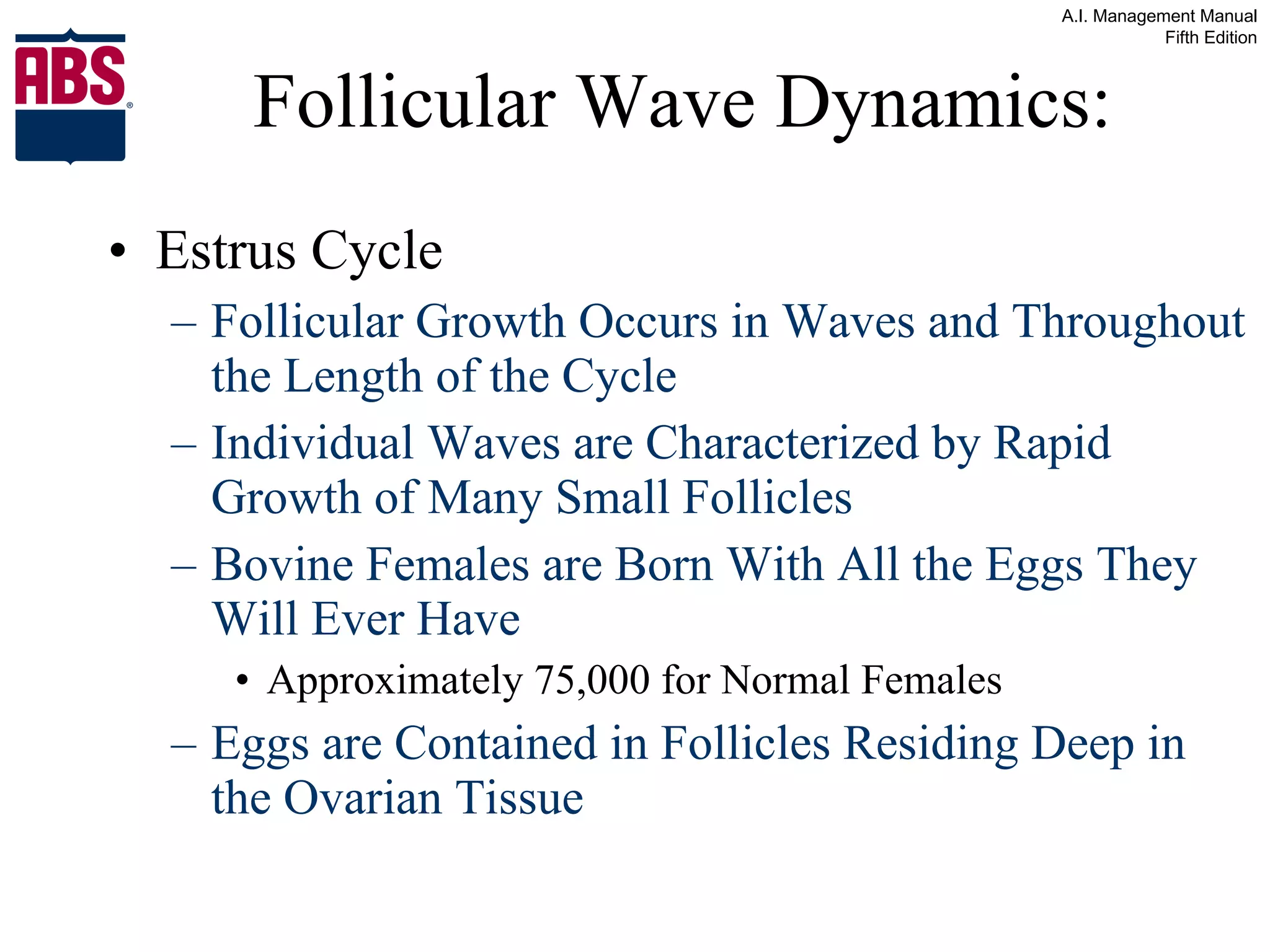
Normal Estrus Cycle
Follicular Wave Dynamics: Estrus Cycle Follicular Growth Occurs in Waves and Throughout the Length of the Cycle Individual Waves are Characterized by Rapid Growth of Many Small Follicles Bovine Females are Born With All the Eggs They Will Ever Have  Approximately 75,000 for Normal Females Eggs are Contained in Follicles Residing Deep in the Ovarian Tissue
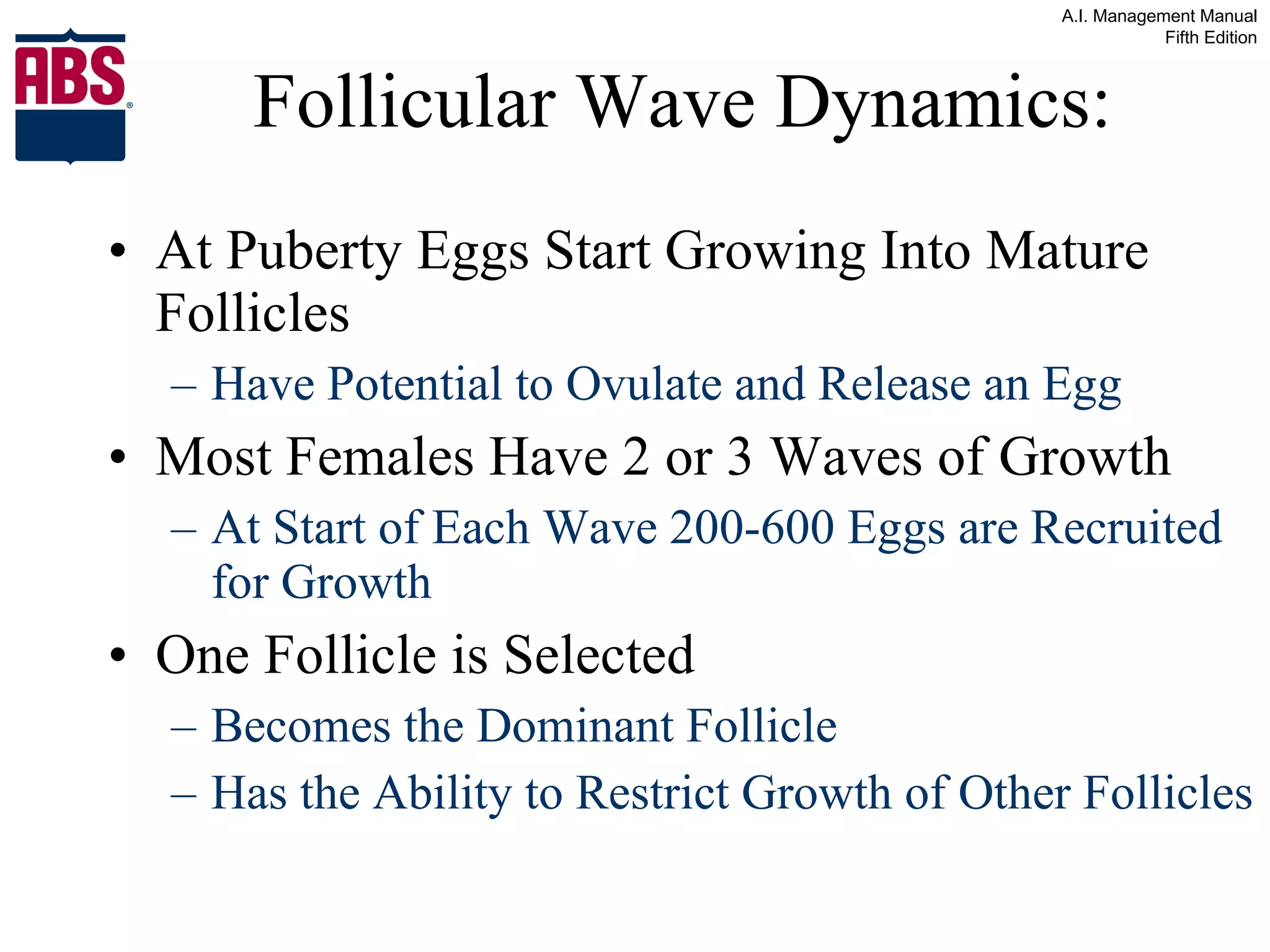
Follicular Wave Dynamics: At Puberty Eggs Start Growing Into Mature Follicles Have Potential to Ovulate and Release an Egg Most Females Have 2 or 3 Waves of Growth  At Start of Each Wave 200-600 Eggs are Recruited for Growth One Follicle is Selected  Becomes the Dominant Follicle Has the Ability to Restrict Growth of Other Follicles
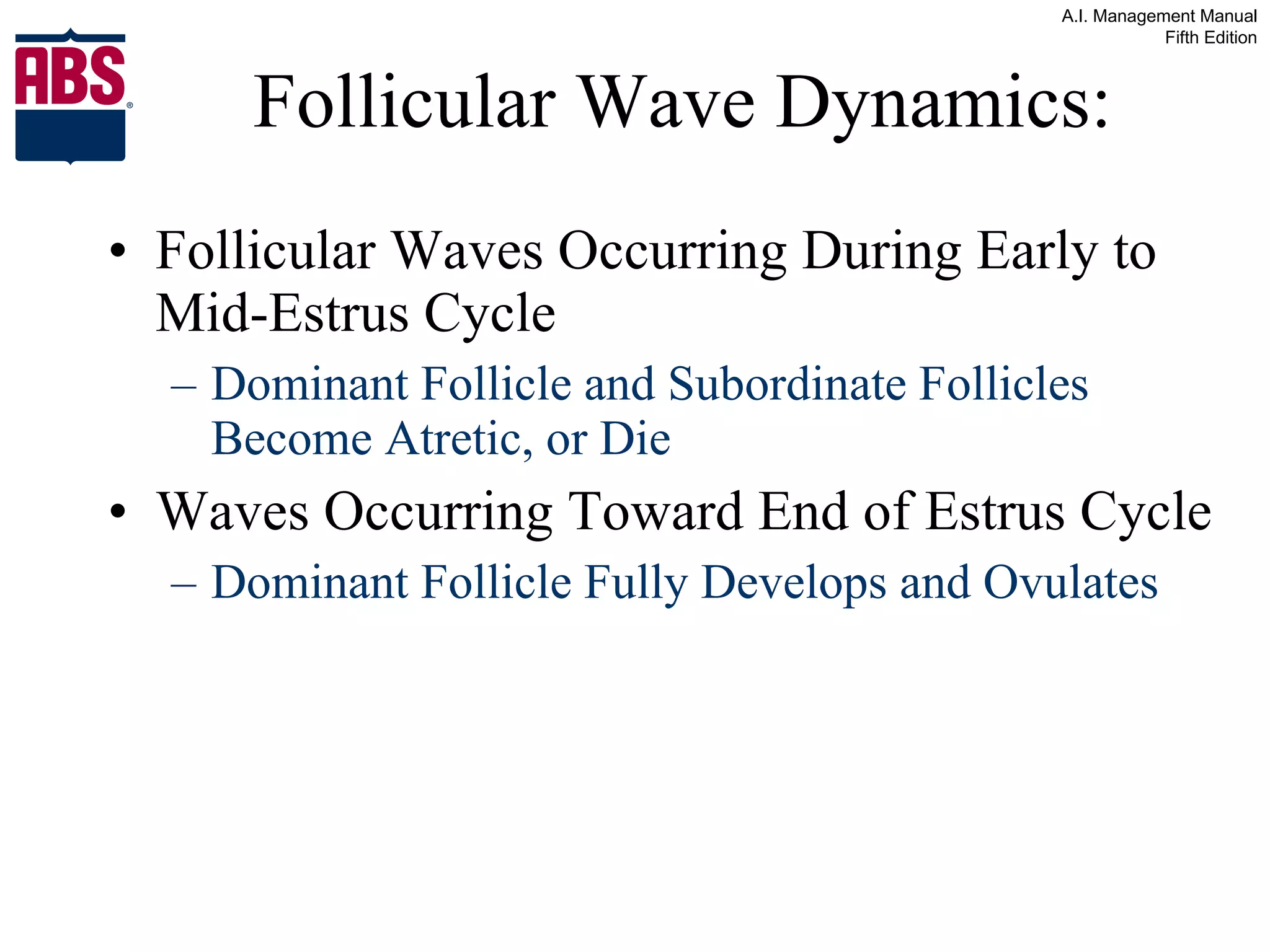
Follicular Wave Dynamics: Follicular Waves Occurring During Early to Mid-Estrus Cycle Dominant Follicle and Subordinate Follicles Become Atretic, or Die Waves Occurring Toward End of Estrus Cycle Dominant Follicle Fully Develops and Ovulates
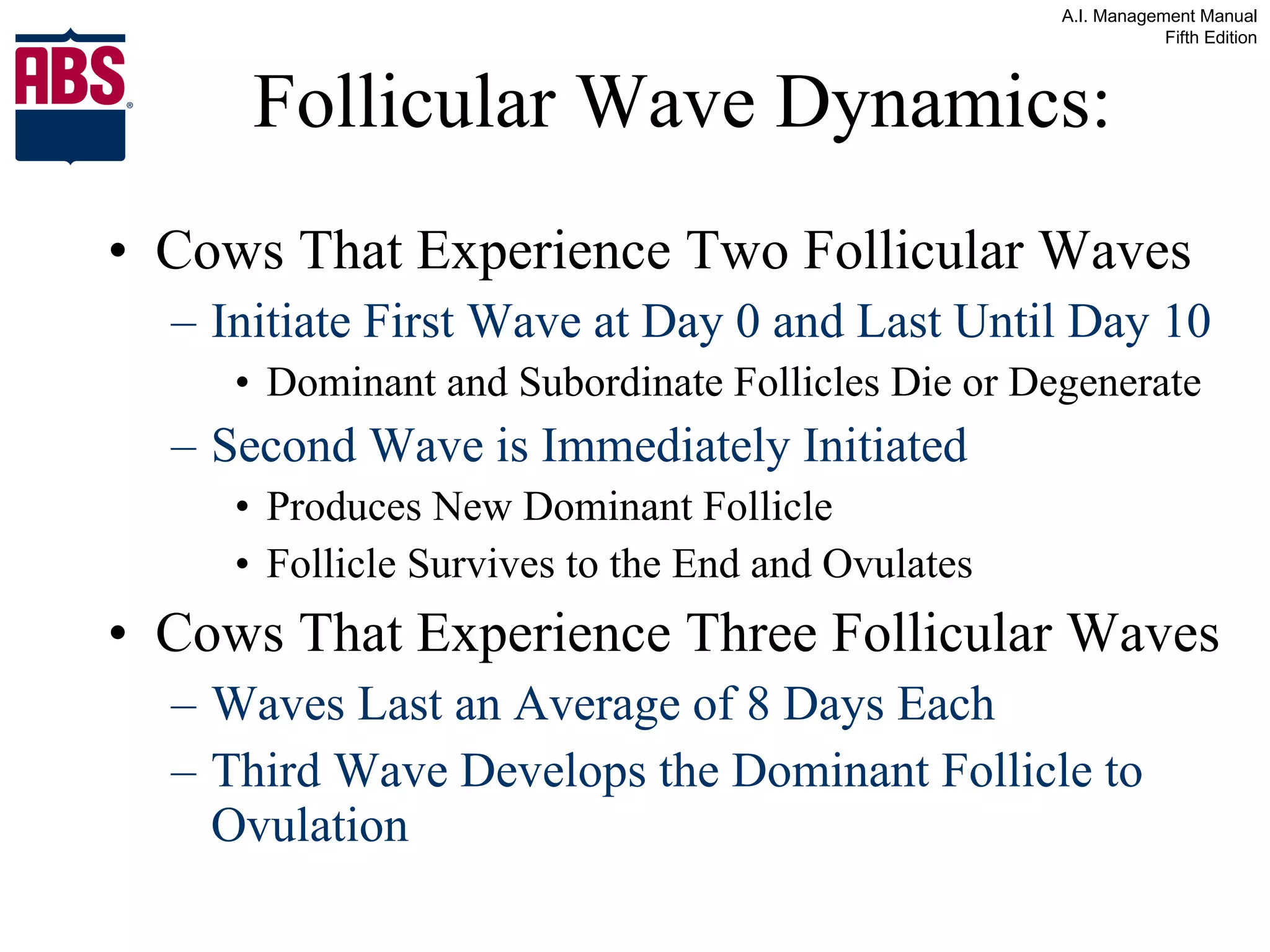
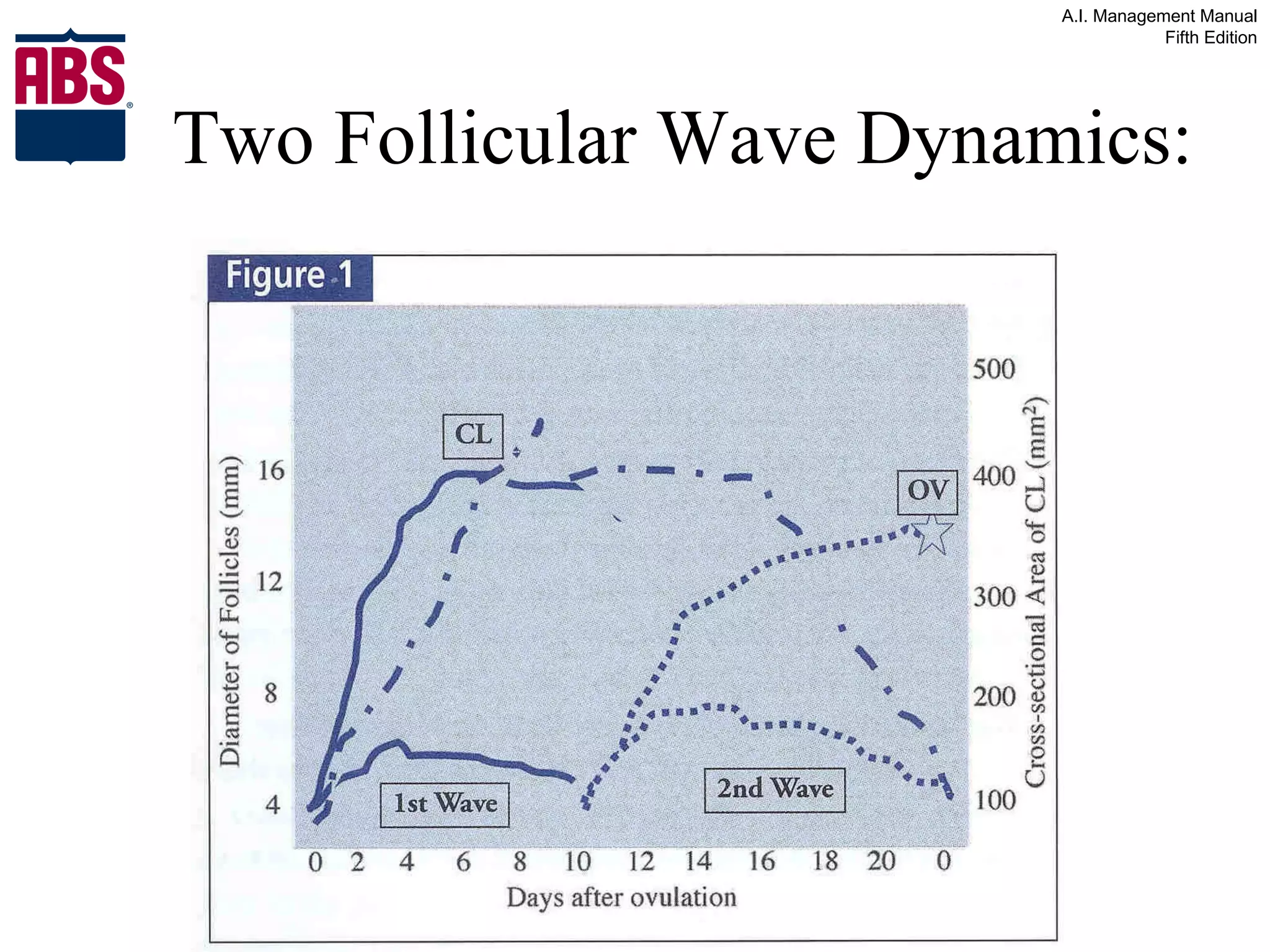
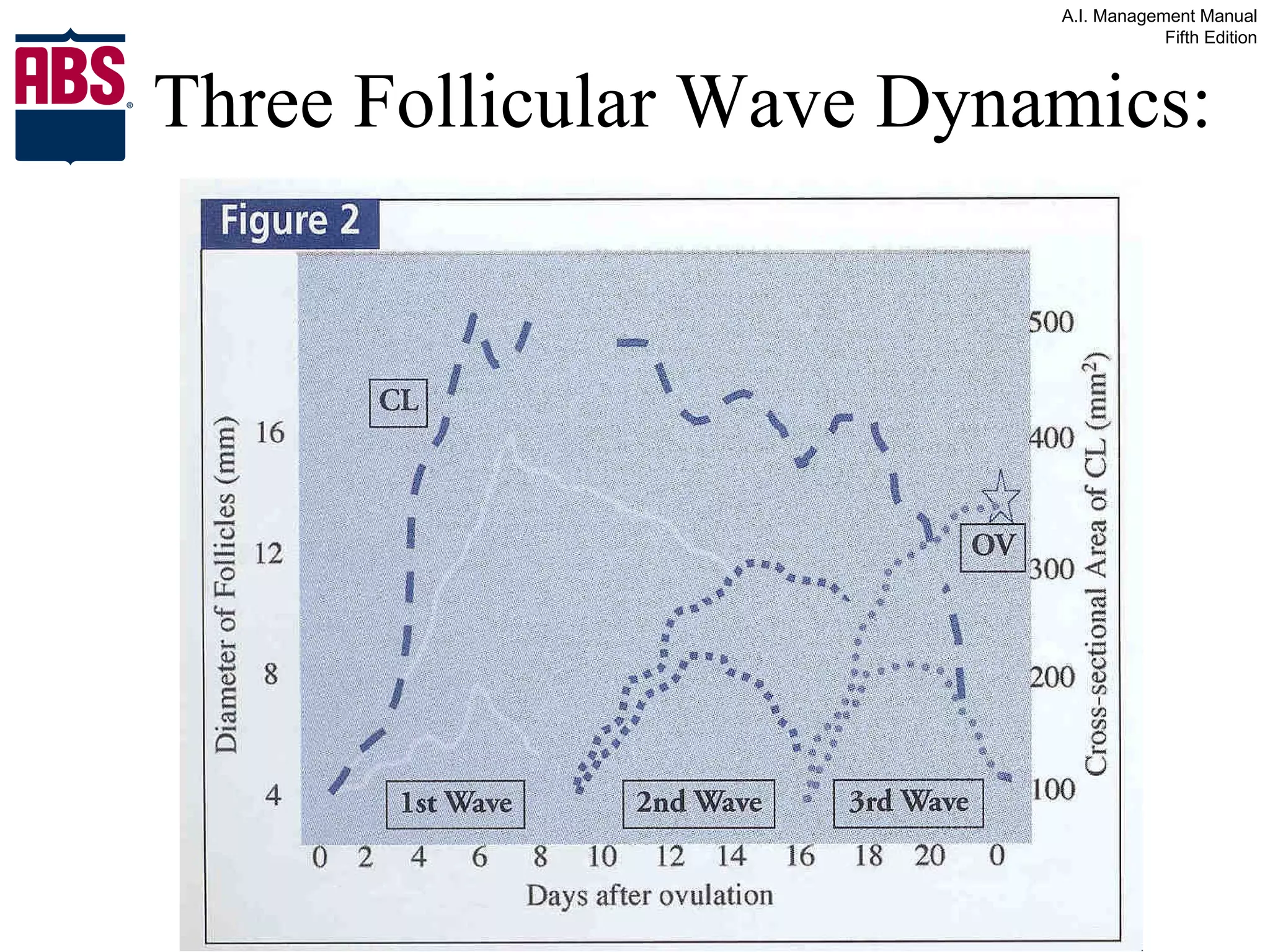
Follicular Wave Dynamics: Cows That Experience Two Follicular Waves Initiate First Wave at Day 0 and Last Until Day 10 Dominant and Subordinate Follicles Die or Degenerate Second Wave is Immediately Initiated Produces New Dominant Follicle  Follicle Survives to the End and Ovulates Cows That Experience Three Follicular Waves Waves Last an Average of 8 Days Each Third Wave Develops the Dominant Follicle to Ovulation
Two Follicular Wave Dynamics:
Three Follicular Wave Dynamics:
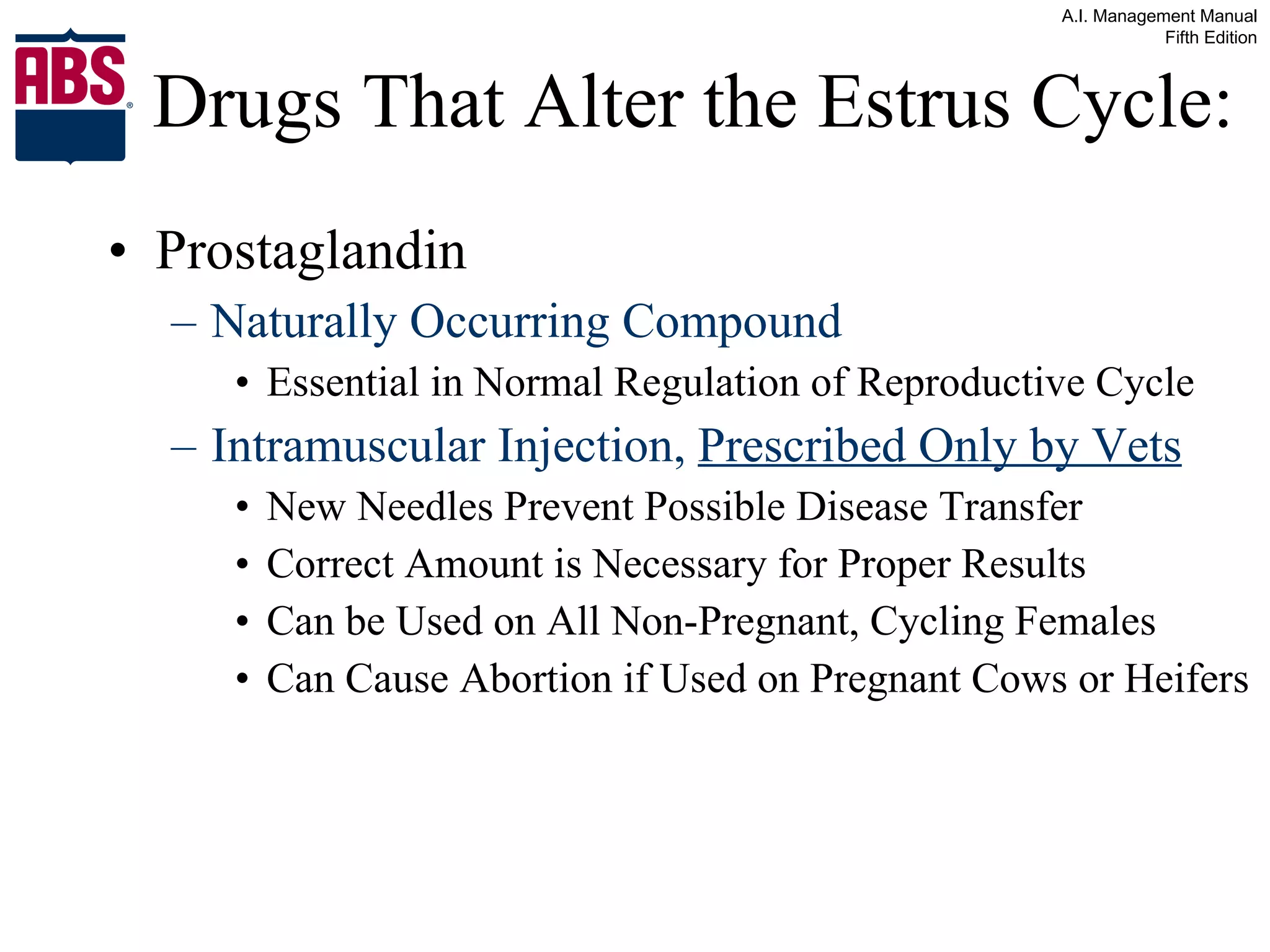
Drugs That Alter the Estrus Cycle: Prostaglandin Naturally Occurring Compound  Essential in Normal Regulation of Reproductive Cycle Intramuscular Injection,  Prescribed Only by Vets New Needles Prevent Possible Disease Transfer Correct Amount is Necessary for Proper Results Can be Used on All Non-Pregnant, Cycling Females Can Cause Abortion if Used on Pregnant Cows or Heifers
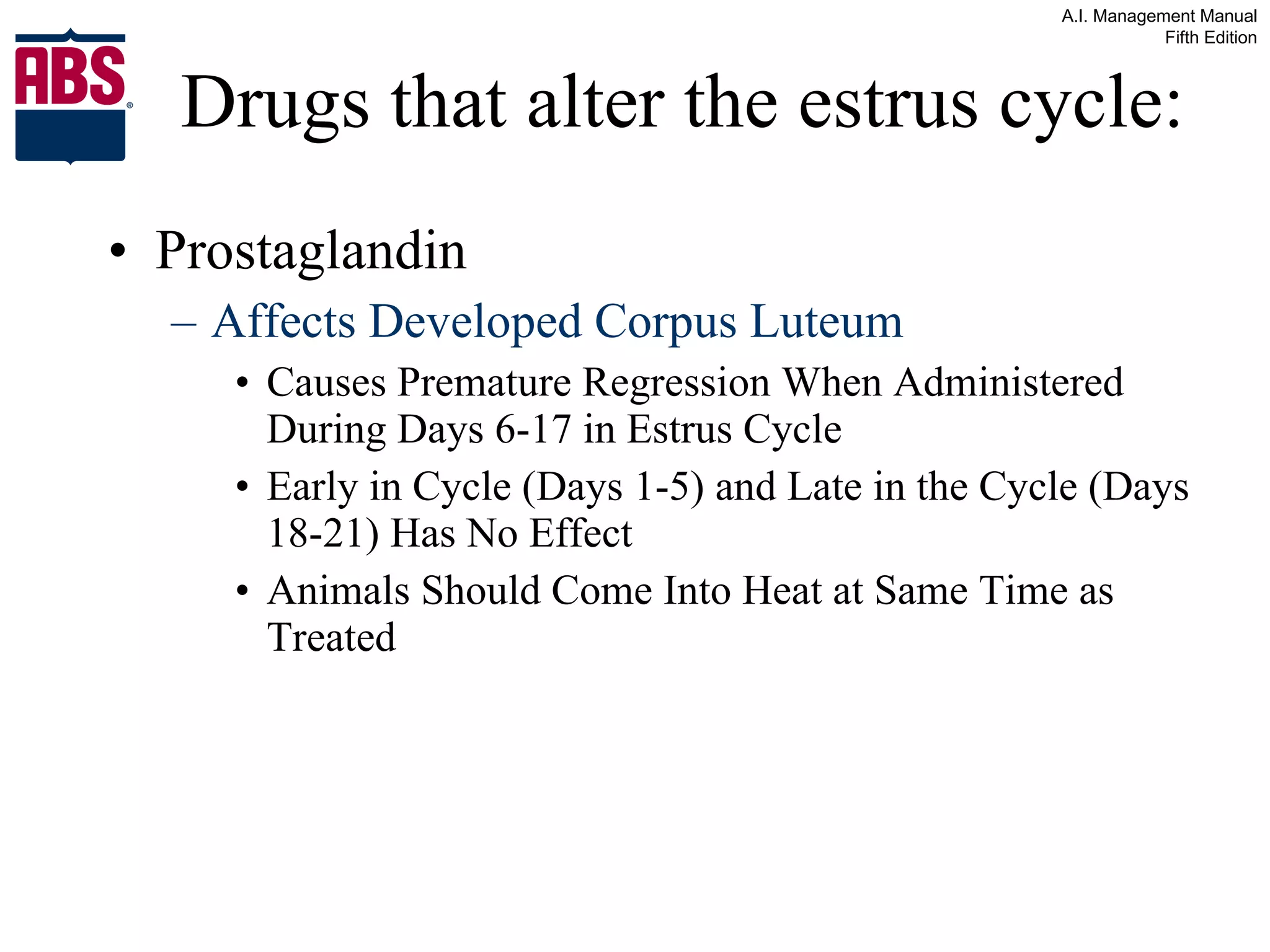
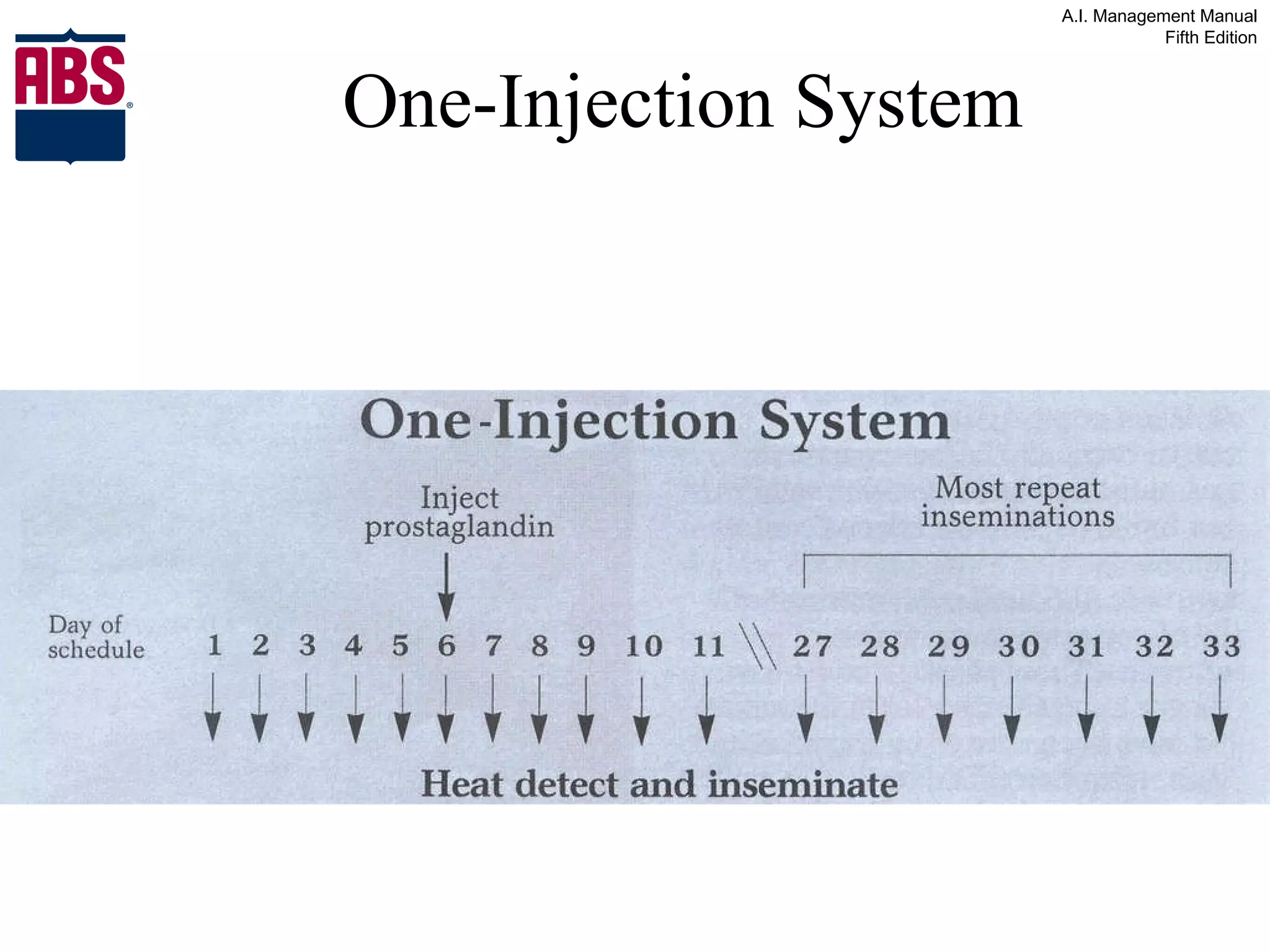
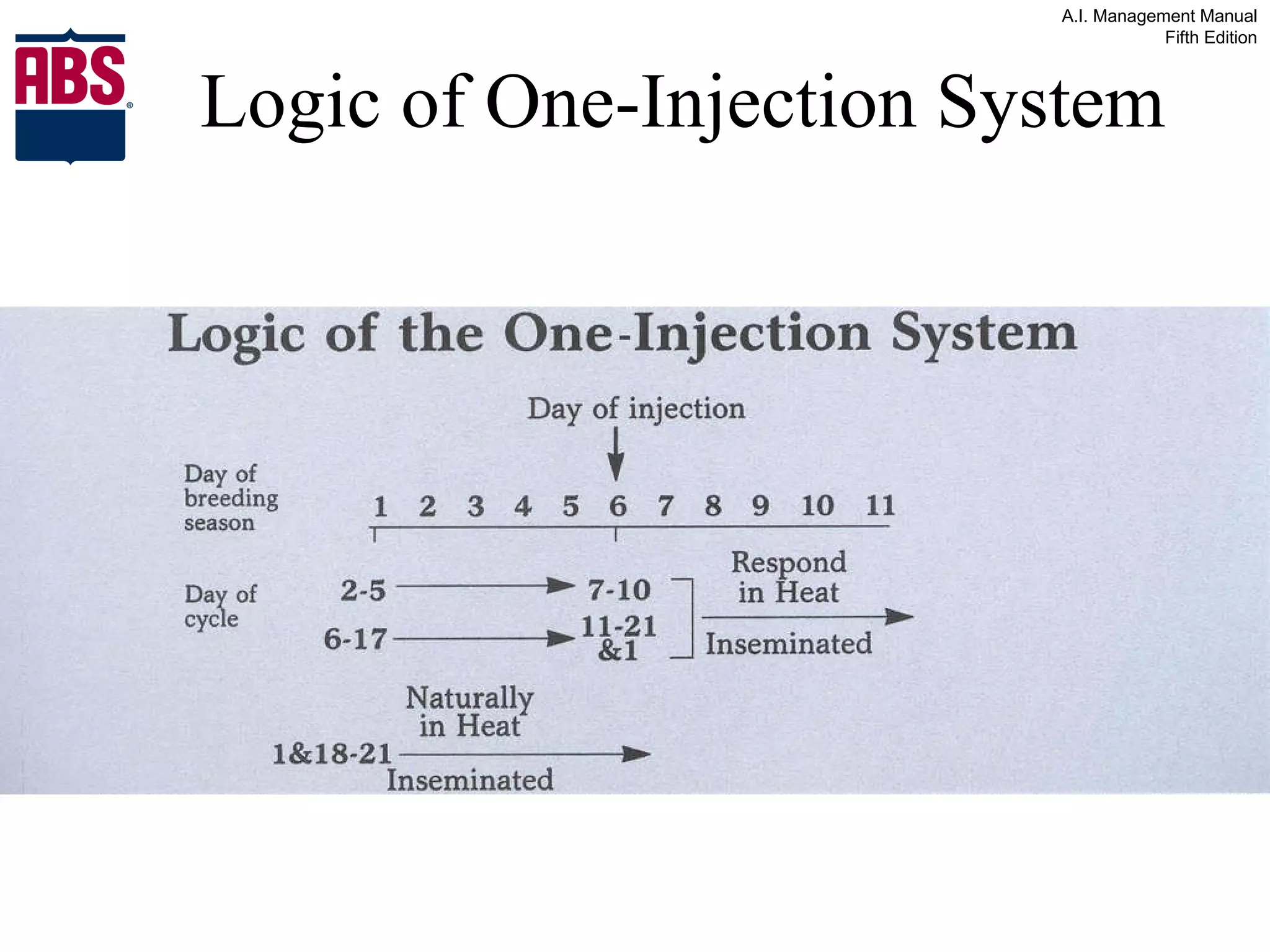
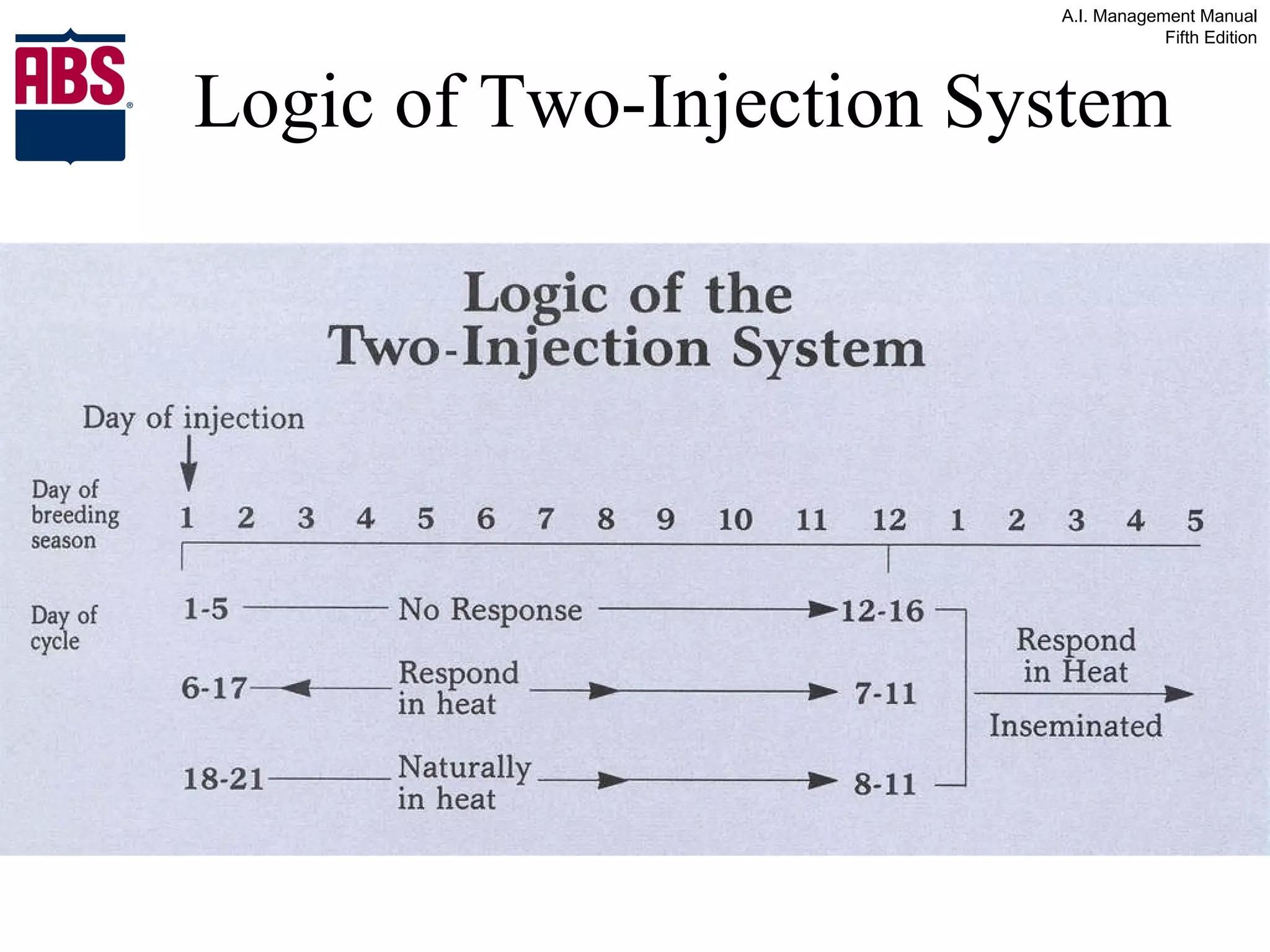
Drugs that alter the estrus cycle: Prostaglandin Affects Developed Corpus Luteum  Causes Premature Regression When Administered During Days 6-17 in Estrus Cycle Early in Cycle (Days 1-5) and Late in the Cycle (Days 18-21) Has No Effect Animals Should Come Into Heat at Same Time as Treated
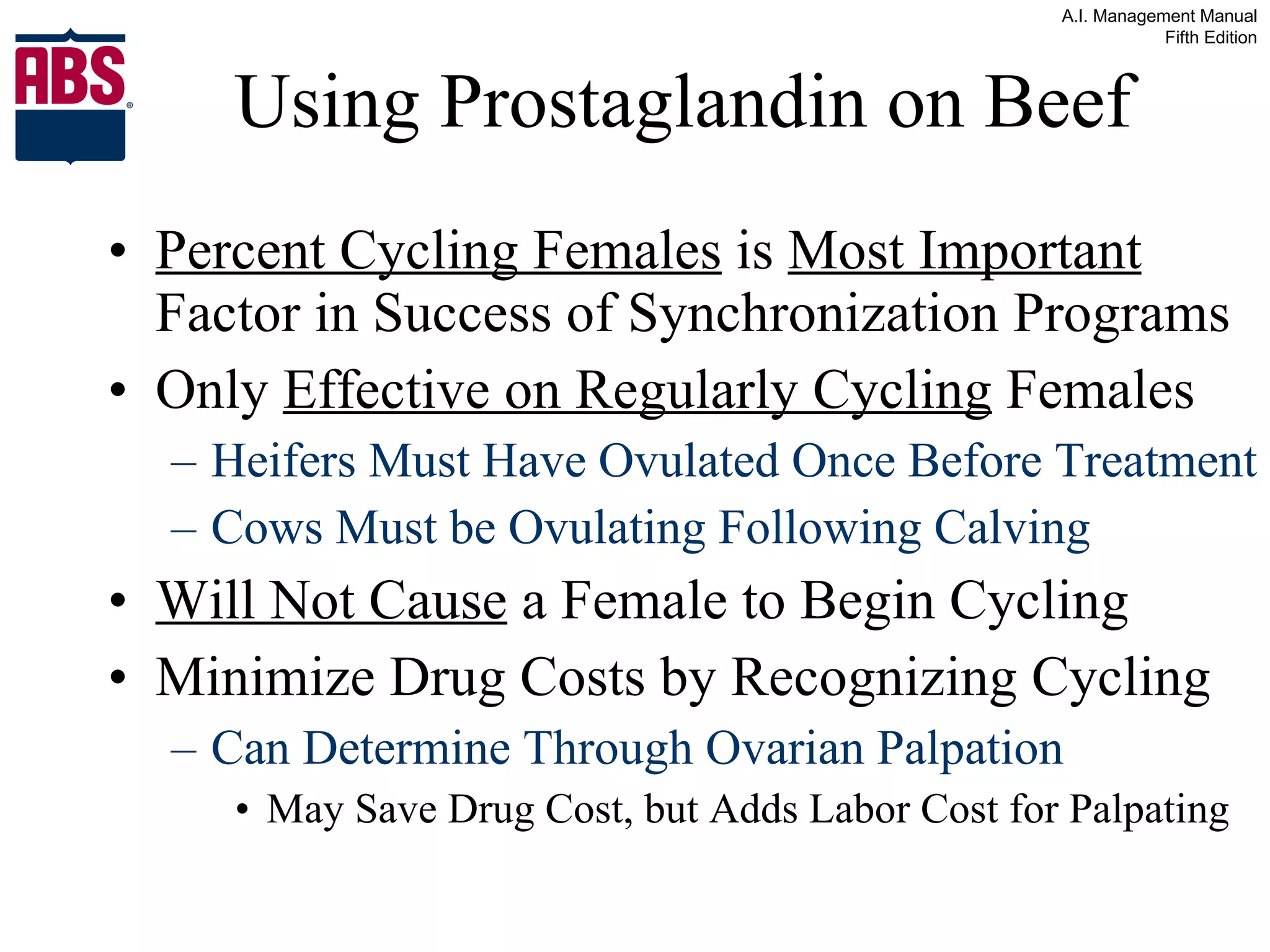
Using Prostaglandin on Beef Percent Cycling Females  is  Most Important  Factor in Success of Synchronization Programs Only  Effective on Regularly Cycling  Females Heifers Must Have Ovulated Once Before Treatment Cows Must be Ovulating Following Calving Will Not Cause  a Female to Begin Cycling Minimize Drug Costs by Recognizing Cycling Can Determine Through Ovarian Palpation May Save Drug Cost, but Adds Labor Cost for Palpating
One-Injection System
Logic of One-Injection System
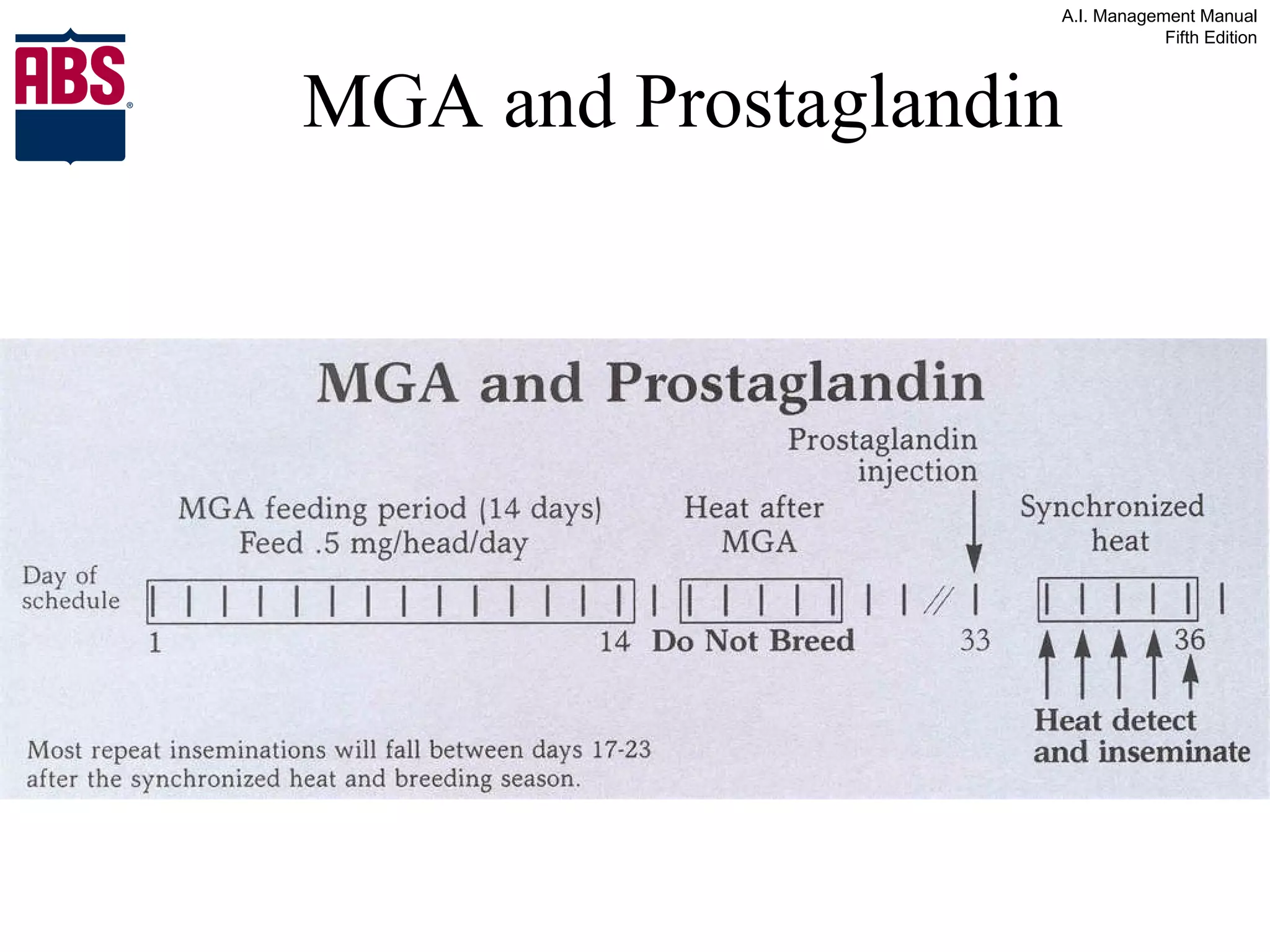
MGA and Prostaglandin
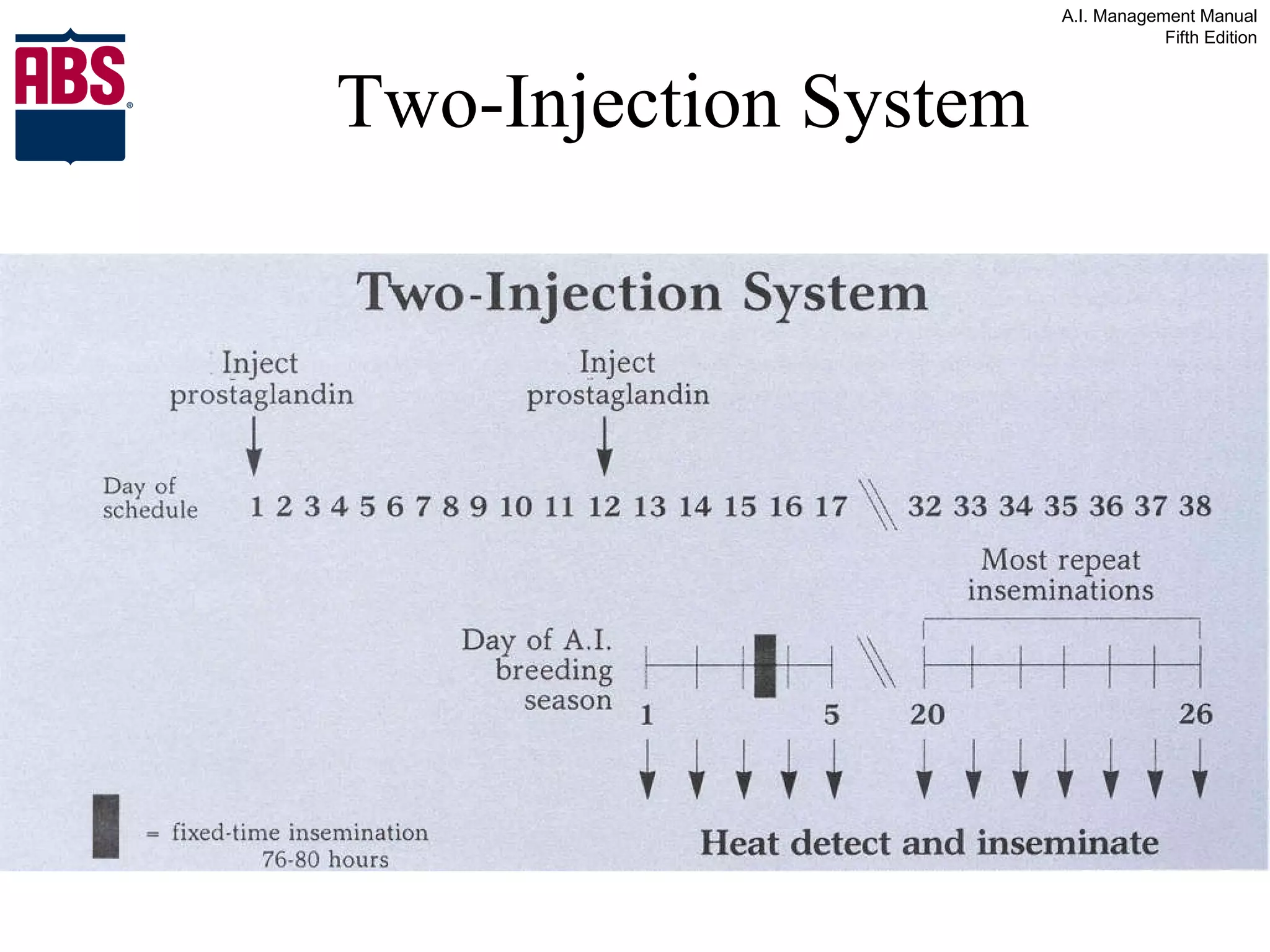
Two-Injection System
Logic of Two-Injection System
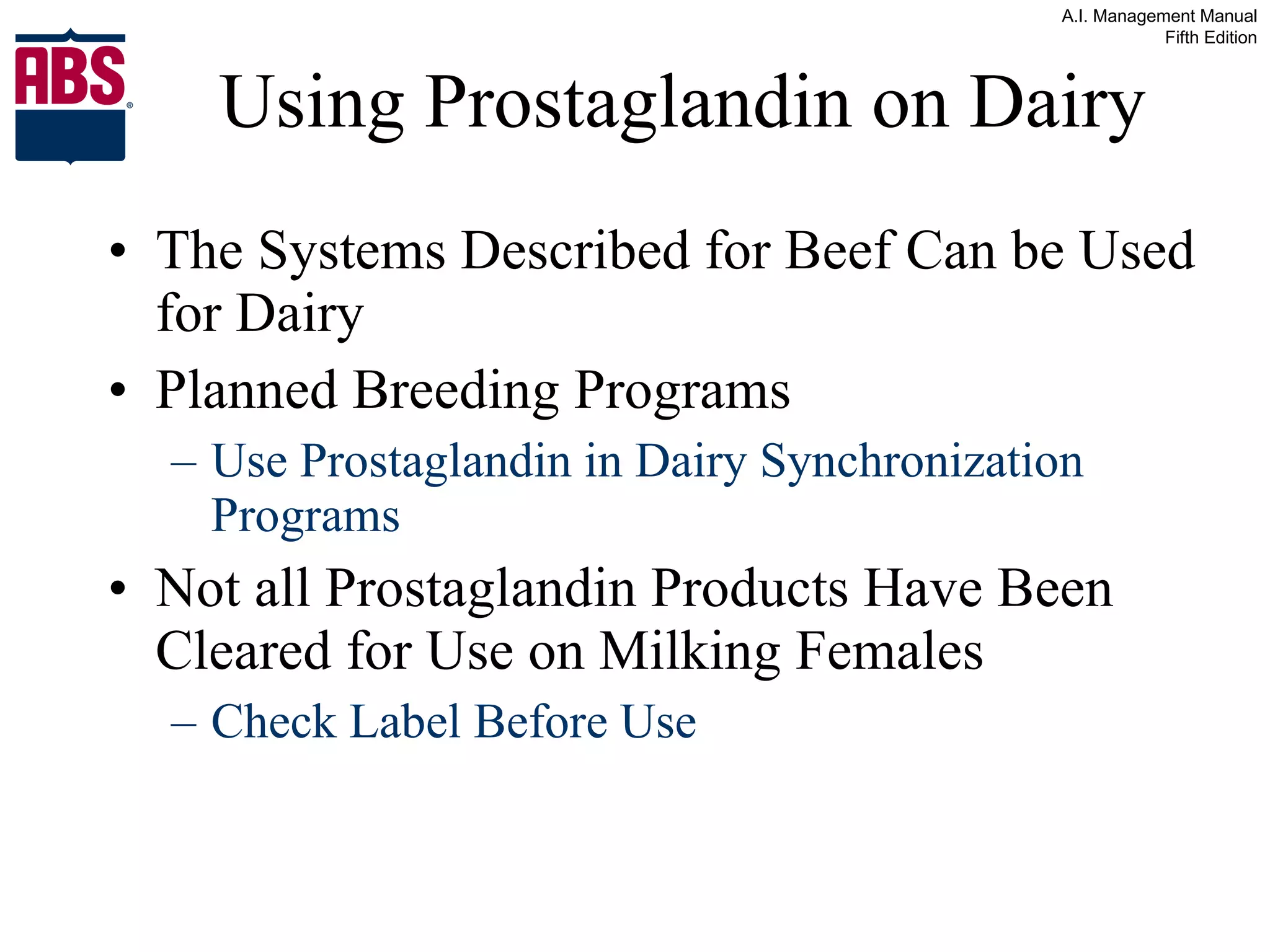
Using Prostaglandin on Dairy The Systems Described for Beef Can be Used for Dairy Planned Breeding Programs Use Prostaglandin in Dairy Synchronization Programs Not all Prostaglandin Products Have Been Cleared for Use on Milking Females Check Label Before Use
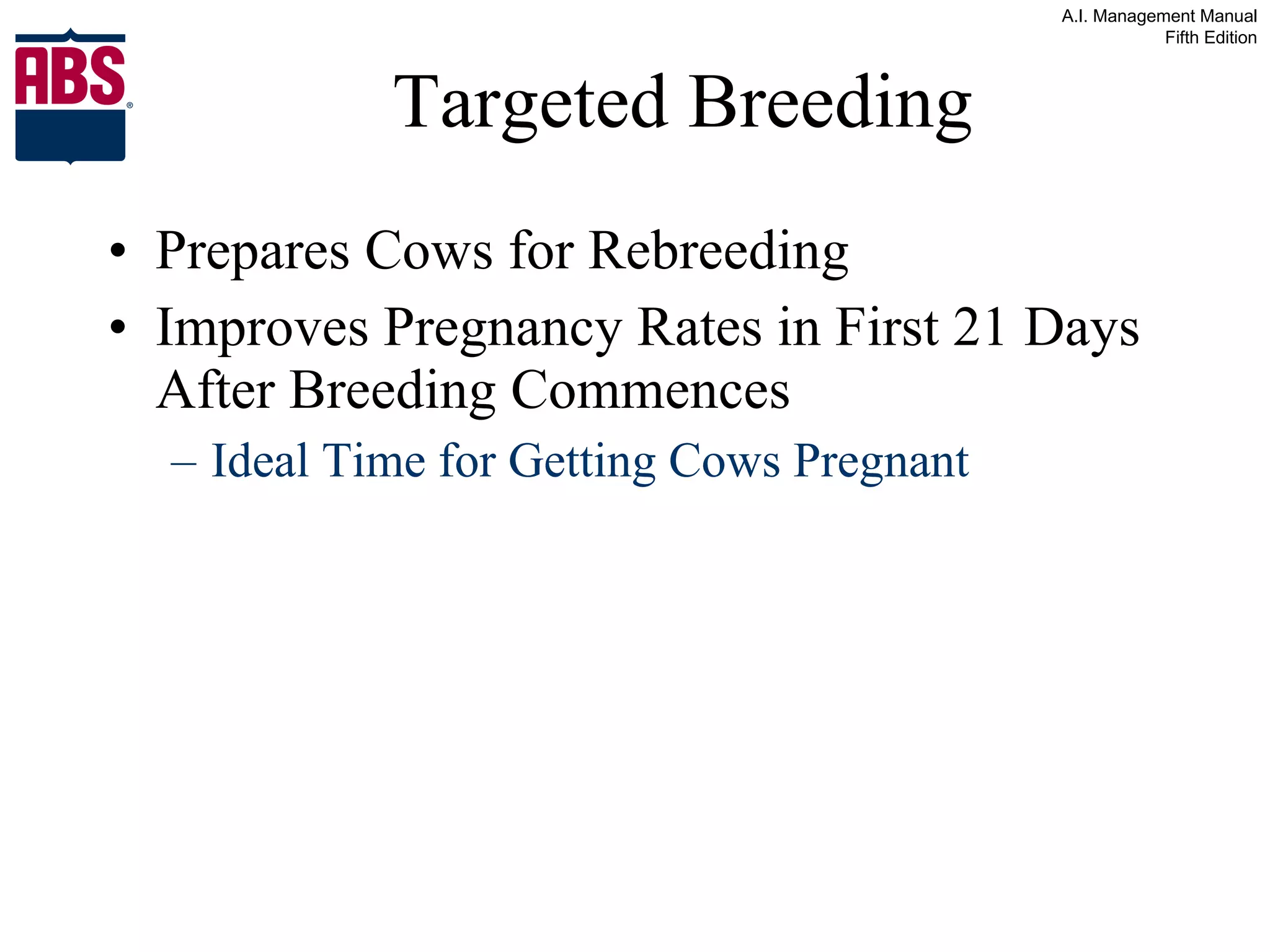
Targeted Breeding Prepares Cows for Rebreeding Improves Pregnancy Rates in First 21 Days After Breeding Commences Ideal Time for Getting Cows Pregnant
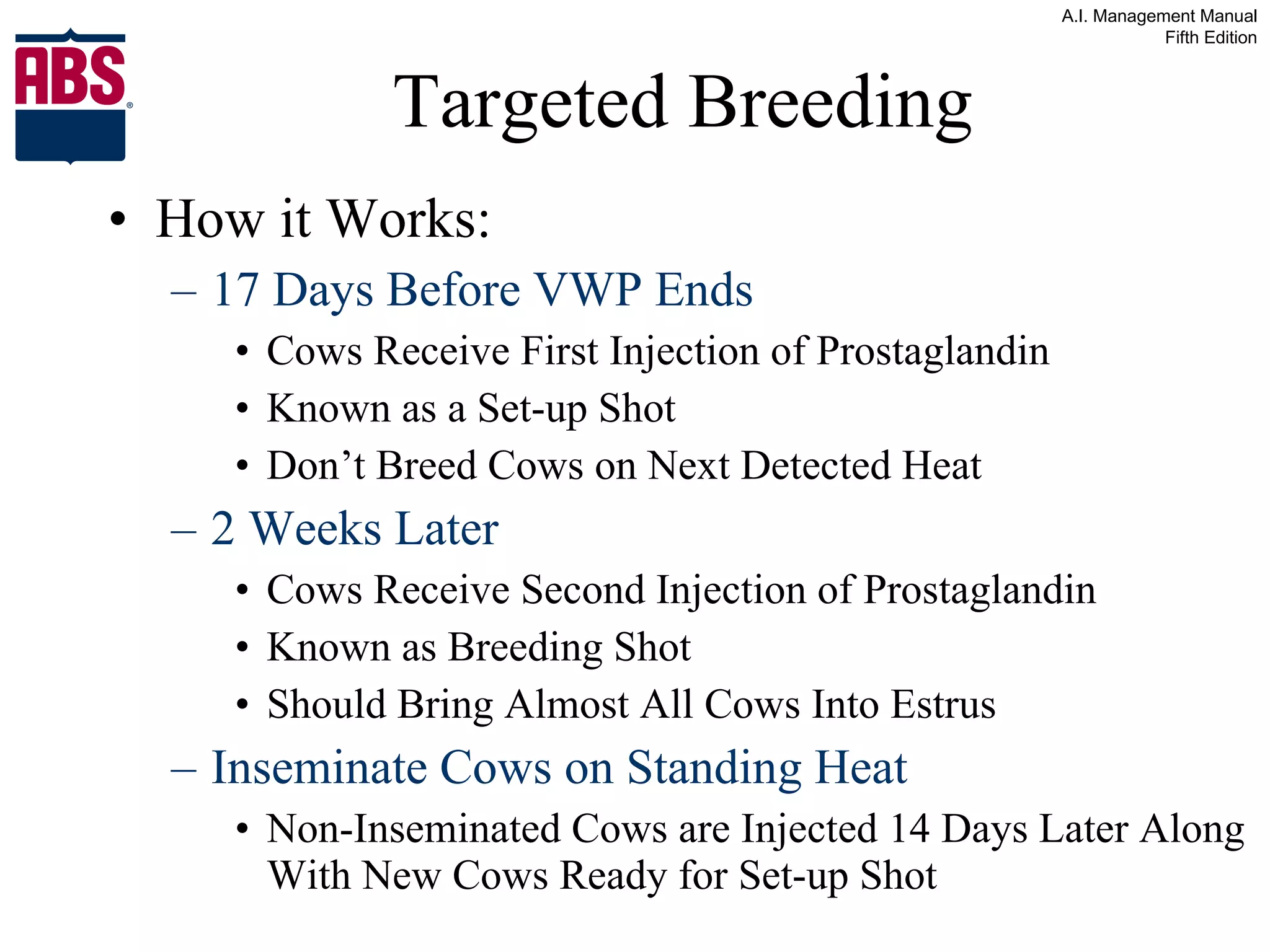
Targeted Breeding How it Works: 17 Days Before VWP Ends Cows Receive First Injection of Prostaglandin Known as a Set-up Shot Don’t Breed Cows on Next Detected Heat 2 Weeks Later Cows Receive Second Injection of Prostaglandin Known as Breeding Shot Should Bring Almost All Cows Into Estrus Inseminate Cows on Standing Heat Non-Inseminated Cows are Injected 14 Days Later Along With New Cows Ready for Set-up Shot
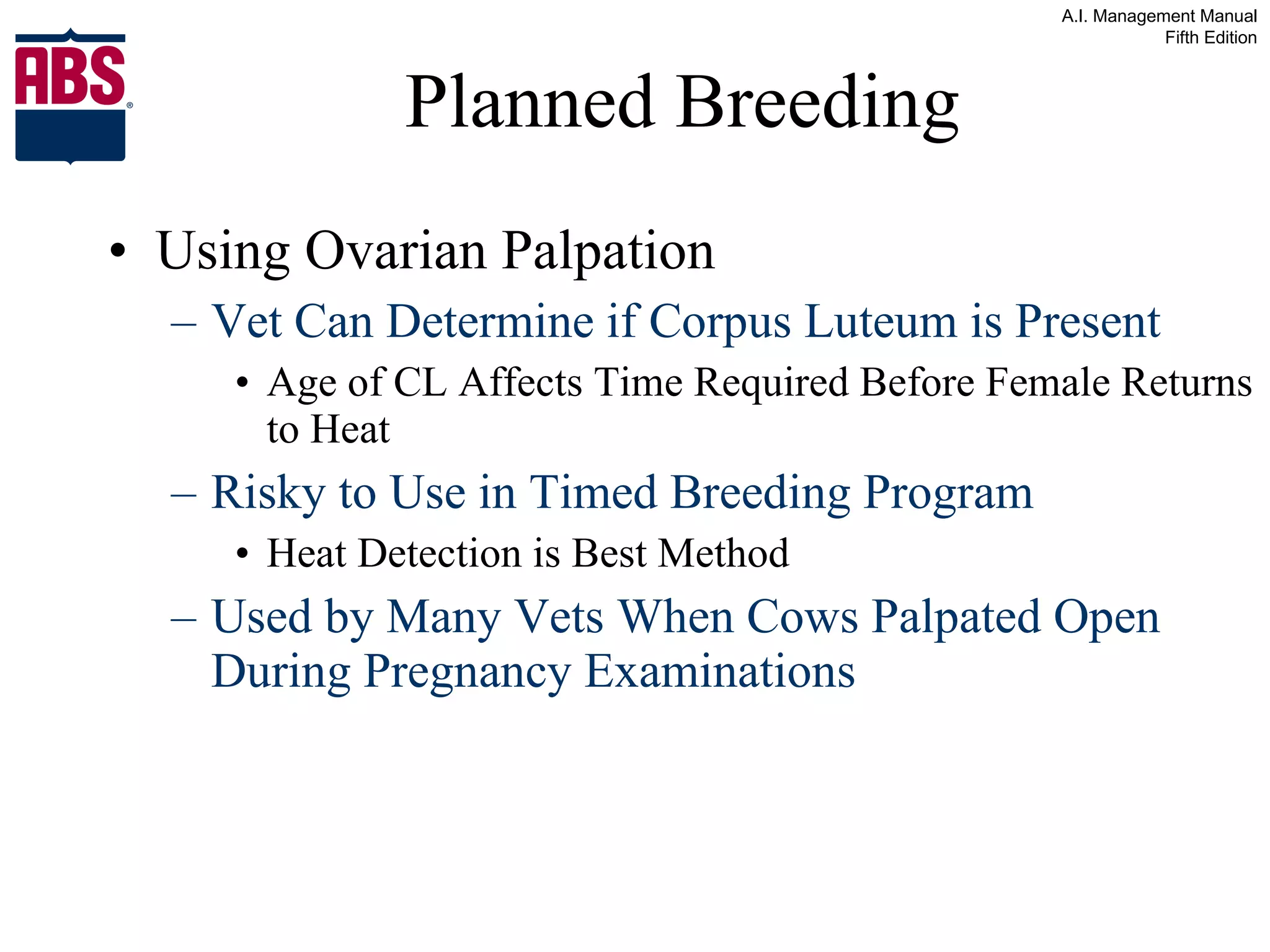
Planned Breeding Using Ovarian Palpation Vet Can Determine if Corpus Luteum is Present Age of CL Affects Time Required Before Female Returns to Heat Risky to Use in Timed Breeding Program Heat Detection is Best Method Used by Many Vets When Cows Palpated Open During Pregnancy Examinations
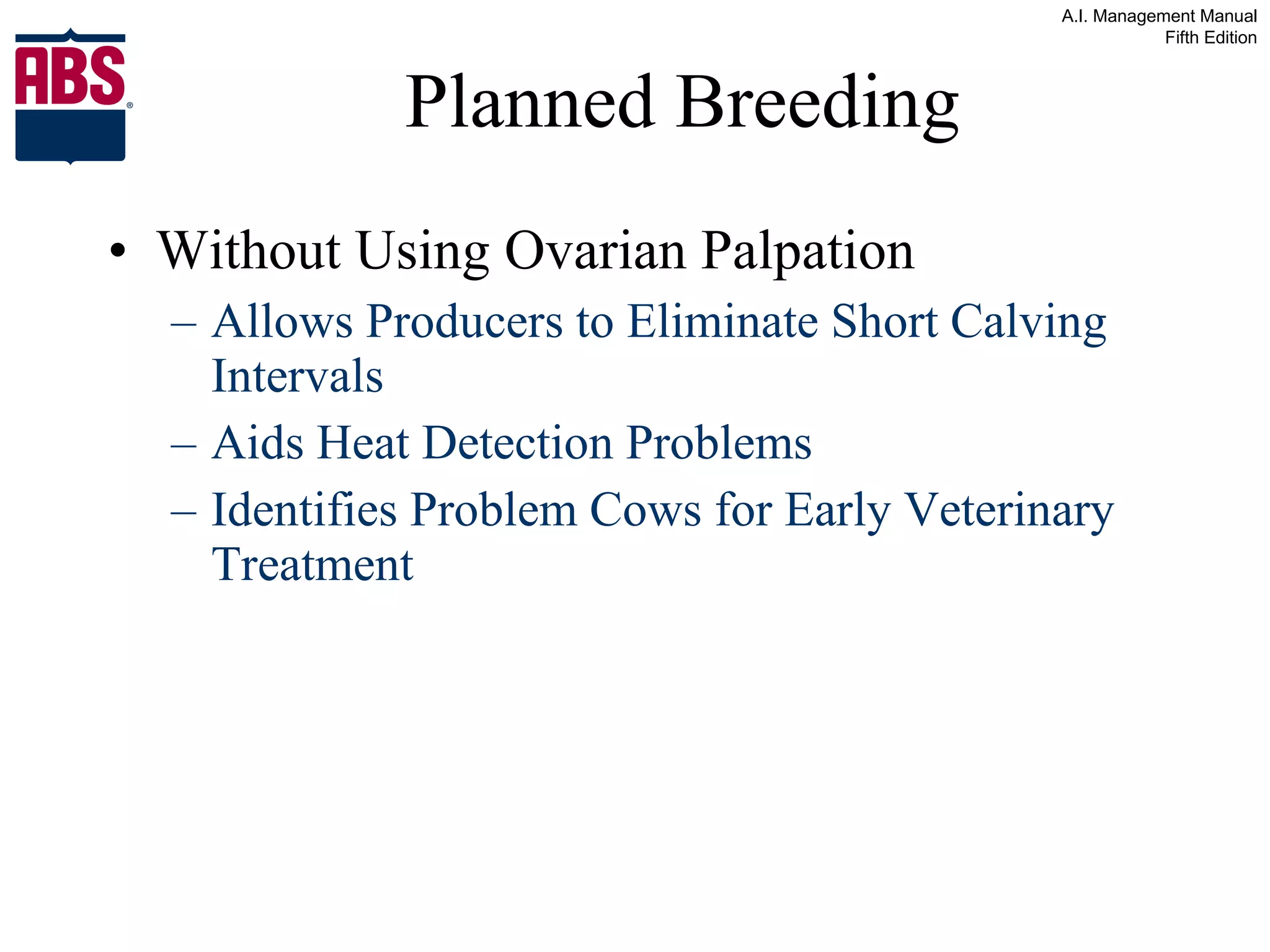
Planned Breeding Without Using Ovarian Palpation Allows Producers to Eliminate Short Calving Intervals Aids Heat Detection Problems Identifies Problem Cows for Early Veterinary Treatment
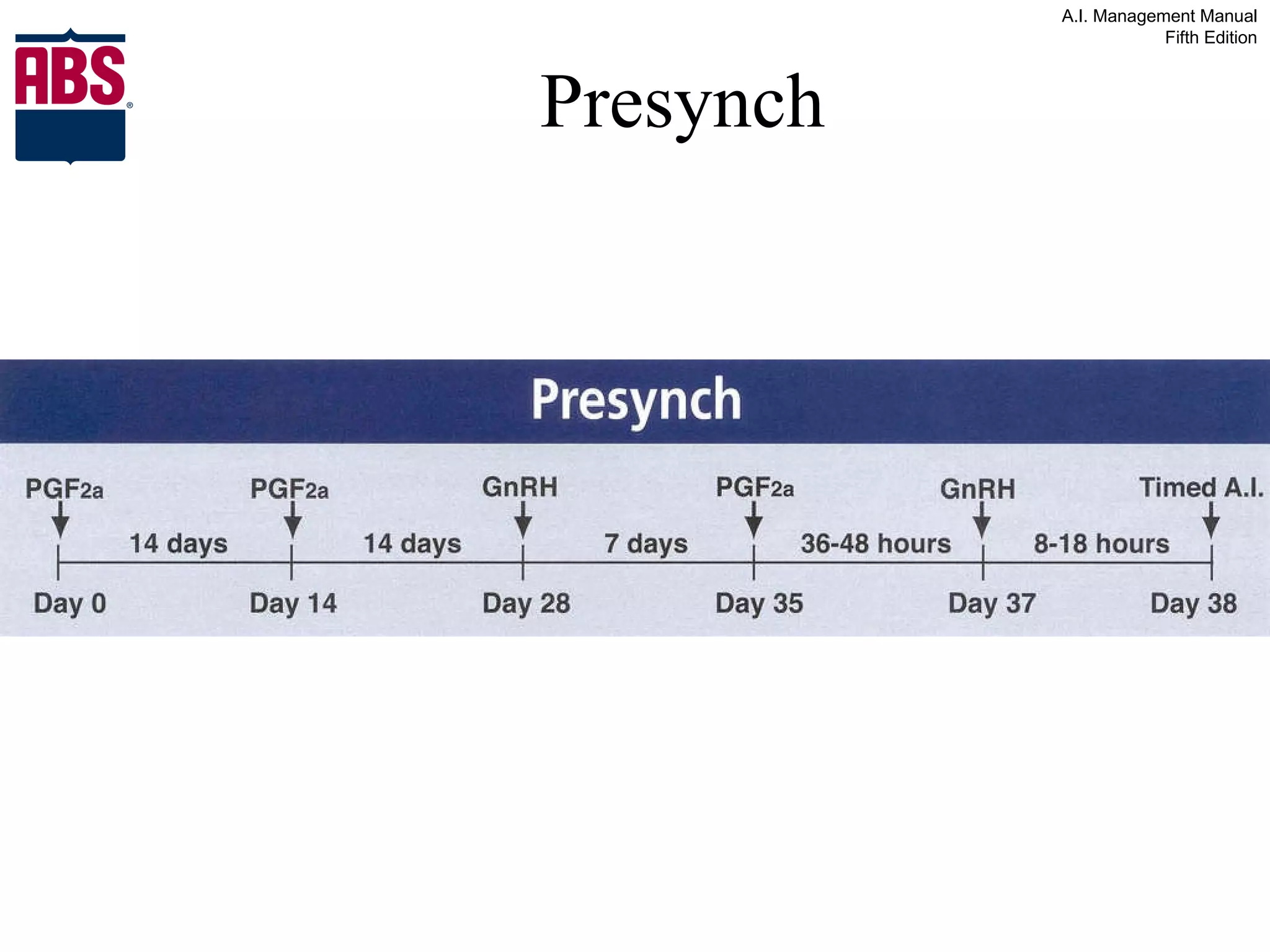
Presynch
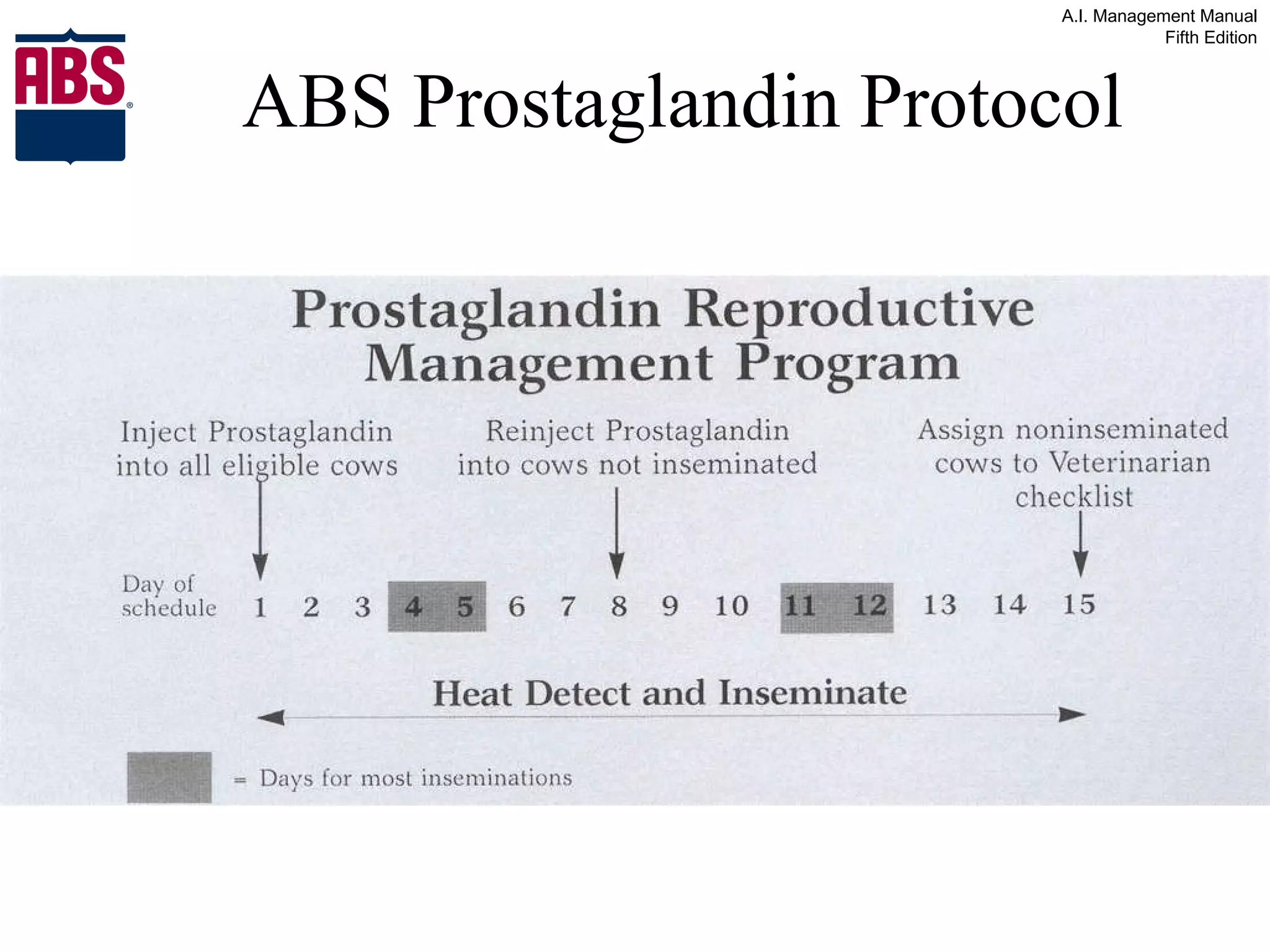
ABS Prostaglandin Protocol
GnRH Based Protocols Use GnRH and Prostaglandin to Synchronize Estrus and Control Ovulation Effective in  Mature Cows Less Effective  in Heifers All Products are Prescriptions Must be Purchased Through Local Veterinarian Common GnRH Products are : Cystorelin® Factrel® Fertagyl®
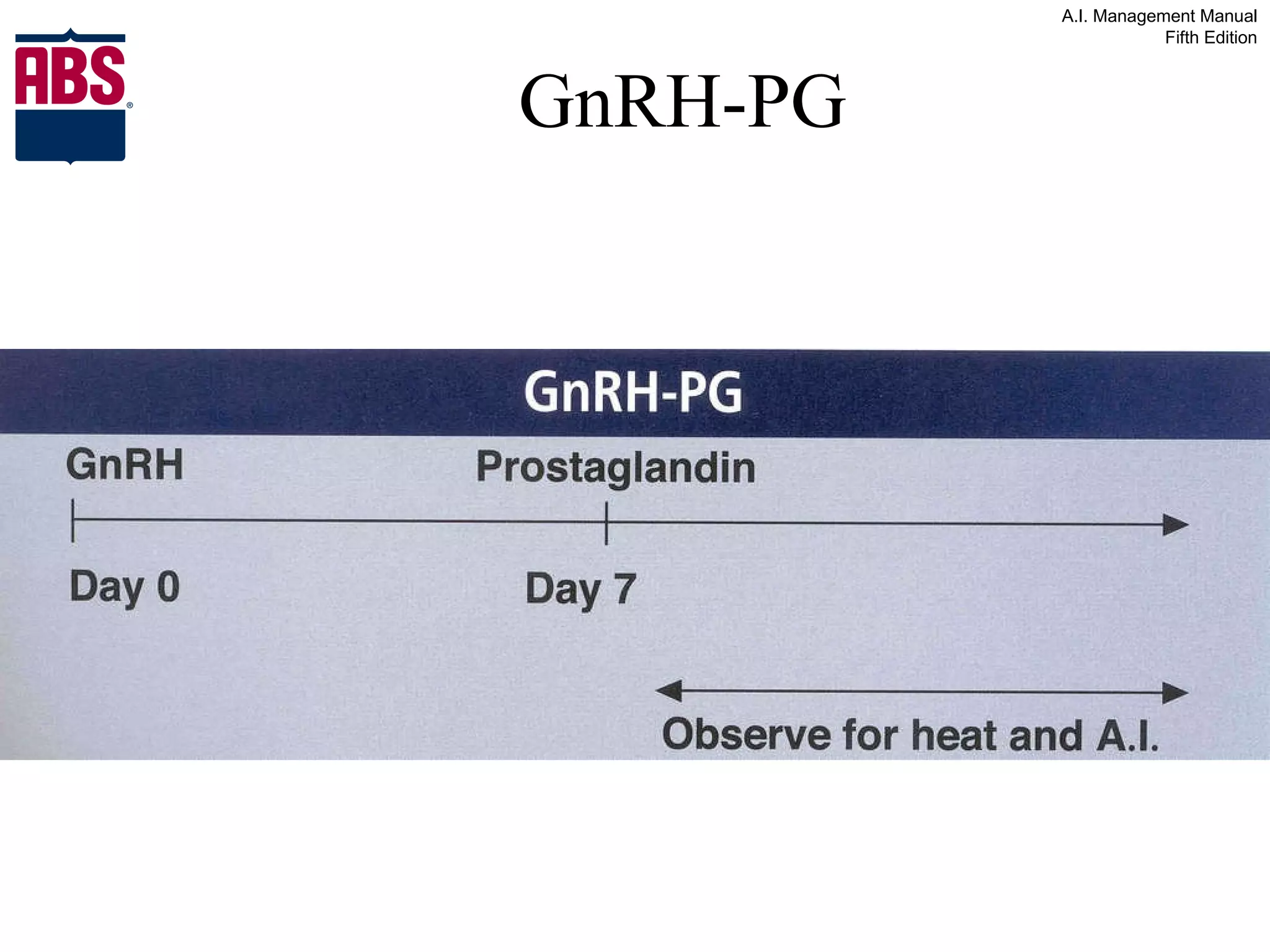
GnRH-PG
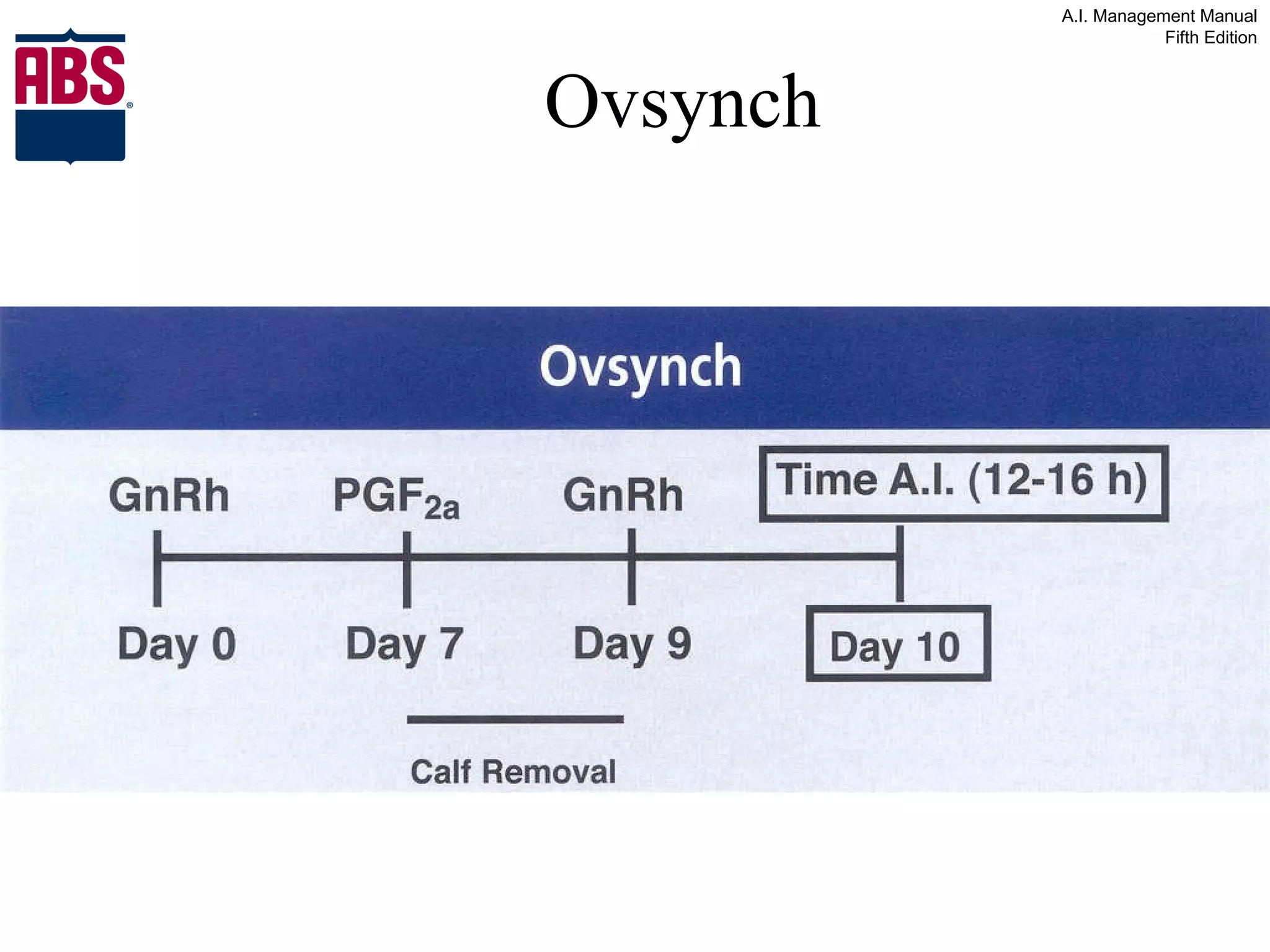
Ovsynch
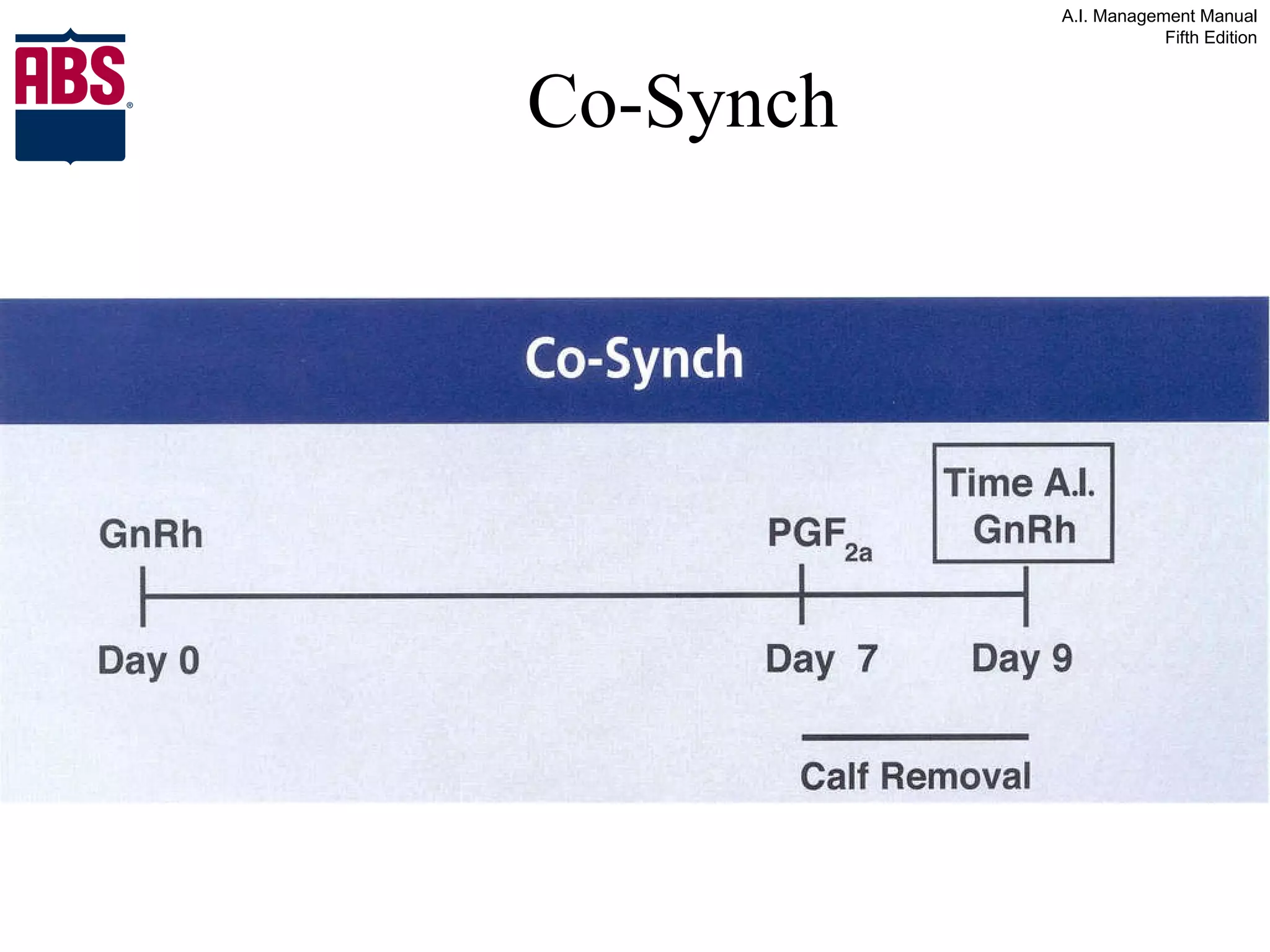
Co-Synch
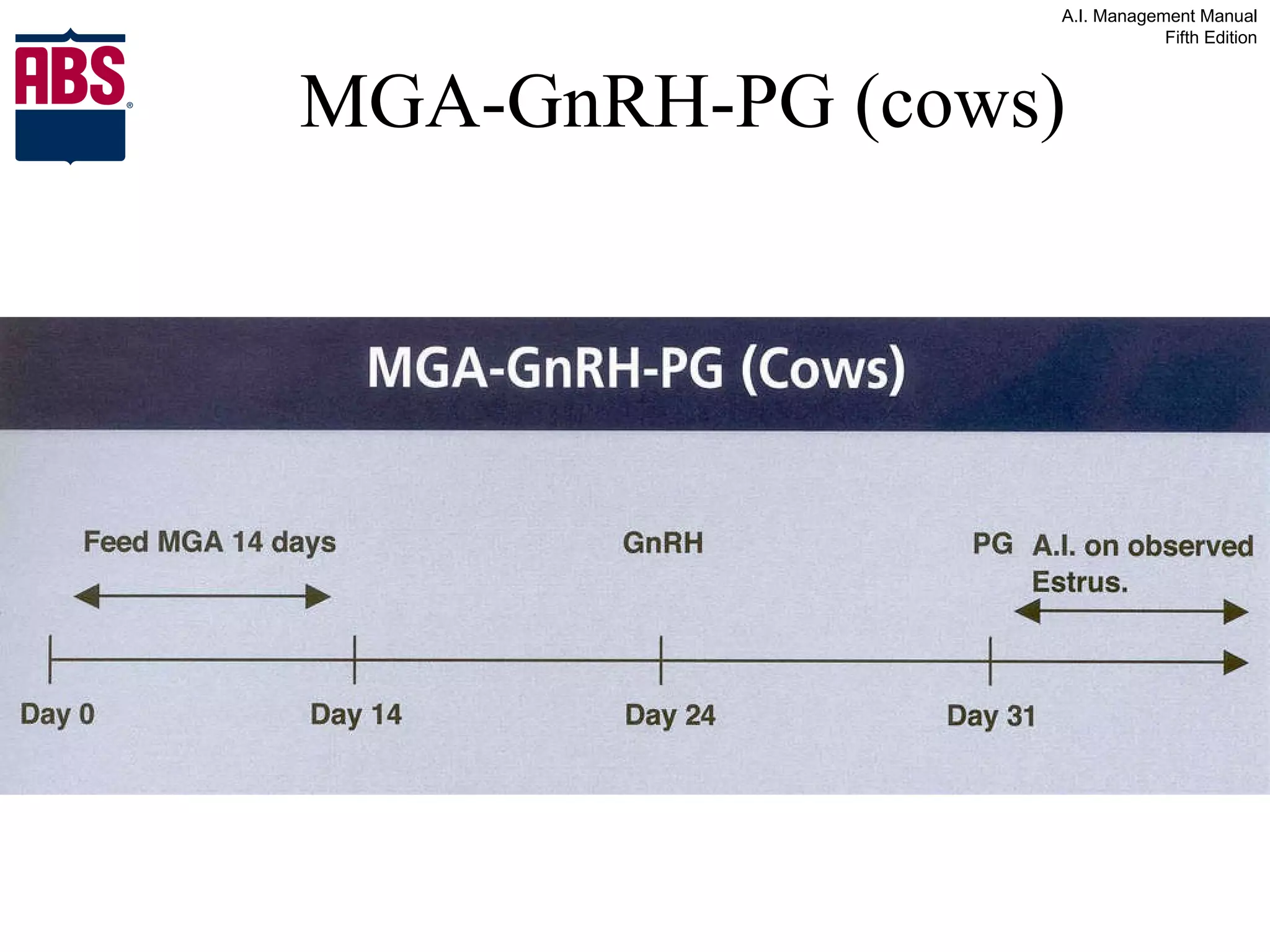
MGA-GnRH-PG (cows)
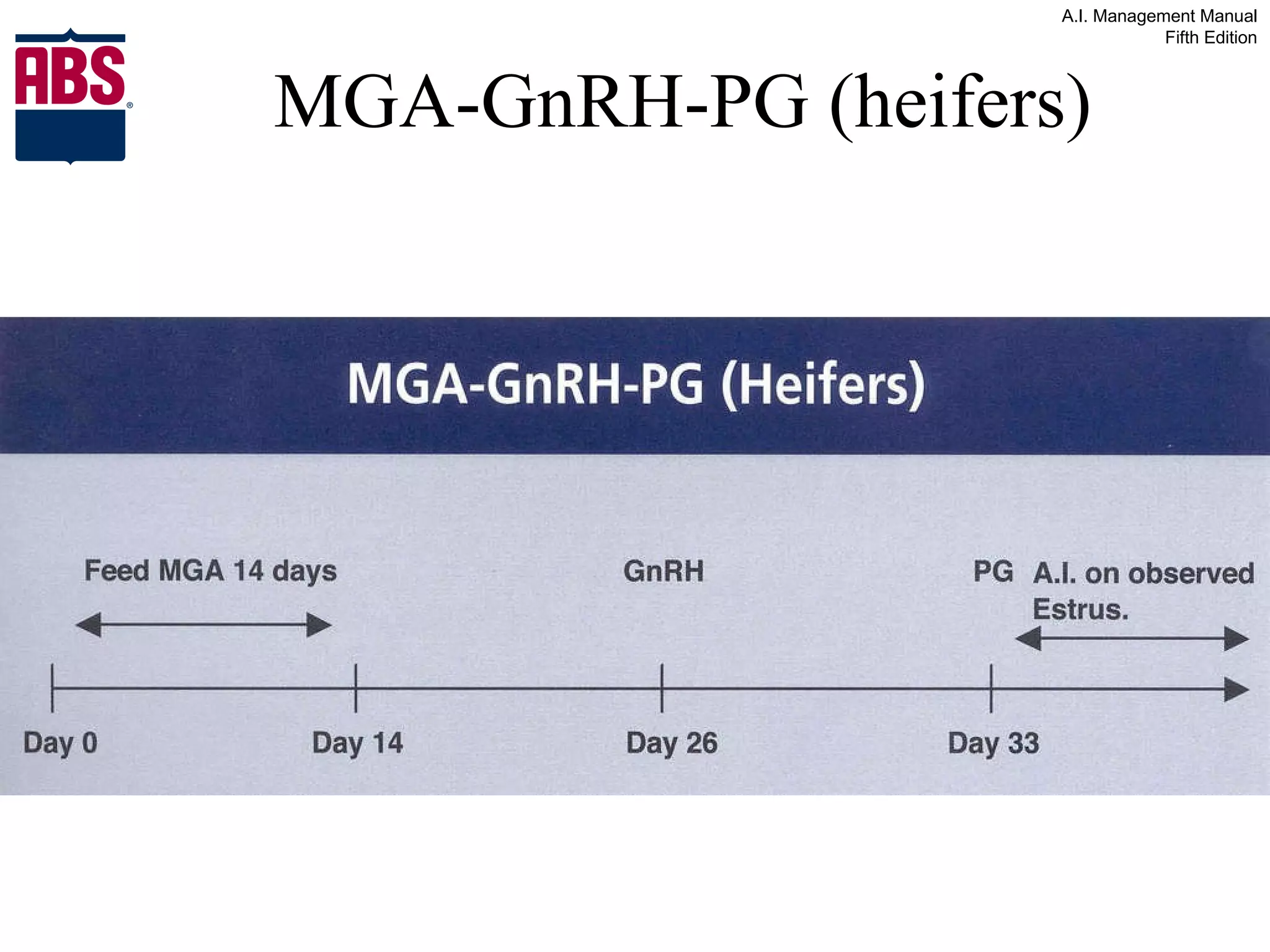
MGA-GnRH-PG (heifers)
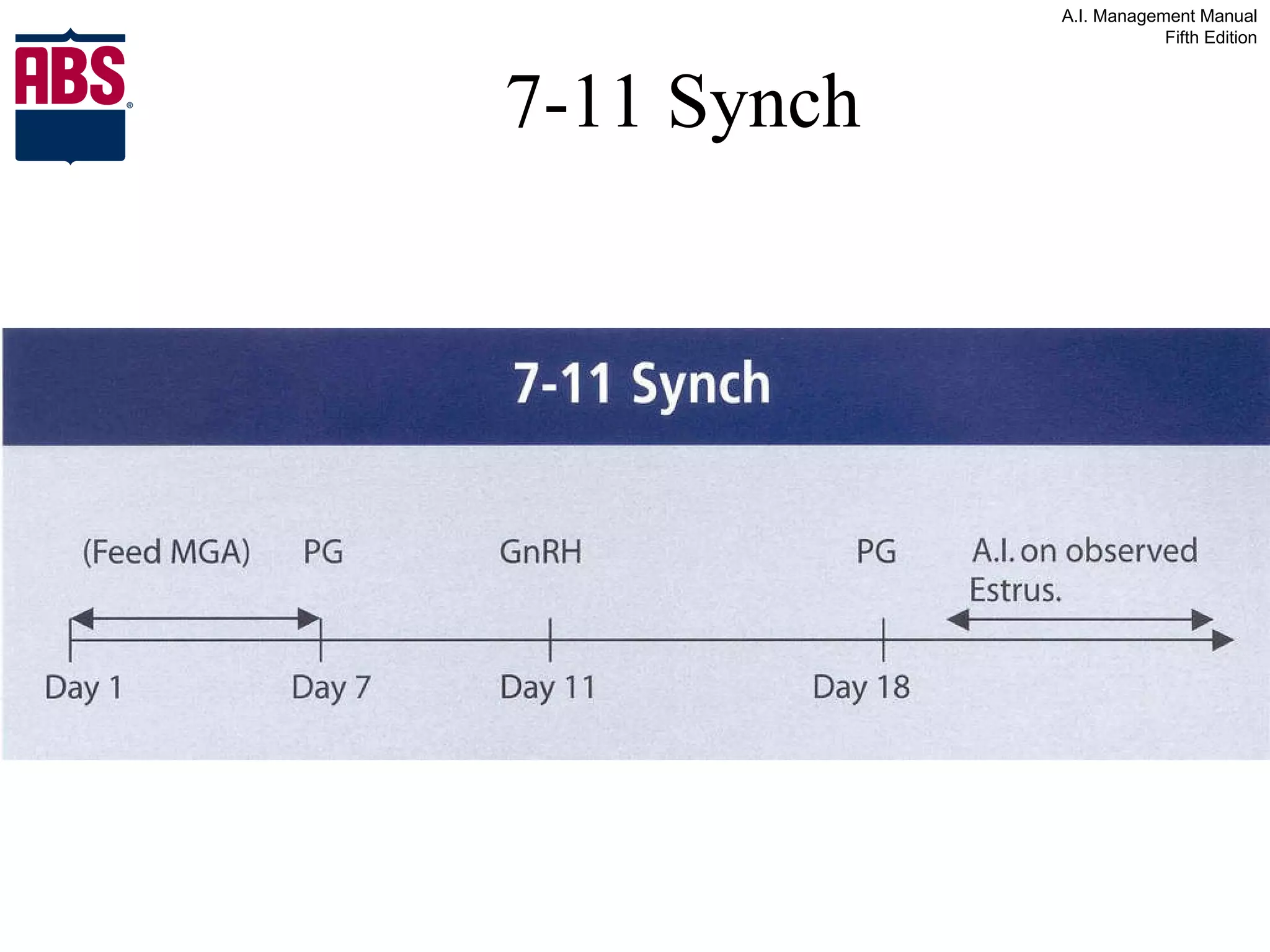
7-11 Synch
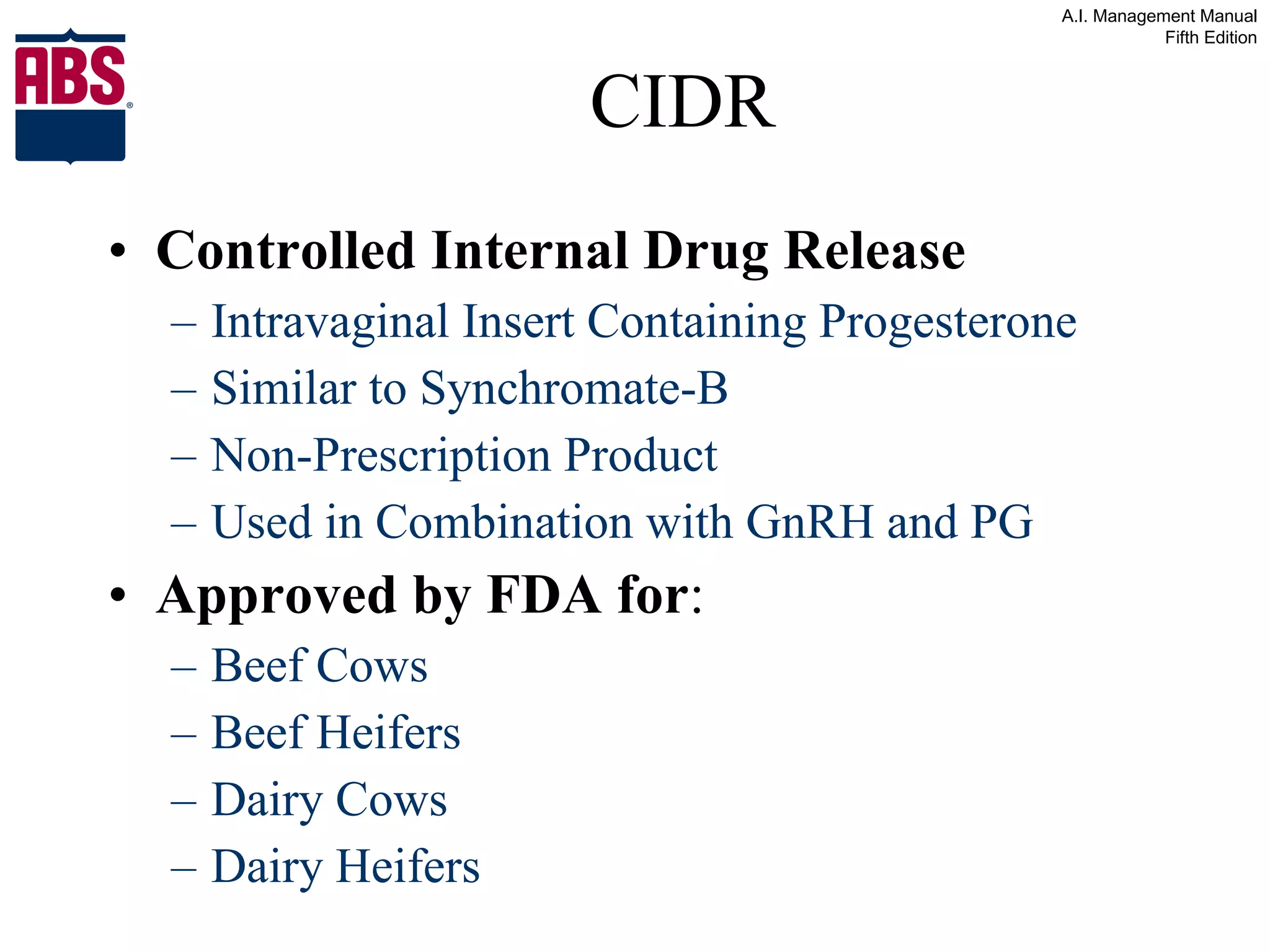
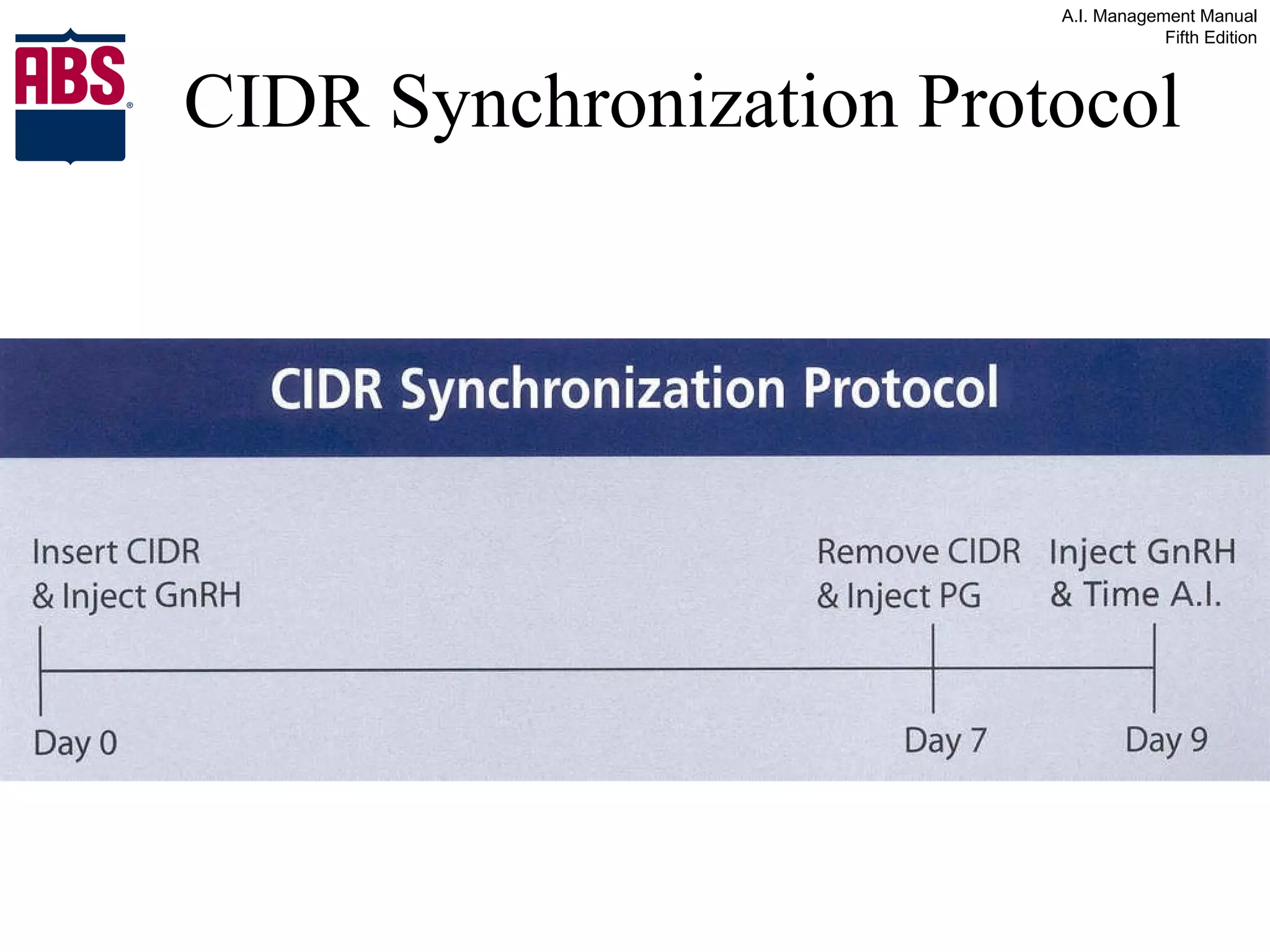
CIDR Controlled Internal Drug Release Intravaginal Insert Containing Progesterone Similar to Synchromate-B Non-Prescription Product Used in Combination with GnRH and PG Approved by FDA for : Beef Cows Beef Heifers Dairy Cows Dairy Heifers
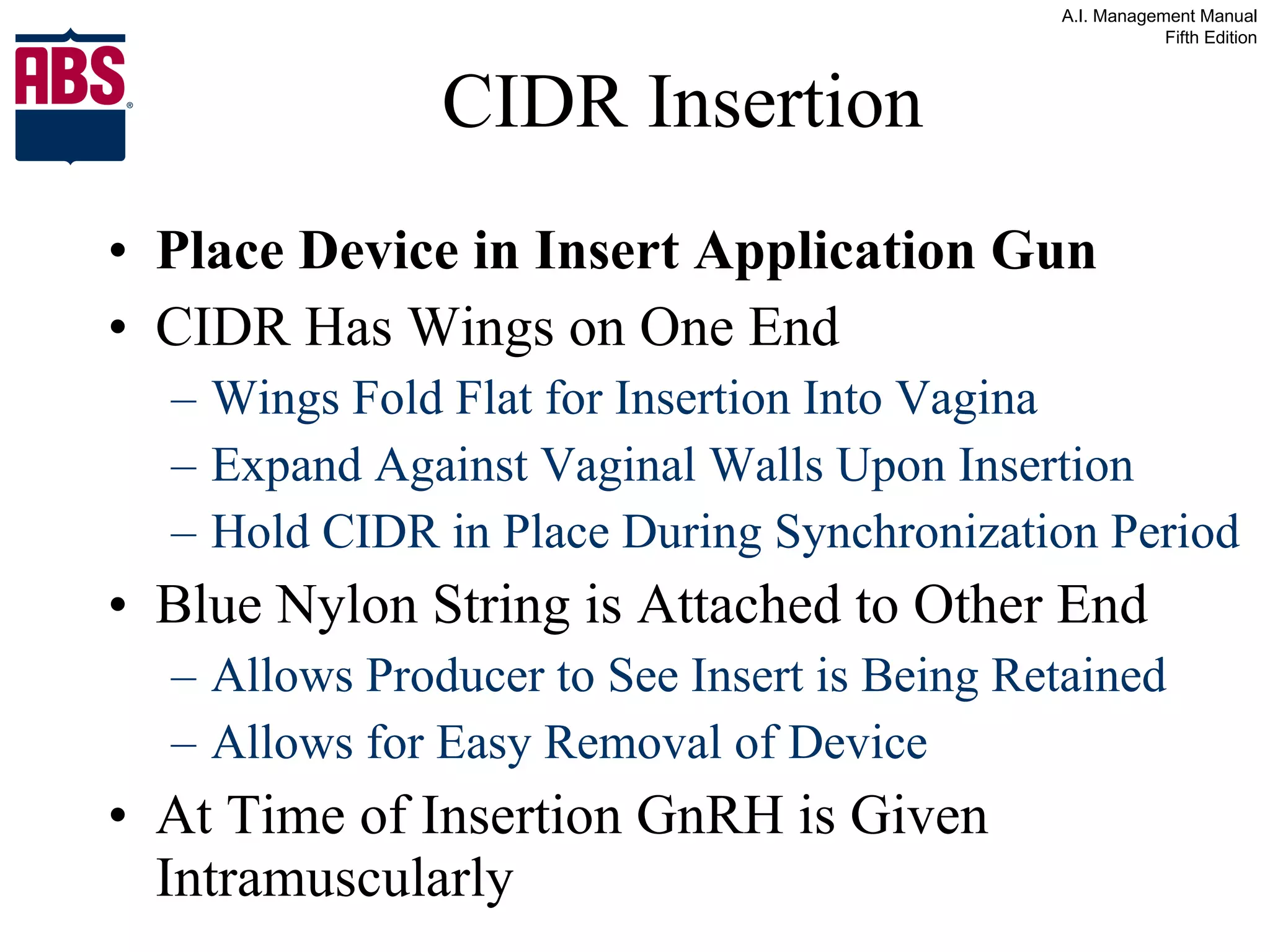
CIDR Insertion Place Device in Insert Application Gun CIDR Has Wings on One End Wings Fold Flat for Insertion Into Vagina Expand Against Vaginal Walls Upon Insertion Hold CIDR in Place During Synchronization Period Blue Nylon String is Attached to Other End Allows Producer to See Insert is Being Retained Allows for Easy Removal of Device At Time of Insertion GnRH is Given Intramuscularly
CIDR Synchronization Protocol
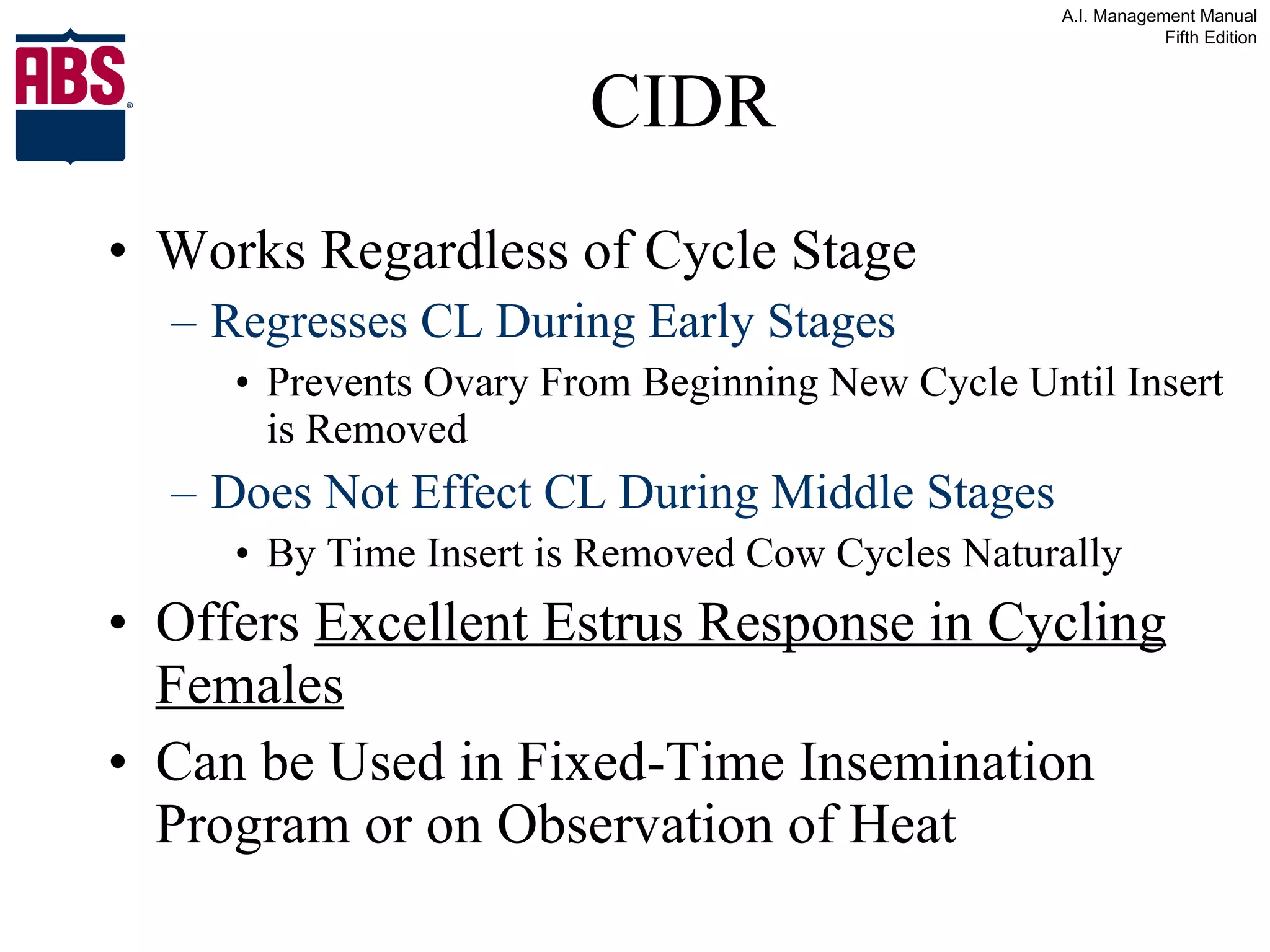
CIDR Works Regardless of Cycle Stage Regresses CL During Early Stages Prevents Ovary From Beginning New Cycle Until Insert is Removed Does Not Effect CL During Middle Stages By Time Insert is Removed Cow Cycles Naturally Offers  Excellent Estrus Response in Cycling Females Can be Used in Fixed-Time Insemination Program or on Observation of Heat
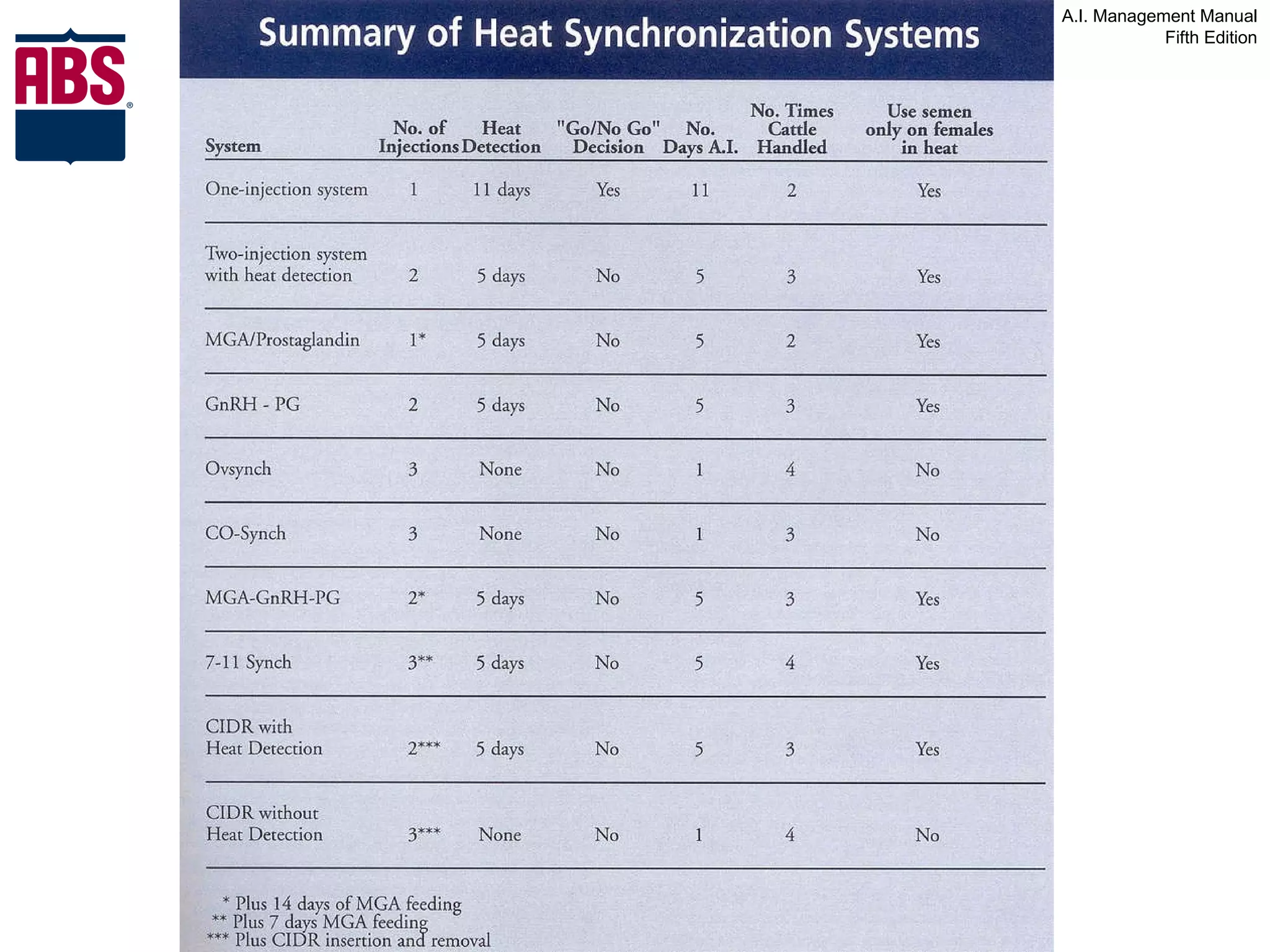
Summary of  Systems
Common Misconceptions: Synchronization Protocols Discussed are Not Miracle Drugs Base Your Program on Realistic Expectations Most Misconceptions Occur From Misinformation About What Drugs Can and Cannot Do
Misconception 1 You Can Breed Cows Earlier After Calving Prostaglandin Does Not Cause  Cows to Come Into Heat Sooner After Calving Cows Must Go Through a Normal Recovery Period and  Begin Cycling  Before Drugs Will be Effective
Misconception 2 You Can Automatically Shorten the Calving Season Unless Strict Culling Practices are Utilized, Late Calvers Will ALWAYS be Late Calvers They Will Not Cycle in Time to be Included in Heat Synch Programs Will Concentrate More Cows at Beginning of Breeding Season for Eligible Cows More Closely Groups Calving Period
Misconception 3 You Won’t Have to Heat Detect Only Works When You Select a Fixed-Time Insemination Program Most Protocols Rely on Inseminating on Detection of Heat Fixed Time Programs Should Only be Used When You are Confident Most Females are in Heat Heat Detecting Helps Spot Animals Who: Come Into Heat Early Come Into Heat Late Are Not Cycling
Misconception 4 By Breeding Cows in a Short Interval, They Will Calve in an Equally Short Interval This is Incorrect Cattle Inseminated on the Same Day Have a Calving Range of  +  10 Days From the Calving Due Date
Which System for Your Operation? Determine Potential Results and Costs Use Feasibility Worksheets to Help Select Best System for Your Situation Advantages and Tradeoffs Must be Weighed in Terms of: Program Cost Time  Facilities Labor Requirements
Management Considerations Several Factors Influence the Outcome of Heat Synchronization  Conditions Affecting Cycling Heat Detection Labor Needs During Insemination Facilities Identification Calving
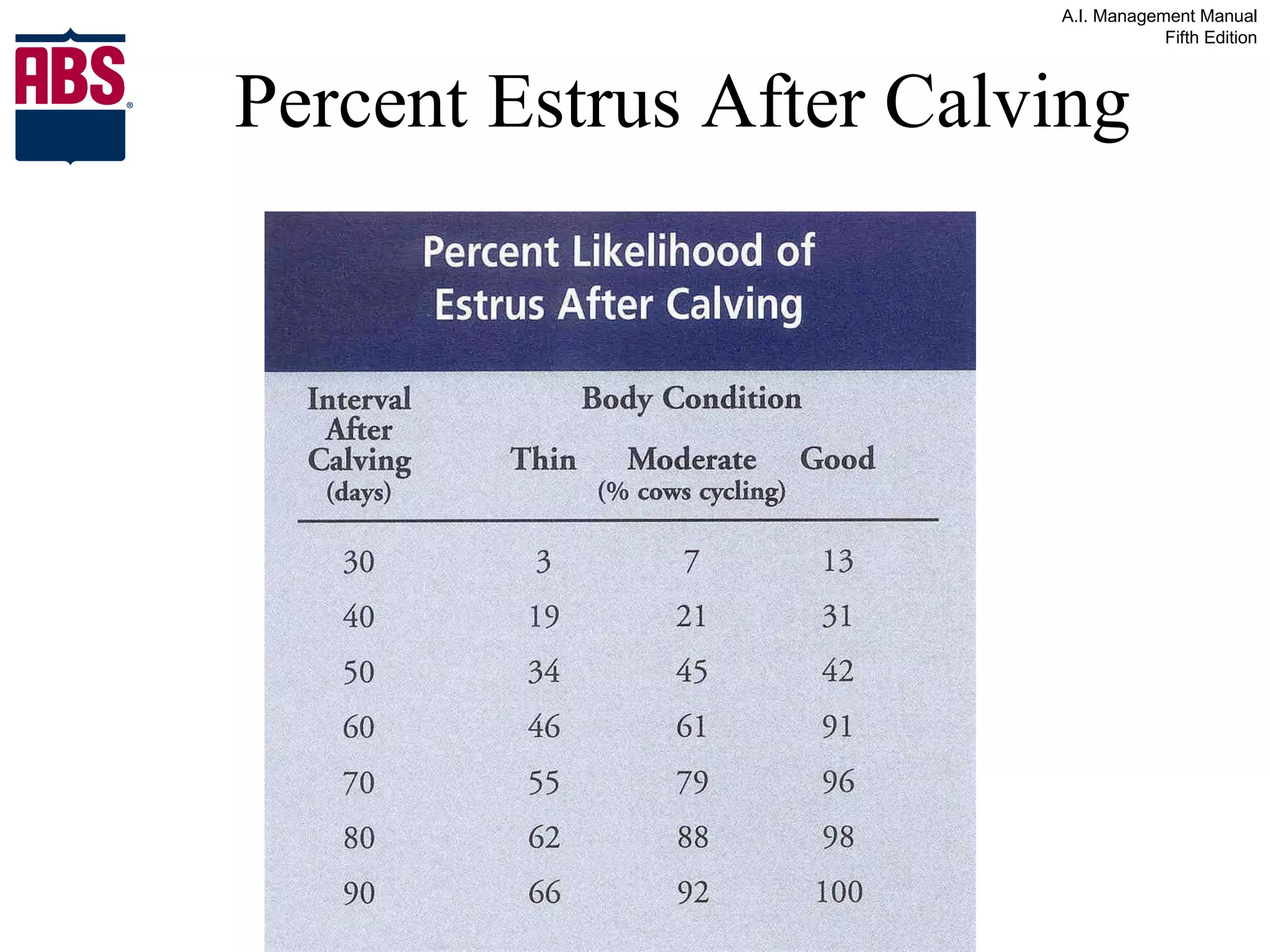
Conditions Affecting Cycling Beef Cows Affected by Two Factors Rest After Calving  Body Condition at Calving The Better the Body Condition Score and the Longer After Calving the More Likely to Enter Heat Proper Nutrition After Calving is Important as Nutrient Requirements Double While Nursing
Percent Estrus After Calving
Conditions Affecting Cycling Beef First Calf Heifers Take Longer to Begin Cycling Than Cows Nutritional Intake Must Support Their Growth and Milk Production for Calf Good Nutrition Can Shorten Recovery Time Need Special Attention to Improve Cycling Rate Separate Heifers From Cows Several Months Before Calving Feed so in Moderate to Good Condition As Virgin Heifers, Inseminate 2 to 3 Weeks Before Older Cows
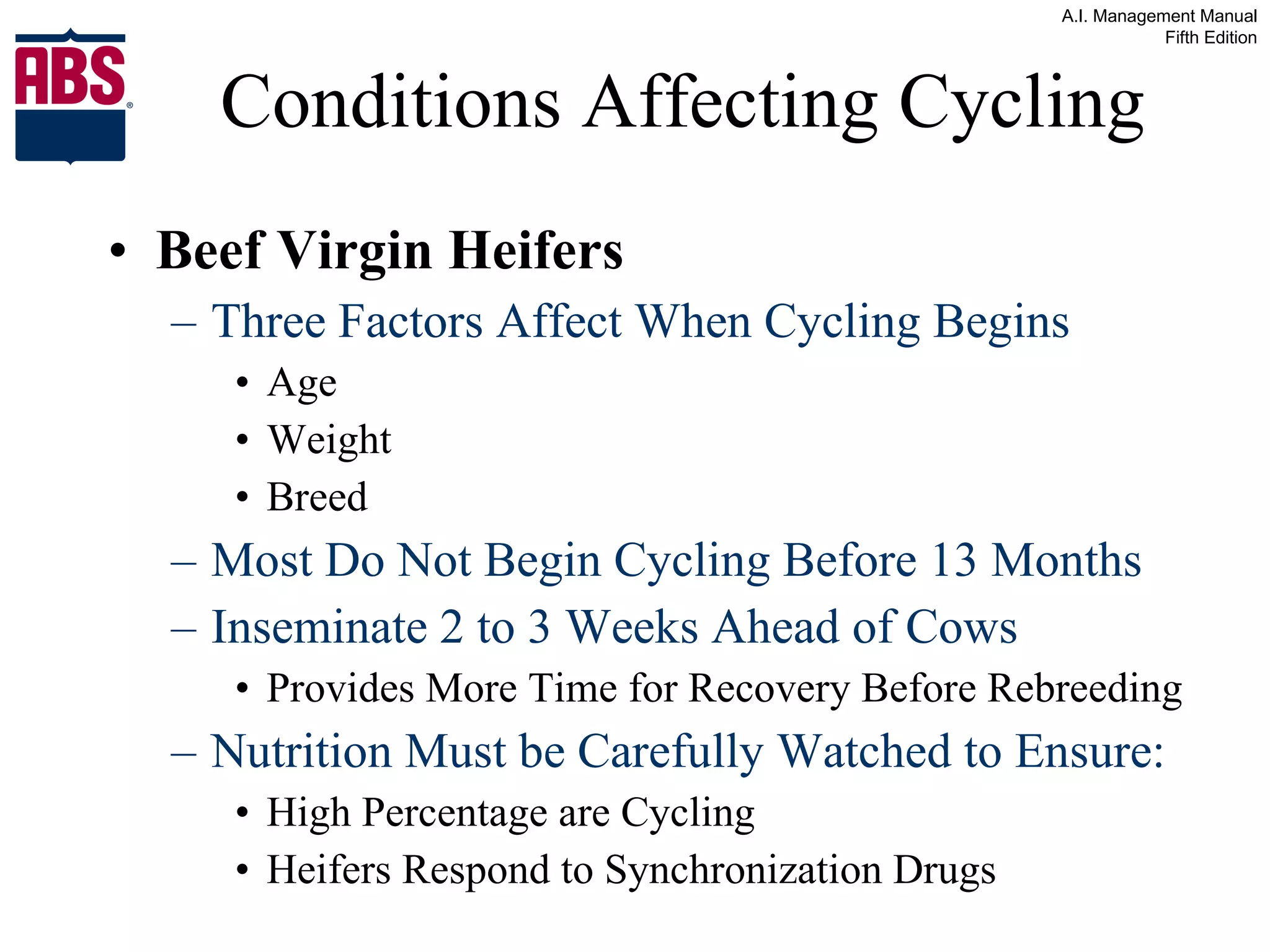
Conditions Affecting Cycling Beef Virgin Heifers Three Factors Affect When Cycling Begins Age Weight Breed Most Do Not Begin Cycling Before 13 Months Inseminate 2 to 3 Weeks Ahead of Cows Provides More Time for Recovery Before Rebreeding Nutrition Must be Carefully Watched to Ensure: High Percentage are Cycling  Heifers Respond to Synchronization Drugs
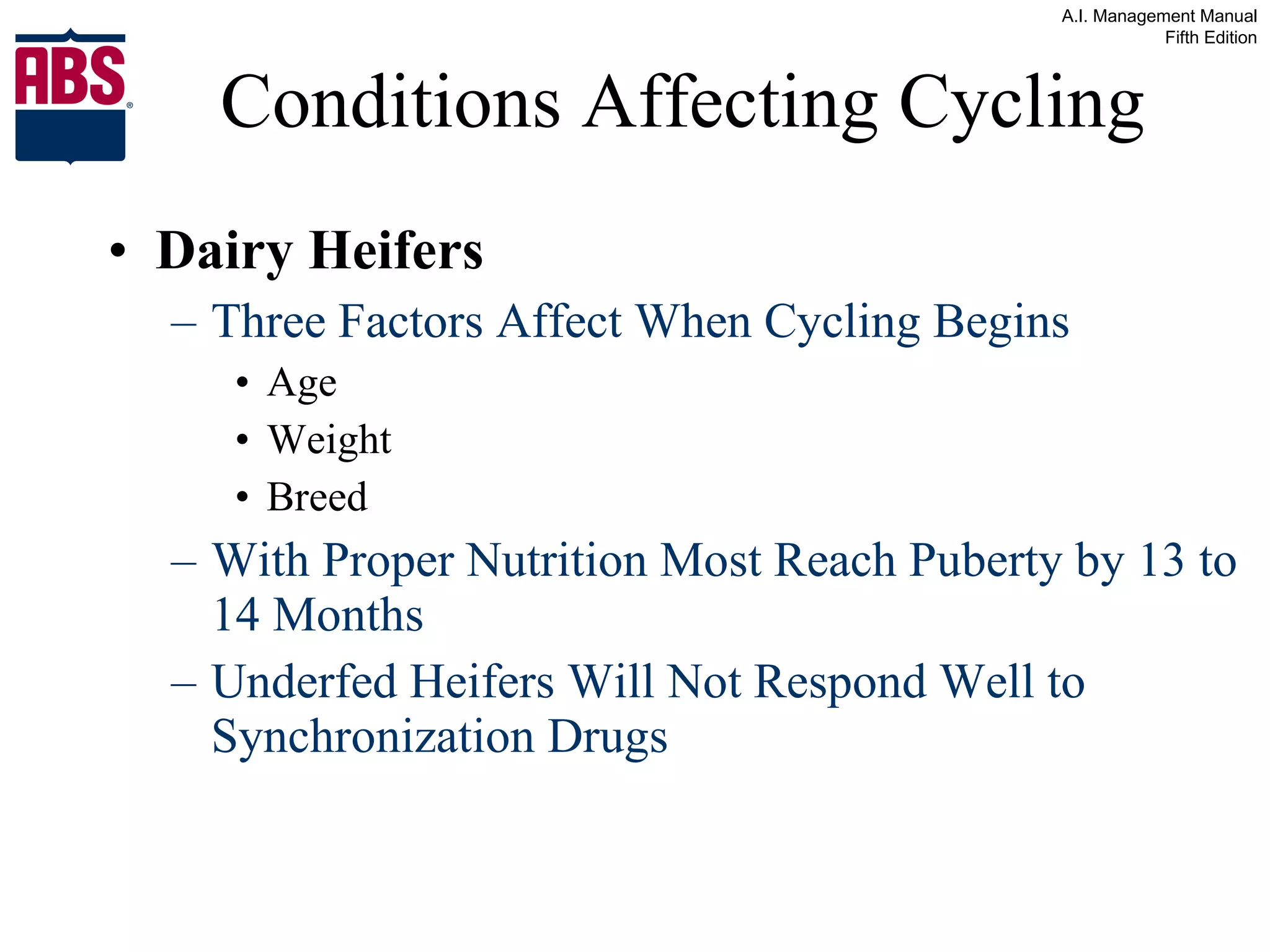
Conditions Affecting Cycling Dairy Heifers Three Factors Affect When Cycling Begins Age Weight Breed With Proper Nutrition Most Reach Puberty by 13 to 14 Months Underfed Heifers Will Not Respond Well to Synchronization Drugs
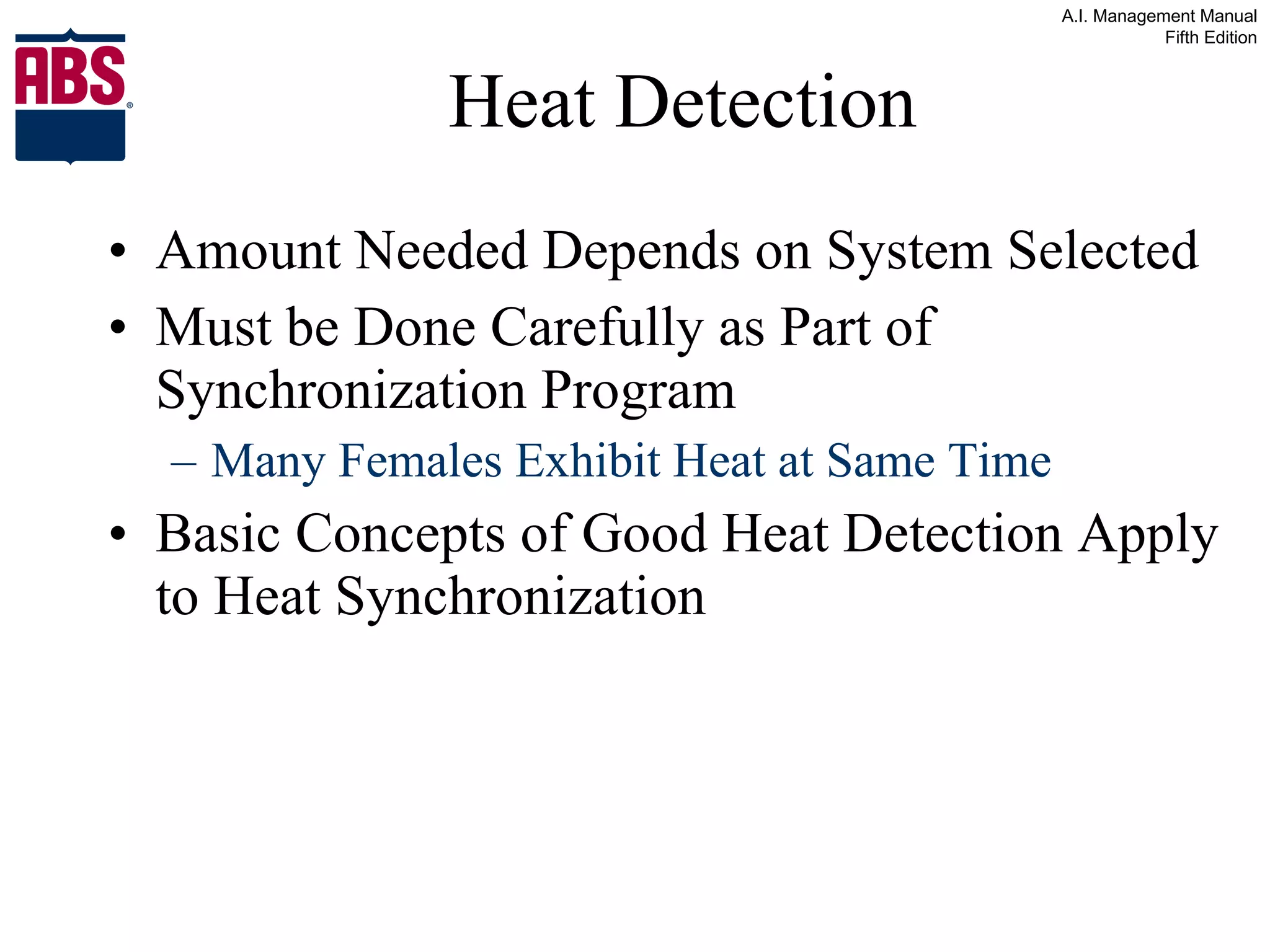
Heat Detection Amount Needed Depends on System Selected Must be Done Carefully as Part of Synchronization Program Many Females Exhibit Heat at Same Time Basic Concepts of Good Heat Detection Apply to Heat Synchronization
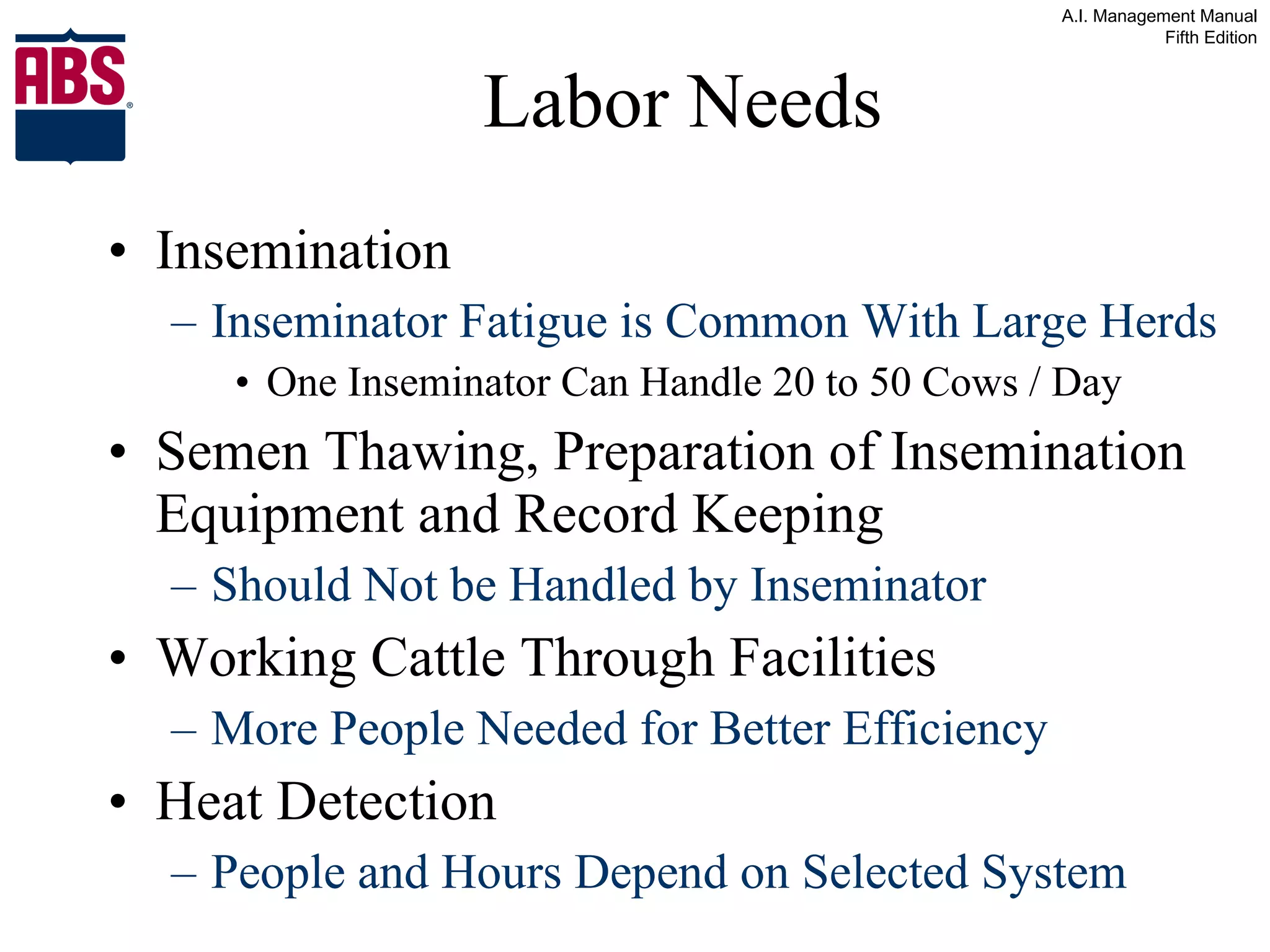
Labor Needs Insemination Inseminator Fatigue is Common With Large Herds One Inseminator Can Handle 20 to 50 Cows / Day Semen Thawing, Preparation of Insemination Equipment and Record Keeping Should Not be Handled by Inseminator Working Cattle Through Facilities More People Needed for Better Efficiency Heat Detection People and Hours Depend on Selected System
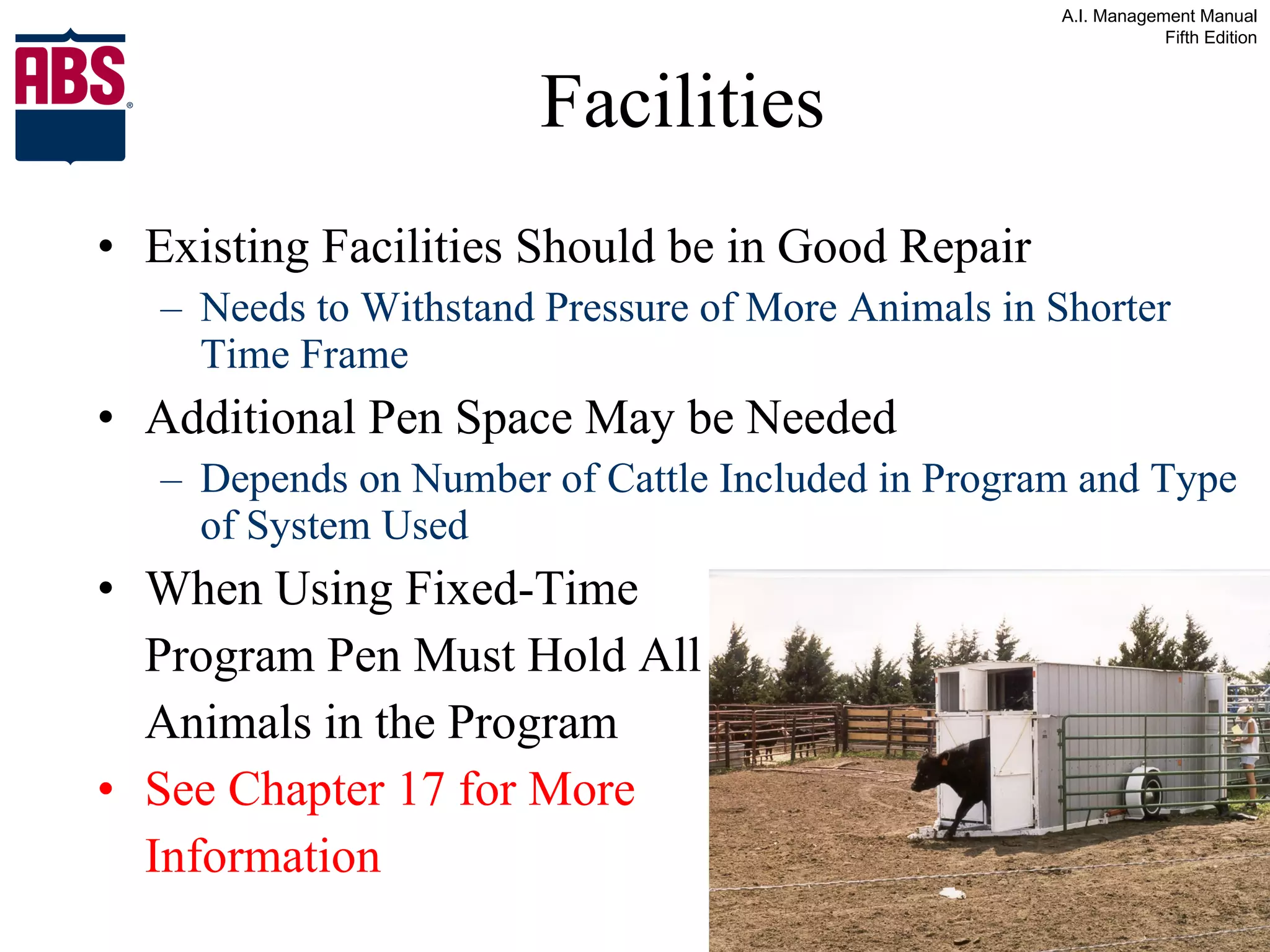
Existing Facilities Should be in Good Repair Needs to Withstand Pressure of More Animals in Shorter Time Frame Additional Pen Space May be Needed Depends on Number of Cattle Included in Program and Type of System Used When Using Fixed-Time  Program Pen Must Hold All Animals in the Program See Chapter 17 for More  Information Facilities
Identification Good Identification Helps any Program Using Heat Detection Essential to Get Maximum Value From A.I. Program See Chapter 6 for More Information
Calving Period Planned Breeding Programs Result in a Shorter Calving Period Helps Herd Owners Closely Observe Calving and Assist With Difficult Births Does Not Mean All Cows Will Calve in 2 to 3 Days Calving Generally Spans 20 Days Around Calving Due Date
Summary Heat Synchronization Controls When Groups of Normally Cycling Females Come Into Heat Heat Cycle: Day 1:  Estrus (Heat) Days 2 to 4/5:  Female Developing Corpus Luteum Days 6 to 17:  CL Fully Developed Days 17 to 18-21:  CL Regresses Prostaglandin Injections Can be Used on All Females
Summary Choose a System That Fits Your Operations Needs for: Calving Times Financial Resources Labor Resources Operation Resources Available Labor Facilities Pastures Feeds
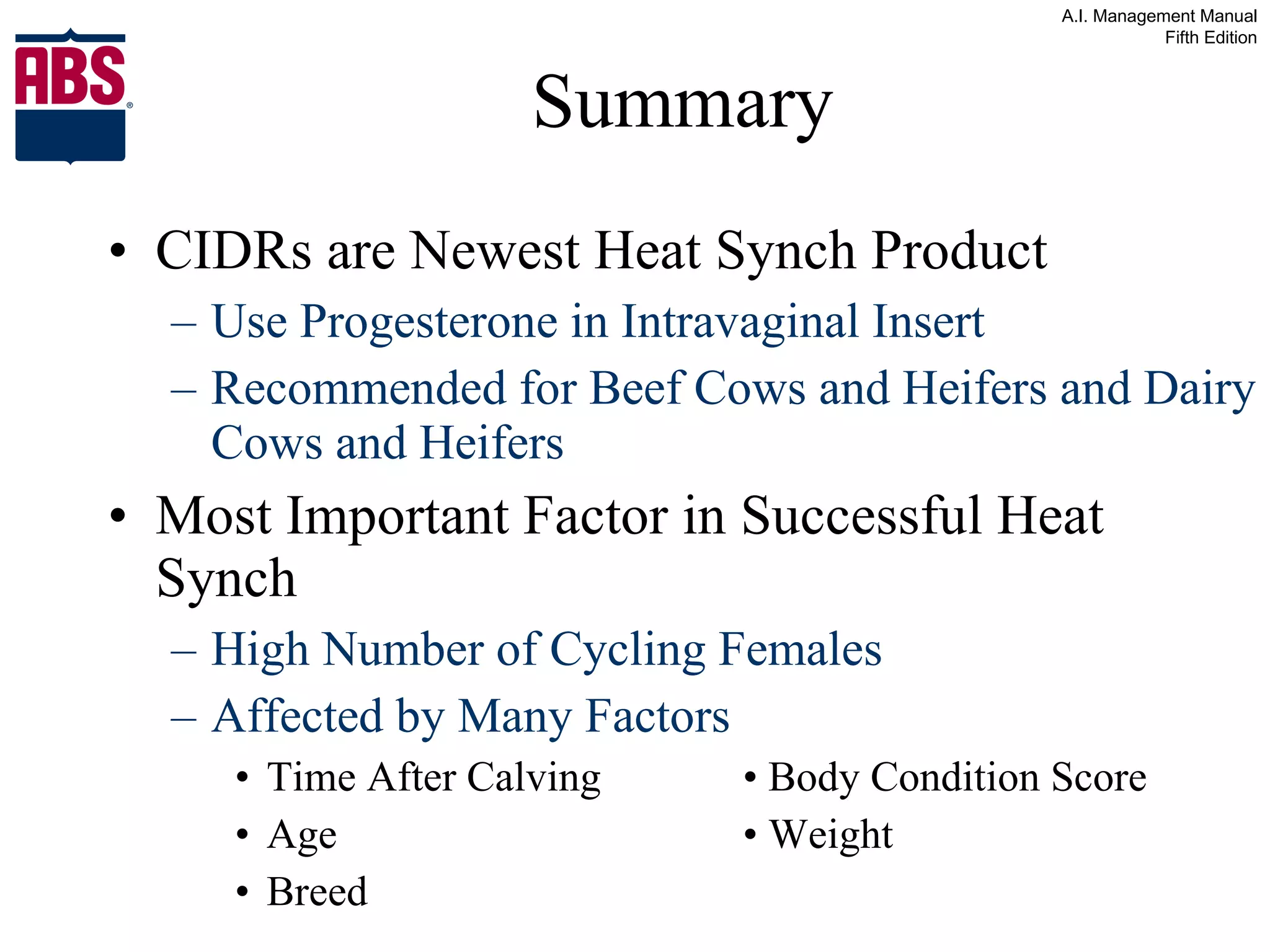
Summary CIDRs are Newest Heat Synch Product Use Progesterone in Intravaginal Insert Recommended for Beef Cows and Heifers and Dairy Cows and Heifers Most Important Factor in Successful Heat Synch High Number of Cycling Females Affected by Many Factors Time After Calving • Body Condition Score Age • Weight Breed
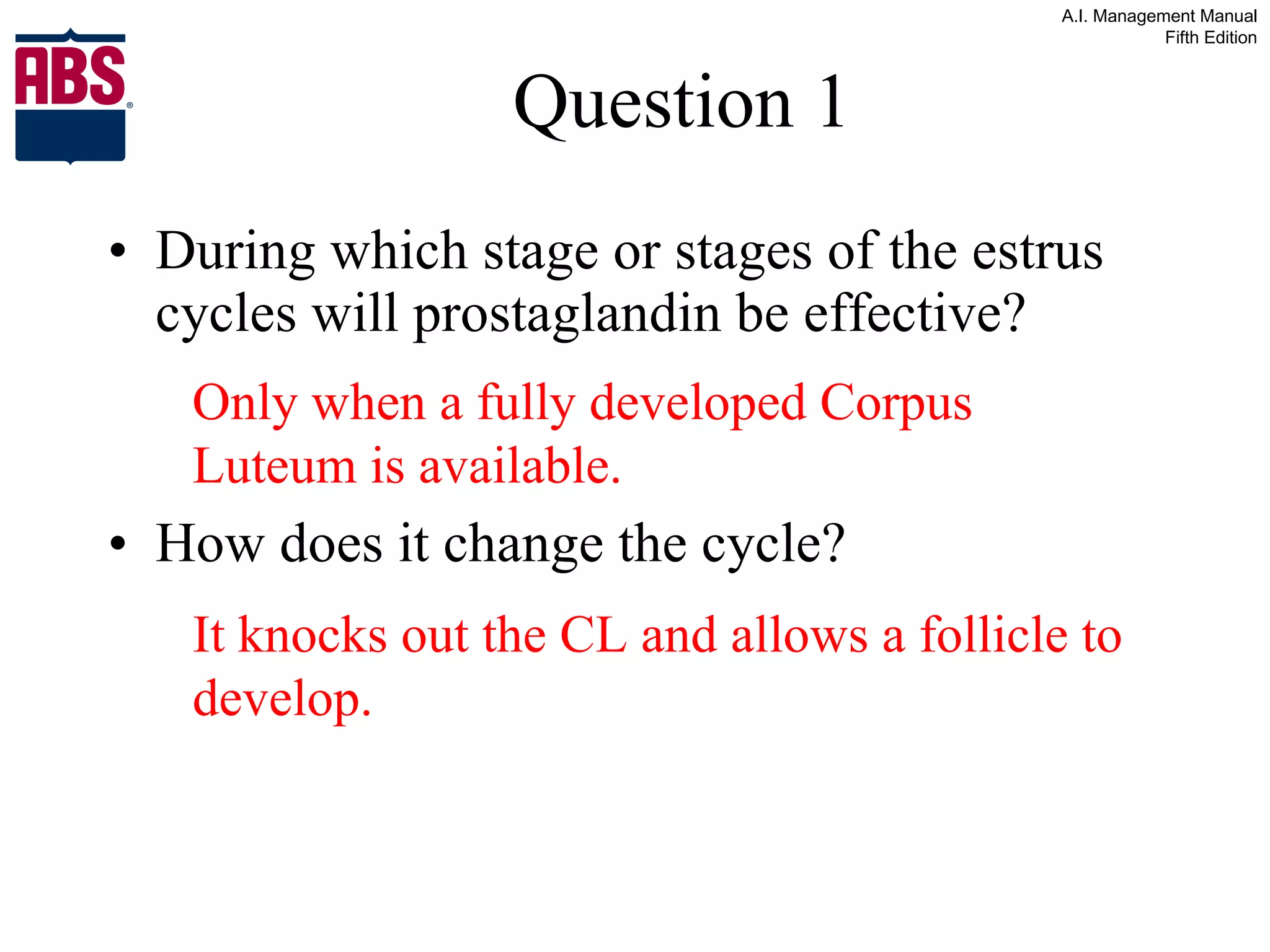
Question 1 During which stage or stages of the estrus cycles will prostaglandin be effective? How does it change the cycle? Only when a fully developed Corpus Luteum is available. It knocks out the CL and allows a follicle to develop.
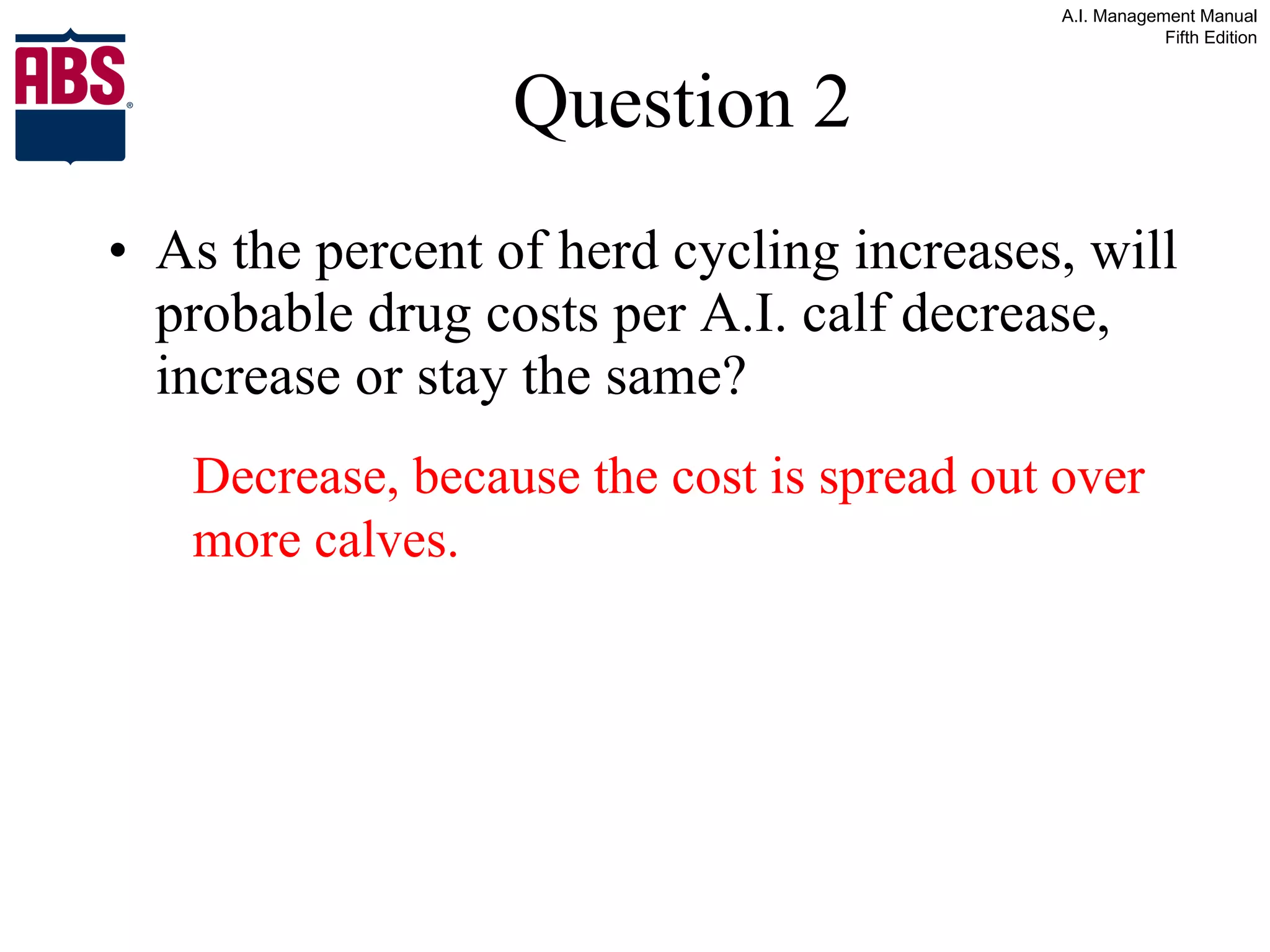
Question 2 As the percent of herd cycling increases, will probable drug costs per A.I. calf decrease, increase or stay the same? Decrease, because the cost is spread out over more calves.
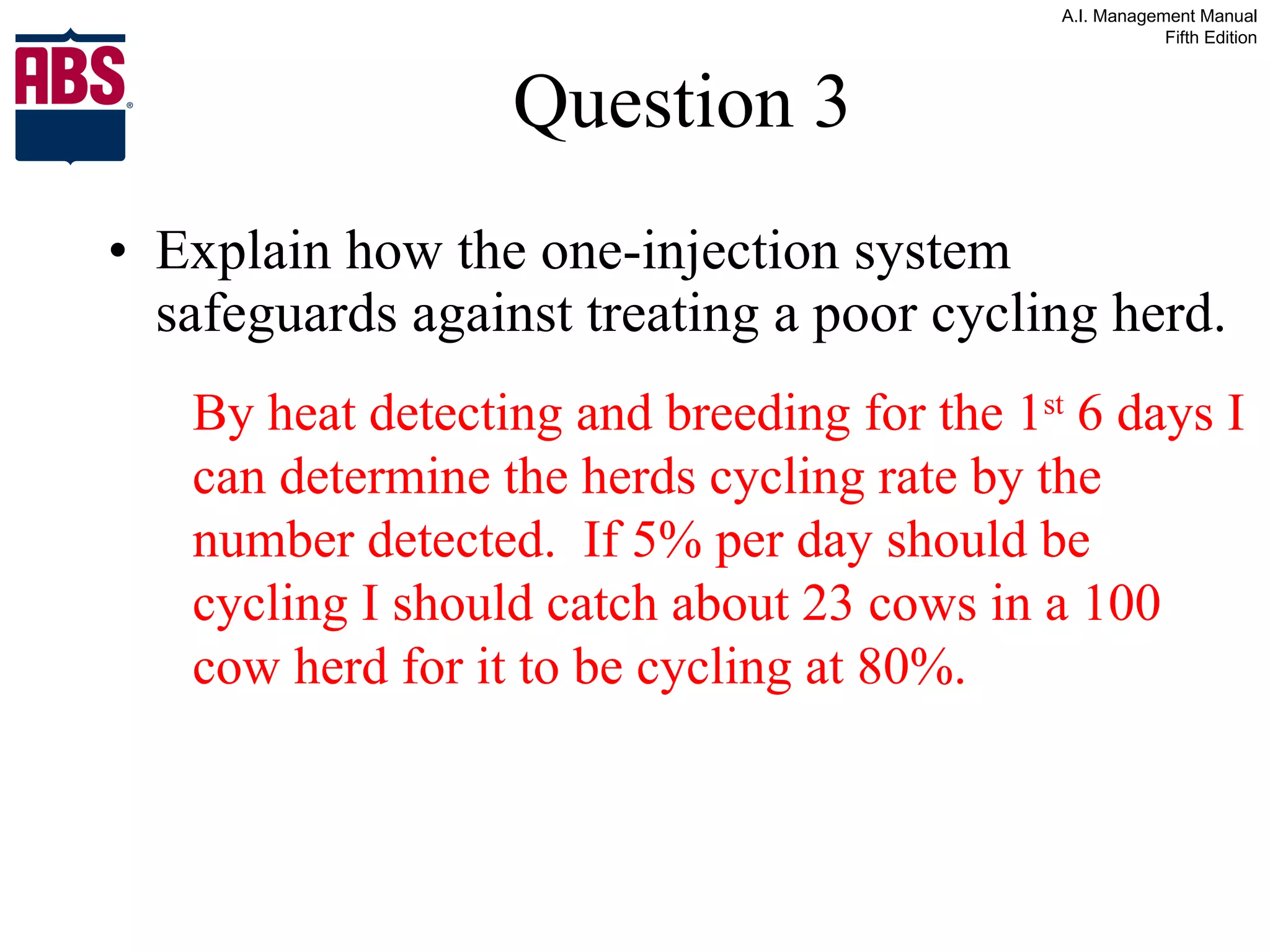
Question 3 Explain how the one-injection system safeguards against treating a poor cycling herd. By heat detecting and breeding for the 1 st  6 days I can determine the herds cycling rate by the number detected.  If 5% per day should be cycling I should catch about 23 cows in a 100 cow herd for it to be cycling at 80%.
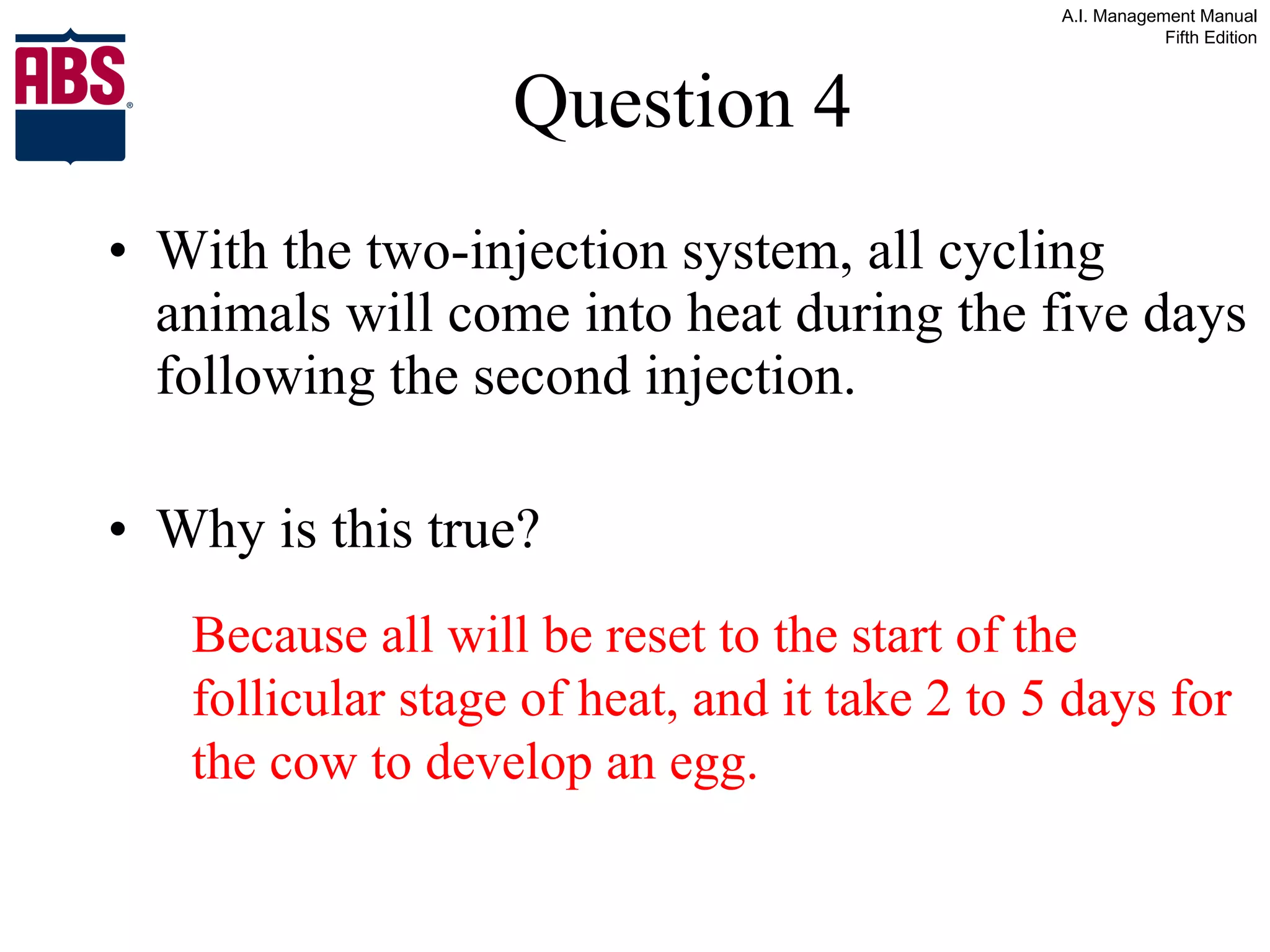
Question 4 With the two-injection system, all cycling animals will come into heat during the five days following the second injection. Why is this true? Because all will be reset to the start of the follicular stage of heat, and it take 2 to 5 days for the cow to develop an egg.
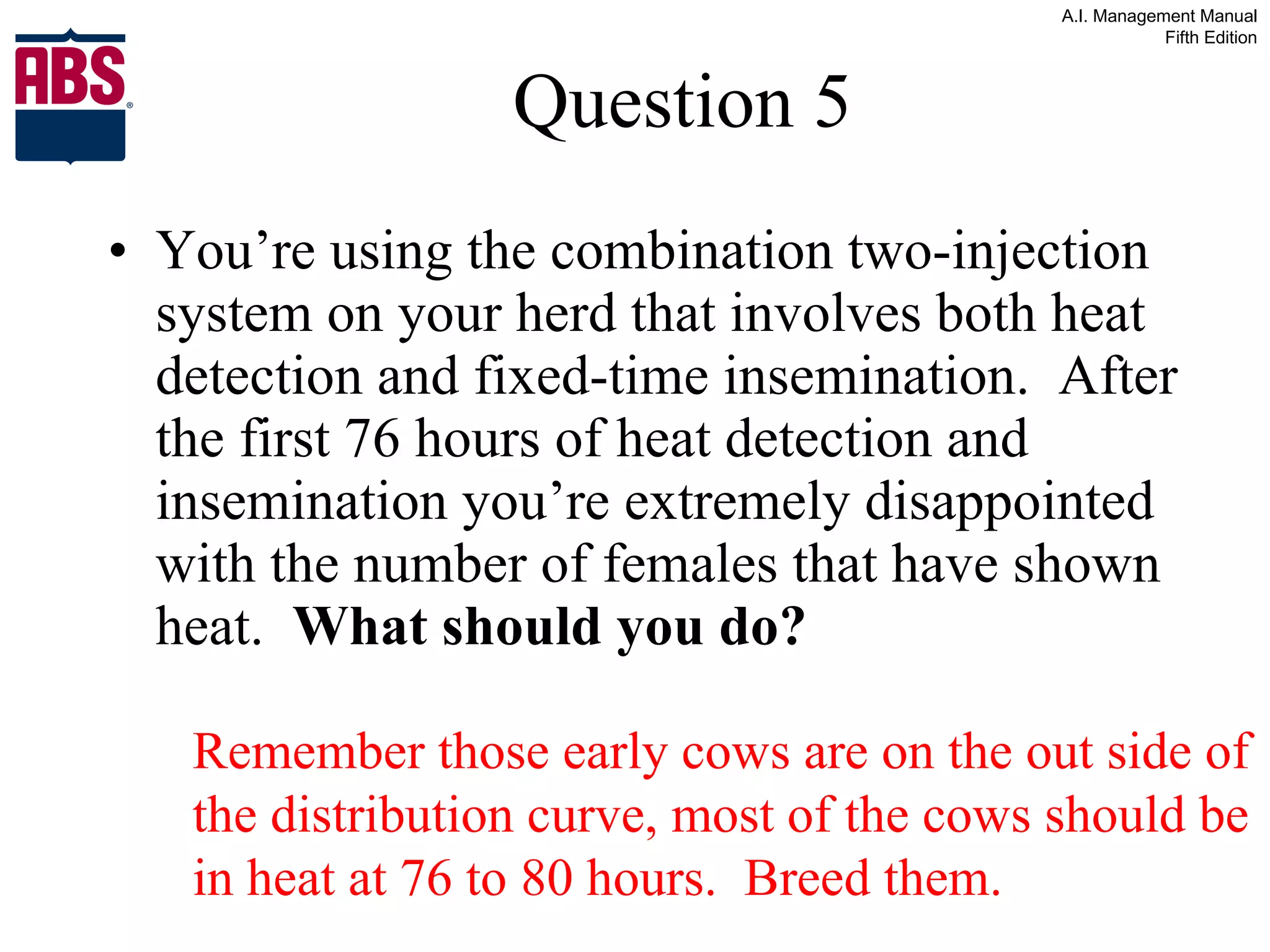
Question 5 You’re using the combination two-injection system on your herd that involves both heat detection and fixed-time insemination.  After the first 76 hours of heat detection and insemination you’re extremely disappointed with the number of females that have shown heat.  What should you do? Remember those early cows are on the out side of the distribution curve, most of the cows should be in heat at 76 to 80 hours.  Breed them.
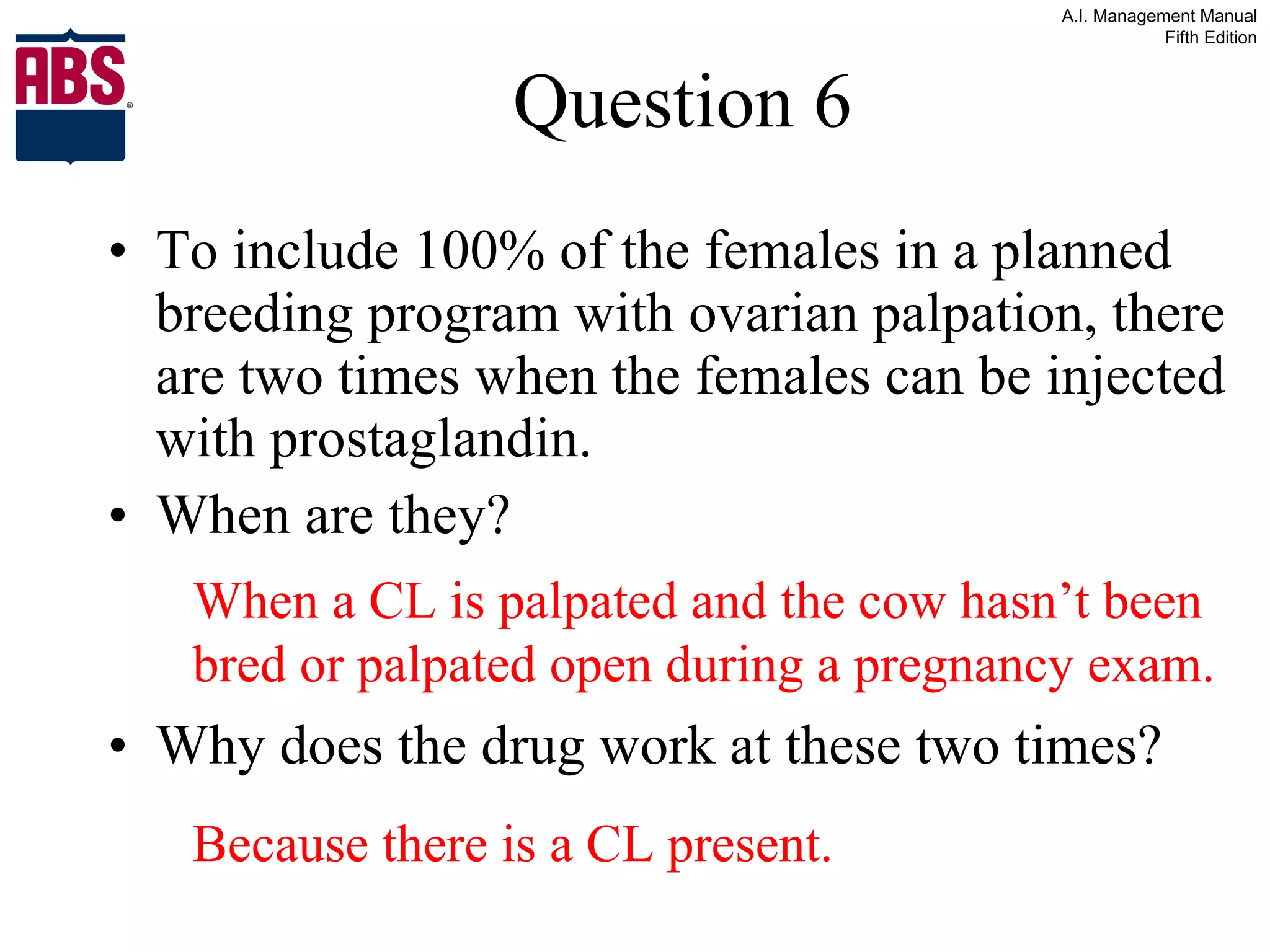
Question 6 To include 100% of the females in a planned breeding program with ovarian palpation, there are two times when the females can be injected with prostaglandin. When are they?  Why does the drug work at these two times? When a CL is palpated and the cow hasn’t been bred or palpated open during a pregnancy exam. Because there is a CL present.
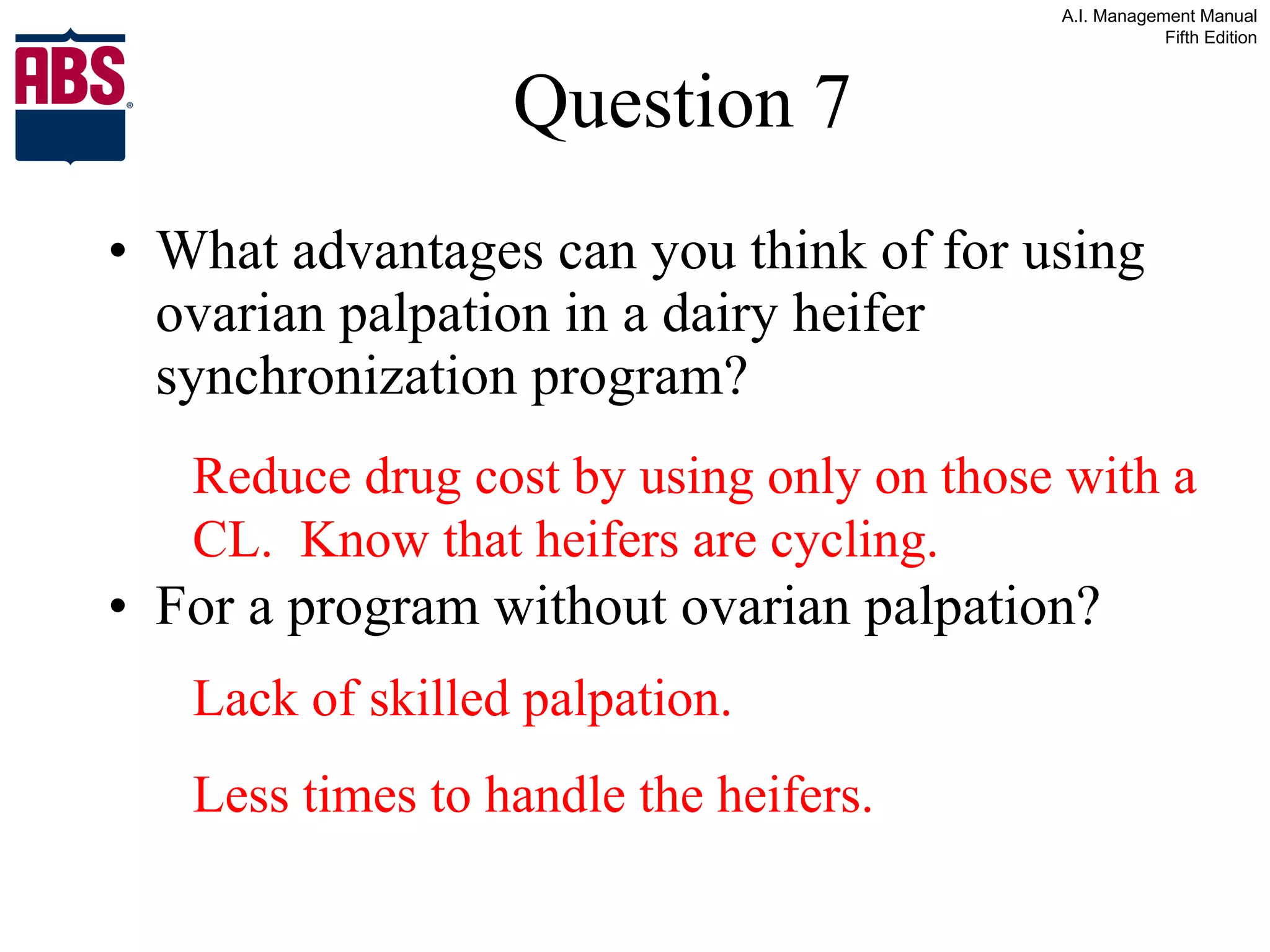
Question 7 What advantages can you think of for using ovarian palpation in a dairy heifer synchronization program? For a program without ovarian palpation? Lack of skilled palpation. Less times to handle the heifers. Reduce drug cost by using only on those with a CL.  Know that heifers are cycling.
Question 8 What is the purpose of the CIDR implant? It stops follicle development until removed.
Question 9 Why can the CIDR insert be used to synchronize estrus without regard to previous stage of estrus cycle? Because it suspends those with a CL present and allows those with follicles developing to catch up.  Putting the entire group in the same stage of  the estrus cycle.
Question 10 Say, for example, your cows were in good condition at calving.  You want to run a synchronization program, but you want to be sure at least 90% of them are cycling before beginning.  How many days after the last cow calved should you wait before inseminating? What if your cows were in moderate condition after calving? 60 days 80 days

Ai manual chapter 03 sychronization

  • 1.
  • 2.
    Heat Synchronization ControlsWhen Groups of Normally Cycling Females Come Into Heat and Ovulate Benefits to Producers Beef: A.I. Becomes Easier and More Timely Dairy: Planned Breeding is Possible for Heifers Requires Top Management of Cattle and Conditions Affecting Cycling Choose the System That Best Fits Your Situation Consider Your Goals, Labor Requirements, Time and Program Cost
  • 3.
    Benefits of SynchronizationOpportunity to Control Group Timing of Heat Facilitates A.I. for Faster Genetic Improvement Days Needed for A.I. Can be Significantly Shortened Time Spent on Heat Detection Can be Considerably Reduced or Eliminated Scheduling Labor is Simplified Because of the Concentrated Period of Heat Detection and A.I.
  • 4.
    Additional Advantages forBeef: More Profitable Beef Calves are Produced Cattle Can be Group Inseminated at Start of Breeding Season More Calves Born Early in Calving Season Calves are Older and Heavier at Weaning and Replacement Females will be Older and Heavier at 1st Breeding Calves Will be More Uniform Due to Similar Inheritance and Age
  • 5.
    Additional Advantages forBeef: Greater Opportunity to Get More Females Pregnant During the Breeding Season Estrus Cycles are Advanced High Percentage of Cycling Cows Come Into Heat at Beginning of Breeding Season Have Two Chances to Get Female Pregnant During a 21-25 Day Insemination Period Continued Use Over Several Years Helps Shorten Calving Season Strict Culling of Late Calving Cows Must be Practiced
  • 6.
    Additional Advantages forDairy: Convenient Way to Include Heifers in an A.I. Program Improve Management by Inseminating at a Predetermined Date Know Calving Due Dates, and Incorporate Them in Plans Allows for Closer Control of Calving Time Milk Base Can be Increased at Specific Time More Show Calves of Optimum Age Can be Produced, or Cattle Can Fit Show Dates Better
  • 7.
    Understanding the EstrusCycle: Estrus and Ovulation Can be Controlled Administer Prostaglandin, Progesterone, or Gonadotropins to Cycling Females Cycling = Females Coming Into Heat Regularly Prior to Treatment Corpus Luteum Develops in Ovary at Ovulation Site Corpus Luteum Produces Progesterone Prepares Uterus for Pregnancy If NOT Pregnant CL Starts regressing 18 days Into the Cycle and a New Egg-Containing Follicle Begins
  • 8.
  • 9.
    Follicular Wave Dynamics:Estrus Cycle Follicular Growth Occurs in Waves and Throughout the Length of the Cycle Individual Waves are Characterized by Rapid Growth of Many Small Follicles Bovine Females are Born With All the Eggs They Will Ever Have Approximately 75,000 for Normal Females Eggs are Contained in Follicles Residing Deep in the Ovarian Tissue
  • 10.
    Follicular Wave Dynamics:At Puberty Eggs Start Growing Into Mature Follicles Have Potential to Ovulate and Release an Egg Most Females Have 2 or 3 Waves of Growth At Start of Each Wave 200-600 Eggs are Recruited for Growth One Follicle is Selected Becomes the Dominant Follicle Has the Ability to Restrict Growth of Other Follicles
  • 11.
    Follicular Wave Dynamics:Follicular Waves Occurring During Early to Mid-Estrus Cycle Dominant Follicle and Subordinate Follicles Become Atretic, or Die Waves Occurring Toward End of Estrus Cycle Dominant Follicle Fully Develops and Ovulates
  • 12.
    Follicular Wave Dynamics:Cows That Experience Two Follicular Waves Initiate First Wave at Day 0 and Last Until Day 10 Dominant and Subordinate Follicles Die or Degenerate Second Wave is Immediately Initiated Produces New Dominant Follicle Follicle Survives to the End and Ovulates Cows That Experience Three Follicular Waves Waves Last an Average of 8 Days Each Third Wave Develops the Dominant Follicle to Ovulation
  • 13.
  • 14.
  • 15.
    Drugs That Alterthe Estrus Cycle: Prostaglandin Naturally Occurring Compound Essential in Normal Regulation of Reproductive Cycle Intramuscular Injection, Prescribed Only by Vets New Needles Prevent Possible Disease Transfer Correct Amount is Necessary for Proper Results Can be Used on All Non-Pregnant, Cycling Females Can Cause Abortion if Used on Pregnant Cows or Heifers
  • 16.
    Drugs that alterthe estrus cycle: Prostaglandin Affects Developed Corpus Luteum Causes Premature Regression When Administered During Days 6-17 in Estrus Cycle Early in Cycle (Days 1-5) and Late in the Cycle (Days 18-21) Has No Effect Animals Should Come Into Heat at Same Time as Treated
  • 17.
    Using Prostaglandin onBeef Percent Cycling Females is Most Important Factor in Success of Synchronization Programs Only Effective on Regularly Cycling Females Heifers Must Have Ovulated Once Before Treatment Cows Must be Ovulating Following Calving Will Not Cause a Female to Begin Cycling Minimize Drug Costs by Recognizing Cycling Can Determine Through Ovarian Palpation May Save Drug Cost, but Adds Labor Cost for Palpating
  • 18.
  • 19.
  • 20.
  • 21.
  • 22.
  • 23.
    Using Prostaglandin onDairy The Systems Described for Beef Can be Used for Dairy Planned Breeding Programs Use Prostaglandin in Dairy Synchronization Programs Not all Prostaglandin Products Have Been Cleared for Use on Milking Females Check Label Before Use
  • 24.
    Targeted Breeding PreparesCows for Rebreeding Improves Pregnancy Rates in First 21 Days After Breeding Commences Ideal Time for Getting Cows Pregnant
  • 25.
    Targeted Breeding Howit Works: 17 Days Before VWP Ends Cows Receive First Injection of Prostaglandin Known as a Set-up Shot Don’t Breed Cows on Next Detected Heat 2 Weeks Later Cows Receive Second Injection of Prostaglandin Known as Breeding Shot Should Bring Almost All Cows Into Estrus Inseminate Cows on Standing Heat Non-Inseminated Cows are Injected 14 Days Later Along With New Cows Ready for Set-up Shot
  • 26.
    Planned Breeding UsingOvarian Palpation Vet Can Determine if Corpus Luteum is Present Age of CL Affects Time Required Before Female Returns to Heat Risky to Use in Timed Breeding Program Heat Detection is Best Method Used by Many Vets When Cows Palpated Open During Pregnancy Examinations
  • 27.
    Planned Breeding WithoutUsing Ovarian Palpation Allows Producers to Eliminate Short Calving Intervals Aids Heat Detection Problems Identifies Problem Cows for Early Veterinary Treatment
  • 28.
  • 29.
  • 30.
    GnRH Based ProtocolsUse GnRH and Prostaglandin to Synchronize Estrus and Control Ovulation Effective in Mature Cows Less Effective in Heifers All Products are Prescriptions Must be Purchased Through Local Veterinarian Common GnRH Products are : Cystorelin® Factrel® Fertagyl®
  • 31.
  • 32.
  • 33.
  • 34.
  • 35.
  • 36.
  • 37.
    CIDR Controlled InternalDrug Release Intravaginal Insert Containing Progesterone Similar to Synchromate-B Non-Prescription Product Used in Combination with GnRH and PG Approved by FDA for : Beef Cows Beef Heifers Dairy Cows Dairy Heifers
  • 38.
    CIDR Insertion PlaceDevice in Insert Application Gun CIDR Has Wings on One End Wings Fold Flat for Insertion Into Vagina Expand Against Vaginal Walls Upon Insertion Hold CIDR in Place During Synchronization Period Blue Nylon String is Attached to Other End Allows Producer to See Insert is Being Retained Allows for Easy Removal of Device At Time of Insertion GnRH is Given Intramuscularly
  • 39.
  • 40.
    CIDR Works Regardlessof Cycle Stage Regresses CL During Early Stages Prevents Ovary From Beginning New Cycle Until Insert is Removed Does Not Effect CL During Middle Stages By Time Insert is Removed Cow Cycles Naturally Offers Excellent Estrus Response in Cycling Females Can be Used in Fixed-Time Insemination Program or on Observation of Heat
  • 41.
    Summary of Systems
  • 42.
    Common Misconceptions: SynchronizationProtocols Discussed are Not Miracle Drugs Base Your Program on Realistic Expectations Most Misconceptions Occur From Misinformation About What Drugs Can and Cannot Do
  • 43.
    Misconception 1 YouCan Breed Cows Earlier After Calving Prostaglandin Does Not Cause Cows to Come Into Heat Sooner After Calving Cows Must Go Through a Normal Recovery Period and Begin Cycling Before Drugs Will be Effective
  • 44.
    Misconception 2 YouCan Automatically Shorten the Calving Season Unless Strict Culling Practices are Utilized, Late Calvers Will ALWAYS be Late Calvers They Will Not Cycle in Time to be Included in Heat Synch Programs Will Concentrate More Cows at Beginning of Breeding Season for Eligible Cows More Closely Groups Calving Period
  • 45.
    Misconception 3 YouWon’t Have to Heat Detect Only Works When You Select a Fixed-Time Insemination Program Most Protocols Rely on Inseminating on Detection of Heat Fixed Time Programs Should Only be Used When You are Confident Most Females are in Heat Heat Detecting Helps Spot Animals Who: Come Into Heat Early Come Into Heat Late Are Not Cycling
  • 46.
    Misconception 4 ByBreeding Cows in a Short Interval, They Will Calve in an Equally Short Interval This is Incorrect Cattle Inseminated on the Same Day Have a Calving Range of + 10 Days From the Calving Due Date
  • 47.
    Which System forYour Operation? Determine Potential Results and Costs Use Feasibility Worksheets to Help Select Best System for Your Situation Advantages and Tradeoffs Must be Weighed in Terms of: Program Cost Time Facilities Labor Requirements
  • 48.
    Management Considerations SeveralFactors Influence the Outcome of Heat Synchronization Conditions Affecting Cycling Heat Detection Labor Needs During Insemination Facilities Identification Calving
  • 49.
    Conditions Affecting CyclingBeef Cows Affected by Two Factors Rest After Calving Body Condition at Calving The Better the Body Condition Score and the Longer After Calving the More Likely to Enter Heat Proper Nutrition After Calving is Important as Nutrient Requirements Double While Nursing
  • 50.
  • 51.
    Conditions Affecting CyclingBeef First Calf Heifers Take Longer to Begin Cycling Than Cows Nutritional Intake Must Support Their Growth and Milk Production for Calf Good Nutrition Can Shorten Recovery Time Need Special Attention to Improve Cycling Rate Separate Heifers From Cows Several Months Before Calving Feed so in Moderate to Good Condition As Virgin Heifers, Inseminate 2 to 3 Weeks Before Older Cows
  • 52.
    Conditions Affecting CyclingBeef Virgin Heifers Three Factors Affect When Cycling Begins Age Weight Breed Most Do Not Begin Cycling Before 13 Months Inseminate 2 to 3 Weeks Ahead of Cows Provides More Time for Recovery Before Rebreeding Nutrition Must be Carefully Watched to Ensure: High Percentage are Cycling Heifers Respond to Synchronization Drugs
  • 53.
    Conditions Affecting CyclingDairy Heifers Three Factors Affect When Cycling Begins Age Weight Breed With Proper Nutrition Most Reach Puberty by 13 to 14 Months Underfed Heifers Will Not Respond Well to Synchronization Drugs
  • 54.
    Heat Detection AmountNeeded Depends on System Selected Must be Done Carefully as Part of Synchronization Program Many Females Exhibit Heat at Same Time Basic Concepts of Good Heat Detection Apply to Heat Synchronization
  • 55.
    Labor Needs InseminationInseminator Fatigue is Common With Large Herds One Inseminator Can Handle 20 to 50 Cows / Day Semen Thawing, Preparation of Insemination Equipment and Record Keeping Should Not be Handled by Inseminator Working Cattle Through Facilities More People Needed for Better Efficiency Heat Detection People and Hours Depend on Selected System
  • 56.
    Existing Facilities Shouldbe in Good Repair Needs to Withstand Pressure of More Animals in Shorter Time Frame Additional Pen Space May be Needed Depends on Number of Cattle Included in Program and Type of System Used When Using Fixed-Time Program Pen Must Hold All Animals in the Program See Chapter 17 for More Information Facilities
  • 57.
    Identification Good IdentificationHelps any Program Using Heat Detection Essential to Get Maximum Value From A.I. Program See Chapter 6 for More Information
  • 58.
    Calving Period PlannedBreeding Programs Result in a Shorter Calving Period Helps Herd Owners Closely Observe Calving and Assist With Difficult Births Does Not Mean All Cows Will Calve in 2 to 3 Days Calving Generally Spans 20 Days Around Calving Due Date
  • 59.
    Summary Heat SynchronizationControls When Groups of Normally Cycling Females Come Into Heat Heat Cycle: Day 1: Estrus (Heat) Days 2 to 4/5: Female Developing Corpus Luteum Days 6 to 17: CL Fully Developed Days 17 to 18-21: CL Regresses Prostaglandin Injections Can be Used on All Females
  • 60.
    Summary Choose aSystem That Fits Your Operations Needs for: Calving Times Financial Resources Labor Resources Operation Resources Available Labor Facilities Pastures Feeds
  • 61.
    Summary CIDRs areNewest Heat Synch Product Use Progesterone in Intravaginal Insert Recommended for Beef Cows and Heifers and Dairy Cows and Heifers Most Important Factor in Successful Heat Synch High Number of Cycling Females Affected by Many Factors Time After Calving • Body Condition Score Age • Weight Breed
  • 62.
    Question 1 Duringwhich stage or stages of the estrus cycles will prostaglandin be effective? How does it change the cycle? Only when a fully developed Corpus Luteum is available. It knocks out the CL and allows a follicle to develop.
  • 63.
    Question 2 Asthe percent of herd cycling increases, will probable drug costs per A.I. calf decrease, increase or stay the same? Decrease, because the cost is spread out over more calves.
  • 64.
    Question 3 Explainhow the one-injection system safeguards against treating a poor cycling herd. By heat detecting and breeding for the 1 st 6 days I can determine the herds cycling rate by the number detected. If 5% per day should be cycling I should catch about 23 cows in a 100 cow herd for it to be cycling at 80%.
  • 65.
    Question 4 Withthe two-injection system, all cycling animals will come into heat during the five days following the second injection. Why is this true? Because all will be reset to the start of the follicular stage of heat, and it take 2 to 5 days for the cow to develop an egg.
  • 66.
    Question 5 You’reusing the combination two-injection system on your herd that involves both heat detection and fixed-time insemination. After the first 76 hours of heat detection and insemination you’re extremely disappointed with the number of females that have shown heat. What should you do? Remember those early cows are on the out side of the distribution curve, most of the cows should be in heat at 76 to 80 hours. Breed them.
  • 67.
    Question 6 Toinclude 100% of the females in a planned breeding program with ovarian palpation, there are two times when the females can be injected with prostaglandin. When are they? Why does the drug work at these two times? When a CL is palpated and the cow hasn’t been bred or palpated open during a pregnancy exam. Because there is a CL present.
  • 68.
    Question 7 Whatadvantages can you think of for using ovarian palpation in a dairy heifer synchronization program? For a program without ovarian palpation? Lack of skilled palpation. Less times to handle the heifers. Reduce drug cost by using only on those with a CL. Know that heifers are cycling.
  • 69.
    Question 8 Whatis the purpose of the CIDR implant? It stops follicle development until removed.
  • 70.
    Question 9 Whycan the CIDR insert be used to synchronize estrus without regard to previous stage of estrus cycle? Because it suspends those with a CL present and allows those with follicles developing to catch up. Putting the entire group in the same stage of the estrus cycle.
  • 71.
    Question 10 Say,for example, your cows were in good condition at calving. You want to run a synchronization program, but you want to be sure at least 90% of them are cycling before beginning. How many days after the last cow calved should you wait before inseminating? What if your cows were in moderate condition after calving? 60 days 80 days