KATA
© 2016 The Leadership Network®
© 2016 Jidoka®
01
© Mike Rother / Improvement Kata Handbook
TOYOTA KATA
PDCA toward the
Target Condition
Part 2
C. Brandon Brown, P.E.
KATA
© 2016 The Leadership Network®
© 2016 Jidoka®
02
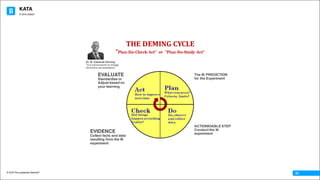
The IK PREDICTION
for the Experiment
ACTIONIOABLE STEP
Conduct the IK
experiment
EVALUATE
Standardize or
Adjust based on
your learning
EVIDENCE
Collect facts and data
resulting from the IK
experiment
THE	DEMING	CYCLE
"Plan-Do-Check-Act"		or		"Plan-Do-Study-Act"	
Dr. W. Edwards Deming
“It	is	not	necessary	to	change.	
Survival	is	not	mandatory.”
KATA
© 2016 The Leadership Network®
© 2016 Jidoka®
03
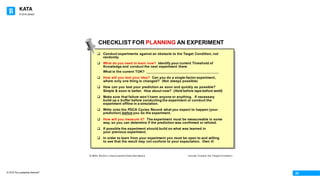
CHECKLIST FOR PLANNING AN EXPERIMENT
q Conduct experiments against an obstacle to the Target Condition, not
randomly.
q What do you need to learn now? Identify your current Threshold of
Knowledge and conduct the next experiment there.
What is the current TOK?
q How will you test your idea? Can you do a single-factor experiment,
where only one thing is changed? (Not always possible)
q How can you test your prediction as soon and quickly as possible?
Simple & soon is better. How about now? (Hold before tape before weld)
q Make sure that failure wonʼt harm anyone or anything. If necessary
build up a buffer before conducting the experiment or conduct the
experiment offline in a simulation.
q Write onto the PDCA Cycles Record what you expect to happen (your
prediction) before you do the experiment.
q How will you measure it? The experiment must be measureable in some
way, so you can determine if the prediction was confirmed or refuted.
q If possible the experiment should build on what was learned in
your previous experiment.
q In order to learn from your experiment you must be open to and willing
to see that the result may not conform to your expectation. Own it!
© Mike Rother / Improvement Kata Handbook Iterate Toward the Target Condition
KATA
© 2016 The Leadership Network®
© 2016 Jidoka®
04
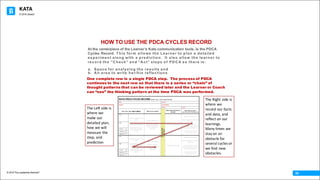
At the centerpiece of the Learner’s Kata communication tools, is the PDCA
Cycles Record. This form allows the Learner to plan a detailed
experiment along with a prediction. It also allow the learner to
record the “C heck” and “A ct” steps of PD C A so there is:
a. Space for analyzing the results and
b. A n area to write her/his reflections
One complete row is a single PDCA step. The process of PDCA
continues to the next row so that there is a series or “chain” of
thought patterns that can be reviewed later and the Learner or Coach
can “see” the thinking pattern at the time PDCA was performed.
The	Left	side	is	
where	we	
make	our	
detailed	plan,	
how	we	will	
measure	the	
step,	and	
prediction
The	Right	side	is	
where	we	
record	our	facts	
and	data,	and	
reflect	on	our	
learnings.		
Many	times	we	
stay	on	an	
obstacle	for	
several	cycles	or	
we	find	new	
obstacles.
HOW TO USE THE PDCA CYCLES RECORD
KATA
© 2016 The Leadership Network®
© 2016 Jidoka®
05
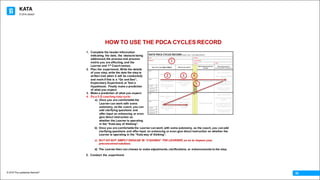
HOW TO USE THE PDCA CYCLES RECORD
b) Once you are comfortable the Learner canwork with some autonomy, as the coach, you canadd
clarifying questions and offer input on enhancing or even give direct instruction on whether the
Learner is operating in the “Kata way of thinking”.
c) BUT DO NOT SIMPLY ENGAGE IN “COAXING” THE LEARNER,so as to impose your
preconceivedsolutions.
d) The Learner then can choose to make adjustments,clarifications, or enhancements to the step.
5. Conduct the experiment.
1. Complete the header information
indicating the date, the obstacle being
addressed,the process and process
metric you are affecting, and the
Learner and 1st
Coachnames.
2. Plan the experiment, Write the details
of your step, write the date the step is
written (not when it will be conducted),
and mark if this is a “Go and See”,
Exploratory Experiment,or Test a
Hypothesis. Finally make a prediction
of what you expect.
3. Make a prediction of what you expect.
4. Do a 5 Q coaching kata cycle:
a) Once you are comfortable the
Learner can work with some
autonomy, as the coach, you can
add clarifying questions and
offer input on enhancing or even
give direct instruction on
whether the Learner is operating
in the “Kata way of thinking”.
1
2 3 4
5
KATA
© 2016 The Leadership Network®
© 2016 Jidoka®
6
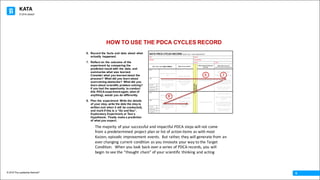
HOW TO USE THE PDCA CYCLES RECORD
6. Record the facts and data about what
actually happened.
7. Reflect on the outcome of the
experiment by comparing the
predicted result with the data, and
summarize what was learned.
Consider what you learned about the
process? What did you learn about
overcoming obstacles? What did you
learn about scientific problem solving?
If you had the opportunity to conduct
this PDCA experiment again, what (if
anything), would you do differently.
8. Plan the experiment: Write the details
of your step, write the date the step is
written (not when it will be conducted),
and mark if this is a “Go and See”,
Exploratory Experiment,or Test a
Hypothesis. Finally make a prediction
of what you expect.
6 7
8
The	majority	of	your	successful	and	impactful	PDCA	steps	will	not	come	
from	a	predetermined	 project	plan	or	list	of	action	items	as	with	most	
Kaizen,	episodic	improvement	events.		But	rather,	they	will	generate	from	an	
ever	changing	current	condition	as	you	innovate	your	way	to	the	Target	
Condition.		When	you	look	back	over	a	series	of	PDCA	records,	you	will	
begin	to	see	the	“thought	chain”	of	your	scientific	thinking	and	acting
KATA
© 2016 The Leadership Network®
© 2016 Jidoka®
7
From	a	conversation	I	had	with	John	Shook,	at	the	
2014	European	Lean	Educators	Conference
“It is easier to act your way to
a new way of thinking, than to
think your way to a new way
of acting.”
…and..
“Kata is not the cure for
cancer, but it is a way to find
a cure for cancer.”
- Quote via conversation in Stuttgart,
German, from 2014 ELEC
KATA
© 2016 The Leadership Network®
© 2016 Jidoka®
8
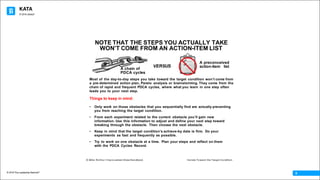
NOTE THAT THE STEPS YOU ACTUALLY TAKE
WONʼT COME FROM AN ACTION-ITEM LIST
Most of the day-to-day steps you take toward the target condition wonʼt come from
a pre-determined action plan, Pareto analysis or brainstorming. They come from the
chain of rapid and frequent PDCA cycles, where what you learn in one step often
leads you to your next step.
Things to keep in mind:
• Only work on those obstacles that you sequentially find are actually preventing
you from reaching the target condition.
• From each experiment related to the current obstacle youʼll gain new
information. Use this information to adjust and define your next step toward
breaking through the obstacle. Then choose the next obstacle.
• Keep in mind that the target conditionʼs achieve-by date is firm. Do your
experiments as fast and frequently as possible.
• Try to work on one obstacle at a time. Plan your steps and reflect on them
with the PDCA Cycles Record.
A chain of
PDCA cycles
© Mike Rother / Improvement Kata Handbook Iterate Toward the Target Condition
VERSUS
A preconceived
action-item list
KATA
© 2016 The Leadership Network®
© 2016 Jidoka®
9
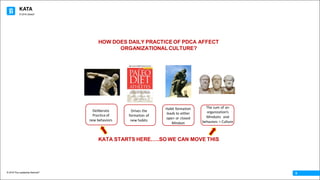
HOW DOES DAILY PRACTICE OF PDCA AFFECT
ORGANIZATIONALCULTURE?
Deliberate	
Practice	of	
new	behaviors
Drives	the	
formation	of	
new	habits	
Habit	formation	
leads	to	either		
open	or	closed	
Mindset
The	sum	of	an	
organization’s		
Mindsets		and	
behaviors	=	Culture
KATA STARTS HERE.….SO WE CAN MOVE THIS
KATA
© 2016 The Leadership Network®
© 2016 Jidoka®
10
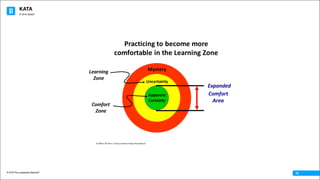
Practicing	to	become	more	
comfortable	in	the	Learning	Zone
Apparent
Certainty
Uncertainty
Mystery
Comfort
Zone
Learning
Zone
Comfort
Area
Expanded
© Mike Rother / Improvement Kata Handbook
KATA
© 2016 The Leadership Network®
© 2016 Jidoka®
11
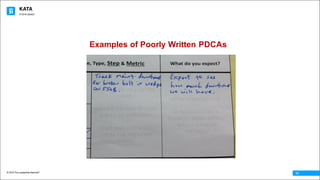
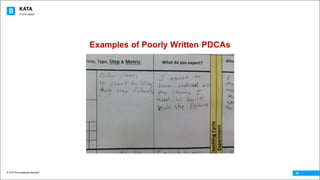
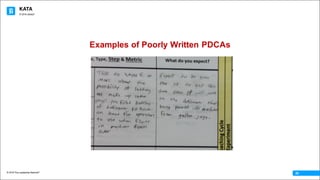
Examples of Poorly Written PDCAs
KATA
© 2016 The Leadership Network®
© 2016 Jidoka®
12
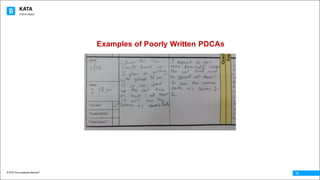
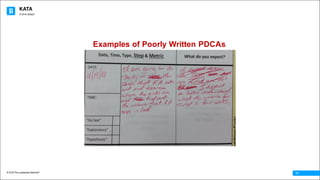
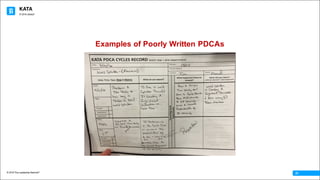
Examples of Poorly Written PDCAs
KATA
© 2016 The Leadership Network®
© 2016 Jidoka®
13
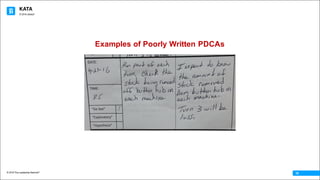
Examples of Poorly Written PDCAs
KATA
© 2016 The Leadership Network®
© 2016 Jidoka®
14
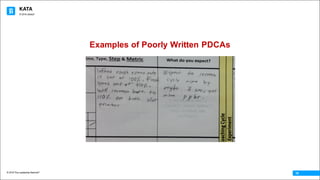
Examples of Poorly Written PDCAs
KATA
© 2016 The Leadership Network®
© 2016 Jidoka®
15
Examples of Poorly Written PDCAs
KATA
© 2016 The Leadership Network®
© 2016 Jidoka®
16
Examples of Poorly Written PDCAs
KATA
© 2016 The Leadership Network®
© 2016 Jidoka®
17
Examples of Poorly Written PDCAs
KATA
© 2016 The Leadership Network®
© 2016 Jidoka®
18
Examples of Poorly Written PDCAs
KATA
© 2016 The Leadership Network®
© 2016 Jidoka®
19
Examples of Poorly Written PDCAs
KATA
© 2016 The Leadership Network®
© 2016 Jidoka®
20
Examples of Poorly Written PDCAs
KATA
© 2016 The Leadership Network®
© 2016 Jidoka®
21
Examples of Poorly Written PDCAs
KATA
© 2016 The Leadership Network®
© 2016 Jidoka®
22
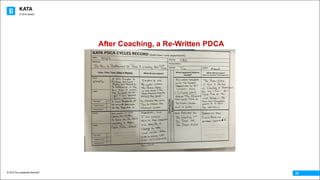
After Coaching, a Re-Written PDCA
KATA
© 2016 The Leadership Network®
© 2016 Jidoka®
23
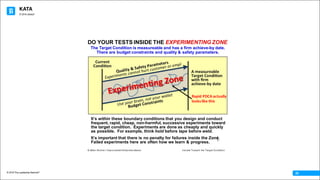
DO YOUR TESTS INSIDE THE EXPERIMENTINGZONE
The Target Condition is measureable and has a firm achieve-by date.
There are budget constraints and quality & safety parameters.
Itʼs within these boundary conditions that you design and conduct
frequent, rapid, cheap, non-harmful, successive experiments toward
the target condition. Experiments are done as cheaply and quickly
as possible. For example, think hold before tape before weld.
Itʼs important that there is no penalty for failures inside the Zone.
Failed experiments here are often how we learn & progress.
© Mike Rother / Improvement Kata Handbook Iterate Toward the Target Condition
2
3
Rapid	PDCA	actually	
looks	like	this
KATA
© 2016 The Leadership Network®
© 2016 Jidoka®
24
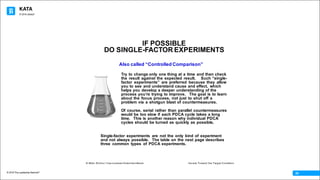
IF POSSIBLE
DO SINGLE-FACTOR EXPERIMENTS
Also called “Controlled Comparison”
Try to change only one thing at a time and then check
the result against the expected result. Such “single-
factor experiments” are preferred because they allow
you to see and understand cause and effect, which
helps you develop a deeper understanding of the
process youʼre trying to improve. The goal is to learn
about the focus process, not just to shut off a
problem via a shotgun blast of countermeasures.
Of course, serial rather than parallel countermeasures
would be too slow if each PDCA cycle takes a long
time. This is another reason why individual PDCA
cycles should be turned as quickly as possible.
Single-factor experiments are not the only kind of experiment
and not always possible. The table on the next page describes
three common types of PDCA experiments.
© Mike Rother / Improvement Kata Handbook Iterate Toward the Target Condition
KATA
© 2016 The Leadership Network®
© 2016 Jidoka®
25
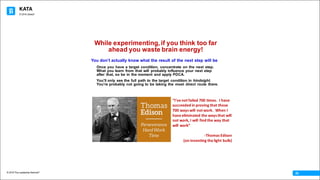
While experimenting, if you think too far
ahead you waste brain energy!
You donʼt actually know what the result of the next step will be
Once you have a target condition, concentrate on the next step.
What you learn from that will probably influence your next step
after that, so be in the moment and apply PDCA.
You'll only see the full path to the target condition in hindsight.
You're probably not going to be taking the most direct route there.
“I’ve	not	failed	700	times.		I	have	
succeeded	in	proving	that	those	
700	ways	will	not	work.		When	I	
have	eliminated	the	ways	that	will	
not	work,	I	will	find	the	way	that	
will	work”
-Thomas	Edison
(on	inventing	the	light	bulb)
KATA
© 2016 The Leadership Network®
© 2016 Jidoka®
26
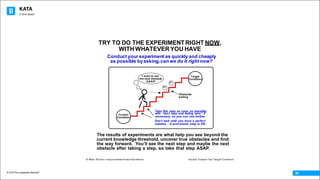
Target
Condition
Current
Condition
Take this step as soon as possible,
with “duct tape and baling wire” if
necessary, so you can see further.
Donʼt wait until you have a perfect
solution. A provisional step is OK.
I want to see
the next obstacle
ASAP!
Obstacles
waiting
TRY TO DO THE EXPERIMENTRIGHT NOW,
WITH WHATEVER YOU HAVE
© Mike Rother / Improvement Kata Handbook Iterate Toward the Target Condition
Conduct your experiment as quickly and cheaply
as possible byasking,can we do it right now?
The results of experiments are what help you see beyond the
current knowledge threshold, uncover true obstacles and find
the way forward. Youʼll see the next step and maybe the next
obstacle after taking a step, so take that step ASAP.
KATA
© 2016 The Leadership Network®
© 2016 Jidoka®
27
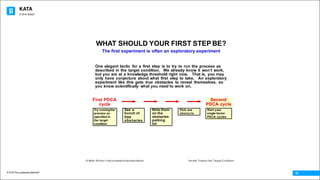
WHAT SHOULD YOUR FIRST STEP BE?
The first experiment is often an exploratory experiment
Try runningthe
process as
specified in
the target
condition
See a
bunch of
true
obstacles
Note them
on the
obstacles
parking
lot
Pick one
obstacle
Start your
single-factor
PDCA cycles
First PDCA
cycle
Second
PDCA cycle
One elegant tactic for a first step is to try to run the process as
described in the target condition. We already know it wonʼt work,
but you are at a knowledge threshold right now. That is, you may
only have conjecture about what first step to take. An exploratory
experiment like this gets true obstacles to reveal themselves, so
you know scientifically what you need to work on.
© Mike Rother / Improvement Kata Handbook Iterate Toward the Target Condition
KATA
© 2016 The Leadership Network®
© 2016 Jidoka®
28
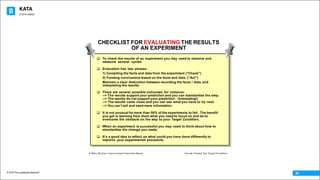
CHECKLIST FOR EVALUATING THE RESULTS
OF AN EXPERIMENT
q To check the results of an experiment you may need to observe and
measure several cycles.
q Evaluation has two phases:
1) Compiling the facts and data from the experiment (“Check”)
2) Forming conclusions based on the facts and data. (“Act”)
Maintain a clear distinction between recording the facts / data, and
interpreting the results.
q There are several possible outcomes, for instance:
--> The results support your prediction and you can standardize the step.
--> The results do not support your prediction. (Interesting!)
--> The results came close and you can see what you have to try next.
--> You canʼt tell and need more information.
q It is not unusual for more than 50% of the experiments to fail. The benefit
you get is learning from them what you need to focus on and do to
overcome the obstacle on the way to your Target Condition.
q When an experiment is successful you may need to think about how to
standardize the change you made.
q Itʼs a good idea to reflect on what could you have done differently to
improve your experimental procedure.
© Mike Rother / Improvement Kata Handbook Iterate Toward the Target Condition
KATA
© 2016 The Leadership Network®
© 2016 Jidoka®
29
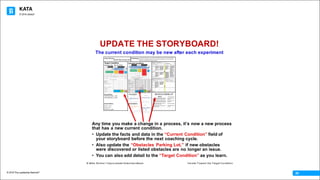
UPDATE THE STORYBOARD!
The current condition may be new after each experiment
Any time you make a change in a process, itʼs now a new process
that has a new current condition.
• Update the facts and data in the “Current Condition” field of
your storyboard before the next coaching cycle.
• Also update the “Obstacles Parking Lot,” if new obstacles
were discovered or listed obstacles are no longer an issue.
• You can also add detail to the “Target Condition” as you learn.
© Mike Rother / Improvement Kata Handbook Iterate Toward the Target Condition
KATA
© 2016 The Leadership Network®
© 2016 Jidoka®
30
KEEP THIS QUESTION IN MIND
PDCA Cycles
This perspective will keep you focused on
the work process and help you work
together with the process team
What is now preventing
the people in the process
from being able to work
according to the Target
Condition?
© Mike Rother / Improvement Kata Handbook
KATA
© 2016 The Leadership Network®
© 2016 Jidoka®
31
When youʼre faced with a difficult process the
question is not whether you should
experiment, but how
How do you accelerate testing in infrequent processes
with extended cycle time -- like some administrative and
chemical processes -- to gain knowledge in a rapid, low
cost way?
In these cases experiments often involve some type of
parallel 'laboratory' simulation. The question becomes, “How
can we artificially test this step or idea more quickly?” This
approach involves conducting a series of rapid, low-cost
simulation experiments (one per day for instance) in between
less-frequent experiments on the actual process. You gain
several learnings in the interval between actual process
cycles, which culminate in one "big" experiment at the actual
process under real conditions, to get information that can
only come from the real process.
© Mike Rother / Improvement Kata Handbook Iterate Toward the Target Condition
EXPERIMENTING WITH LONG-CYCLE PROCESSES
KATA
© 2016 The Leadership Network®
© 2016 Jidoka®
32
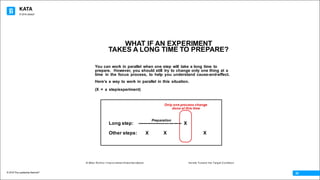
WHAT IF AN EXPERIMENT
TAKES A LONG TIME TO PREPARE?
X X
You can work in parallel when one step will take a long time to
prepare. However, you should still try to change only one thing at a
time in the focus process, to help you understand cause-and-effect.
Hereʼs a way to work in parallel in this situation.
(X = a step/experiment)
Only one process change
done at this time
Long step:
Other steps: X
---------------------------- X
Preparation
© Mike Rother / Improvement Kata Handbook Iterate Toward the Target Condition
KATA
© 2016 The Leadership Network®
© 2016 Jidoka®
33
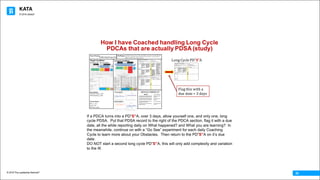
If a PDCA turns into a PD”S”A, over 3 days, allow yourself one, and only one, long
cycle PDSA. Put that PDSA record to the right of the PDCA section, flag it with a due
date, all the while reporting daily on What happened? and What you are learning? In
the meanwhile, continue on with a “Go See” experiment for each daily Coaching
Cycle to learn more about your Obstacles. Then return to the PD”S”A on it’s due
date.
DO NOT start a second long cycle PD”S”A, this will only add complexity and variation
to the IK
How I have Coached handling Long Cycle
PDCAs that are actually PDSA (study)
Long	Cycle	PD”S”A	
Flag	this	with	a	
due	date	<	3	days

Lecture 4b

  • 1.
    KATA © 2016 TheLeadership Network® © 2016 Jidoka® 01 © Mike Rother / Improvement Kata Handbook TOYOTA KATA PDCA toward the Target Condition Part 2 C. Brandon Brown, P.E.
  • 2.
    KATA © 2016 TheLeadership Network® © 2016 Jidoka® 02 The IK PREDICTION for the Experiment ACTIONIOABLE STEP Conduct the IK experiment EVALUATE Standardize or Adjust based on your learning EVIDENCE Collect facts and data resulting from the IK experiment THE DEMING CYCLE "Plan-Do-Check-Act" or "Plan-Do-Study-Act" Dr. W. Edwards Deming “It is not necessary to change. Survival is not mandatory.”
  • 3.
    KATA © 2016 TheLeadership Network® © 2016 Jidoka® 03 CHECKLIST FOR PLANNING AN EXPERIMENT q Conduct experiments against an obstacle to the Target Condition, not randomly. q What do you need to learn now? Identify your current Threshold of Knowledge and conduct the next experiment there. What is the current TOK? q How will you test your idea? Can you do a single-factor experiment, where only one thing is changed? (Not always possible) q How can you test your prediction as soon and quickly as possible? Simple & soon is better. How about now? (Hold before tape before weld) q Make sure that failure wonʼt harm anyone or anything. If necessary build up a buffer before conducting the experiment or conduct the experiment offline in a simulation. q Write onto the PDCA Cycles Record what you expect to happen (your prediction) before you do the experiment. q How will you measure it? The experiment must be measureable in some way, so you can determine if the prediction was confirmed or refuted. q If possible the experiment should build on what was learned in your previous experiment. q In order to learn from your experiment you must be open to and willing to see that the result may not conform to your expectation. Own it! © Mike Rother / Improvement Kata Handbook Iterate Toward the Target Condition
  • 4.
    KATA © 2016 TheLeadership Network® © 2016 Jidoka® 04 At the centerpiece of the Learner’s Kata communication tools, is the PDCA Cycles Record. This form allows the Learner to plan a detailed experiment along with a prediction. It also allow the learner to record the “C heck” and “A ct” steps of PD C A so there is: a. Space for analyzing the results and b. A n area to write her/his reflections One complete row is a single PDCA step. The process of PDCA continues to the next row so that there is a series or “chain” of thought patterns that can be reviewed later and the Learner or Coach can “see” the thinking pattern at the time PDCA was performed. The Left side is where we make our detailed plan, how we will measure the step, and prediction The Right side is where we record our facts and data, and reflect on our learnings. Many times we stay on an obstacle for several cycles or we find new obstacles. HOW TO USE THE PDCA CYCLES RECORD
  • 5.
    KATA © 2016 TheLeadership Network® © 2016 Jidoka® 05 HOW TO USE THE PDCA CYCLES RECORD b) Once you are comfortable the Learner canwork with some autonomy, as the coach, you canadd clarifying questions and offer input on enhancing or even give direct instruction on whether the Learner is operating in the “Kata way of thinking”. c) BUT DO NOT SIMPLY ENGAGE IN “COAXING” THE LEARNER,so as to impose your preconceivedsolutions. d) The Learner then can choose to make adjustments,clarifications, or enhancements to the step. 5. Conduct the experiment. 1. Complete the header information indicating the date, the obstacle being addressed,the process and process metric you are affecting, and the Learner and 1st Coachnames. 2. Plan the experiment, Write the details of your step, write the date the step is written (not when it will be conducted), and mark if this is a “Go and See”, Exploratory Experiment,or Test a Hypothesis. Finally make a prediction of what you expect. 3. Make a prediction of what you expect. 4. Do a 5 Q coaching kata cycle: a) Once you are comfortable the Learner can work with some autonomy, as the coach, you can add clarifying questions and offer input on enhancing or even give direct instruction on whether the Learner is operating in the “Kata way of thinking”. 1 2 3 4 5
  • 6.
    KATA © 2016 TheLeadership Network® © 2016 Jidoka® 6 HOW TO USE THE PDCA CYCLES RECORD 6. Record the facts and data about what actually happened. 7. Reflect on the outcome of the experiment by comparing the predicted result with the data, and summarize what was learned. Consider what you learned about the process? What did you learn about overcoming obstacles? What did you learn about scientific problem solving? If you had the opportunity to conduct this PDCA experiment again, what (if anything), would you do differently. 8. Plan the experiment: Write the details of your step, write the date the step is written (not when it will be conducted), and mark if this is a “Go and See”, Exploratory Experiment,or Test a Hypothesis. Finally make a prediction of what you expect. 6 7 8 The majority of your successful and impactful PDCA steps will not come from a predetermined project plan or list of action items as with most Kaizen, episodic improvement events. But rather, they will generate from an ever changing current condition as you innovate your way to the Target Condition. When you look back over a series of PDCA records, you will begin to see the “thought chain” of your scientific thinking and acting
  • 7.
    KATA © 2016 TheLeadership Network® © 2016 Jidoka® 7 From a conversation I had with John Shook, at the 2014 European Lean Educators Conference “It is easier to act your way to a new way of thinking, than to think your way to a new way of acting.” …and.. “Kata is not the cure for cancer, but it is a way to find a cure for cancer.” - Quote via conversation in Stuttgart, German, from 2014 ELEC
  • 8.
    KATA © 2016 TheLeadership Network® © 2016 Jidoka® 8 NOTE THAT THE STEPS YOU ACTUALLY TAKE WONʼT COME FROM AN ACTION-ITEM LIST Most of the day-to-day steps you take toward the target condition wonʼt come from a pre-determined action plan, Pareto analysis or brainstorming. They come from the chain of rapid and frequent PDCA cycles, where what you learn in one step often leads you to your next step. Things to keep in mind: • Only work on those obstacles that you sequentially find are actually preventing you from reaching the target condition. • From each experiment related to the current obstacle youʼll gain new information. Use this information to adjust and define your next step toward breaking through the obstacle. Then choose the next obstacle. • Keep in mind that the target conditionʼs achieve-by date is firm. Do your experiments as fast and frequently as possible. • Try to work on one obstacle at a time. Plan your steps and reflect on them with the PDCA Cycles Record. A chain of PDCA cycles © Mike Rother / Improvement Kata Handbook Iterate Toward the Target Condition VERSUS A preconceived action-item list
  • 9.
    KATA © 2016 TheLeadership Network® © 2016 Jidoka® 9 HOW DOES DAILY PRACTICE OF PDCA AFFECT ORGANIZATIONALCULTURE? Deliberate Practice of new behaviors Drives the formation of new habits Habit formation leads to either open or closed Mindset The sum of an organization’s Mindsets and behaviors = Culture KATA STARTS HERE.….SO WE CAN MOVE THIS
  • 10.
    KATA © 2016 TheLeadership Network® © 2016 Jidoka® 10 Practicing to become more comfortable in the Learning Zone Apparent Certainty Uncertainty Mystery Comfort Zone Learning Zone Comfort Area Expanded © Mike Rother / Improvement Kata Handbook
  • 11.
    KATA © 2016 TheLeadership Network® © 2016 Jidoka® 11 Examples of Poorly Written PDCAs
  • 12.
    KATA © 2016 TheLeadership Network® © 2016 Jidoka® 12 Examples of Poorly Written PDCAs
  • 13.
    KATA © 2016 TheLeadership Network® © 2016 Jidoka® 13 Examples of Poorly Written PDCAs
  • 14.
    KATA © 2016 TheLeadership Network® © 2016 Jidoka® 14 Examples of Poorly Written PDCAs
  • 15.
    KATA © 2016 TheLeadership Network® © 2016 Jidoka® 15 Examples of Poorly Written PDCAs
  • 16.
    KATA © 2016 TheLeadership Network® © 2016 Jidoka® 16 Examples of Poorly Written PDCAs
  • 17.
    KATA © 2016 TheLeadership Network® © 2016 Jidoka® 17 Examples of Poorly Written PDCAs
  • 18.
    KATA © 2016 TheLeadership Network® © 2016 Jidoka® 18 Examples of Poorly Written PDCAs
  • 19.
    KATA © 2016 TheLeadership Network® © 2016 Jidoka® 19 Examples of Poorly Written PDCAs
  • 20.
    KATA © 2016 TheLeadership Network® © 2016 Jidoka® 20 Examples of Poorly Written PDCAs
  • 21.
    KATA © 2016 TheLeadership Network® © 2016 Jidoka® 21 Examples of Poorly Written PDCAs
  • 22.
    KATA © 2016 TheLeadership Network® © 2016 Jidoka® 22 After Coaching, a Re-Written PDCA
  • 23.
    KATA © 2016 TheLeadership Network® © 2016 Jidoka® 23 DO YOUR TESTS INSIDE THE EXPERIMENTINGZONE The Target Condition is measureable and has a firm achieve-by date. There are budget constraints and quality & safety parameters. Itʼs within these boundary conditions that you design and conduct frequent, rapid, cheap, non-harmful, successive experiments toward the target condition. Experiments are done as cheaply and quickly as possible. For example, think hold before tape before weld. Itʼs important that there is no penalty for failures inside the Zone. Failed experiments here are often how we learn & progress. © Mike Rother / Improvement Kata Handbook Iterate Toward the Target Condition 2 3 Rapid PDCA actually looks like this
  • 24.
    KATA © 2016 TheLeadership Network® © 2016 Jidoka® 24 IF POSSIBLE DO SINGLE-FACTOR EXPERIMENTS Also called “Controlled Comparison” Try to change only one thing at a time and then check the result against the expected result. Such “single- factor experiments” are preferred because they allow you to see and understand cause and effect, which helps you develop a deeper understanding of the process youʼre trying to improve. The goal is to learn about the focus process, not just to shut off a problem via a shotgun blast of countermeasures. Of course, serial rather than parallel countermeasures would be too slow if each PDCA cycle takes a long time. This is another reason why individual PDCA cycles should be turned as quickly as possible. Single-factor experiments are not the only kind of experiment and not always possible. The table on the next page describes three common types of PDCA experiments. © Mike Rother / Improvement Kata Handbook Iterate Toward the Target Condition
  • 25.
    KATA © 2016 TheLeadership Network® © 2016 Jidoka® 25 While experimenting, if you think too far ahead you waste brain energy! You donʼt actually know what the result of the next step will be Once you have a target condition, concentrate on the next step. What you learn from that will probably influence your next step after that, so be in the moment and apply PDCA. You'll only see the full path to the target condition in hindsight. You're probably not going to be taking the most direct route there. “I’ve not failed 700 times. I have succeeded in proving that those 700 ways will not work. When I have eliminated the ways that will not work, I will find the way that will work” -Thomas Edison (on inventing the light bulb)
  • 26.
    KATA © 2016 TheLeadership Network® © 2016 Jidoka® 26 Target Condition Current Condition Take this step as soon as possible, with “duct tape and baling wire” if necessary, so you can see further. Donʼt wait until you have a perfect solution. A provisional step is OK. I want to see the next obstacle ASAP! Obstacles waiting TRY TO DO THE EXPERIMENTRIGHT NOW, WITH WHATEVER YOU HAVE © Mike Rother / Improvement Kata Handbook Iterate Toward the Target Condition Conduct your experiment as quickly and cheaply as possible byasking,can we do it right now? The results of experiments are what help you see beyond the current knowledge threshold, uncover true obstacles and find the way forward. Youʼll see the next step and maybe the next obstacle after taking a step, so take that step ASAP.
  • 27.
    KATA © 2016 TheLeadership Network® © 2016 Jidoka® 27 WHAT SHOULD YOUR FIRST STEP BE? The first experiment is often an exploratory experiment Try runningthe process as specified in the target condition See a bunch of true obstacles Note them on the obstacles parking lot Pick one obstacle Start your single-factor PDCA cycles First PDCA cycle Second PDCA cycle One elegant tactic for a first step is to try to run the process as described in the target condition. We already know it wonʼt work, but you are at a knowledge threshold right now. That is, you may only have conjecture about what first step to take. An exploratory experiment like this gets true obstacles to reveal themselves, so you know scientifically what you need to work on. © Mike Rother / Improvement Kata Handbook Iterate Toward the Target Condition
  • 28.
    KATA © 2016 TheLeadership Network® © 2016 Jidoka® 28 CHECKLIST FOR EVALUATING THE RESULTS OF AN EXPERIMENT q To check the results of an experiment you may need to observe and measure several cycles. q Evaluation has two phases: 1) Compiling the facts and data from the experiment (“Check”) 2) Forming conclusions based on the facts and data. (“Act”) Maintain a clear distinction between recording the facts / data, and interpreting the results. q There are several possible outcomes, for instance: --> The results support your prediction and you can standardize the step. --> The results do not support your prediction. (Interesting!) --> The results came close and you can see what you have to try next. --> You canʼt tell and need more information. q It is not unusual for more than 50% of the experiments to fail. The benefit you get is learning from them what you need to focus on and do to overcome the obstacle on the way to your Target Condition. q When an experiment is successful you may need to think about how to standardize the change you made. q Itʼs a good idea to reflect on what could you have done differently to improve your experimental procedure. © Mike Rother / Improvement Kata Handbook Iterate Toward the Target Condition
  • 29.
    KATA © 2016 TheLeadership Network® © 2016 Jidoka® 29 UPDATE THE STORYBOARD! The current condition may be new after each experiment Any time you make a change in a process, itʼs now a new process that has a new current condition. • Update the facts and data in the “Current Condition” field of your storyboard before the next coaching cycle. • Also update the “Obstacles Parking Lot,” if new obstacles were discovered or listed obstacles are no longer an issue. • You can also add detail to the “Target Condition” as you learn. © Mike Rother / Improvement Kata Handbook Iterate Toward the Target Condition
  • 30.
    KATA © 2016 TheLeadership Network® © 2016 Jidoka® 30 KEEP THIS QUESTION IN MIND PDCA Cycles This perspective will keep you focused on the work process and help you work together with the process team What is now preventing the people in the process from being able to work according to the Target Condition? © Mike Rother / Improvement Kata Handbook
  • 31.
    KATA © 2016 TheLeadership Network® © 2016 Jidoka® 31 When youʼre faced with a difficult process the question is not whether you should experiment, but how How do you accelerate testing in infrequent processes with extended cycle time -- like some administrative and chemical processes -- to gain knowledge in a rapid, low cost way? In these cases experiments often involve some type of parallel 'laboratory' simulation. The question becomes, “How can we artificially test this step or idea more quickly?” This approach involves conducting a series of rapid, low-cost simulation experiments (one per day for instance) in between less-frequent experiments on the actual process. You gain several learnings in the interval between actual process cycles, which culminate in one "big" experiment at the actual process under real conditions, to get information that can only come from the real process. © Mike Rother / Improvement Kata Handbook Iterate Toward the Target Condition EXPERIMENTING WITH LONG-CYCLE PROCESSES
  • 32.
    KATA © 2016 TheLeadership Network® © 2016 Jidoka® 32 WHAT IF AN EXPERIMENT TAKES A LONG TIME TO PREPARE? X X You can work in parallel when one step will take a long time to prepare. However, you should still try to change only one thing at a time in the focus process, to help you understand cause-and-effect. Hereʼs a way to work in parallel in this situation. (X = a step/experiment) Only one process change done at this time Long step: Other steps: X ---------------------------- X Preparation © Mike Rother / Improvement Kata Handbook Iterate Toward the Target Condition
  • 33.
    KATA © 2016 TheLeadership Network® © 2016 Jidoka® 33 If a PDCA turns into a PD”S”A, over 3 days, allow yourself one, and only one, long cycle PDSA. Put that PDSA record to the right of the PDCA section, flag it with a due date, all the while reporting daily on What happened? and What you are learning? In the meanwhile, continue on with a “Go See” experiment for each daily Coaching Cycle to learn more about your Obstacles. Then return to the PD”S”A on it’s due date. DO NOT start a second long cycle PD”S”A, this will only add complexity and variation to the IK How I have Coached handling Long Cycle PDCAs that are actually PDSA (study) Long Cycle PD”S”A Flag this with a due date < 3 days