Welcome to a new World!
A world of
SCRUM
“Designing and programming are above all
human activities, forget that and all is lost“
--- B Stroustrup
About the Speaker(s)
Srinivas Chillara
• Masters, Reading University, UK
Information Systems Engineering
• Professional interests
– Software processes
– Software quality
• Current foci
– Scrum
– TDD
– Test management and strategy
Sub topics (TBD)
• Co-creation of this talk
• Roles: Programmer, analyst, tester, architect, manager, build engineer; The
opportunity of leadership, and the need for it;
• Scrum in action:
• Prioritisation
• Feedback
• Communication
• Inspect and adapt
• Case study 1: Team in offshore unit of product dev co.
• Case study 2: IT subsidiary of global bank; with vendor team members
What is good about the waterfall?
• Predictable
• Demarcated
• Popular
• Dependable
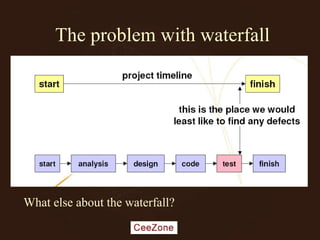
The problem with waterfall
What else about the waterfall?
Project Management Traditional
• Centralised, irrespective of the circumstance
• Plan and task driven
• Based on production line approach
• Deferral of pain to the end
Project Management-new wave
Scrum
• Iterative and Incremental
• Flexible
• People-centric
• Goal oriented – not task oriented
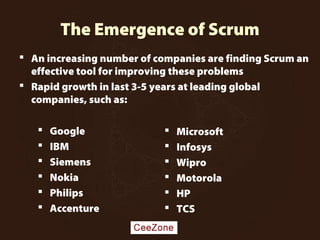
The Emergence of Scrum
 Google
 IBM
 Siemens
 Nokia
 Philips
 Accenture
 Microsoft
 Infosys
 Wipro
 Motorola
 HP
 TCS
 An increasing number of companies are finding Scrum an
effective tool for improving these problems
 Rapid growth in last 3-5 years at leading global
companies, such as:
Distribution of methodologies
Source: VersionOne 3rd
Annual survey
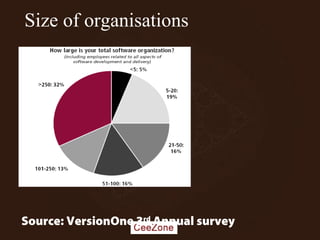
Size of organisations
Source: VersionOne 3rd
Annual survey
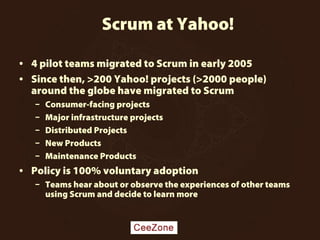
Scrum at Yahoo!
• 4 pilot teams migrated to Scrum in early 2005
• Since then, >200 Yahoo! projects (>2000 people)
around the globe have migrated to Scrum
– Consumer-facing projects
– Major infrastructure projects
– Distributed Projects
– New Products
– Maintenance Products
• Policy is 100% voluntary adoption
– Teams hear about or observe the experiences of other teams
using Scrum and decide to learn more
0%
5%
10%
15%
20%
25%
30%
35%
40%
45%
50%
Scrum
MUCH
WORSE
Scrum
WORSE
Scrum
about the
same
Scrum
BETTER
Scrum
MUCH
BETTER
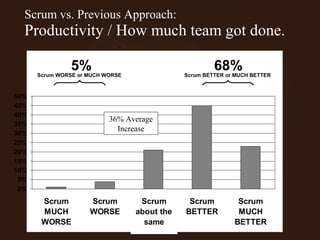
68%5% Scrum BETTER or MUCH BETTERScrum WORSE or MUCH WORSE
Scrum vs. Previous Approach:
Productivity / How much team got done.
36% Average
Increase
Scrum vs. Previous Approach:
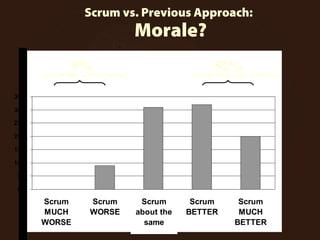
Morale?
0%
5%
10%
15%
20%
25%
30%
35%
Scrum
MUCH
WORSE
Scrum
WORSE
Scrum
about the
same
Scrum
BETTER
Scrum
MUCH
BETTER
52%9% Scrum BETTER or MUCH BETTERScrum WORSE or MUCH WORSE
Scrum vs. Previous Approach:
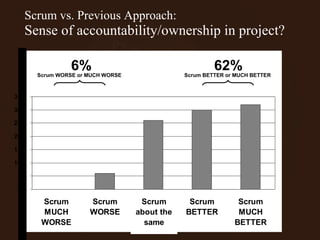
Sense of accountability/ownership in project?
0%
5%
10%
15%
20%
25%
30%
35%
Scrum
MUCH
WORSE
Scrum
WORSE
Scrum
about the
same
Scrum
BETTER
Scrum
MUCH
BETTER
62%6% Scrum BETTER or MUCH BETTERScrum WORSE or MUCH WORSE
Scrum vs. Previous Approach:
Overall quality of what was developed?
0%
5%
10%
15%
20%
25%
30%
35%
40%
45%
Scrum
MUCH
WORSE
Scrum
WORSE
Scrum
about the
same
Scrum
BETTER
Scrum
MUCH
BETTER
44%10% Scrum BETTER or MUCH BETTERScrum WORSE or MUCH WORSE
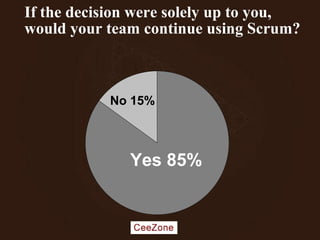
Yes 85%
No 15%
If the decision were solely up to you,
would your team continue using Scrum?
Scrum characteristics
Stresses dependence on people.
Properties
– Iterative
– Time-boxed
– Customer instantiation
– Scalable
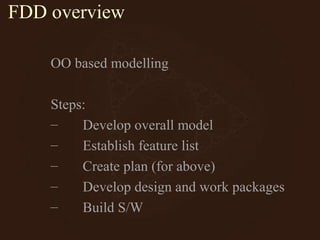
FDD overview
OO based modelling
Steps:
– Develop overall model
– Establish feature list
– Create plan (for above)
– Develop design and work packages
– Build S/W
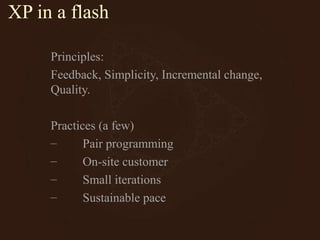
XP in a flash
Principles:
Feedback, Simplicity, Incremental change,
Quality.
Practices (a few)
– Pair programming
– On-site customer
– Small iterations
– Sustainable pace
It is Scrum not SCRUM!
Rugby student William Webb Ellis, 17,
inaugurates a new game whose rules will be
codified in 1839. Playing football for the 256-
year-old school in East Warwickshire, Ellis
sees that the clock is running out with his team
behind so he scoops up the ball and runs with
it in defiance of the rules.
It is Scrum not SCRUM!
Occasionally spelt as scum, not always by mistake.
Scrum is a framework where customers and
teams can create/develop software
and ….
It is NOT a magic wand!!
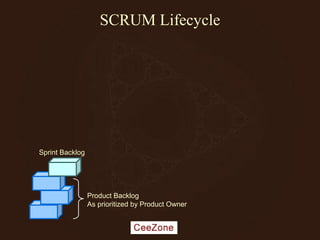
SCRUM Lifecycle
Product Backlog
As prioritized by Product Owner
Sprint Backlog
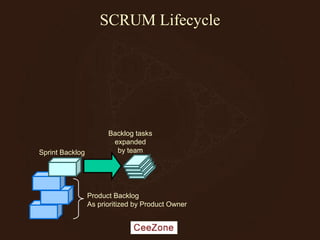
SCRUM Lifecycle
Product Backlog
As prioritized by Product Owner
Sprint Backlog
Backlog tasks
expanded
by team
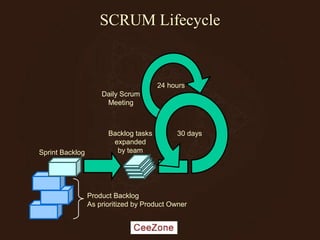
SCRUM Lifecycle
30 days
Product Backlog
As prioritized by Product Owner
Sprint Backlog
Backlog tasks
expanded
by team
SPRINT
SCRUM Lifecycle
30 days
24 hours
Product Backlog
As prioritized by Product Owner
Sprint Backlog
Backlog tasks
expanded
by team
Daily Scrum
Meeting
SCRUM Lifecycle
30 days
24 hours
Product Backlog
As prioritized by Product Owner
Sprint Backlog
Backlog tasks
expanded
by team
Potentially Shippable
Product Increment
Daily Scrum
Meeting
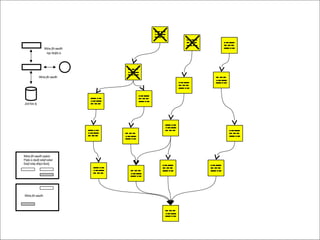
Wkhe jfih weoifh sadiuh
Fhjds io dsoifj iodsjf iodsd
Dsojf oidsj ofisjoi fsoidj
Wkhe jfih weoifh
Wkhe jfih weoifh
Iojs rfodjfo is
Wkhe jfih weoifh
Joid fois dj
Wkhe jfih weoifh sadiuh
Fhjds io dsoifj iodsjf iodsd
Dsojf oidsj ofisjoi fsoidj
Wkhe jfih weoifh
Wkhe jfih weoifh
Iojs rfodjfo is
Wkhe jfih weoifh
Joid fois dj
Wkhe jfih weoifh sadiuh
Fhjds io dsoifj iodsjf iodsd
Dsojf oidsj ofisjoi fsoidj
Wkhe jfih weoifh
Wkhe jfih weoifh
Iojs rfodjfo is
Wkhe jfih weoifh
Joid fois dj
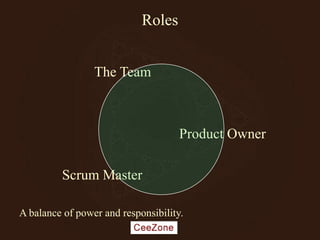
Roles
The Team
Product Owner
Scrum Master
A balance of power and responsibility.
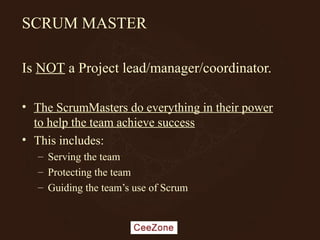
SCRUM MASTER
Is NOT a Project lead/manager/coordinator.
• The ScrumMasters do everything in their power
to help the team achieve success
• This includes:
– Serving the team
– Protecting the team
– Guiding the team’s use of Scrum
Scrum smells
• Loss of Rhythm
• Talking Chickens
• Missing Pigs
• Lack of Progress Part One: Failing in Backlog Management
• Persistent Signatures
• ScrumMaster Assigns Work
Scrum smells
• The daily Scrum lasts 45 min over the phone
• The daily Scrum is For the ScrumMaster
• Specialized Job Roles
• Testers will not integrate with Team
• It is done, well, almost done
• No One Wants to Attend Retrospectives
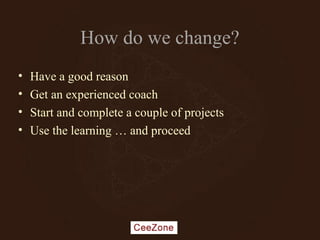
How do we change?
• Have a good reason
• Get an experienced coach
• Start and complete a couple of projects
• Use the learning … and proceed
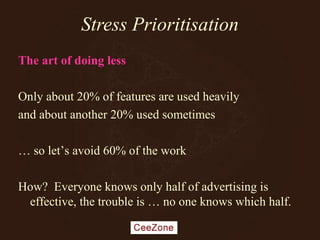
Stress Prioritisation
The art of doing less
Only about 20% of features are used heavily
and about another 20% used sometimes
… so let’s avoid 60% of the work
How? Everyone knows only half of advertising is
effective, the trouble is … no one knows which half.
Scrum charecteristics
• Prioritisation
• Focus
• Communication
• Feedback
Business Value
100
90
80
70
60
50
40
30
20
10
0
BusinessValue%
Month 1 Month 2 Month 3 Month 4 Month 5 Month 6
Why Has Scrum Become So Popular?
• More business value delivered sooner
• Better return-on-investment for projects
• Greater visibility
• Improved productivity
• Less waste
• Higher quality
• Stronger teams
• Better morale
Scrum Challenges
• It’s hard!
• It requires significant change
• It makes all dysfunction visible
– Scrum doesn’t fix anything: the team has to do it
– It forces honesty and transparency
– If you don’t address the problems, it will be painful
• Bad products will be delivered sooner, and
doomed projects will fail faster
• Partial adoption may be worse than none at all
• Be forewarned: many Scrum adoptions fail
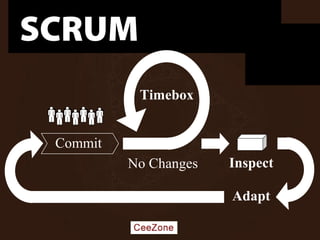
The Essence of Scrum
Timebox
InspectNo Changes
Adapt
Commit
SCRUM
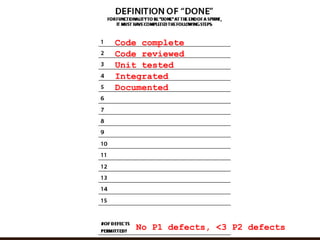
Code complete
Code reviewed
Unit tested
Integrated
Documented
No P1 defects, <3 P2 defects
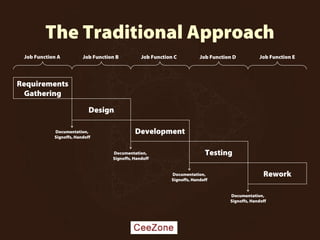
The Traditional Approach
Requirements
Gathering
Design
Development
Testing
Rework
Documentation,
Signoffs, Handoff
Documentation,
Signoffs, Handoff
Documentation,
Signoffs, Handoff
Documentation,
Signoffs, Handoff
Job Function A Job Function B Job Function C Job Function D Job Function E
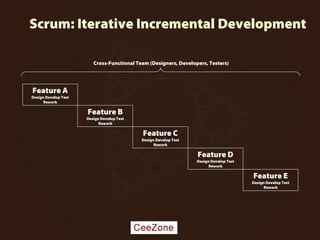
Scrum: Iterative Incremental Development
Feature A
Design Develop Test
Rework
Feature B
Design Develop Test
Rework
Feature C
Design Develop Test
Rework
Feature D
Design Develop Test
Rework
Feature E
Design Develop Test
Rework
Cross-Functional Team (Designers, Developers, Testers)
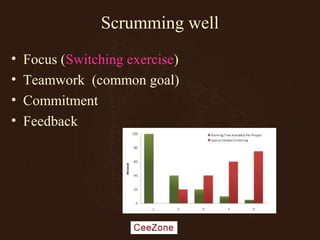
Scrumming well
• Focus (Switching exercise)
• Teamwork (common goal)
• Commitment
• Feedback
References
BOOK(S)
• Agile Project management with Scrum –
Ken Schwaber
• Exploring Scrum – Dan Rawsthorne and
Doug Shimp
WEBSITES
http://www.scrumalliance.org
http://www.mountaingoat.com

Scrum overview

  • 1.
    Welcome to anew World! A world of SCRUM “Designing and programming are above all human activities, forget that and all is lost“ --- B Stroustrup
  • 2.
    About the Speaker(s) SrinivasChillara • Masters, Reading University, UK Information Systems Engineering • Professional interests – Software processes – Software quality • Current foci – Scrum – TDD – Test management and strategy
  • 3.
    Sub topics (TBD) •Co-creation of this talk • Roles: Programmer, analyst, tester, architect, manager, build engineer; The opportunity of leadership, and the need for it; • Scrum in action: • Prioritisation • Feedback • Communication • Inspect and adapt • Case study 1: Team in offshore unit of product dev co. • Case study 2: IT subsidiary of global bank; with vendor team members
  • 4.
    What is goodabout the waterfall? • Predictable • Demarcated • Popular • Dependable
  • 5.
    The problem withwaterfall What else about the waterfall?
  • 6.
    Project Management Traditional •Centralised, irrespective of the circumstance • Plan and task driven • Based on production line approach • Deferral of pain to the end
  • 7.
    Project Management-new wave Scrum •Iterative and Incremental • Flexible • People-centric • Goal oriented – not task oriented
  • 8.
    The Emergence ofScrum  Google  IBM  Siemens  Nokia  Philips  Accenture  Microsoft  Infosys  Wipro  Motorola  HP  TCS  An increasing number of companies are finding Scrum an effective tool for improving these problems  Rapid growth in last 3-5 years at leading global companies, such as:
  • 9.
    Distribution of methodologies Source:VersionOne 3rd Annual survey
  • 10.
    Size of organisations Source:VersionOne 3rd Annual survey
  • 11.
    Scrum at Yahoo! •4 pilot teams migrated to Scrum in early 2005 • Since then, >200 Yahoo! projects (>2000 people) around the globe have migrated to Scrum – Consumer-facing projects – Major infrastructure projects – Distributed Projects – New Products – Maintenance Products • Policy is 100% voluntary adoption – Teams hear about or observe the experiences of other teams using Scrum and decide to learn more
  • 12.
    0% 5% 10% 15% 20% 25% 30% 35% 40% 45% 50% Scrum MUCH WORSE Scrum WORSE Scrum about the same Scrum BETTER Scrum MUCH BETTER 68%5% ScrumBETTER or MUCH BETTERScrum WORSE or MUCH WORSE Scrum vs. Previous Approach: Productivity / How much team got done. 36% Average Increase
  • 13.
    Scrum vs. PreviousApproach: Morale? 0% 5% 10% 15% 20% 25% 30% 35% Scrum MUCH WORSE Scrum WORSE Scrum about the same Scrum BETTER Scrum MUCH BETTER 52%9% Scrum BETTER or MUCH BETTERScrum WORSE or MUCH WORSE
  • 14.
    Scrum vs. PreviousApproach: Sense of accountability/ownership in project? 0% 5% 10% 15% 20% 25% 30% 35% Scrum MUCH WORSE Scrum WORSE Scrum about the same Scrum BETTER Scrum MUCH BETTER 62%6% Scrum BETTER or MUCH BETTERScrum WORSE or MUCH WORSE
  • 15.
    Scrum vs. PreviousApproach: Overall quality of what was developed? 0% 5% 10% 15% 20% 25% 30% 35% 40% 45% Scrum MUCH WORSE Scrum WORSE Scrum about the same Scrum BETTER Scrum MUCH BETTER 44%10% Scrum BETTER or MUCH BETTERScrum WORSE or MUCH WORSE
  • 16.
    Yes 85% No 15% Ifthe decision were solely up to you, would your team continue using Scrum?
  • 17.
    Scrum characteristics Stresses dependenceon people. Properties – Iterative – Time-boxed – Customer instantiation – Scalable
  • 18.
    FDD overview OO basedmodelling Steps: – Develop overall model – Establish feature list – Create plan (for above) – Develop design and work packages – Build S/W
  • 19.
    XP in aflash Principles: Feedback, Simplicity, Incremental change, Quality. Practices (a few) – Pair programming – On-site customer – Small iterations – Sustainable pace
  • 20.
    It is Scrumnot SCRUM! Rugby student William Webb Ellis, 17, inaugurates a new game whose rules will be codified in 1839. Playing football for the 256- year-old school in East Warwickshire, Ellis sees that the clock is running out with his team behind so he scoops up the ball and runs with it in defiance of the rules.
  • 21.
    It is Scrumnot SCRUM! Occasionally spelt as scum, not always by mistake. Scrum is a framework where customers and teams can create/develop software and …. It is NOT a magic wand!!
  • 22.
    SCRUM Lifecycle Product Backlog Asprioritized by Product Owner Sprint Backlog
  • 23.
    SCRUM Lifecycle Product Backlog Asprioritized by Product Owner Sprint Backlog Backlog tasks expanded by team
  • 24.
    SCRUM Lifecycle 30 days ProductBacklog As prioritized by Product Owner Sprint Backlog Backlog tasks expanded by team SPRINT
  • 25.
    SCRUM Lifecycle 30 days 24hours Product Backlog As prioritized by Product Owner Sprint Backlog Backlog tasks expanded by team Daily Scrum Meeting
  • 26.
    SCRUM Lifecycle 30 days 24hours Product Backlog As prioritized by Product Owner Sprint Backlog Backlog tasks expanded by team Potentially Shippable Product Increment Daily Scrum Meeting
  • 27.
    Wkhe jfih weoifhsadiuh Fhjds io dsoifj iodsjf iodsd Dsojf oidsj ofisjoi fsoidj Wkhe jfih weoifh Wkhe jfih weoifh Iojs rfodjfo is Wkhe jfih weoifh Joid fois dj
  • 28.
    Wkhe jfih weoifhsadiuh Fhjds io dsoifj iodsjf iodsd Dsojf oidsj ofisjoi fsoidj Wkhe jfih weoifh Wkhe jfih weoifh Iojs rfodjfo is Wkhe jfih weoifh Joid fois dj
  • 29.
    Wkhe jfih weoifhsadiuh Fhjds io dsoifj iodsjf iodsd Dsojf oidsj ofisjoi fsoidj Wkhe jfih weoifh Wkhe jfih weoifh Iojs rfodjfo is Wkhe jfih weoifh Joid fois dj
  • 30.
    Roles The Team Product Owner ScrumMaster A balance of power and responsibility.
  • 31.
    SCRUM MASTER Is NOTa Project lead/manager/coordinator. • The ScrumMasters do everything in their power to help the team achieve success • This includes: – Serving the team – Protecting the team – Guiding the team’s use of Scrum
  • 32.
    Scrum smells • Lossof Rhythm • Talking Chickens • Missing Pigs • Lack of Progress Part One: Failing in Backlog Management • Persistent Signatures • ScrumMaster Assigns Work
  • 33.
    Scrum smells • Thedaily Scrum lasts 45 min over the phone • The daily Scrum is For the ScrumMaster • Specialized Job Roles • Testers will not integrate with Team • It is done, well, almost done • No One Wants to Attend Retrospectives
  • 34.
    How do wechange? • Have a good reason • Get an experienced coach • Start and complete a couple of projects • Use the learning … and proceed
  • 35.
    Stress Prioritisation The artof doing less Only about 20% of features are used heavily and about another 20% used sometimes … so let’s avoid 60% of the work How? Everyone knows only half of advertising is effective, the trouble is … no one knows which half.
  • 36.
    Scrum charecteristics • Prioritisation •Focus • Communication • Feedback
  • 37.
  • 38.
    Why Has ScrumBecome So Popular? • More business value delivered sooner • Better return-on-investment for projects • Greater visibility • Improved productivity • Less waste • Higher quality • Stronger teams • Better morale
  • 39.
    Scrum Challenges • It’shard! • It requires significant change • It makes all dysfunction visible – Scrum doesn’t fix anything: the team has to do it – It forces honesty and transparency – If you don’t address the problems, it will be painful • Bad products will be delivered sooner, and doomed projects will fail faster • Partial adoption may be worse than none at all • Be forewarned: many Scrum adoptions fail
  • 40.
    The Essence ofScrum Timebox InspectNo Changes Adapt Commit SCRUM
  • 41.
    Code complete Code reviewed Unittested Integrated Documented No P1 defects, <3 P2 defects
  • 42.
    The Traditional Approach Requirements Gathering Design Development Testing Rework Documentation, Signoffs,Handoff Documentation, Signoffs, Handoff Documentation, Signoffs, Handoff Documentation, Signoffs, Handoff Job Function A Job Function B Job Function C Job Function D Job Function E
  • 43.
    Scrum: Iterative IncrementalDevelopment Feature A Design Develop Test Rework Feature B Design Develop Test Rework Feature C Design Develop Test Rework Feature D Design Develop Test Rework Feature E Design Develop Test Rework Cross-Functional Team (Designers, Developers, Testers)
  • 44.
    Scrumming well • Focus(Switching exercise) • Teamwork (common goal) • Commitment • Feedback
  • 45.
    References BOOK(S) • Agile Projectmanagement with Scrum – Ken Schwaber • Exploring Scrum – Dan Rawsthorne and Doug Shimp WEBSITES http://www.scrumalliance.org http://www.mountaingoat.com

Editor's Notes

  • #19 Steps 3 onward it is iterative
  • #36 The software is put into usage earlier, so essential features are found out earlier.
  • #37 The software is put into usage earlier, so essential features are found out earlier.