KATA
© 2016 The Leadership Network®
© 2016 Jidoka®
Beth Carrington
01
Mike Rother
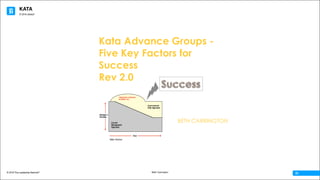
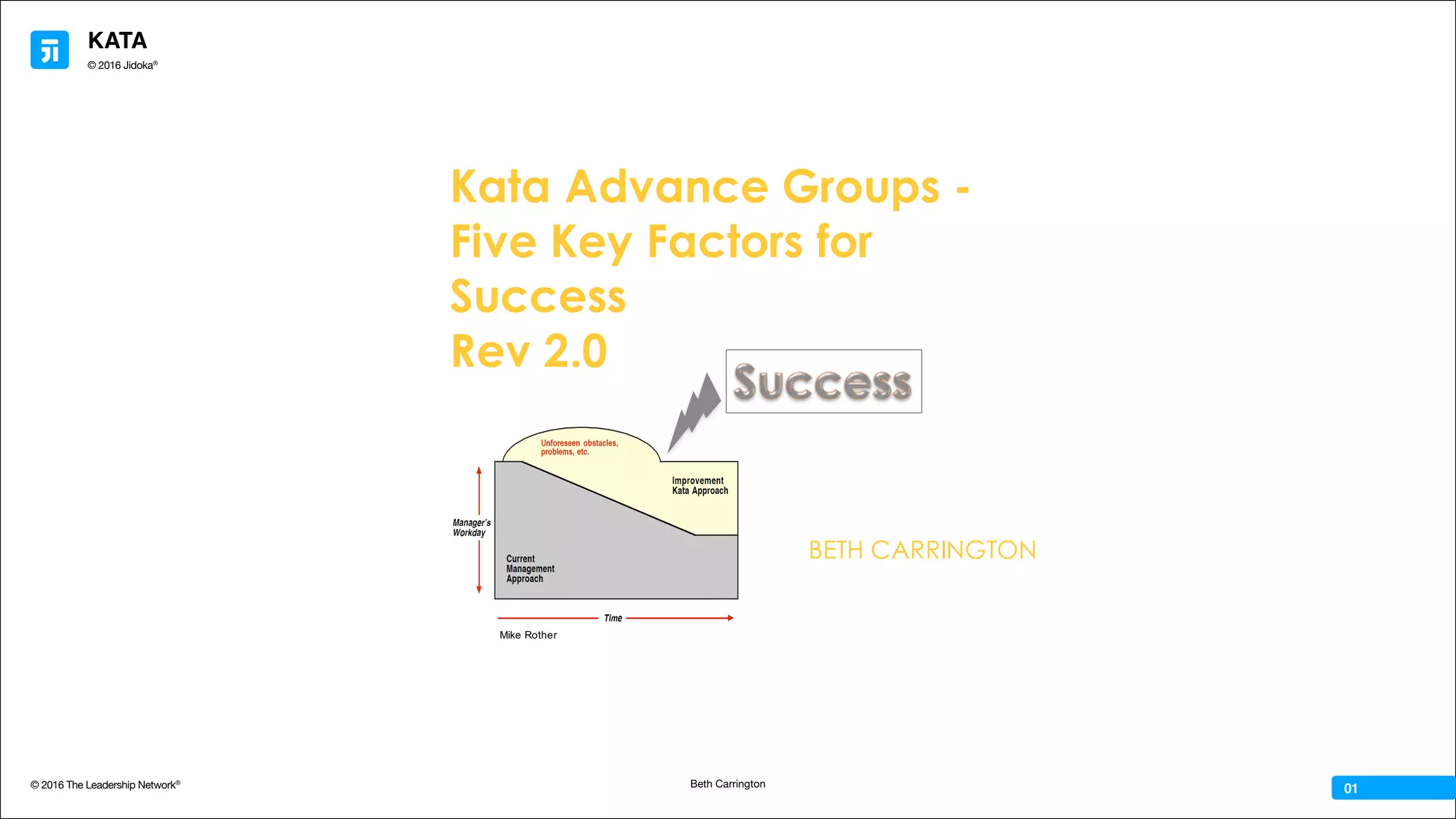
Kata Advance Groups -
Five Key Factors for
Success
Rev 2.0
BETH CARRINGTON
KATA
© 2016 The Leadership Network®
© 2016 Jidoka®
Beth Carrington
02
5 FACTORS
in the successful deployment
of Toyota Kata
1. Relevancy
2. Right People in Right Roles
3. Close-in Target Conditions
4. Frequent and Rapid PDCA’s
5. Purposeful Coaching Cycles
Your “Advance Group”, who shepherds and
PDCAs your organization’s deployment, should
assure that these factors are in play
KATA
© 2016 The Leadership Network®
© 2016 Jidoka®
Beth Carrington
03
ADVANCE GROUPS
Advance Groups (AGs) are charged with
actively monitoring and guiding
the organization’s kata deployment.
KATA
© 2016 The Leadership Network®
© 2016 Jidoka®
Beth Carrington
04
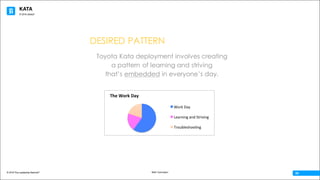
DESIRED PATTERN
Toyota Kata deployment involves creating
a pattern of learning and striving
that’s embedded in everyone’s day.
The	Work	Day	
Work	Day	
Learning	and	Striving	
Troubleshoo8ng
KATA
© 2016 The Leadership Network®
© 2016 Jidoka®
Beth Carrington
05
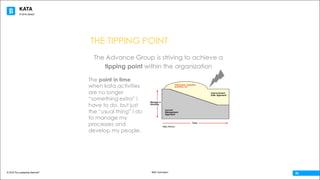
THE TIPPING POINT
The Advance Group is striving to achieve a
tipping point within the organization
The point in time
when kata activities
are no longer
“something extra” I
have to do, but just
the “usual thing” I do
to manage my
processes and
develop my people.
Mike Rother
KATA
© 2016 The Leadership Network®
© 2016 Jidoka®
Beth Carrington
06
A MOMENT
§ A tipping point is a moment that signals the
beginning of dramatic change.
§ Malcolm Gladwell asserts that tipping points
explain uncanny phenomena; the momentum
behind the spread of AIDS or the murder rate in
the NYC suddenly dropping in the mid 1990’s.
§ More interestingly, it’s the basis of the idea that
behaviors and ideas are contagious; in other
words, they also have tipping points.
KATA
© 2016 The Leadership Network®
© 2016 Jidoka®
Beth Carrington
07
FACTOR 1
RELEVANCY
Improvement Kata activity has to be
relevant
q to the organization
q to the 2nd Coach
q to the Coach
q to the Learner
KATA
© 2016 The Leadership Network®
© 2016 Jidoka®
Beth Carrington
08
OUTCOMES ARE
CRITICAL
Relevancy comes when the outcomes are
critical…
qImprovement Kata is deployed on critical
organizational challenges and processes.
qCoaches have a vested interest in the outcomes
and are held accountable for the results.
qLearners are the process owners and will
personally benefit from the improvements
achieved.
KATA
© 2016 The Leadership Network®
© 2016 Jidoka®
Beth Carrington
09
FACTOR 2
RIGHT PEOPLE IN RIGHT ROLES
q Learner’s role is to apply the Improvement
Kata following a scientific model to obtain
innovative improvements.
q Coach’s role is to teach the scientific model
to obtain innovative improvements.
q 2nd Coach’s role is to the teach coaching
kata to the primary coach.
KATA
© 2016 The Leadership Network®
© 2016 Jidoka®
10Beth Carrington
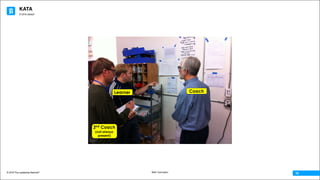
Learner
2nd Coach
(not always
present)
Coach
KATA
© 2016 The Leadership Network®
© 2016 Jidoka®
11Beth Carrington
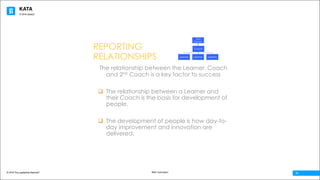
REPORTING
RELATIONSHIPS
The relationship between the Learner, Coach
and 2nd Coach is a key factor to success
q The relationship between a Learner and
their Coach is the basis for development of
people.
q The development of people is how day-to-
day improvement and innovation are
delivered.
2nd
Coach
LearnerLearnerLearner
Coach
KATA
© 2016 The Leadership Network®
© 2016 Jidoka®
12Beth Carrington
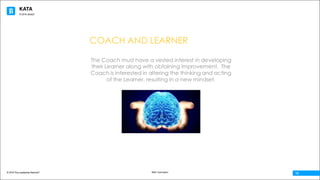
COACH AND LEARNER
The Coach must have a vested interest in developing
their Learner along with obtaining improvement. The
Coach is interested in altering the thinking and acting
of the Learner, resulting in a new mindset.
KATA
© 2016 The Leadership Network®
© 2016 Jidoka®
13Beth Carrington
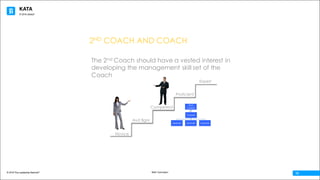
2ND COACH AND COACH
The 2nd Coach should have a vested interest in
developing the management skill set of the
Coach
Novice
Avd Bgnr
Competent
Proficient
Expert
2nd
Coach
LearnerLearnerLearner
Coach
KATA
© 2016 The Leadership Network®
© 2016 Jidoka®
14Beth Carrington
PEER SKILL DEVELOPMENT VERSUS
DAY-TO-DAY MANGANGENT
Sometimes peer-to-peer Learner, Coach and
2nd Coach roles are assigned, particularly
during early skill development stages.
While peers can find challenges relevant and
improvements can be made, there is no
expectation to develop skill. Skill development
of peers is not in their scope of responsibilities,
unlike a manager with their subordinate.
KATA
© 2016 The Leadership Network®
© 2016 Jidoka®
15Beth Carrington
FACTOR 3
CLOSE-IN TARGET CONDITIONS
Target conditions,
particularly with Novice
learners and coaches, tend
to be large and more
complex then they should
be.
This leads to large and
complex PDCA’s. PDCA’s
that could be target
conditions in and of
themselves!
KATA
© 2016 The Leadership Network®
© 2016 Jidoka®
16Beth Carrington
ADVANCE GROUP
TARGET CONDITION REVIEWS
Advance Groups should
review target conditions to
assure they are:
1. Of the proper distance
into the future
2. Aligned to
organizational
challenge
KATA
© 2016 The Leadership Network®
© 2016 Jidoka®
17Beth Carrington
NOVICE SKILL LEVEL
TARGET CONDITIONS
For Novices, Target
Conditions should
be set 1 or 2 weeks
out.
KATA
© 2016 The Leadership Network®
© 2016 Jidoka®
18Beth Carrington
ADVANCED BEGINNER
OR COMPETENT SKILL LEVEL
Process level
target conditions
should be no more
than 3 to 4 weeks out.
Value stream target
conditions should be
no more than 1
month to 3 months
out.
KATA
© 2016 The Leadership Network®
© 2016 Jidoka®
19Beth Carrington
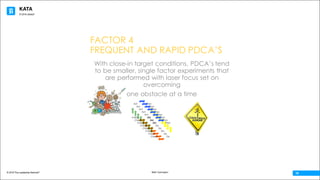
FACTOR 4
FREQUENT AND RAPID PDCA’S
With close-in target conditions, PDCA’s tend
to be smaller, single factor experiments that
are performed with laser focus set on
overcoming
one obstacle at a time
Plan
DoCheck
Act
Plan
DoCheck
Act
Plan
DoCheck
Act
Plan
DoCheck
Act
Plan
DoCheck
Act
Plan
DoCheck
Act
Plan
DoCheck
Act
Plan
DoCheck
Act
KATA
© 2016 The Leadership Network®
© 2016 Jidoka®
20Beth Carrington
KEEP LEARNERS ENGAGED
Frequent and rapid PDCA’s keep the learning
and improvements coming at a fast pace,
keeping the Learner and their teams
motivated and engaged.
KATA
© 2016 The Leadership Network®
© 2016 Jidoka®
21Beth Carrington
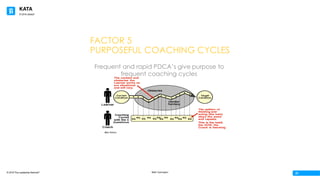
FACTOR 5
PURPOSEFUL COACHING CYCLES
Frequent and rapid PDCA’s give purpose to
frequent coaching cycles
Mike Rother
KATA
© 2016 The Leadership Network®
© 2016 Jidoka®
22Beth Carrington
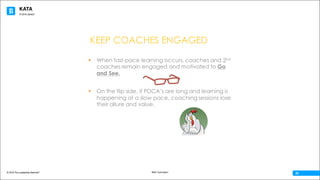
KEEP COACHES ENGAGED
§ When fast-pace learning occurs, coaches and 2nd
coaches remain engaged and motivated to Go
and See.
§ On the flip side, if PDCA’s are long and learning is
happening at a slow pace, coaching sessions lose
their allure and value.
KATA
© 2016 The Leadership Network®
© 2016 Jidoka®
23Beth Carrington
SUMMARY
1. Relevancy
2. Right People in Right Roles
3. Close-in Target Conditions
4. Frequent and Rapid PDCA’s
5. Purposeful Coaching Cycles
Advance Groups... keep these factors in
play!
KATA
© 2016 The Leadership Network®
© 2016 Jidoka®
24Beth Carrington
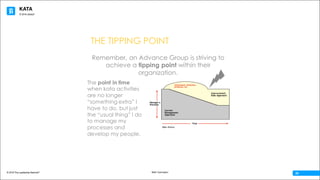
THE TIPPING POINT
Remember, an Advance Group is striving to
achieve a tipping point within their
organization.
The point in time
when kata activities
are no longer
“something extra” I
have to do, but just
the “usual thing” I do
to manage my
processes and
develop my people.
Mike Rother

Lecture 7a

  • 1.
    KATA © 2016 TheLeadership Network® © 2016 Jidoka® Beth Carrington 01 Mike Rother Kata Advance Groups - Five Key Factors for Success Rev 2.0 BETH CARRINGTON
  • 2.
    KATA © 2016 TheLeadership Network® © 2016 Jidoka® Beth Carrington 02 5 FACTORS in the successful deployment of Toyota Kata 1. Relevancy 2. Right People in Right Roles 3. Close-in Target Conditions 4. Frequent and Rapid PDCA’s 5. Purposeful Coaching Cycles Your “Advance Group”, who shepherds and PDCAs your organization’s deployment, should assure that these factors are in play
  • 3.
    KATA © 2016 TheLeadership Network® © 2016 Jidoka® Beth Carrington 03 ADVANCE GROUPS Advance Groups (AGs) are charged with actively monitoring and guiding the organization’s kata deployment.
  • 4.
    KATA © 2016 TheLeadership Network® © 2016 Jidoka® Beth Carrington 04 DESIRED PATTERN Toyota Kata deployment involves creating a pattern of learning and striving that’s embedded in everyone’s day. The Work Day Work Day Learning and Striving Troubleshoo8ng
  • 5.
    KATA © 2016 TheLeadership Network® © 2016 Jidoka® Beth Carrington 05 THE TIPPING POINT The Advance Group is striving to achieve a tipping point within the organization The point in time when kata activities are no longer “something extra” I have to do, but just the “usual thing” I do to manage my processes and develop my people. Mike Rother
  • 6.
    KATA © 2016 TheLeadership Network® © 2016 Jidoka® Beth Carrington 06 A MOMENT § A tipping point is a moment that signals the beginning of dramatic change. § Malcolm Gladwell asserts that tipping points explain uncanny phenomena; the momentum behind the spread of AIDS or the murder rate in the NYC suddenly dropping in the mid 1990’s. § More interestingly, it’s the basis of the idea that behaviors and ideas are contagious; in other words, they also have tipping points.
  • 7.
    KATA © 2016 TheLeadership Network® © 2016 Jidoka® Beth Carrington 07 FACTOR 1 RELEVANCY Improvement Kata activity has to be relevant q to the organization q to the 2nd Coach q to the Coach q to the Learner
  • 8.
    KATA © 2016 TheLeadership Network® © 2016 Jidoka® Beth Carrington 08 OUTCOMES ARE CRITICAL Relevancy comes when the outcomes are critical… qImprovement Kata is deployed on critical organizational challenges and processes. qCoaches have a vested interest in the outcomes and are held accountable for the results. qLearners are the process owners and will personally benefit from the improvements achieved.
  • 9.
    KATA © 2016 TheLeadership Network® © 2016 Jidoka® Beth Carrington 09 FACTOR 2 RIGHT PEOPLE IN RIGHT ROLES q Learner’s role is to apply the Improvement Kata following a scientific model to obtain innovative improvements. q Coach’s role is to teach the scientific model to obtain innovative improvements. q 2nd Coach’s role is to the teach coaching kata to the primary coach.
  • 10.
    KATA © 2016 TheLeadership Network® © 2016 Jidoka® 10Beth Carrington Learner 2nd Coach (not always present) Coach
  • 11.
    KATA © 2016 TheLeadership Network® © 2016 Jidoka® 11Beth Carrington REPORTING RELATIONSHIPS The relationship between the Learner, Coach and 2nd Coach is a key factor to success q The relationship between a Learner and their Coach is the basis for development of people. q The development of people is how day-to- day improvement and innovation are delivered. 2nd Coach LearnerLearnerLearner Coach
  • 12.
    KATA © 2016 TheLeadership Network® © 2016 Jidoka® 12Beth Carrington COACH AND LEARNER The Coach must have a vested interest in developing their Learner along with obtaining improvement. The Coach is interested in altering the thinking and acting of the Learner, resulting in a new mindset.
  • 13.
    KATA © 2016 TheLeadership Network® © 2016 Jidoka® 13Beth Carrington 2ND COACH AND COACH The 2nd Coach should have a vested interest in developing the management skill set of the Coach Novice Avd Bgnr Competent Proficient Expert 2nd Coach LearnerLearnerLearner Coach
  • 14.
    KATA © 2016 TheLeadership Network® © 2016 Jidoka® 14Beth Carrington PEER SKILL DEVELOPMENT VERSUS DAY-TO-DAY MANGANGENT Sometimes peer-to-peer Learner, Coach and 2nd Coach roles are assigned, particularly during early skill development stages. While peers can find challenges relevant and improvements can be made, there is no expectation to develop skill. Skill development of peers is not in their scope of responsibilities, unlike a manager with their subordinate.
  • 15.
    KATA © 2016 TheLeadership Network® © 2016 Jidoka® 15Beth Carrington FACTOR 3 CLOSE-IN TARGET CONDITIONS Target conditions, particularly with Novice learners and coaches, tend to be large and more complex then they should be. This leads to large and complex PDCA’s. PDCA’s that could be target conditions in and of themselves!
  • 16.
    KATA © 2016 TheLeadership Network® © 2016 Jidoka® 16Beth Carrington ADVANCE GROUP TARGET CONDITION REVIEWS Advance Groups should review target conditions to assure they are: 1. Of the proper distance into the future 2. Aligned to organizational challenge
  • 17.
    KATA © 2016 TheLeadership Network® © 2016 Jidoka® 17Beth Carrington NOVICE SKILL LEVEL TARGET CONDITIONS For Novices, Target Conditions should be set 1 or 2 weeks out.
  • 18.
    KATA © 2016 TheLeadership Network® © 2016 Jidoka® 18Beth Carrington ADVANCED BEGINNER OR COMPETENT SKILL LEVEL Process level target conditions should be no more than 3 to 4 weeks out. Value stream target conditions should be no more than 1 month to 3 months out.
  • 19.
    KATA © 2016 TheLeadership Network® © 2016 Jidoka® 19Beth Carrington FACTOR 4 FREQUENT AND RAPID PDCA’S With close-in target conditions, PDCA’s tend to be smaller, single factor experiments that are performed with laser focus set on overcoming one obstacle at a time Plan DoCheck Act Plan DoCheck Act Plan DoCheck Act Plan DoCheck Act Plan DoCheck Act Plan DoCheck Act Plan DoCheck Act Plan DoCheck Act
  • 20.
    KATA © 2016 TheLeadership Network® © 2016 Jidoka® 20Beth Carrington KEEP LEARNERS ENGAGED Frequent and rapid PDCA’s keep the learning and improvements coming at a fast pace, keeping the Learner and their teams motivated and engaged.
  • 21.
    KATA © 2016 TheLeadership Network® © 2016 Jidoka® 21Beth Carrington FACTOR 5 PURPOSEFUL COACHING CYCLES Frequent and rapid PDCA’s give purpose to frequent coaching cycles Mike Rother
  • 22.
    KATA © 2016 TheLeadership Network® © 2016 Jidoka® 22Beth Carrington KEEP COACHES ENGAGED § When fast-pace learning occurs, coaches and 2nd coaches remain engaged and motivated to Go and See. § On the flip side, if PDCA’s are long and learning is happening at a slow pace, coaching sessions lose their allure and value.
  • 23.
    KATA © 2016 TheLeadership Network® © 2016 Jidoka® 23Beth Carrington SUMMARY 1. Relevancy 2. Right People in Right Roles 3. Close-in Target Conditions 4. Frequent and Rapid PDCA’s 5. Purposeful Coaching Cycles Advance Groups... keep these factors in play!
  • 24.
    KATA © 2016 TheLeadership Network® © 2016 Jidoka® 24Beth Carrington THE TIPPING POINT Remember, an Advance Group is striving to achieve a tipping point within their organization. The point in time when kata activities are no longer “something extra” I have to do, but just the “usual thing” I do to manage my processes and develop my people. Mike Rother