KATA
© 2016 The Leadership Network®
© 2016 Jidoka®
01
© Mike Rother / Improvement Kata Handbook
TOYOTA KATA
PDCA toward the
Target Condition
KATA
© 2016 The Leadership Network®
© 2016 Jidoka®
02
NOW THAT YOU HAVE A TARGET CONDITION,
HOW DO YOU GET THERE?
How to reach your
goals when you
cannot see the road
ahead?
KATA
© 2016 The Leadership Network®
© 2016 Jidoka®
03
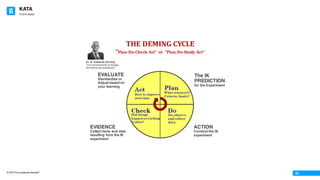
The IK
PREDICTION
for the Experiment
ACTION
Conduct the IK
experiment
EVALUATE
Standardize or
Adjust based on
your learning
EVIDENCE
Collect facts and data
resulting from the IK
experiment
THE	DEMING	CYCLE
"Plan-Do-Check-Act"		or		"Plan-Do-Study-Act"	
Dr. W. Edwards Deming
“It	is	not	necessary	to	change.	
Survival	is	not	mandatory.”
KATA
© 2016 The Leadership Network®
© 2016 Jidoka®
04
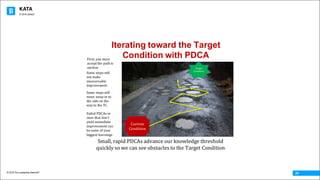
Iterating toward the Target
Condition with PDCA
Small,	rapid	PDCAs	advance	our	knowledge	threshold	
quickly	so	we	can	see	obstacles	to	the	Target	Condition
Current	
Condition
Target	
Condition
First,	you	must	
accept	the	path	is	
unclear
Some	steps	will	
not	make	
measureable	
improvement.
Some	steps	will	
move	away	or	to	
the	side	on	the	
way	to	the	TC.
Failed	PDCAs	or	
ones	that	don’t	
yield	immediate	
improvement	can	
be	some	of	your	
biggest	learnings
KATA
© 2016 The Leadership Network®
© 2016 Jidoka®
05
© Mike Rother / Improvement Kata Handbook Iterate Toward the Target Condition
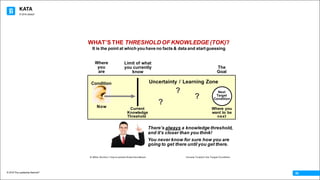
WHATʼS THE THRESHOLD OF KNOWLEDGE (TOK)?
It is the point at which you have no facts & data and start guessing
Thereʼs always a knowledge threshold,
and itʼs closer than you think!
You never know for sure how you are
going to get there until you get there.
Uncertainty / Learning Zone
Next
Target
Condition
Current
Knowledge
Threshold
?
?
?
Condition
Now Where you
want to be
next
Where
you
are
Limit of what
you currently
know
The
Goal
KATA
© 2016 The Leadership Network®
© 2016 Jidoka®
6
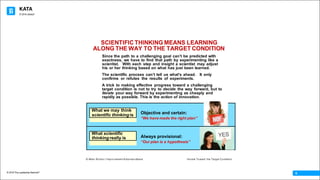
Since the path to a challenging goal canʼt be predicted with
exactness, we have to find that path by experimenting like a
scientist. With each step and insight a scientist may adjust
his or her thinking based on what has just been learned.
The scientific process canʼt tell us what's ahead. It only
confirms or refutes the results of experiments.
A trick to making effective progress toward a challenging
target condition is not to try to decide the way forward, but to
iterate your way forward by experimenting as cheaply and
rapidly as possible. This is the action of innovation.
SCIENTIFIC THINKING MEANS LEARNING
ALONG THE WAY TO THE TARGET CONDITION
Objective and certain:
“We have made the right plan”
Always provisional:
“Our plan is a hypothesis”
What we may think
scientific thinking is
What scientific
thinking really is
© Mike Rother / Improvement Kata Handbook Iterate Toward the Target Condition
6
KATA
© 2016 The Leadership Network®
© 2016 Jidoka®
7
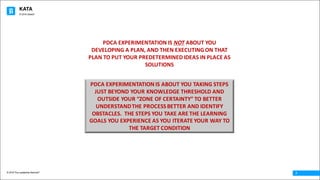
PDCA	EXPERIMENTATION	IS	NOT ABOUT	YOU	
DEVELOPING	A	PLAN,	AND	THEN	EXECUTING	ON	THAT	
PLAN	TO	PUT	YOUR	PREDETERMINED	IDEAS	IN	PLACE	AS	
SOLUTIONS
PDCA	EXPERIMENTATION	IS	ABOUT	YOU	TAKING	STEPS	
JUST	BEYOND	YOUR	KNOWLEDGE	THRESHOLD	AND	
OUTSIDE	YOUR	“ZONE	OF	CERTAINTY”	TO	BETTER	
UNDERSTAND	THE	PROCESS	BETTER	AND	IDENTIFY	
OBSTACLES.		THE	STEPS	YOU	TAKE	ARE	THE	LEARNING	
GOALS	YOU	EXPERIENCE	AS	YOU	ITERATE	YOUR	WAY	TO	
THE	TARGET	CONDITION
KATA
© 2016 The Leadership Network®
© 2016 Jidoka®
8
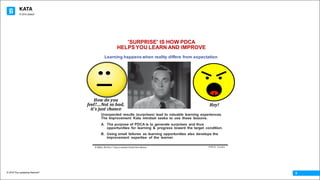
'SURPRISE' IS HOW PDCA
HELPS YOU LEARN AND IMPROVE
Learning happens when reality differs from expectation
Unexpected results (surprises) lead to valuable learning experiences.
The Improvement Kata mindset seeks to use these lessons.
A. The purpose of PDCA is to generate surprises and thus
opportunities for learning & progress toward the target condition.
B. Using small failures as learning opportunities also develops the
improvement expertise of the learner.
PDCA Cycles
Scenario	2
2,	4,	8,	16,	32,	______	?
Write	down	the	next	
two	numbers	in	this	
series.		Then	click.		
How	do	you	feel?
Scenario	1
Write	the	Sum	of	a	3	
dice	roll______?
Roll	them	and	see	if	
your	sum	was	correct
-2,	-4
How	do	you	
feel?....Not	so	bad,
it’s	just	chance
Hey!
© Mike Rother / Improvement Kata Handbook
KATA
© 2016 The Leadership Network®
© 2016 Jidoka®
9
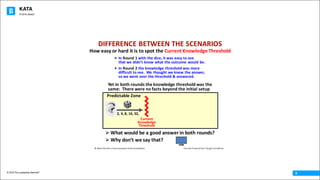
DIFFERENCE	BETWEEN	THE	SCENARIOS
How	easy	or	hard	it	is	to	spot	the	Current	Knowledge	Threshold
• In	Round	1 with	the	dice,	it	was	easy	to	see
that	we	didn’t	know	what	the	outcome	would	be.
•	 In	Round	2 the	knowledge	threshold	was	more
difficult	to	see.		We	thought	we	knew	the	answer,
so	we	went	over	the	threshold	&	answered.
Ø What	would	be	a	good	answer	in	both	rounds?
Ø Why	don’t	we	say	that?
Yet	in	both	rounds	the	knowledge	threshold	was	the	
same:		There	were	no	facts	beyond	the	initial	setup
Predictable	Zone
Current
Knowledge
Threshold
2,	4,	8,	16,	32,
© Mike Rother / Improvement Kata Handbook Iterate Toward the Target Condition
KATA
© 2016 The Leadership Network®
© 2016 Jidoka®
10
VIDEO:		Scientific	thinking
(3	minutes)
KATA
© 2016 The Leadership Network®
© 2016 Jidoka®
11
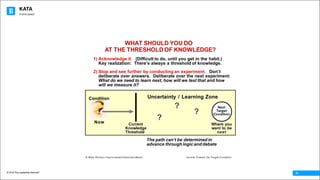
WHAT SHOULD YOU DO
AT THE THRESHOLD OF KNOWLEDGE?
1) Acknowledge it. (Difficult to do, until you get in the habit.)
Key realization: Thereʼs always a threshold of knowledge.
2) Stop and see further by conducting an experiment. Donʼt
deliberate over answers. Deliberate over the next experiment:
What do we need to learn next, how will we test that and how
will we measure it?
The path canʼt be determined in
advance through logic and debate
Uncertainty / Learning Zone
Next
Target
Condition
Current
Knowledge
Threshold
?
?
?
Condition
Now
© Mike Rother / Improvement Kata Handbook Iterate Toward the Target Condition
Where you
want to be
next
KATA
© 2016 The Leadership Network®
© 2016 Jidoka®
12
Scientific thinking is the process you go through to disprove your theory and
hypothesis. You should think of ways to refute what you believe to be true.
When your results (evidence) differ from your expectations (predictions) real
learning happens – this is called prediction error, and is necessary to advance
our exploration. If you set out to disprove your theories, then you cannot,
then and only then, can you say “we must be getting at something really true!”
If your simply confirming what you already know or think to be true, you are
engaging in prediction confirmation.
However, in traditional problem solving thinking, we do the opposite. We set
out to prove our perceptions of reality are true. This stifles the innovation
process. We analyze the process attempting to determine the root cause of
where it breaks down, and then FIX IT!, and move on. But the law of entropy
states that any system will deteriorate over time.
It’s the process of constantly striving for the Target Condition, reaching it, and
then establishing where we want to be next (i.e. the next Target Condition) that
fights entropy and fuels sustainment.
SO WHAT DOES SCIENTIFIC
THINKING MEAN?
Prediction	Confirmation	=	little learning
KATA
© 2016 The Leadership Network®
© 2016 Jidoka®
13
Learning	through	refuted	hypotheses
KATA
© 2016 The Leadership Network®
© 2016 Jidoka®
14
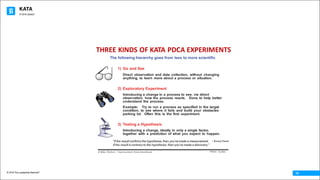
THREE	KINDS	OF	KATA	PDCA	EXPERIMENTS
PDCA Cycles
The following hierarchy goes from less to more scientific
1) Go and See
Direct observation and data collection, without changing
anything, to learn more about a process or situation.
2) Exploratory Experiment
Introducing a change in a process to see, via direct
observation, how the process reacts. Done to help better
understand the process.
Example: Try to run a process as specified in the target
condition, to see where it fails and build your obstacles
parking lot. Often this is the first experiment.
3) Testing a Hypothesis
Introducing a change, ideally in only a single factor,
together with a prediction of what you expect to happen.
“If the result confirms the hypothesis, then you've made a measurement.
If the result is contrary to the hypothesis, then you've made a discovery.”
~ Enrico Fermi
© Mike Rother / Improvement Kata Handbook
KATA
© 2016 The Leadership Network®
© 2016 Jidoka®
15
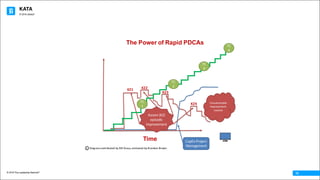
The Power of Rapid PDCAs
Time CapEx	Project	
Management
Kaizen	(KZ)	
episodic	
improvement
KZ1 KZ2
KZ3
KZ4
TC
4
c			Diagram	contributed	by	Bill	Kraus,	animated	by	Brandon	Brown
TC
3
TC
2
TC
1
Unsustainable	
improvement	
routine
KATA
© 2016 The Leadership Network®
© 2016 Jidoka®
16
VIDEO	2:		Working	Iteratively
(3	minutes)
https://www.youtube.com/watch?v=H0_yKBitO8M
Also	available	on	the	IK/CK	YouTube	Channel
KATA
© 2016 The Leadership Network®
© 2016 Jidoka®
17
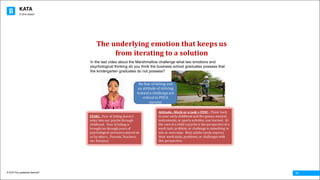
The	underlying	emotion	that	keeps	us	
from	iterating	to	a	solution
In the last video about the Marshmallow challenge what two emotions and
psychological thinking do you think the business school graduates possess that
the kindergarten graduates do not possess?
FEAR!....Fear	of	failing	doesn’t	
enter	into	our	psyche	through	
childhood.		Fear	of	failing	is	
brought	on	through	years	of	
psychological	pressures	placed	on	
us	by	others…Parents,	Teachers,	
our	Boss(es).	
Attitude…Work	or	a	task	=	FUN!....Think	 back	
to	your	early	childhood	and	the	games,	musical	
instruments,	or	sports	activities	you	learned.		At	
the	core	of	a	child’s	psyche	is	the	perspective	of	a	
work	task,	problem,	or	challenge	is	something	to	
win	or	overcome.		Most	adults	rarely	express	
their	work	tasks,	problems,	or	challenges	with	
this	perspective.
No	fear	of	failing	and	
an	attitude	of	striving	
toward	a	challenge	are	
critical	to	PDCA	
success
KATA
© 2016 The Leadership Network®
© 2016 Jidoka®
18
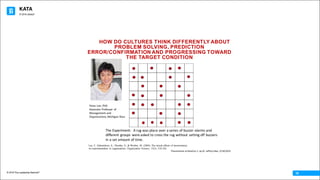
HOW DO CULTURES THINK DIFFERENTLY ABOUT
PROBLEM SOLVING, PREDICTION
ERROR/CONFIRMATION AND PROGRESSING TOWARD
THE TARGET CONDITION
Lee, F., Edmondson, A., Thomke, S., & Worline, M. (2004). The mixed effects of inconsistency
on experimentation in organizations. Organization Science, 15(3), 310-326.
The	Experiment:		A	rug	was	place	over	a	series	of	buzzer	alarms	and	
different	groups	were	asked	to	cross	the	rug	without	setting	off	buzzers	
in	a	set	amount	of	time.
Fiona	Lee,	PhD.
Associate	Professor	of	
Management	and	
Organizations,	Michigan	Ross
Presentation	at	KataCon	1,	by	Dr.	Jeffery	Liker,	2/18/2015
KATA
© 2016 The Leadership Network®
© 2016 Jidoka®
19
RESULTS OF THE EXPERIMENT
Lee, F., Edmondson, A., Thomke, S., & Worline, M. (2004). The mixed effects of inconsistency
on experimentation in organizations. Organization Science, 15(3), 310-326.
Presentation	at	KataCon	1,	by	Dr.	Jeffery	Liker,	2/18/2015,
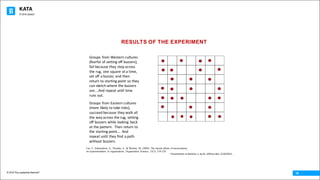
Groups	from	Western	cultures	
(fearful	of	setting	off	buzzers),	
fail	because	they	step	across	
the	rug,	one	square	at	a	time,	
set	off	a	buzzer,	and	then	
return	to	starting	point	so	they	
can	sketch	where	the	buzzers	
are….And	repeat	until	time	
runs	out.
Groups	from	Eastern	cultures	
(more	likely	to	take	risks),	
succeed	because	they	walk	all	
the	way	across	the	rug,	setting	
off	buzzers	while	looking	 back	
at	the	pattern.		Then	return	to	
the	starting	point….	And	
repeat	until	they	find	a	path	
without	buzzers.
KATA
© 2016 The Leadership Network®
© 2016 Jidoka®
20
1. They	seldom	feel	disconnected	from	the	challenge	that	first	engaged	their	
interest.	People	who	love	what	they	do	never	fully	lose	sight	of	the	Challenge	and	
the	sense	of	purpose	that	drives	them.
2. They’re	remarkably	well-attuned	to	the	“early	years.”	Cognitive	science	tells	us	
that	all	of	us	”confabulate”	memory	to	varying	degrees	(that	is,	our	brains	
reconstruct	memories	combining	shards	of	what	actually	happened	with	bits	and	
pieces	of	imagined	realities).	They’ve	successfully	integrated	elements	of	those	
passions	into	what	they	do.	In	effect,	they’re	energized	kids	with	the	seasoned	
perspective	of	adults.
3. They	are	“portfolio”	thinkers. People	want	to	be	around	people	who	are	
passionate	about	what	they	do,	because	it’s	an	infectious	feeling	that	psychologists	
call	“psychosocial	contagions”.	They	are	even-keeled;	never	to	high,	never	too	low.
4. They	live	in	the	now. The	“now”	for	someone	who	loves	what	they	do	is	precious,	
because	it	can	disappear	in	a	heartbeat
5. They	never,	ever	limit	their	vision	to	serve	the	interests	of	petty	competition.
Stephen	Covey	famously	said	(paraphrasing),	highly	effective	people	don’t	see	the	
“pie”	as	having	a	limited	number	of	pieces.	Instead,	they	see	a	pie	with	pieces	
enough	for	everyone,	and	it	doesn’t	bother	them	to	watch	others	get	their	slice.
A	Key	Concept	about	PDCAs,	Target	Conditions	and	
Challenges:		People	that	love	their	job	and	are	passionate	
about	Challenges…..
Citation	from	Forbes	Magazine,	“10	Reasons	Why	Some	People	Love	What	They	Do”	by	David	DiSalvo
http://www.forbes.com/sites/daviddisalvo/2012/08/28/10-reasons-why-some-people-love-what-they-do
KATA
© 2016 The Leadership Network®
© 2016 Jidoka®
21
6. They	will	stay…but	just	know,	they’ll	also	leave.If	a	company	or	firm	or	
nonprofit—whatever—ceases	to	provide	an	adequate	venue	for	doing	what	they	
love	to	do	(i.e.	face	Challenges),	then	it’s	time	to	move	on.
7. They	won’t	be	stopped.When	a	manager	says,	in	so	many	words,	“this	is	your	
role	in	my	plan,	and	failure	to	fill	it	will	have	negative	consequences,”	the	smart	
person	usually	obliges,	at	least	temporarily.	But	the	passion-drive	person	bent	
on	doing	what	they	love	(i.e.	face	Challenges)	is	already	figuring	out	how	to	blow	
the	walls	off	that	plan	and	move	on.
8. They	draw	people	to	them	without	even	trying.	John	C.	Maxwell	‘s	Law	of	
Magnetism	says	“success	breads	success”	and	“people	draw	to	winners”
9. They	don’t	care	what	you	think.	People		who	genuinely	love	what	they	do	(i.e.	
face	Challenges)	don’t	allow	others	to	talk	them	out	of	it.
10.They	are	born	succession	planners. People	who	love	their	jobs	embrace	
succession	planning	wholeheartedly	and	actively	look	for	others	to	share	their	
passions	with,	in	hopes	that	they’ll	want	to	do	that	job	one	day	as	well.	 These	
folks	aren’t	doing	this	because	the	company	handbook	tells	them	to	– they	do	it	
because	they	love	what	they	do,	and	that	passion	compels	them	to	share	their	
knowledge	and	acumen	with	others.
Citation	from	Forbes	Magazine,	“10	Reasons	Why	Some	People	Love	What	They	Do”	by	David	DiSalvo
http://www.forbes.com/sites/daviddisalvo/2012/08/28/10-reasons-why-some-people-love-what-they-do
A	Key	Concept	about	PDCAs,	Target	Conditions	and	
Challenges:		People	that	love	their	job	and	are	passionate	
about	Challenges…..

Lecture 4a

  • 1.
    KATA © 2016 TheLeadership Network® © 2016 Jidoka® 01 © Mike Rother / Improvement Kata Handbook TOYOTA KATA PDCA toward the Target Condition
  • 2.
    KATA © 2016 TheLeadership Network® © 2016 Jidoka® 02 NOW THAT YOU HAVE A TARGET CONDITION, HOW DO YOU GET THERE? How to reach your goals when you cannot see the road ahead?
  • 3.
    KATA © 2016 TheLeadership Network® © 2016 Jidoka® 03 The IK PREDICTION for the Experiment ACTION Conduct the IK experiment EVALUATE Standardize or Adjust based on your learning EVIDENCE Collect facts and data resulting from the IK experiment THE DEMING CYCLE "Plan-Do-Check-Act" or "Plan-Do-Study-Act" Dr. W. Edwards Deming “It is not necessary to change. Survival is not mandatory.”
  • 4.
    KATA © 2016 TheLeadership Network® © 2016 Jidoka® 04 Iterating toward the Target Condition with PDCA Small, rapid PDCAs advance our knowledge threshold quickly so we can see obstacles to the Target Condition Current Condition Target Condition First, you must accept the path is unclear Some steps will not make measureable improvement. Some steps will move away or to the side on the way to the TC. Failed PDCAs or ones that don’t yield immediate improvement can be some of your biggest learnings
  • 5.
    KATA © 2016 TheLeadership Network® © 2016 Jidoka® 05 © Mike Rother / Improvement Kata Handbook Iterate Toward the Target Condition WHATʼS THE THRESHOLD OF KNOWLEDGE (TOK)? It is the point at which you have no facts & data and start guessing Thereʼs always a knowledge threshold, and itʼs closer than you think! You never know for sure how you are going to get there until you get there. Uncertainty / Learning Zone Next Target Condition Current Knowledge Threshold ? ? ? Condition Now Where you want to be next Where you are Limit of what you currently know The Goal
  • 6.
    KATA © 2016 TheLeadership Network® © 2016 Jidoka® 6 Since the path to a challenging goal canʼt be predicted with exactness, we have to find that path by experimenting like a scientist. With each step and insight a scientist may adjust his or her thinking based on what has just been learned. The scientific process canʼt tell us what's ahead. It only confirms or refutes the results of experiments. A trick to making effective progress toward a challenging target condition is not to try to decide the way forward, but to iterate your way forward by experimenting as cheaply and rapidly as possible. This is the action of innovation. SCIENTIFIC THINKING MEANS LEARNING ALONG THE WAY TO THE TARGET CONDITION Objective and certain: “We have made the right plan” Always provisional: “Our plan is a hypothesis” What we may think scientific thinking is What scientific thinking really is © Mike Rother / Improvement Kata Handbook Iterate Toward the Target Condition 6
  • 7.
    KATA © 2016 TheLeadership Network® © 2016 Jidoka® 7 PDCA EXPERIMENTATION IS NOT ABOUT YOU DEVELOPING A PLAN, AND THEN EXECUTING ON THAT PLAN TO PUT YOUR PREDETERMINED IDEAS IN PLACE AS SOLUTIONS PDCA EXPERIMENTATION IS ABOUT YOU TAKING STEPS JUST BEYOND YOUR KNOWLEDGE THRESHOLD AND OUTSIDE YOUR “ZONE OF CERTAINTY” TO BETTER UNDERSTAND THE PROCESS BETTER AND IDENTIFY OBSTACLES. THE STEPS YOU TAKE ARE THE LEARNING GOALS YOU EXPERIENCE AS YOU ITERATE YOUR WAY TO THE TARGET CONDITION
  • 8.
    KATA © 2016 TheLeadership Network® © 2016 Jidoka® 8 'SURPRISE' IS HOW PDCA HELPS YOU LEARN AND IMPROVE Learning happens when reality differs from expectation Unexpected results (surprises) lead to valuable learning experiences. The Improvement Kata mindset seeks to use these lessons. A. The purpose of PDCA is to generate surprises and thus opportunities for learning & progress toward the target condition. B. Using small failures as learning opportunities also develops the improvement expertise of the learner. PDCA Cycles Scenario 2 2, 4, 8, 16, 32, ______ ? Write down the next two numbers in this series. Then click. How do you feel? Scenario 1 Write the Sum of a 3 dice roll______? Roll them and see if your sum was correct -2, -4 How do you feel?....Not so bad, it’s just chance Hey! © Mike Rother / Improvement Kata Handbook
  • 9.
    KATA © 2016 TheLeadership Network® © 2016 Jidoka® 9 DIFFERENCE BETWEEN THE SCENARIOS How easy or hard it is to spot the Current Knowledge Threshold • In Round 1 with the dice, it was easy to see that we didn’t know what the outcome would be. • In Round 2 the knowledge threshold was more difficult to see. We thought we knew the answer, so we went over the threshold & answered. Ø What would be a good answer in both rounds? Ø Why don’t we say that? Yet in both rounds the knowledge threshold was the same: There were no facts beyond the initial setup Predictable Zone Current Knowledge Threshold 2, 4, 8, 16, 32, © Mike Rother / Improvement Kata Handbook Iterate Toward the Target Condition
  • 10.
    KATA © 2016 TheLeadership Network® © 2016 Jidoka® 10 VIDEO: Scientific thinking (3 minutes)
  • 11.
    KATA © 2016 TheLeadership Network® © 2016 Jidoka® 11 WHAT SHOULD YOU DO AT THE THRESHOLD OF KNOWLEDGE? 1) Acknowledge it. (Difficult to do, until you get in the habit.) Key realization: Thereʼs always a threshold of knowledge. 2) Stop and see further by conducting an experiment. Donʼt deliberate over answers. Deliberate over the next experiment: What do we need to learn next, how will we test that and how will we measure it? The path canʼt be determined in advance through logic and debate Uncertainty / Learning Zone Next Target Condition Current Knowledge Threshold ? ? ? Condition Now © Mike Rother / Improvement Kata Handbook Iterate Toward the Target Condition Where you want to be next
  • 12.
    KATA © 2016 TheLeadership Network® © 2016 Jidoka® 12 Scientific thinking is the process you go through to disprove your theory and hypothesis. You should think of ways to refute what you believe to be true. When your results (evidence) differ from your expectations (predictions) real learning happens – this is called prediction error, and is necessary to advance our exploration. If you set out to disprove your theories, then you cannot, then and only then, can you say “we must be getting at something really true!” If your simply confirming what you already know or think to be true, you are engaging in prediction confirmation. However, in traditional problem solving thinking, we do the opposite. We set out to prove our perceptions of reality are true. This stifles the innovation process. We analyze the process attempting to determine the root cause of where it breaks down, and then FIX IT!, and move on. But the law of entropy states that any system will deteriorate over time. It’s the process of constantly striving for the Target Condition, reaching it, and then establishing where we want to be next (i.e. the next Target Condition) that fights entropy and fuels sustainment. SO WHAT DOES SCIENTIFIC THINKING MEAN? Prediction Confirmation = little learning
  • 13.
    KATA © 2016 TheLeadership Network® © 2016 Jidoka® 13 Learning through refuted hypotheses
  • 14.
    KATA © 2016 TheLeadership Network® © 2016 Jidoka® 14 THREE KINDS OF KATA PDCA EXPERIMENTS PDCA Cycles The following hierarchy goes from less to more scientific 1) Go and See Direct observation and data collection, without changing anything, to learn more about a process or situation. 2) Exploratory Experiment Introducing a change in a process to see, via direct observation, how the process reacts. Done to help better understand the process. Example: Try to run a process as specified in the target condition, to see where it fails and build your obstacles parking lot. Often this is the first experiment. 3) Testing a Hypothesis Introducing a change, ideally in only a single factor, together with a prediction of what you expect to happen. “If the result confirms the hypothesis, then you've made a measurement. If the result is contrary to the hypothesis, then you've made a discovery.” ~ Enrico Fermi © Mike Rother / Improvement Kata Handbook
  • 15.
    KATA © 2016 TheLeadership Network® © 2016 Jidoka® 15 The Power of Rapid PDCAs Time CapEx Project Management Kaizen (KZ) episodic improvement KZ1 KZ2 KZ3 KZ4 TC 4 c Diagram contributed by Bill Kraus, animated by Brandon Brown TC 3 TC 2 TC 1 Unsustainable improvement routine
  • 16.
    KATA © 2016 TheLeadership Network® © 2016 Jidoka® 16 VIDEO 2: Working Iteratively (3 minutes) https://www.youtube.com/watch?v=H0_yKBitO8M Also available on the IK/CK YouTube Channel
  • 17.
    KATA © 2016 TheLeadership Network® © 2016 Jidoka® 17 The underlying emotion that keeps us from iterating to a solution In the last video about the Marshmallow challenge what two emotions and psychological thinking do you think the business school graduates possess that the kindergarten graduates do not possess? FEAR!....Fear of failing doesn’t enter into our psyche through childhood. Fear of failing is brought on through years of psychological pressures placed on us by others…Parents, Teachers, our Boss(es). Attitude…Work or a task = FUN!....Think back to your early childhood and the games, musical instruments, or sports activities you learned. At the core of a child’s psyche is the perspective of a work task, problem, or challenge is something to win or overcome. Most adults rarely express their work tasks, problems, or challenges with this perspective. No fear of failing and an attitude of striving toward a challenge are critical to PDCA success
  • 18.
    KATA © 2016 TheLeadership Network® © 2016 Jidoka® 18 HOW DO CULTURES THINK DIFFERENTLY ABOUT PROBLEM SOLVING, PREDICTION ERROR/CONFIRMATION AND PROGRESSING TOWARD THE TARGET CONDITION Lee, F., Edmondson, A., Thomke, S., & Worline, M. (2004). The mixed effects of inconsistency on experimentation in organizations. Organization Science, 15(3), 310-326. The Experiment: A rug was place over a series of buzzer alarms and different groups were asked to cross the rug without setting off buzzers in a set amount of time. Fiona Lee, PhD. Associate Professor of Management and Organizations, Michigan Ross Presentation at KataCon 1, by Dr. Jeffery Liker, 2/18/2015
  • 19.
    KATA © 2016 TheLeadership Network® © 2016 Jidoka® 19 RESULTS OF THE EXPERIMENT Lee, F., Edmondson, A., Thomke, S., & Worline, M. (2004). The mixed effects of inconsistency on experimentation in organizations. Organization Science, 15(3), 310-326. Presentation at KataCon 1, by Dr. Jeffery Liker, 2/18/2015, Groups from Western cultures (fearful of setting off buzzers), fail because they step across the rug, one square at a time, set off a buzzer, and then return to starting point so they can sketch where the buzzers are….And repeat until time runs out. Groups from Eastern cultures (more likely to take risks), succeed because they walk all the way across the rug, setting off buzzers while looking back at the pattern. Then return to the starting point…. And repeat until they find a path without buzzers.
  • 20.
    KATA © 2016 TheLeadership Network® © 2016 Jidoka® 20 1. They seldom feel disconnected from the challenge that first engaged their interest. People who love what they do never fully lose sight of the Challenge and the sense of purpose that drives them. 2. They’re remarkably well-attuned to the “early years.” Cognitive science tells us that all of us ”confabulate” memory to varying degrees (that is, our brains reconstruct memories combining shards of what actually happened with bits and pieces of imagined realities). They’ve successfully integrated elements of those passions into what they do. In effect, they’re energized kids with the seasoned perspective of adults. 3. They are “portfolio” thinkers. People want to be around people who are passionate about what they do, because it’s an infectious feeling that psychologists call “psychosocial contagions”. They are even-keeled; never to high, never too low. 4. They live in the now. The “now” for someone who loves what they do is precious, because it can disappear in a heartbeat 5. They never, ever limit their vision to serve the interests of petty competition. Stephen Covey famously said (paraphrasing), highly effective people don’t see the “pie” as having a limited number of pieces. Instead, they see a pie with pieces enough for everyone, and it doesn’t bother them to watch others get their slice. A Key Concept about PDCAs, Target Conditions and Challenges: People that love their job and are passionate about Challenges….. Citation from Forbes Magazine, “10 Reasons Why Some People Love What They Do” by David DiSalvo http://www.forbes.com/sites/daviddisalvo/2012/08/28/10-reasons-why-some-people-love-what-they-do
  • 21.
    KATA © 2016 TheLeadership Network® © 2016 Jidoka® 21 6. They will stay…but just know, they’ll also leave.If a company or firm or nonprofit—whatever—ceases to provide an adequate venue for doing what they love to do (i.e. face Challenges), then it’s time to move on. 7. They won’t be stopped.When a manager says, in so many words, “this is your role in my plan, and failure to fill it will have negative consequences,” the smart person usually obliges, at least temporarily. But the passion-drive person bent on doing what they love (i.e. face Challenges) is already figuring out how to blow the walls off that plan and move on. 8. They draw people to them without even trying. John C. Maxwell ‘s Law of Magnetism says “success breads success” and “people draw to winners” 9. They don’t care what you think. People who genuinely love what they do (i.e. face Challenges) don’t allow others to talk them out of it. 10.They are born succession planners. People who love their jobs embrace succession planning wholeheartedly and actively look for others to share their passions with, in hopes that they’ll want to do that job one day as well. These folks aren’t doing this because the company handbook tells them to – they do it because they love what they do, and that passion compels them to share their knowledge and acumen with others. Citation from Forbes Magazine, “10 Reasons Why Some People Love What They Do” by David DiSalvo http://www.forbes.com/sites/daviddisalvo/2012/08/28/10-reasons-why-some-people-love-what-they-do A Key Concept about PDCAs, Target Conditions and Challenges: People that love their job and are passionate about Challenges…..