
Mainstreaming DRR into Development
Planning
By Negussie Kefeni
Disaster Risk Mangement & Food Security Sector, Ministry of
Agriculture
Dhaka Bangladesh
April,2013
Disaster risks: Context of Ethiopia
• Ethiopia is still highly vulnerable to a wide range of CC
induced natural as well as man-made disasters.
• Drought remains the country’s leading major hazard
while flood is the second major hazard next to drought.
• Recent experience shows an apparent marked increase
in area coverage and frequency of such disasters
• Climate Change and associated risks are and will
continue to affect the economy in general and
agriculture and FS in particular
2
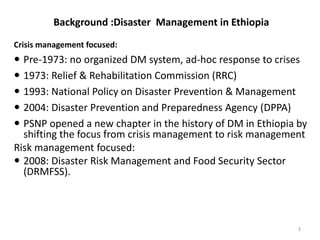
Background :Disaster Management in Ethiopia
Crisis management focused:
 Pre-1973: no organized DM system, ad-hoc response to crises
 1973: Relief & Rehabilitation Commission (RRC)
 1993: National Policy on Disaster Prevention & Management
 2004: Disaster Prevention and Preparedness Agency (DPPA)
 PSNP opened a new chapter in the history of DM in Ethiopia by
shifting the focus from crisis management to risk management
Risk management focused:
 2008: Disaster Risk Management and Food Security Sector
(DRMFSS).
3
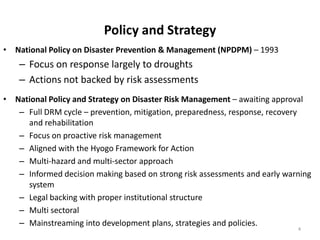
• National Policy on Disaster Prevention & Management (NPDPM) – 1993
– Focus on response largely to droughts
– Actions not backed by risk assessments
• National Policy and Strategy on Disaster Risk Management – awaiting approval
– Full DRM cycle – prevention, mitigation, preparedness, response, recovery
and rehabilitation
– Focus on proactive risk management
– Aligned with the Hyogo Framework for Action
– Multi-hazard and multi-sector approach
– Informed decision making based on strong risk assessments and early warning
system
– Legal backing with proper institutional structure
– Multi sectoral
– Mainstreaming into development plans, strategies and policies.
4
Policy and Strategy
Disaster Risk Management –Strategic Programme & Investment
Framework (DRM-SPIF)
 Translating the new DRM approach into action
 Designed to achieve the goals and targets of the Growth &
Transformation Plan
 Will help harmonize DRM initiatives and create synergies for a more
effective implementation and maximize the available resource
efficiency of utilization
 Main features
– Aligned with the new revised DRM Policy, HFA and GTP.
– Presents all DRM programme components along the different phases
of DRM and their interrelationships
– Substantively defines and costs (in detail) the various DRM
components/programmes
– Provides a mechanism for assessing progress and evaluating results
on DRM
5
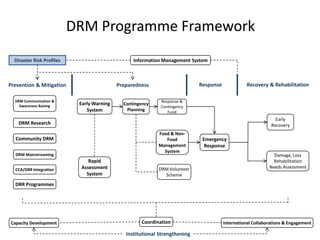
DRM Programme Framework
Prevention & Mitigation Preparedness Response Recovery & Rehabilitation
DRM Communication &
Awareness Raising
DRM Research
Community DRM
DRM Mainstreaming
CCA/DRR Integration
Disaster Risk Profiles
Early Warning
System
Rapid
Assessment
System
Contingency
Planning
Food & Non-
Food
Management
System
DRR Programmes
Information Management System
Response &
Contingency
Fund
Institutional Strengthening
Capacity Development International Collaborations & Engagement
DRM Volunteer
Scheme
Emergency
Response
Early
Recovery
Damage, Loss
Rehabilitation
Needs Assessment
Coordination
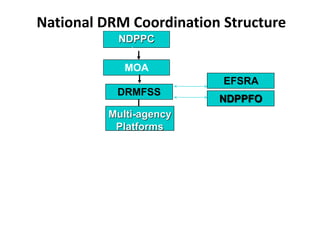
National DRM Coordination Structure
MOA
DRMFSS
EFSRA
NDPPFO
NDPPC
Multi-agency
Platforms
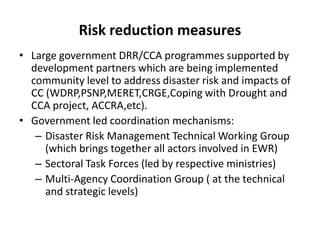
Risk reduction measures
• Large government DRR/CCA programmes supported by
development partners which are being implemented
community level to address disaster risk and impacts of
CC (WDRP,PSNP,MERET,CRGE,Coping with Drought and
CCA project, ACCRA,etc).
• Government led coordination mechanisms:
– Disaster Risk Management Technical Working Group
(which brings together all actors involved in EWR)
– Sectoral Task Forces (led by respective ministries)
– Multi-Agency Coordination Group ( at the technical
and strategic levels)
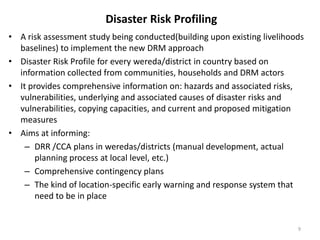
Disaster Risk Profiling
• A risk assessment study being conducted(building upon existing livelihoods
baselines) to implement the new DRM approach
• Disaster Risk Profile for every wereda/district in country based on
information collected from communities, households and DRM actors
• It provides comprehensive information on: hazards and associated risks,
vulnerabilities, underlying and associated causes of disaster risks and
vulnerabilities, copying capacities, and current and proposed mitigation
measures
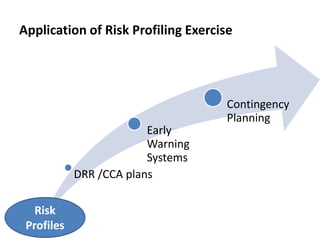
• Aims at informing:
– DRR /CCA plans in weredas/districts (manual development, actual
planning process at local level, etc.)
– Comprehensive contingency plans
– The kind of location-specific early warning and response system that
need to be in place
9
Application of Risk Profiling Exercise
DRR /CCA plans
Early
Warning
Systems
Contingency
Planning
Risk
Profiles
Thank you for your kind attention!!

Mainstreaming DRR into Development Planning

  • 1.
    Mainstreaming DRR intoDevelopment Planning By Negussie Kefeni Disaster Risk Mangement & Food Security Sector, Ministry of Agriculture Dhaka Bangladesh April,2013
  • 2.
    Disaster risks: Contextof Ethiopia • Ethiopia is still highly vulnerable to a wide range of CC induced natural as well as man-made disasters. • Drought remains the country’s leading major hazard while flood is the second major hazard next to drought. • Recent experience shows an apparent marked increase in area coverage and frequency of such disasters • Climate Change and associated risks are and will continue to affect the economy in general and agriculture and FS in particular 2
  • 3.
    Background :Disaster Managementin Ethiopia Crisis management focused:  Pre-1973: no organized DM system, ad-hoc response to crises  1973: Relief & Rehabilitation Commission (RRC)  1993: National Policy on Disaster Prevention & Management  2004: Disaster Prevention and Preparedness Agency (DPPA)  PSNP opened a new chapter in the history of DM in Ethiopia by shifting the focus from crisis management to risk management Risk management focused:  2008: Disaster Risk Management and Food Security Sector (DRMFSS). 3
  • 4.
    • National Policyon Disaster Prevention & Management (NPDPM) – 1993 – Focus on response largely to droughts – Actions not backed by risk assessments • National Policy and Strategy on Disaster Risk Management – awaiting approval – Full DRM cycle – prevention, mitigation, preparedness, response, recovery and rehabilitation – Focus on proactive risk management – Aligned with the Hyogo Framework for Action – Multi-hazard and multi-sector approach – Informed decision making based on strong risk assessments and early warning system – Legal backing with proper institutional structure – Multi sectoral – Mainstreaming into development plans, strategies and policies. 4 Policy and Strategy
  • 5.
    Disaster Risk Management–Strategic Programme & Investment Framework (DRM-SPIF)  Translating the new DRM approach into action  Designed to achieve the goals and targets of the Growth & Transformation Plan  Will help harmonize DRM initiatives and create synergies for a more effective implementation and maximize the available resource efficiency of utilization  Main features – Aligned with the new revised DRM Policy, HFA and GTP. – Presents all DRM programme components along the different phases of DRM and their interrelationships – Substantively defines and costs (in detail) the various DRM components/programmes – Provides a mechanism for assessing progress and evaluating results on DRM 5
  • 6.
    DRM Programme Framework Prevention& Mitigation Preparedness Response Recovery & Rehabilitation DRM Communication & Awareness Raising DRM Research Community DRM DRM Mainstreaming CCA/DRR Integration Disaster Risk Profiles Early Warning System Rapid Assessment System Contingency Planning Food & Non- Food Management System DRR Programmes Information Management System Response & Contingency Fund Institutional Strengthening Capacity Development International Collaborations & Engagement DRM Volunteer Scheme Emergency Response Early Recovery Damage, Loss Rehabilitation Needs Assessment Coordination
  • 7.
    National DRM CoordinationStructure MOA DRMFSS EFSRA NDPPFO NDPPC Multi-agency Platforms
  • 8.
    Risk reduction measures •Large government DRR/CCA programmes supported by development partners which are being implemented community level to address disaster risk and impacts of CC (WDRP,PSNP,MERET,CRGE,Coping with Drought and CCA project, ACCRA,etc). • Government led coordination mechanisms: – Disaster Risk Management Technical Working Group (which brings together all actors involved in EWR) – Sectoral Task Forces (led by respective ministries) – Multi-Agency Coordination Group ( at the technical and strategic levels)
  • 9.
    Disaster Risk Profiling •A risk assessment study being conducted(building upon existing livelihoods baselines) to implement the new DRM approach • Disaster Risk Profile for every wereda/district in country based on information collected from communities, households and DRM actors • It provides comprehensive information on: hazards and associated risks, vulnerabilities, underlying and associated causes of disaster risks and vulnerabilities, copying capacities, and current and proposed mitigation measures • Aims at informing: – DRR /CCA plans in weredas/districts (manual development, actual planning process at local level, etc.) – Comprehensive contingency plans – The kind of location-specific early warning and response system that need to be in place 9
  • 10.
    Application of RiskProfiling Exercise DRR /CCA plans Early Warning Systems Contingency Planning Risk Profiles
  • 11.
    Thank you foryour kind attention!!

Editor's Notes

  • #7 Risk Profiles as the beginning of the whole DRM System.