Managing  Brand Equity
You can download this presentation at: www.studyMarketing.org Visit  www.studyMarketing.org   for more presentations on Marketing, Strategy, Innovation, and Branding
Brand equity  is a set of brand assets and liabilities linked to a brand
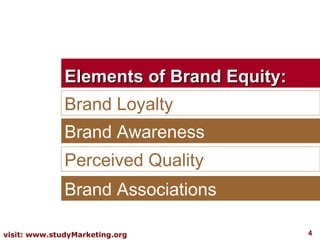
Elements of Brand Equity: Brand Loyalty Brand Awareness Perceived Quality Brand Associations
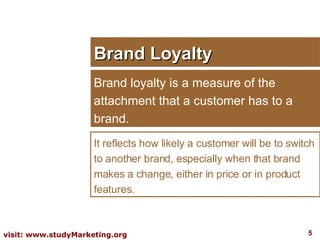
Brand Loyalty Brand loyalty is a measure of the attachment that a customer has to a brand.  It reflects how likely a customer will be to switch to another brand, especially when that brand makes a change, either in price or in product features.
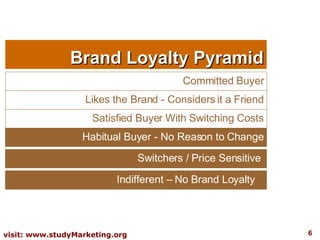
Brand Loyalty Pyramid Committed Buyer Likes the Brand - Considers it a Friend Satisfied Buyer With Switching Costs Habitual Buyer - No Reason to Change Indifferent – No Brand Loyalty  Switchers / Price Sensitive
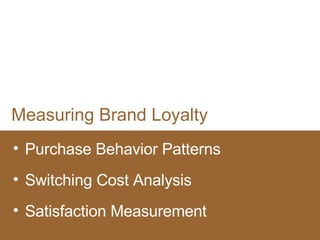
Measuring Brand Loyalty Purchase Behavior Patterns Switching Cost Analysis Satisfaction Measurement
Strategic Value of Brand Loyalty Reduce marketing cost Trade (channel distribution) leverage Attracting new customers
Enhancing Brand Loyalty Treat the customer right Stay close to the customer Measure/manage customer satisfaction Create switching cost Provide extras
Brand Awareness is   the ability of a potential buyer to recognize or recall that a brand is a member of a certain product category
Brand Awareness Hierarchy Top of Mind Brand Recall Brand Recognition Unaware of Brand
Value of Brand Awareness Anchor to which other associations can be attached Familiarity and liking Signal of substance/commitment Brand to be considered
How to Achieve Brand Awareness Be different, memorable Involve a slogan or jingle Symbol exposure Publicity Event sponsorship
The customer's perception of the overall quality or superiority of a product or service with respect to its intended purpose, relative to alternatives. Perceived quality is a perception by customers. Perceived Quality
What Influences Perceived Quality of  Product ? Performance Features Conformance with specifications Reliability Durability Serviceability Fit and finish
What Influences Perceived Quality of  Service ? Appearance Reliability Competence Responsiveness Empathy
The Value of Perceived Quality Reason-to-Buy Differentiate/Position  A Price Premium  Channel Member Interest  Brand Extensions
Brand Association A brand association is anything "linked" in memory to a brand.  Thus, McDonald's could be linked to a character such as Ronald McDonald, a consumer segment such as kids, a feeling such as having fun, a product characteristic such as service, or a symbol such as the Golden Arches.
Some Types of Associations Product Attributes Customer Benefits Relative Price Lifestyle/Personality Celebrity/Person Use/Application
The Value of Brand Associations Help Process/Retrieve Information Differentiate/Position Reason-to-Buy Create Positive Attitudes/Feelings  Basis for Extensions
Maintaining Associations Be consistent over time Be consistent over elements of the marketing program Manage disasters in order to minimize their damage
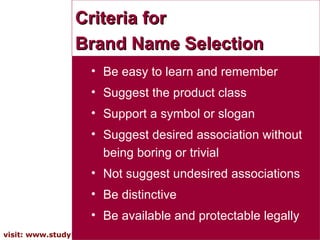
Criteria for  Brand Name Selection Be easy to learn and remember Suggest the product class Support a symbol or slogan Suggest desired association without being boring or trivial Not suggest undesired associations  Be distinctive Be available and protectable legally
Source of Reference: David Aaker,  Managing Brand Equity : Capitalizing on the Value of A Brand Name , Free Press

Brand Equity

  • 1.
  • 2.
    You can downloadthis presentation at: www.studyMarketing.org Visit www.studyMarketing.org for more presentations on Marketing, Strategy, Innovation, and Branding
  • 3.
    Brand equity is a set of brand assets and liabilities linked to a brand
  • 4.
    Elements of BrandEquity: Brand Loyalty Brand Awareness Perceived Quality Brand Associations
  • 5.
    Brand Loyalty Brandloyalty is a measure of the attachment that a customer has to a brand. It reflects how likely a customer will be to switch to another brand, especially when that brand makes a change, either in price or in product features.
  • 6.
    Brand Loyalty PyramidCommitted Buyer Likes the Brand - Considers it a Friend Satisfied Buyer With Switching Costs Habitual Buyer - No Reason to Change Indifferent – No Brand Loyalty Switchers / Price Sensitive
  • 7.
    Measuring Brand LoyaltyPurchase Behavior Patterns Switching Cost Analysis Satisfaction Measurement
  • 8.
    Strategic Value ofBrand Loyalty Reduce marketing cost Trade (channel distribution) leverage Attracting new customers
  • 9.
    Enhancing Brand LoyaltyTreat the customer right Stay close to the customer Measure/manage customer satisfaction Create switching cost Provide extras
  • 10.
    Brand Awareness is the ability of a potential buyer to recognize or recall that a brand is a member of a certain product category
  • 11.
    Brand Awareness HierarchyTop of Mind Brand Recall Brand Recognition Unaware of Brand
  • 12.
    Value of BrandAwareness Anchor to which other associations can be attached Familiarity and liking Signal of substance/commitment Brand to be considered
  • 13.
    How to AchieveBrand Awareness Be different, memorable Involve a slogan or jingle Symbol exposure Publicity Event sponsorship
  • 14.
    The customer's perceptionof the overall quality or superiority of a product or service with respect to its intended purpose, relative to alternatives. Perceived quality is a perception by customers. Perceived Quality
  • 15.
    What Influences PerceivedQuality of Product ? Performance Features Conformance with specifications Reliability Durability Serviceability Fit and finish
  • 16.
    What Influences PerceivedQuality of Service ? Appearance Reliability Competence Responsiveness Empathy
  • 17.
    The Value ofPerceived Quality Reason-to-Buy Differentiate/Position A Price Premium Channel Member Interest Brand Extensions
  • 18.
    Brand Association Abrand association is anything "linked" in memory to a brand. Thus, McDonald's could be linked to a character such as Ronald McDonald, a consumer segment such as kids, a feeling such as having fun, a product characteristic such as service, or a symbol such as the Golden Arches.
  • 19.
    Some Types ofAssociations Product Attributes Customer Benefits Relative Price Lifestyle/Personality Celebrity/Person Use/Application
  • 20.
    The Value ofBrand Associations Help Process/Retrieve Information Differentiate/Position Reason-to-Buy Create Positive Attitudes/Feelings Basis for Extensions
  • 21.
    Maintaining Associations Beconsistent over time Be consistent over elements of the marketing program Manage disasters in order to minimize their damage
  • 22.
    Criteria for Brand Name Selection Be easy to learn and remember Suggest the product class Support a symbol or slogan Suggest desired association without being boring or trivial Not suggest undesired associations Be distinctive Be available and protectable legally
  • 23.
    Source of Reference:David Aaker, Managing Brand Equity : Capitalizing on the Value of A Brand Name , Free Press