Lecture # 3
1. Compounding Factors
2. Effect of Inflation
1-1 Dr. A. Alim
Determination of Unknown Interest Rate
 Class of problems where the interest rate, i%,
is the unknown value
 For simple, single payment problems (i.e., P
and F only), solving for i% given the other
parameters is not difficult
 For annuity and gradient type problems,
solving for i% can be tedious
 Trial and error method
 Use EXCEL
Slide Sets to accompany Blank & Tarquin, Engineering
Economy, 7th Edition, 2012 1-2 © 2012 by McGraw-Hill, New York, N.Y All Rights Reserved
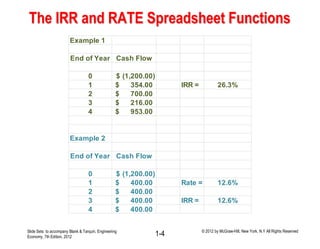
The IRR and RATE Spreadsheet Functions
 Define the total cash flow as a column of
values within Excel
 Apply the IRR function:
=IRR(first_cell:last_cell, guess value)
 If the cash flow series is an A value then apply
the RATE function:
=RATE(number_years, A,P,F)
Slide Sets to accompany Blank & Tarquin, Engineering
Economy, 7th Edition, 2012 1-3 © 2012 by McGraw-Hill, New York, N.Y All Rights Reserved
The IRR and RATE Spreadsheet Functions
Slide Sets to accompany Blank & Tarquin, Engineering
Economy, 7th Edition, 2012 1-4 © 2012 by McGraw-Hill, New York, N.Y All Rights Reserved
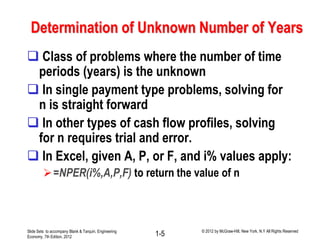
Example 1
End of Year Cash Flow
0 (1,200.00)$
1 354.00$ IRR = 26.3%
2 700.00$
3 216.00$
4 953.00$
Example 2
End of Year Cash Flow
0 (1,200.00)$
1 400.00$ Rate = 12.6%
2 400.00$
3 400.00$ IRR = 12.6%
4 400.00$
Determination of Unknown Number of Years
 Class of problems where the number of time
periods (years) is the unknown
 In single payment type problems, solving for
n is straight forward
 In other types of cash flow profiles, solving
for n requires trial and error.
 In Excel, given A, P, or F, and i% values apply:
=NPER(i%,A,P,F) to return the value of n
Slide Sets to accompany Blank & Tarquin, Engineering
Economy, 7th Edition, 2012 1-5 © 2012 by McGraw-Hill, New York, N.Y All Rights Reserved
Determination of Unknown Number of Years
Slide Sets to accompany Blank & Tarquin, Engineering
Economy, 7th Edition, 2012 1-6 © 2012 by McGraw-Hill, New York, N.Y All Rights Reserved
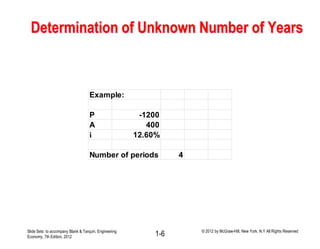
Example:
P -1200
A 400
i 12.60%
Number of periods = 4
In practice – interest rates do not stay the same
over time unless by contractual obligation.
There can exist “variation” of interest rates over
time – quite normal!
If required, how do we handle that situation?
Interest rates that vary over time
Slide Sets to accompany Blank & Tarquin, Engineering
Economy, 7th Edition, 2012 1-7 © 2012 by McGraw-Hill, New York, N.Y All Rights Reserved
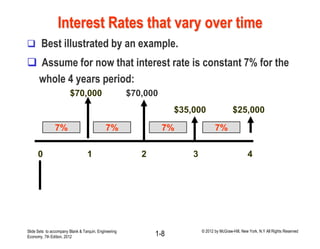
Interest Rates that vary over time
 Best illustrated by an example.
 Assume for now that interest rate is constant 7% for the
whole 4 years period:
0 1 2 3 4
$70,000 $70,000
$35,000 $25,000
7% 7% 7% 7%
Slide Sets to accompany Blank & Tarquin, Engineering
Economy, 7th Edition, 2012 1-8 © 2012 by McGraw-Hill, New York, N.Y All Rights Reserved
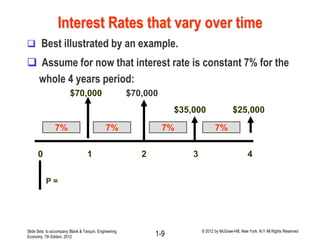
Interest Rates that vary over time
 Best illustrated by an example.
 Assume for now that interest rate is constant 7% for the
whole 4 years period:
0 1 2 3 4
$70,000 $70,000
$35,000 $25,000
7% 7% 7% 7%
P =
Slide Sets to accompany Blank & Tarquin, Engineering
Economy, 7th Edition, 2012 1-9 © 2012 by McGraw-Hill, New York, N.Y All Rights Reserved
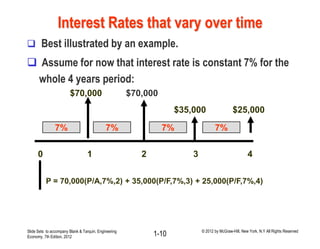
Interest Rates that vary over time
 Best illustrated by an example.
 Assume for now that interest rate is constant 7% for the
whole 4 years period:
0 1 2 3 4
$70,000 $70,000
$35,000 $25,000
7% 7% 7% 7%
P = 70,000(P/A,7%,2) + 35,000(P/F,7%,3) + 25,000(P/F,7%,4)
Slide Sets to accompany Blank & Tarquin, Engineering
Economy, 7th Edition, 2012 1-10 © 2012 by McGraw-Hill, New York, N.Y All Rights Reserved
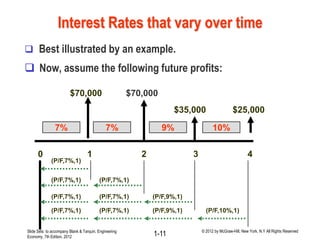
Interest Rates that vary over time
 Best illustrated by an example.
 Now, assume the following future profits:
0 1 2 3 4
$70,000 $70,000
$35,000 $25,000
7% 7% 9% 10%
(P/F,7%,1)
(P/F,7%,1)
(P/F,9%,1)
(P/F,10%,1)
(P/F,7%,1)
(P/F,7%,1) (P/F,7%,1)
(P/F,7%,1) (P/F,7%,1) (P/F,9%,1)
Slide Sets to accompany Blank & Tarquin, Engineering
Economy, 7th Edition, 2012 1-11 © 2012 by McGraw-Hill, New York, N.Y All Rights Reserved
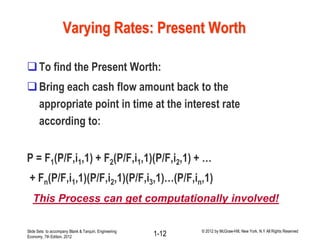
Varying Rates: Present Worth
To find the Present Worth:
Bring each cash flow amount back to the
appropriate point in time at the interest rate
according to:
P = F1(P/F,i1,1) + F2(P/F,i1,1)(P/F,i2,1) + …
+ Fn(P/F,i1,1)(P/F,i2,1)(P/F,i3,1)…(P/F,in,1)
This Process can get computationally involved!
Slide Sets to accompany Blank & Tarquin, Engineering
Economy, 7th Edition, 2012 1-12 © 2012 by McGraw-Hill, New York, N.Y All Rights Reserved
Period-by-Period Analysis
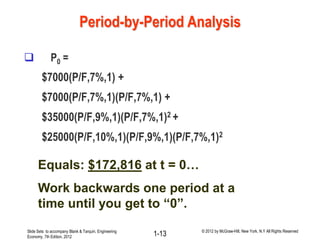
 P0 =
$7000(P/F,7%,1) +
$7000(P/F,7%,1)(P/F,7%,1) +
$35000(P/F,9%,1)(P/F,7%,1)2 +
$25000(P/F,10%,1)(P/F,9%,1)(P/F,7%,1)2
Equals: $172,816 at t = 0…
Work backwards one period at a
time until you get to “0”.
Slide Sets to accompany Blank & Tarquin, Engineering
Economy, 7th Edition, 2012 1-13 © 2012 by McGraw-Hill, New York, N.Y All Rights Reserved
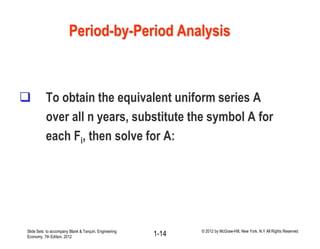
Period-by-Period Analysis
 To obtain the equivalent uniform series A
over all n years, substitute the symbol A for
each Fi, then solve for A:
Slide Sets to accompany Blank & Tarquin, Engineering
Economy, 7th Edition, 2012 1-14 © 2012 by McGraw-Hill, New York, N.Y All Rights Reserved
Period-by-Period Analysis
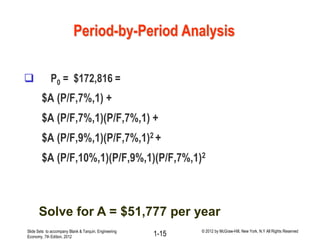
 P0 = $172,816 =
$A (P/F,7%,1) +
$A (P/F,7%,1)(P/F,7%,1) +
$A (P/F,9%,1)(P/F,7%,1)2 +
$A (P/F,10%,1)(P/F,9%,1)(P/F,7%,1)2
Solve for A = $51,777 per year
Slide Sets to accompany Blank & Tarquin, Engineering
Economy, 7th Edition, 2012 1-15 © 2012 by McGraw-Hill, New York, N.Y All Rights Reserved
Varying Rates: Approximation
 An alternative approach that approximates the present value:
 Average the interest rates over the appropriate number of time
periods. In the previous example {7% + 7% + 9% + 10%} / 4 =
8.25%
 This approach is only an approximation. Students MUST NOT use
this method in solving problems in quizzes or examinations.
Slide Sets to accompany Blank & Tarquin, Engineering
Economy, 7th Edition, 2012 1-16 © 2012 by McGraw-Hill, New York, N.Y All Rights Reserved
Inflation - Definition
 The increase in the amount of money
necessary to obtain the same amount of
product or service before the inflated
price was present;
 Social Phenomena where too much
money chases too few goods/services;
 Harmful impact because the purchasing
power of the currency changes downward
in value.
Slide Sets to accompany Blank & Tarquin, Engineering
Economy, 7th Edition, 2012 1-17 © 2012 by McGraw-Hill, New York, N.Y All Rights Reserved
Deflation
 Where the value , i.e. the
purchasing power of the currency
increases over time.
 Less amounts of the currency can
purchase more goods and services
than before.
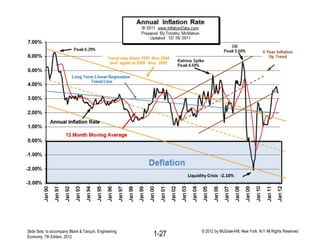
 Not very commonly seen……2009
was the first year with deflation (or
zero inflation) in a very long time!
Slide Sets to accompany Blank & Tarquin, Engineering
Economy, 7th Edition, 2012 1-18 © 2012 by McGraw-Hill, New York, N.Y All Rights Reserved
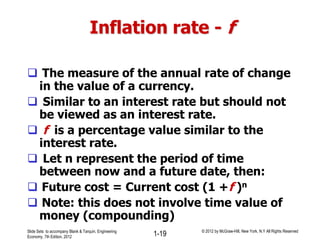
Inflation rate - f
 The measure of the annual rate of change
in the value of a currency.
 Similar to an interest rate but should not
be viewed as an interest rate.
 f is a percentage value similar to the
interest rate.
 Let n represent the period of time
between now and a future date, then:
 Future cost = Current cost (1 +f )n
 Note: this does not involve time value of
money (compounding)
Slide Sets to accompany Blank & Tarquin, Engineering
Economy, 7th Edition, 2012 1-19 © 2012 by McGraw-Hill, New York, N.Y All Rights Reserved
Example to Consider
 Assume a firm desires to purchase a
productive asset that costs $209,000 in
today’s dollars.
 Assume an inflation rate of say, 4% per
year;
 In 10 years, that same piece of equipment
would cost:
 $209,000(1.04)10 = $309,371!
 Does not include an interest rate or rate of return
consideration.
 The $309,371 are called “future dollars”.
Slide Sets to accompany Blank & Tarquin, Engineering
Economy, 7th Edition, 2012 1-20 © 2012 by McGraw-Hill, New York, N.Y All Rights Reserved
Inflation can be Significant
 From the previous example we see that
even at a modest 4% rate of inflation, the
future impact on cost can be and often is
significant!
 The previous example does not consider
the time value of money.
 A proper engineering economy analysis
should consider both inflation and the
time value of money.
Slide Sets to accompany Blank & Tarquin, Engineering
Economy, 7th Edition, 2012 1-21 © 2012 by McGraw-Hill, New York, N.Y All Rights Reserved
How is inflation measured*?
 Consumer Price Index (CPI) - a government measure of the
price change of a “market basket” of goods and services
(national inflation rate)
 Producer Price Indices – a government measure of price
changes for specific industries
 Chemical and Petrochemical Process Plants
 Farm Products
 Consulting Engineering Services Price Indexes
 Residential Building Construction Input Price Indexes
 Industrial product price indexes
 Raw materials price indexes
 Energy consumer price indices
* Ref. : J.C. Paradi, Centre for Management of Technology and
Entrepreneurship ( 1996-2004)
1-22Slide Sets to accompany Blank & Tarquin, Engineering
Economy, 7th Edition, 2012
© 2012 by McGraw-Hill, New York, N.Y All Rights Reserved
CPI
The CPI for a given period relates the average
price of a fixed “basket” of goods in the given
period to the average price of the same basket
of goods in a base period.
Current CPI base year is 1982 -84.
Base year index is set at 100.
The index for any other year indicates the
number of dollars needed in that year to buy the
basket of goods that cost $100 in 1982-84.
1-23Slide Sets to accompany Blank & Tarquin, Engineering
Economy, 7th Edition, 2012
© 2012 by McGraw-Hill, New York, N.Y All Rights Reserved
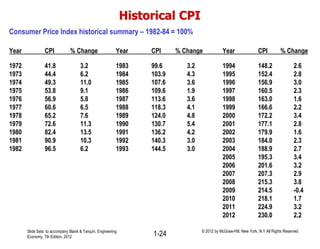
Historical CPI
Consumer Price Index historical summary – 1982-84 = 100%
Year CPI % Change Year CPI % Change Year CPI % Change
1972 41.8 3.2 1983 99.6 3.2 1994 148.2 2.6
1973 44.4 6.2 1984 103.9 4.3 1995 152.4 2.8
1974 49.3 11.0 1985 107.6 3.6 1996 156.9 3.0
1975 53.8 9.1 1986 109.6 1.9 1997 160.5 2.3
1976 56.9 5.8 1987 113.6 3.6 1998 163.0 1.6
1977 60.6 6.5 1988 118.3 4.1 1999 166.6 2.2
1978 65.2 7.6 1989 124.0 4.8 2000 172.2 3.4
1979 72.6 11.3 1990 130.7 5.4 2001 177.1 2.8
1980 82.4 13.5 1991 136.2 4.2 2002 179.9 1.6
1981 90.9 10.3 1992 140.3 3.0 2003 184.0 2.3
1982 96.5 6.2 1993 144.5 3.0 2004 188.9 2.7
2005 195.3 3.4
2006 201.6 3.2
2007 207.3 2.9
2008 215.3 3.8
2009 214.5 -0.4
2010 218.1 1.7
2011 224.9 3.2
2012 230.0 2.2
1-24Slide Sets to accompany Blank & Tarquin, Engineering
Economy, 7th Edition, 2012
© 2012 by McGraw-Hill, New York, N.Y All Rights Reserved
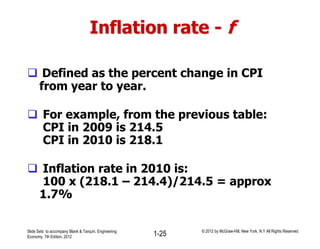
Inflation rate - f
 Defined as the percent change in CPI
from year to year.
 For example, from the previous table:
CPI in 2009 is 214.5
CPI in 2010 is 218.1
 Inflation rate in 2010 is:
100 x (218.1 – 214.4)/214.5 = approx
1.7%
Slide Sets to accompany Blank & Tarquin, Engineering
Economy, 7th Edition, 2012 1-25 © 2012 by McGraw-Hill, New York, N.Y All Rights Reserved
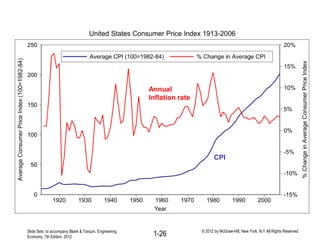
Annual
Inflation rate
CPI
1-26Slide Sets to accompany Blank & Tarquin, Engineering
Economy, 7th Edition, 2012
© 2012 by McGraw-Hill, New York, N.Y All Rights Reserved
1-27Slide Sets to accompany Blank & Tarquin, Engineering
Economy, 7th Edition, 2012
© 2012 by McGraw-Hill, New York, N.Y All Rights Reserved
Accounting for inflation
There are two ways to make meaningful economic
calculations when the currency is changing in
value, that is when inflation is considered:
1. Convert the amounts that occur in different time
periods into constant value dollars. This is
accomplished before any time value of money
calculation is made using the real interest rate.
2. Change the interest rate used to account for
inflation plus the time value of money. This is
called the inflation-adjusted or market interest
rate.
Slide Sets to
accompany Blank &
Tarquin, Engineering
Economy, 7th Edition,
2012
28© 2012 by McGraw-Hill, New
York, N.Y All Rights Reserved
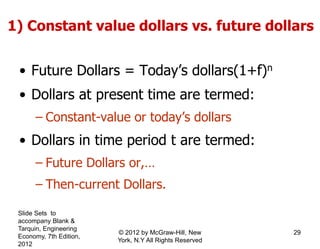
• Future Dollars = Today’s dollars(1+f)n
• Dollars at present time are termed:
– Constant-value or today’s dollars
• Dollars in time period t are termed:
– Future Dollars or,…
– Then-current Dollars.
1) Constant value dollars vs. future dollars
Slide Sets to
accompany Blank &
Tarquin, Engineering
Economy, 7th Edition,
2012
29© 2012 by McGraw-Hill, New
York, N.Y All Rights Reserved
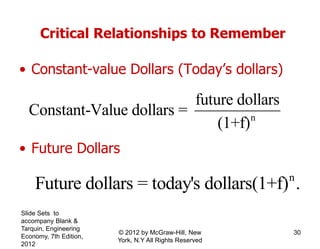
Critical Relationships to Remember
• Constant-value Dollars (Today’s dollars)
• Future Dollars
n
future dollars
Constant-Value dollars =
(1+f)
n
Future dollars = today's dollars(1+f) .
Slide Sets to
accompany Blank &
Tarquin, Engineering
Economy, 7th Edition,
2012
30© 2012 by McGraw-Hill, New
York, N.Y All Rights Reserved
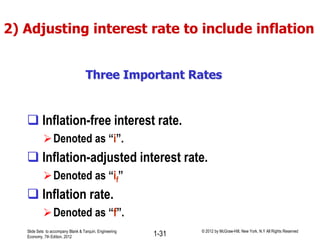
Three Important Rates
 Inflation-free interest rate.
Denoted as “i”.
 Inflation-adjusted interest rate.
Denoted as “if”
 Inflation rate.
Denoted as “f”.
2) Adjusting interest rate to include inflation
Slide Sets to accompany Blank & Tarquin, Engineering
Economy, 7th Edition, 2012 1-31 © 2012 by McGraw-Hill, New York, N.Y All Rights Reserved
Real or Inflation-free Interest Rate - i
• Rate at which interest is earned.
• Effects of any inflation have been
removed.
• Represents the actual or real gain
received/charged on investments or
borrowing.
Slide Sets to
accompany Blank &
Tarquin, Engineering
Economy, 7th Edition,
2012 32© 2012 by McGraw-Hill, New
York, N.Y All Rights Reserved
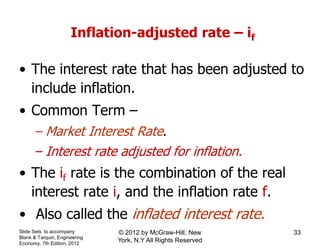
Inflation-adjusted rate – if
• The interest rate that has been adjusted to
include inflation.
• Common Term –
– Market Interest Rate.
– Interest rate adjusted for inflation.
• The if rate is the combination of the real
interest rate i, and the inflation rate f.
• Also called the inflated interest rate.
Slide Sets to accompany
Blank & Tarquin, Engineering
Economy, 7th Edition, 2012
33© 2012 by McGraw-Hill, New
York, N.Y All Rights Reserved
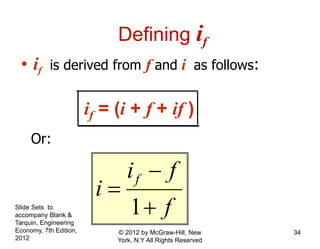
Defining if
• if is derived from f and i as follows:
if = (i + f + if )
Or:
1
fi f
i
f


Slide Sets to
accompany Blank &
Tarquin, Engineering
Economy, 7th Edition,
2012
34© 2012 by McGraw-Hill, New
York, N.Y All Rights Reserved
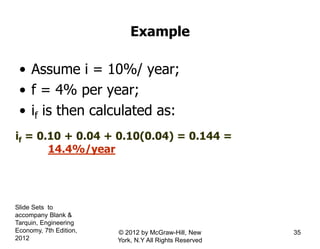
Example
• Assume i = 10%/ year;
• f = 4% per year;
• if is then calculated as:
if = 0.10 + 0.04 + 0.10(0.04) = 0.144 =
14.4%/year
Slide Sets to
accompany Blank &
Tarquin, Engineering
Economy, 7th Edition,
2012
35© 2012 by McGraw-Hill, New
York, N.Y All Rights Reserved
Which interest rate to use?
• Either rate is correct when the correct dollar
value is selected:
Cash flow in Interest rate to use
Today’s dollar (constant value) i
Future dollars if
Slide Sets to
accompany Blank &
Tarquin, Engineering
Economy, 7th Edition,
2012
36© 2012 by McGraw-Hill, New
York, N.Y All Rights Reserved
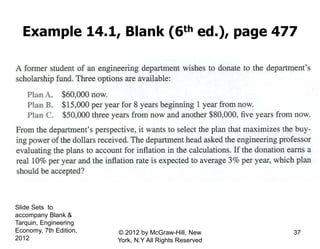
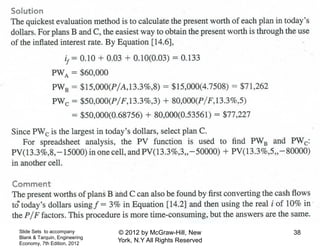
Example 14.1, Blank (6th ed.), page 477
Slide Sets to
accompany Blank &
Tarquin, Engineering
Economy, 7th Edition,
2012
37© 2012 by McGraw-Hill, New
York, N.Y All Rights Reserved
Slide Sets to accompany
Blank & Tarquin, Engineering
Economy, 7th Edition, 2012
38© 2012 by McGraw-Hill, New
York, N.Y All Rights Reserved
Effect of Inflation on the MARR
When inflation is expected during the life of a project, the
MARR needs to be increased to avoid accepting poor
projects.
 Inflated MARR = minimum acceptable rate of return when cash
flows are in actual dollars (future dollars).
If investors expect inflation, they require higher actual
rates of return on their investments than if inflation were
not expected.
 Inflated MARR = real MARR (without inflation) + upwards
adjustment which reflects the effect of inflation.
So, following from the definition, we have: if = (i + f + if )
MARRinflated = MARRR + f + MARRR * f
 where MARRinflated(if) is inflated MARR and MARRR (i) is real MARR
(without inflation).
Slide Sets to accompany Blank & Tarquin, Engineering
Economy, 7th Edition, 2012 1-39 © 2012 by McGraw-Hill, New York, N.Y All Rights Reserved
Abbott Mining Systems wants to determine whether it should buy now or buy
later a piece of equipment used in deep mining operations. If the
company selects plan N, the equipment will be purchased now for $200,000.
However, if the company selects plan L, the purchase will be deferred for
3 years when the cost is expected to rise rapidly to $340,000. Abbott is
ambitious; it expects a real MARR of 12% per year. The inflation rate in the
country has averaged 6.75% per year. From only an economic perspective,
determine whether the company should purchase now or later (a) when inflation
is not considered and (b) when inflation is considered.
Solution
a) Inflation not considered: The real rate, or MARR, is i = 12% per year. The
cost of plan L is $340,000 three years hence. Calculate the FW value for
plan N three years from now:
FWN = -200,000(F/P,12%,3) = $-280,986
FWL = $-340,000
Hence buy now
Example 14.4, Blank (6th ed.), page 483:
Slide Sets to accompany Blank & Tarquin, Engineering
Economy, 7th Edition, 2012 1-40 © 2012 by McGraw-Hill, New York, N.Y All Rights Reserved
b) Inflation considered: There is a real rate (12%), and inflation
is 6.75%. First, compute the inflation-adjusted MARR :
MARRf = 0.12 + 0.0675 + 0.12(0.0675) = 0.1956
Compute the FW value for plan N in future dollars.
FWN = -200,000(F/P,19.56%,3) = $-341,812
FWL = $-340,000
Purchasing later is selected, because it requires fewer equivalent future
dollars. The inflation rate of 6.75% per year has raised the equivalent future
worth of costs by 21.6% to $341,812.
Slide Sets to accompany Blank & Tarquin, Engineering
Economy, 7th Edition, 2012 1-41 © 2012 by McGraw-Hill, New York, N.Y All Rights Reserved

Lecture3 compoundingfactors effectsofinflation

  • 1.
    Lecture # 3 1.Compounding Factors 2. Effect of Inflation 1-1 Dr. A. Alim
  • 2.
    Determination of UnknownInterest Rate  Class of problems where the interest rate, i%, is the unknown value  For simple, single payment problems (i.e., P and F only), solving for i% given the other parameters is not difficult  For annuity and gradient type problems, solving for i% can be tedious  Trial and error method  Use EXCEL Slide Sets to accompany Blank & Tarquin, Engineering Economy, 7th Edition, 2012 1-2 © 2012 by McGraw-Hill, New York, N.Y All Rights Reserved
  • 3.
    The IRR andRATE Spreadsheet Functions  Define the total cash flow as a column of values within Excel  Apply the IRR function: =IRR(first_cell:last_cell, guess value)  If the cash flow series is an A value then apply the RATE function: =RATE(number_years, A,P,F) Slide Sets to accompany Blank & Tarquin, Engineering Economy, 7th Edition, 2012 1-3 © 2012 by McGraw-Hill, New York, N.Y All Rights Reserved
  • 4.
    The IRR andRATE Spreadsheet Functions Slide Sets to accompany Blank & Tarquin, Engineering Economy, 7th Edition, 2012 1-4 © 2012 by McGraw-Hill, New York, N.Y All Rights Reserved Example 1 End of Year Cash Flow 0 (1,200.00)$ 1 354.00$ IRR = 26.3% 2 700.00$ 3 216.00$ 4 953.00$ Example 2 End of Year Cash Flow 0 (1,200.00)$ 1 400.00$ Rate = 12.6% 2 400.00$ 3 400.00$ IRR = 12.6% 4 400.00$
  • 5.
    Determination of UnknownNumber of Years  Class of problems where the number of time periods (years) is the unknown  In single payment type problems, solving for n is straight forward  In other types of cash flow profiles, solving for n requires trial and error.  In Excel, given A, P, or F, and i% values apply: =NPER(i%,A,P,F) to return the value of n Slide Sets to accompany Blank & Tarquin, Engineering Economy, 7th Edition, 2012 1-5 © 2012 by McGraw-Hill, New York, N.Y All Rights Reserved
  • 6.
    Determination of UnknownNumber of Years Slide Sets to accompany Blank & Tarquin, Engineering Economy, 7th Edition, 2012 1-6 © 2012 by McGraw-Hill, New York, N.Y All Rights Reserved Example: P -1200 A 400 i 12.60% Number of periods = 4
  • 7.
    In practice –interest rates do not stay the same over time unless by contractual obligation. There can exist “variation” of interest rates over time – quite normal! If required, how do we handle that situation? Interest rates that vary over time Slide Sets to accompany Blank & Tarquin, Engineering Economy, 7th Edition, 2012 1-7 © 2012 by McGraw-Hill, New York, N.Y All Rights Reserved
  • 8.
    Interest Rates thatvary over time  Best illustrated by an example.  Assume for now that interest rate is constant 7% for the whole 4 years period: 0 1 2 3 4 $70,000 $70,000 $35,000 $25,000 7% 7% 7% 7% Slide Sets to accompany Blank & Tarquin, Engineering Economy, 7th Edition, 2012 1-8 © 2012 by McGraw-Hill, New York, N.Y All Rights Reserved
  • 9.
    Interest Rates thatvary over time  Best illustrated by an example.  Assume for now that interest rate is constant 7% for the whole 4 years period: 0 1 2 3 4 $70,000 $70,000 $35,000 $25,000 7% 7% 7% 7% P = Slide Sets to accompany Blank & Tarquin, Engineering Economy, 7th Edition, 2012 1-9 © 2012 by McGraw-Hill, New York, N.Y All Rights Reserved
  • 10.
    Interest Rates thatvary over time  Best illustrated by an example.  Assume for now that interest rate is constant 7% for the whole 4 years period: 0 1 2 3 4 $70,000 $70,000 $35,000 $25,000 7% 7% 7% 7% P = 70,000(P/A,7%,2) + 35,000(P/F,7%,3) + 25,000(P/F,7%,4) Slide Sets to accompany Blank & Tarquin, Engineering Economy, 7th Edition, 2012 1-10 © 2012 by McGraw-Hill, New York, N.Y All Rights Reserved
  • 11.
    Interest Rates thatvary over time  Best illustrated by an example.  Now, assume the following future profits: 0 1 2 3 4 $70,000 $70,000 $35,000 $25,000 7% 7% 9% 10% (P/F,7%,1) (P/F,7%,1) (P/F,9%,1) (P/F,10%,1) (P/F,7%,1) (P/F,7%,1) (P/F,7%,1) (P/F,7%,1) (P/F,7%,1) (P/F,9%,1) Slide Sets to accompany Blank & Tarquin, Engineering Economy, 7th Edition, 2012 1-11 © 2012 by McGraw-Hill, New York, N.Y All Rights Reserved
  • 12.
    Varying Rates: PresentWorth To find the Present Worth: Bring each cash flow amount back to the appropriate point in time at the interest rate according to: P = F1(P/F,i1,1) + F2(P/F,i1,1)(P/F,i2,1) + … + Fn(P/F,i1,1)(P/F,i2,1)(P/F,i3,1)…(P/F,in,1) This Process can get computationally involved! Slide Sets to accompany Blank & Tarquin, Engineering Economy, 7th Edition, 2012 1-12 © 2012 by McGraw-Hill, New York, N.Y All Rights Reserved
  • 13.
    Period-by-Period Analysis  P0= $7000(P/F,7%,1) + $7000(P/F,7%,1)(P/F,7%,1) + $35000(P/F,9%,1)(P/F,7%,1)2 + $25000(P/F,10%,1)(P/F,9%,1)(P/F,7%,1)2 Equals: $172,816 at t = 0… Work backwards one period at a time until you get to “0”. Slide Sets to accompany Blank & Tarquin, Engineering Economy, 7th Edition, 2012 1-13 © 2012 by McGraw-Hill, New York, N.Y All Rights Reserved
  • 14.
    Period-by-Period Analysis  Toobtain the equivalent uniform series A over all n years, substitute the symbol A for each Fi, then solve for A: Slide Sets to accompany Blank & Tarquin, Engineering Economy, 7th Edition, 2012 1-14 © 2012 by McGraw-Hill, New York, N.Y All Rights Reserved
  • 15.
    Period-by-Period Analysis  P0= $172,816 = $A (P/F,7%,1) + $A (P/F,7%,1)(P/F,7%,1) + $A (P/F,9%,1)(P/F,7%,1)2 + $A (P/F,10%,1)(P/F,9%,1)(P/F,7%,1)2 Solve for A = $51,777 per year Slide Sets to accompany Blank & Tarquin, Engineering Economy, 7th Edition, 2012 1-15 © 2012 by McGraw-Hill, New York, N.Y All Rights Reserved
  • 16.
    Varying Rates: Approximation An alternative approach that approximates the present value:  Average the interest rates over the appropriate number of time periods. In the previous example {7% + 7% + 9% + 10%} / 4 = 8.25%  This approach is only an approximation. Students MUST NOT use this method in solving problems in quizzes or examinations. Slide Sets to accompany Blank & Tarquin, Engineering Economy, 7th Edition, 2012 1-16 © 2012 by McGraw-Hill, New York, N.Y All Rights Reserved
  • 17.
    Inflation - Definition The increase in the amount of money necessary to obtain the same amount of product or service before the inflated price was present;  Social Phenomena where too much money chases too few goods/services;  Harmful impact because the purchasing power of the currency changes downward in value. Slide Sets to accompany Blank & Tarquin, Engineering Economy, 7th Edition, 2012 1-17 © 2012 by McGraw-Hill, New York, N.Y All Rights Reserved
  • 18.
    Deflation  Where thevalue , i.e. the purchasing power of the currency increases over time.  Less amounts of the currency can purchase more goods and services than before.  Not very commonly seen……2009 was the first year with deflation (or zero inflation) in a very long time! Slide Sets to accompany Blank & Tarquin, Engineering Economy, 7th Edition, 2012 1-18 © 2012 by McGraw-Hill, New York, N.Y All Rights Reserved
  • 19.
    Inflation rate -f  The measure of the annual rate of change in the value of a currency.  Similar to an interest rate but should not be viewed as an interest rate.  f is a percentage value similar to the interest rate.  Let n represent the period of time between now and a future date, then:  Future cost = Current cost (1 +f )n  Note: this does not involve time value of money (compounding) Slide Sets to accompany Blank & Tarquin, Engineering Economy, 7th Edition, 2012 1-19 © 2012 by McGraw-Hill, New York, N.Y All Rights Reserved
  • 20.
    Example to Consider Assume a firm desires to purchase a productive asset that costs $209,000 in today’s dollars.  Assume an inflation rate of say, 4% per year;  In 10 years, that same piece of equipment would cost:  $209,000(1.04)10 = $309,371!  Does not include an interest rate or rate of return consideration.  The $309,371 are called “future dollars”. Slide Sets to accompany Blank & Tarquin, Engineering Economy, 7th Edition, 2012 1-20 © 2012 by McGraw-Hill, New York, N.Y All Rights Reserved
  • 21.
    Inflation can beSignificant  From the previous example we see that even at a modest 4% rate of inflation, the future impact on cost can be and often is significant!  The previous example does not consider the time value of money.  A proper engineering economy analysis should consider both inflation and the time value of money. Slide Sets to accompany Blank & Tarquin, Engineering Economy, 7th Edition, 2012 1-21 © 2012 by McGraw-Hill, New York, N.Y All Rights Reserved
  • 22.
    How is inflationmeasured*?  Consumer Price Index (CPI) - a government measure of the price change of a “market basket” of goods and services (national inflation rate)  Producer Price Indices – a government measure of price changes for specific industries  Chemical and Petrochemical Process Plants  Farm Products  Consulting Engineering Services Price Indexes  Residential Building Construction Input Price Indexes  Industrial product price indexes  Raw materials price indexes  Energy consumer price indices * Ref. : J.C. Paradi, Centre for Management of Technology and Entrepreneurship ( 1996-2004) 1-22Slide Sets to accompany Blank & Tarquin, Engineering Economy, 7th Edition, 2012 © 2012 by McGraw-Hill, New York, N.Y All Rights Reserved
  • 23.
    CPI The CPI fora given period relates the average price of a fixed “basket” of goods in the given period to the average price of the same basket of goods in a base period. Current CPI base year is 1982 -84. Base year index is set at 100. The index for any other year indicates the number of dollars needed in that year to buy the basket of goods that cost $100 in 1982-84. 1-23Slide Sets to accompany Blank & Tarquin, Engineering Economy, 7th Edition, 2012 © 2012 by McGraw-Hill, New York, N.Y All Rights Reserved
  • 24.
    Historical CPI Consumer PriceIndex historical summary – 1982-84 = 100% Year CPI % Change Year CPI % Change Year CPI % Change 1972 41.8 3.2 1983 99.6 3.2 1994 148.2 2.6 1973 44.4 6.2 1984 103.9 4.3 1995 152.4 2.8 1974 49.3 11.0 1985 107.6 3.6 1996 156.9 3.0 1975 53.8 9.1 1986 109.6 1.9 1997 160.5 2.3 1976 56.9 5.8 1987 113.6 3.6 1998 163.0 1.6 1977 60.6 6.5 1988 118.3 4.1 1999 166.6 2.2 1978 65.2 7.6 1989 124.0 4.8 2000 172.2 3.4 1979 72.6 11.3 1990 130.7 5.4 2001 177.1 2.8 1980 82.4 13.5 1991 136.2 4.2 2002 179.9 1.6 1981 90.9 10.3 1992 140.3 3.0 2003 184.0 2.3 1982 96.5 6.2 1993 144.5 3.0 2004 188.9 2.7 2005 195.3 3.4 2006 201.6 3.2 2007 207.3 2.9 2008 215.3 3.8 2009 214.5 -0.4 2010 218.1 1.7 2011 224.9 3.2 2012 230.0 2.2 1-24Slide Sets to accompany Blank & Tarquin, Engineering Economy, 7th Edition, 2012 © 2012 by McGraw-Hill, New York, N.Y All Rights Reserved
  • 25.
    Inflation rate -f  Defined as the percent change in CPI from year to year.  For example, from the previous table: CPI in 2009 is 214.5 CPI in 2010 is 218.1  Inflation rate in 2010 is: 100 x (218.1 – 214.4)/214.5 = approx 1.7% Slide Sets to accompany Blank & Tarquin, Engineering Economy, 7th Edition, 2012 1-25 © 2012 by McGraw-Hill, New York, N.Y All Rights Reserved
  • 26.
    Annual Inflation rate CPI 1-26Slide Setsto accompany Blank & Tarquin, Engineering Economy, 7th Edition, 2012 © 2012 by McGraw-Hill, New York, N.Y All Rights Reserved
  • 27.
    1-27Slide Sets toaccompany Blank & Tarquin, Engineering Economy, 7th Edition, 2012 © 2012 by McGraw-Hill, New York, N.Y All Rights Reserved
  • 28.
    Accounting for inflation Thereare two ways to make meaningful economic calculations when the currency is changing in value, that is when inflation is considered: 1. Convert the amounts that occur in different time periods into constant value dollars. This is accomplished before any time value of money calculation is made using the real interest rate. 2. Change the interest rate used to account for inflation plus the time value of money. This is called the inflation-adjusted or market interest rate. Slide Sets to accompany Blank & Tarquin, Engineering Economy, 7th Edition, 2012 28© 2012 by McGraw-Hill, New York, N.Y All Rights Reserved
  • 29.
    • Future Dollars= Today’s dollars(1+f)n • Dollars at present time are termed: – Constant-value or today’s dollars • Dollars in time period t are termed: – Future Dollars or,… – Then-current Dollars. 1) Constant value dollars vs. future dollars Slide Sets to accompany Blank & Tarquin, Engineering Economy, 7th Edition, 2012 29© 2012 by McGraw-Hill, New York, N.Y All Rights Reserved
  • 30.
    Critical Relationships toRemember • Constant-value Dollars (Today’s dollars) • Future Dollars n future dollars Constant-Value dollars = (1+f) n Future dollars = today's dollars(1+f) . Slide Sets to accompany Blank & Tarquin, Engineering Economy, 7th Edition, 2012 30© 2012 by McGraw-Hill, New York, N.Y All Rights Reserved
  • 31.
    Three Important Rates Inflation-free interest rate. Denoted as “i”.  Inflation-adjusted interest rate. Denoted as “if”  Inflation rate. Denoted as “f”. 2) Adjusting interest rate to include inflation Slide Sets to accompany Blank & Tarquin, Engineering Economy, 7th Edition, 2012 1-31 © 2012 by McGraw-Hill, New York, N.Y All Rights Reserved
  • 32.
    Real or Inflation-freeInterest Rate - i • Rate at which interest is earned. • Effects of any inflation have been removed. • Represents the actual or real gain received/charged on investments or borrowing. Slide Sets to accompany Blank & Tarquin, Engineering Economy, 7th Edition, 2012 32© 2012 by McGraw-Hill, New York, N.Y All Rights Reserved
  • 33.
    Inflation-adjusted rate –if • The interest rate that has been adjusted to include inflation. • Common Term – – Market Interest Rate. – Interest rate adjusted for inflation. • The if rate is the combination of the real interest rate i, and the inflation rate f. • Also called the inflated interest rate. Slide Sets to accompany Blank & Tarquin, Engineering Economy, 7th Edition, 2012 33© 2012 by McGraw-Hill, New York, N.Y All Rights Reserved
  • 34.
    Defining if • ifis derived from f and i as follows: if = (i + f + if ) Or: 1 fi f i f   Slide Sets to accompany Blank & Tarquin, Engineering Economy, 7th Edition, 2012 34© 2012 by McGraw-Hill, New York, N.Y All Rights Reserved
  • 35.
    Example • Assume i= 10%/ year; • f = 4% per year; • if is then calculated as: if = 0.10 + 0.04 + 0.10(0.04) = 0.144 = 14.4%/year Slide Sets to accompany Blank & Tarquin, Engineering Economy, 7th Edition, 2012 35© 2012 by McGraw-Hill, New York, N.Y All Rights Reserved
  • 36.
    Which interest rateto use? • Either rate is correct when the correct dollar value is selected: Cash flow in Interest rate to use Today’s dollar (constant value) i Future dollars if Slide Sets to accompany Blank & Tarquin, Engineering Economy, 7th Edition, 2012 36© 2012 by McGraw-Hill, New York, N.Y All Rights Reserved
  • 37.
    Example 14.1, Blank(6th ed.), page 477 Slide Sets to accompany Blank & Tarquin, Engineering Economy, 7th Edition, 2012 37© 2012 by McGraw-Hill, New York, N.Y All Rights Reserved
  • 38.
    Slide Sets toaccompany Blank & Tarquin, Engineering Economy, 7th Edition, 2012 38© 2012 by McGraw-Hill, New York, N.Y All Rights Reserved
  • 39.
    Effect of Inflationon the MARR When inflation is expected during the life of a project, the MARR needs to be increased to avoid accepting poor projects.  Inflated MARR = minimum acceptable rate of return when cash flows are in actual dollars (future dollars). If investors expect inflation, they require higher actual rates of return on their investments than if inflation were not expected.  Inflated MARR = real MARR (without inflation) + upwards adjustment which reflects the effect of inflation. So, following from the definition, we have: if = (i + f + if ) MARRinflated = MARRR + f + MARRR * f  where MARRinflated(if) is inflated MARR and MARRR (i) is real MARR (without inflation). Slide Sets to accompany Blank & Tarquin, Engineering Economy, 7th Edition, 2012 1-39 © 2012 by McGraw-Hill, New York, N.Y All Rights Reserved
  • 40.
    Abbott Mining Systemswants to determine whether it should buy now or buy later a piece of equipment used in deep mining operations. If the company selects plan N, the equipment will be purchased now for $200,000. However, if the company selects plan L, the purchase will be deferred for 3 years when the cost is expected to rise rapidly to $340,000. Abbott is ambitious; it expects a real MARR of 12% per year. The inflation rate in the country has averaged 6.75% per year. From only an economic perspective, determine whether the company should purchase now or later (a) when inflation is not considered and (b) when inflation is considered. Solution a) Inflation not considered: The real rate, or MARR, is i = 12% per year. The cost of plan L is $340,000 three years hence. Calculate the FW value for plan N three years from now: FWN = -200,000(F/P,12%,3) = $-280,986 FWL = $-340,000 Hence buy now Example 14.4, Blank (6th ed.), page 483: Slide Sets to accompany Blank & Tarquin, Engineering Economy, 7th Edition, 2012 1-40 © 2012 by McGraw-Hill, New York, N.Y All Rights Reserved
  • 41.
    b) Inflation considered:There is a real rate (12%), and inflation is 6.75%. First, compute the inflation-adjusted MARR : MARRf = 0.12 + 0.0675 + 0.12(0.0675) = 0.1956 Compute the FW value for plan N in future dollars. FWN = -200,000(F/P,19.56%,3) = $-341,812 FWL = $-340,000 Purchasing later is selected, because it requires fewer equivalent future dollars. The inflation rate of 6.75% per year has raised the equivalent future worth of costs by 21.6% to $341,812. Slide Sets to accompany Blank & Tarquin, Engineering Economy, 7th Edition, 2012 1-41 © 2012 by McGraw-Hill, New York, N.Y All Rights Reserved