Lecturer: Prof. Dr. Thamer Ahmad Mohammad
Lecture 18/ 18 April 2021
Dam Engineering
Final Year
Department of Water Resources Engineering
College of Engineering
University of Baghdad
COLLEGE OF
ENGINEERING
Definition
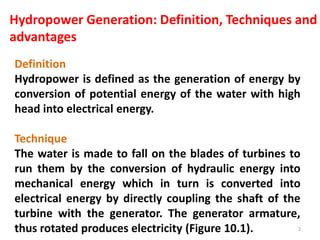
Hydropower is defined as the generation of energy by
conversion of potential energy of the water with high
head into electrical energy.
Technique
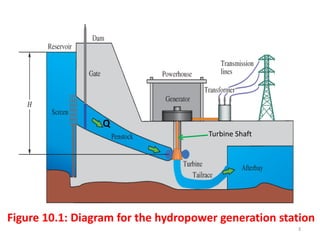
The water is made to fall on the blades of turbines to
run them by the conversion of hydraulic energy into
mechanical energy which in turn is converted into
electrical energy by directly coupling the shaft of the
turbine with the generator. The generator armature,
thus rotated produces electricity (Figure 10.1).
Hydropower Generation: Definition, Techniques and
advantages
2
Figure 10.1: Diagram for the hydropower generation station
Q
3
Turbine Shaft
Advantages
The main advantages of the hydropower are:
1. It has been one of the earliest and simple sources of
energy. The conversion of a flow of water into
electricity was first created in 1892
2. It is among the most cost-effective preferred method
of electricity generating
3. It is clean without pollution
4
Types of Hydropower Plants
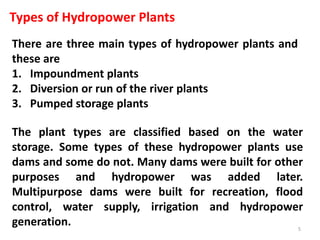
There are three main types of hydropower plants and
these are
1. Impoundment plants
2. Diversion or run of the river plants
3. Pumped storage plants
The plant types are classified based on the water
storage. Some types of these hydropower plants use
dams and some do not. Many dams were built for other
purposes and hydropower was added later.
Multipurpose dams were built for recreation, flood
control, water supply, irrigation and hydropower
generation. 5
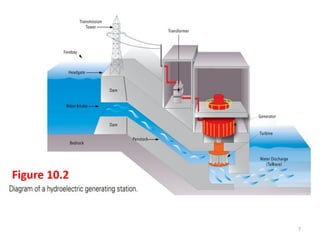
Impoundment plant is the most common type
of hydropower plant and it is typically large
hydropower system, uses dam to store river
water in a reservoir. Water released from the
reservoir flows through a turbine, spinning it,
which in turn activates a generator to produce
electricity as shown in Figure 10.2. The water
may be released either to meet changing in the
demand of electricity or to maintain a constant
reservoir level.
6
1. Impoundment Plants
Figure 10.2
7
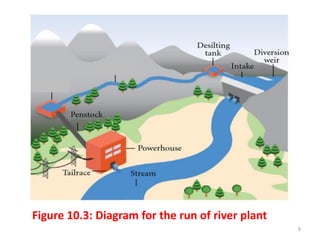
2. Diversion or Run of River Plants
A diversion, sometimes called run of river and it may not
require the use of a dam. A run of river plant is located
on a perennial river in which adequate discharge is
available throughout the year. The plant uses the water
as it comes in the river, without storing it. As such, a run
of river plants is feasible only on such stream which has a
minimum dry weather flow of adequate magnitude that
makes the hydropower development economically
viable. A weir or barrage is usually constructed across
the river to maintain the required water level and the
head for the power plant located on its side or
downstream as shown in Figure 10.3.
8
Figure 10.3: Diagram for the run of river plant
9
The run of river plants are generally low head plants (2-
10 m). In such plants, sometimes the tail water rises to
such a high level during flood that plants become
inoperative. The run of river plants usually have a small
pond on the upstream to store some water during off
peak hours, which is later utilised during peak hours.
For such plants, sometimes installation has to be
designed for a discharge of (10-20)Qmin where Qmin is
the minimum flow. Sometimes, a run of river is located
at a point far away downstream of a dam which
regularly releases water so that the flow in the river is
perennial.
10
3. Pumped Storage Plants
pumped storage hydropower plant is a plant
that stores energy by pumping water uphill to
a reservoir at higher elevation from a second
reservoir at a lower elevation. When the
demand for electricity is low, a pumped
storage facility stores energy by pumping
water from a lower reservoir to an upper
reservoir as shown in Figure 10.4. During
periods of high electrical demand, the water is
released back to the lower reservoir and turns
a turbine, generating electricity.
11
Figure 10.4: Diagram for a typical pumped storage plant
12
A unique feature of the pumped storage plant is that
the same quantity of water is used again and again.
However, because of evaporation and seepage losses,
the quantity of water is slightly reduced in each cycle,
which is compensated by additional supplies. It is
usually not necessary to install a separate pumping
system for head up to 120 m. special Francis turbine
have been developed for the pumped storage plants
which can also be used as pumps. The runners of
these turbines are so shaped that they can be used for
turbines as well as pumps. Such turbines are known
as reversible pump turbines or reversible turbines.
These turbines thus save the cost of the pumping
units and the pump house.
13
However, the efficiency of such a unit is usually less
than that of the individual turbine and pump units.
For heads greater than 120 m, separate pumping
units and turbine units are usually required.
14

Lecture 18-DE.pdf

  • 1.
    Lecturer: Prof. Dr.Thamer Ahmad Mohammad Lecture 18/ 18 April 2021 Dam Engineering Final Year Department of Water Resources Engineering College of Engineering University of Baghdad COLLEGE OF ENGINEERING
  • 2.
    Definition Hydropower is definedas the generation of energy by conversion of potential energy of the water with high head into electrical energy. Technique The water is made to fall on the blades of turbines to run them by the conversion of hydraulic energy into mechanical energy which in turn is converted into electrical energy by directly coupling the shaft of the turbine with the generator. The generator armature, thus rotated produces electricity (Figure 10.1). Hydropower Generation: Definition, Techniques and advantages 2
  • 3.
    Figure 10.1: Diagramfor the hydropower generation station Q 3 Turbine Shaft
  • 4.
    Advantages The main advantagesof the hydropower are: 1. It has been one of the earliest and simple sources of energy. The conversion of a flow of water into electricity was first created in 1892 2. It is among the most cost-effective preferred method of electricity generating 3. It is clean without pollution 4
  • 5.
    Types of HydropowerPlants There are three main types of hydropower plants and these are 1. Impoundment plants 2. Diversion or run of the river plants 3. Pumped storage plants The plant types are classified based on the water storage. Some types of these hydropower plants use dams and some do not. Many dams were built for other purposes and hydropower was added later. Multipurpose dams were built for recreation, flood control, water supply, irrigation and hydropower generation. 5
  • 6.
    Impoundment plant isthe most common type of hydropower plant and it is typically large hydropower system, uses dam to store river water in a reservoir. Water released from the reservoir flows through a turbine, spinning it, which in turn activates a generator to produce electricity as shown in Figure 10.2. The water may be released either to meet changing in the demand of electricity or to maintain a constant reservoir level. 6 1. Impoundment Plants
  • 7.
  • 8.
    2. Diversion orRun of River Plants A diversion, sometimes called run of river and it may not require the use of a dam. A run of river plant is located on a perennial river in which adequate discharge is available throughout the year. The plant uses the water as it comes in the river, without storing it. As such, a run of river plants is feasible only on such stream which has a minimum dry weather flow of adequate magnitude that makes the hydropower development economically viable. A weir or barrage is usually constructed across the river to maintain the required water level and the head for the power plant located on its side or downstream as shown in Figure 10.3. 8
  • 9.
    Figure 10.3: Diagramfor the run of river plant 9
  • 10.
    The run ofriver plants are generally low head plants (2- 10 m). In such plants, sometimes the tail water rises to such a high level during flood that plants become inoperative. The run of river plants usually have a small pond on the upstream to store some water during off peak hours, which is later utilised during peak hours. For such plants, sometimes installation has to be designed for a discharge of (10-20)Qmin where Qmin is the minimum flow. Sometimes, a run of river is located at a point far away downstream of a dam which regularly releases water so that the flow in the river is perennial. 10
  • 11.
    3. Pumped StoragePlants pumped storage hydropower plant is a plant that stores energy by pumping water uphill to a reservoir at higher elevation from a second reservoir at a lower elevation. When the demand for electricity is low, a pumped storage facility stores energy by pumping water from a lower reservoir to an upper reservoir as shown in Figure 10.4. During periods of high electrical demand, the water is released back to the lower reservoir and turns a turbine, generating electricity. 11
  • 12.
    Figure 10.4: Diagramfor a typical pumped storage plant 12
  • 13.
    A unique featureof the pumped storage plant is that the same quantity of water is used again and again. However, because of evaporation and seepage losses, the quantity of water is slightly reduced in each cycle, which is compensated by additional supplies. It is usually not necessary to install a separate pumping system for head up to 120 m. special Francis turbine have been developed for the pumped storage plants which can also be used as pumps. The runners of these turbines are so shaped that they can be used for turbines as well as pumps. Such turbines are known as reversible pump turbines or reversible turbines. These turbines thus save the cost of the pumping units and the pump house. 13
  • 14.
    However, the efficiencyof such a unit is usually less than that of the individual turbine and pump units. For heads greater than 120 m, separate pumping units and turbine units are usually required. 14