1
Formal Methods in SE
Qaisar Javaid
Assistant Professor
Lecture # 10
2
A transition system
 A (finite) set of variables V over some
domain.
 A set of states S.
 A (finite) set of transitions T, each
transition e t has
 an enabling condition e, and
 a transformation t.
 An initial condition I.
3
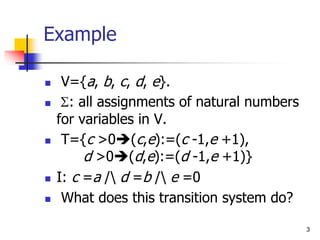
Example
 V={a, b, c, d, e}.
 S: all assignments of natural numbers
for variables in V.
 T={c >0(c,e):=(c -1,e +1),
d >0(d,e):=(d -1,e +1)}
 I: c =a / d =b / e =0
 What does this transition system do?
4
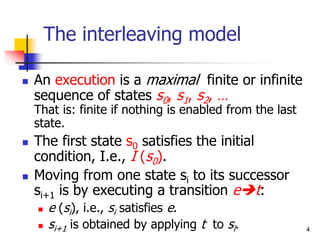
The interleaving model
 An execution is a maximal finite or infinite
sequence of states s0, s1, s2, …
That is: finite if nothing is enabled from the last
state.
 The first state s0 satisfies the initial
condition, I.e., I (s0).
 Moving from one state si to its successor
si+1 is by executing a transition et:
 e (si), i.e., si satisfies e.
 si+1 is obtained by applying t to si.
5
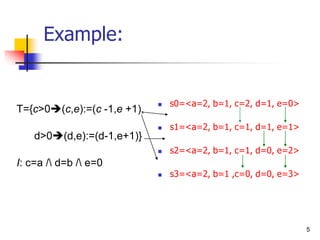
Example:
 s0=<a=2, b=1, c=2, d=1, e=0>
 s1=<a=2, b=1, c=1, d=1, e=1>
 s2=<a=2, b=1, c=1, d=0, e=2>
 s3=<a=2, b=1 ,c=0, d=0, e=3>
T={c>0(c,e):=(c -1,e +1),
d>0(d,e):=(d-1,e+1)}
I: c=a / d=b / e=0
6
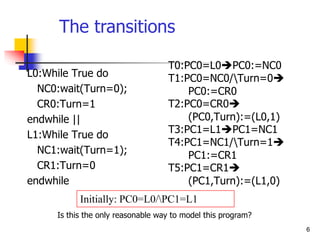
L0:While True do
NC0:wait(Turn=0);
CR0:Turn=1
endwhile ||
L1:While True do
NC1:wait(Turn=1);
CR1:Turn=0
endwhile
T0:PC0=L0PC0:=NC0
T1:PC0=NC0/Turn=0
PC0:=CR0
T2:PC0=CR0
(PC0,Turn):=(L0,1)
T3:PC1=L1PC1=NC1
T4:PC1=NC1/Turn=1
PC1:=CR1
T5:PC1=CR1
(PC1,Turn):=(L1,0)
Initially: PC0=L0/PC1=L1
The transitions
Is this the only reasonable way to model this program?
7
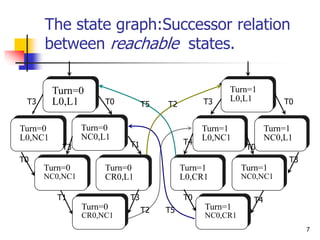
The state graph:Successor relation
between reachable states.
Turn=0
L0,L1
Turn=0
L0,NC1
Turn=0
NC0,L1
Turn=0
CR0,NC1
Turn=0
NC0,NC1
Turn=0
CR0,L1
Turn=1
L0,CR1
Turn=1
NC0,CR1
Turn=1
L0,NC1
Turn=1
NC0,NC1
Turn=1
NC0,L1
Turn=1
L0,L1
T0 T0
T3 T3
T1 T4
T3
T0 T3
T0
T0 T4
T1 T3
T2
T2
T5
T5
8
Some important points
 Reachable states: obtained from an initial state
through a sequence of enabled transitions.
 Executions: the set of maximal paths (finite or
terminating in a node where nothing is
enabled).
 Nondeterministic choice: when more than a
single transition is enabled at a given state. We
have a nondeterministic choice when at least
one node at the state graph has more than one
successor.
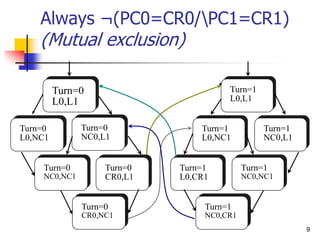
9
Always ¬(PC0=CR0/PC1=CR1)
(Mutual exclusion)
Turn=0
L0,L1
Turn=0
L0,NC1
Turn=0
NC0,L1
Turn=0
CR0,NC1
Turn=0
NC0,NC1
Turn=0
CR0,L1
Turn=1
L0,CR1
Turn=1
NC0,CR1
Turn=1
L0,NC1
Turn=1
NC0,NC1
Turn=1
NC0,L1
Turn=1
L0,L1
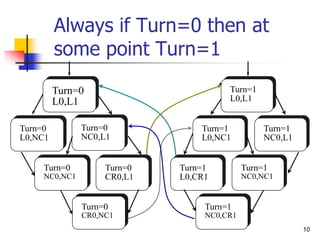
10
Always if Turn=0 then at
some point Turn=1
Turn=0
L0,L1
Turn=0
L0,NC1
Turn=0
NC0,L1
Turn=0
CR0,NC1
Turn=0
NC0,NC1
Turn=0
CR0,L1
Turn=1
L0,CR1
Turn=1
NC0,CR1
Turn=1
L0,NC1
Turn=1
NC0,NC1
Turn=1
NC0,L1
Turn=1
L0,L1
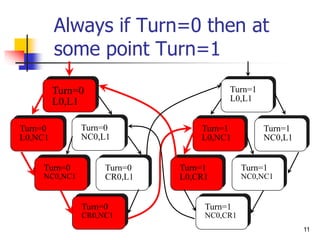
11
Always if Turn=0 then at
some point Turn=1
Turn=0
L0,L1
Turn=0
L0,NC1
Turn=0
NC0,L1
Turn=0
CR0,NC1
Turn=0
NC0,NC1
Turn=0
CR0,L1
Turn=1
L0,CR1
Turn=1
NC0,CR1
Turn=1
L0,NC1
Turn=1
NC0,NC1
Turn=1
NC0,L1
Turn=1
L0,L1
12
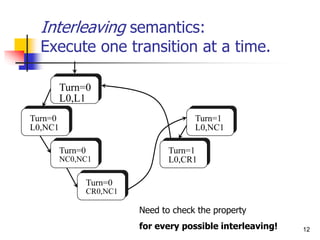
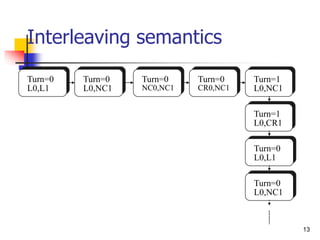
Interleaving semantics:
Execute one transition at a time.
Turn=0
L0,L1
Turn=0
L0,NC1
Turn=0
CR0,NC1
Turn=0
NC0,NC1
Turn=1
L0,CR1
Turn=1
L0,NC1
Need to check the property
for every possible interleaving!
13
Interleaving semantics
Turn=0
L0,L1
Turn=0
L0,NC1
Turn=0
CR0,NC1
Turn=0
NC0,NC1
Turn=1
L0,CR1
Turn=1
L0,NC1
Turn=0
L0,L1
Turn=0
L0,NC1
14
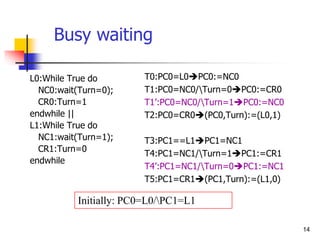
L0:While True do
NC0:wait(Turn=0);
CR0:Turn=1
endwhile ||
L1:While True do
NC1:wait(Turn=1);
CR1:Turn=0
endwhile
T0:PC0=L0PC0:=NC0
T1:PC0=NC0/Turn=0PC0:=CR0
T1’:PC0=NC0/Turn=1PC0:=NC0
T2:PC0=CR0(PC0,Turn):=(L0,1)
T3:PC1==L1PC1=NC1
T4:PC1=NC1/Turn=1PC1:=CR1
T4’:PC1=NC1/Turn=0PC1:=NC1
T5:PC1=CR1(PC1,Turn):=(L1,0)
Initially: PC0=L0/PC1=L1
Busy waiting
15
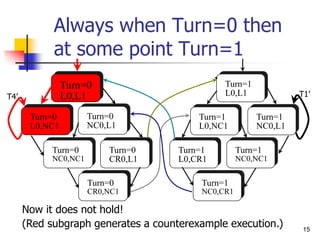
Always when Turn=0 then
at some point Turn=1
Now it does not hold!
(Red subgraph generates a counterexample execution.)
Turn=0
L0,L1
Turn=0
L0,NC1
Turn=0
NC0,L1
Turn=0
CR0,NC1
Turn=0
NC0,NC1
Turn=0
CR0,L1
Turn=1
L0,CR1
Turn=1
NC0,CR1
Turn=1
L0,NC1
Turn=1
NC0,NC1
Turn=1
NC0,L1
Turn=1
L0,L1
T4’ T1’
16
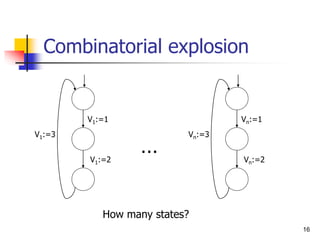
Combinatorial explosion
V1:=1
V1:=3
V1:=2
Vn:=1
Vn:=3
Vn:=2
…
How many states?
17
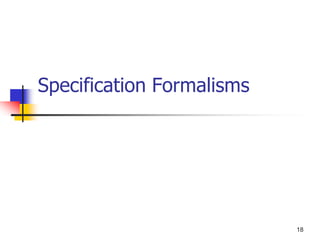
Global states
3n states
v1=1,v2=1…vn=1
v1=2,v2=1…vn=1 v1=1,v2=1…vn=2
…
v1=3,v2=1…vn=1
…
…
v1=1,v2=1…vn=3
18
Specification Formalisms
19
Properties of formalisms
 Formal. Unique interpretation.
 Intuitive. Simple to understand (visual).
 Succinct. Spec. of reasonable size.
 Effective.
 Check that there are no contradictions.
 Check that the spec. is implementable.
 Check that the implementation satisfies spec.
 Expressive.
 May be used to generate initial code.
Specifying the implementation or its properties?
20
A transition system
 A (finite) set of variables V.
 A set of states S.
 A (finite) set of transitions T, each transition et
has
 an enabling condition e and a transformation t.
 An initial condition I.
 Denote by R(s, s’) the fact that s’ is a successor of s.
21
The interleaving model
 An execution is a finite or infinite sequence of states s0, s1,
s2, …
 The initial state satisfies the initial condition, I.e., I (s0).
 Moving from one state si to si+1 is by executing a transition
et:
 e(si), I.e., si satisfies e.
 si+1 is obtained by applying t to si.
 Lets assume all sequences are infinite by extending finite
ones by “stuttering” the last state.
22
Temporal logic
 Dynamic, speaks about several “worlds”
and the relation between them.
 Our “worlds” are the states in an
execution.
 There is a linear relation between them,
each two sequences in our execution
are ordered.
 Interpretation: over an execution,
later over all executions.
23
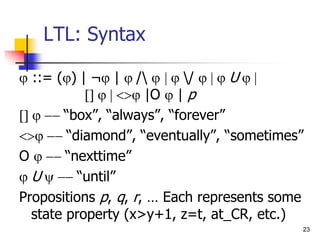
LTL: Syntax
 ::= () | ¬ | /  / U
 |O  | p
“box”, “always”, “forever”
“diamond”, “eventually”, “sometimes”
O “nexttime”
U“until”
Propositions p, q, r, … Each represents some
state property (x>y+1, z=t, at_CR, etc.)
24
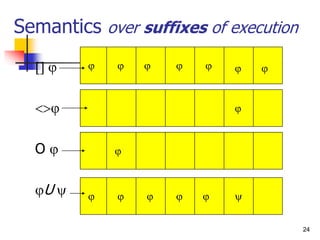
Semantics over suffixes of execution


O 
U


    








25
Can discard some operators
 Instead of <>p, write true U p.
 Instead of []p, we can write ¬(<>¬p),
or ¬(true U ¬p).
Because []p=¬¬[]p.
¬[]p means it is not true that p holds
forever, or at some point ¬p holds or
<>¬p.
26
Combinations
 []<>p “p will happen infinitely often”
 <>[]p “p will happen from some point
forever”.
 ([]<>p)  ([]<>q) “If p happens
infinitely often, then q also happens
infinitely often”.
27
Some relations:
 [](/)=([])/([])
 But <>(/)(<>)/(<>)
 <>(/)=(<>)/(<>)
 But [](/)([])/([])











28
What about
 ([]<>)/([]<>)=[]<>(/)?
 ([]<>)/([]<>)=[]<>(/)?
 (<>[])/(<>[])=<>[](/)?
 (<>[])/(<>[])=<>[](/)?
No, just 
Yes!!!
Yes!!!
No, just 
29
Formal semantic definition
 Let  be a sequence s0 s1 s2 …
 Let i be a suffix of : si si+1 si+2 … (0 = )
 i |= p, where p a proposition, if si|=p.
 i |= / if i |=  and i |= .
 i |= / if i |=  or i |= .
 i |= ¬ if it is not the case that i |= .
 i |= <> if for some ji, j |= .
 i |= [] if for each ji, j |= .
 i |= U  if for some ji, j|=.
and for each ik<j, k |=.
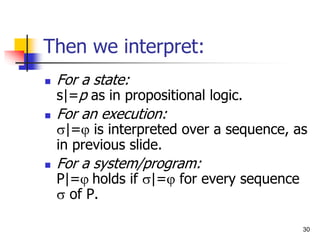
30
Then we interpret:
 For a state:
s|=p as in propositional logic.
 For an execution:
|= is interpreted over a sequence, as
in previous slide.
 For a system/program:
P|= holds if |= for every sequence
 of P.
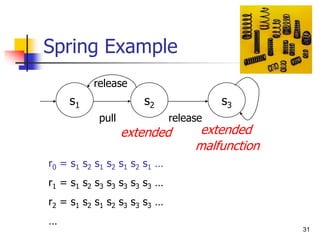
31
Spring Example
s1 s3
s2
pull
release
release
extended
malfunction
extended
r0 = s1 s2 s1 s2 s1 s2 s1 …
r1 = s1 s2 s3 s3 s3 s3 s3 …
r2 = s1 s2 s1 s2 s3 s3 s3 …
…
32
LTL satisfaction by a single
sequence
malfunction
s1 s3
s2
pull
release
release
extended extended
r2 = s1 s2 s1 s2 s3 s3 s3 …
r2 |= extended ??
r2 |= O extended ??
r2 |= O O extended ??
r2 |= <> extended ??
r2 |= [] extended ??
r2 |= <>[] extended ??
r2 |= ¬ <>[] extended ??
r2 |= (¬extended) U malfunction ??
r2 |= [](¬extended->O extended) ??
33
LTL satisfaction by a system
malfunction
s1 s3
s2
pull
release
release
extended extended
P |= extended ??
P |= O extended ??
P |= O O extended ??
P |= <> extended ??
P|= [] extended ??
P |= <>[] extended ??
P |= ¬ <>[] extended ??
P |= (¬extended) U malfunction ??
P |= [](¬extended->O extended) ??
34
More specifications
 [] (PC0=NC0  <> PC0=CR0)
 [] (PC0=NC0 U Turn=0)
 Try at home:
- The processes alternate in entering
their critical sections.
- Each process enters its critical section
infinitely often.
35
Proof system
 ¬<>p<-->[]¬p
 [](pq)([]p[]q)
 []p(p/O[]p)
 O¬p<-->¬Op
 [](pOp)(p[]p)
 (pUq)<-->(q/(p/O(pUq)))
 (pUq)<>q
 + propositional logic
axiomatization.
 + proof rule:
_p_
[]p
36
Traffic light example
Green  Yellow  Red
Always has exactly one light:
[](¬(gr/ye)/¬(ye/re)/¬(re/gr)/(gr/ye/re))
Correct change of color:
[]((grU ye)/(yeU re)/(reU gr))
37
Another kind of traffic light
GreenYellowRedYellow
First attempt:
[](((gr/re) U ye)/(ye U (gr/re)))
Correct specification:
[]( (gr(gr U (ye / ( ye U re ))))
/(re(re U (ye / ( ye U gr ))))
/(ye(ye U (gr / re))))
Needed only when we
can start with yellow
38
Properties of sequential
programs
 init-when the program starts and
satisfies the initial condition.
 finish-when the program terminates and
nothing is enabled.
 Partial correctness: init/[](finish)
 Termination: init/<>finish
 Total correctness: init/<>(finish/ )
 Invariant: init/[]
39
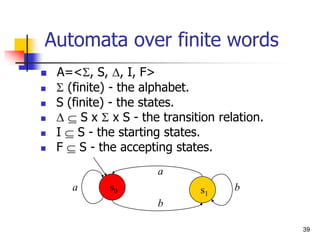
Automata over finite words
 A=<S, S, , I, F>
 S (finite) - the alphabet.
 S (finite) - the states.
   S x S x S - the transition relation.
 I  S - the starting states.
 F  S - the accepting states.
a
a
b
b
s0 s1
40
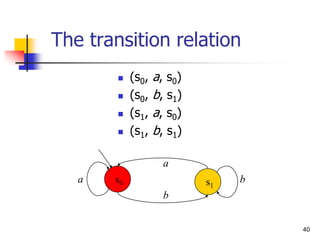
The transition relation
 (s0, a, s0)
 (s0, b, s1)
 (s1, a, s0)
 (s1, b, s1)
a
a
b
b
s0 s1
41
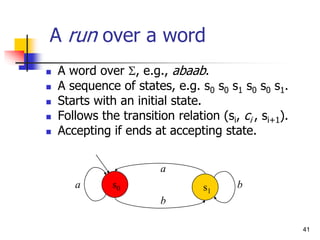
A run over a word
 A word over S, e.g., abaab.
 A sequence of states, e.g. s0 s0 s1 s0 s0 s1.
 Starts with an initial state.
 Follows the transition relation (si, ci , si+1).
 Accepting if ends at accepting state.
a
a
b
b
s0 s1
42
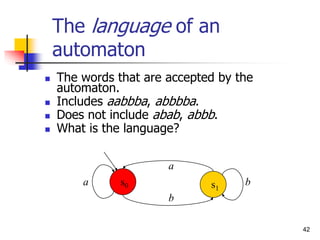
The language of an
automaton
 The words that are accepted by the
automaton.
 Includes aabbba, abbbba.
 Does not include abab, abbb.
 What is the language?
a
a
b
b
s0 s1
43
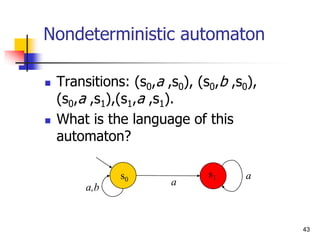
Nondeterministic automaton
 Transitions: (s0,a ,s0), (s0,b ,s0),
(s0,a ,s1),(s1,a ,s1).
 What is the language of this
automaton?
a,b a
a
s0
s1
44
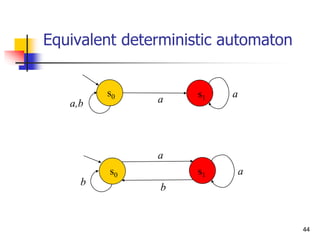
Equivalent deterministic automaton
b
a
a
s0 s1
b
a,b a
a
s0 s1
45
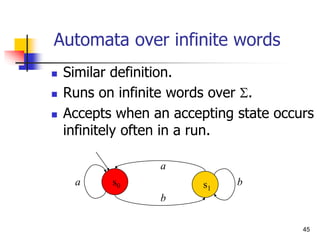
Automata over infinite words
 Similar definition.
 Runs on infinite words over S.
 Accepts when an accepting state occurs
infinitely often in a run.
a
a
b
b
s0 s1
46
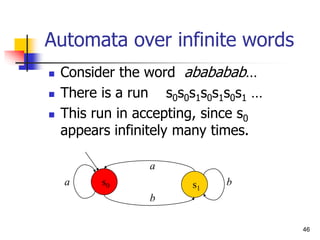
Automata over infinite words
 Consider the word abababab…
 There is a run s0s0s1s0s1s0s1 …
 This run in accepting, since s0
appears infinitely many times.
a
a
b
b
s0 s1
47
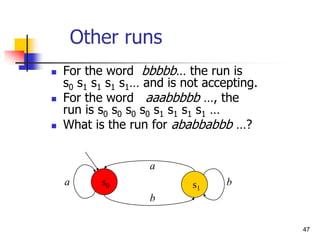
Other runs
 For the word bbbbb… the run is
s0 s1 s1 s1 s1… and is not accepting.
 For the word aaabbbbb …, the
run is s0 s0 s0 s0 s1 s1 s1 s1 …
 What is the run for ababbabbb …?
a
a
b
b
s0 s1
48
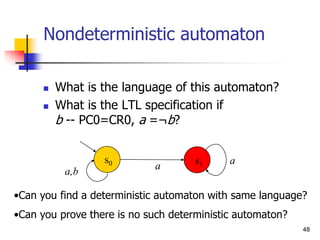
Nondeterministic automaton
 What is the language of this automaton?
 What is the LTL specification if
b -- PC0=CR0, a =¬b?
•Can you find a deterministic automaton with same language?
•Can you prove there is no such deterministic automaton?
a,b
a
a
s0 s1
49
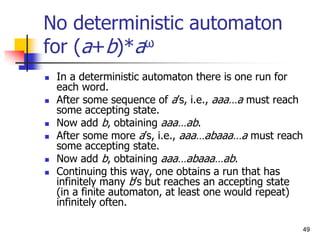
No deterministic automaton
for (a+b)*aω
 In a deterministic automaton there is one run for
each word.
 After some sequence of a’s, i.e., aaa…a must reach
some accepting state.
 Now add b, obtaining aaa…ab.
 After some more a’s, i.e., aaa…abaaa…a must reach
some accepting state.
 Now add b, obtaining aaa…abaaa…ab.
 Continuing this way, one obtains a run that has
infinitely many b’s but reaches an accepting state
(in a finite automaton, at least one would repeat)
infinitely often.
50
Specification using Automata
 Let each letter correspond to some propositional
property.
 Example: a -- P0 enters critical section,
b -- P0 does not enter section.
 []<>PC0=CR0
a
a
b
b
s0 s1
51
Mutual Exclusion
 a -- PC0=CR0/PC1=CR1
 b -- ¬(PC0=CR0/PC1=CR1)
 c -- true
 []¬(PC0=CR0/PC1=CR1)
b a c
s0 s1
52
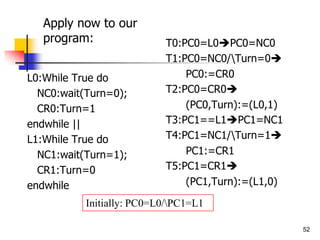
L0:While True do
NC0:wait(Turn=0);
CR0:Turn=1
endwhile ||
L1:While True do
NC1:wait(Turn=1);
CR1:Turn=0
endwhile
T0:PC0=L0PC0=NC0
T1:PC0=NC0/Turn=0
PC0:=CR0
T2:PC0=CR0
(PC0,Turn):=(L0,1)
T3:PC1==L1PC1=NC1
T4:PC1=NC1/Turn=1
PC1:=CR1
T5:PC1=CR1
(PC1,Turn):=(L1,0)
Initially: PC0=L0/PC1=L1
Apply now to our
program:
53
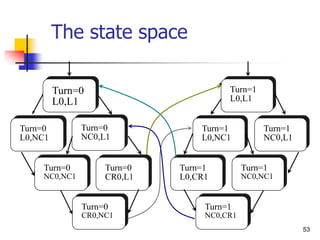
The state space
Turn=0
L0,L1
Turn=0
L0,NC1
Turn=0
NC0,L1
Turn=0
CR0,NC1
Turn=0
NC0,NC1
Turn=0
CR0,L1
Turn=1
L0,CR1
Turn=1
NC0,CR1
Turn=1
L0,NC1
Turn=1
NC0,NC1
Turn=1
NC0,L1
Turn=1
L0,L1
54
[]¬(PC0=CR0/PC1=CR1)
(Mutual exclusion)
Turn=0
L0,L1
Turn=0
L0,NC1
Turn=0
NC0,L1
Turn=0
CR0,NC1
Turn=0
NC0,NC1
Turn=0
CR0,L1
Turn=1
L0,CR1
Turn=1
NC0,CR1
Turn=1
L0,NC1
Turn=1
NC0,NC1
Turn=1
NC0,L1
Turn=1
L0,L1
55
[](Turn=0 <>Turn=1)
Turn=0
L0,L1
Turn=0
L0,NC1
Turn=0
NC0,L1
Turn=0
CR0,NC1
Turn=0
NC0,NC1
Turn=0
CR0,L1
Turn=1
L0,CR1
Turn=1
NC0,CR1
Turn=1
L0,NC1
Turn=1
NC0,NC1
Turn=1
NC0,L1
Turn=1
L0,L1
56
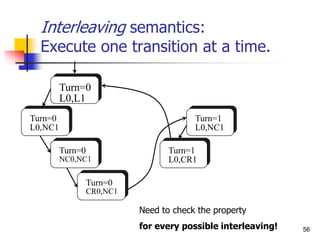
Interleaving semantics:
Execute one transition at a time.
Turn=0
L0,L1
Turn=0
L0,NC1
Turn=0
CR0,NC1
Turn=0
NC0,NC1
Turn=1
L0,CR1
Turn=1
L0,NC1
Need to check the property
for every possible interleaving!
57
[](Turn=0  <>Turn=1)
Turn=0
L0,L1
Turn=0
L0,NC1
Turn=0
NC0,L1
Turn=0
CR0,NC1
Turn=0
NC0,NC1
Turn=0
CR0,L1
Turn=1
L0,CR1
Turn=1
NC0,CR1
Turn=1
L0,NC1
Turn=1
NC0,NC1
Turn=1
NC0,L1
Turn=1
L0,L1
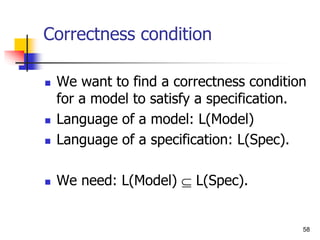
58
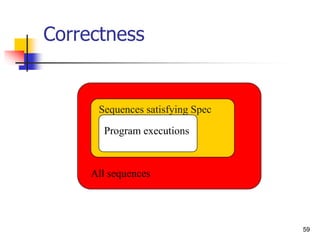
Correctness condition
 We want to find a correctness condition
for a model to satisfy a specification.
 Language of a model: L(Model)
 Language of a specification: L(Spec).
 We need: L(Model)  L(Spec).
59
Correctness
All sequences
Sequences satisfying Spec
Program executions
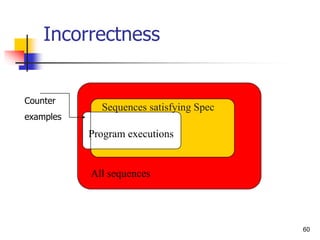
60
Incorrectness
All sequences
Sequences satisfying Spec
Program executions
Counter
examples
61
Automatic Verification
(Book: Chapter 6)
62
How can we check the model?
 The model is a graph.
 The specification should refer the the
graph representation.
 Apply graph theory algorithms.
63
What properties can we check?
 Invariant: a property that needs to
hold in each state.
 Deadlock detection: can we reach a
state where the program is blocked?
 Dead code: does the program have
parts that are never executed.

lecture 10 formal methods in software enginnering.pptx