AVL Trees
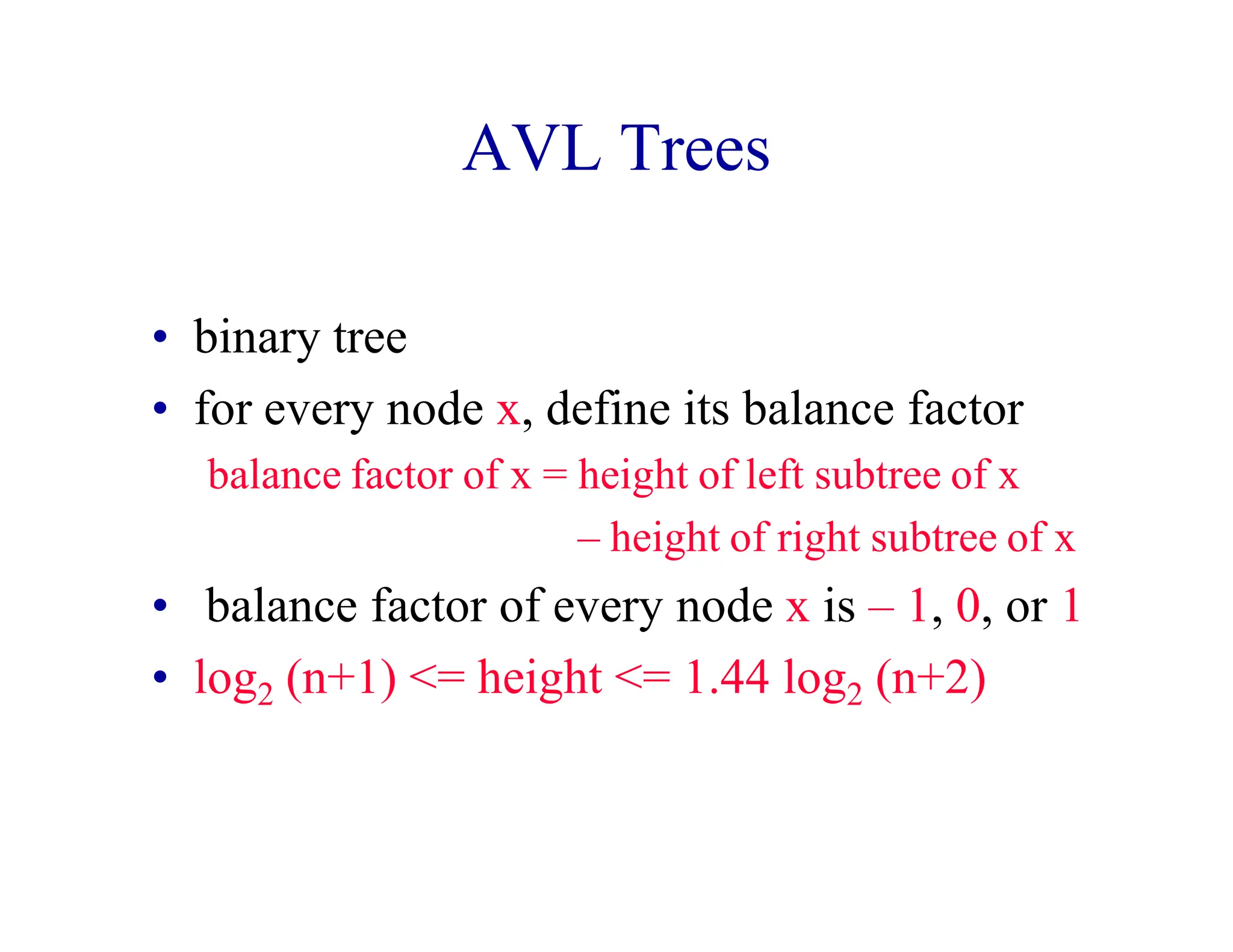
• binary tree
• for every node x, define its balance factor
balance factor of x = height of left subtree of x
– height of right subtree of x
• balance factor of every node x is – 1, 0, or 1
• log2 (n+1) <= height <= 1.44 log2 (n+2)
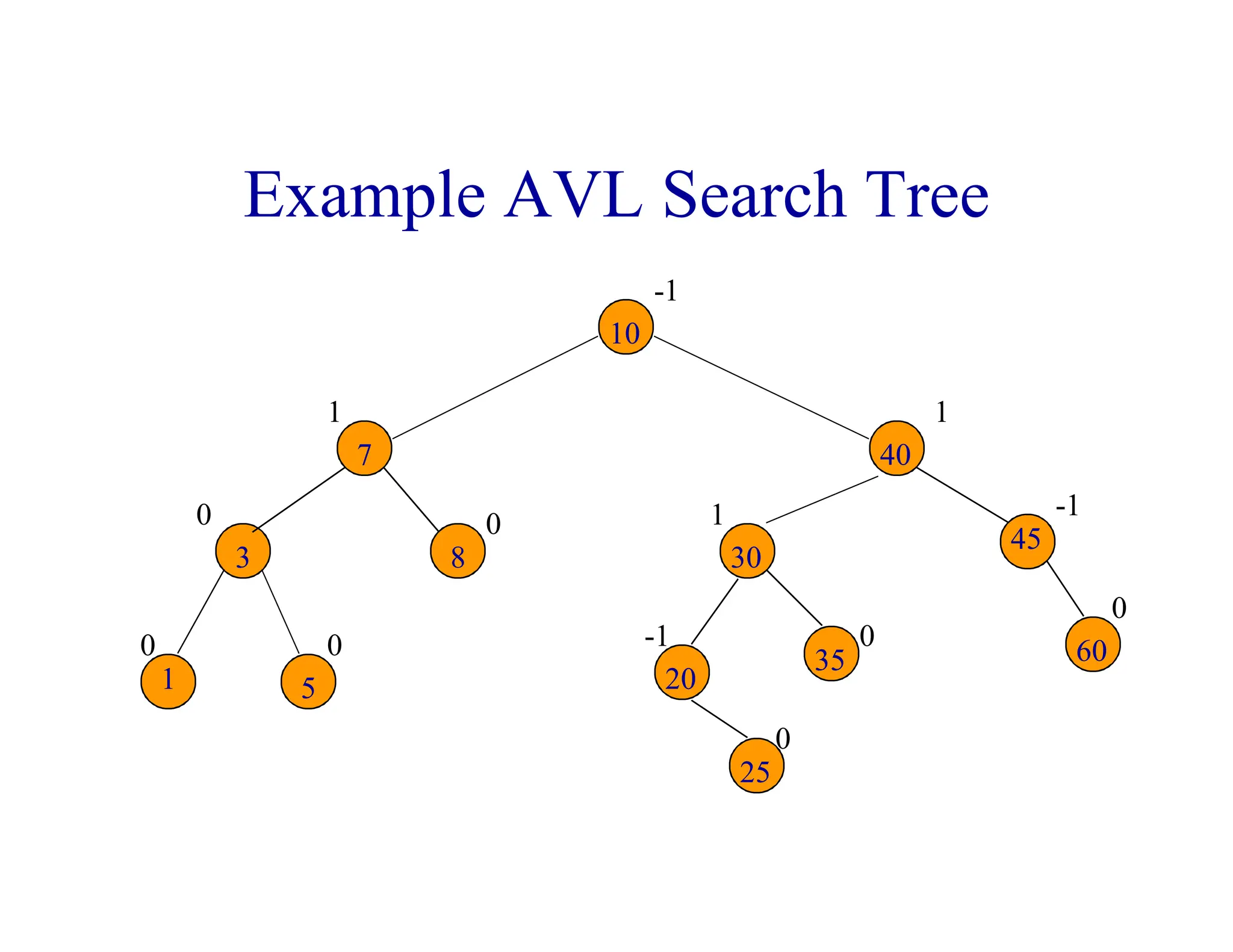
Example AVL Search Tree
0 0
0 0
1
0
-1 0
1
0
-1
1
-1
10
7
8
3
1 5
30
40
20
25
35
45
60
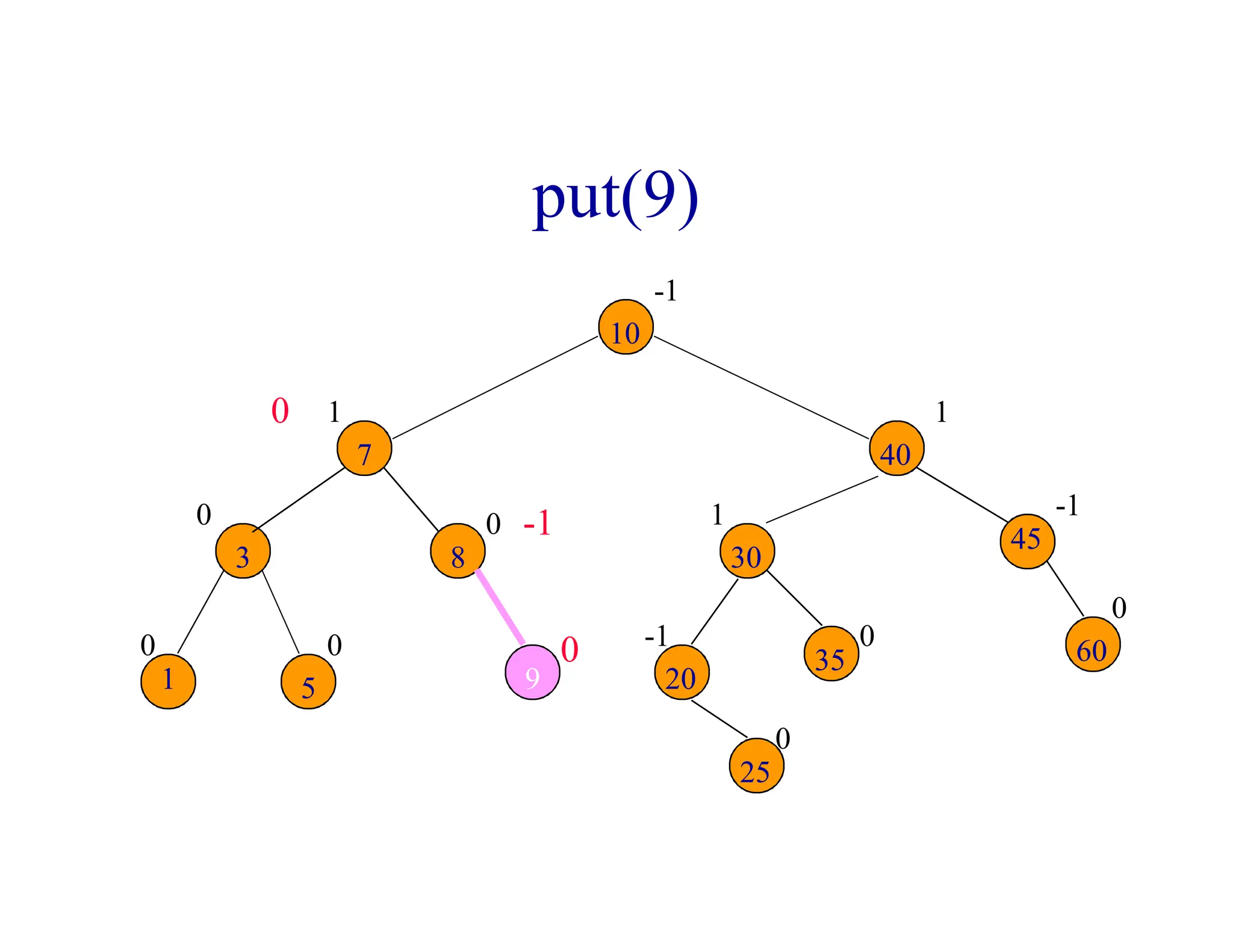
put(9)
0 0
0 0
1
0
-1 0
1
0
-1
1
-1
9
0
-1
0
10
7
8
3
1 5
30
40
20
25
35
45
60
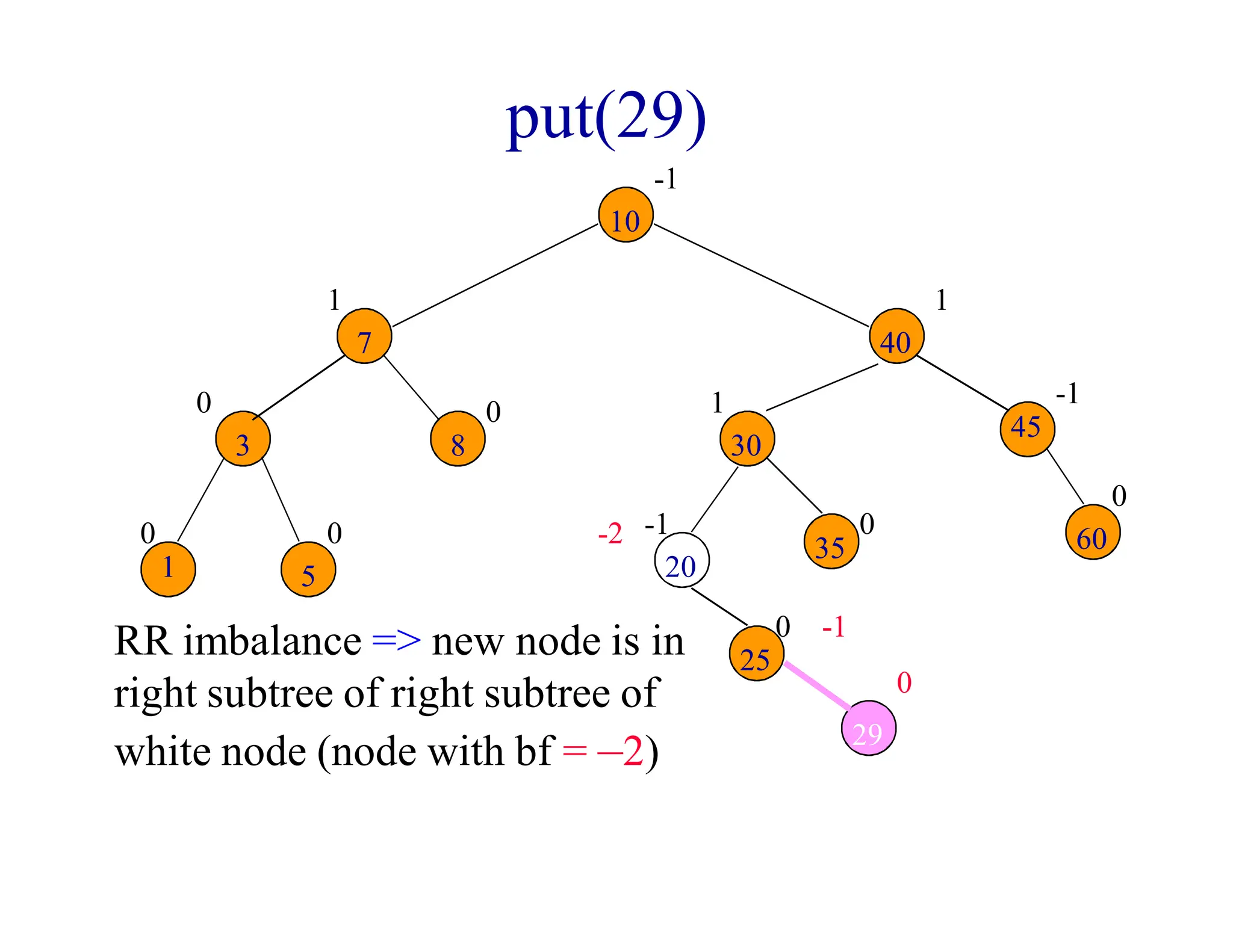
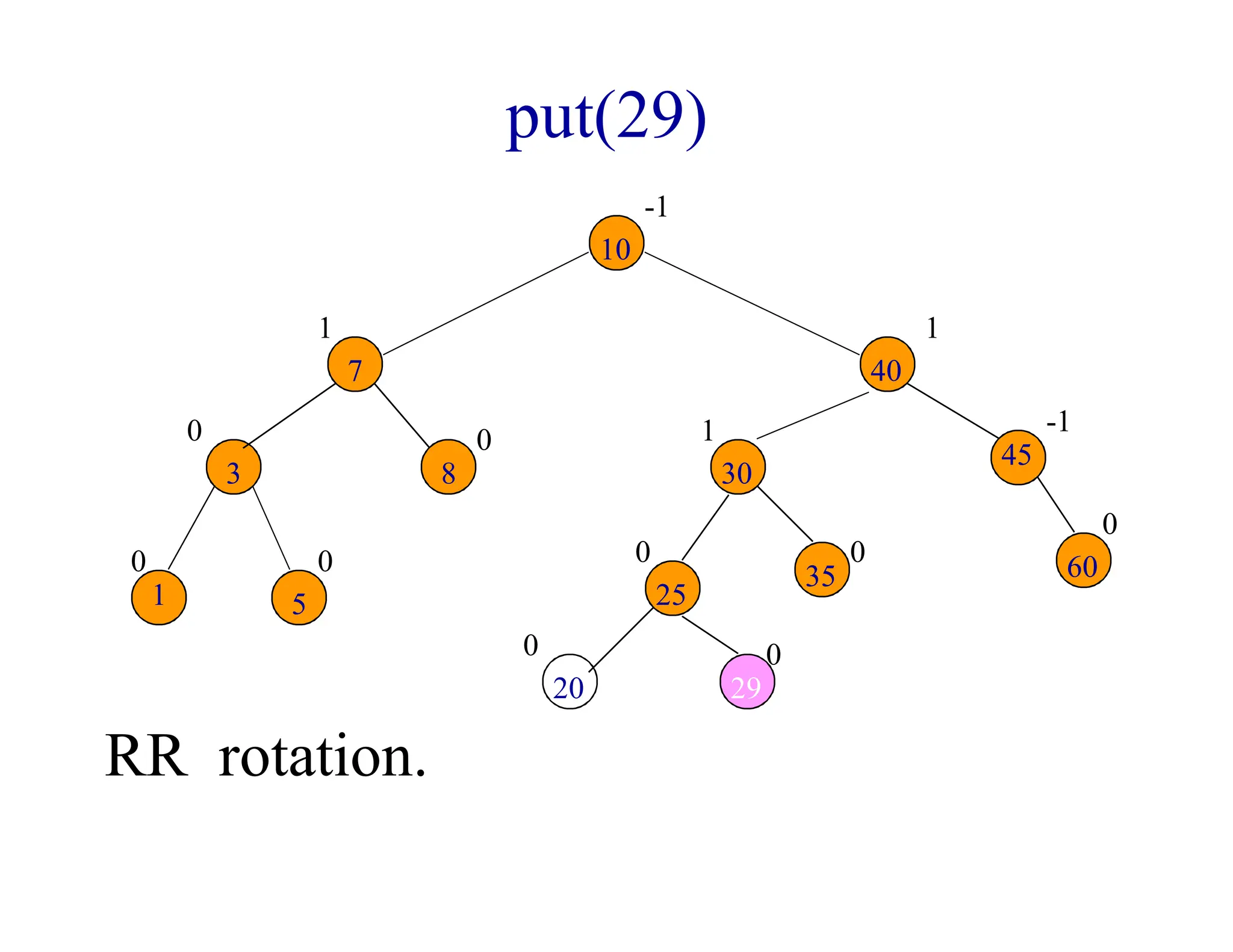
put(29)
0 0
0 0
1
0
0
1
0
-1
1
-1
10
7
8
3
1 5
30
40
20
25
35
45
60
29
0
-1
-1
-2
RR imbalance => new node is in
right subtree of right subtree of
white node (node with bf = –2)
0 0
0 0
1
0
0
1
0
-1
1
-1
10
7
8
3
1 5
30
40
25
35
45
60
0
RR rotation.
20
0
29
put(29)
Insert/Put
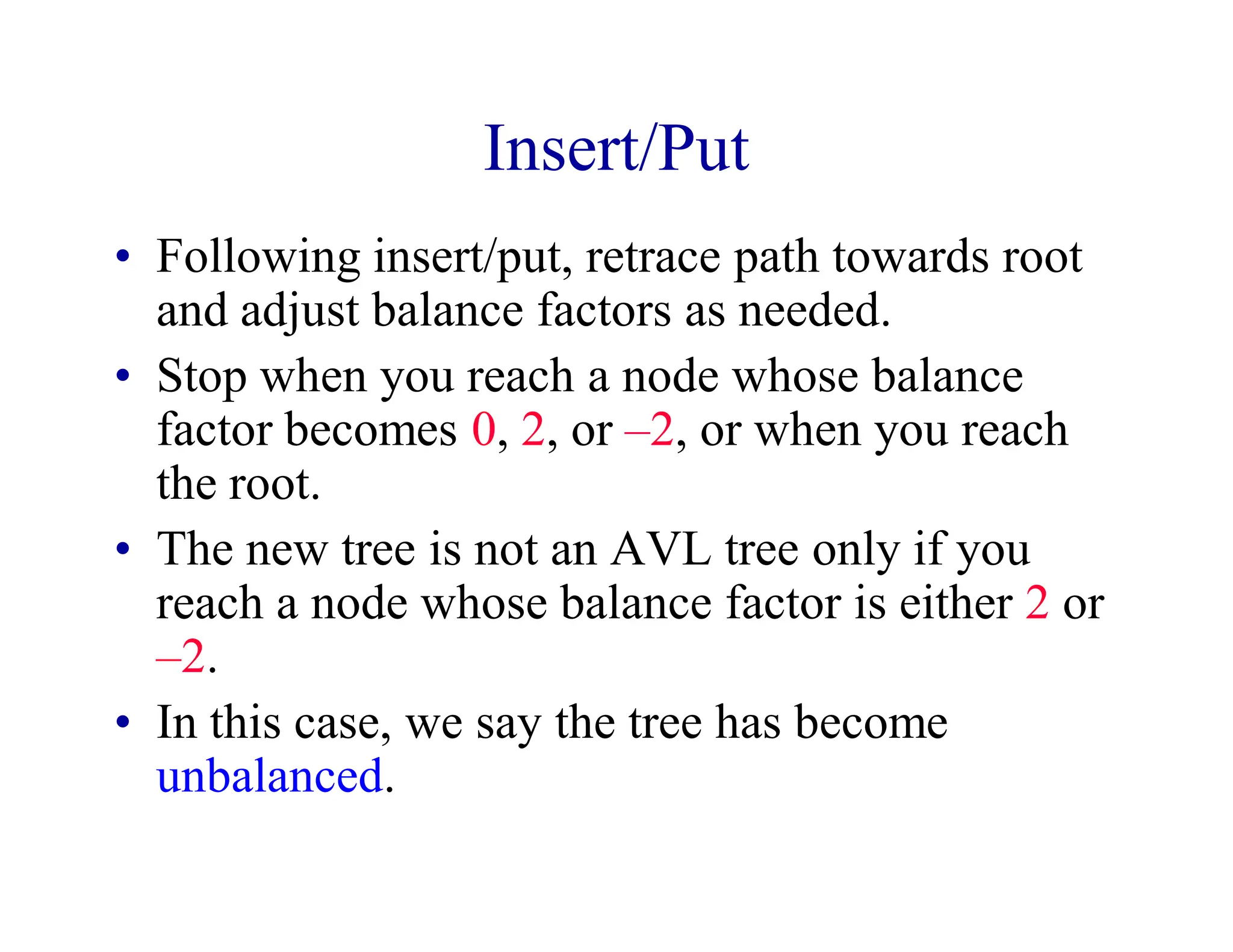
• Following insert/put, retrace path towards root
and adjust balance factors as needed.
• Stop when you reach a node whose balance
factor becomes 0, 2, or –2, or when you reach
the root.
• The new tree is not an AVL tree only if you
reach a node whose balance factor is either 2 or
–2.
• In this case, we say the tree has become
unbalanced.
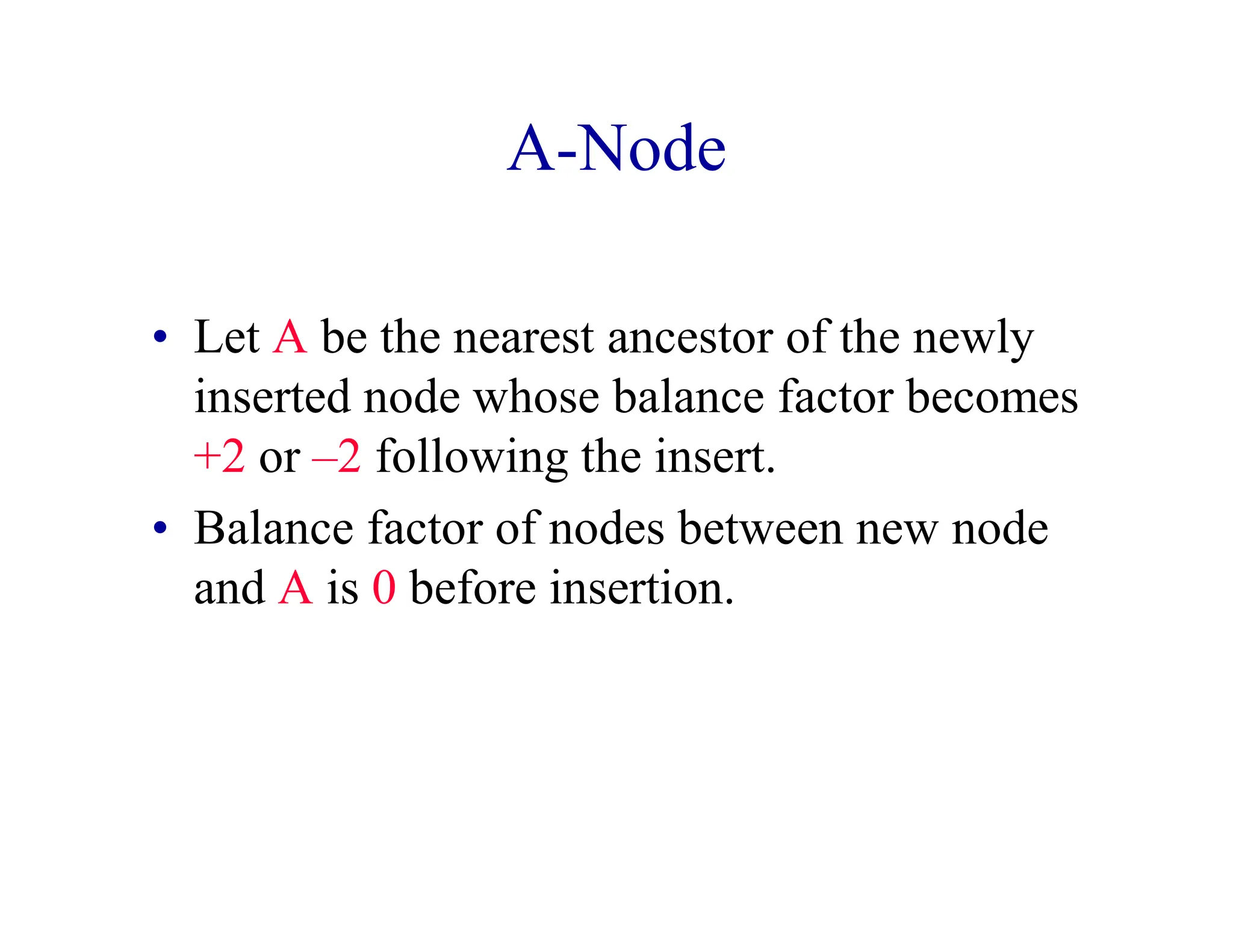
A-Node
• Let A be the nearest ancestor of the newly
inserted node whose balance factor becomes
+2 or –2 following the insert.
• Balance factor of nodes between new node
and A is 0 before insertion.
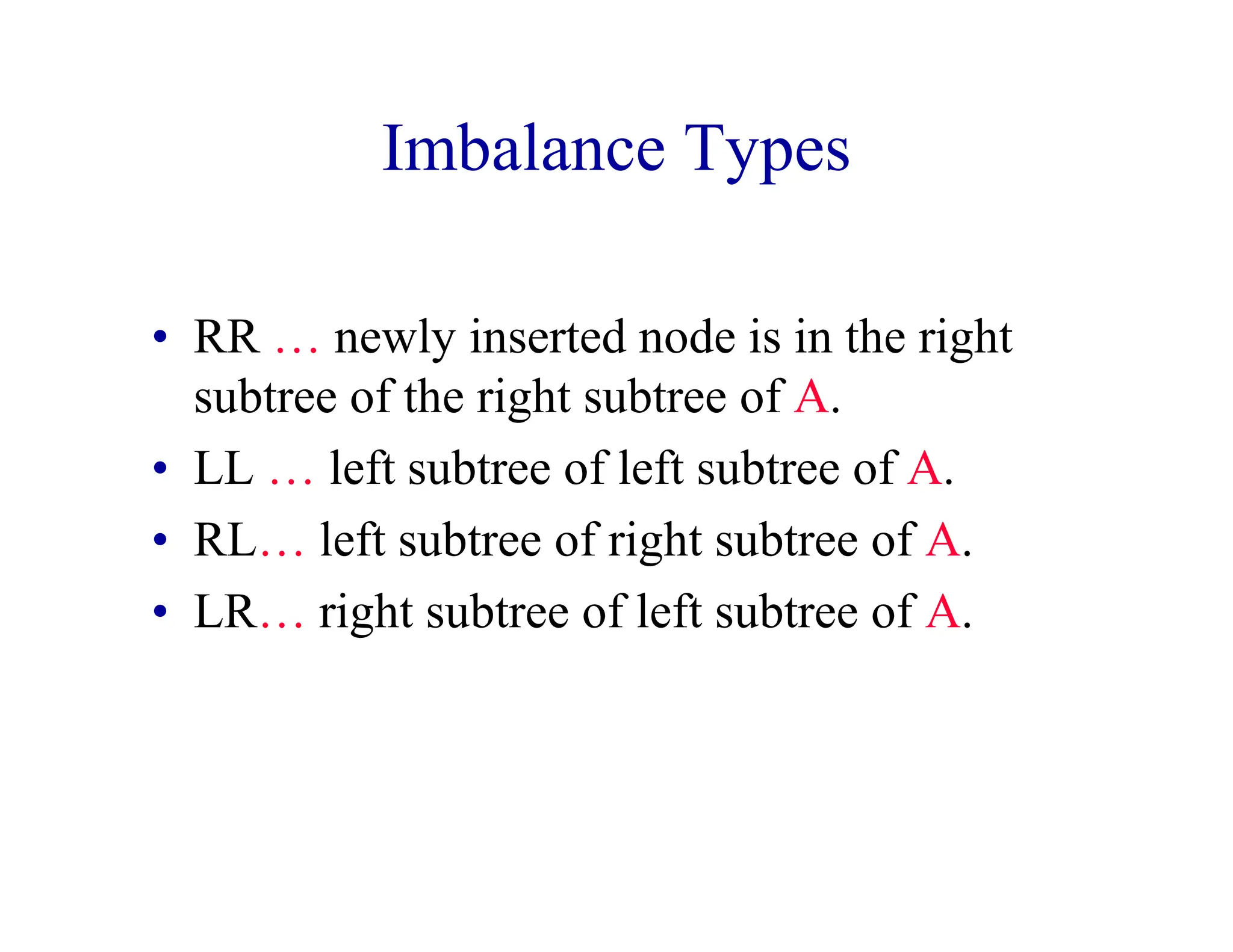
Imbalance Types
• RR … newly inserted node is in the right
subtree of the right subtree of A.
• LL … left subtree of left subtree of A.
• RL… left subtree of right subtree of A.
• LR… right subtree of left subtree of A.
LL rotation
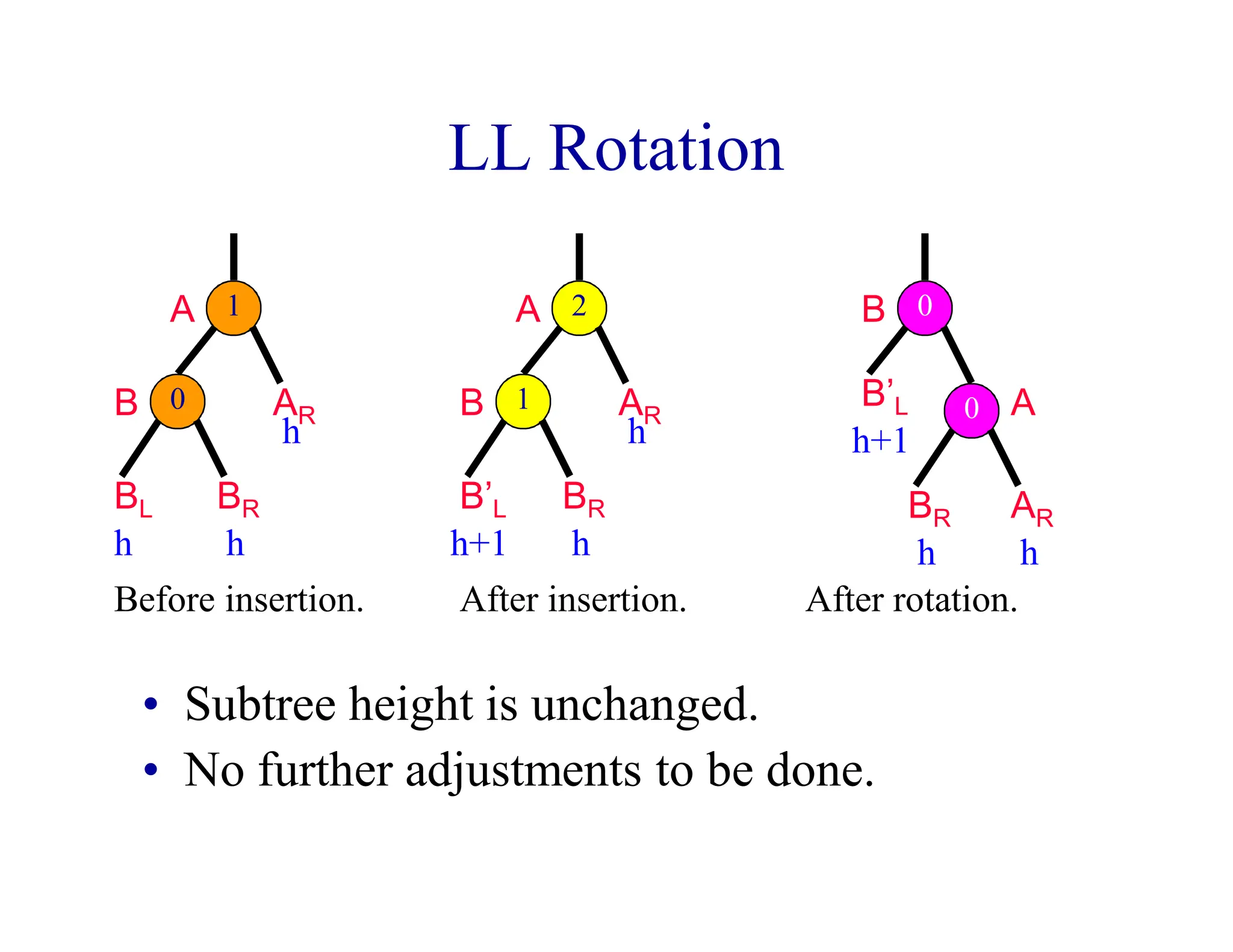
LL Rotation
• Subtree height is unchanged.
• No further adjustments to be done.
Before insertion.
1
0
A
B
BL BR
AR
h h
h
A
B
B’L BR
AR
After insertion.
h+1 h
h
B
A
After rotation.
BR
h
AR
h
B’L
h+1
0
0
1
2
Example
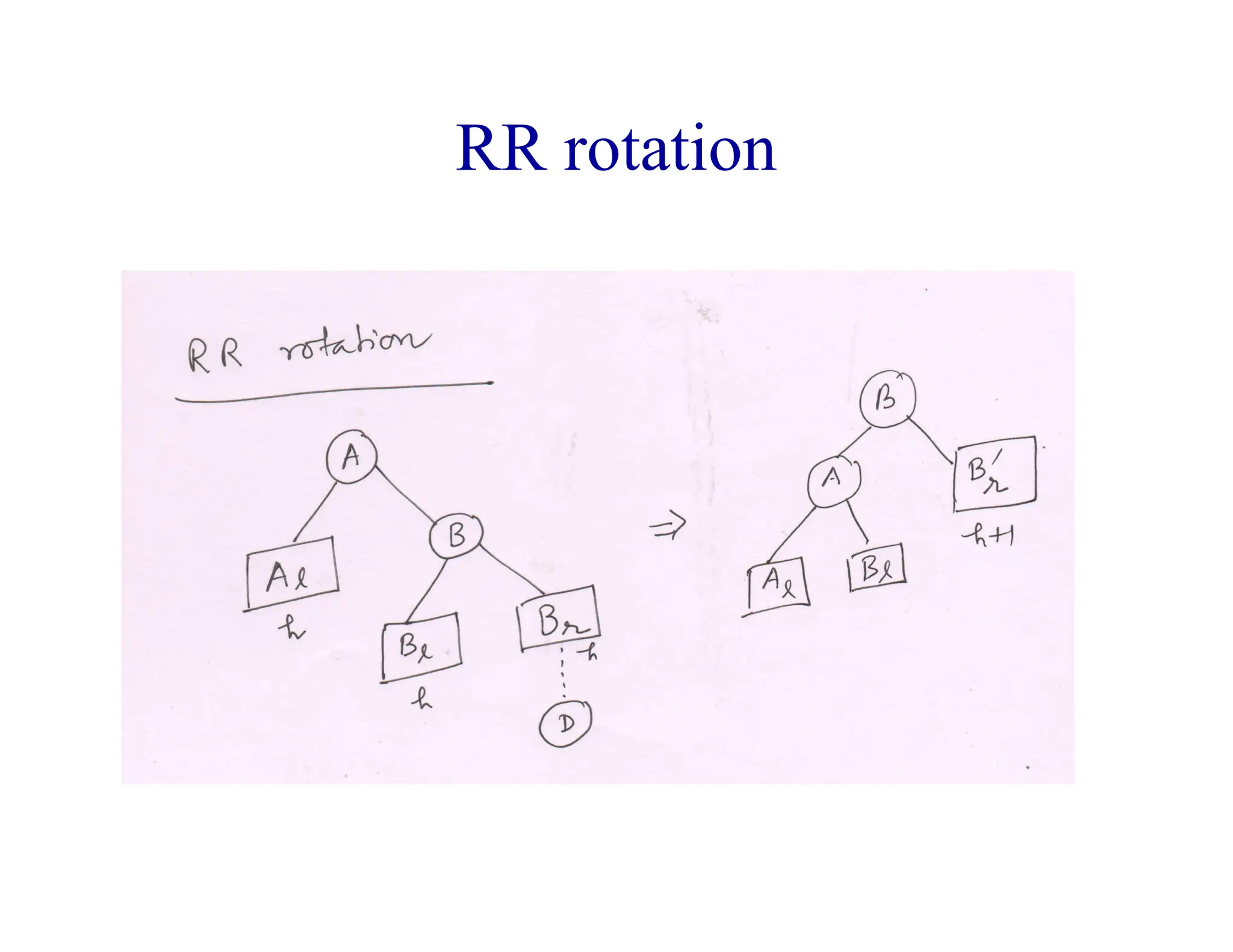
RR rotation
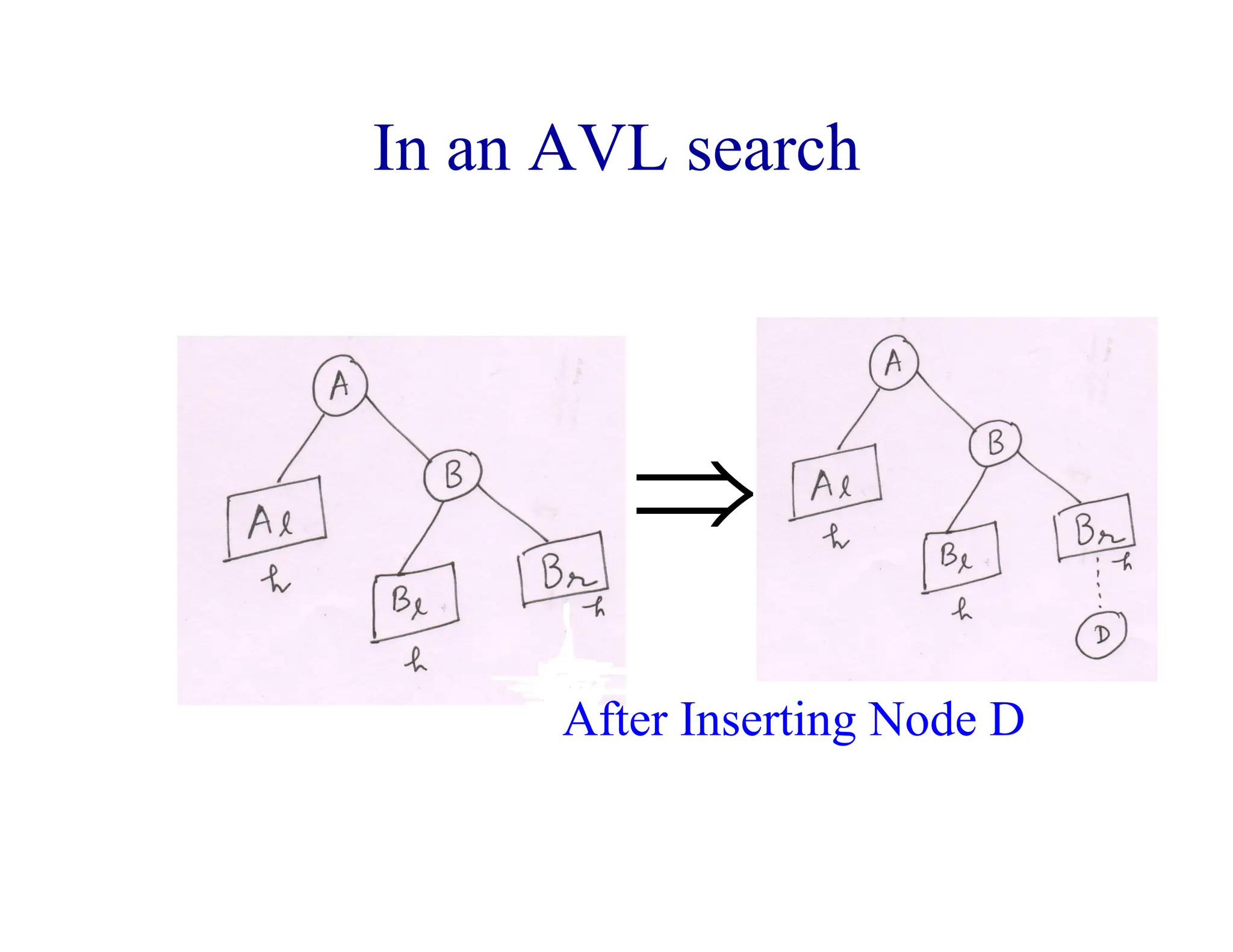
In an AVL search
After Inserting Node D

RR rotation
Example
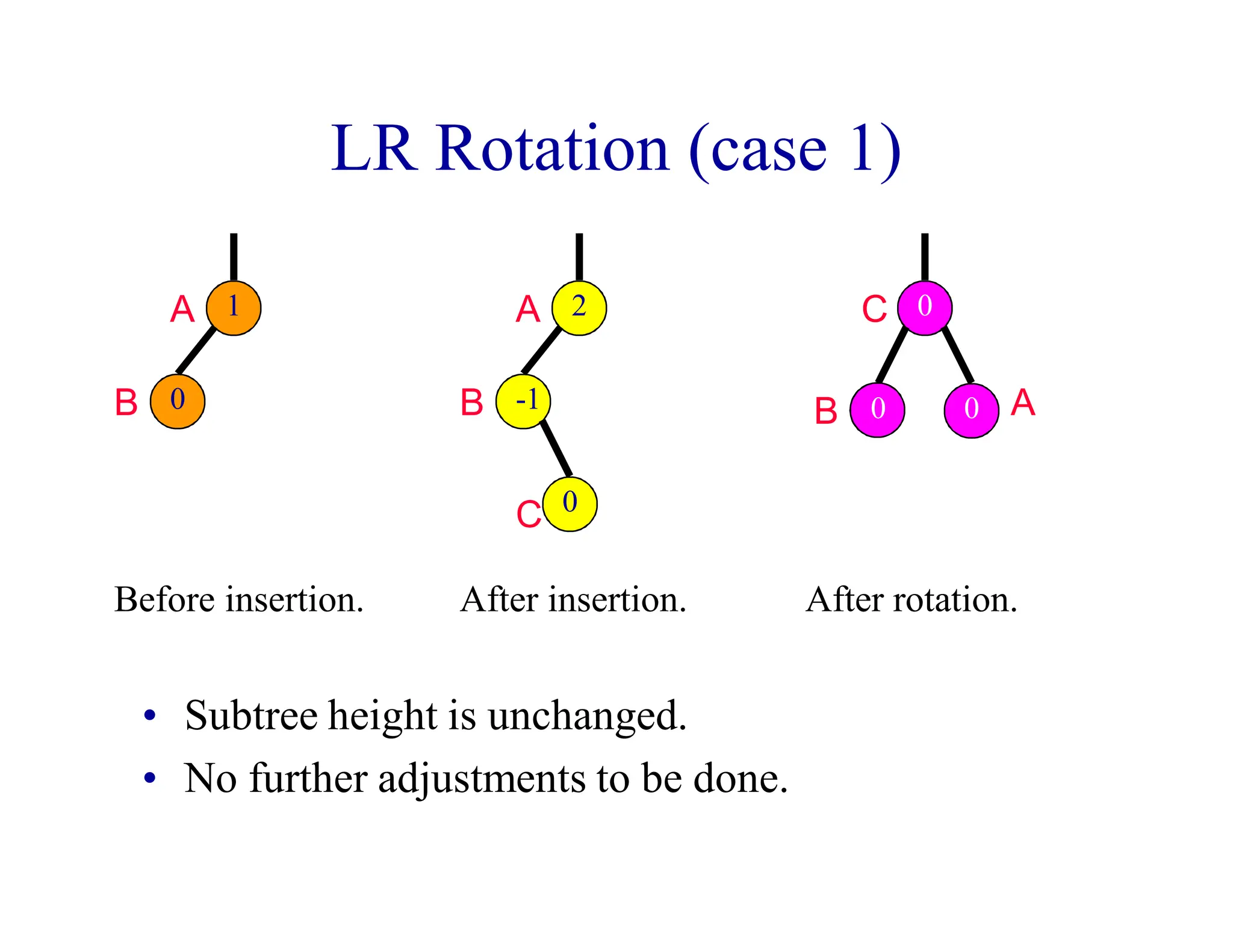
LR Rotation (case 1)
• Subtree height is unchanged.
• No further adjustments to be done.
Before insertion.
1
0
A
B
A
B
After insertion.
C
C
A
After rotation.
B
0
-1
2
0 0
0
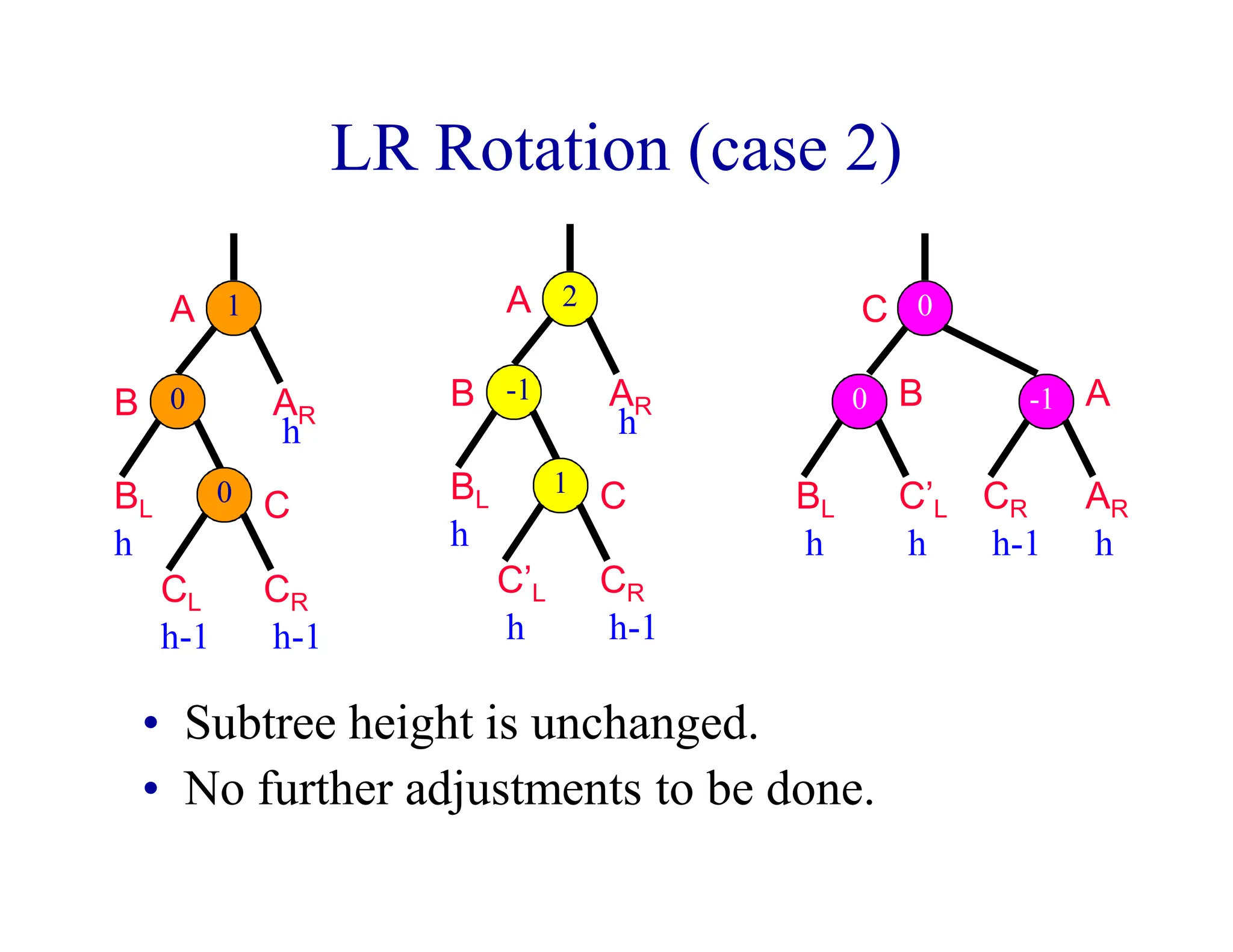
LR Rotation (case 2)
• Subtree height is unchanged.
• No further adjustments to be done.
C
A
CR
h-1
AR
h
1
0
A
B
BL
CR
AR
h
h-1
h
0
CL
h-1
C
A
B
BL
CR
AR
h
h-1
h
C’L
h
C
B
BL
h
C’L
h
1
-1
2
0 -1
0
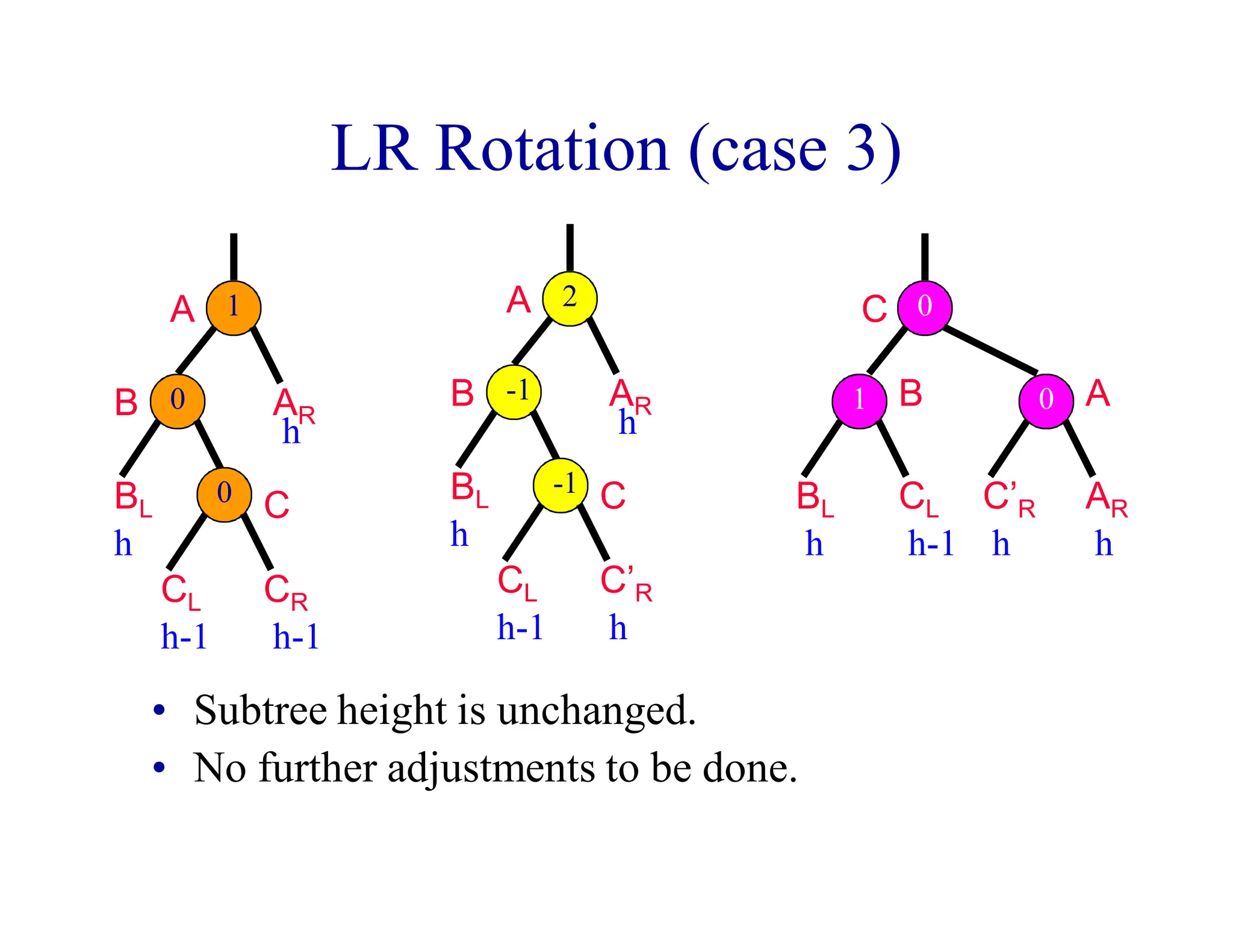
LR Rotation (case 3)
• Subtree height is unchanged.
• No further adjustments to be done.
1
0
A
B
BL
CR
AR
h
h-1
h
0
CL
h-1
C
A
B
BL
C’R
AR
h
h
h
CL
h-1
C
-1
-1
2
C
A
C’R
h
AR
h
B
BL
h
CL
h-1
1 0
0
Example
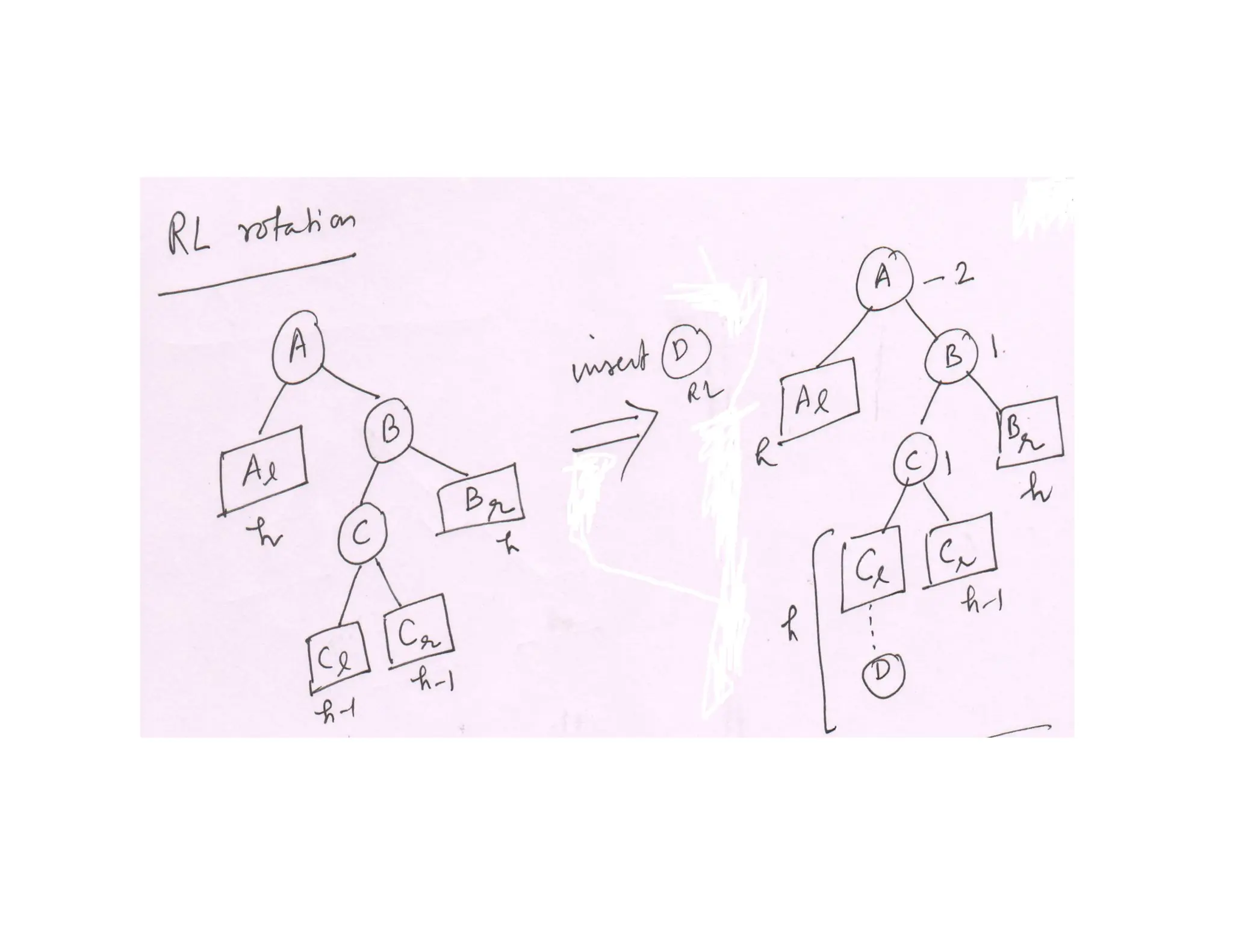
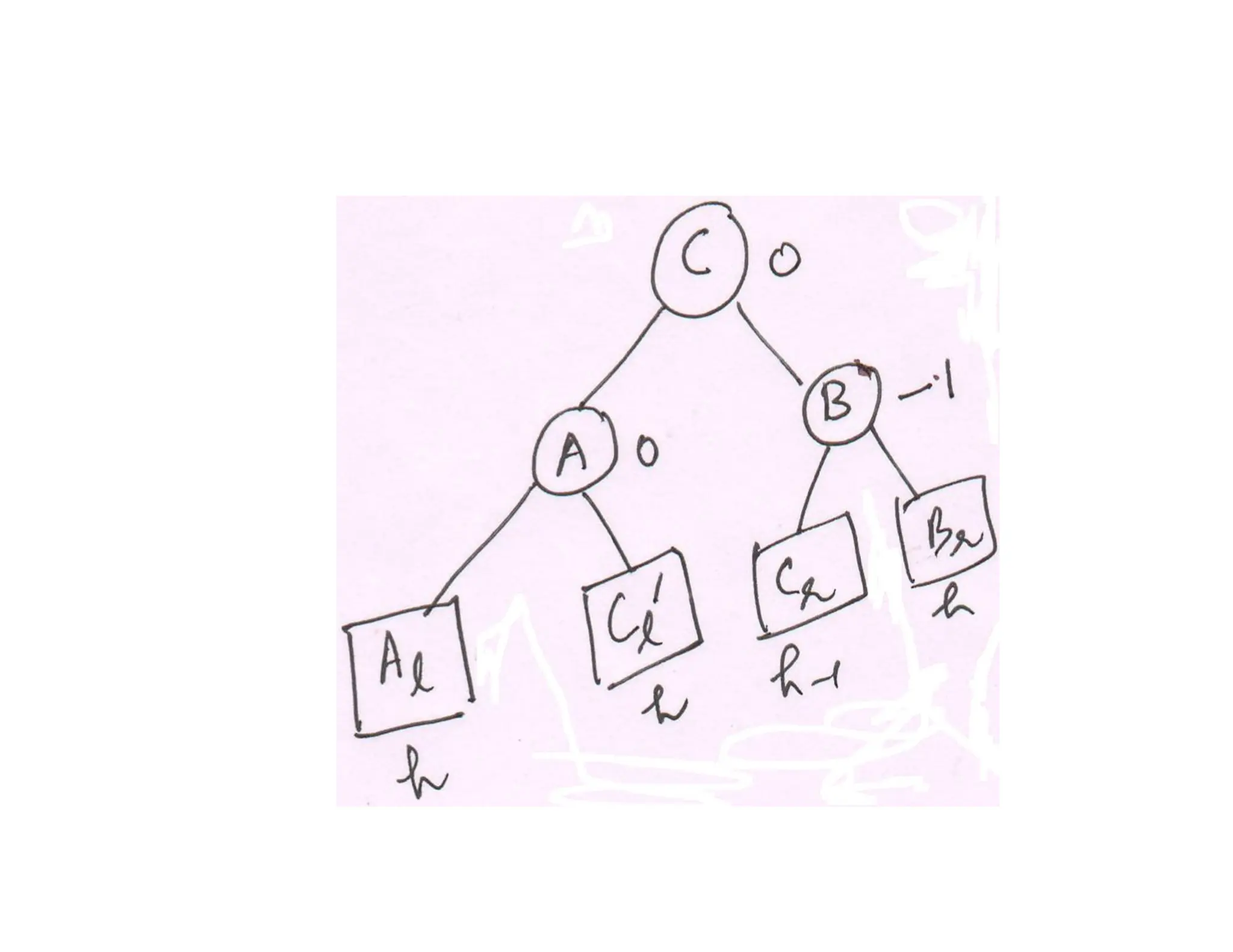
RL Rotation
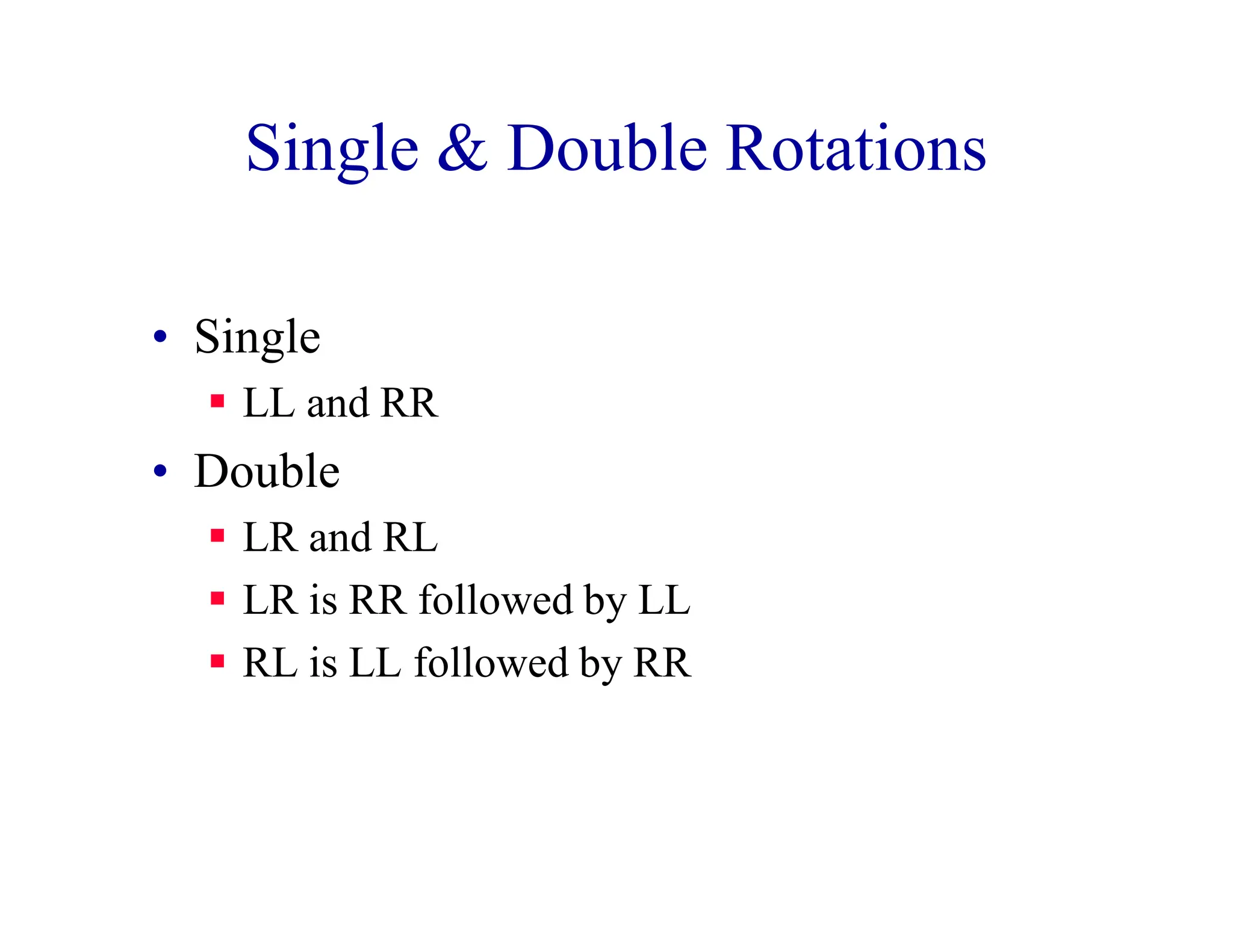
Single & Double Rotations
• Single
 LL and RR
• Double
 LR and RL
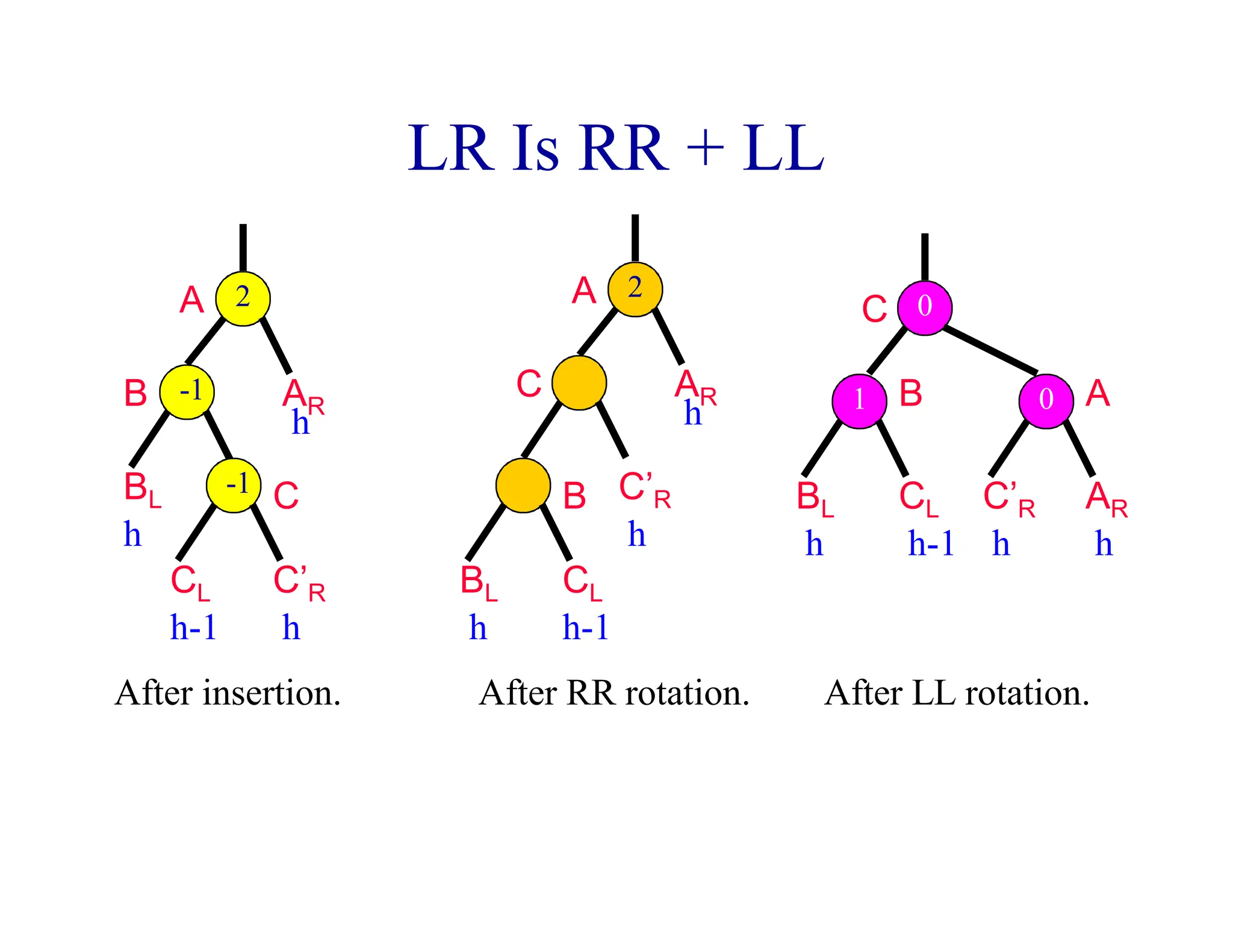
 LR is RR followed by LL
 RL is LL followed by RR
LR Is RR + LL
A
B
BL
C’R
AR
h
h
h
CL
h-1
C
-1
-1
2
After insertion.
A
C
CL
C’R
AR
h
h
BL
h
B
2
After RR rotation.
h-1
C
A
C’R
h
AR
h
B
BL
h
CL
h-1
1 0
0
After LL rotation.
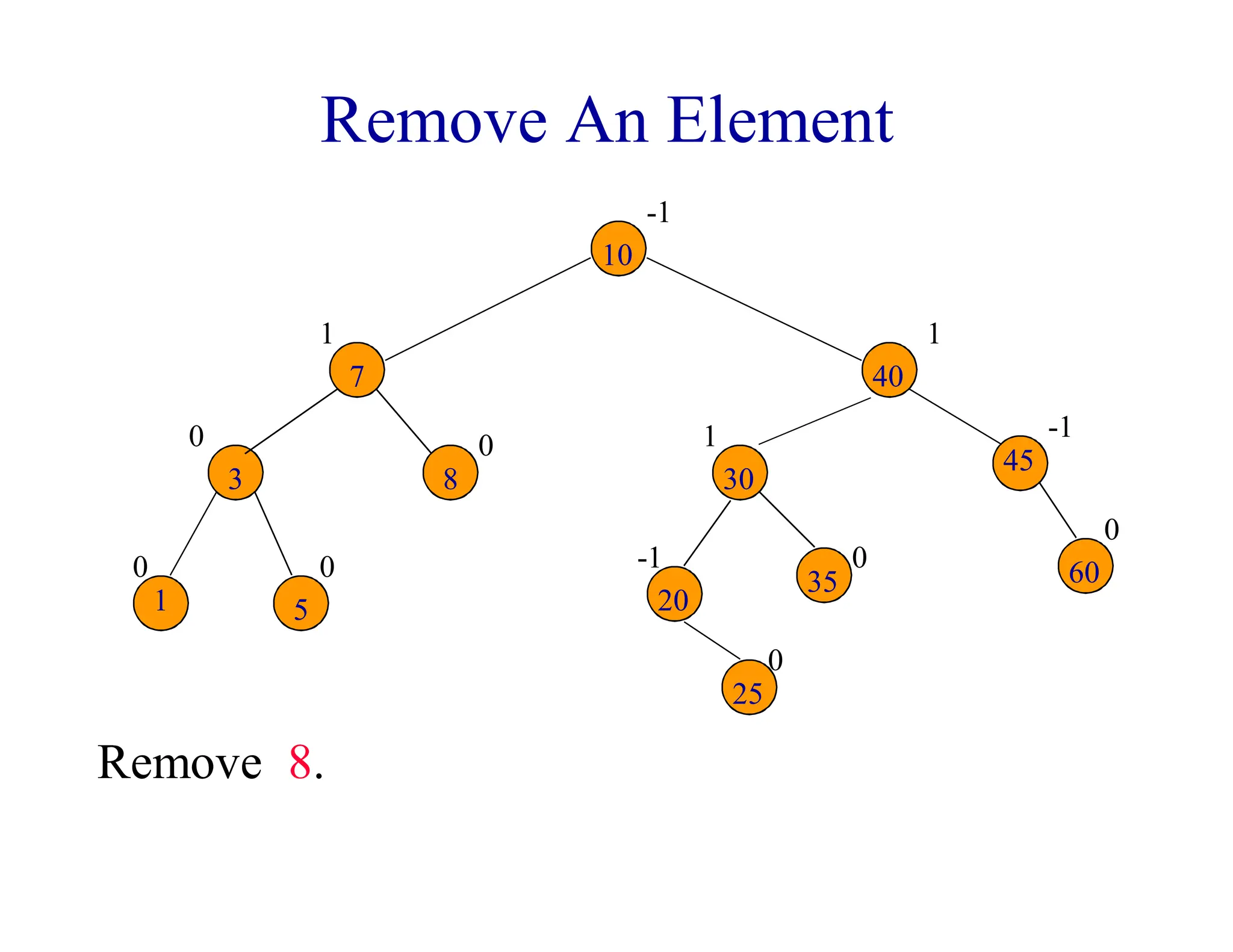
Remove An Element
0 0
0 0
1
0
-1 0
1
0
-1
1
-1
10
7
8
3
1 5
30
40
20
25
35
45
60
Remove 8.
Remove An Element
0 0
0
2
0
-1 0
1
0
-1
1
-1
10
7
3
1 5
30
40
20
25
35
45
60
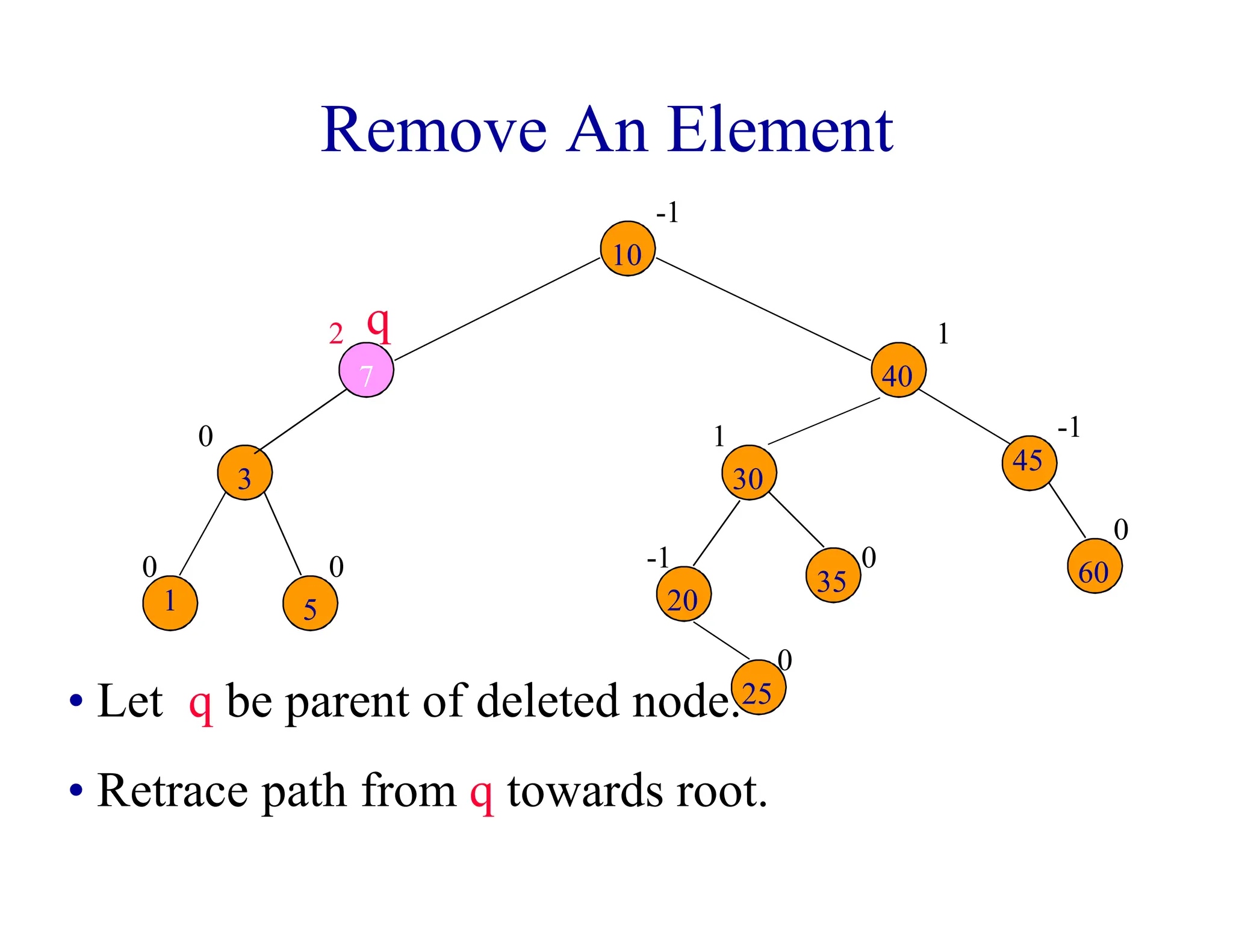
• Let q be parent of deleted node.
• Retrace path from q towards root.
q
New Balance Factor Of q
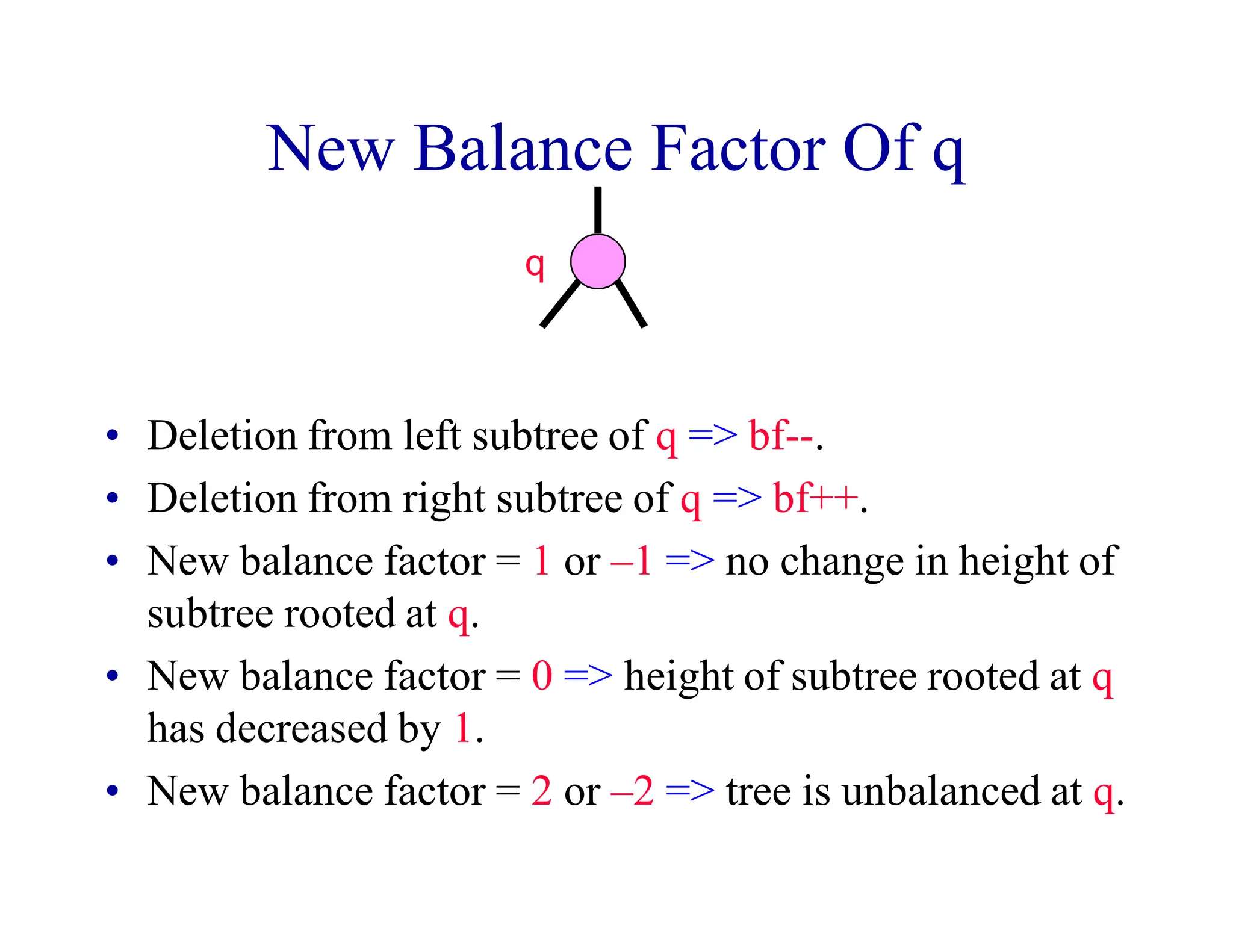
• Deletion from left subtree of q => bf--.
• Deletion from right subtree of q => bf++.
• New balance factor = 1 or –1 => no change in height of
subtree rooted at q.
• New balance factor = 0 => height of subtree rooted at q
has decreased by 1.
• New balance factor = 2 or –2 => tree is unbalanced at q.
q
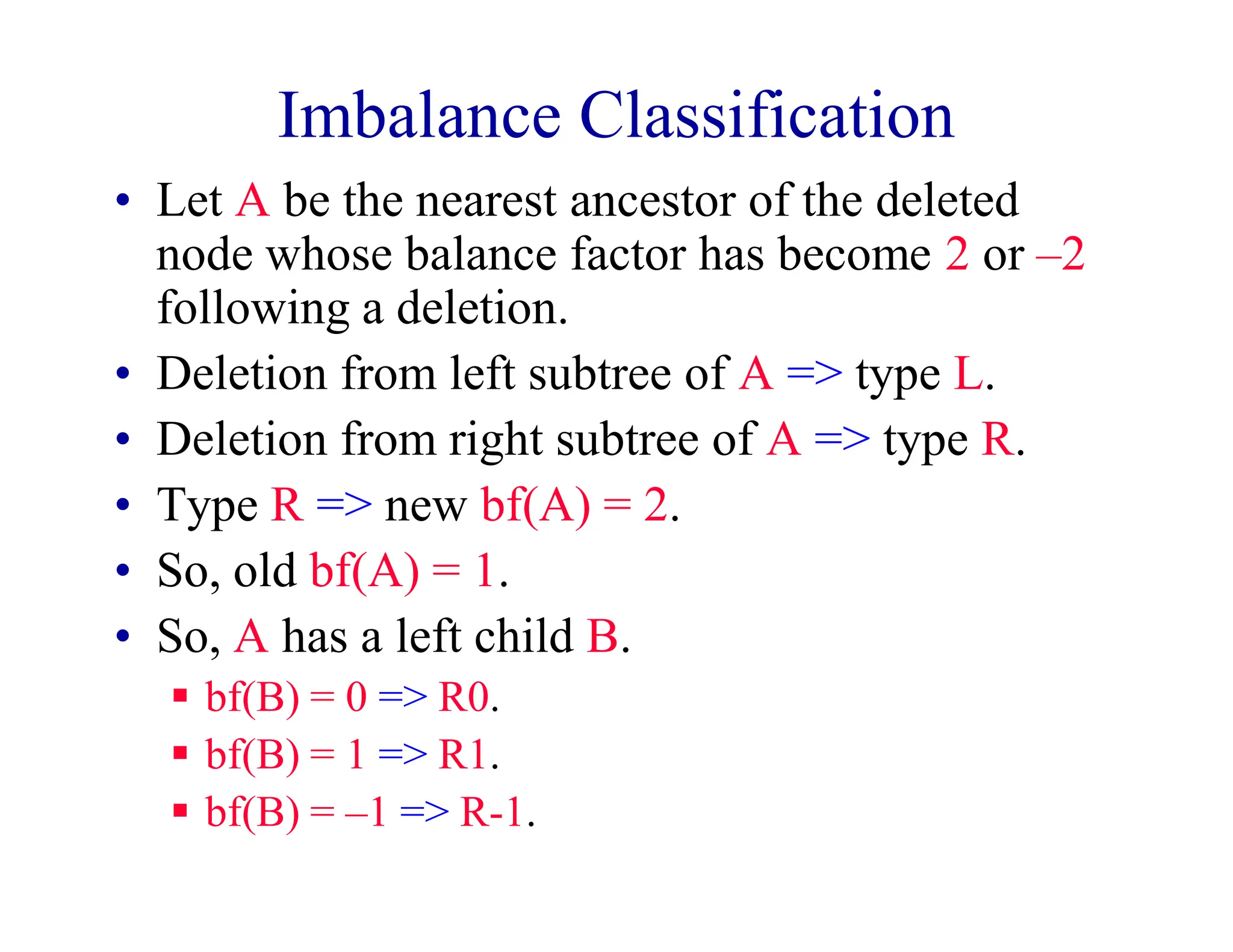
Imbalance Classification
• Let A be the nearest ancestor of the deleted
node whose balance factor has become 2 or –2
following a deletion.
• Deletion from left subtree of A => type L.
• Deletion from right subtree of A => type R.
• Type R => new bf(A) = 2.
• So, old bf(A) = 1.
• So, A has a left child B.
 bf(B) = 0 => R0.
 bf(B) = 1 => R1.
 bf(B) = –1 => R-1.
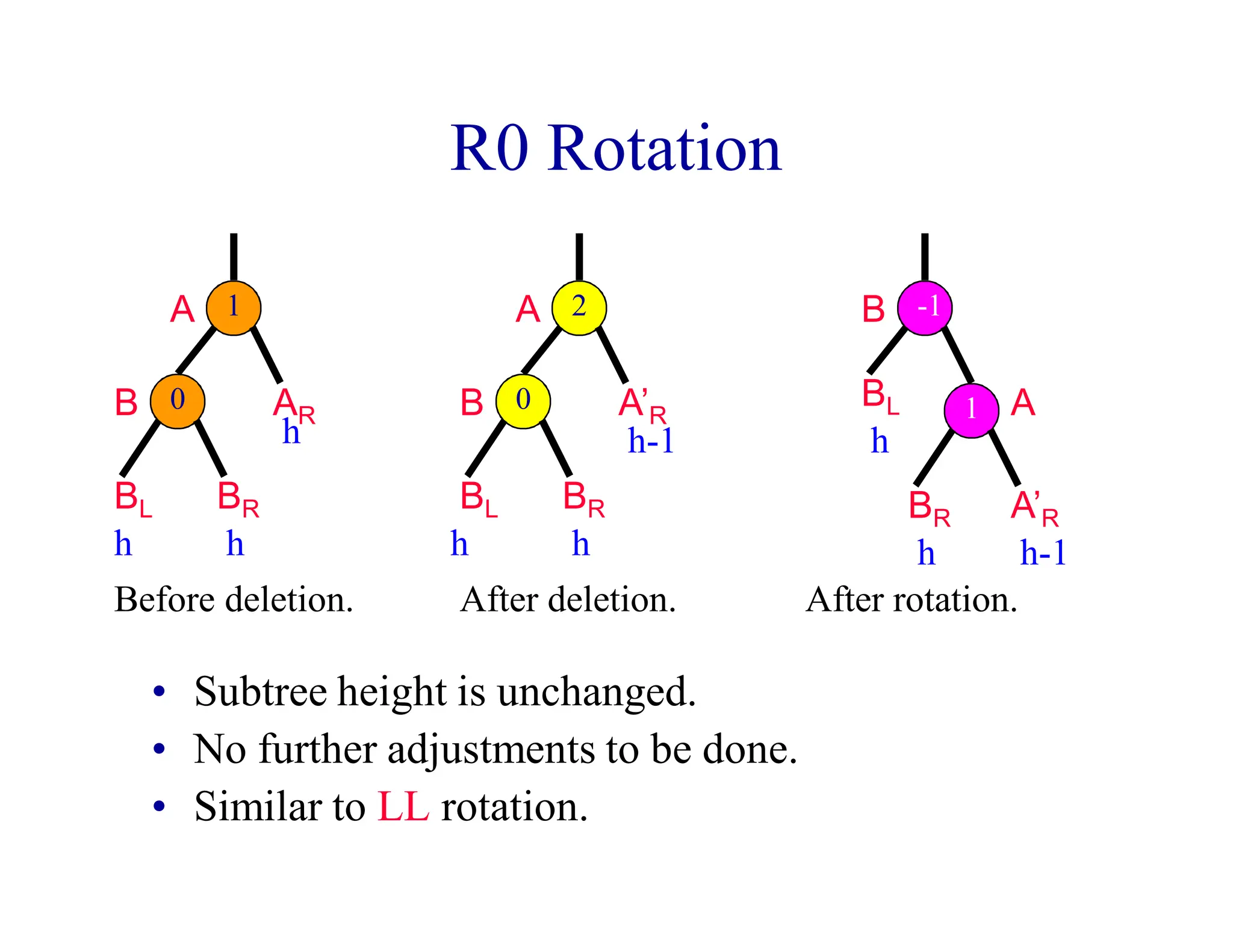
R0 Rotation
• Subtree height is unchanged.
• No further adjustments to be done.
• Similar to LL rotation.
Before deletion.
1
0
A
B
BL BR
AR
h h
h
B
A
After rotation.
BR
h
A’R
h-1
BL
h
1
-1
A
B
BL BR
A’R
After deletion.
h h
h-1
0
2
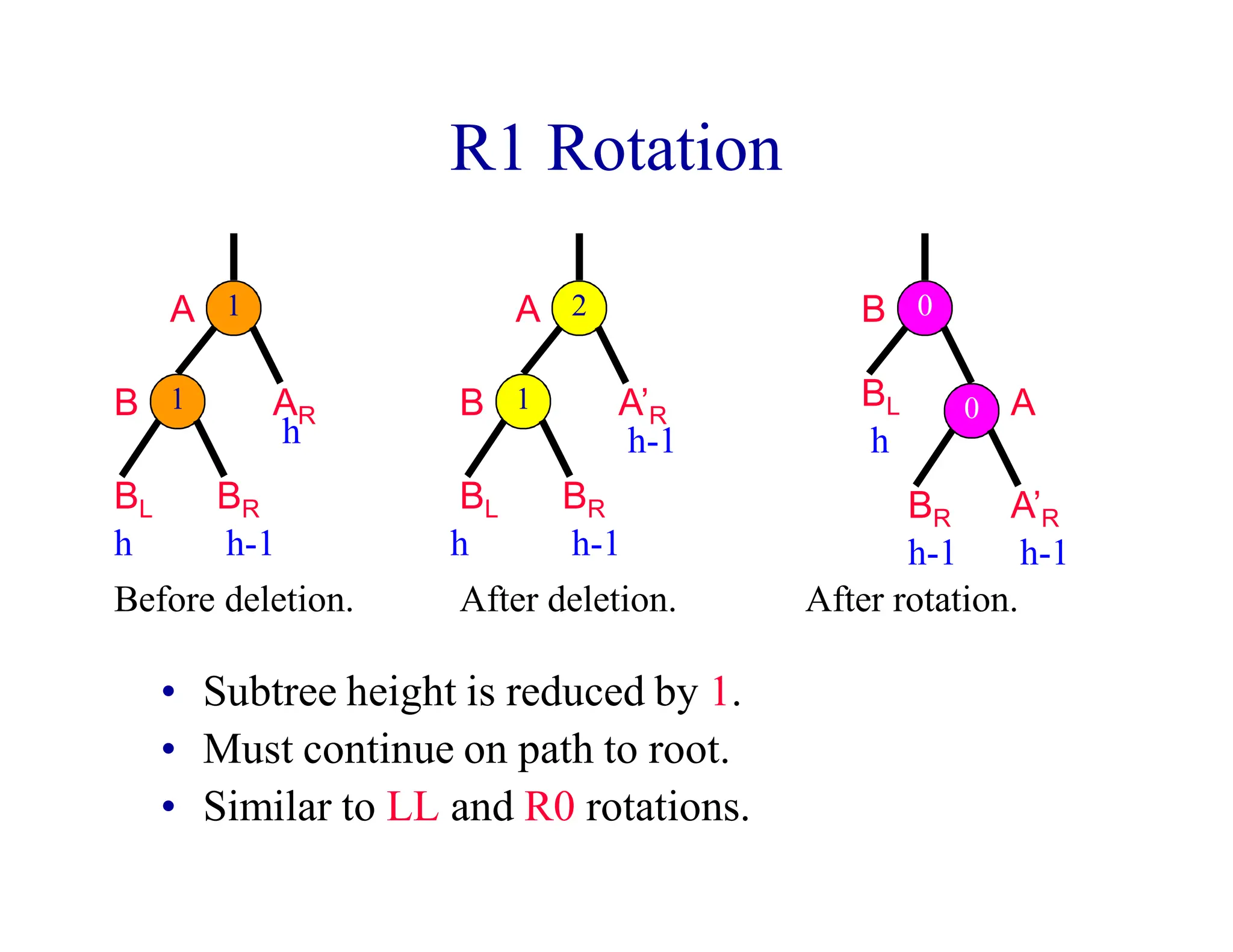
R1 Rotation
• Subtree height is reduced by 1.
• Must continue on path to root.
• Similar to LL and R0 rotations.
Before deletion.
1
1
A
B
BL BR
AR
h h-1
h
B
A
After rotation.
BR
h-1
A’R
h-1
BL
h
0
0
A
B
BL BR
A’R
After deletion.
h h-1
h-1
1
2
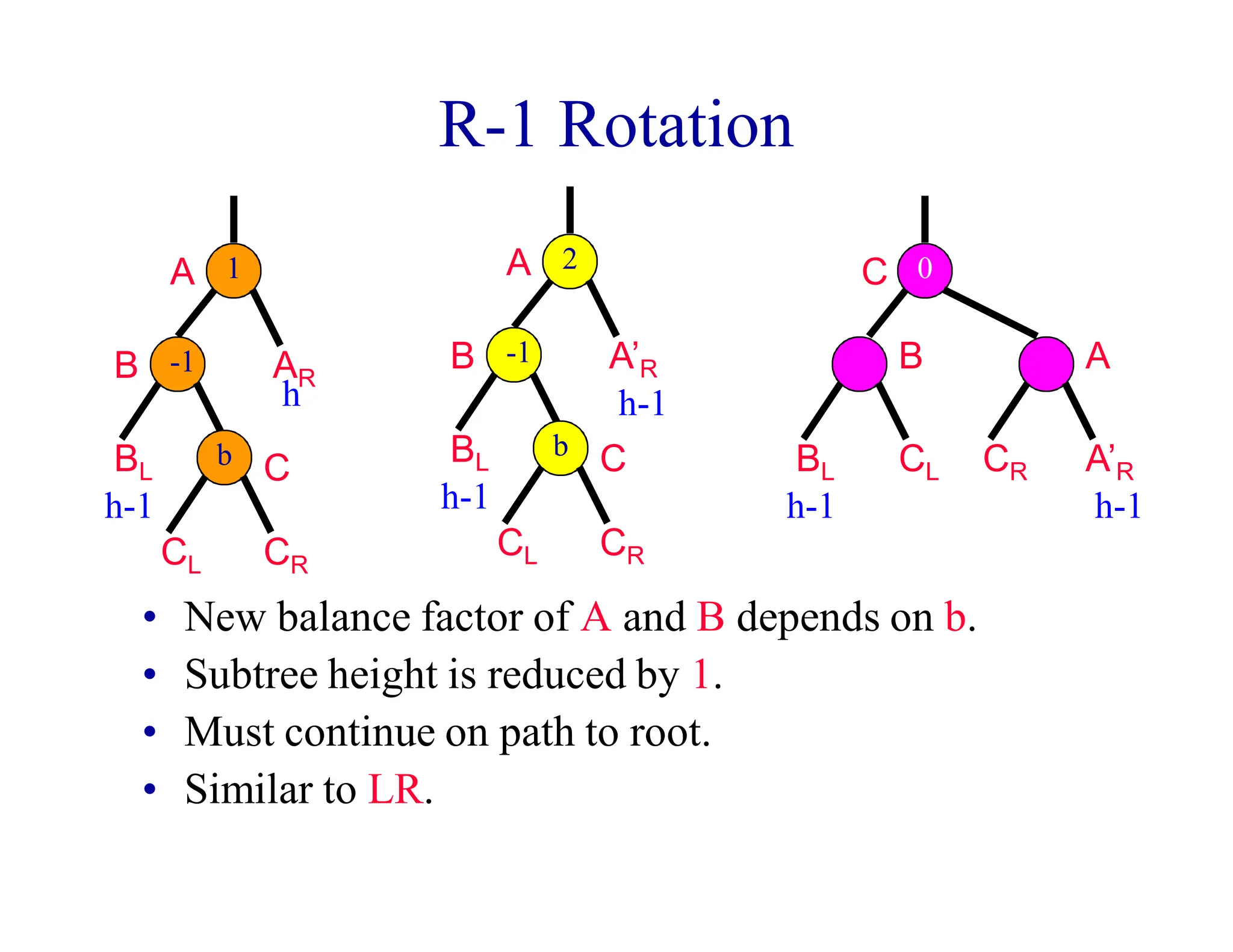
R-1 Rotation
• New balance factor of A and B depends on b.
• Subtree height is reduced by 1.
• Must continue on path to root.
• Similar to LR.
1
-1
A
B
BL
CR
AR
h-1
h
b
CL
C
A
B
BL
CR
A’R
h-1
h-1
CL
C
b
-1
2
C
A
CR A’R
h-1
B
BL
h-1
CL
0
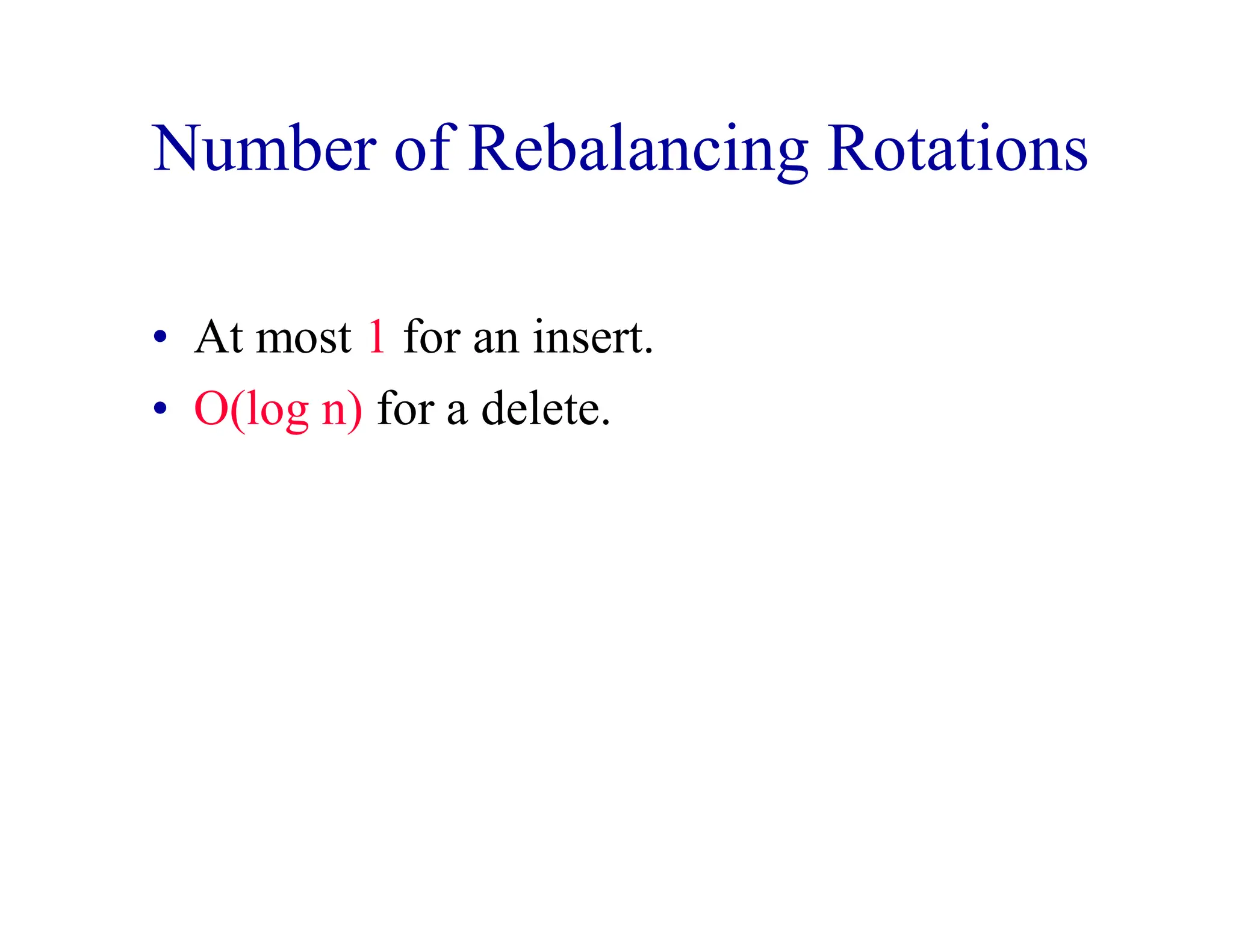
Number of Rebalancing Rotations
• At most 1 for an insert.
• O(log n) for a delete.
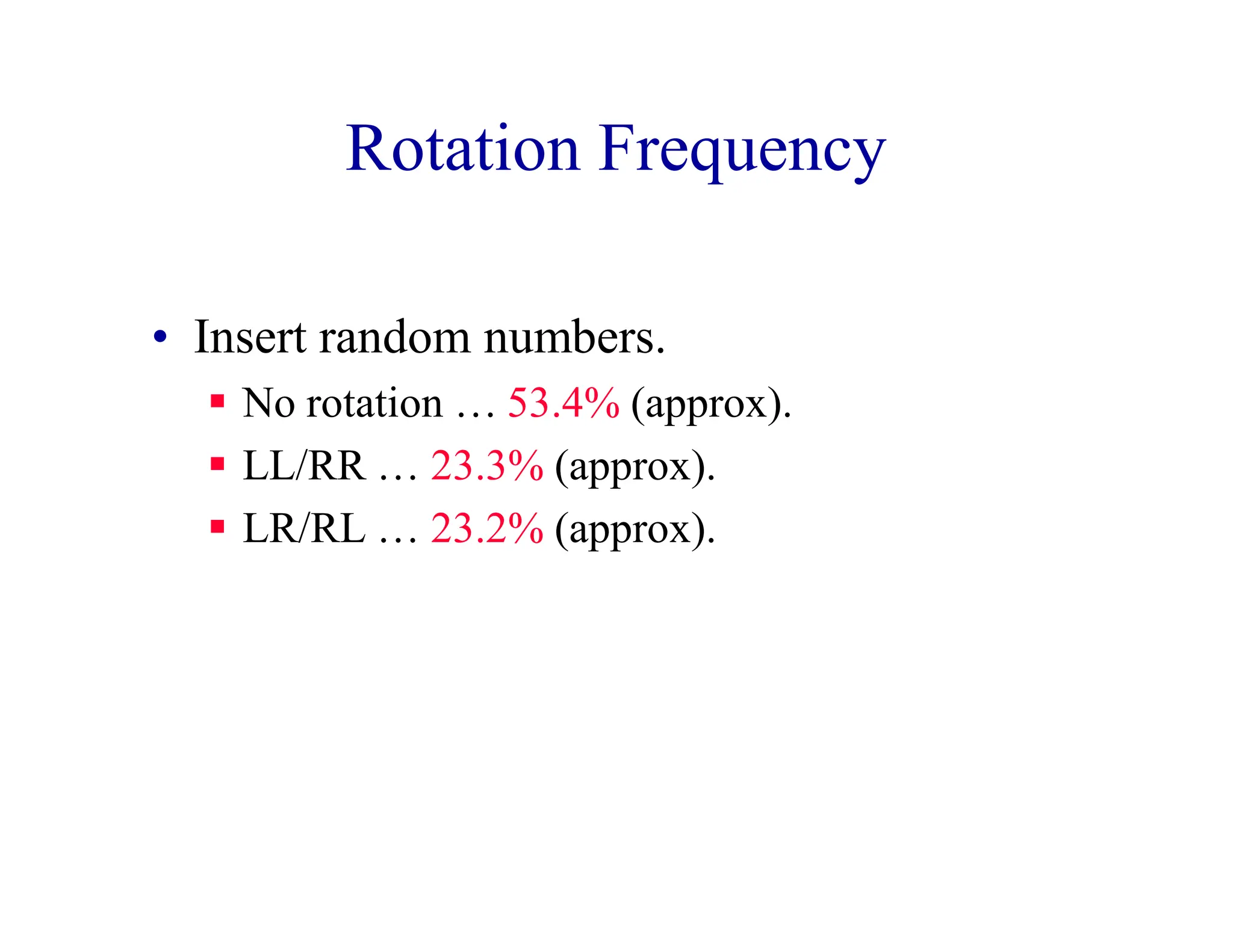
Rotation Frequency
• Insert random numbers.
 No rotation … 53.4% (approx).
 LL/RR … 23.3% (approx).
 LR/RL … 23.2% (approx).

CS-102 AVLS.pdf

  • 1.
    AVL Trees • binarytree • for every node x, define its balance factor balance factor of x = height of left subtree of x – height of right subtree of x • balance factor of every node x is – 1, 0, or 1 • log2 (n+1) <= height <= 1.44 log2 (n+2)
  • 2.
    Example AVL SearchTree 0 0 0 0 1 0 -1 0 1 0 -1 1 -1 10 7 8 3 1 5 30 40 20 25 35 45 60
  • 3.
    put(9) 0 0 0 0 1 0 -10 1 0 -1 1 -1 9 0 -1 0 10 7 8 3 1 5 30 40 20 25 35 45 60
  • 4.
    put(29) 0 0 0 0 1 0 0 1 0 -1 1 -1 10 7 8 3 15 30 40 20 25 35 45 60 29 0 -1 -1 -2 RR imbalance => new node is in right subtree of right subtree of white node (node with bf = –2)
  • 5.
    0 0 0 0 1 0 0 1 0 -1 1 -1 10 7 8 3 15 30 40 25 35 45 60 0 RR rotation. 20 0 29 put(29)
  • 6.
    Insert/Put • Following insert/put,retrace path towards root and adjust balance factors as needed. • Stop when you reach a node whose balance factor becomes 0, 2, or –2, or when you reach the root. • The new tree is not an AVL tree only if you reach a node whose balance factor is either 2 or –2. • In this case, we say the tree has become unbalanced.
  • 7.
    A-Node • Let Abe the nearest ancestor of the newly inserted node whose balance factor becomes +2 or –2 following the insert. • Balance factor of nodes between new node and A is 0 before insertion.
  • 8.
    Imbalance Types • RR… newly inserted node is in the right subtree of the right subtree of A. • LL … left subtree of left subtree of A. • RL… left subtree of right subtree of A. • LR… right subtree of left subtree of A.
  • 9.
  • 10.
    LL Rotation • Subtreeheight is unchanged. • No further adjustments to be done. Before insertion. 1 0 A B BL BR AR h h h A B B’L BR AR After insertion. h+1 h h B A After rotation. BR h AR h B’L h+1 0 0 1 2
  • 11.
  • 12.
  • 13.
    In an AVLsearch After Inserting Node D 
  • 14.
  • 15.
  • 16.
    LR Rotation (case1) • Subtree height is unchanged. • No further adjustments to be done. Before insertion. 1 0 A B A B After insertion. C C A After rotation. B 0 -1 2 0 0 0
  • 17.
    LR Rotation (case2) • Subtree height is unchanged. • No further adjustments to be done. C A CR h-1 AR h 1 0 A B BL CR AR h h-1 h 0 CL h-1 C A B BL CR AR h h-1 h C’L h C B BL h C’L h 1 -1 2 0 -1 0
  • 18.
    LR Rotation (case3) • Subtree height is unchanged. • No further adjustments to be done. 1 0 A B BL CR AR h h-1 h 0 CL h-1 C A B BL C’R AR h h h CL h-1 C -1 -1 2 C A C’R h AR h B BL h CL h-1 1 0 0
  • 19.
  • 20.
  • 23.
    Single & DoubleRotations • Single  LL and RR • Double  LR and RL  LR is RR followed by LL  RL is LL followed by RR
  • 24.
    LR Is RR+ LL A B BL C’R AR h h h CL h-1 C -1 -1 2 After insertion. A C CL C’R AR h h BL h B 2 After RR rotation. h-1 C A C’R h AR h B BL h CL h-1 1 0 0 After LL rotation.
  • 25.
    Remove An Element 00 0 0 1 0 -1 0 1 0 -1 1 -1 10 7 8 3 1 5 30 40 20 25 35 45 60 Remove 8.
  • 26.
    Remove An Element 00 0 2 0 -1 0 1 0 -1 1 -1 10 7 3 1 5 30 40 20 25 35 45 60 • Let q be parent of deleted node. • Retrace path from q towards root. q
  • 27.
    New Balance FactorOf q • Deletion from left subtree of q => bf--. • Deletion from right subtree of q => bf++. • New balance factor = 1 or –1 => no change in height of subtree rooted at q. • New balance factor = 0 => height of subtree rooted at q has decreased by 1. • New balance factor = 2 or –2 => tree is unbalanced at q. q
  • 28.
    Imbalance Classification • LetA be the nearest ancestor of the deleted node whose balance factor has become 2 or –2 following a deletion. • Deletion from left subtree of A => type L. • Deletion from right subtree of A => type R. • Type R => new bf(A) = 2. • So, old bf(A) = 1. • So, A has a left child B.  bf(B) = 0 => R0.  bf(B) = 1 => R1.  bf(B) = –1 => R-1.
  • 29.
    R0 Rotation • Subtreeheight is unchanged. • No further adjustments to be done. • Similar to LL rotation. Before deletion. 1 0 A B BL BR AR h h h B A After rotation. BR h A’R h-1 BL h 1 -1 A B BL BR A’R After deletion. h h h-1 0 2
  • 31.
    R1 Rotation • Subtreeheight is reduced by 1. • Must continue on path to root. • Similar to LL and R0 rotations. Before deletion. 1 1 A B BL BR AR h h-1 h B A After rotation. BR h-1 A’R h-1 BL h 0 0 A B BL BR A’R After deletion. h h-1 h-1 1 2

  • 33.
    R-1 Rotation • Newbalance factor of A and B depends on b. • Subtree height is reduced by 1. • Must continue on path to root. • Similar to LR. 1 -1 A B BL CR AR h-1 h b CL C A B BL CR A’R h-1 h-1 CL C b -1 2 C A CR A’R h-1 B BL h-1 CL 0
  • 35.
    Number of RebalancingRotations • At most 1 for an insert. • O(log n) for a delete.
  • 36.
    Rotation Frequency • Insertrandom numbers.  No rotation … 53.4% (approx).  LL/RR … 23.3% (approx).  LR/RL … 23.2% (approx).