Structure And Architecture 2nd Edition Angus J Macdonald
1.
Structure And Architecture2nd Edition Angus J
Macdonald download
https://ebookbell.com/product/structure-and-architecture-2nd-
edition-angus-j-macdonald-1134578
Explore and download more ebooks at ebookbell.com
2.
Here are somerecommended products that we believe you will be
interested in. You can click the link to download.
Structure And Architecture Paperback Angus J Macdonald
https://ebookbell.com/product/structure-and-architecture-paperback-
angus-j-macdonald-7294646
Advances In Civil Function Structure And Industrial Architecture
Qingwang And Fauziah Ahmad
https://ebookbell.com/product/advances-in-civil-function-structure-
and-industrial-architecture-qingwang-and-fauziah-ahmad-46542880
Structure As Space Engineering And Architecture In The Works Of Jrg
Conzett And His Partners Jrg Conzett Mohsen Mostafavi Bruno Reichlin
https://ebookbell.com/product/structure-as-space-engineering-and-
architecture-in-the-works-of-jrg-conzett-and-his-partners-jrg-conzett-
mohsen-mostafavi-bruno-reichlin-32955912
Architecture And Narrative The Structure Of Space And Cultural Meaning
In Buildings 1st Edition Sophia Psarra
https://ebookbell.com/product/architecture-and-narrative-the-
structure-of-space-and-cultural-meaning-in-buildings-1st-edition-
sophia-psarra-1935288
3.
Eskimo Architecture DwellingAnd Structure In The Early Historic
Period 1st Edition Molly Lee
https://ebookbell.com/product/eskimo-architecture-dwelling-and-
structure-in-the-early-historic-period-1st-edition-molly-lee-1221966
Timber Gridshells Architecture Structure And Craft John Chilton
https://ebookbell.com/product/timber-gridshells-architecture-
structure-and-craft-john-chilton-7018852
Hagia Sophia Architecture Structure And Liturgy Of Justinians Great
Church 2001 Rowland J Mainstone
https://ebookbell.com/product/hagia-sophia-architecture-structure-and-
liturgy-of-justinians-great-church-2001-rowland-j-mainstone-38411042
Clean Architecture A Craftsmans Guide To Software Structure And Design
Robert C Martin Series Robert C Martin
https://ebookbell.com/product/clean-architecture-a-craftsmans-guide-
to-software-structure-and-design-robert-c-martin-series-robert-c-
martin-47823168
Clean Architecture A Craftsmans Guide To Software Structure And Design
1st Edition Robert C Martin
https://ebookbell.com/product/clean-architecture-a-craftsmans-guide-
to-software-structure-and-design-1st-edition-robert-c-martin-7420338
Structure and Architecture
AngusJ. Macdonald
Department of Architecture, University of Edinburgh
Second edition
Architectural Press
OXFORD AUCKLAND BOSTON JOHANNESBURG MELBOURNE NEW DELHI
Preface vii
Acknowledgements ix
Introductionxi
1 The relationship of structure to building 1
2 Structural requirements 9
2.1 Introduction 9
2.2 Equilibrium 9
2.3 Geometric stability 9
2.4 Strength and rigidity 15
2.5 Conclusion 21
3 Structural materials 22
3.1 Introduction 22
3.2 Masonry 22
3.3 Timber 25
3.4 Steel 30
3.5 Concrete 35
4 The relationship between structural form
and structural efficiency 37
4.1 Introduction 37
4.2 The effect of form on internal
force type 37
4.3 The concept of ‘improved’ shapes in
cross-section and longitudinal
profile 40
4.4 Classification of structural elements 45
5 Complete structural arrangements 47
5.1 Introduction 47
5.2 Post-and-beam structures 48
5.3 Semi-form-active structures 55
5.4 Form-active structures 57
5.5 Conclusion 59
6 The critical appraisal of structures 60
6.1 Introduction 60
6.2 Complexity and efficiency in structural
design 60
6.3 Reading a building as a structural
object 67
6.4 Conclusion 71
7 Structure and architecture 73
7.1 Introduction 73
7.2 The types of relationship between
structure and architecture 73
7.3 The relationship between architects
and engineers 114
Selected bibliography 124
Appendix 1: Simple two-dimensional force
systems and static equilibrium 128
A1.1 Introduction 128
A1.2 Force vectors and resultants 128
A1.3 Resolution of a force into
components 129
A1.4 Moments of forces 129
A1.5 Static equilibrium and the equations
of equilibrium 129
A1.6 The ‘free-body-diagram’ 132
A1.7 The ‘imaginary cut’ technique 132
Appendix 2: Stress and strain 134
A2.1 Introduction 134
A2.2 Calculation of axial stress 135
A2.3 Calculation of bending stress 135
A2.4 Strain 138
Appendix 3: The concept of statical
determinacy 140
A3.1 Introduction 140
A3.2 The characteristics of statically
determinate and statically
indeterminate structures 140
A3.3 Design considerations in relation to
statical determinacy 146
Index 149
Contents
The major themeof this book is the
relationship between structural design and
architectural design. The various aspects of
this are brought together in the last chapter
which has been expanded in this second
edition, partly in response to comments from
readers of the first edition, partly because my
own ideas have changed and developed, and
partly as a consequence of discussion of the
issues with colleagues in architecture and
structural engineering. I have also added a
section on the types of relationship which have
existed between architects, builders and
engineers, and on the influence which these
have had on architectural style and form. The
penultimate chapter, on structural criticism,
has also been extensively rewritten. It is hoped
that the ideas explored in both of these
chapters will contribute to the better
understanding of the essential and
undervalued contribution of structural
engineering to the Western architectural
tradition and to present-day practice.
Angus J. Macdonald
Department of Architecture,
University of Edinburgh
December 2000
vii
Preface to the
second edition
Angus Macdonald wouldlike to thank all
those, too numerous to mention, who have
assisted in the making of this book. Special
thanks are due to Stephen Gibson for his
carefully crafted line drawings, Hilary Norman
for her intelligent design, Thérèse Duriez for
picture research and the staff of Architectural
Press (and previously Butterworth-Heinemann)
for their hard work and patience in initiating,
editing and producing the book, particularly
Neil Warnock-Smith, Diane Chandler, Angela
Leopard, Siân Cryer and Sue Hamilton.
Illustrations other than those commissioned
specially for the book are individually credited
in their captions. Thanks are due to all those
who supplied illustrations and especially to
Pat Hunt, Tony Hunt, the late Alastair Hunter,
Jill Hunter and the staff of the picture libraries
of Ove Arup & Partners, Anthony Hunt
Associates, the British Cement Association, the
Architectural Association, the British
Architecture Library and the Courtauld
Institute.
Thanks are also due most particularly to
my wife Pat, for her continued
encouragement and for her expert scrutiny of
the typescript.
ix
Acknowledgements
It has longbeen recognised that an
appreciation of the role of structure is
essential to the understanding of architecture.
It was Vitruvius, writing at the time of the
founding of the Roman Empire, who identified
the three basic components of architecture as
firmitas, utilitas and venustas and Sir Henry
Wooton, in the seventeenth century1
, who
translated these as ‘firmness’, ‘commodity’ and
‘delight’. Subsequent theorists have proposed
different systems by which buildings may be
analysed, their qualities discussed and their
meanings understood but the Vitruvian
breakdown nevertheless still provides a valid
basis for the examination and criticism of a
building.
‘Commodity’, which is perhaps the most
obvious of the Vitruvian qualities to
appreciate, refers to the practical functioning
of the building; the requirement that the set of
spaces which is provided is actually useful and
serves the purpose for which the building was
intended. ‘Delight’ is the term for the effect of
the building on the aesthetic sensibilities of
those who come into contact with it. It may
arise from one or more of a number of factors.
The symbolic meanings of the chosen forms,
the aesthetic qualities of the shapes, textures
and colours, the elegance with which the
various practical and programmatic problems
posed by the building have been solved, and
the ways in which links have been made
between the different aspects of the design are
all possible generators of ‘delight’.
‘Firmness’ is the most basic quality. It is
concerned with the ability of the building to
preserve its physical integrity and survive in
the world as a physical object. The part of the
building which satisfies the need for ‘firmness’
is the structure. Structure is fundamental:
without structure there is no building and
therefore no ‘commodity’. Without well-
designed structure there can be no ‘delight’.
To appreciate fully the qualities of a work of
architecture the critic or observer should
therefore know something of its structural
make-up. This requires an intuitive ability to
read a building as a structural object, a skill
which depends on a knowledge of the
functional requirements of structure and an
ability to distinguish between the structural
and the non-structural parts of the building.
The first of these attributes can only be
acquired by systematic study of those branches
of mechanical science which are concerned
with statics, equilibrium and the properties of
materials. The second depends on a knowledge
of buildings and how they are constructed.
These topics are reviewed briefly in the
preliminary chapters of this book.
The form of a structural armature is
inevitably very closely related to that of the
building which it supports, and the act of
designing a building – of determining its
overall form – is therefore also an act of
structural design. The relationship between
structural design and architectural design can
take many forms however. At one extreme it is
possible for an architect virtually to ignore
structural considerations while inventing the
form of a building and to conceal entirely the
structural elements in the completed version
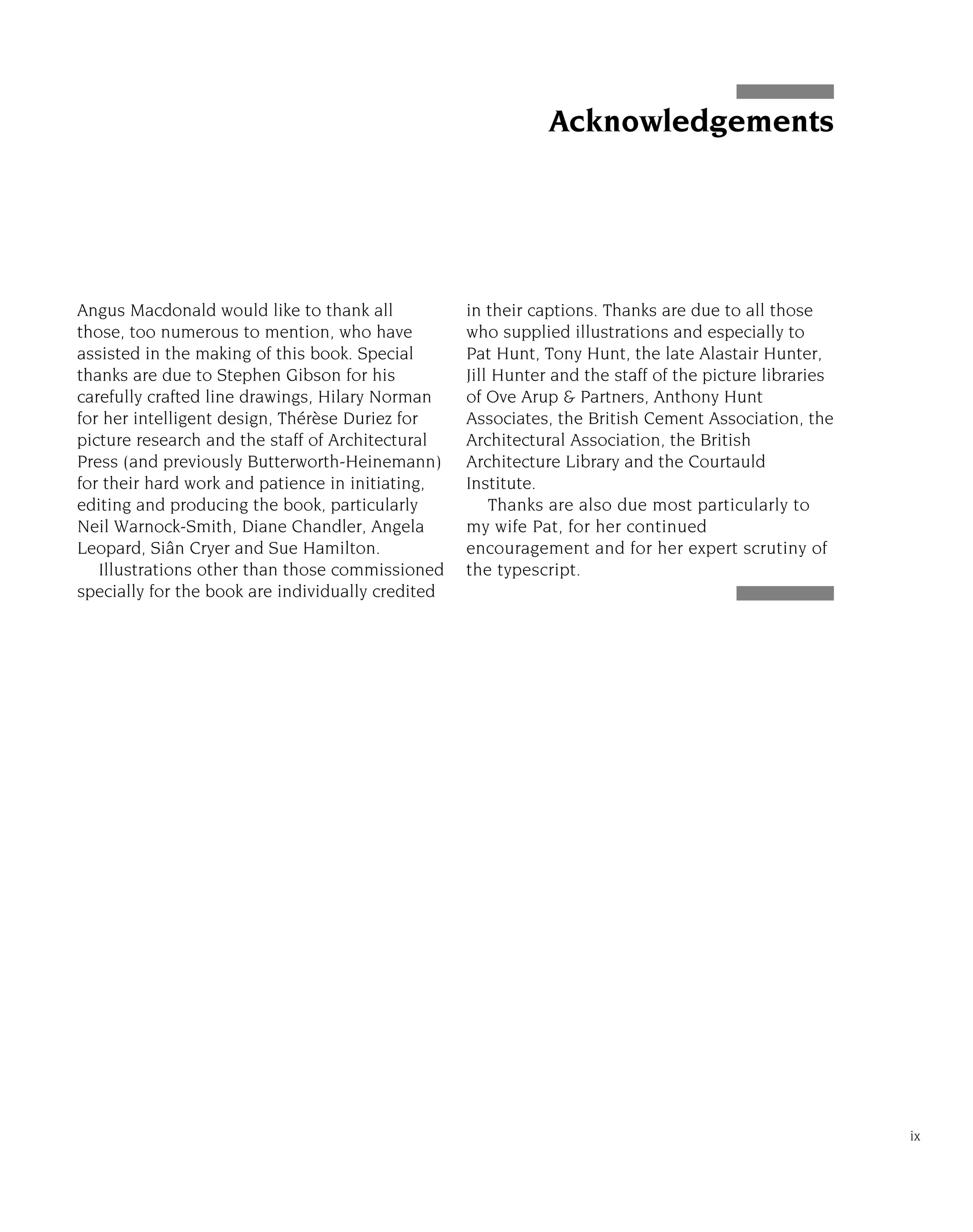
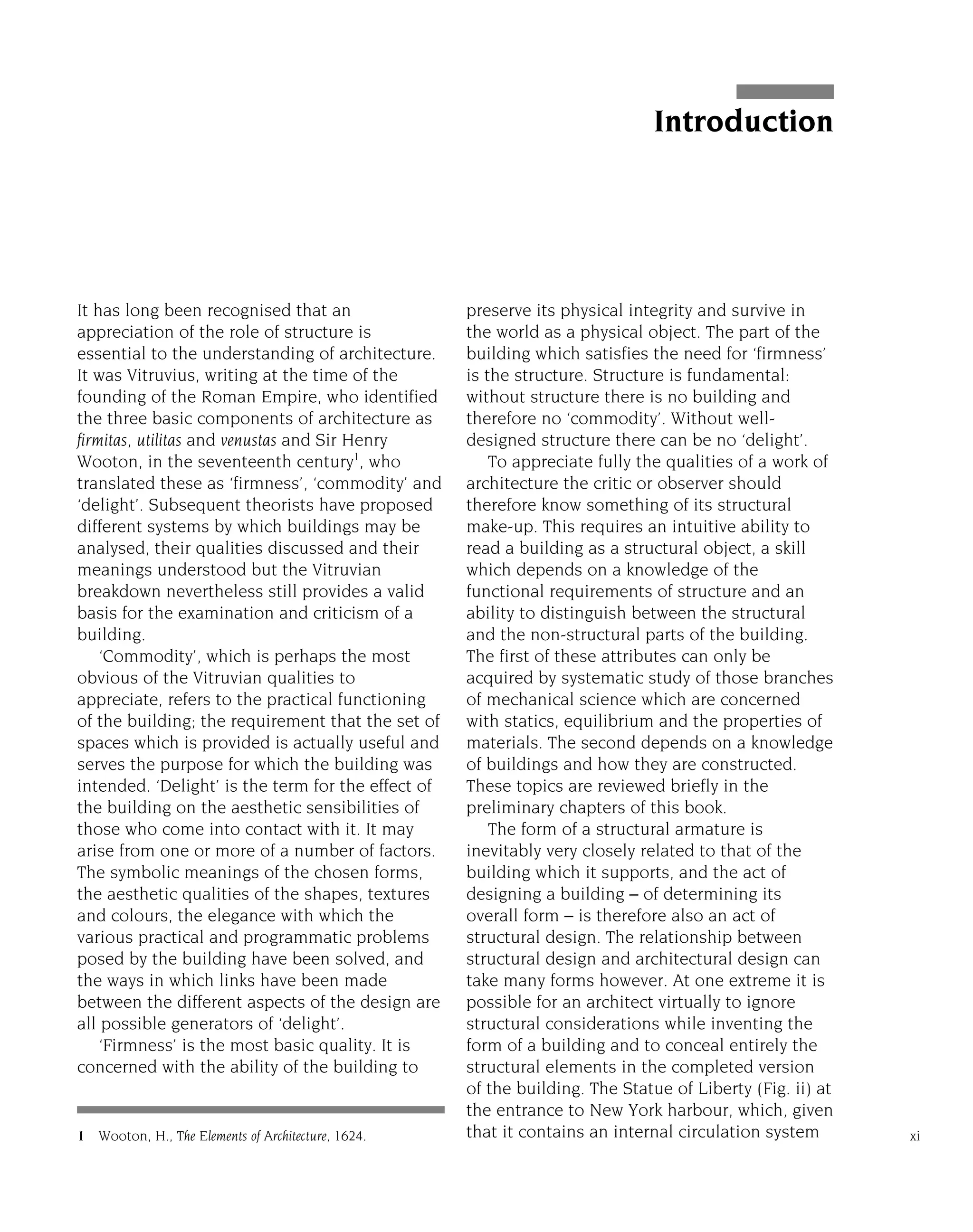
of the building. The Statue of Liberty (Fig. ii) at
the entrance to New York harbour, which, given
that it contains an internal circulation system xi
Introduction
1 Wooton, H., The Elements of Architecture, 1624.
17.
of stairs andelevators, can be considered to be
a building, is an example of this type. The
buildings of early twentieth-century
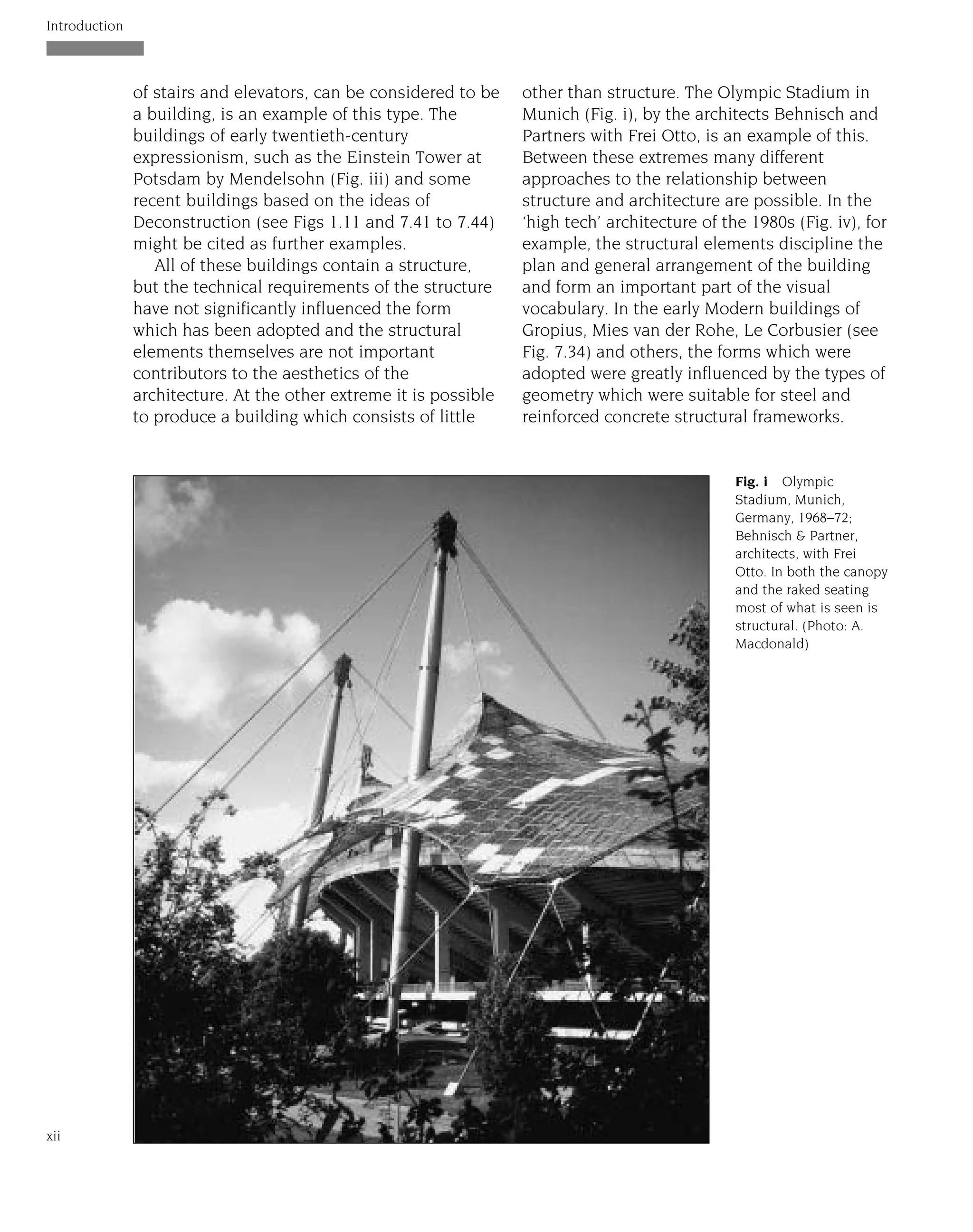
expressionism, such as the Einstein Tower at
Potsdam by Mendelsohn (Fig. iii) and some
recent buildings based on the ideas of
Deconstruction (see Figs 1.11 and 7.41 to 7.44)
might be cited as further examples.
All of these buildings contain a structure,
but the technical requirements of the structure
have not significantly influenced the form
which has been adopted and the structural
elements themselves are not important
contributors to the aesthetics of the
architecture. At the other extreme it is possible
to produce a building which consists of little
other than structure. The Olympic Stadium in
Munich (Fig. i), by the architects Behnisch and
Partners with Frei Otto, is an example of this.
Between these extremes many different
approaches to the relationship between
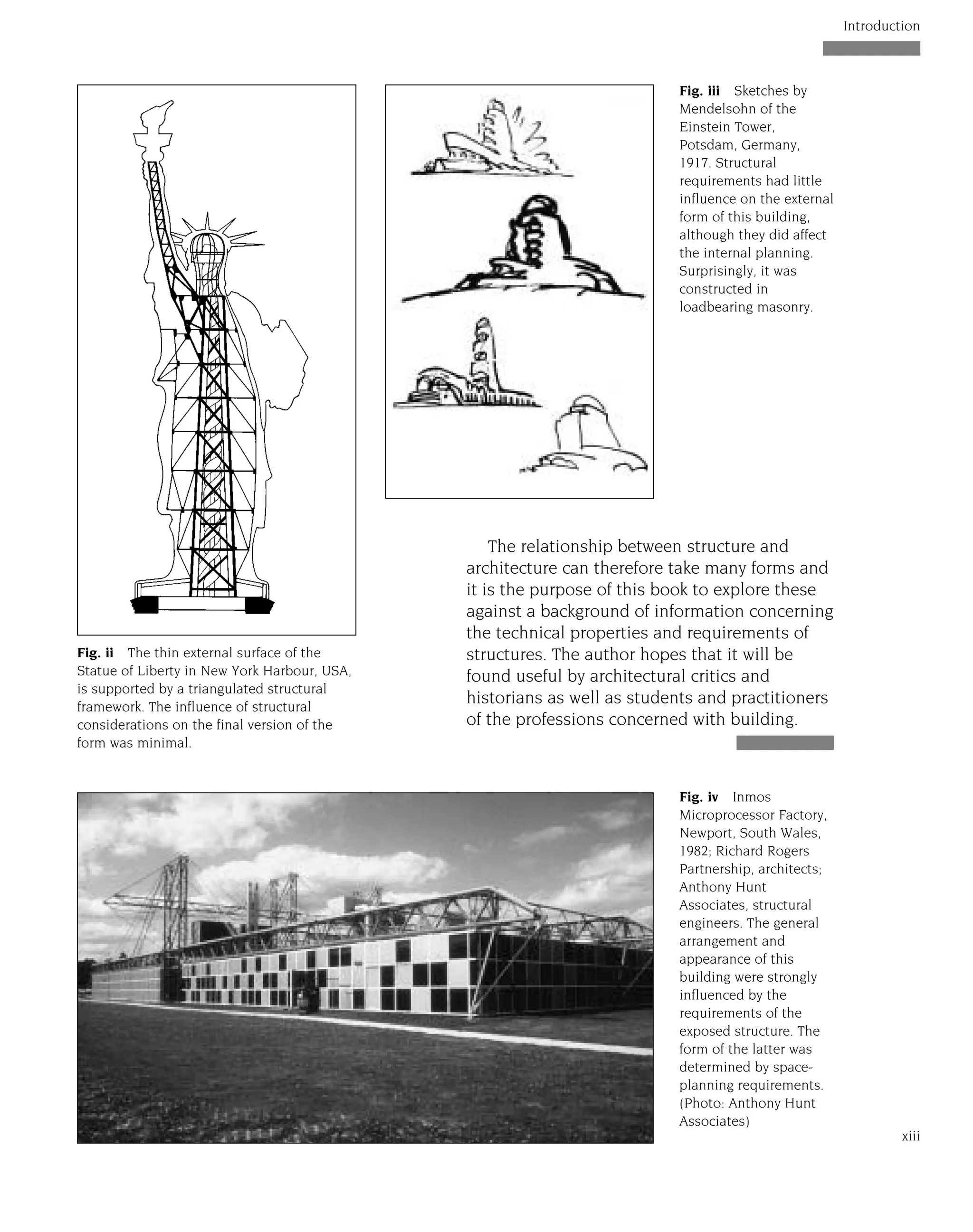
structure and architecture are possible. In the
‘high tech’ architecture of the 1980s (Fig. iv), for
example, the structural elements discipline the
plan and general arrangement of the building
and form an important part of the visual
vocabulary. In the early Modern buildings of
Gropius, Mies van der Rohe, Le Corbusier (see
Fig. 7.34) and others, the forms which were
adopted were greatly influenced by the types of
geometry which were suitable for steel and
reinforced concrete structural frameworks.
Introduction
xii
Fig. i Olympic
Stadium, Munich,
Germany, 1968–72;
Behnisch & Partner,
architects, with Frei
Otto. In both the canopy
and the raked seating
most of what is seen is
structural. (Photo: A.
Macdonald)
18.
The relationship betweenstructure and
architecture can therefore take many forms and
it is the purpose of this book to explore these
against a background of information concerning
the technical properties and requirements of
structures. The author hopes that it will be
found useful by architectural critics and
historians as well as students and practitioners
of the professions concerned with building.
xiii
Introduction
Fig. iv Inmos
Microprocessor Factory,
Newport, South Wales,
1982; Richard Rogers
Partnership, architects;
Anthony Hunt
Associates, structural
engineers. The general
arrangement and
appearance of this
building were strongly
influenced by the
requirements of the
exposed structure. The
form of the latter was
determined by space-
planning requirements.
(Photo: Anthony Hunt
Associates)
Fig. ii The thin external surface of the
Statue of Liberty in New York Harbour, USA,
is supported by a triangulated structural
framework. The influence of structural
considerations on the final version of the
form was minimal.
Fig. iii Sketches by
Mendelsohn of the
Einstein Tower,
Potsdam, Germany,
1917. Structural
requirements had little
influence on the external
form of this building,
although they did affect
the internal planning.
Surprisingly, it was
constructed in
loadbearing masonry.
The simplest wayof describing the function of
an architectural structure is to say that it is the
part of a building which resists the loads that
are imposed on it. A building may be regarded
as simply an envelope which encloses and
subdivides space in order to create a protected
environment. The surfaces which form the
envelope, that is the walls, the floors and the
roof of the building, are subjected to various
types of loading: external surfaces are exposed
to the climatic loads of snow, wind and rain;
floors are subjected to the gravitational loads
of the occupants and their effects; and most of
the surfaces also have to carry their own
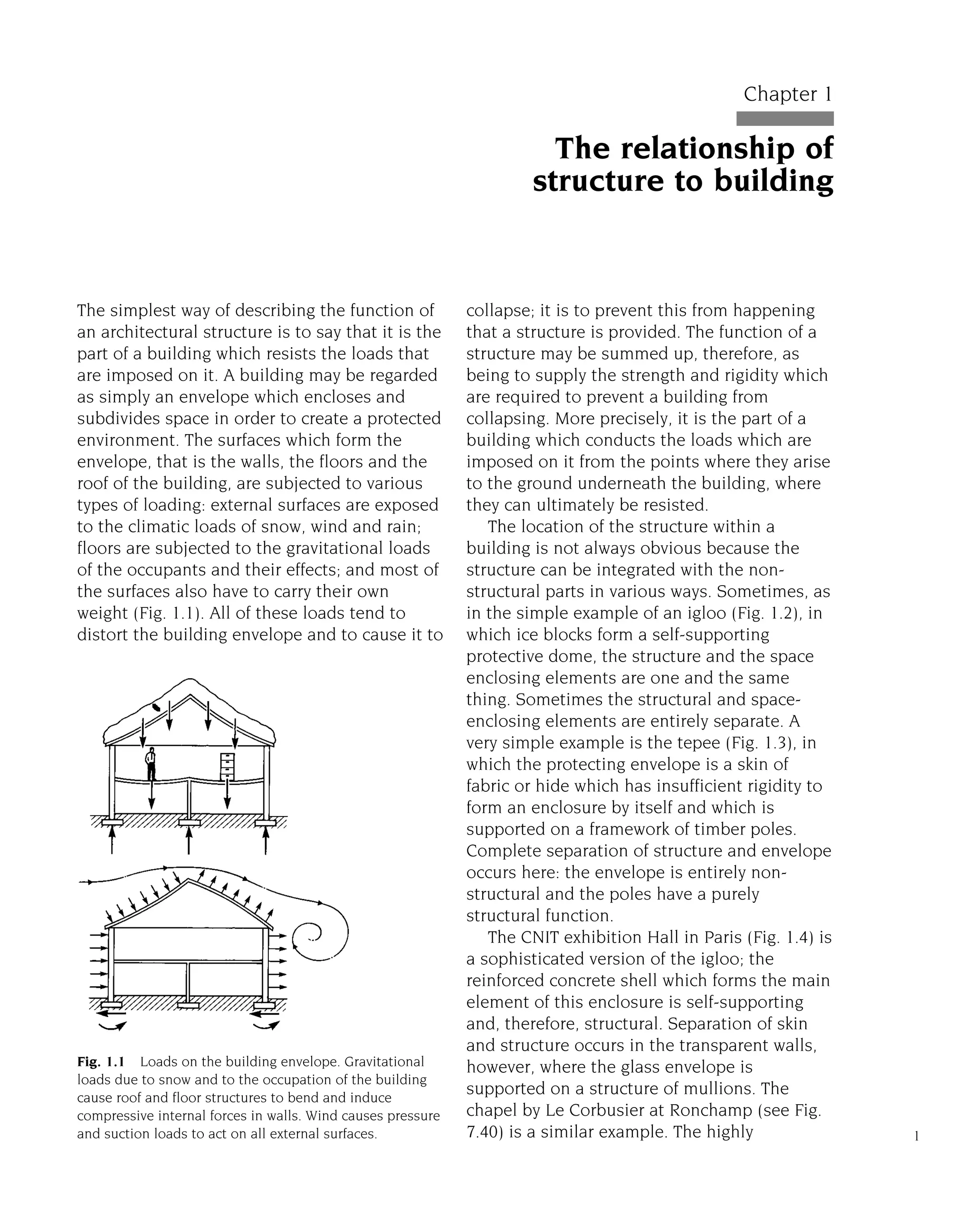
weight (Fig. 1.1). All of these loads tend to
distort the building envelope and to cause it to
collapse; it is to prevent this from happening
that a structure is provided. The function of a
structure may be summed up, therefore, as
being to supply the strength and rigidity which
are required to prevent a building from
collapsing. More precisely, it is the part of a
building which conducts the loads which are
imposed on it from the points where they arise
to the ground underneath the building, where
they can ultimately be resisted.
The location of the structure within a
building is not always obvious because the
structure can be integrated with the non-
structural parts in various ways. Sometimes, as
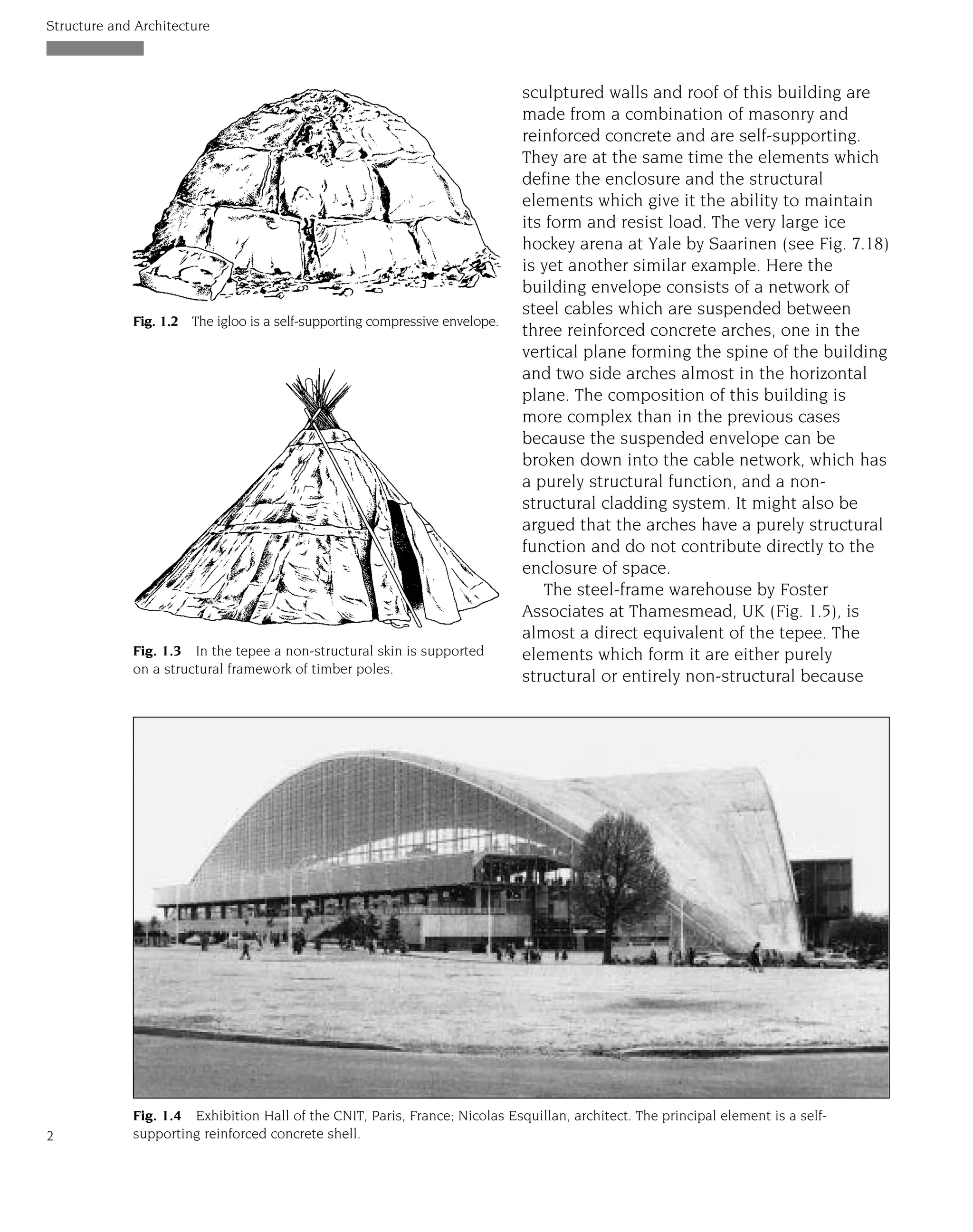
in the simple example of an igloo (Fig. 1.2), in
which ice blocks form a self-supporting
protective dome, the structure and the space
enclosing elements are one and the same
thing. Sometimes the structural and space-
enclosing elements are entirely separate. A
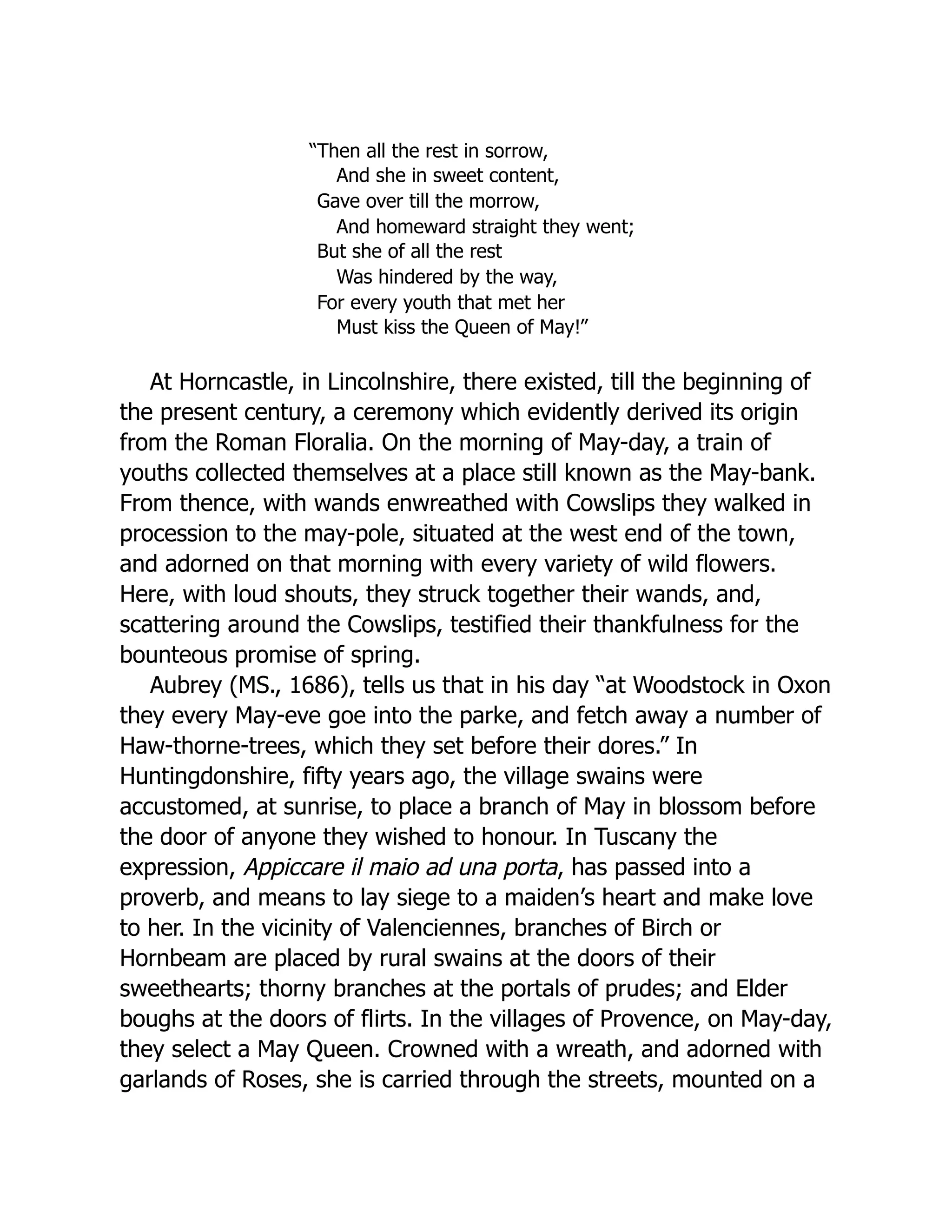
very simple example is the tepee (Fig. 1.3), in
which the protecting envelope is a skin of
fabric or hide which has insufficient rigidity to
form an enclosure by itself and which is
supported on a framework of timber poles.
Complete separation of structure and envelope
occurs here: the envelope is entirely non-
structural and the poles have a purely
structural function.
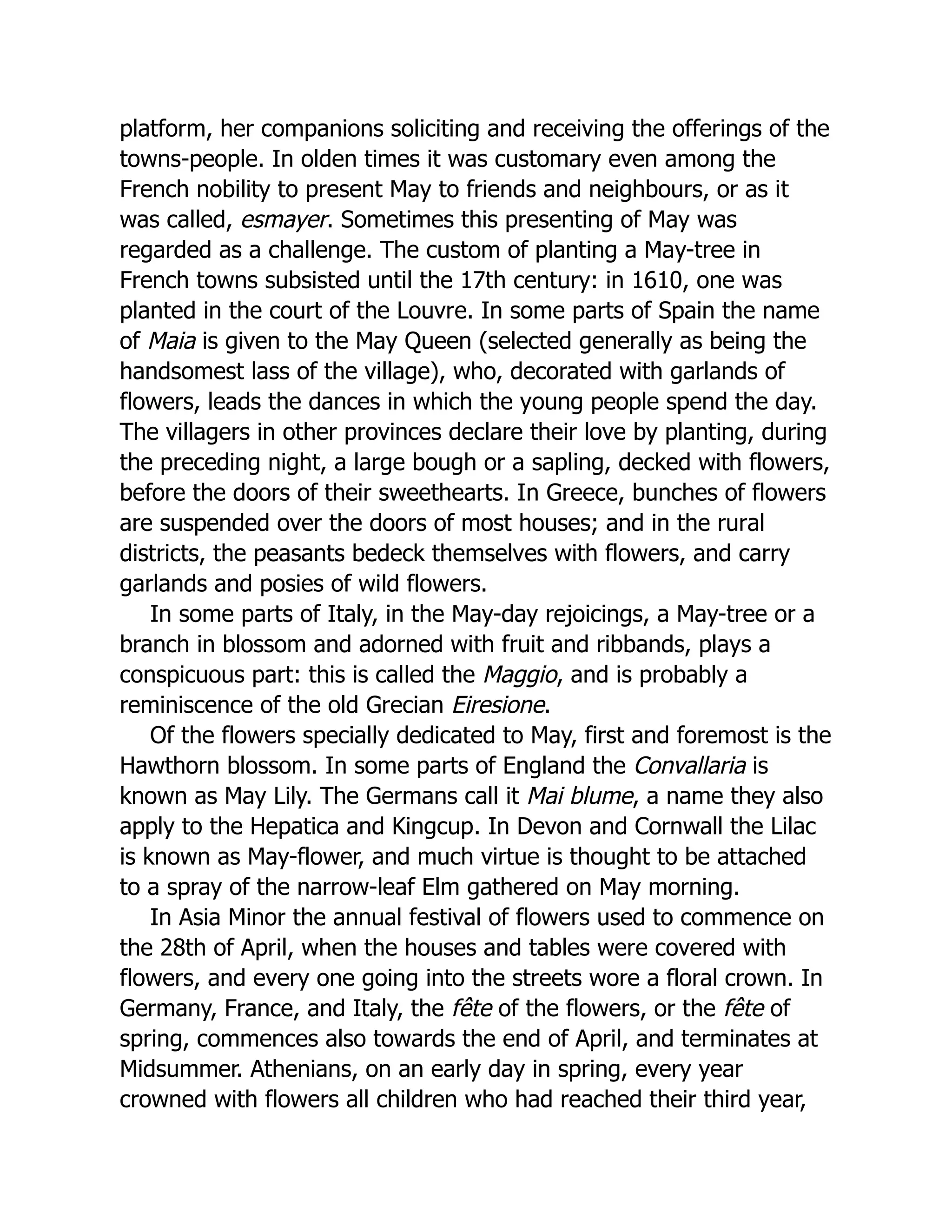
The CNIT exhibition Hall in Paris (Fig. 1.4) is
a sophisticated version of the igloo; the
reinforced concrete shell which forms the main
element of this enclosure is self-supporting
and, therefore, structural. Separation of skin
and structure occurs in the transparent walls,
however, where the glass envelope is
supported on a structure of mullions. The
chapel by Le Corbusier at Ronchamp (see Fig.
7.40) is a similar example. The highly 1
Chapter 1
The relationship of
structure to building
Fig. 1.1 Loads on the building envelope. Gravitational
loads due to snow and to the occupation of the building
cause roof and floor structures to bend and induce
compressive internal forces in walls. Wind causes pressure
and suction loads to act on all external surfaces.
21.
sculptured walls androof of this building are
made from a combination of masonry and
reinforced concrete and are self-supporting.
They are at the same time the elements which
define the enclosure and the structural
elements which give it the ability to maintain
its form and resist load. The very large ice
hockey arena at Yale by Saarinen (see Fig. 7.18)
is yet another similar example. Here the
building envelope consists of a network of
steel cables which are suspended between
three reinforced concrete arches, one in the
vertical plane forming the spine of the building
and two side arches almost in the horizontal
plane. The composition of this building is
more complex than in the previous cases
because the suspended envelope can be
broken down into the cable network, which has
a purely structural function, and a non-
structural cladding system. It might also be
argued that the arches have a purely structural
function and do not contribute directly to the
enclosure of space.
The steel-frame warehouse by Foster
Associates at Thamesmead, UK (Fig. 1.5), is
almost a direct equivalent of the tepee. The
elements which form it are either purely
structural or entirely non-structural because
Structure and Architecture
2
Fig. 1.2 The igloo is a self-supporting compressive envelope.
Fig. 1.3 In the tepee a non-structural skin is supported
on a structural framework of timber poles.
Fig. 1.4 Exhibition Hall of the CNIT, Paris, France; Nicolas Esquillan, architect. The principal element is a self-
supporting reinforced concrete shell.
“Then all therest in sorrow,
And she in sweet content,
Gave over till the morrow,
And homeward straight they went;
But she of all the rest
Was hindered by the way,
For every youth that met her
Must kiss the Queen of May!”
At Horncastle, in Lincolnshire, there existed, till the beginning of
the present century, a ceremony which evidently derived its origin
from the Roman Floralia. On the morning of May-day, a train of
youths collected themselves at a place still known as the May-bank.
From thence, with wands enwreathed with Cowslips they walked in
procession to the may-pole, situated at the west end of the town,
and adorned on that morning with every variety of wild flowers.
Here, with loud shouts, they struck together their wands, and,
scattering around the Cowslips, testified their thankfulness for the
bounteous promise of spring.
Aubrey (MS., 1686), tells us that in his day “at Woodstock in Oxon
they every May-eve goe into the parke, and fetch away a number of
Haw-thorne-trees, which they set before their dores.” In
Huntingdonshire, fifty years ago, the village swains were
accustomed, at sunrise, to place a branch of May in blossom before
the door of anyone they wished to honour. In Tuscany the
expression, Appiccare il maio ad una porta, has passed into a
proverb, and means to lay siege to a maiden’s heart and make love
to her. In the vicinity of Valenciennes, branches of Birch or
Hornbeam are placed by rural swains at the doors of their
sweethearts; thorny branches at the portals of prudes; and Elder
boughs at the doors of flirts. In the villages of Provence, on May-day,
they select a May Queen. Crowned with a wreath, and adorned with
garlands of Roses, she is carried through the streets, mounted on a
24.
platform, her companionssoliciting and receiving the offerings of the
towns-people. In olden times it was customary even among the
French nobility to present May to friends and neighbours, or as it
was called, esmayer. Sometimes this presenting of May was
regarded as a challenge. The custom of planting a May-tree in
French towns subsisted until the 17th century: in 1610, one was
planted in the court of the Louvre. In some parts of Spain the name
of Maia is given to the May Queen (selected generally as being the
handsomest lass of the village), who, decorated with garlands of
flowers, leads the dances in which the young people spend the day.
The villagers in other provinces declare their love by planting, during
the preceding night, a large bough or a sapling, decked with flowers,
before the doors of their sweethearts. In Greece, bunches of flowers
are suspended over the doors of most houses; and in the rural
districts, the peasants bedeck themselves with flowers, and carry
garlands and posies of wild flowers.
In some parts of Italy, in the May-day rejoicings, a May-tree or a
branch in blossom and adorned with fruit and ribbands, plays a
conspicuous part: this is called the Maggio, and is probably a
reminiscence of the old Grecian Eiresione.
Of the flowers specially dedicated to May, first and foremost is the
Hawthorn blossom. In some parts of England the Convallaria is
known as May Lily. The Germans call it Mai blume, a name they also
apply to the Hepatica and Kingcup. In Devon and Cornwall the Lilac
is known as May-flower, and much virtue is thought to be attached
to a spray of the narrow-leaf Elm gathered on May morning.
In Asia Minor the annual festival of flowers used to commence on
the 28th of April, when the houses and tables were covered with
flowers, and every one going into the streets wore a floral crown. In
Germany, France, and Italy, the fête of the flowers, or the fête of
spring, commences also towards the end of April, and terminates at
Midsummer. Athenians, on an early day in spring, every year
crowned with flowers all children who had reached their third year,
25.
and in thisway the parents testified their joy that the little ones had
passed the age rendered critical by the maladies incident to infants.
The Roman Catholic priesthood, always alert at appropriating
popular pagan customs, and adapting them to the service of their
church, have perpetuated this old practice. The little children
crowned with flowers and habited as angels, who to this day
accompany the procession of the Corpus Domini at the beginning of
June, are taught to scatter flowers in the road, to symbolise their
own spring-time and the spring-time of nature. On this day, along
the entire route of the procession at Rome, the ground is thickly
strewn with Bay and other fragrant leaves. In the worship of the
Madonna, flowers play an important rôle, and Roman altars are still
piled up with fragrant blossoms, and still smoke with perfumed
incense.
After the feast of Whitsuntide, the young Russian maidens repair
to the banks of the Neva, and fling in its waters wreaths of flowers,
which are tokens of affection to absent friends.
In the West of Germany and the greater part of France the
ceremony is observed of bringing home on the last harvest wain a
tree or bough decorated with flowers and gay ribbons, which is
graciously received by the master and planted on or near the house,
to remain there till the next harvest brings its successor. Some rite of
this sort, Mr. Ralston says, seems to have prevailed all over the
North of Europe. “So, in the autumnal harvest thanksgiving feast at
Athens, it was customary to carry in sacred procession an Olive-
branch wrapped in wool, called Eiresione, to the temple of Apollo,
and there to leave it; and in addition to this a similar bough was
solemnly placed beside the house door of every Athenian who was
engaged in fruit culture or agriculture, there to remain until replaced
by a similar successor twelve months later.”
Well-Flowering.
26.
From the earliestdays of the Christian era our Lord’s ascension into
heaven has been commemorated by various ceremonies, one of
which was the perambulation of parish boundaries. At Penkridge, in
Staffordshire, as well as at Wolverhampton, long after the
Reformation, the inhabitants, during the time of processioning, used
to adorn their wells with boughs and flowers; and this ancient
custom is still practised every year at Tissington, in Derbyshire,
where it is known as “well-flowering.” There are five wells so
decorated, and the mode of dressing or adorning them is this:—the
flowers are inserted in moist clay and put upon boards cut in various
forms, surrounded with boughs of Laurel and White Thorn, so as to
give the appearance of water issuing from small grottoes. The
flowers are arranged in various patterns, to give the effect of mosaic
work, and are inscribed with texts of Scripture and suitable mottoes.
After church, the congregation walk in procession to the wells and
decorate them with these boards, as well as with garlands of
flowers, boughs, &c. Flowers were cast into the wells, and from their
manner of falling, lads and lasses divined as to the progress of their
love affairs.
“Bring flowers! bring flowers! to the crystal well,
That springs ’neath the Willows in yonder dell.
* * * * * * * *
And we’ll scatter them over the charmed well,
And learn our fate from its mystic spell.”
“And she whose flower most tranquilly
Glides down the stream our Queen shall be.
In a crown we’ll wreath
Wild flowers that breathe;
And the maiden by whom this wreath shall be worn
Shall wear it again on her bridal morn.”—Merritt.
Before the Reformation the Celtic population of Scotland, the
Hebrides, Ireland, Wales, and Cornwall were in the habit of naming
27.
wells and springsafter different saints and martyrs. Though
forbidden by the canons of St. Anselm, many pilgrimages continued
to be made to them, and the custom was long retained of throwing
nosegays into springs and fountains, and chaplets into wells. Sir
Walter Scott tells us that “in Perthshire there are several wells
dedicated to St. Fillan, which are still places of pilgrimage and
offerings, even among Protestants.”
“Thence to St. Fillan’s blessed well
Whose spring can frenzied dreams dispel,
And the crazed brain restore.”
Into some of these Highland wells flowers are cast, and occasionally
pins, while the surrounding bushes are hung with rags and shreds,
in imitation of the old heathen practice. The ceremony of sprinkling
rivers with flowers was probably of similar origin. Milton and Dryden
both allude to this custom being in vogue as regards the Severn, and
this floral rite is described in ‘The Fleece’ as follows:—
“With light fantastic toe the nymphs
Thither assembled, thither every swain;
And o’er the dimpled stream a thousand flowers,
Pale Lilies, Roses, Violets, and Pinks,
Mix’d with the greens of Burnet, Mint, and Thyme,
And Trefoil, sprinkled with their sportive arms.
Such custom holds along th’ irriguous vales,
From Wreken’s brow to rocky Dolvoryn,
Sabrina’s early haunt.”
Bridal Floral Ceremonies.
In all countries flowers have from time immemorial been chosen as
the happy accompaniment of bridal ceremonies. Among the ancients
it was customary to crown newly-married persons with a chaplet of
red and white Roses. On arriving at the house of her husband, the
28.
Roman bride foundwoollen fillets round the door-posts, which were
adorned with evergreens and blossoms, and anointed with the fat of
wolves to avert enchantment.
In M. Barthélemi’s ‘Travels of Young Anacharsis’ the author,
describing a marriage ceremony in the Island of Delos, says that the
inhabitants of the island assembled at daybreak, crowned with
flowers; flowers were strewn in the path of the bride and
bridegroom; and the house was garlanded with them. Singers and
dancers appeared crowned with Oak, Myrtles, and Hawthorn. The
bride and bridegroom were crowned with Poppies, and upon their
approach to the temple, a priest received them at the entrance, and
presented to each a branch of Ivy—a symbol of the tie which was to
unite them for ever.[6]
At Indian nuptials, the wedding wreath, the varamâlâ, united
bride and bridegroom. At the marriage feasts of the Persians, a little
tree is introduced, the branches of which are laden with fruit: the
guests endeavour to pluck these without the bridegroom perceiving
them; if successful, the latter has to make them a present; if,
however, a guest fails, he has to give the bridegroom a hundred
times the value of the object he sought to remove from the tree.
In Germany, among the inhabitants of Oldenburg, there exists a
curious wedding custom. When the bridegroom quits his father’s
roof to settle in some other town or village, he has his bed linen
embroidered at the corners with flowers surmounted by a tree, on
whose branches are perched cock birds: on each side of the tree are
embroidered the bridegroom’s initials. In many European countries it
is customary to plant before the house of a newly-married couple,
one or two trees, as a symbol of the good luck wished them by their
friends.
Floral Games and Festivals.
29.
Floral games havefor many years been held at Toulouse, Barcelona,
Tortosi, and other places; but the former are the most famed, both
on account of their antiquity and the value of the prizes distributed
during the fêtes. The ancient city of Toulouse had formerly a great
reputation for literature, which had, however, been allowed to
decline until the visit of Charles IV. and his bride determined the
capitouls or chief magistrates to make an effort to restore its
prestige as the centre of Provençal song. Troubadours there were
who, banded together in a society, met in the garden of the
Augustine monks to recite their songs, sirventes, and ballads; and in
order to foster the latent taste for poetry, the capitouls invited the
poets of the Langue d’oc, to compete for a golden Violet to be
awarded to the author of the best poem produced on May 4th, 1324.
The competition created the greatest excitement, and great numbers
of people met to hear the judges’ decision: they awarded the golden
Violet to Arnaud Vidal for his poem in honour of the Virgin. In 1355,
three prizes were offered—a golden Violet for the best song; an
Eglantine (Spanish Jasmine), for the best sirvente, or finest pastoral;
and a Flor-de-gang (yellow Acacia) for the best ballad. In later years
four prizes were competed for, viz., an Amaranth, a Violet, a Pansy,
and a Lily. In 1540, Clemence Isaure, a poetess, bequeathed the
bulk of her fortune to the civic authorities to be expended in prizes
for poetic merits, and in fêtes to be held on the 1st and 3rd of May.
She was interred in the church of La Daurade, on the high altar of
which are preserved the golden flowers presented to the successful
competitors at the Floral Games. The ceremonies of the fêtes thus
revived by Clemence Isaure commenced with the strewing of her
tomb with Roses, followed by mass, a sermon, and alms-giving. In
1694, the Jeux Floraux were merged into the Academy of Belles
Lettres, which gives prizes, but almost exclusively to French poets.
The festival, interrupted by the Revolution, was once more revived in
1806, and is still held annually in the Hotel-de-Ville, Toulouse.
30.
St. Medard, Bishopof Noyon, in France, instituted in the sixth
century a festival at Salency, his birth-place, for adjudging a most
interesting prize offered by piety to virtue. This prize consists of a
simple crown of Roses bestowed on the girl who is acknowledged by
all her competitors to be the most amiable, modest, and dutiful. The
founder of this festival had the pleasure of crowning his own sister
as the first Rosiere of Salency. This simple institution still survives,
and the crown of Roses continues to be awarded to the most
virtuous of the maidens of the obscure French village. A similar prize
is awarded in the East of London by an active member of the Roman
Catholic Church—the ceremony of crowning the Rose Queen being
performed annually in the Crystal Palace at Sydenham.
In the middle ages the Queen of Flowers contributed to a singular
popular festival at Treviso, in Italy. In the middle of the city the
inhabitants erected a mock castle of upholstery. The most
distinguished unmarried females of the place defended the fortress,
which was attacked by the youth of the other sex. The missiles with
which both parties fought consisted of Roses, Lilies, Narcissi, Violets,
Apples, and Nuts, which were hurled at each other by the
combatants. Volleys of Rose-water and other perfumes were also
discharged by means of syringes. This entertainment attracted
thousands of spectators from far and near, and the Emperor
Frederick Barbarossa himself accounted it a most pleasing diversion.
The custom of pelting with Roses is still common in Persia, where
it is practised during the whole season that these flowers are
blooming. A company of young men repair to the places of public
entertainment to amuse the guests with music, singing, and
dancing, and in their way through the streets they pelt the
passengers whom they meet with Roses, and generally receive a
small gratuity in return.
Striking features of the Japanese festival on New Year’s Day are
the decorations erected in front of nearly every door, of which Mr.
Dixon tells us the principal objects are, on the right a Pinus
31.
densiflora, on theleft a P. Thunbergius, both standing upright: the
former is supposed to be of the female and the latter of the male
sex, and both symbolise a robust age that has withstood the storms
and trials of life. Immediately behind each of the Pines is a Bamboo,
the straight stem of which, with the knots marking its growth,
indicates hale life and fulness of years. A straw rope of about six feet
in length connects the Bamboos seven or more feet from the
ground, thus completing the triumphal arch. In the centre of the
rope (which is there to ward off evil spirits) is a group in which
figures a scarlet lobster, the bent back of which symbolises old age:
this is embedded in branches of the Melia Japonica, the older leaves
of which still remain after the young ones have burst forth. So may
the parents continue to flourish while children and grandchildren
spring forth! Another plant in the central group is the Polypodium
dicotomon, a Fern which is regarded as a symbol of conjugal life,
because the fronds spring in pairs from the stem. There are also
bunches of seaweed, which have local significance, and a lucky bag,
filled with roasted Chesnuts, the seeds of the Torreya nucifera, and
the dried fruit of the Kaki.
Garlands, Chaplets, and Wreaths.
All the nations of antiquity—Indians, Chinese, Medes, Persians,
Assyrians, Chaldeans, Egyptians, Hebrews, Greeks, and Romans—
were accustomed to deck themselves, their altars, and their
dwellings with flowers, and to weave chaplets and garlands of leaves
and blossoms. In the Vedic Vishnupurâna, the sage Durvâsas (one of
the names of Siva, the destroyer), receives of the goddess Srî (the
Indian Venus) a garland of flowers gathered from the trees of
heaven. Proceeding on his way, he meets the god Indra, seated on
an elephant, and to pay him homage he places on his brow the
garland, to which the bees fly in order to suck the ambrosia. The
Persians were fond of wearing on their heads crowns made of Myrrh
32.
and a sweet-smellingplant called Labyzus. Antiochus Epiphanes, the
Syrian king, once held some games at Daphne, to which thousands
of guests were invited, who, after being richly feasted, were sent
away with crowns of Myrrh and Frankincense. Josephus, in his
history of the Jews, has recorded the use of crowns in the time of
Moses, and on certain occasions the mitre of the High Priest was
adorned with a chaplet of Henbane (Hyoscyamus niger). Wreaths
and chaplets were in common use among the Egyptians at a very
early period; and although the Lotus was principally preferred in
their formation, many other flowers and leaves were employed—as
of the Chrysanthemum, Acinos, Acacia, Strychnos, Persoluta,
Anemone, Convolvulus, Olive, Myrtle, Amaracus, Xeranthemum, Bay-
tree, and others. Plutarch says that when Agesilaus visited Egypt, he
was so delighted with the chaplets of Papyrus sent him by the King,
that he took some home when he returned to Sparta. In India,
Greece, and Rome, the sacrificial priests were crowned, and their
victims were decorated with garlands of flowers.
In ancient Greece and Rome the manufacture of garlands and
chaplets became quite an art, so great was the estimation in which
these adornments were held by these highly-civilised nations. With
them the composition of a garland possessed a deep significance,
and warriors, statesmen, and poets alike coveted these simple
insignia at the hands of their countrymen. Pliny tells us that the
Sicyonians were considered to surpass all other people in the art of
arranging the colours of garlands and imparting to them the most
agreeable mixture of perfumes. They derived this taste from Glycera,
a woman so skilled in the art of arranging chaplets and garlands that
she won the affection of Pausias, a celebrated painter, who delighted
in copying the wreaths of flowers so deftly arranged by his mistress.
Some of these pictures were still in existence when Pliny wrote, four
hundred and fifty years after they were painted. Cato, in his treatise
on gardens, directs specially that they should be planted with such
flowers as are adapted for chaplets and wreaths. Pliny states that
33.
Mnestheus and Callimachus,two renowned Greek physicians,
compiled several books on the virtues of chaplets, pointing out those
hurtful to the brain, as well as those which had a beneficial influence
on the wearer; for both Greeks and Romans had found, by
experience, that certain plants and flowers facilitated the functions
of the brain, and assisted materially to neutralise the inebriating
qualities of wine. Thus, as Horace tells us, the floral chaplets worn
by guests at feasts were tied with the bark of the Linden to prevent
intoxication.
“I tell thee, boy, that I detest
The grandeur of a Persian feast;
Nor for me the binder’s rind
Shall no flow’ry chaplet bind.
Then search not where the curious Rose,
Beyond his season loitering grows;
But beneath the mantling Vine,
While I quaff the flowing wine,
The Myrtle’s wreath shall crown our brows,
While you shall wait and I carouse.”
Besides the guests at feasts, the attendants were decorated with
wreaths, and the wine-cups and apartments adorned with flowers.
From an anecdote related by Pliny we learn that it was a frequent
custom, common to both Greeks and Romans, to mix the flowers of
their chaplets in their wine, when they pledged the healths of their
friends. Cleopatra, to ridicule the mistrust of Antony, who would
never eat or drink at her table without causing his taster to test
every viand, lest any should be poisoned, commanded a chaplet of
flowers to be prepared for the Roman General, the edges of which
were dipped in the most deadly poison, whilst that which was woven
for her own brow was, as usual, mixed with aromatic spices. At the
banquet Antony received his coronet of flowers, and when they had
become cheerful through the aid of Bacchus, Cleopatra pledged him
in wine, and taking off the wreath from her head, and rubbing the
34.
blossoms into hergoblet, drank off the contents. Antony was
following her example, but just as he had raised the fatal cup to his
lips, the Queen seized his arm, exclaiming, “Cure your jealous fears,
and learn that I should not have to seek the means of your
destruction, could I live without you.” She then ordered a prisoner to
be brought before them, who, on drinking the wine from Antony’s
goblet, instantly expired in their presence.
The Romans wore garlands at sacred rites, games and festivals,
on journeys and in war. When an army was freed from a blockade its
deliverer was presented with a crown composed of the Grass
growing on the spot. In modern heraldry, this crown of Grass is
called the Crown Obsidional, and appertains to the general who has
held a fortress against a besieging army and ultimately relieved it
from the assailants. To him who had saved the life of a Roman
soldier was given a chaplet of Oak-leaves: this is the modern
heraldic civic crown bestowed on a brave soldier who has saved the
life of a comrade or has rescued him after having been taken
prisoner by the enemy. The glories of all grand deeds were
signalized by the crown of Laurel among both Greeks and Romans.
This is the heraldic Crown Triumphant, adjudged in our own times to
a general who has achieved a signal victory. The Romans were not
allowed by law to appear in festal garlands on ordinary occasions.
Hence Cæsar valued most highly the privilege accorded him by the
Senate of wearing a Laurel crown, because it screened his baldness,
which, both by the Romans and Jews, was considered a deformity.
This crown was generally composed of the Alexandrian Laurel
(Ruscus Hypoglossum)—the Laurel usually depicted on busts and
coins. The victors at the athletic games were adjudged crowns
differing in their composition according to the place in which they
had won their honours. Thus, crowns of
Olive were given at the Olympic games.
Beech, Laurel, or Palm were given at the Pythian games.
35.
Parsley were givenat the Nemean games.
Pine were given at the Isthmian games.
It is not too much to say that Greeks and Romans employed
garlands, wreaths, and festoons of flowers on every possible
occasion; they adorned with them the sacrificial victims, the statue
of the god to whom sacrifice was offered, and the priest who
performed the rite. They placed chaplets on the brows of the dead,
and strewed their graves with floral wreaths, whilst at their funeral
feasts the parents of the departed one encircled their heads with
floral crowns. They threw them to the successful actors on the
stage. They hung with garlands the gates of their cities on days of
rejoicing. They employed floral wreaths at their nuptials. Nearly all
the plants composing these wreaths had a symbolical meaning, and
they were varied according to the seasons and the circumstances of
the wearer. The Hawthorn adorned Grecian brides; but the bridal
wreath of the Romans was usually composed of Verbena, plucked by
the bride herself. Holly wreaths were sent as tokens of good wishes.
Chaplets of Parsley and Rue were worn to keep off evil spirits.
But the employment of garlands has by no means been confined
to the ancients. At the present day the inhabitants of India make
constant use of them. The Brahmin women, who burn themselves
on the funeral pyres of their husbands, deck their persons with
chaplets and garlands, and present wreaths to the young women
who attend them at this terrible sacrifice. The young Indian girls
adorn themselves with garlands during the festival of Kâmadeva, the
god of love, which takes place during the last days of spring. In the
nuptial ceremonies of India, the garland of flowers is still a feature
which possesses a recognised symbolic value. In Northern India
garlands of the African Marigold are placed on the trident emblem of
Mahâdeva, and both male and female worshippers wear chaplets
composed of the same sacred flower on his festivals. The Moo-le-
hua, a fragrant Jasmine, is employed in China and other Eastern
36.
countries in formingwreaths for the decoration of ladies’ hair, and an
Olive crown is still the reward of literary merit in China. The
Japanese of both sexes are fond of wearing wreaths of fragrant
blossoms.
The Italians have artificers called Festaroli, whose especial office
it is to manufacture garlands and festoons of flowers and other
decorations for feasts. The maidens of Greece, Germany, and
Roumania still bear wreaths of flowers in certain processions which
have long been customary in the spring of the year. The Swiss
peasants are fond of making garlands, for rural festivities, of the
Globe-flower (Trollius Europæus), which grows freely on all the chain
of the Alps. In Germany a wreath of Vervain is presented to the
newly-married, and in place of the wreath of Orange-blossoms which
decorates the brow of the bride in England, France, and America, a
chaplet of Myrtle is worn. The blossom of the Bizarade or bitter
Orange is most prized for wreaths and favours when the fresh
flowers can be procured.
37.
CHAPTER V.
Plants ofthe Christian Church.
A FTER Rome Pagan became Rome Christian, the priests of
the Church of Christ recognised the importance of
utilising the connexion which existed between plants and
the old pagan worship, and bringing the floral world into
active co-operation with the Christian Church by the institution of a
floral symbolism which should be associated not only with the names
of saints, but also with the Festivals of the Church.
But it was more especially upon the Virgin Mary that the early
Church bestowed their floral symbolism. Mr. Hepworth Dixon, writing
of those quiet days of the Virgin’s life, passed purely and tenderly
among the flowers of Nazareth, says—“Hearing that the best years
of her youth and womanhood were spent, before she yet knew grief,
on this sunny hill and side slope, her feet being for ever among the
Daisies, Poppies, and Anemones, which grow everywhere about, we
have made her the patroness of all our flowers. The Virgin is our
Rose of Sharon—our Lily of the Valley. The poetry no less than the
piety of Europe has inscribed to her the whole bloom and colouring
of the fields and hedges.”
The choicest flowers were wrested from the classic Juno, Venus,
and Diana, and from the Scandinavian Bertha and Freyja, and
38.
bestowed upon theMadonna, whilst floral offerings of every sort
were laid upon her shrines.
Her husband, Joseph, has allotted to him a white Campanula,
which in Bologna is known as the little Staff of St. Joseph. In
Tuscany the name of St. Joseph’s staff is given to the Oleander: a
legend recounts that the good Joseph possessed originally only an
ordinary staff, but that when the angel announced to him that he
was destined to be the husband of the Virgin Mary, he became so
radiant with joy, that his very staff flowered in his hand.
Before our Saviour’s birth, the Virgin Mary, strongly desiring to
refresh herself with some luscious cherries that were hanging in
clusters upon the branch of a tree, asked Joseph to gather some for
her. He hesitated, and mockingly said—“Let the father of thy child
present them to you.” Instantly the branch of the Cherry-tree
inclined itself to the Virgin’s hand, and she plucked from it the
refreshing fruit. On this account the Cherry has always been
dedicated to the Virgin Mary. The Strawberry, also, is specially set
apart to the Virgin’s use; and in the Isle of Harris a species of Beans,
called Molluka Beans, are called, after her, the Virgin Mary’s Nuts.
At Bethlehem, the manger in which the Infant Jesus was laid
after His birth was filled with Our Lady’s Bedstraw (Galium verum).
Some few drops of the Virgin’s milk fell upon a Thistle, which from
that time has had its leaves spotted with white, and is known as Our
Lady’s Thistle (Carduus Marianus). In Germany the Polypodium
vulgare, which grows in clefts of rocks, is believed to have sprung
from the milk of the Virgin (in ancient times from Freyja’s milk). The
Pulmonaria is also known as Unser Frauen Milch (Our Lady’s Milk).
When, after the birth of Jesus, His parents fled into Egypt,
traditions record that in order that the Virgin might conceal herself
and the infant Saviour from the assassins sent out by Herod, various
trees opened, or stretched their branches and enlarged their leaves.
As the Juniper is dedicated to the Virgin, the Italians consider that it
was a tree of that species which thus saved the mother and child,
39.
and the Juniperis supposed to possess the power of driving away
evil spirits and of destroying magical spells. The Palm, the Willow,
and the Rosemary have severally been named as having afforded
their shelter to the fugitives. On the other hand, the Lupine,
according to a tradition still current among the Bolognese, received
the maledictions of the Virgin Mary because, during the flight,
certain plants of this species, by the noise they made, drew the
attention of the soldiers of Herod to the spot where the harassed
travellers had halted.
During the flight into Egypt a legend relates that certain precious
bushes sprang up by the fountain where the Virgin washed the
swaddling clothes of her Divine babe. These bushes were produced
by the drops of water which fell from the clothes, and from which
germinated a number of little plants, each yielding precious balm.
Wherever the Holy Family rested in their flight sprang up the Rosa
Hierosolymitana—the Rosa Mariæ, or Rose of the Virgin. Near the
city of On there was shown for many centuries the sacred Fig-tree
under which the Holy Family rested. They also, according to Bavarian
tradition, rested under a Hazel.
Plants of the Virgin Mary.
In Tuscany there grows on walls a rootless little pellitory (Parietaria),
with tiny pale-pink flowers and small leaves. They gather it on the
morning of the Feast of the Ascension, and suspend it on the walls
of bed-rooms till the day of the Nativity of the Virgin (8th
September), from which it derives its name—the Herb of the
Madonna. It generally opens its flowers after it has been gathered,
retaining sufficient sap to make it do so. This opening of a cut flower
is regarded by the peasantry as a token of the special blessing of the
Virgin. Should the flower not open, it is taken as an omen of the
Divine displeasure. In the province of Bellune, in Italy, the Matricaria
40.
Parthenium is calledthe Herb of the Blessed Mary: this flower was
formerly consecrated to Minerva.
In Denmark, Norway, and Iceland, they give the name of
Mariengras (Herb of Mary) to different Ferns, and in those countries
Mary often replaces the goddess Freyja, the Venus of the North, in
the names of flowers. No doubt the monks of old delighted in
bestowing upon the Virgin Mary the floral attributes of Venus, Freyja,
Isis, and other goddesses of the heathen; but, nevertheless, it is not
long since that a Catholic writer complained that at the Reformation
“the very names of plants were changed in order to divert men’s
minds from the least recollection of ancient Christian piety;” and a
Protestant writer of the last century, bewailing the ruthless action of
the Puritans in giving to the “Queen of Beauty” flowers named after
the “Queen of Heaven,” says: “Botany, which in ancient times was
full of the Blessed Virgin Mary, ... is now as full of the heathen
Venus.”
Amongst the titles of honour given to the Virgin in the ‘Ballad of
Commendation of Our Lady,’ in the old editions of Chaucer, we find:
“Benigne braunchlet of the Pine tree.”
In England “Lady” in the names of plants generally has allusion to
Our Lady, Notre Dame, the Virgin Mary. Our Lady’s Mantle
(Alchemilla vulgaris) is the Máríu Stakkr of Iceland, which insures
repose when placed beneath the pillow. Scandix Pecten was Our
Lady’s Comb, but in Puritan times was changed into Venus’ Comb.
The Cardamine pratensis is Our Lady’s Smock; Neottia spiralis, Our
Lady’s Tresses; Armeria vulgaris, Our Lady’s Cushion; Anthyllis
vulneraria, Our Lady’s Fingers; Campanula hybrida, Our Lady’s
Looking-glass; Cypripedium Calceolus, Our Lady’s Slipper; the
Cowslip, Our Lady’s Bunch of Keys; Black Briony, Our Lady’s Seal (a
name which has been transferred from Solomon’s Seal, of which the
‘Grete Herbal’ states, “It is al one herbe, Solomon’s Seale and Our
Lady’s Seale”). Quaking Grass, Briza media, is Our Lady’s Hair;
Maidenhair Fern, the Virgin’s Hair; Mary-golds (Calendula officinalis)
41.
and Mary-buds (Calthapalustris) are both named after the Virgin
Mary. The Campanula and the Digitalis are in France the Gloves of
Mary; the Nardus Celtica is by the Germans called Marienblumen;
the White-flowered Wormwood is Unser Frauen Rauch (Smoke of
Our Lady); Mentha spicata is in French, Menthe de Notre Dame—in
German, Unser Frauen Müntz; the Costus hortensis, the Eupatorium,
the Matricaria, the Gallitrichum sativum, the Tanacetum, the
Persicaria, and a Parietaria are all, according to Bauhin, dedicated to
the Virgin Mary. The name of Our Lady’s Tears, or Larmes de Sainte
Marie, has been given to the Lily of the Valley, as well as to the
Lithospermon of Dioscorides, the Satyrium maculatum, and the
Satyrium basilicum majus. The Narcissus Italicus is the Lily of Mary.
The Toad Flax is in France Lin de Notre Dame, in Germany, Unser
Frauen Flachs. The Dead-Nettle is Main de Sainte Marie. Besides the
Alchemilla, the Leontopodium, the Drosera, and the Sanicula major
are called on the Continent Our Lady’s Mantle. Woodroof, Thyme,
Groundsel, and St. John’s Wort form the bed of Mary.
In Piedmont they give the name of the Herb of the Blessed Mary
to a certain plant that the birds are reputed to carry to their young
ones which have been stolen and imprisoned in cages, in order that
it shall cause their death and thus deliver them from their slavery.
The Snowdrop is the Fair Maid of February, as being sacred to the
Purification of the Virgin (February 2nd), when her image was
removed from the altar and Snowdrops strewed in its place.
To the Madonna, in her capacity of Queen of Heaven, were
dedicated the Almond, the White Iris, the White Lily, and the
Narcissus, all appropriate to the Annunciation (March 25th). The Lily
and White and Red Roses were assigned to the Visitation of Our
Lady (July 2nd): these flowers are typical of the love and purity of
the Virgin Mother. To the Feast of the Assumption (August 15th) is
assigned the Virgin’s Bower (Clematis Flammula); to the Nativity of
the Blessed Virgin (September 8th) the Amellus (Aster Amellus); and
to the Conception (December 8th) the Arbor Vitæ.
42.
St. Dominick institutedthe “Devotion of the Rosary” of the Virgin
Mary—a series of prayers, to mark the repetition of which a chaplet
of beads is employed, which consists of fifteen large and one
hundred and fifty small beads; the former representing the number
of Pater Nosters, the latter the number of Ave Marias. As these
beads were formerly made of Rose-leaves tightly pressed into round
moulds, where real Roses were not strung together, this chaplet was
called a Rosary, and was blessed by the Pope or some other holy
person before being so used.
Valeriana sativa is in France called Herbe de Marie Magdaleine, in
Germany Marien Magdalenen Kraut; the Pomegranate is the
Pommier de Marie Magdaleine and Marien Magdalenen Apfel.
The Plants of Our Saviour.
We have seen that at the birth of Christ, the infant Jesus was laid on
a manger containing Galium verum, at Bethlehem, a place
commemorated by the Ornithogalum umbellatum, or Star of
Bethlehem, the flowers of which resemble the pictures of the star
that indicated the birth of Jesus. Whilst lying in the manger, a spray
of the rose-coloured Sainfoin, says a French legend, was found
among the dried grass and herbs which served for His bed. Suddenly
the Sainfoin began to expand its delicate blossoms, and to the
astonishment of Mary, formed a wreath around the head of the holy
babe. In commemoration of the infant Saviour having laid on a
manger, it is customary, in some parts of Italy, to deck mangers at
Christmas time with Moss, Sow-Thistle, Cypress, and prickly Holly:
boughs of Juniper are also used for Christmas decorations, because
tradition affirms that the Virgin and Child found safety amongst its
branches when pursued by Herod’s mercenaries. The Juniper is also
believed to have furnished the wood of the Cross on which Jesus
was crucified.
43.
At Christmas, accordingto an ancient pious tradition, all the
plants rejoice. In commemoration of the birth of our Saviour, in
countries nearer His birthplace than England, the Apple, Cherry,
Carnation, Balm, Rose of Jericho, and Rose of Mariastem (in Alsatia),
burst forth into blossom at Christmas, whilst in our own land the day
is celebrated by the blossoming of the Glastonbury Thorn, sprung
from St. Joseph’s staff, and the flowering of the Christmas Rose, or
Christ’s Herb, known in France as la Rose de Noel, and in Germany
as Christwurzel.
On Good Friday, in remembrance of the Passion of our Lord, all
the trees, says the legend, shudder and tremble. The Swedes and
Scotch have a tradition that Christ was scourged with a rod of the
dwarf Birch, which was once a noble tree, but has ever since
remained stunted and lowly. It is called Láng Fredags ris, or Good
Friday rod. There is another legend extant, which states that the rod
with which Christ was scourged was cut from a Willow, and that the
trees of its species have drooped their branches to the earth in grief
and shame from that time, and have, consequently, borne the name
of Weeping Willows.
The Crown of Thorns.
Sir J. Maundevile, who visited the Holy Land in the fourteenth
century, has recorded that he had many times seen the identical
crown of Thorns worn by Jesus Christ, one half of which was at
Constantinople and the other half at Paris, where it was religiously
preserved in a vessel of crystal in the King’s Chapel. This crown
Maundevile says was of “Jonkes of the see, that is to sey, Rushes of
the see, that prykken als scharpely as Thornes;” he further adds that
he had been presented with one of the precious thorns, which had
fallen off into the vessel, and that it resembled a White Thorn. The
old traveller gives the following circumstantial account of our Lord’s
trial and condemnation, from which it would appear that Jesus was
44.
first crowned withWhite Thorn, then with Eglantine, and finally with
Rushes of the sea. He writes:—“In that nyghte that He was taken,
He was ylad into a gardyn; and there He was first examyned righte
scharply; and there the Jewes scorned Him, and maden Him a
croune of the braunches of Albespyne, that is White Thorn, that
grew in the same gardyn, and setten it on His heved, so faste and so
sore, that the blood ran doun be many places of His visage, and of
His necke, and of His schuldres. And therefore hathe the White
Thorn many vertues; for he that berethe a braunche on him
thereoffe, no thondre, ne no maner of tempest may dere him; ne in
the hows that it is inne may non evylle gost entre ne come unto the
place that it is inne. And in that same gardyn Seynt Petre denyed
oure Lord thryes. Aftreward was oure Lord lad forthe before the
bischoppes and the maystres of the lawe, in to another gardyn of
Anne; and there also He was examyned, repreved, and scorned, and
crouned eft with a White Thorn, that men clepethe Barbarynes, that
grew in that gardyn; and that hathe also manye vertues. And
afterward He was lad into a gardyn of Cayphas, and there He was
crouned with Eglentier. And aftre He was lad in to the chambre of
Pylate, and there He was examynd and crouned. And the Jewes
setten Hym in a chayere and cladde Hym in a mantelle; and there
made thei the croune of Jonkes of the see; and there thei kneled to
Hym, and skorned Hym, seyenge: ‘Heyl, King of the Jewes!’”
45.
Relics of theCrucifixion. From Maundevile’s Travels.
The illustration represents the Crown of Thorns, worn by our
Saviour, his coat without seams, called tunica inconsutilis; the
sponge; the reed by means of which the Jews gave our Lord vinegar
and gall; and one of the nails wherewith He was fastened to the
Cross. All these relics Maundevile tells us he saw at Constantinople.
Of what particular plant was composed the crown of Thorns
which the Roman soldiers plaited and placed on the Saviour’s head,
has long been a matter of dispute. Gerarde says it was the Paliurus
aculeatus, a sharp-spined shrub, which he calls Christ’s Thorn; and
the old herbalist quotes Bellonius, who had travelled in the Holy
Land, and who stated that this shrubby Thorn was common in
46.
Judea, and thatit was “The Thorne wherewith they crowned our
Saviour Christ.” The melancholy distinction has, however, been
variously conferred on the Buckthorns, Rhamnus Spina Christi and R.
Paliurus; the Boxthorn, the Barberry, the Bramble, the Rose-briar,
the Wild Hyssop, the Acanthus, or Brank-ursine, the Spartium
villosum, the Holly (called in Germany, Christdorn), the Acacia, or
Nabkha of the Arabians, a thorny plant, very suitable for the
purpose, since its flexible twigs could be twisted into a chaplet, and
its small but pointed thorns would cause terrible wounds; and, in
France, the Hawthorn—the épine noble. The West Indian negroes
state that Christ’s crown was composed of a branch of the Cashew-
tree, and that in consequence one of the golden petals of its
blossom became black and blood-stained.
The Reed Mace (Typha latifolia) is generally represented as the
reed placed, in mockery, by the soldiers in the Saviour’s right hand.
The Wood of the Cross.
According to the legend connected with the Tree of Adam, the wood
of the Cross on which our Lord was crucified was Cedar—a beam
hewn from a tree which incorporated in itself the essence of the
Cedar, the Cypress, and the Olive (the vegetable emblems of the
Holy Trinity). Curzon, in his ‘Monasteries of the Levant,’ gives a
tradition that the Cedar was cut down by Solomon, and buried on
the spot afterwards called the Pool of Bethesda; that about the time
of the Passion of our Blessed Lord the wood floated, and was used
by the Jews for the upright posts of the Cross. Another legend
makes the Cross of four kinds of wood representing the four
quarters of the globe, or all mankind: it is not, however, agreed what
those four kinds of wood were, or their respective places in the
Cross. Some say they were the Palm, the Cedar, the Olive, and the
Cypress; hence the line—
47.
“Ligna crucis Palma,Cedrus, Cupressus, Oliva.”
In place of the Palm or the Olive, some claim the mournful honour
for the Pine and the Box; whilst there are others who aver it was
made entirely of Oak. Another account states the wood to have been
the Aspen, and since that fatal day its leaves have never ceased
trembling with horror.
“Far off in Highland wilds ’tis said
That of this tree the Cross was made.”
In some parts of England it is believed that the Elder was the
unfortunate tree; and woodmen will look carefully into the faggots
before using them for fuel, in case any of this wood should be bound
up in them. The gipsies entertain the notion that the Cross was
made of Ash; the Welsh that the Mountain Ash furnished the wood.
In the West of England there is a curious tradition that the Cross
was made of Mistletoe, which, until the time of our Saviour’s death,
had been a goodly forest tree, but was condemned henceforth to
become a mere parasite.
Sir John Maundevile asserts that the Cross was made of Palm,
Cedar, Cypress, and Olive, and he gives the following curious
account of its manufacture:—“For that pece that wente upright fro
the erthe to the heved was of Cypresse; and the pece that wente
overthwart to the wiche his honds weren nayled was of Palme; and
the stock that stode within the erthe, in the whiche was made the
morteys, was of Cedre; and the table aboven his heved, that was a
fote and an half long, on the whiche the title was written, in Ebreu,
Grece, and Latyn, that was of Olyve. And the Jewes maden the Cros
of theise 4 manere of trees: for thei trowed that oure Lord Jesu Crist
scholde han honged on the Cros als longe as the Cros myghten
laste. And therfore made thei the foot of the Cros of Cedre: for
Cedre may not in erthe ne in watre rote. And therfore thei wolde
that it scholde have lasted longe. For thei trowed that the body of
48.
Crist scholde havestonken; therfore thei made that pece that went
from the erthe upward, of Cypres: for it is welle smellynge, so that
the smelle of His body scholde not greve men that wenten forby.
And the overthwart pece was of Palme: for in the Olde Testament it
was ordyned that whan on overcomen, He scholde be crowned with
Palme. And the table of the tytle thei maden of Olyve; for Olyve
betokenethe pes. And the storye of Noe wytnessethe whan that the
culver broughte the braunche of Olyve, that betokend pes made
betwene God and man. And so trowed the Jewes for to have pes
whan Crist was ded: for thei seyd that He made discord and strif
amonges hem.”
Plants of the Crucifixion.
In Brittany the Vervain is known as the Herb of the Cross. John
White, writing in 1624, says of it—
“Hallow’d be thou Vervain, as thou growest in the ground,
For in the Mount of Calvary thou first was found.
Thou healedst our Saviour Jesus Christ
And staunchedst His bleeding wound.
In the name of Father, Son, and Holy Ghost, I take thee from the ground.”
In the Flax-fields of Flanders, there grows a plant called the
Roodselken, the red spots on the leaves of which betoken the blood
which fell on it from the Cross, and which neither rain nor snow has
since been able to wash off. In Cheshire a similar legend is attached
to the Orchis maculata, which is there called Gethsemane.
“Those deep unwrought marks,
The villager will tell thee,
Are the flower’s portion from the atoning blood
On Calvary shed. Beneath the Cross it grew.”
49.
In Palestine thereexists a notion that the red Anemone grew at
the foot of the Cross, and hence the flower bears the name of the
“Blood-drops of Christ.” The Wood Sorrel is introduced in their
paintings of the Crucifixion by the early Italian painters, perhaps as
symbolizing the Trinity with its triple leaf.
Whilst wearily bearing His Cross on the way to Calvary, our Lord
passed by the door of St. Veronica, who, with womanly compassion,
wiped with her kerchief the drops of agony from His brow. The
Redeemer’s features remained miraculously impressed on the linen,
and from that time the flowers of the wayside Speedwell have ever
borne a representation of the precious relic. In Brittany it is said that
whilst Christ was bearing His Cross a little robin took from His
mocking crown one of the thorns, steeped in His blood, which dyed
the robin’s breast; henceforth the robin has always been the friend
of man.
“Bearing His cross, while Christ passed forth forlorn,
His God-like forehead by the mock crown torn,
A little bird took from that crown one thorn,
To soothe the dear Redeemer’s throbbing head,
That bird did what she could; His blood, ’tis said,
Down dropping, dyed her bosom red.”—J. H. Abrahall.
The early Spanish settlers of South America saw in the Flor de las
cinco llagas, the Flower of the Five Wounds, or Passion Flower, a
marvellous floral emblem of the mysteries of Christ’s Passion, and
the Jesuits eagerly adopted it as likely to prove useful in winning
souls to their faith.
An old legend, probably of monkish origin, recounts the emotions
of plants on the death of the Saviour of mankind.
The Pine of Damascus said:—As a sign of mourning, from this day
my foliage will remain sombre, and I will dwell in solitary places.
The Willow of Babylon.—My branches shall henceforth incline
towards the waters of the Euphrates, and there shed the tears of the
50.
Welcome to ourwebsite – the perfect destination for book lovers and
knowledge seekers. We believe that every book holds a new world,
offering opportunities for learning, discovery, and personal growth.
That’s why we are dedicated to bringing you a diverse collection of
books, ranging from classic literature and specialized publications to
self-development guides and children's books.
More than just a book-buying platform, we strive to be a bridge
connecting you with timeless cultural and intellectual values. With an
elegant, user-friendly interface and a smart search system, you can
quickly find the books that best suit your interests. Additionally,
our special promotions and home delivery services help you save time
and fully enjoy the joy of reading.
Join us on a journey of knowledge exploration, passion nurturing, and
personal growth every day!
ebookbell.com













![Roman bride found woollen fillets round the door-posts, which were
adorned with evergreens and blossoms, and anointed with the fat of
wolves to avert enchantment.
In M. Barthélemi’s ‘Travels of Young Anacharsis’ the author,
describing a marriage ceremony in the Island of Delos, says that the
inhabitants of the island assembled at daybreak, crowned with
flowers; flowers were strewn in the path of the bride and
bridegroom; and the house was garlanded with them. Singers and
dancers appeared crowned with Oak, Myrtles, and Hawthorn. The
bride and bridegroom were crowned with Poppies, and upon their
approach to the temple, a priest received them at the entrance, and
presented to each a branch of Ivy—a symbol of the tie which was to
unite them for ever.[6]
At Indian nuptials, the wedding wreath, the varamâlâ, united
bride and bridegroom. At the marriage feasts of the Persians, a little
tree is introduced, the branches of which are laden with fruit: the
guests endeavour to pluck these without the bridegroom perceiving
them; if successful, the latter has to make them a present; if,
however, a guest fails, he has to give the bridegroom a hundred
times the value of the object he sought to remove from the tree.
In Germany, among the inhabitants of Oldenburg, there exists a
curious wedding custom. When the bridegroom quits his father’s
roof to settle in some other town or village, he has his bed linen
embroidered at the corners with flowers surmounted by a tree, on
whose branches are perched cock birds: on each side of the tree are
embroidered the bridegroom’s initials. In many European countries it
is customary to plant before the house of a newly-married couple,
one or two trees, as a symbol of the good luck wished them by their
friends.
Floral Games and Festivals.](https://image.slidesharecdn.com/567289-250526045820-fab698f5/75/Structure-And-Architecture-2nd-Edition-Angus-J-Macdonald-28-2048.jpg)