B.Arch. - 5th Semester
(2019-20)
Topic :
VECTOR STRUCTURAL SYSTEM
School of Architecture &
Town Planning,
R.R.I.M.T., Lucknow
GROUP MEMBERS :
1. Vikash Chandra Sharma
R.R.I.M.T., Lucknow
1. Vikash Chandra Sharma
2. Sukirt Verma
3. Mehul Hotwani
INTRODUCTION TO THE SYSTEM
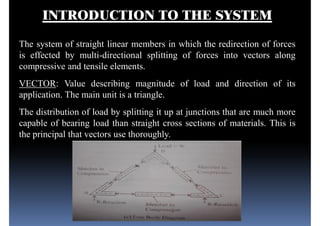
The system of straight linear members in which the redirection of forces
is effected by multi-directional splitting of forces into vectors along
compressive and tensile elements.
VECTOR: Value describing magnitude of load and direction of its
application. The main unit is a triangle.
The distribution of load by splitting it up at junctions that are much more
capable of bearing load than straight cross sections of materials. This is
the principal that vectors use thoroughly.
TRUSS
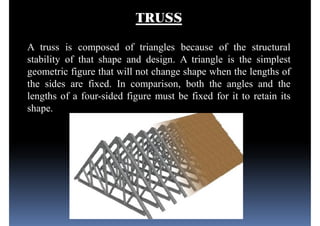
A truss is composed of triangles because of the structural
stability of that shape and design. A triangle is the simplest
geometric figure that will not change shape when the lengths ofgeometric figure that will not change shape when the lengths of
the sides are fixed. In comparison, both the angles and the
lengths of a four-sided figure must be fixed for it to retain its
shape.
EVOLIUTION OF VECTOR STRUCTURAL
SYSTEM
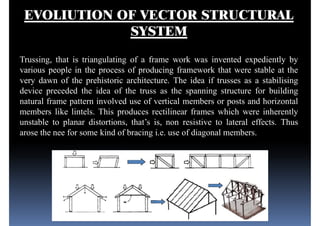
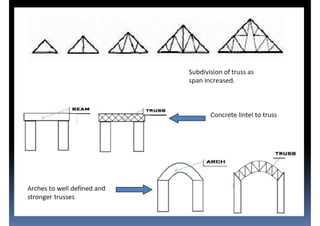
Trussing, that is triangulating of a frame work was invented expediently by
various people in the process of producing framework that were stable at the
very dawn of the prehistoric architecture. The idea if trusses as a stabilising
device preceded the idea of the truss as the spanning structure for building
natural frame pattern involved use of vertical members or posts and horizontal
members like lintels. This produces rectilinear frames which were inherently
unstable to planar distortions, that’s is, non resistive to lateral effects. Thus
arose the nee for some kind of bracing i.e. use of diagonal members.
THE NEXT TRUSSED STRUCTURES,
BRIDGES & TIMBER BRACED HOUSES
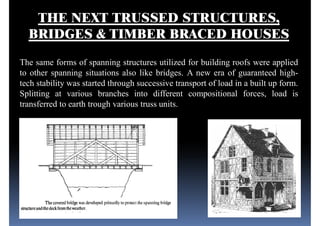
The same forms of spanning structures utilized for building roofs were applied
to other spanning situations also like bridges. A new era of guaranteed high-to other spanning situations also like bridges. A new era of guaranteed high-
tech stability was started through successive transport of load in a built up form.
Splitting at various branches into different compositional forces, load is
transferred to earth trough various truss units.
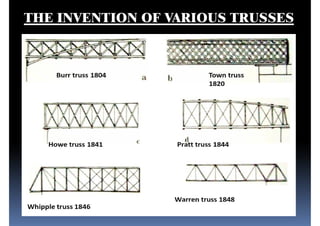
THE INVENTION OF VARIOUS TRUSSES
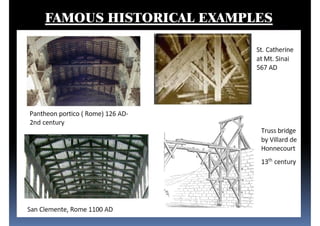
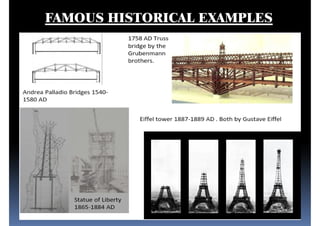
FAMOUS HISTORICAL EXAMPLES
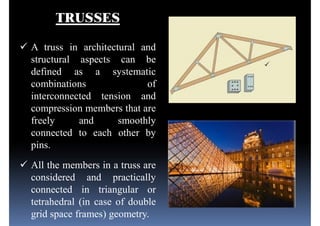
TRUSSES
 A truss in architectural and
structural aspects can be
defined as a systematicdefined as a systematic
combinations of
interconnected tension and
compression members that are
freely and smoothly
connected to each other by
pins.
 All the members in a truss are
considered and practically
connected in triangular or
tetrahedral (in case of double
grid space frames) geometry.
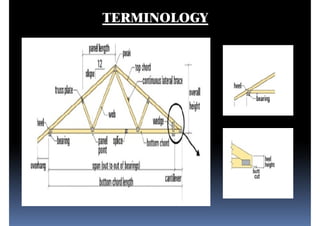
TERMINOLOGY
TERMINOLOGY
TERMINOLOGY
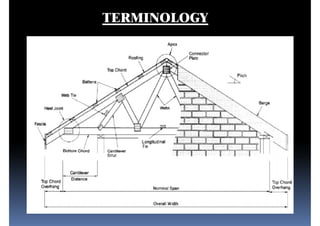
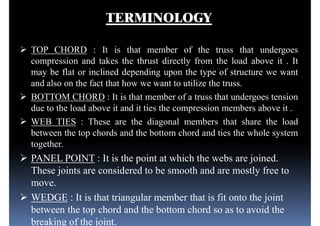
 TOP CHORD : It is that member of the truss that undergoes
compression and takes the thrust directly from the load above it . It
may be flat or inclined depending upon the type of structure we wantmay be flat or inclined depending upon the type of structure we want
and also on the fact that how we want to utilize the truss.
 BOTTOM CHORD : It is that member of a truss that undergoes tension
due to the load above it and it ties the compression members above it .
 WEB TIES : These are the diagonal members that share the load
between the top chords and the bottom chord and ties the whole system
together.
 PANEL POINT : It is the point at which the webs are joined.
These joints are considered to be smooth and are mostly free to
move.
 WEDGE : It is that triangular member that is fit onto the joint
between the top chord and the bottom chord so as to avoid the
breaking of the joint.
TERMINOLOGY
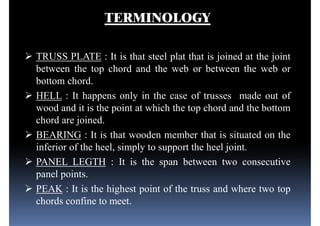
 TRUSS PLATE : It is that steel plat that is joined at the joint
between the top chord and the web or between the web or
bottom chord.bottom chord.
 HELL : It happens only in the case of trusses made out of
wood and it is the point at which the top chord and the bottom
chord are joined.
 BEARING : It is that wooden member that is situated on the
inferior of the heel, simply to support the heel joint.inferior of the heel, simply to support the heel joint.
 PANEL LEGTH : It is the span between two consecutive
panel points.
 PEAK : It is the highest point of the truss and where two top
chords confine to meet.
THEORY OF TRUSSEDS, TENSION AND
COMPRESSION & APPLICATION IN
TRUSSES
 All members in a truss are considered to be straight, stiff and upstretched within All members in a truss are considered to be straight, stiff and upstretched within
the elastic limit of the material of which it is made.
 The total load acting on a truss is taken total load acting on a truss is taken to be
concentrated upon the joints that it possesses.
 All the members are axial load elements which may either exist in tension or
compression.
 Trusses can be further classified according to an equation between the on/ of
members the truss possesses and the on. Of joints it is bound by.members the truss possesses and the on. Of joints it is bound by.
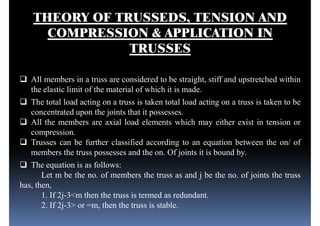
 The equation is as follows:
Let m be the no. of members the truss as and j be the no. of joints the truss
has, then,
1. If 2j-3<m then the truss is termed as redundant.
2. If 2j-3> or =m, then the truss is stable.
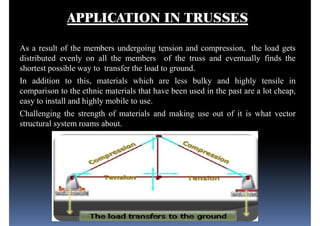
APPLICATION IN TRUSSES
As a result of the members undergoing tension and compression, the load gets
distributed evenly on all the members of the truss and eventually finds the
shortest possible way to transfer the load to ground.
In addition to this, materials which are less bulky and highly tensile in
comparison to the ethnic materials that have been used in the past are a lot cheap,
easy to install and highly mobile to use.
Challenging the strength of materials and making use out of it is what vector
structural system roams about.
RELEVANCE OF
LAMI’S THEOREM
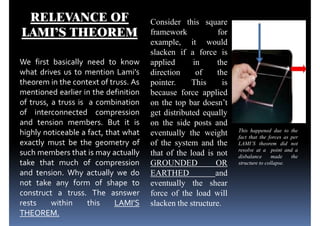
We first basically need to know
what drives us to mention Lami’s
Consider this square
framework for
example, it would
slacken if a force is
applied in the
direction of thewhat drives us to mention Lami’s
theorem in the context of truss. As
mentioned earlier in the definition
of truss, a truss is a combination
of interconnected compression
and tension members. But it is
highly noticeable a fact, that what
exactly must be the geometry of
such members that is may actually
direction of the
pointer. This is
because force applied
on the top bar doesn’t
get distributed equally
on the side posts and
eventually the weight
of the system and the
that of the load is not
This happened due to the
fact that the forces as per
LAMI’S theorem did not
resolve at a point and a
such members that is may actually
take that much of compression
and tension. Why actually we do
not take any form of shape to
construct a truss. The asnswer
rests within this LAMI’S
THEOREM.
that of the load is not
GROUNDED OR
EARTHED and
eventually the shear
force of the load will
slacken the structure.
resolve at a point and a
disbalance made the
structure to collapse.
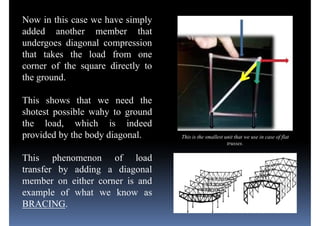
Now in this case we have simply
added another member that
undergoes diagonal compression
that takes the load from one
corner of the square directly to
the ground.the ground.
This shows that we need the
shotest possible wahy to ground
the load, which is indeed
provided by the body diagonal. This is the smallest unit that we use in case of flat
trusses.
This phenomenon of load
transfer by adding a diagonal
member on either corner is and
example of what we know as
BRACING.
NEED OF TRIANGULATION AND POINT
CONNECTION
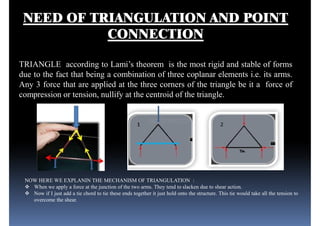
TRIANGLE according to Lami’s theorem is the most rigid and stable of forms
due to the fact that being a combination of three coplanar elements i.e. its arms.due to the fact that being a combination of three coplanar elements i.e. its arms.
Any 3 force that are applied at the three corners of the triangle be it a force of
compression or tension, nullify at the centroid of the triangle.
NOW HERE WE EXPLANIN THE MECHANISM OF TRIANGULATION :
 When we apply a force at the junction of the two arms. They tend to slacken due to shear action.
 Now if I just add a tie chord to tie these ends together it just hold onto the structure. This tie would take all the tension to
overcome the shear.
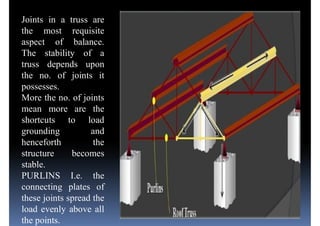
Joints in a truss are
the most requisite
aspect of balance.
The stability of a
truss depends upon
the no. of joints itthe no. of joints it
possesses.
More the no. of joints
mean more are the
shortcuts to load
grounding and
henceforth the
structure becomesstructure becomes
stable.
PURLINS I.e. the
connecting plates of
these joints spread the
load evenly above all
the points.
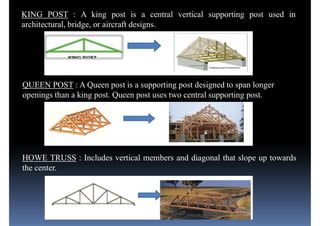
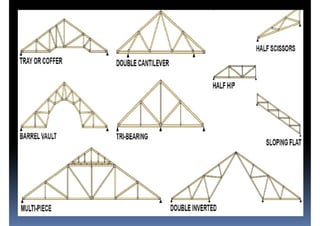
KING POST : A king post is a central vertical supporting post used in
architectural, bridge, or aircraft designs.
QUEEN POST : A Queen post is a supporting post designed to span longer
openings than a king post. Queen post uses two central supporting post.
HOWE TRUSS : Includes vertical members and diagonal that slope up towards
the center.
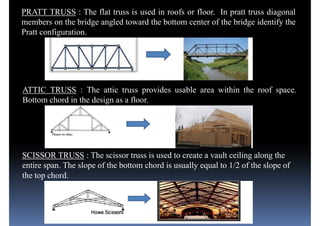
PRATT TRUSS : The flat truss is used in roofs or floor. In pratt truss diagonal
members on the bridge angled toward the bottom center of the bridge identify the
Pratt configuration.
ATTIC TRUSS : The attic truss provides usable area within the roof space.
Bottom chord in the design as a floor.
SCISSOR TRUSS : The scissor truss is used to create a vault ceiling along theSCISSOR TRUSS : The scissor truss is used to create a vault ceiling along the
entire span. The slope of the bottom chord is usually equal to 1/2 of the slope of
the top chord.
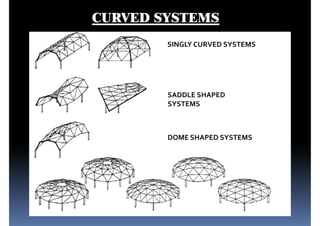
SINGLY CURVED SYSTEMS
CURVED SYSTEMS
SADDLE SHAPED
SYSTEMS
DOME SHAPED SYSTEMS
MERITS
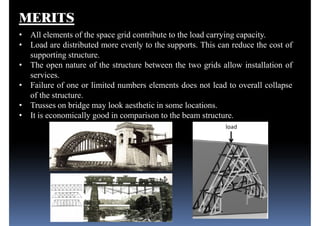
• All elements of the space grid contribute to the load carrying capacity.
• Load are distributed more evenly to the supports. This can reduce the cost of
supporting structure.
• The open nature of the structure between the two grids allow installation of
services.services.
• Failure of one or limited numbers elements does not lead to overall collapse
of the structure.
• Trusses on bridge may look aesthetic in some locations.
• It is economically good in comparison to the beam structure.
DEMERITS
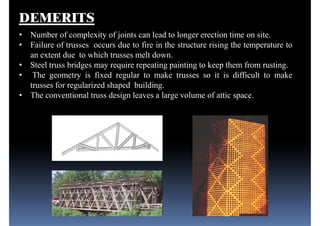
• Number of complexity of joints can lead to longer erection time on site.
• Failure of trusses occurs due to fire in the structure rising the temperature to
an extent due to which trusses melt down.
• Steel truss bridges may require repeating painting to keep them from rusting.
• The geometry is fixed regular to make trusses so it is difficult to make• The geometry is fixed regular to make trusses so it is difficult to make
trusses for regularized shaped building.
• The conventional truss design leaves a large volume of attic space.
THANK-YOU

Vector Structure System

  • 1.
    B.Arch. - 5thSemester (2019-20) Topic : VECTOR STRUCTURAL SYSTEM
  • 2.
    School of Architecture& Town Planning, R.R.I.M.T., Lucknow GROUP MEMBERS : 1. Vikash Chandra Sharma R.R.I.M.T., Lucknow 1. Vikash Chandra Sharma 2. Sukirt Verma 3. Mehul Hotwani
  • 3.
    INTRODUCTION TO THESYSTEM The system of straight linear members in which the redirection of forces is effected by multi-directional splitting of forces into vectors along compressive and tensile elements. VECTOR: Value describing magnitude of load and direction of its application. The main unit is a triangle. The distribution of load by splitting it up at junctions that are much more capable of bearing load than straight cross sections of materials. This is the principal that vectors use thoroughly.
  • 4.
    TRUSS A truss iscomposed of triangles because of the structural stability of that shape and design. A triangle is the simplest geometric figure that will not change shape when the lengths ofgeometric figure that will not change shape when the lengths of the sides are fixed. In comparison, both the angles and the lengths of a four-sided figure must be fixed for it to retain its shape.
  • 5.
    EVOLIUTION OF VECTORSTRUCTURAL SYSTEM Trussing, that is triangulating of a frame work was invented expediently by various people in the process of producing framework that were stable at the very dawn of the prehistoric architecture. The idea if trusses as a stabilising device preceded the idea of the truss as the spanning structure for building natural frame pattern involved use of vertical members or posts and horizontal members like lintels. This produces rectilinear frames which were inherently unstable to planar distortions, that’s is, non resistive to lateral effects. Thus arose the nee for some kind of bracing i.e. use of diagonal members.
  • 7.
    THE NEXT TRUSSEDSTRUCTURES, BRIDGES & TIMBER BRACED HOUSES The same forms of spanning structures utilized for building roofs were applied to other spanning situations also like bridges. A new era of guaranteed high-to other spanning situations also like bridges. A new era of guaranteed high- tech stability was started through successive transport of load in a built up form. Splitting at various branches into different compositional forces, load is transferred to earth trough various truss units.
  • 8.
    THE INVENTION OFVARIOUS TRUSSES
  • 9.
  • 10.
  • 11.
    TRUSSES  A trussin architectural and structural aspects can be defined as a systematicdefined as a systematic combinations of interconnected tension and compression members that are freely and smoothly connected to each other by pins.  All the members in a truss are considered and practically connected in triangular or tetrahedral (in case of double grid space frames) geometry.
  • 12.
  • 13.
  • 14.
    TERMINOLOGY  TOP CHORD: It is that member of the truss that undergoes compression and takes the thrust directly from the load above it . It may be flat or inclined depending upon the type of structure we wantmay be flat or inclined depending upon the type of structure we want and also on the fact that how we want to utilize the truss.  BOTTOM CHORD : It is that member of a truss that undergoes tension due to the load above it and it ties the compression members above it .  WEB TIES : These are the diagonal members that share the load between the top chords and the bottom chord and ties the whole system together.  PANEL POINT : It is the point at which the webs are joined. These joints are considered to be smooth and are mostly free to move.  WEDGE : It is that triangular member that is fit onto the joint between the top chord and the bottom chord so as to avoid the breaking of the joint.
  • 15.
    TERMINOLOGY  TRUSS PLATE: It is that steel plat that is joined at the joint between the top chord and the web or between the web or bottom chord.bottom chord.  HELL : It happens only in the case of trusses made out of wood and it is the point at which the top chord and the bottom chord are joined.  BEARING : It is that wooden member that is situated on the inferior of the heel, simply to support the heel joint.inferior of the heel, simply to support the heel joint.  PANEL LEGTH : It is the span between two consecutive panel points.  PEAK : It is the highest point of the truss and where two top chords confine to meet.
  • 16.
    THEORY OF TRUSSEDS,TENSION AND COMPRESSION & APPLICATION IN TRUSSES  All members in a truss are considered to be straight, stiff and upstretched within All members in a truss are considered to be straight, stiff and upstretched within the elastic limit of the material of which it is made.  The total load acting on a truss is taken total load acting on a truss is taken to be concentrated upon the joints that it possesses.  All the members are axial load elements which may either exist in tension or compression.  Trusses can be further classified according to an equation between the on/ of members the truss possesses and the on. Of joints it is bound by.members the truss possesses and the on. Of joints it is bound by.  The equation is as follows: Let m be the no. of members the truss as and j be the no. of joints the truss has, then, 1. If 2j-3<m then the truss is termed as redundant. 2. If 2j-3> or =m, then the truss is stable.
  • 17.
    APPLICATION IN TRUSSES Asa result of the members undergoing tension and compression, the load gets distributed evenly on all the members of the truss and eventually finds the shortest possible way to transfer the load to ground. In addition to this, materials which are less bulky and highly tensile in comparison to the ethnic materials that have been used in the past are a lot cheap, easy to install and highly mobile to use. Challenging the strength of materials and making use out of it is what vector structural system roams about.
  • 18.
    RELEVANCE OF LAMI’S THEOREM Wefirst basically need to know what drives us to mention Lami’s Consider this square framework for example, it would slacken if a force is applied in the direction of thewhat drives us to mention Lami’s theorem in the context of truss. As mentioned earlier in the definition of truss, a truss is a combination of interconnected compression and tension members. But it is highly noticeable a fact, that what exactly must be the geometry of such members that is may actually direction of the pointer. This is because force applied on the top bar doesn’t get distributed equally on the side posts and eventually the weight of the system and the that of the load is not This happened due to the fact that the forces as per LAMI’S theorem did not resolve at a point and a such members that is may actually take that much of compression and tension. Why actually we do not take any form of shape to construct a truss. The asnswer rests within this LAMI’S THEOREM. that of the load is not GROUNDED OR EARTHED and eventually the shear force of the load will slacken the structure. resolve at a point and a disbalance made the structure to collapse.
  • 19.
    Now in thiscase we have simply added another member that undergoes diagonal compression that takes the load from one corner of the square directly to the ground.the ground. This shows that we need the shotest possible wahy to ground the load, which is indeed provided by the body diagonal. This is the smallest unit that we use in case of flat trusses. This phenomenon of load transfer by adding a diagonal member on either corner is and example of what we know as BRACING.
  • 20.
    NEED OF TRIANGULATIONAND POINT CONNECTION TRIANGLE according to Lami’s theorem is the most rigid and stable of forms due to the fact that being a combination of three coplanar elements i.e. its arms.due to the fact that being a combination of three coplanar elements i.e. its arms. Any 3 force that are applied at the three corners of the triangle be it a force of compression or tension, nullify at the centroid of the triangle. NOW HERE WE EXPLANIN THE MECHANISM OF TRIANGULATION :  When we apply a force at the junction of the two arms. They tend to slacken due to shear action.  Now if I just add a tie chord to tie these ends together it just hold onto the structure. This tie would take all the tension to overcome the shear.
  • 21.
    Joints in atruss are the most requisite aspect of balance. The stability of a truss depends upon the no. of joints itthe no. of joints it possesses. More the no. of joints mean more are the shortcuts to load grounding and henceforth the structure becomesstructure becomes stable. PURLINS I.e. the connecting plates of these joints spread the load evenly above all the points.
  • 22.
    KING POST :A king post is a central vertical supporting post used in architectural, bridge, or aircraft designs. QUEEN POST : A Queen post is a supporting post designed to span longer openings than a king post. Queen post uses two central supporting post. HOWE TRUSS : Includes vertical members and diagonal that slope up towards the center.
  • 23.
    PRATT TRUSS :The flat truss is used in roofs or floor. In pratt truss diagonal members on the bridge angled toward the bottom center of the bridge identify the Pratt configuration. ATTIC TRUSS : The attic truss provides usable area within the roof space. Bottom chord in the design as a floor. SCISSOR TRUSS : The scissor truss is used to create a vault ceiling along theSCISSOR TRUSS : The scissor truss is used to create a vault ceiling along the entire span. The slope of the bottom chord is usually equal to 1/2 of the slope of the top chord.
  • 26.
    SINGLY CURVED SYSTEMS CURVEDSYSTEMS SADDLE SHAPED SYSTEMS DOME SHAPED SYSTEMS
  • 27.
    MERITS • All elementsof the space grid contribute to the load carrying capacity. • Load are distributed more evenly to the supports. This can reduce the cost of supporting structure. • The open nature of the structure between the two grids allow installation of services.services. • Failure of one or limited numbers elements does not lead to overall collapse of the structure. • Trusses on bridge may look aesthetic in some locations. • It is economically good in comparison to the beam structure.
  • 28.
    DEMERITS • Number ofcomplexity of joints can lead to longer erection time on site. • Failure of trusses occurs due to fire in the structure rising the temperature to an extent due to which trusses melt down. • Steel truss bridges may require repeating painting to keep them from rusting. • The geometry is fixed regular to make trusses so it is difficult to make• The geometry is fixed regular to make trusses so it is difficult to make trusses for regularized shaped building. • The conventional truss design leaves a large volume of attic space.
  • 29.