Introduction to Software Engineering 
Introduction 
Muhammad Nasir 
m.nasir@iiu.edu.pk
Outline 
 What is software 
 What is Engineering 
 What is Software Engineering 
 Hardware vs. Software 
 Software characteristics 
 Types of software
What is Software ? 
 Software is a set of instructions 
that directs a computer's 
processor to perform specific 
operation(s)
What is Software ? 
 Types of Software 
 Generic - developed to be sold to a 
range of different customers e.g. 
Application software such as Excel or 
Word. 
 Bespoke (custom) - developed for a 
single customer according to their 
specification
What is Engineering 
 Engineering is the application 
of Scientific, Economic, Social, and 
Practical knowledge in order to design, 
build, and maintain structures, 
machines, devices, systems, materials 
and processes.
What is software engineering? 
 Definition by IEEE : 
(1) The application of systematic, disciplined, 
quantifiable approach to the development, 
operation, and maintenance of software; that is, 
the application of engineering to software. 
(2) The study of approaches as in (1) above 
 Its a discipline that is concerned with all 
aspects of software production.
Hardware vs. Software 
Hardware Software 
 Manufactured 
 Wear out 
 Built using 
components 
 Relatively simple 
 Developed/ 
Engineered 
 Deteriorate 
 Custom built 
 Complex
Manufacturing vs. Development 
 Once a hardware product has 
been manufactured, it is difficult 
or impossible to modify. 
 In contrast, software products are 
routinely modified and upgraded.
Manufacturing vs. Development 
 In hardware, hiring more people 
allows you to accomplish more work, 
but the same does not necessarily 
hold true in software engineering. 
 Unlike hardware, software costs are 
concentrated in design rather than 
production.
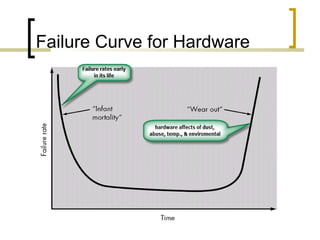
Failure Curve for Hardware
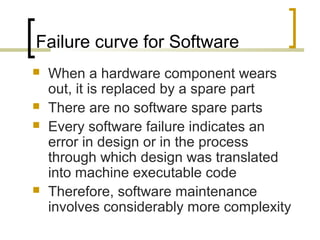
Failure curve for Software
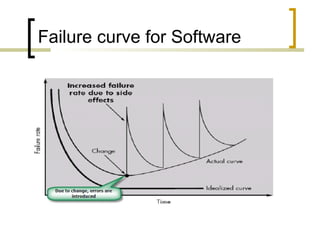
Failure curve for Software 
 When a hardware component wears 
out, it is replaced by a spare part 
 There are no software spare parts 
 Every software failure indicates an 
error in design or in the process 
through which design was translated 
into machine executable code 
 Therefore, software maintenance 
involves considerably more complexity
Component Based vs. Custom Built 
 Hardware products typically employ 
many standardized design 
components. 
 Most software continues to be custom 
built. 
 The software industry does seem to be 
moving (slowly) toward component-based 
construction.
Characteristics of Software 
 Software is developed or 
engineered; it is not manufactured. 
 Software does not “wear out” but it 
does deteriorate. 
 Software continues to be custom 
built, as industry is moving toward 
component based construction.
Types of Software 
 System software 
 Application software 
 Engineering/scientific software 
 Embedded software 
 Web applications 
 Artificial intelligence software
The End 
 Thanks For Listening

Lecture 1 introduction to software engineering 1

  • 1.
    Introduction to SoftwareEngineering Introduction Muhammad Nasir m.nasir@iiu.edu.pk
  • 2.
    Outline  Whatis software  What is Engineering  What is Software Engineering  Hardware vs. Software  Software characteristics  Types of software
  • 3.
    What is Software?  Software is a set of instructions that directs a computer's processor to perform specific operation(s)
  • 4.
    What is Software?  Types of Software  Generic - developed to be sold to a range of different customers e.g. Application software such as Excel or Word.  Bespoke (custom) - developed for a single customer according to their specification
  • 5.
    What is Engineering  Engineering is the application of Scientific, Economic, Social, and Practical knowledge in order to design, build, and maintain structures, machines, devices, systems, materials and processes.
  • 6.
    What is softwareengineering?  Definition by IEEE : (1) The application of systematic, disciplined, quantifiable approach to the development, operation, and maintenance of software; that is, the application of engineering to software. (2) The study of approaches as in (1) above  Its a discipline that is concerned with all aspects of software production.
  • 7.
    Hardware vs. Software Hardware Software  Manufactured  Wear out  Built using components  Relatively simple  Developed/ Engineered  Deteriorate  Custom built  Complex
  • 8.
    Manufacturing vs. Development  Once a hardware product has been manufactured, it is difficult or impossible to modify.  In contrast, software products are routinely modified and upgraded.
  • 9.
    Manufacturing vs. Development  In hardware, hiring more people allows you to accomplish more work, but the same does not necessarily hold true in software engineering.  Unlike hardware, software costs are concentrated in design rather than production.
  • 10.
  • 11.
  • 12.
    Failure curve forSoftware  When a hardware component wears out, it is replaced by a spare part  There are no software spare parts  Every software failure indicates an error in design or in the process through which design was translated into machine executable code  Therefore, software maintenance involves considerably more complexity
  • 13.
    Component Based vs.Custom Built  Hardware products typically employ many standardized design components.  Most software continues to be custom built.  The software industry does seem to be moving (slowly) toward component-based construction.
  • 14.
    Characteristics of Software  Software is developed or engineered; it is not manufactured.  Software does not “wear out” but it does deteriorate.  Software continues to be custom built, as industry is moving toward component based construction.
  • 15.
    Types of Software  System software  Application software  Engineering/scientific software  Embedded software  Web applications  Artificial intelligence software
  • 16.
    The End Thanks For Listening