Writing a Memorandum
Presented by:
Dr. Akhlas Ahmed
Preston University
Memorandum
A memorandum is
considered “inside”
correspondence.
It is written to someone
in your company.
Advantages of Memos
Memos are:
Quick
Inexpensive
Convenient
A Written Record
Memorandum
A memo is less formal than a letter.
It usually conveys one idea and is likely to be
short.
Effective memos are clearly written with the
objective stated in the first sentence.
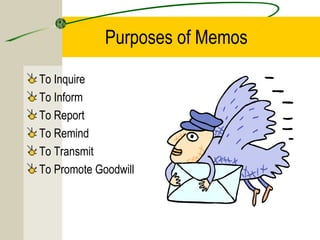
Purposes of Memos
To Inquire
To Inform
To Report
To Remind
To Transmit
To Promote Goodwill
Questions
You should be able to answer several
questions regarding your memo:
1. Exactly why are you writing the memo?
2. Is the person you are writing to in a position to
make a decision?
3. Do you state your objectives immediately?
Check Your Memo
Is is easy to find the main
point?
Would it help to
underline, indent, or
bullet the main points?
Does your memo have
plenty of white space for
easy readability?

Have you removed
unnecessary words?
Is your memo filled with
technical jargon?
Is it positive?
Does it “step on
anyone’s toes”?
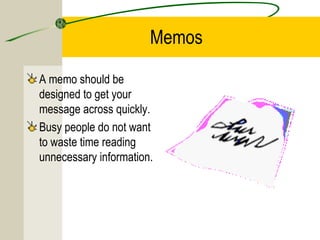
Memos
A memo should be
designed to get your
message across quickly.
Busy people do not want
to waste time reading
unnecessary information.
Organization of the Memo
Statement of Purpose
Message
Statement of Future
Action
Special Formatting and
Mechanical Techniques
Use enumerations to list
important items
Use solid capitals and
centering to emphasize an
important detail
Use columns with headings
to make reading and
understanding easier
Special Formatting and
Mechanical Techniques
Use underlining and side
headings to show natural
breaks
Use bullets to emphasize
several points
Use boldface and italics when
appropriate
Use color coding to attract
attention
Important “Nevers” in
Memo Writing
Never write memos or any other
communications which are
unnecessary.
Never write complicated, hardto-understand memos.
Keep them simple and to the
point.
Important “Nevers” in
Memos Writing
Never write rude, blunt,
or thoughtless memos.
Never send memos that
have typos, misspelled
words, or grammatical
errors.
– They are a poor reflection
on you!
Important “Nevers” in
Memos Writing
Never waste space with
unnecessary introductory
material.
– Plunge in!

Never leave out
necessary details
causing people to have
to follow up with
questions.
Important “Nevers” in
Memos Writing
Never use a closing line
or a signature in a
memo.
BASIC PARTS OF A MEMO
TO:
FROM:
DATE:
SUBJECT:
Body of the memorandum—single spaced
Reference initials
Memo
Make sure the memo is
Clear
Concise
Correct
Concrete
Complete
Memos
Make sure the
memorandum is
Well placed
Has correct punctuation
and spelling
Memos
Be sure the memo
States the purpose clearly
Presents message effectively
Uses a courteous tone
Gives reader complete, accurate details
Concludes appropriately
Thanks

Lecture 04 writing a memorandum

  • 1.
    Writing a Memorandum Presentedby: Dr. Akhlas Ahmed Preston University
  • 2.
    Memorandum A memorandum is considered“inside” correspondence. It is written to someone in your company.
  • 3.
    Advantages of Memos Memosare: Quick Inexpensive Convenient A Written Record
  • 4.
    Memorandum A memo isless formal than a letter. It usually conveys one idea and is likely to be short. Effective memos are clearly written with the objective stated in the first sentence.
  • 5.
    Purposes of Memos ToInquire To Inform To Report To Remind To Transmit To Promote Goodwill
  • 6.
    Questions You should beable to answer several questions regarding your memo: 1. Exactly why are you writing the memo? 2. Is the person you are writing to in a position to make a decision? 3. Do you state your objectives immediately?
  • 7.
    Check Your Memo Isis easy to find the main point? Would it help to underline, indent, or bullet the main points? Does your memo have plenty of white space for easy readability? Have you removed unnecessary words? Is your memo filled with technical jargon? Is it positive? Does it “step on anyone’s toes”?
  • 8.
    Memos A memo shouldbe designed to get your message across quickly. Busy people do not want to waste time reading unnecessary information.
  • 9.
    Organization of theMemo Statement of Purpose Message Statement of Future Action
  • 10.
    Special Formatting and MechanicalTechniques Use enumerations to list important items Use solid capitals and centering to emphasize an important detail Use columns with headings to make reading and understanding easier
  • 11.
    Special Formatting and MechanicalTechniques Use underlining and side headings to show natural breaks Use bullets to emphasize several points Use boldface and italics when appropriate Use color coding to attract attention
  • 12.
    Important “Nevers” in MemoWriting Never write memos or any other communications which are unnecessary. Never write complicated, hardto-understand memos. Keep them simple and to the point.
  • 13.
    Important “Nevers” in MemosWriting Never write rude, blunt, or thoughtless memos. Never send memos that have typos, misspelled words, or grammatical errors. – They are a poor reflection on you!
  • 14.
    Important “Nevers” in MemosWriting Never waste space with unnecessary introductory material. – Plunge in! Never leave out necessary details causing people to have to follow up with questions.
  • 15.
    Important “Nevers” in MemosWriting Never use a closing line or a signature in a memo.
  • 16.
    BASIC PARTS OFA MEMO TO: FROM: DATE: SUBJECT: Body of the memorandum—single spaced Reference initials
  • 17.
    Memo Make sure thememo is Clear Concise Correct Concrete Complete
  • 18.
    Memos Make sure the memorandumis Well placed Has correct punctuation and spelling
  • 19.
    Memos Be sure thememo States the purpose clearly Presents message effectively Uses a courteous tone Gives reader complete, accurate details Concludes appropriately
  • 20.