INTRODUCING ARCHITECTURAL
THEORY:
DEBATING A DISCIPLINE
EDITED BY KORYDON SMITH
LEC 4
NOV 6,2015
INTRODUCTION
• This is the most accessible architectural theory book that
exists. Korydon Smith presents each common architectural
subject—such as tectonics, use, and site—as though it were a
conversation across history between theorists by providing you with
the original text, a reflective text, and a philosophical text.
• He also introduces each chapter by high lighting key ideas
and asking you a set of reflective questions so that one can have his
own theory, which is essential to both the success in the studio and
adaptability in the profession. These primary source texts, which
are central to your understanding of the discipline, were written
by such architects as Le Corbusier, Robert Venturi, and Adrian Forty
More than any other architectural theory book about the great
thinkers, “Introducing Architectural Theory” teaches you to think
as well.
• Korydon Smith is an architecture professor in the U.S. who teaches
courses in architectural theory, methods, and design at all year
levels.
• The book begins with a discussion of the role of debate in
architecture: “Debating a Discipline: Architecture, Argument, and
the Concept of the Dialectic.”
• This section illustrates how architecture is an ongoing debate
about a number of topics: aesthetics, structure, functionality,
tectonics, context, politics, economics, culture, etc.
• Architectural and non-architectural examples illuminate
how debate is related to the concept of the “dialectic.”
• Unlike most debates, which contain two opposing sides, dialectical
debates involve three parts: thesis, antithesis, and synthesis
(described in the book as original, reflective, and philosophical).
• The thesis is the originating theory or idea, the antithesis is an
opposition to the thesis, and the synthesis is an attempt to
reconcile or transform the previous two.
STRUCTURE OF THE BOOK
FUTURE OF THE ARCHITECTURAL
THEORY
• It is an exciting time to study architecture. While the
primary subjects of architecture two millennia ago—
tectonics, use, and site—remain central to the
discipline, new materials and technologies are
emerging every day and environmental, social, and
economic challenges are growing. This makes it a vital
time to study architectural theory.
• Undoubtedly, as architects of the future, peers
will question your roles relative to these emerging
challenges and opportunities. The debate will likely
center on the ways that structure, space, form,
material, program, and context are transformed to
address these issues. Debates in architectural theory
will be transformed.
• ORIGINAL TEXT
“Original” texts are made up mostly of architectural treatises written
by significant historical architects, such as, Alberti, Palladio, and
Loos, who established foundational theoretical propositions made
evident in their built works.
• REFLECTIVE TEXT
“Reflective” texts are represented by author–architects, such as,
Banham, Eisenman, Venturi, and Pallasmaa, who placed the ideas
and buildings found in the previous category under particular
scrutiny, paving the way for more self-conscious, more critical
transformations of architectural theory.
• PHILOSOPHICAL TEXT
“Philosophical” texts are more challenging to classify and, in many
cases, are the origins of a new “thesis.” They represent a synthetic,
critical eye toward both the history and the future of architecture..
• The goal is to open up questions that have relevance to one, as an
architectural student, and that will remain significant as we
continue debating a discipline
DIALECTICAL READINGS IN
ARCHITECTURE:TECTONICS
SIMPLICITY AND COMPLEXITY
INTRODUCTORY DISCUSSIONS
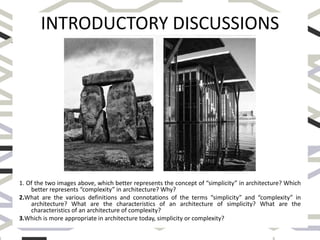
1. Of the two images above, which better represents the concept of “simplicity” in architecture? Which
better represents “complexity” in architecture? Why?
2.What are the various definitions and connotations of the terms “simplicity” and “complexity” in
architecture? What are the characteristics of an architecture of simplicity? What are the
characteristics of an architecture of complexity?
3.Which is more appropriate in architecture today, simplicity or complexity?
INTRODUCTION
• In 1958, Peter Blake—American architect, critic, educator,
editor of Architectural Forum ,and once-director of New York’s
Museum of Modern Art—wrote that “the only trouble with a
simple little word like ‘simple’ is that so many people think it
is synonymous with ‘easy.’ In real life, of course, ‘simple’
often means ‘difficult.’”
• Blake wrote about Le Corbusier, Phillip Johnson, Frank Lloyd
Wright, Marcel Breuer, Ulrich Franzen, and other proponents
of Modernist architecture and minimalism. Most notably,
however, it is in “The Difficult Art of Simplicity” that Blake
made the aforementioned statement and extensively
discussed the work of Ludwig Mies van der Rohe. Regarding
Mies’s use of the structural steel frame, Blake wrote, “Mies’s
system of simplicity...is one of the most important resources
architecture can claim.”
IS ARCHITECTURE SIMPLE OR
COMPLEX?
• Architecture is influenced by a wide array
of issues: tectonics, use, and site; aesthetic
and economic trends; architect–client–public
relationships; conventions and innovations;
and a variety of other factors. With this
diversity of issues, and the conflicts among
them, one might say that architecture is
inherently “complex.”
“A building is simple not because its shapes
conformto elementary geometry, not because
all of it is immediately visible, or because the
logic is evident in its connections, but
because all its parts voice their
necessity...reciprocally.”
• As stated by Adrian Forty, “‘Simple’ must be
one of the most over worked words in
the architectural vocabulary.”
• While hundreds of architects, critics, and
architectural educators have argued
vehemently for “an architecture of simplicity”
or “an architecture of complexity,” the debate
is no more resolved today than it was a
century ago
ORNAMENT AND AUSTERITY
INTRODUCTION
• With The Emergence Of Technology, Economic
And Scientific Mindset Of The Late 1800s,
Ornament Itself Was Called Into Question
• Ornament And Crime By Adolf Loos
• Ornament Equals Crime
• In What Ways Is The Debate Of “Ornament Vs
Austerity” Relevant To Architecture Today?
INTRODUCTORY DISCUSSION
•Of the two images above, which better represents the concept of “ornament”
• in architecture today? Why?
•What are the various definitions and connotations of the term “ornament” in
architecture? For example, how is “ornament” similar or different from terms like
decoration, application, integration, function etc
•How is or is not “ornament” an appropriate concept or term in architecture today?
ORIGINAL TEXT:ADOLF LOSS,
“ORNAMENT AND CRIME”
• The evolution of culture is synonymous with
the removal of ornamentation from objects of
everyday use
• Crime that leads to waste of human labour,
money and materials
• Ornament means wasted labor and therefore
wasted health
REFLECTIVE TEXT: REYNER BANHAM,
“ORNAMENT AND CRIME: THE
DECISIVE CONTRIBUTION OF ADOLF
LOSS”
• Modern ornament has neither forebears nor
descendents, no past and no future
• Ornament equals crime
PHILOSOPHICAL TEXT: JOSEPH
RYKWERT, “ORNAMENT IS NO CRIME”
• Modesty, French academy dictionary defines,
“is a great ornament of merit”
• That which is beautiful does not need
decoration, since it decorates
• Not as a problem of ornament or not
ornament, but as a problem of meaning
HONESTY AND DECEPTION
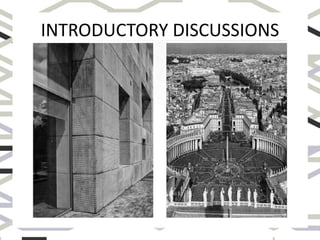
INTRODUCTORY DISCUSSIONS
1.Of the two images above, which better represents the
concept of “honesty” in architecture? Which better
represents “deception” in architecture? Why?
2.What are the various definitions and connotations of
the terms “honesty” and “deception” in architecture?
What are the characteristics of an architecture of
honesty? What are the characteristics of
an architecture of deception?
3.Which is more appropriate in architecture today,
honesty or deception?
INTRODUCTION
• Honesty is the best policy
• Ruskin articulated three types of deceits:
Structural deceit
The suggestion of a mode of structure or support,
other than the true one
Surface deceits
The painting of surfaces to represent some other
material than that of which they actually consist..
Operative deceits
The use of cast or machine made ornament of any kind
MATERIAL AND IMMATERIAL
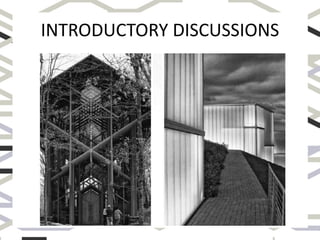
INTRODUCTORY DISCUSSIONS
1.Of the two images above, which better represents
“material” expression in architecture? Which better
represents the concept of “immaterial” architecture?
Why?
2.What are the various definitions and connotations of
the terms “material,”“materiality,” “immaterial,” and
“immateriality” in architecture? What are the
characteristics of an architecture of materiality? What
are the characteristics of an architecture
of immateriality?
3.Which is more appropriate in architecture today,
materiality or immateriality?
JONATHON HILL, “EXCERPTS FROM
IMMATERIAL ARCHITECTURE”
• Architecture is expected to b solid, stable
reassuring-physically, socially and
psychologically
• The architectural and the material are
considered inseparable
• The current over-emphasis on the intellectual
and conceptual dimensions of architecture
contributes to the disappearance of its
physical, sensual and embodied essence
• Contemporary architecture needed to
intensify material qualities of weight, texture
and time
• This heightened interest in “materiality”- the
experienced “reality” of materials- led to a
search for complementary properties of
“immateriality”

Lec 4 introducing architectural theories

  • 1.
    INTRODUCING ARCHITECTURAL THEORY: DEBATING ADISCIPLINE EDITED BY KORYDON SMITH LEC 4 NOV 6,2015
  • 2.
    INTRODUCTION • This isthe most accessible architectural theory book that exists. Korydon Smith presents each common architectural subject—such as tectonics, use, and site—as though it were a conversation across history between theorists by providing you with the original text, a reflective text, and a philosophical text. • He also introduces each chapter by high lighting key ideas and asking you a set of reflective questions so that one can have his own theory, which is essential to both the success in the studio and adaptability in the profession. These primary source texts, which are central to your understanding of the discipline, were written by such architects as Le Corbusier, Robert Venturi, and Adrian Forty More than any other architectural theory book about the great thinkers, “Introducing Architectural Theory” teaches you to think as well. • Korydon Smith is an architecture professor in the U.S. who teaches courses in architectural theory, methods, and design at all year levels.
  • 3.
    • The bookbegins with a discussion of the role of debate in architecture: “Debating a Discipline: Architecture, Argument, and the Concept of the Dialectic.” • This section illustrates how architecture is an ongoing debate about a number of topics: aesthetics, structure, functionality, tectonics, context, politics, economics, culture, etc. • Architectural and non-architectural examples illuminate how debate is related to the concept of the “dialectic.” • Unlike most debates, which contain two opposing sides, dialectical debates involve three parts: thesis, antithesis, and synthesis (described in the book as original, reflective, and philosophical). • The thesis is the originating theory or idea, the antithesis is an opposition to the thesis, and the synthesis is an attempt to reconcile or transform the previous two. STRUCTURE OF THE BOOK
  • 4.
    FUTURE OF THEARCHITECTURAL THEORY • It is an exciting time to study architecture. While the primary subjects of architecture two millennia ago— tectonics, use, and site—remain central to the discipline, new materials and technologies are emerging every day and environmental, social, and economic challenges are growing. This makes it a vital time to study architectural theory. • Undoubtedly, as architects of the future, peers will question your roles relative to these emerging challenges and opportunities. The debate will likely center on the ways that structure, space, form, material, program, and context are transformed to address these issues. Debates in architectural theory will be transformed.
  • 5.
    • ORIGINAL TEXT “Original”texts are made up mostly of architectural treatises written by significant historical architects, such as, Alberti, Palladio, and Loos, who established foundational theoretical propositions made evident in their built works. • REFLECTIVE TEXT “Reflective” texts are represented by author–architects, such as, Banham, Eisenman, Venturi, and Pallasmaa, who placed the ideas and buildings found in the previous category under particular scrutiny, paving the way for more self-conscious, more critical transformations of architectural theory. • PHILOSOPHICAL TEXT “Philosophical” texts are more challenging to classify and, in many cases, are the origins of a new “thesis.” They represent a synthetic, critical eye toward both the history and the future of architecture.. • The goal is to open up questions that have relevance to one, as an architectural student, and that will remain significant as we continue debating a discipline
  • 6.
  • 7.
  • 8.
    INTRODUCTORY DISCUSSIONS 1. Ofthe two images above, which better represents the concept of “simplicity” in architecture? Which better represents “complexity” in architecture? Why? 2.What are the various definitions and connotations of the terms “simplicity” and “complexity” in architecture? What are the characteristics of an architecture of simplicity? What are the characteristics of an architecture of complexity? 3.Which is more appropriate in architecture today, simplicity or complexity?
  • 9.
    INTRODUCTION • In 1958,Peter Blake—American architect, critic, educator, editor of Architectural Forum ,and once-director of New York’s Museum of Modern Art—wrote that “the only trouble with a simple little word like ‘simple’ is that so many people think it is synonymous with ‘easy.’ In real life, of course, ‘simple’ often means ‘difficult.’” • Blake wrote about Le Corbusier, Phillip Johnson, Frank Lloyd Wright, Marcel Breuer, Ulrich Franzen, and other proponents of Modernist architecture and minimalism. Most notably, however, it is in “The Difficult Art of Simplicity” that Blake made the aforementioned statement and extensively discussed the work of Ludwig Mies van der Rohe. Regarding Mies’s use of the structural steel frame, Blake wrote, “Mies’s system of simplicity...is one of the most important resources architecture can claim.”
  • 10.
    IS ARCHITECTURE SIMPLEOR COMPLEX? • Architecture is influenced by a wide array of issues: tectonics, use, and site; aesthetic and economic trends; architect–client–public relationships; conventions and innovations; and a variety of other factors. With this diversity of issues, and the conflicts among them, one might say that architecture is inherently “complex.”
  • 11.
    “A building issimple not because its shapes conformto elementary geometry, not because all of it is immediately visible, or because the logic is evident in its connections, but because all its parts voice their necessity...reciprocally.”
  • 12.
    • As statedby Adrian Forty, “‘Simple’ must be one of the most over worked words in the architectural vocabulary.” • While hundreds of architects, critics, and architectural educators have argued vehemently for “an architecture of simplicity” or “an architecture of complexity,” the debate is no more resolved today than it was a century ago
  • 13.
  • 14.
    INTRODUCTION • With TheEmergence Of Technology, Economic And Scientific Mindset Of The Late 1800s, Ornament Itself Was Called Into Question • Ornament And Crime By Adolf Loos • Ornament Equals Crime • In What Ways Is The Debate Of “Ornament Vs Austerity” Relevant To Architecture Today?
  • 15.
    INTRODUCTORY DISCUSSION •Of thetwo images above, which better represents the concept of “ornament” • in architecture today? Why? •What are the various definitions and connotations of the term “ornament” in architecture? For example, how is “ornament” similar or different from terms like decoration, application, integration, function etc •How is or is not “ornament” an appropriate concept or term in architecture today?
  • 16.
    ORIGINAL TEXT:ADOLF LOSS, “ORNAMENTAND CRIME” • The evolution of culture is synonymous with the removal of ornamentation from objects of everyday use • Crime that leads to waste of human labour, money and materials • Ornament means wasted labor and therefore wasted health
  • 17.
    REFLECTIVE TEXT: REYNERBANHAM, “ORNAMENT AND CRIME: THE DECISIVE CONTRIBUTION OF ADOLF LOSS” • Modern ornament has neither forebears nor descendents, no past and no future • Ornament equals crime
  • 18.
    PHILOSOPHICAL TEXT: JOSEPH RYKWERT,“ORNAMENT IS NO CRIME” • Modesty, French academy dictionary defines, “is a great ornament of merit” • That which is beautiful does not need decoration, since it decorates • Not as a problem of ornament or not ornament, but as a problem of meaning
  • 19.
  • 20.
  • 21.
    1.Of the twoimages above, which better represents the concept of “honesty” in architecture? Which better represents “deception” in architecture? Why? 2.What are the various definitions and connotations of the terms “honesty” and “deception” in architecture? What are the characteristics of an architecture of honesty? What are the characteristics of an architecture of deception? 3.Which is more appropriate in architecture today, honesty or deception?
  • 22.
    INTRODUCTION • Honesty isthe best policy • Ruskin articulated three types of deceits: Structural deceit The suggestion of a mode of structure or support, other than the true one Surface deceits The painting of surfaces to represent some other material than that of which they actually consist.. Operative deceits The use of cast or machine made ornament of any kind
  • 23.
  • 24.
  • 25.
    1.Of the twoimages above, which better represents “material” expression in architecture? Which better represents the concept of “immaterial” architecture? Why? 2.What are the various definitions and connotations of the terms “material,”“materiality,” “immaterial,” and “immateriality” in architecture? What are the characteristics of an architecture of materiality? What are the characteristics of an architecture of immateriality? 3.Which is more appropriate in architecture today, materiality or immateriality?
  • 26.
    JONATHON HILL, “EXCERPTSFROM IMMATERIAL ARCHITECTURE” • Architecture is expected to b solid, stable reassuring-physically, socially and psychologically • The architectural and the material are considered inseparable • The current over-emphasis on the intellectual and conceptual dimensions of architecture contributes to the disappearance of its physical, sensual and embodied essence
  • 27.
    • Contemporary architectureneeded to intensify material qualities of weight, texture and time • This heightened interest in “materiality”- the experienced “reality” of materials- led to a search for complementary properties of “immateriality”