Knowledge Representation
and
Reasoning
The AI Cycle
The dilemma
• How to approach the problem?
• should we try to emulate the human brain completely and exactly as it is?
• Or should we come up with something new?
• Do we know how the KR and reasoning components are implemented in
humans ? No
• we need a synthetic (artificial) way to model the knowledge
representation and reasoning capability of humans in computers.
Knowledge and its Types
• Knowledge is the Understanding of a subject area
• knowledge domain : a well-focused subject area
• Eg. medical domain, engineering domain, business domain, etc
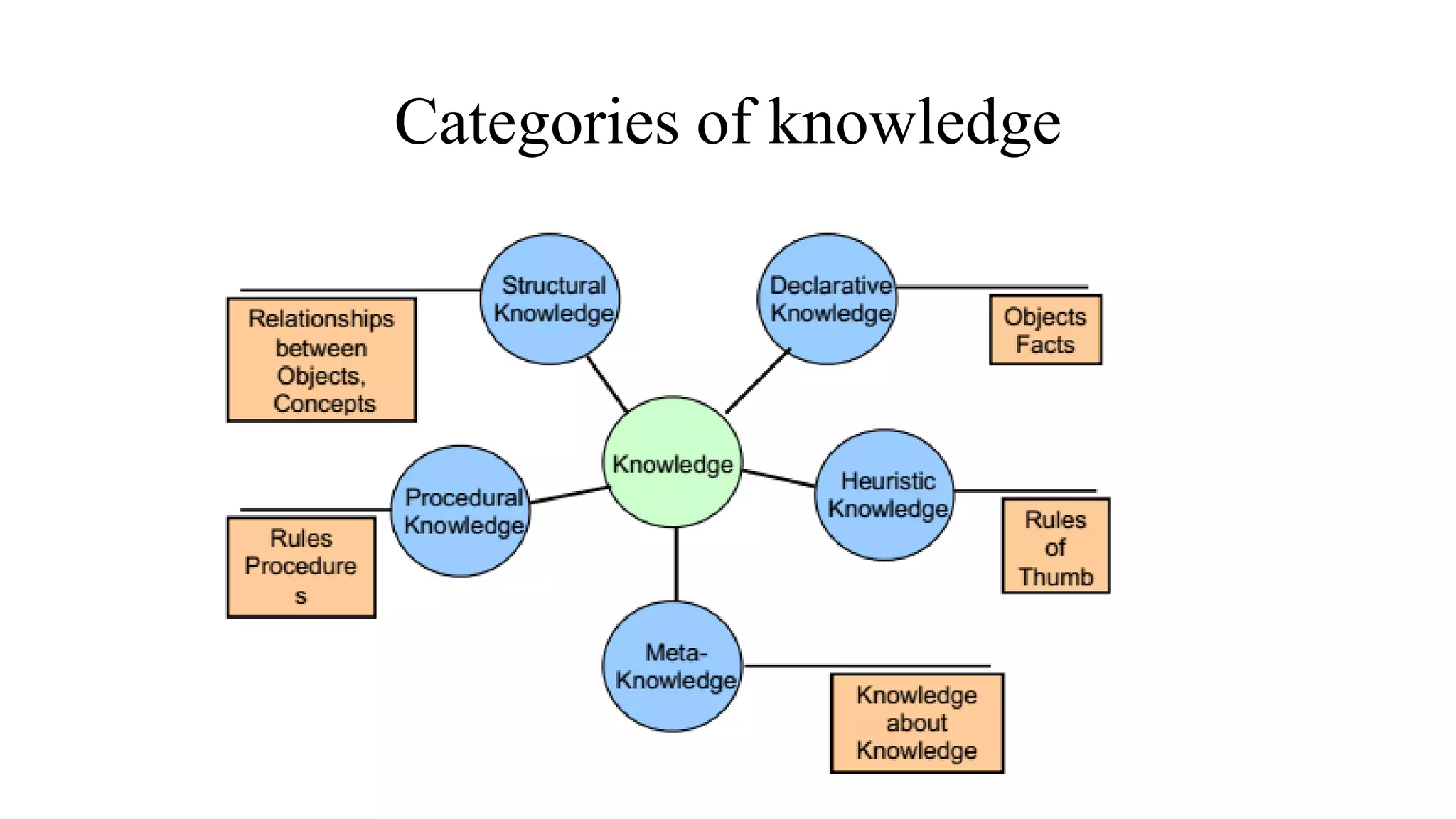
Categories of knowledge
Intuitive Ways of Knowledge Representation
• Pictures
• they provide a high level view of
a concept to be obtained
• Graphs and networks
• allow relationships between
objects/entities to be incorporated
• Numbers
• integral part of knowledge
representation used by humans.
Formal KR techniques
• Choosing the proper knowledge representation helps in reasoning. =>
‘Knowledge is Power’.
• Formal KR techniques includes
• Facts
• Rules
• Semantic networks
• Frames
• Logic
Facts
• basic block of knowledge (the atomic units of knowledge).
• represent declarative knowledge (they declare knowledge about objects).
• A proposition is the statement of a fact.
• Each proposition has an associated truth value. It may be either true or false.
• In AI, to represent a fact, we use a proposition and its associated truth value.
eg.
–Proposition A: It is raining
–Proposition B: I have an umbrella
–Proposition C: I will go to school
Types of facts
• Single-valued or multiple –valued
• Uncertain facts
• Fuzzy facts
• Object-Attribute-Value triplets
Rules
• Rule: A knowledge structure that relates some known information to
other information that can be concluded or inferred to be true.
• Components of a rule
• A rule consists of two components
• Antecedent or premise or the IF part
• Consequent or conclusion or the THEN part
• Example
Compound Rules
• Multiple premises or antecedents may be joined using AND
(conjunctions) and OR (disjunctions), e.g.
Types of Rules
• Relationship
• Recommendation
• Directive
• Variable Rules
• Uncertain Rules
• Meta Rules
• Rule Sets
Semantic networks
• Semantic networks are graphs, with
• nodes representing objects and
• arcs representing relationships between
objects.
• The two most common types of
relationships are
• IS-A (Inheritance relation)
• HAS (Ownership relation)
Vehicle Semantic Network
Problems with Semantic Networks
• Semantic networks are computationally expensive at run-time
• They try to model human associative memory (store information
using associations),
• Semantic networks are logically inadequate as they do not have
any equivalent quantifiers, e.g., for all, for some, none.
Frames
• Frames are data structures for representing stereotypical
knowledge of some concept or object
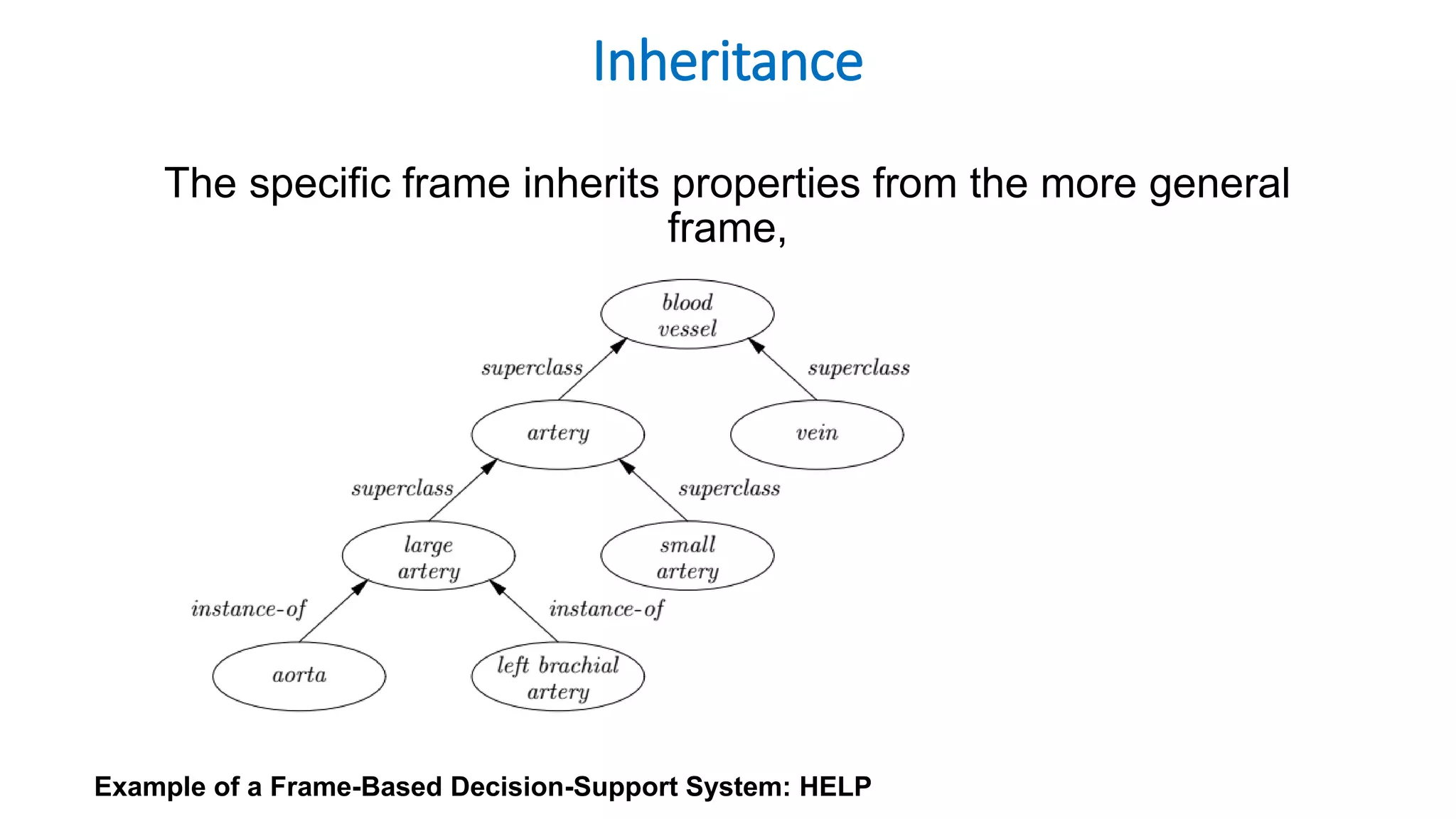
Inheritance
The specific frame inherits properties from the more general
frame,
Example of a Frame-Based Decision-Support System: HELP
FACETS
• A slot in a frame can hold more that just a value, it consists of
metadata and procedures.
• The various aspects of a slot are called facets.
• They are a feature of frames that allows us to put constraints on
frames.
• e.g. IF-NEEDED Facets are called when the data of a particular slot is
needed.
• Similarly, IFCHANGED Facets are when the value of a slot changes.
Logic
• propositional logic and predicate calculus are forms of formal
logic for dealing with propositions.
• Two basic logic representation techniques:
• Propositional Logic
• Predicate Calculus
Propositional logic
• A proposition is the statement of a fact.
• We usually assign a symbolic variable to represent a proposition, e.g.
• A proposition is a sentence whose truth values may be determined.
• So, each proposition has a truth value, e.g.
–The proposition ‘A rectangle has four sides’ is true
–The proposition ‘The world is a cube’ is false.
Compound Statements
Logical Connectives
Limitations of Propositional Logic
• Propositions can only represent knowledge as complete sentences, e.g.
a = the ball’s color is blue.
• Cannot analyze the internal structure of the sentence.
• No quantifiers are available, e.g. for-all, there-exists
• Propositional logic provides no framework for proving statements
such as:
All humans are mortal
All women are humans
Therefore, all women are mortals
This is a limitation in its representational power.
Predicate calculus
• Predicate Calculus is an extension of propositional logic that allows
the structure of facts and sentences to be defined.
• With predicate logic, we can use expressions like
Color( ball, blue)
• predicate calculus provides a mechanism for proving
statements and can be used as a logic system for proving logical
theorems
Quantifiers
• The Universal quantifier
Eg.
• Existential quantifier
Eg.
First Order Predicate Logic

Lec 3 knowledge acquisition representation and inference

  • 1.
  • 2.
  • 3.
    The dilemma • Howto approach the problem? • should we try to emulate the human brain completely and exactly as it is? • Or should we come up with something new? • Do we know how the KR and reasoning components are implemented in humans ? No • we need a synthetic (artificial) way to model the knowledge representation and reasoning capability of humans in computers.
  • 4.
    Knowledge and itsTypes • Knowledge is the Understanding of a subject area • knowledge domain : a well-focused subject area • Eg. medical domain, engineering domain, business domain, etc
  • 5.
  • 6.
    Intuitive Ways ofKnowledge Representation • Pictures • they provide a high level view of a concept to be obtained • Graphs and networks • allow relationships between objects/entities to be incorporated • Numbers • integral part of knowledge representation used by humans.
  • 7.
    Formal KR techniques •Choosing the proper knowledge representation helps in reasoning. => ‘Knowledge is Power’. • Formal KR techniques includes • Facts • Rules • Semantic networks • Frames • Logic
  • 8.
    Facts • basic blockof knowledge (the atomic units of knowledge). • represent declarative knowledge (they declare knowledge about objects). • A proposition is the statement of a fact. • Each proposition has an associated truth value. It may be either true or false. • In AI, to represent a fact, we use a proposition and its associated truth value. eg. –Proposition A: It is raining –Proposition B: I have an umbrella –Proposition C: I will go to school
  • 9.
    Types of facts •Single-valued or multiple –valued • Uncertain facts • Fuzzy facts • Object-Attribute-Value triplets
  • 10.
    Rules • Rule: Aknowledge structure that relates some known information to other information that can be concluded or inferred to be true. • Components of a rule • A rule consists of two components • Antecedent or premise or the IF part • Consequent or conclusion or the THEN part • Example
  • 11.
    Compound Rules • Multiplepremises or antecedents may be joined using AND (conjunctions) and OR (disjunctions), e.g.
  • 12.
    Types of Rules •Relationship • Recommendation • Directive • Variable Rules • Uncertain Rules • Meta Rules • Rule Sets
  • 13.
    Semantic networks • Semanticnetworks are graphs, with • nodes representing objects and • arcs representing relationships between objects. • The two most common types of relationships are • IS-A (Inheritance relation) • HAS (Ownership relation)
  • 14.
  • 15.
    Problems with SemanticNetworks • Semantic networks are computationally expensive at run-time • They try to model human associative memory (store information using associations), • Semantic networks are logically inadequate as they do not have any equivalent quantifiers, e.g., for all, for some, none.
  • 16.
    Frames • Frames aredata structures for representing stereotypical knowledge of some concept or object
  • 17.
    Inheritance The specific frameinherits properties from the more general frame, Example of a Frame-Based Decision-Support System: HELP
  • 18.
    FACETS • A slotin a frame can hold more that just a value, it consists of metadata and procedures. • The various aspects of a slot are called facets. • They are a feature of frames that allows us to put constraints on frames. • e.g. IF-NEEDED Facets are called when the data of a particular slot is needed. • Similarly, IFCHANGED Facets are when the value of a slot changes.
  • 19.
    Logic • propositional logicand predicate calculus are forms of formal logic for dealing with propositions. • Two basic logic representation techniques: • Propositional Logic • Predicate Calculus
  • 20.
    Propositional logic • Aproposition is the statement of a fact. • We usually assign a symbolic variable to represent a proposition, e.g. • A proposition is a sentence whose truth values may be determined. • So, each proposition has a truth value, e.g. –The proposition ‘A rectangle has four sides’ is true –The proposition ‘The world is a cube’ is false.
  • 21.
  • 22.
    Limitations of PropositionalLogic • Propositions can only represent knowledge as complete sentences, e.g. a = the ball’s color is blue. • Cannot analyze the internal structure of the sentence. • No quantifiers are available, e.g. for-all, there-exists • Propositional logic provides no framework for proving statements such as: All humans are mortal All women are humans Therefore, all women are mortals This is a limitation in its representational power.
  • 23.
    Predicate calculus • PredicateCalculus is an extension of propositional logic that allows the structure of facts and sentences to be defined. • With predicate logic, we can use expressions like Color( ball, blue) • predicate calculus provides a mechanism for proving statements and can be used as a logic system for proving logical theorems
  • 24.
    Quantifiers • The Universalquantifier Eg. • Existential quantifier Eg.
  • 25.