Knowledge Representation
J. Felicia Lilian
Introduction to KR
• Human beings are good at understanding, reasoning and
interpreting knowledge.
• And using this knowledge, they are able to perform various actions
in the real world.
• But how do machines perform the same?
• Knowledge Representation in AI describes it as a study of how the
beliefs, intentions, and judgments of an intelligent agent can be
expressed suitably for automated reasoning.
• One of the primary purposes of Knowledge Representation includes
modeling intelligent behavior for an agent.
Knowledge Representation &
Reasoning
• Knowledge Representation and Reasoning (KR, KRR)
represents information from the real world for a computer
to understand and then utilize this knowledge to solve
complex real-life problems like communicating with
human beings in natural language.
• Knowledge representation in AI is not just about storing
data in a database, it allows a machine to learn from that
knowledge and behave intelligently like a human being.
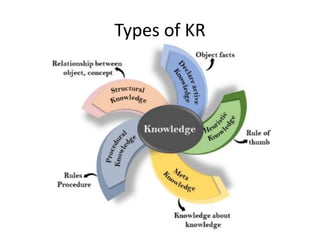
Types of KR
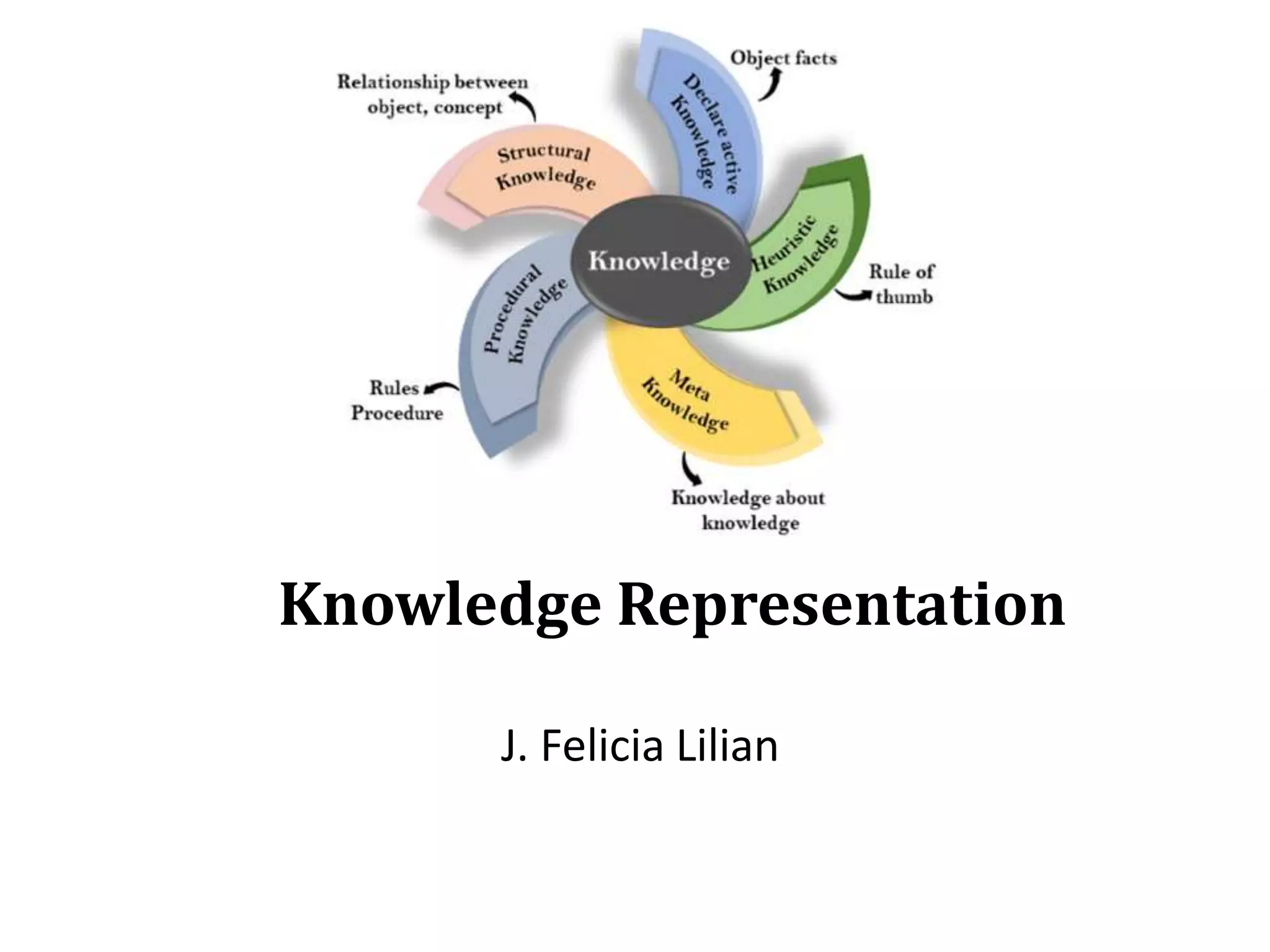
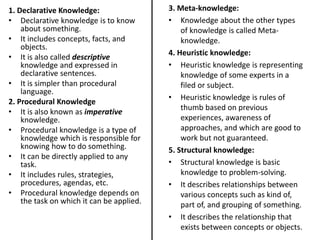
1. Declarative Knowledge:
• Declarative knowledge is to know
about something.
• It includes concepts, facts, and
objects.
• It is also called descriptive
knowledge and expressed in
declarative sentences.
• It is simpler than procedural
language.
2. Procedural Knowledge
• It is also known as imperative
knowledge.
• Procedural knowledge is a type of
knowledge which is responsible for
knowing how to do something.
• It can be directly applied to any
task.
• It includes rules, strategies,
procedures, agendas, etc.
• Procedural knowledge depends on
the task on which it can be applied.
3. Meta-knowledge:
• Knowledge about the other types
of knowledge is called Meta-
knowledge.
4. Heuristic knowledge:
• Heuristic knowledge is representing
knowledge of some experts in a
filed or subject.
• Heuristic knowledge is rules of
thumb based on previous
experiences, awareness of
approaches, and which are good to
work but not guaranteed.
5. Structural knowledge:
• Structural knowledge is basic
knowledge to problem-solving.
• It describes relationships between
various concepts such as kind of,
part of, and grouping of something.
• It describes the relationship that
exists between concepts or objects.
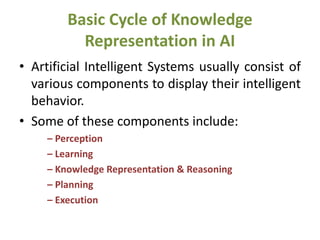
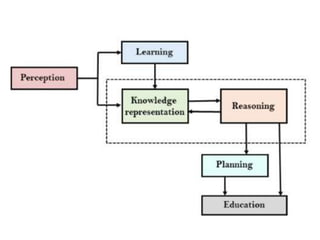
Basic Cycle of Knowledge
Representation in AI
• Artificial Intelligent Systems usually consist of
various components to display their intelligent
behavior.
• Some of these components include:
– Perception
– Learning
– Knowledge Representation & Reasoning
– Planning
– Execution
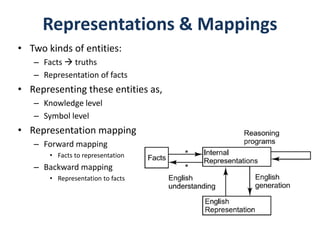
Representations & Mappings
• Two kinds of entities:
– Facts  truths
– Representation of facts
• Representing these entities as,
– Knowledge level
– Symbol level
• Representation mapping
– Forward mapping
• Facts to representation
– Backward mapping
• Representation to facts
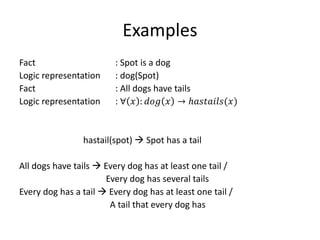
Examples
Fact : Spot is a dog
Logic representation : dog(Spot)
Fact : All dogs have tails
Logic representation : ∀ 𝑥 : 𝑑𝑜𝑔 𝑥 → ℎ𝑎𝑠𝑡𝑎𝑖𝑙𝑠(𝑥)
hastail(spot)  Spot has a tail
All dogs have tails  Every dog has at least one tail /
Every dog has several tails
Every dog has a tail  Every dog has at least one tail /
A tail that every dog has
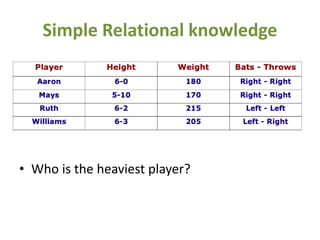
Simple Relational knowledge
• Who is the heaviest player?
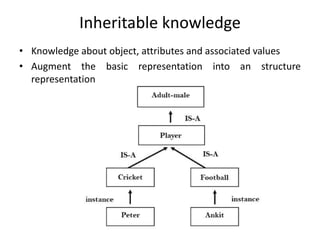
Inheritable knowledge
• Knowledge about object, attributes and associated values
• Augment the basic representation into an structure
representation
Inferential knowledge
• Inferential knowledge approach represents knowledge in the form of
formal logics.
• This approach can be used to derive more facts.
• It guaranteed correctness.
• Example: Let's suppose there are two statements:
– Marcus is a man
– All men are mortal
Then it can represent as;
man(Marcus)
∀x = man (x) ----------> mortal (x)s
Procedural knowledge
• Procedural knowledge approach uses small programs and codes
which describes how to do specific things, and how to proceed.
• In this approach, one important rule is used which is If-Then rule.
• In this knowledge, we can use various coding languages such as LISP
language and Prolog language.
• We can easily represent heuristic or domain-specific knowledge
using this approach.
• But it is not necessary that we can represent all cases in this
approach.
Approaches to KR
• Four properties:
– Representational Adequacy  represent all kinds
of knowledge
– Inferential Adequacy  manipulate the
representational structure
– Inferential Efficiency  incorporate into
knowledge
– Acquisitional Efficiency  Acquire new
information / knowledge
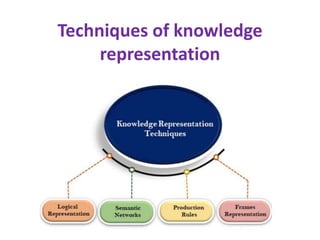
Techniques of knowledge
representation
Logical Representation
• Logical representation is a language with some concrete rules which
deals with propositions and has no ambiguity in representation.
• Logical representation means drawing a conclusion based on
various conditions.
• This representation lays down some important communication
rules.
• It consists of precisely defined syntax and semantics which
supports the sound inference.
• Each sentence can be translated into logics using syntax and
semantics.
Syntax:
• Syntaxes are the rules which decide how we can construct legal sentences
in the logic.
• It determines which symbol we can use in knowledge representation.
• How to write those symbols.
Semantics:
• Semantics are the rules by which we can interpret the sentence in the
logic.
• Semantic also involves assigning a meaning to each sentence.
Logical representation can be categorised into mainly two logics:
• Propositional Logics
• Predicate logics
Semantic Network Representation
• Semantic networks are alternative of predicate logic for knowledge
representation.
• In Semantic networks, we can represent our knowledge in the form
of graphical networks.
• This network consists of nodes representing objects and arcs which
describe the relationship between those objects.
• Semantic networks can categorize the object in different forms and
can also link those objects.
• Semantic networks are easy to understand and can be easily
extended.
Types of relations:
– IS-A relation (Inheritance)
– Kind-of-relation
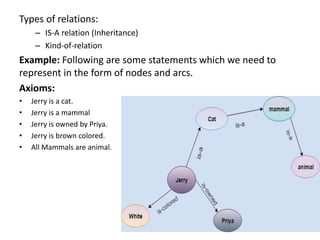
Example: Following are some statements which we need to
represent in the form of nodes and arcs.
Axioms:
• Jerry is a cat.
• Jerry is a mammal
• Jerry is owned by Priya.
• Jerry is brown colored.
• All Mammals are animal.
Frame Representation
• A frame is a record like structure which consists of a collection of
attributes and its values to describe an entity in the world.
• Frames are the AI data structure which divides knowledge into
substructures by representing stereotypes situations.
• It consists of a collection of slots and slot values.
• These slots may be of any type and sizes.
• Slots have names and values which are called facets.
Facet
• Facets are features of frames which enable us to put
constraints on the frames.
Example: IF-NEEDED facts are called when data of any
particular slot is needed.
A frame may consist of any number of slots, and a slot
may include any number of facets and facets may have
any number of values.
A frame is also known as slot-filter knowledge
representation in artificial intelligence.
Semantic Network  Frames
• Frames are derived from semantic networks and later
evolved into our modern-day classes and objects.
• A single frame is not much useful.
• Frames system consist of a collection of frames which are
connected.
• In the frame, knowledge about an object or event can be
stored together in the knowledge base.
• The frame is a type of technology which is widely used in
various applications including Natural language processing
and machine visions.
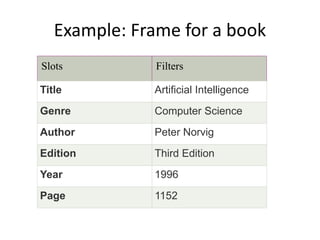
Example: Frame for a book
Slots Filters
Title Artificial Intelligence
Genre Computer Science
Author Peter Norvig
Edition Third Edition
Year 1996
Page 1152
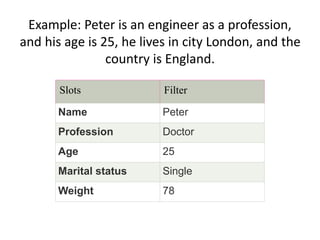
Example: Peter is an engineer as a profession,
and his age is 25, he lives in city London, and the
country is England.
Slots Filter
Name Peter
Profession Doctor
Age 25
Marital status Single
Weight 78
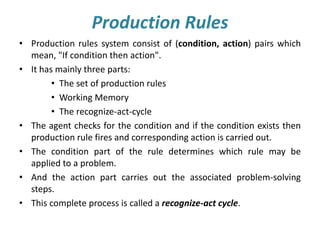
Production Rules
• Production rules system consist of (condition, action) pairs which
mean, "If condition then action".
• It has mainly three parts:
• The set of production rules
• Working Memory
• The recognize-act-cycle
• The agent checks for the condition and if the condition exists then
production rule fires and corresponding action is carried out.
• The condition part of the rule determines which rule may be
applied to a problem.
• And the action part carries out the associated problem-solving
steps.
• This complete process is called a recognize-act cycle.
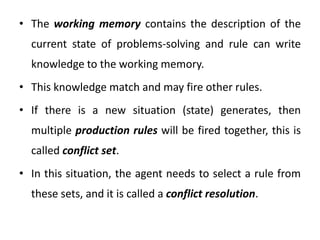
• The working memory contains the description of the
current state of problems-solving and rule can write
knowledge to the working memory.
• This knowledge match and may fire other rules.
• If there is a new situation (state) generates, then
multiple production rules will be fired together, this is
called conflict set.
• In this situation, the agent needs to select a rule from
these sets, and it is called a conflict resolution.
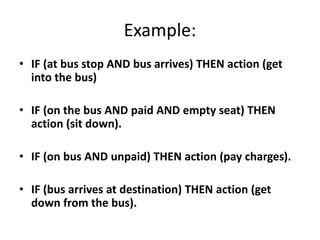
Example:
• IF (at bus stop AND bus arrives) THEN action (get
into the bus)
• IF (on the bus AND paid AND empty seat) THEN
action (sit down).
• IF (on bus AND unpaid) THEN action (pay charges).
• IF (bus arrives at destination) THEN action (get
down from the bus).

uploadscribd2.pptx

  • 1.
  • 2.
    Introduction to KR •Human beings are good at understanding, reasoning and interpreting knowledge. • And using this knowledge, they are able to perform various actions in the real world. • But how do machines perform the same? • Knowledge Representation in AI describes it as a study of how the beliefs, intentions, and judgments of an intelligent agent can be expressed suitably for automated reasoning. • One of the primary purposes of Knowledge Representation includes modeling intelligent behavior for an agent.
  • 3.
    Knowledge Representation & Reasoning •Knowledge Representation and Reasoning (KR, KRR) represents information from the real world for a computer to understand and then utilize this knowledge to solve complex real-life problems like communicating with human beings in natural language. • Knowledge representation in AI is not just about storing data in a database, it allows a machine to learn from that knowledge and behave intelligently like a human being.
  • 4.
  • 5.
    1. Declarative Knowledge: •Declarative knowledge is to know about something. • It includes concepts, facts, and objects. • It is also called descriptive knowledge and expressed in declarative sentences. • It is simpler than procedural language. 2. Procedural Knowledge • It is also known as imperative knowledge. • Procedural knowledge is a type of knowledge which is responsible for knowing how to do something. • It can be directly applied to any task. • It includes rules, strategies, procedures, agendas, etc. • Procedural knowledge depends on the task on which it can be applied. 3. Meta-knowledge: • Knowledge about the other types of knowledge is called Meta- knowledge. 4. Heuristic knowledge: • Heuristic knowledge is representing knowledge of some experts in a filed or subject. • Heuristic knowledge is rules of thumb based on previous experiences, awareness of approaches, and which are good to work but not guaranteed. 5. Structural knowledge: • Structural knowledge is basic knowledge to problem-solving. • It describes relationships between various concepts such as kind of, part of, and grouping of something. • It describes the relationship that exists between concepts or objects.
  • 6.
    Basic Cycle ofKnowledge Representation in AI • Artificial Intelligent Systems usually consist of various components to display their intelligent behavior. • Some of these components include: – Perception – Learning – Knowledge Representation & Reasoning – Planning – Execution
  • 8.
    Representations & Mappings •Two kinds of entities: – Facts  truths – Representation of facts • Representing these entities as, – Knowledge level – Symbol level • Representation mapping – Forward mapping • Facts to representation – Backward mapping • Representation to facts
  • 9.
    Examples Fact : Spotis a dog Logic representation : dog(Spot) Fact : All dogs have tails Logic representation : ∀ 𝑥 : 𝑑𝑜𝑔 𝑥 → ℎ𝑎𝑠𝑡𝑎𝑖𝑙𝑠(𝑥) hastail(spot)  Spot has a tail All dogs have tails  Every dog has at least one tail / Every dog has several tails Every dog has a tail  Every dog has at least one tail / A tail that every dog has
  • 10.
    Simple Relational knowledge •Who is the heaviest player?
  • 11.
    Inheritable knowledge • Knowledgeabout object, attributes and associated values • Augment the basic representation into an structure representation
  • 12.
    Inferential knowledge • Inferentialknowledge approach represents knowledge in the form of formal logics. • This approach can be used to derive more facts. • It guaranteed correctness. • Example: Let's suppose there are two statements: – Marcus is a man – All men are mortal Then it can represent as; man(Marcus) ∀x = man (x) ----------> mortal (x)s
  • 13.
    Procedural knowledge • Proceduralknowledge approach uses small programs and codes which describes how to do specific things, and how to proceed. • In this approach, one important rule is used which is If-Then rule. • In this knowledge, we can use various coding languages such as LISP language and Prolog language. • We can easily represent heuristic or domain-specific knowledge using this approach. • But it is not necessary that we can represent all cases in this approach.
  • 14.
    Approaches to KR •Four properties: – Representational Adequacy  represent all kinds of knowledge – Inferential Adequacy  manipulate the representational structure – Inferential Efficiency  incorporate into knowledge – Acquisitional Efficiency  Acquire new information / knowledge
  • 15.
  • 16.
    Logical Representation • Logicalrepresentation is a language with some concrete rules which deals with propositions and has no ambiguity in representation. • Logical representation means drawing a conclusion based on various conditions. • This representation lays down some important communication rules. • It consists of precisely defined syntax and semantics which supports the sound inference. • Each sentence can be translated into logics using syntax and semantics.
  • 17.
    Syntax: • Syntaxes arethe rules which decide how we can construct legal sentences in the logic. • It determines which symbol we can use in knowledge representation. • How to write those symbols. Semantics: • Semantics are the rules by which we can interpret the sentence in the logic. • Semantic also involves assigning a meaning to each sentence. Logical representation can be categorised into mainly two logics: • Propositional Logics • Predicate logics
  • 18.
    Semantic Network Representation •Semantic networks are alternative of predicate logic for knowledge representation. • In Semantic networks, we can represent our knowledge in the form of graphical networks. • This network consists of nodes representing objects and arcs which describe the relationship between those objects. • Semantic networks can categorize the object in different forms and can also link those objects. • Semantic networks are easy to understand and can be easily extended.
  • 19.
    Types of relations: –IS-A relation (Inheritance) – Kind-of-relation Example: Following are some statements which we need to represent in the form of nodes and arcs. Axioms: • Jerry is a cat. • Jerry is a mammal • Jerry is owned by Priya. • Jerry is brown colored. • All Mammals are animal.
  • 20.
    Frame Representation • Aframe is a record like structure which consists of a collection of attributes and its values to describe an entity in the world. • Frames are the AI data structure which divides knowledge into substructures by representing stereotypes situations. • It consists of a collection of slots and slot values. • These slots may be of any type and sizes. • Slots have names and values which are called facets.
  • 21.
    Facet • Facets arefeatures of frames which enable us to put constraints on the frames. Example: IF-NEEDED facts are called when data of any particular slot is needed. A frame may consist of any number of slots, and a slot may include any number of facets and facets may have any number of values. A frame is also known as slot-filter knowledge representation in artificial intelligence.
  • 22.
    Semantic Network Frames • Frames are derived from semantic networks and later evolved into our modern-day classes and objects. • A single frame is not much useful. • Frames system consist of a collection of frames which are connected. • In the frame, knowledge about an object or event can be stored together in the knowledge base. • The frame is a type of technology which is widely used in various applications including Natural language processing and machine visions.
  • 23.
    Example: Frame fora book Slots Filters Title Artificial Intelligence Genre Computer Science Author Peter Norvig Edition Third Edition Year 1996 Page 1152
  • 24.
    Example: Peter isan engineer as a profession, and his age is 25, he lives in city London, and the country is England. Slots Filter Name Peter Profession Doctor Age 25 Marital status Single Weight 78
  • 25.
    Production Rules • Productionrules system consist of (condition, action) pairs which mean, "If condition then action". • It has mainly three parts: • The set of production rules • Working Memory • The recognize-act-cycle • The agent checks for the condition and if the condition exists then production rule fires and corresponding action is carried out. • The condition part of the rule determines which rule may be applied to a problem. • And the action part carries out the associated problem-solving steps. • This complete process is called a recognize-act cycle.
  • 26.
    • The workingmemory contains the description of the current state of problems-solving and rule can write knowledge to the working memory. • This knowledge match and may fire other rules. • If there is a new situation (state) generates, then multiple production rules will be fired together, this is called conflict set. • In this situation, the agent needs to select a rule from these sets, and it is called a conflict resolution.
  • 27.
    Example: • IF (atbus stop AND bus arrives) THEN action (get into the bus) • IF (on the bus AND paid AND empty seat) THEN action (sit down). • IF (on bus AND unpaid) THEN action (pay charges). • IF (bus arrives at destination) THEN action (get down from the bus).