(http://research­methodology.net/)
Constructivism
(http://research­methodology.net/wp­
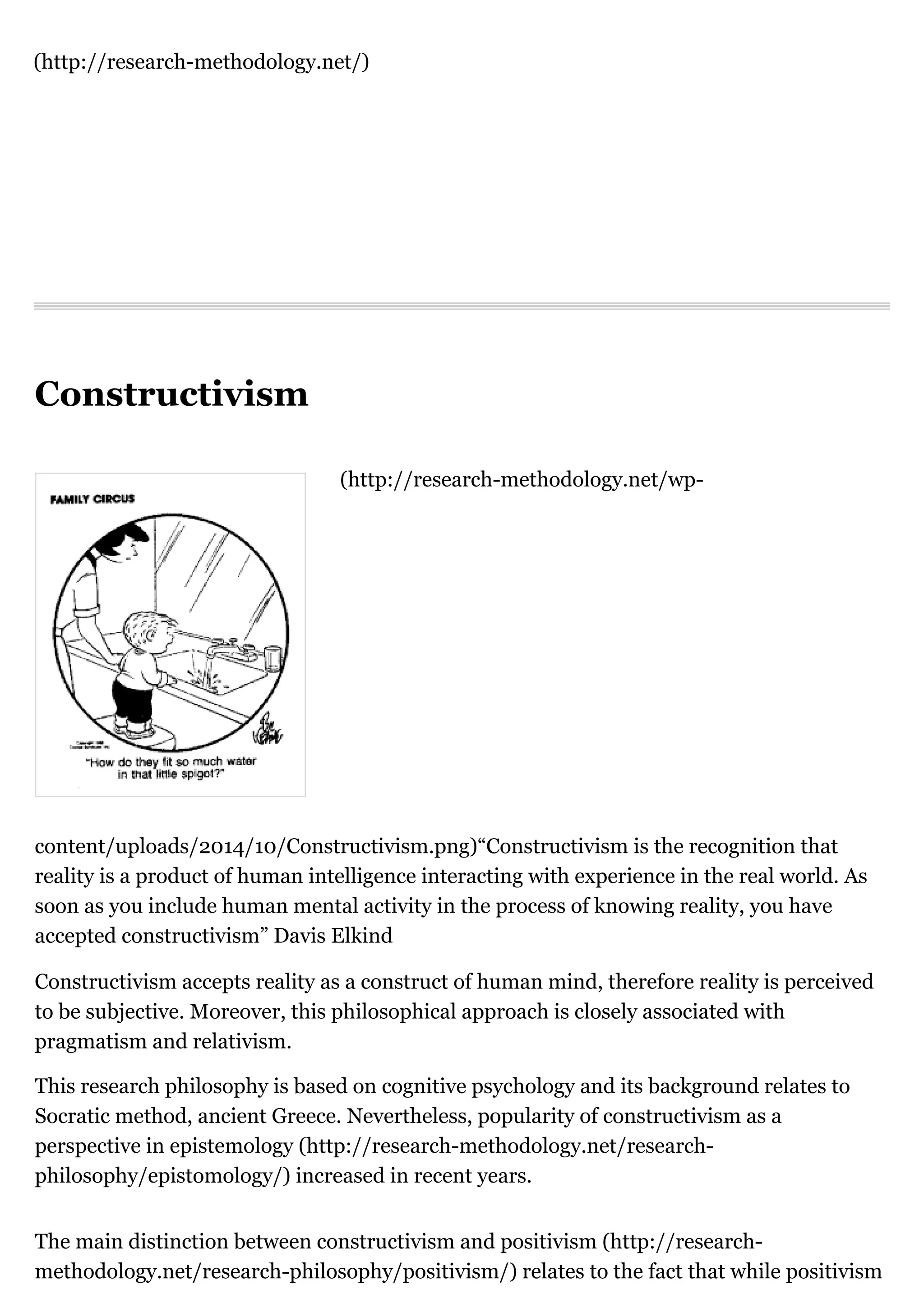
content/uploads/2014/10/Constructivism.png)“Constructivism is the recognition that
reality is a product of human intelligence interacting with experience in the real world. As
soon as you include human mental activity in the process of knowing reality, you have
accepted constructivism” Davis Elkind
Constructivism accepts reality as a construct of human mind, therefore reality is perceived
to be subjective. Moreover, this philosophical approach is closely associated with
pragmatism and relativism.
This research philosophy is based on cognitive psychology and its background relates to
Socratic method, ancient Greece. Nevertheless, popularity of constructivism as a
perspective in epistemology (http://research­methodology.net/research­
philosophy/epistomology/) increased in recent years.
The main distinction between constructivism and positivism (http://research­
methodology.net/research­philosophy/positivism/) relates to the fact that while positivism
argues that knowledge is generated in a scientific method, constructivism maintains that
knowledge is constructed by scientists and it opposes the idea that there is a single
methodology to generate knowledge.
Although used in business studies as well, constructivism is mainly a teaching philosophy
that is based on the idea that student understanding is formed via reflection on their
personal experiences and relating new knowledge to the knowledge that they already
possessed.
Philosophy Constructivism Positivism Pragmatism
Type of
research
Qualitative Quantitative Mixed
Methods Open­ended questions,
emerging approaches,
text and/or image data
Closed­ended
questions, pre­
determined
approaches, numeric
data
Both, open and closed­
ended questions, both,
emerging and
predetermined
approaches, and both,
qualitative and
quantitative data
analysis
Research
practices
Positions researcher
within the context
Collects participant­
generate meanings
Focuses on a single
concept or
phenomenon
Brings personal values
into the study
Studies the context or
setting of participants
Validates the accuracy
of findings
Interprets the data
Creates an agenda for
change or reform
Involves researcher in
collaborating with
participants
Tests or verifies theories
or explanations
Identifies variables of
interest
Relates variables in
questions or
hypotheses
Uses standards of
reliability and validity
Observes and then
measures information
numerically
Uses unbiased
approaches
Employs statistical
procedures
 
Collects both,
qualitative and
quantitative data
Develops a rationale for
mixing methods
Integrates the data at
various stages of inquiry
Presents visual pictures
of the procedures in the
study
Employs practices of
both qualitative and
quantitative research
 
 
participants
Source: Andrew et. al. (2011)
 
References
Andrew, P.S., Pedersen, P.M. & McEvoy, C.D. (2011) “Research Methods and Designs in
Sport Management” Human Kinetics

Constructivism and positivism research methodology