Six Strategies for Effective Learning
Content by Yana Weinstein (University of Massachusetts Lowell) & Megan Smith (Rhode Island College) | Illustrations by Oliver Caviglioli (teachinghow2s.com/cogsci)
Funding provided by the APS Fund for Teaching and Public Understanding of Psychological Science
LEARNINGSCIENTISTS.ORG
RETRIEVAL PRACTICE
SPACEDPRACTICE
CONCRETEEXAMPLES
ELABORATION
DUAL CODINGINTERLEAVING
WRITE
SKETCH
OR
1
2
3
SPACING
TESTING SKETCHING
MY
FOLDER
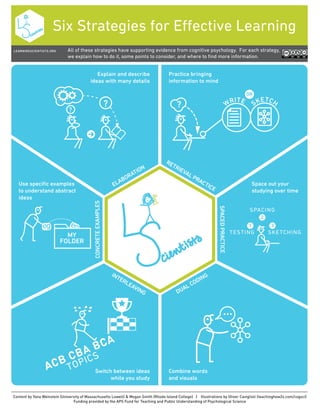
All of these strategies have supporting evidence from cognitive psychology. For each strategy,
we explain how to do it, some points to consider, and where to find more information.
Use specific examples
to understand abstract
ideas
Switch between ideas
while you study
Combine words
and visuals
Space out your
studying over time
Practice bringing
information to mind
Explain and describe
ideas with many details
L E A R N T O S T U D Y U S I N G …
Spaced Practice
Content by Yana Weinstein (University of Massachusetts Lowell) & Megan Smith (Rhode Island College) | Illustrations by Oliver Caviglioli (teachinghow2s.com/cogsci)
Funding provided by the APS Fund for Teaching and Public Understanding of Psychological Science
S PA C E O U T Y O U R S T U D Y I N G O V E R T I M E
H O W T O D O I T
H O L D O N !
R E S E A R C H
Benjamin, A. S., & Tullis, J. (2010). What makes distributed practice effective? Cognitive
Psychology, 61, 228-247.
Read more about
spaced pratice
as a study strategy
When you sit down to study, make sure you are using effective study
strategies rather than just re-reading your class notes.
This may seem difficult and you may forget some information from
day to day, but this is actually a good thing! This forces you to retrieve
information from memory (see Retrieval Practice poster).
Create small spaces (a few days) and do a little bit over time, so that it
adds up!
1
2
3
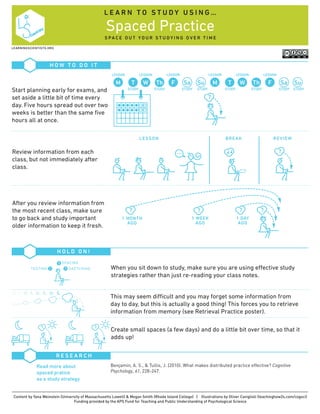
Start planning early for exams, and
set aside a little bit of time every
day. Five hours spread out over two
weeks is better than the same five
hours all at once.
After you review information from
the most recent class, make sure
to go back and study important
older information to keep it fresh.
Review information from each
class, but not immediately after
class.
SPACING
TESTING SKETCHING
LESSON
LESSON LESSON LESSON
STUDY STUDY STUDY STUDY STUDY STUDY STUDY STUDY
LESSON LESSON LESSON
BREAK REVIEW
M T W Th F Sa Su M T W Th F Sa Su
1 DAY
AGO
1 WEEK
AGO
1 MONTH
AGO
LEARNINGSCIENTISTS.ORG
WRITE
SKETCH CHECK
Retrieval Practice
Content by Yana Weinstein (University of Massachusetts Lowell) & Megan Smith (Rhode Island College) | Illustrations by Oliver Caviglioli (teachinghow2s.com/cogsci)
Funding provided by the APS Fund for Teaching and Public Understanding of Psychological Science
L E A R N T O S T U D Y U S I N G …
P R A C T I C E B R I N G I N G I N F O R M AT I O N T O M I N D
H O W T O D O I T
H O L D O N !
R E S E A R C H
Roediger, H. L., Putnam, A. L., & Smith, M. A. (2011). Ten benefits of testing and their
applications to educational practice. In J. Mestre & B. Ross (Eds.), Psychology of learning and
motivation: Cognition in education, (pp. 1-36). Oxford: Elsevier.
Read more about
retrieval practice
as a study strategy
Retrieval practice works best when you go back to check your class
materials for accuracy afterward.
Retrieval is hard! If you’re struggling, identify the things you’ve missed
from your class materials, and work your way up to recalling it on your
own with the class materials closed.
Don’t only recall words and definitions. Make sure to recall main ideas,
how things are related or different from one another, and new examples.
1
2
3
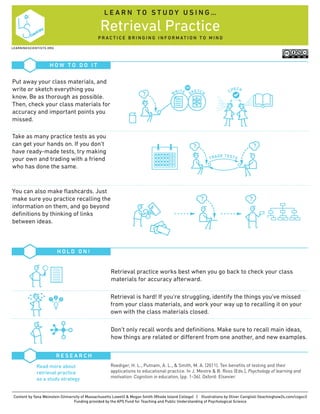
Put away your class materials, and
write or sketch everything you
know. Be as thorough as possible.
Then, check your class materials for
accuracy and important points you
missed.
You can also make flashcards. Just
make sure you practice recalling the
information on them, and go beyond
definitions by thinking of links
between ideas.
Take as many practice tests as you
can get your hands on. If you don’t
have ready-made tests, try making
your own and trading with a friend
who has done the same.
OR
TRADE TESTS
LEARNINGSCIENTISTS.ORG
Elaboration
Content by Yana Weinstein (University of Massachusetts Lowell) & Megan Smith (Rhode Island College) | Illustrations by Oliver Caviglioli (teachinghow2s.com/cogsci)
Funding provided by the APS Fund for Teaching and Public Understanding of Psychological Science
L E A R N T O S T U D Y U S I N G …
E X P L A I N A N D D E S C R I B E I D E A S W I T H M A N Y D E TA I L S
H O W T O D O I T
H O L D O N !
R E S E A R C H
McDaniel, M. A., & Donnelly, C. M. (1996). Learning with analogy and elaborative interrogation.
Journal of Educational Psychology, 88, 508-519.
Wong, B. Y. L. (1985). Self-questioning instructional research: A review. Review of Educational
Research, 55, 227-268.
Read more about
elaboration
as a study strategy
Make sure the way you are explaining and describing an idea is accurate.
Don’t overextend the elaborations, and always check your class
materials or ask your teacher.
Work your way up so that you can describe and explain without looking
at your class materials.
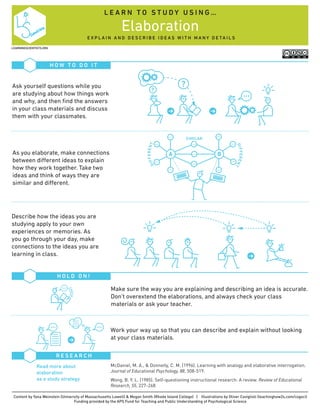
Ask yourself questions while you
are studying about how things work
and why, and then find the answers
in your class materials and discuss
them with your classmates.
Describe how the ideas you are
studying apply to your own
experiences or memories. As
you go through your day, make
connections to the ideas you are
learning in class.
As you elaborate, make connections
between different ideas to explain
how they work together. Take two
ideas and think of ways they are
similar and different.
LEARNINGSCIENTISTS.ORG
A B
SIMILAR
DIFFERENT
DIFFERENT
CHECK
Interleaving
Content by Yana Weinstein (University of Massachusetts Lowell) & Megan Smith (Rhode Island College) | Illustrations by Oliver Caviglioli (teachinghow2s.com/cogsci)
Funding provided by the APS Fund for Teaching and Public Understanding of Psychological Science
L E A R N T O S T U D Y U S I N G …
S W I T C H B E T W E E N I D E A S W H I L E Y O U S T U D Y
H O W T O D O I T
H O L D O N !
R E S E A R C H
Rohrer, D. (2012). Interleaving helps students distinguish among similar concepts. Educational
Psychology Review, 24, 355-367.
Read more about
interleaving
as a study strategy
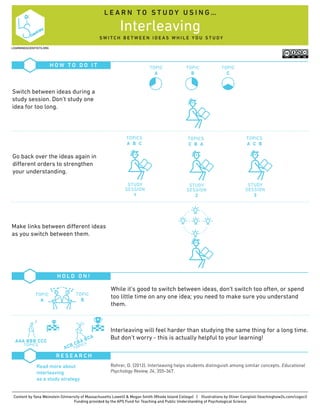
While it’s good to switch between ideas, don’t switch too often, or spend
too little time on any one idea; you need to make sure you understand
them.
Interleaving will feel harder than studying the same thing for a long time.
But don’t worry - this is actually helpful to your learning!
Switch between ideas during a
study session. Don’t study one
idea for too long.
Make links between different ideas
as you switch between them.
Go back over the ideas again in
different orders to strengthen
your understanding.
LEARNINGSCIENTISTS.ORG
TOPIC
A
TOPIC
A
TOPIC
B
TOPIC
B
TOPICS
C B A
STUDY
SESSION
2
TOPICS
A B C
STUDY
SESSION
1
TOPICS
A C B
STUDY
SESSION
3
TOPIC
C
Concrete Examples
Content by Yana Weinstein (University of Massachusetts Lowell) & Megan Smith (Rhode Island College) | Illustrations by Oliver Caviglioli (teachinghow2s.com/cogsci)
Funding provided by the APS Fund for Teaching and Public Understanding of Psychological Science
L E A R N T O S T U D Y U S I N G …
U S E S P E C I F I C E X A M P L E S T O U N D E R S TA N D A B S T R A C T I D E A S
H O W T O D O I T
H O L D O N !
R E S E A R C H
Rawson, K. A., Thomas, R. C., & Jacoby, L. L. (2014). The power of examples: Illustrative
examples enhance conceptual learning of declarative concepts. Educational Psychology Review,
27, 483-504.
Read more about
concrete examples
as a study strategy
You may find examples on the internet that are not used appropriately.
Make sure your examples are correct - check with your teacher.
Ultimately, creating your own relevant examples will be the most helpful
for learning.
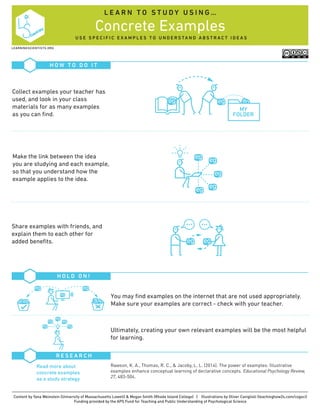
Collect examples your teacher has
used, and look in your class
materials for as many examples
as you can find.
Share examples with friends, and
explain them to each other for
added benefits.
Make the link between the idea
you are studying and each example,
so that you understand how the
example applies to the idea.
LEARNINGSCIENTISTS.ORG
MY
FOLDER
Dual Coding
Content by Yana Weinstein (University of Massachusetts Lowell) & Megan Smith (Rhode Island College) | Illustrations by Oliver Caviglioli (teachinghow2s.com/cogsci)
Funding provided by the APS Fund for Teaching and Public Understanding of Psychological Science
L E A R N T O S T U D Y U S I N G …
C O M B I N E W O R D S A N D V I S U A L S
H O W T O D O I T
H O L D O N !
R E S E A R C H
Mayer, R. E., & Anderson, R. B. (1992). The instructive animation: Helping students build
connections between words and pictures in multimedia learning. Journal of Educational
Psychology, 4, 444-452.
Read more about
dual coding as a
study strategy
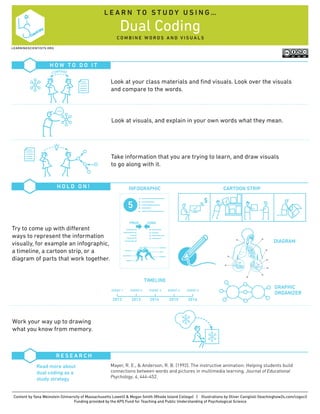
Try to come up with different
ways to represent the information
visually, for example an infographic,
a timeline, a cartoon strip, or a
diagram of parts that work together.
Work your way up to drawing
what you know from memory.
Look at your class materials and find visuals. Look over the visuals
and compare to the words.
Take information that you are trying to learn, and draw visuals
to go along with it.
Look at visuals, and explain in your own words what they mean.
LEARNINGSCIENTISTS.ORG
COMPARE
DIAGRAM
GRAPHIC
ORGANIZER
INFOGRAPHIC CARTOON STRIP
TIMELINE
5
PROS CONS
2012 2013 2014 2015 2016
EVENT 1 EVENT 2 EVENT 3 EVENT 4 EVENT 5

Learning strategies

  • 1.
    Six Strategies forEffective Learning Content by Yana Weinstein (University of Massachusetts Lowell) & Megan Smith (Rhode Island College) | Illustrations by Oliver Caviglioli (teachinghow2s.com/cogsci) Funding provided by the APS Fund for Teaching and Public Understanding of Psychological Science LEARNINGSCIENTISTS.ORG RETRIEVAL PRACTICE SPACEDPRACTICE CONCRETEEXAMPLES ELABORATION DUAL CODINGINTERLEAVING WRITE SKETCH OR 1 2 3 SPACING TESTING SKETCHING MY FOLDER All of these strategies have supporting evidence from cognitive psychology. For each strategy, we explain how to do it, some points to consider, and where to find more information. Use specific examples to understand abstract ideas Switch between ideas while you study Combine words and visuals Space out your studying over time Practice bringing information to mind Explain and describe ideas with many details
  • 2.
    L E AR N T O S T U D Y U S I N G … Spaced Practice Content by Yana Weinstein (University of Massachusetts Lowell) & Megan Smith (Rhode Island College) | Illustrations by Oliver Caviglioli (teachinghow2s.com/cogsci) Funding provided by the APS Fund for Teaching and Public Understanding of Psychological Science S PA C E O U T Y O U R S T U D Y I N G O V E R T I M E H O W T O D O I T H O L D O N ! R E S E A R C H Benjamin, A. S., & Tullis, J. (2010). What makes distributed practice effective? Cognitive Psychology, 61, 228-247. Read more about spaced pratice as a study strategy When you sit down to study, make sure you are using effective study strategies rather than just re-reading your class notes. This may seem difficult and you may forget some information from day to day, but this is actually a good thing! This forces you to retrieve information from memory (see Retrieval Practice poster). Create small spaces (a few days) and do a little bit over time, so that it adds up! 1 2 3 Start planning early for exams, and set aside a little bit of time every day. Five hours spread out over two weeks is better than the same five hours all at once. After you review information from the most recent class, make sure to go back and study important older information to keep it fresh. Review information from each class, but not immediately after class. SPACING TESTING SKETCHING LESSON LESSON LESSON LESSON STUDY STUDY STUDY STUDY STUDY STUDY STUDY STUDY LESSON LESSON LESSON BREAK REVIEW M T W Th F Sa Su M T W Th F Sa Su 1 DAY AGO 1 WEEK AGO 1 MONTH AGO LEARNINGSCIENTISTS.ORG
  • 3.
    WRITE SKETCH CHECK Retrieval Practice Contentby Yana Weinstein (University of Massachusetts Lowell) & Megan Smith (Rhode Island College) | Illustrations by Oliver Caviglioli (teachinghow2s.com/cogsci) Funding provided by the APS Fund for Teaching and Public Understanding of Psychological Science L E A R N T O S T U D Y U S I N G … P R A C T I C E B R I N G I N G I N F O R M AT I O N T O M I N D H O W T O D O I T H O L D O N ! R E S E A R C H Roediger, H. L., Putnam, A. L., & Smith, M. A. (2011). Ten benefits of testing and their applications to educational practice. In J. Mestre & B. Ross (Eds.), Psychology of learning and motivation: Cognition in education, (pp. 1-36). Oxford: Elsevier. Read more about retrieval practice as a study strategy Retrieval practice works best when you go back to check your class materials for accuracy afterward. Retrieval is hard! If you’re struggling, identify the things you’ve missed from your class materials, and work your way up to recalling it on your own with the class materials closed. Don’t only recall words and definitions. Make sure to recall main ideas, how things are related or different from one another, and new examples. 1 2 3 Put away your class materials, and write or sketch everything you know. Be as thorough as possible. Then, check your class materials for accuracy and important points you missed. You can also make flashcards. Just make sure you practice recalling the information on them, and go beyond definitions by thinking of links between ideas. Take as many practice tests as you can get your hands on. If you don’t have ready-made tests, try making your own and trading with a friend who has done the same. OR TRADE TESTS LEARNINGSCIENTISTS.ORG
  • 4.
    Elaboration Content by YanaWeinstein (University of Massachusetts Lowell) & Megan Smith (Rhode Island College) | Illustrations by Oliver Caviglioli (teachinghow2s.com/cogsci) Funding provided by the APS Fund for Teaching and Public Understanding of Psychological Science L E A R N T O S T U D Y U S I N G … E X P L A I N A N D D E S C R I B E I D E A S W I T H M A N Y D E TA I L S H O W T O D O I T H O L D O N ! R E S E A R C H McDaniel, M. A., & Donnelly, C. M. (1996). Learning with analogy and elaborative interrogation. Journal of Educational Psychology, 88, 508-519. Wong, B. Y. L. (1985). Self-questioning instructional research: A review. Review of Educational Research, 55, 227-268. Read more about elaboration as a study strategy Make sure the way you are explaining and describing an idea is accurate. Don’t overextend the elaborations, and always check your class materials or ask your teacher. Work your way up so that you can describe and explain without looking at your class materials. Ask yourself questions while you are studying about how things work and why, and then find the answers in your class materials and discuss them with your classmates. Describe how the ideas you are studying apply to your own experiences or memories. As you go through your day, make connections to the ideas you are learning in class. As you elaborate, make connections between different ideas to explain how they work together. Take two ideas and think of ways they are similar and different. LEARNINGSCIENTISTS.ORG A B SIMILAR DIFFERENT DIFFERENT CHECK
  • 5.
    Interleaving Content by YanaWeinstein (University of Massachusetts Lowell) & Megan Smith (Rhode Island College) | Illustrations by Oliver Caviglioli (teachinghow2s.com/cogsci) Funding provided by the APS Fund for Teaching and Public Understanding of Psychological Science L E A R N T O S T U D Y U S I N G … S W I T C H B E T W E E N I D E A S W H I L E Y O U S T U D Y H O W T O D O I T H O L D O N ! R E S E A R C H Rohrer, D. (2012). Interleaving helps students distinguish among similar concepts. Educational Psychology Review, 24, 355-367. Read more about interleaving as a study strategy While it’s good to switch between ideas, don’t switch too often, or spend too little time on any one idea; you need to make sure you understand them. Interleaving will feel harder than studying the same thing for a long time. But don’t worry - this is actually helpful to your learning! Switch between ideas during a study session. Don’t study one idea for too long. Make links between different ideas as you switch between them. Go back over the ideas again in different orders to strengthen your understanding. LEARNINGSCIENTISTS.ORG TOPIC A TOPIC A TOPIC B TOPIC B TOPICS C B A STUDY SESSION 2 TOPICS A B C STUDY SESSION 1 TOPICS A C B STUDY SESSION 3 TOPIC C
  • 6.
    Concrete Examples Content byYana Weinstein (University of Massachusetts Lowell) & Megan Smith (Rhode Island College) | Illustrations by Oliver Caviglioli (teachinghow2s.com/cogsci) Funding provided by the APS Fund for Teaching and Public Understanding of Psychological Science L E A R N T O S T U D Y U S I N G … U S E S P E C I F I C E X A M P L E S T O U N D E R S TA N D A B S T R A C T I D E A S H O W T O D O I T H O L D O N ! R E S E A R C H Rawson, K. A., Thomas, R. C., & Jacoby, L. L. (2014). The power of examples: Illustrative examples enhance conceptual learning of declarative concepts. Educational Psychology Review, 27, 483-504. Read more about concrete examples as a study strategy You may find examples on the internet that are not used appropriately. Make sure your examples are correct - check with your teacher. Ultimately, creating your own relevant examples will be the most helpful for learning. Collect examples your teacher has used, and look in your class materials for as many examples as you can find. Share examples with friends, and explain them to each other for added benefits. Make the link between the idea you are studying and each example, so that you understand how the example applies to the idea. LEARNINGSCIENTISTS.ORG MY FOLDER
  • 7.
    Dual Coding Content byYana Weinstein (University of Massachusetts Lowell) & Megan Smith (Rhode Island College) | Illustrations by Oliver Caviglioli (teachinghow2s.com/cogsci) Funding provided by the APS Fund for Teaching and Public Understanding of Psychological Science L E A R N T O S T U D Y U S I N G … C O M B I N E W O R D S A N D V I S U A L S H O W T O D O I T H O L D O N ! R E S E A R C H Mayer, R. E., & Anderson, R. B. (1992). The instructive animation: Helping students build connections between words and pictures in multimedia learning. Journal of Educational Psychology, 4, 444-452. Read more about dual coding as a study strategy Try to come up with different ways to represent the information visually, for example an infographic, a timeline, a cartoon strip, or a diagram of parts that work together. Work your way up to drawing what you know from memory. Look at your class materials and find visuals. Look over the visuals and compare to the words. Take information that you are trying to learn, and draw visuals to go along with it. Look at visuals, and explain in your own words what they mean. LEARNINGSCIENTISTS.ORG COMPARE DIAGRAM GRAPHIC ORGANIZER INFOGRAPHIC CARTOON STRIP TIMELINE 5 PROS CONS 2012 2013 2014 2015 2016 EVENT 1 EVENT 2 EVENT 3 EVENT 4 EVENT 5