www.teachingstudentshow.com
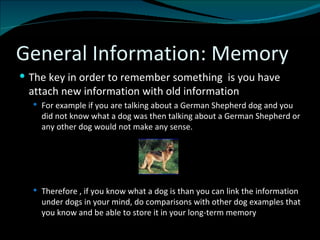
General Information: Memory The key in order to remember something  is you have attach new information with old information  For example if you are talking about a German Shepherd dog and you did not know what a dog was then talking about a German Shepherd or any other dog would not make any sense.  Therefore , if you know what a dog is than you can link the information under dogs in your mind, do comparisons with other dog examples that you know and be able to store it in your long-term memory
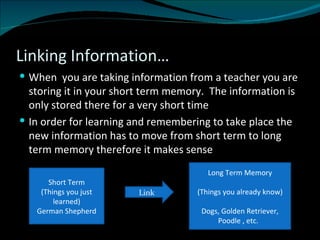
Linking Information…  When  you are taking information from a teacher you are storing it in your short term memory.  The information is only stored there for a very short time  In order for learning and remembering to take place the new information has to move from short term to long term memory therefore it makes sense Short Term (Things you just learned) German Shepherd Link Long Term Memory (Things you already know) Dogs, Golden Retriever, Poodle , etc.
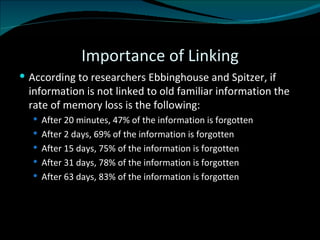
Importance of Linking According to researchers Ebbinghouse and Spitzer, if information is not linked to old familiar information the rate of memory loss is the following: After 20 minutes, 47% of the information is forgotten After 2 days, 69% of the information is forgotten After 15 days, 75% of the information is forgotten After 31 days, 78% of the information is forgotten After 63 days, 83% of the information is forgotten
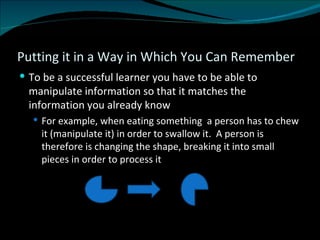
Putting it in a Way in Which You Can Remember To be a successful learner you have to be able to manipulate information so that it matches the information you already know For example, when eating something  a person has to chew it (manipulate it) in order to swallow it.  A person is therefore is changing the shape, breaking it into small pieces in order to process it
Putting it in a Way in Which You Can Remember When learning, sometimes you have to summarize, visualize, use aids (re-shape) it so that it is easier to link to existing information , therefore, it is easier to remember
Simple Strategies to Help Store it in Your Long-term Memory for Remembering Lists Mnemonics  is a type of strategy that helps you remember lists of information Form a cue word Use the beginning letters of a words in the list to make a word that is easier to remember Use capital letters for all letters of the cue word   Question:  Name the Great Lakes?  Example:  H uron O ntario M ichigan E rie S uperior
Mnemonics continued… Use can use a cute phrase using the first letters of the word  For example when remembering the exact order of a operation in math such as Parenthesis, Exponents, Multiplication, Division, Addition, Subtraction Can be remembered like this: P lease  E xcuse  M y  D ear  A unt  S ally
Use Summary Writings to Help You Reduce the Amount of Information Needed to Remember Four Rules to Summary Writing #1 Collapse Lists – If you see a list of things, try to think of a word or phrase as a name for the whole list If you saw a list like eyes, ears, neck, arms, legs you could substitute that list by labeling it body parts
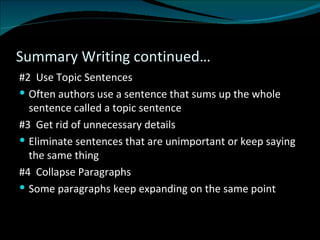
Summary Writing continued… #2  Use Topic Sentences Often authors use a sentence that sums up the whole sentence called a topic sentence #3  Get rid of unnecessary details  Eliminate sentences that are unimportant or keep saying the same thing  #4  Collapse Paragraphs Some paragraphs keep expanding on the same point
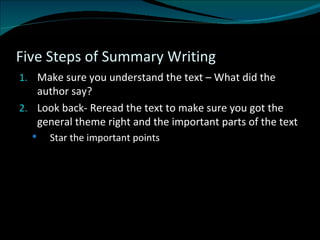
Five Steps of Summary Writing Make sure you understand the text – What did the author say? Look back- Reread the text to make sure you got the general theme right and the important parts of the text Star the important points
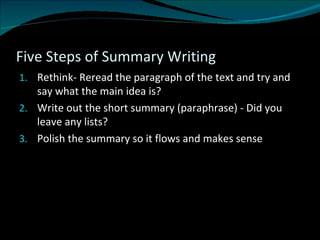
Five Steps of Summary Writing Rethink- Reread the paragraph of the text and try and say what the main idea is? Write out the short summary (paraphrase) - Did you leave any lists? Polish the summary so it flows and makes sense
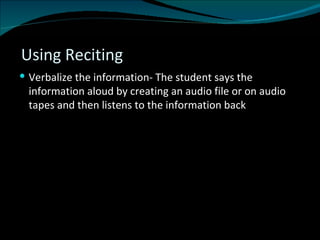
Using Reciting  Verbalize the information- The student says the information aloud by creating an audio file or on audio tapes and then listens to the information back
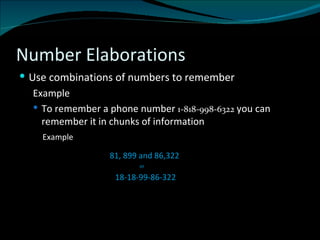
Number Elaborations Use combinations of numbers to remember Example To remember a phone number  1-818-998-6322  you can remember it in chunks of information  Example 81, 899 and 86,322   or   18-18-99-86-322
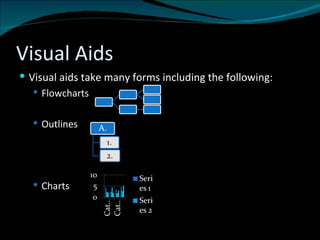
Visual Aids Visual aids take many forms including the following: Flowcharts Outlines Charts
Color Coding Color coding funtions do a number of  things: Indentifies important information Indicates  things are linked to one another Organizes information Provides the brain and easy path to remember information
Color Coding When studying write out flash cards that contain different topics on different color cards Use different color ink to stress the main ideas and supporting details Use same color ink for the topics that are linked to one another Identify important information by using a highlighter
 

Memory97

  • 1.
  • 2.
    General Information: MemoryThe key in order to remember something is you have attach new information with old information For example if you are talking about a German Shepherd dog and you did not know what a dog was then talking about a German Shepherd or any other dog would not make any sense. Therefore , if you know what a dog is than you can link the information under dogs in your mind, do comparisons with other dog examples that you know and be able to store it in your long-term memory
  • 3.
    Linking Information… When you are taking information from a teacher you are storing it in your short term memory. The information is only stored there for a very short time In order for learning and remembering to take place the new information has to move from short term to long term memory therefore it makes sense Short Term (Things you just learned) German Shepherd Link Long Term Memory (Things you already know) Dogs, Golden Retriever, Poodle , etc.
  • 4.
    Importance of LinkingAccording to researchers Ebbinghouse and Spitzer, if information is not linked to old familiar information the rate of memory loss is the following: After 20 minutes, 47% of the information is forgotten After 2 days, 69% of the information is forgotten After 15 days, 75% of the information is forgotten After 31 days, 78% of the information is forgotten After 63 days, 83% of the information is forgotten
  • 5.
    Putting it ina Way in Which You Can Remember To be a successful learner you have to be able to manipulate information so that it matches the information you already know For example, when eating something a person has to chew it (manipulate it) in order to swallow it. A person is therefore is changing the shape, breaking it into small pieces in order to process it
  • 6.
    Putting it ina Way in Which You Can Remember When learning, sometimes you have to summarize, visualize, use aids (re-shape) it so that it is easier to link to existing information , therefore, it is easier to remember
  • 7.
    Simple Strategies toHelp Store it in Your Long-term Memory for Remembering Lists Mnemonics is a type of strategy that helps you remember lists of information Form a cue word Use the beginning letters of a words in the list to make a word that is easier to remember Use capital letters for all letters of the cue word Question: Name the Great Lakes? Example: H uron O ntario M ichigan E rie S uperior
  • 8.
    Mnemonics continued… Usecan use a cute phrase using the first letters of the word For example when remembering the exact order of a operation in math such as Parenthesis, Exponents, Multiplication, Division, Addition, Subtraction Can be remembered like this: P lease E xcuse M y D ear A unt S ally
  • 9.
    Use Summary Writingsto Help You Reduce the Amount of Information Needed to Remember Four Rules to Summary Writing #1 Collapse Lists – If you see a list of things, try to think of a word or phrase as a name for the whole list If you saw a list like eyes, ears, neck, arms, legs you could substitute that list by labeling it body parts
  • 10.
    Summary Writing continued…#2 Use Topic Sentences Often authors use a sentence that sums up the whole sentence called a topic sentence #3 Get rid of unnecessary details Eliminate sentences that are unimportant or keep saying the same thing #4 Collapse Paragraphs Some paragraphs keep expanding on the same point
  • 11.
    Five Steps ofSummary Writing Make sure you understand the text – What did the author say? Look back- Reread the text to make sure you got the general theme right and the important parts of the text Star the important points
  • 12.
    Five Steps ofSummary Writing Rethink- Reread the paragraph of the text and try and say what the main idea is? Write out the short summary (paraphrase) - Did you leave any lists? Polish the summary so it flows and makes sense
  • 13.
    Using Reciting Verbalize the information- The student says the information aloud by creating an audio file or on audio tapes and then listens to the information back
  • 14.
    Number Elaborations Usecombinations of numbers to remember Example To remember a phone number 1-818-998-6322 you can remember it in chunks of information Example 81, 899 and 86,322 or 18-18-99-86-322
  • 15.
    Visual Aids Visualaids take many forms including the following: Flowcharts Outlines Charts
  • 16.
    Color Coding Colorcoding funtions do a number of things: Indentifies important information Indicates things are linked to one another Organizes information Provides the brain and easy path to remember information
  • 17.
    Color Coding Whenstudying write out flash cards that contain different topics on different color cards Use different color ink to stress the main ideas and supporting details Use same color ink for the topics that are linked to one another Identify important information by using a highlighter
  • 18.