Learning
Logs
By Brittany DiNunzio
What are Learning Logs?
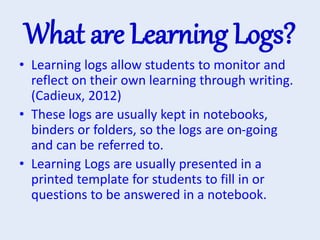
• Learning logs allow students to monitor and
reflect on their own learning through writing.
(Cadieux, 2012)
• These logs are usually kept in notebooks,
binders or folders, so the logs are on-going
and can be referred to.
• Learning Logs are usually presented in a
printed template for students to fill in or
questions to be answered in a notebook.
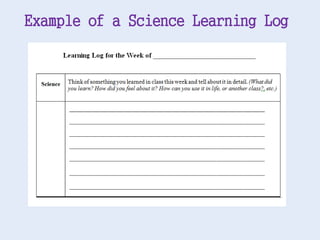
Example of a Science Learning Log
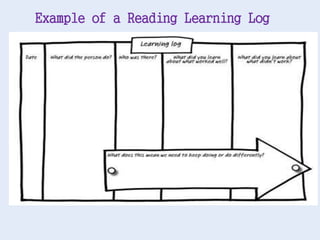
Example of a Reading Learning Log
More About Learning Logs
• Learning Logs can be used in any grade level
and in any content area.
• They encourage independent learning.
• They keep students organized.
• Learning Logs are completed at the end of a
lesson or at the end of the day.
• They can include word wall pages for students
to add new vocabulary words.
Why Would You Teach Using Learning
Logs?
• Learning Logs encourage students to discuss and
share their thoughts about what they have learned.
• They are an easy way for teachers to assess
whether or not a student understands specific
concepts.
• They help build note taking and self-reflection skills.
• They also build personal connections on what they
learn in school
• Learning Logs Foster the “Writing to Learn” Motto!
How To Teach Using Learning
Logs• There are many different ways to teach using
Learning Logs. Some examples include:
– Reading Responses
– End of Lesson Responses
– Science Lab Logs
– Free Write/Topic of the Day
– Letter to the Teacher
– Sequence Logs
– KWL Logs
– Content Learning Logs
Step by Step Instructions for
using a Content Learning Log
1) Teach a lesson in any content area.
2) After finishing the lesson, give the students 10-
15 minutes to fill in their content learning logs,
including the questions:
I’ve been learning about…
Knowing about this topic helps me…
This topic reminds me of…
The part I know the most about is…
The part that is most confusing is…
I’d like to know more about…
*Questions taken from Klingner & Vaughn, 1998
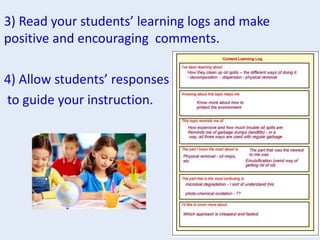
3) Read your students’ learning logs and make
positive and encouraging comments.
4) Allow students’ responses
to guide your instruction.
Ways Students Use Learning
Logs• Math: Write explanations for problems and
solutions
• Social Studies: Write from an historical
person’s point of view
• Science: Collect and record data
• Reading: discuss literary elements or character
traits from a story
Using Learning Logs in Mathematics (Article)
By Margaret E. McIntosh and Roni Jo Draper
Key Points:
• Teachers should read students’ learning logs to understand their
students’ thinking.
• Teachers should leave responses on learning logs.
• Teachers should write learning logs with students to model their own
thinking.
• Article shows different examples of how students use learning logs to
explain their thinking for different types of math problems.
McIntosh, M., & Draper, R. (2001). Using Learning Logs in
Mathematics: Writing to Learn. The Mathematics Teacher,
94(7), 554-557. Retrieved January 10, 2016, from
http://www.jstor.org/stable/20870796
References
• Cadieux, C. (2012, January 17). Learning Logs Are Important Literacy Tools.
Retrieved January 10, 2016, from
http://info.marygrove.edu/MATblog/bid/77519/Learning-logs-are-
important-literacy-tools
• Klingner, J., & Vaughn, S. (1998). Using Collaborative Strategic Reading.
Retrieved 2016, January 10, from
http://www.teachingld.org/pdf/teaching_how-tos

Learning logs

  • 1.
  • 2.
    What are LearningLogs? • Learning logs allow students to monitor and reflect on their own learning through writing. (Cadieux, 2012) • These logs are usually kept in notebooks, binders or folders, so the logs are on-going and can be referred to. • Learning Logs are usually presented in a printed template for students to fill in or questions to be answered in a notebook.
  • 3.
    Example of aScience Learning Log
  • 4.
    Example of aReading Learning Log
  • 5.
    More About LearningLogs • Learning Logs can be used in any grade level and in any content area. • They encourage independent learning. • They keep students organized. • Learning Logs are completed at the end of a lesson or at the end of the day. • They can include word wall pages for students to add new vocabulary words.
  • 6.
    Why Would YouTeach Using Learning Logs? • Learning Logs encourage students to discuss and share their thoughts about what they have learned. • They are an easy way for teachers to assess whether or not a student understands specific concepts. • They help build note taking and self-reflection skills. • They also build personal connections on what they learn in school • Learning Logs Foster the “Writing to Learn” Motto!
  • 7.
    How To TeachUsing Learning Logs• There are many different ways to teach using Learning Logs. Some examples include: – Reading Responses – End of Lesson Responses – Science Lab Logs – Free Write/Topic of the Day – Letter to the Teacher – Sequence Logs – KWL Logs – Content Learning Logs
  • 8.
    Step by StepInstructions for using a Content Learning Log 1) Teach a lesson in any content area. 2) After finishing the lesson, give the students 10- 15 minutes to fill in their content learning logs, including the questions: I’ve been learning about… Knowing about this topic helps me… This topic reminds me of… The part I know the most about is… The part that is most confusing is… I’d like to know more about… *Questions taken from Klingner & Vaughn, 1998
  • 9.
    3) Read yourstudents’ learning logs and make positive and encouraging comments. 4) Allow students’ responses to guide your instruction.
  • 10.
    Ways Students UseLearning Logs• Math: Write explanations for problems and solutions • Social Studies: Write from an historical person’s point of view • Science: Collect and record data • Reading: discuss literary elements or character traits from a story
  • 11.
    Using Learning Logsin Mathematics (Article) By Margaret E. McIntosh and Roni Jo Draper Key Points: • Teachers should read students’ learning logs to understand their students’ thinking. • Teachers should leave responses on learning logs. • Teachers should write learning logs with students to model their own thinking. • Article shows different examples of how students use learning logs to explain their thinking for different types of math problems. McIntosh, M., & Draper, R. (2001). Using Learning Logs in Mathematics: Writing to Learn. The Mathematics Teacher, 94(7), 554-557. Retrieved January 10, 2016, from http://www.jstor.org/stable/20870796
  • 12.
    References • Cadieux, C.(2012, January 17). Learning Logs Are Important Literacy Tools. Retrieved January 10, 2016, from http://info.marygrove.edu/MATblog/bid/77519/Learning-logs-are- important-literacy-tools • Klingner, J., & Vaughn, S. (1998). Using Collaborative Strategic Reading. Retrieved 2016, January 10, from http://www.teachingld.org/pdf/teaching_how-tos