Pervasive Learning at Workplace based on a  mixed Strategy, Situation-based and Activity-basedSerge GarlattiAmel Bouzeghoub
OutlinePLearNet ProjectIntroductionMobile & Pervasive LearningLearning atWorkplaceTwo Learning StrategiesSituation-based LearningActivity-based LearningA Mixed StrategyConclusionpage 1
page 2P-LearNet ProjectPervasive Learning NetworkNational Research AgencyE-retail groupPostal Services CompagnyAIDA SeminarPage 2
page 3P-LearNet ProjectIssuesIntegrate context-aware corporate learning and working activities Learning at workplace whatever the place, the time, the organisational and technological contexts of the individual or collective learning and working processesSolving the particular working tasks is prior Learning is just a meansAIDA Seminarpage 3
page 4P-LearNet ProjectIssuesQuality and efficiency of information and services to increase market shareSeamless learning and workingacross different contexts AIDA Seminarpage 4
page 5Pervasive LearningContext“Contextas a construct that is continually created by the interaction of learners, teachers, physical settings, and social environments” (M. Sharples)“Learning not only occurs in the context, it also creates context through continual interaction” (N. Balacheff)Unpredictable Context features are not always availableContext changes are not predictableAIDA Seminarpage 5
page 6Learning at WorkplaceFeaturesEnhance business performance and qualityFocused on working activitiesAcquire new knowledge, meta-knowledge and skills,Reflect on business processesLinking of working activities and social contextsIntegrate knowledge, working and learning spacesSituated Learning: just-in-case, just-in-timeAIDA Seminarpage 6
page 7Learning at WorplaceFeatures Learning at Workplace   Pervasive LearningLearning activities at workplace : situated, in context, across contextsThe context   relevant entities (contents, web services, collaborators, activities, etc.)AIDA Seminarpage 7
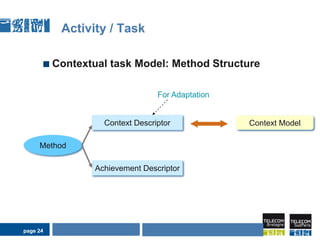
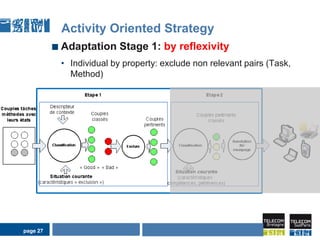
page 8Two Learning StrategiesSituation-based Learning Employee oriented Learning: PullSystem oriented Learning: PushProvides recommendations on the flyPassive / Proactive Adaptation Activity-based Learning“Guided” LearningHierarchical Task Model, Task / Method paradigmAdaptation by reflexivity and by contractAIDA Seminar
Situation-based Learningpage 9AIDA Seminar
Situation-based LearningScenario LaPostepage 10
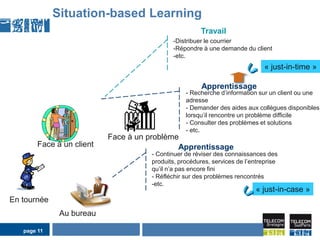
Situation-based Learningpage 11TravailDistribuer le courrier
Répondre à une demande du client
etc.Apprentissage Recherche d’information sur un client ou une adresse
 Demander des aides aux collègues disponibles lorsqu’il rencontre un problème difficile
 Consulter des problèmes et solutions
 etc.« just-in-time »Face à un problèmeFace à un clientApprentissage Continuer de réviser des connaissances des produits, procédures, services de l’entreprise qu’il n’a pas encore fini
 Réfléchir sur des problèmes rencontrés
etc.« just-in-case »En tournéeAu bureau
PrinciplesThe employee situation is the main focus for learningTo detect the learning needs of employees by analyzing the current situation To represent situated knowledge at workplace and to react to situation changes of employeesProvide recommendations on the fly to employees according to the current situationPropose relevant entities: information, services, collaborators, equipements, etc. Push or Pullpage 12
Situation definition A situation is a temporal state in the contextExternal and semantical interpretation of low level context to acquire high level specifications of human being behaviors and system servicesSituations provide meaning in applications and are more stable and easy to define and to maintain than low level contextual datapage 13
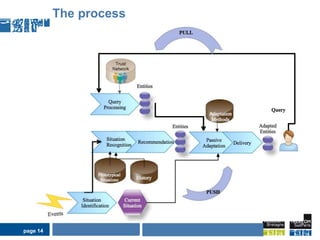
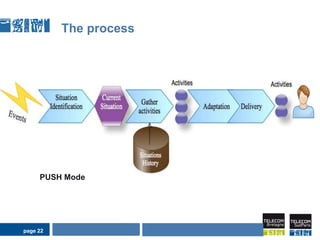
The processpage 14
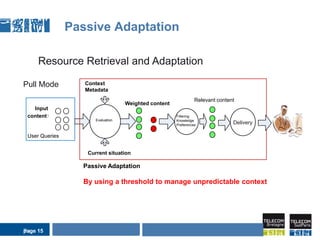
page 15Context Metadata Relevant contentWeighted contentInput content:FilteringKnowledgePreferencesEvaluationUser QueriesCurrent situationPassive AdaptationBy using a threshold to manage unpredictablecontextPassive AdaptationResource Retrieval and AdaptationPull ModeDeliveryAIDA SeminarPage 15
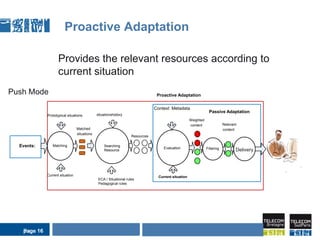
page 16Proactive AdaptationProvides the relevant resources according to current situationPush ModeProactive AdaptationContext  MetadataPassive AdaptationsituationshistoryPrototypical situationsWeightedRelevantcontentMatchedcontentsituationsResourcesEvents:Matching Searching Resource DeliveryEvaluationFiltering, , Current situationCurrent situationECA / Situational rulesPedagogical rulesAIDA SeminarPage 16
Seamless Learning at two levelsAt learning object level (learning ressources, services, etc.)After a break of the current situation due to an event, the system enables an employee to continue his/her activity in the new situation with the same entity or an equivalent one.At domain concept levelTo insure learning continuity, an employee may go on with the acquisition of knowledge and / or concepts. page 17
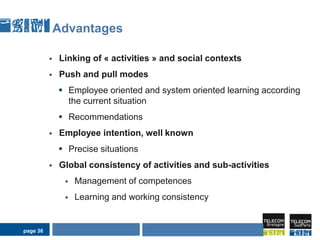
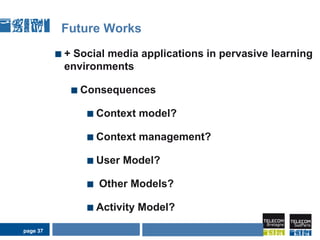
Advantages/DrawbacksAdvantagesPush and pull modesEmployee oriented and system oriented learning according to the current situationRecommendationsLinking of « activities » and social contextsDrawbackDo not guarantee learning consistencyUnknown employee intentionpage 18AIDA Seminar
Activity Oriented Strategypage 19AIDA Seminar
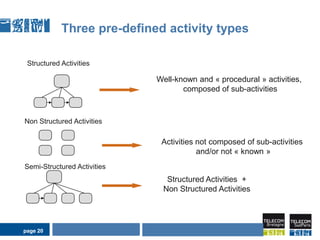
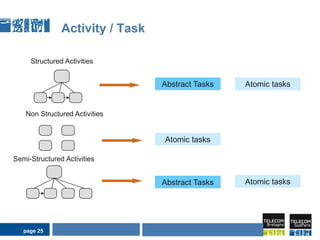
page 20Three pre-defined activity typesStructured ActivitiesWell-known and « procedural » activities, composed of sub-activitiesNon Structured ActivitiesActivities not composed of sub-activities and/or not « known »Semi-Structured ActivitiesStructured Activities  +Non Structured ActivitiesAIDA Seminarpage 20
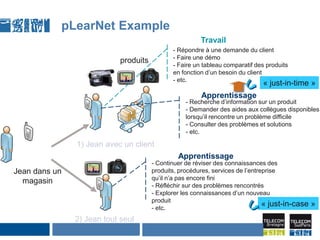
Travail Répondre à une demande du client
 Faire une démo
 Faire un tableau comparatif des produits en fonction d’un besoin du client
 etc.produitsApprentissage Recherche d’information sur un produit
 Demander des aides aux collègues disponibles lorsqu’il rencontre un problème difficile
 Consulter des problèmes et solutions
 etc.« just-in-time »1) Jean avec un clientApprentissage Continuer de réviser des connaissances des produits, procédures, services de l’entreprise qu’il n’a pas encore fini
 Réfléchir sur des problèmes rencontrés
 Explorer les connaissances d’un nouveau produit
 etc.« just-in-case »2) Jean tout seulpLearNet ExampleJean dans un magasinAIDA Seminarpage 21page 21

Learning at workplace

  • 1.
    Pervasive Learning atWorkplace based on a mixed Strategy, Situation-based and Activity-basedSerge GarlattiAmel Bouzeghoub
  • 2.
    OutlinePLearNet ProjectIntroductionMobile &Pervasive LearningLearning atWorkplaceTwo Learning StrategiesSituation-based LearningActivity-based LearningA Mixed StrategyConclusionpage 1
  • 3.
    page 2P-LearNet ProjectPervasiveLearning NetworkNational Research AgencyE-retail groupPostal Services CompagnyAIDA SeminarPage 2
  • 4.
    page 3P-LearNet ProjectIssuesIntegratecontext-aware corporate learning and working activities Learning at workplace whatever the place, the time, the organisational and technological contexts of the individual or collective learning and working processesSolving the particular working tasks is prior Learning is just a meansAIDA Seminarpage 3
  • 5.
    page 4P-LearNet ProjectIssuesQualityand efficiency of information and services to increase market shareSeamless learning and workingacross different contexts AIDA Seminarpage 4
  • 6.
    page 5Pervasive LearningContext“Contextasa construct that is continually created by the interaction of learners, teachers, physical settings, and social environments” (M. Sharples)“Learning not only occurs in the context, it also creates context through continual interaction” (N. Balacheff)Unpredictable Context features are not always availableContext changes are not predictableAIDA Seminarpage 5
  • 7.
    page 6Learning atWorkplaceFeaturesEnhance business performance and qualityFocused on working activitiesAcquire new knowledge, meta-knowledge and skills,Reflect on business processesLinking of working activities and social contextsIntegrate knowledge, working and learning spacesSituated Learning: just-in-case, just-in-timeAIDA Seminarpage 6
  • 8.
    page 7Learning atWorplaceFeatures Learning at Workplace  Pervasive LearningLearning activities at workplace : situated, in context, across contextsThe context  relevant entities (contents, web services, collaborators, activities, etc.)AIDA Seminarpage 7
  • 9.
    page 8Two LearningStrategiesSituation-based Learning Employee oriented Learning: PullSystem oriented Learning: PushProvides recommendations on the flyPassive / Proactive Adaptation Activity-based Learning“Guided” LearningHierarchical Task Model, Task / Method paradigmAdaptation by reflexivity and by contractAIDA Seminar
  • 10.
  • 11.
  • 12.
  • 13.
    Répondre à unedemande du client
  • 14.
  • 15.
    Demander desaides aux collègues disponibles lorsqu’il rencontre un problème difficile
  • 16.
    Consulter desproblèmes et solutions
  • 17.
    etc.« just-in-time »Face àun problèmeFace à un clientApprentissage Continuer de réviser des connaissances des produits, procédures, services de l’entreprise qu’il n’a pas encore fini
  • 18.
    Réfléchir surdes problèmes rencontrés
  • 19.
  • 20.
    PrinciplesThe employee situationis the main focus for learningTo detect the learning needs of employees by analyzing the current situation To represent situated knowledge at workplace and to react to situation changes of employeesProvide recommendations on the fly to employees according to the current situationPropose relevant entities: information, services, collaborators, equipements, etc. Push or Pullpage 12
  • 21.
    Situation definition Asituation is a temporal state in the contextExternal and semantical interpretation of low level context to acquire high level specifications of human being behaviors and system servicesSituations provide meaning in applications and are more stable and easy to define and to maintain than low level contextual datapage 13
  • 22.
  • 23.
    page 15Context MetadataRelevant contentWeighted contentInput content:FilteringKnowledgePreferencesEvaluationUser QueriesCurrent situationPassive AdaptationBy using a threshold to manage unpredictablecontextPassive AdaptationResource Retrieval and AdaptationPull ModeDeliveryAIDA SeminarPage 15
  • 24.
    page 16Proactive AdaptationProvidesthe relevant resources according to current situationPush ModeProactive AdaptationContext MetadataPassive AdaptationsituationshistoryPrototypical situationsWeightedRelevantcontentMatchedcontentsituationsResourcesEvents:Matching Searching Resource DeliveryEvaluationFiltering, , Current situationCurrent situationECA / Situational rulesPedagogical rulesAIDA SeminarPage 16
  • 25.
    Seamless Learning attwo levelsAt learning object level (learning ressources, services, etc.)After a break of the current situation due to an event, the system enables an employee to continue his/her activity in the new situation with the same entity or an equivalent one.At domain concept levelTo insure learning continuity, an employee may go on with the acquisition of knowledge and / or concepts. page 17
  • 26.
    Advantages/DrawbacksAdvantagesPush and pullmodesEmployee oriented and system oriented learning according to the current situationRecommendationsLinking of « activities » and social contextsDrawbackDo not guarantee learning consistencyUnknown employee intentionpage 18AIDA Seminar
  • 27.
  • 28.
    page 20Three pre-definedactivity typesStructured ActivitiesWell-known and « procedural » activities, composed of sub-activitiesNon Structured ActivitiesActivities not composed of sub-activities and/or not « known »Semi-Structured ActivitiesStructured Activities +Non Structured ActivitiesAIDA Seminarpage 20
  • 29.
    Travail Répondre àune demande du client
  • 30.
  • 31.
    Faire untableau comparatif des produits en fonction d’un besoin du client
  • 32.
    etc.produitsApprentissage Recherched’information sur un produit
  • 33.
    Demander desaides aux collègues disponibles lorsqu’il rencontre un problème difficile
  • 34.
    Consulter desproblèmes et solutions
  • 35.
    etc.« just-in-time »1) Jeanavec un clientApprentissage Continuer de réviser des connaissances des produits, procédures, services de l’entreprise qu’il n’a pas encore fini
  • 36.
    Réfléchir surdes problèmes rencontrés
  • 37.
    Explorer lesconnaissances d’un nouveau produit
  • 38.
    etc.« just-in-case »2) Jeantout seulpLearNet ExampleJean dans un magasinAIDA Seminarpage 21page 21