Semantic Web in Action:

     Ontologies for Social Web


S. Garlatti


10/09/09
Outline

         ¢  Semantic   Web
         ¢  Linked   Data
         ¢  SPARQL

         ¢  Semantic   Web & Social Web
           •  FOAF : Friend of Friend
           •  SIOC: Semantically-Interlinked Online Communities
           •  SKOS: Simple Knowledge Organisation Systems
           •  DOAP: Description of a Project


page 2                        Semantic Web in Action
FOAF : Friend of Friend

         ¢    http://www.wasab.dk/morten/blog/archives/author/mortenf/

         ¢    http://www.openlinksw.com/blog/~kidehen/

         ¢    http://www.mkbergman.com/

         ¢    http://fgiasson.com/blog/

         ¢    http://virtuoso.openlinksw.com/wiki/main/Main/Ods

         ¢    http://www.johnbreslin.com/blog/

         ¢    http://www.wikier.org/

         ¢    http://swaml.berlios.de/


page 3                                  Semantic Web in Action
Social Web : Web 3.0


                     Web 2.0


             [SKOS]


                  Semantic Web

page 4                 Semantic Web in Action
Social Web : Web 3.0


         “I think we could...have both Semantic Web
         technology supporting online communities, but
         at the same time also online communities can
         also support Semantic Web data by being the
         sources of people voluntarily connecting things
         together.”


                 Tim Berners-Lee, ISWC2005 Podcast

page 5                    Semantic Web in Action
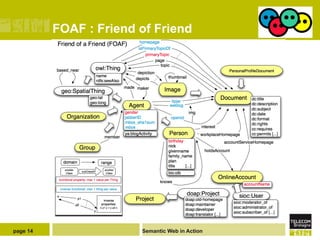
FOAF : Friend of Friend

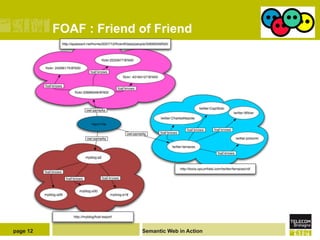
         ¢    FOAF (an acronym of Friend of a Friend)

               •  Is a machine-readable ontology describing persons, their
                  activities and their relations to other people and objects.

                 Anyone can use FOAF to describe him or herself. FOAF allows
                 groups of people to describe social networks without the need
                 for a centralised database (Wikipedia)

         ¢    Everyone can create their own FOAF document and link to it
               from their homepage

         ¢    FOAF documents usually contain personal info, links to
               friends, and other related resources


page 6                                Semantic Web in Action
FOAF : Friend of Friend

         ¢ Resources

          •  http://www.foaf-project.org/

          •  http://websemantique.org/FOAF

          •  http://fr.wikipedia.org/wiki/FOAF


page 7                     Semantic Web in Action
FOAF : Friend of Friend

         ¢  Social   vocabulary
           •  Information about
             -  Person
             -  Social Network / Relations
             -  Groups (multiple)
             -  FOAF can be combined with other vocabularies


page 8                              Semantic Web in Action
FOAF : Friend of Friend

         ¢  Components   (data)
          •  A way to identify persons across sites / services
            -  Privacy

          •  A way to describe social network
            -  Relations between people

          •  Email address (private)
          •  Hash of email (semi-public)
          •  URL’s (public)


page 9                         Semantic Web in Action
FOAF : Friend of Friend

          ¢  Component   (tools)

           •  Tools / services

           •  Data providers
             -  Opening up social media sites

           •  Data users / consumers


page 10                          Semantic Web in Action
FOAF : Friend of Friend
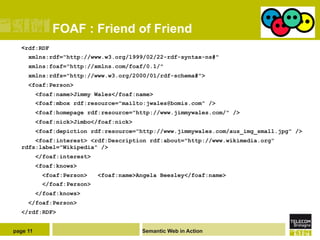
  <rdf:RDF
     xmlns:rdf="http://www.w3.org/1999/02/22-rdf-syntax-ns#"
     xmlns:foaf="http://xmlns.com/foaf/0.1/"
     xmlns:rdfs="http://www.w3.org/2000/01/rdf-schema#">
     <foaf:Person>
          <foaf:name>Jimmy Wales</foaf:name>
          <foaf:mbox rdf:resource="mailto:jwales@bomis.com" />
          <foaf:homepage rdf:resource="http://www.jimmywales.com/" />
          <foaf:nick>Jimbo</foaf:nick>
          <foaf:depiction rdf:resource="http://www.jimmywales.com/aus_img_small.jpg" />
      <foaf:interest> <rdf:Description rdf:about="http://www.wikimedia.org"
  rdfs:label="Wikipedia" />
          </foaf:interest>
          <foaf:knows>
            <foaf:Person>    <foaf:name>Angela Beesley</foaf:name>
            </foaf:Person>
          </foaf:knows>
     </foaf:Person>
  </rdf:RDF>


page 11                                  Semantic Web in Action
FOAF : Friend of Friend


page 12                 Semantic Web in Action
FOAF : Friend of Friend

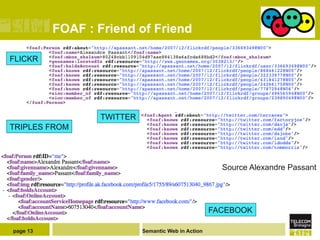
FLICKR


                 TWITTER
TRIPLES FROM


                                                      Source Alexandre Passant


                                                    FACEBOOK

page 13                    Semantic Web in Action
FOAF : Friend of Friend


page 14                 Semantic Web in Action
FOAF : Friend of Friend

          ¢  Some   Tools
           •  FOAF-a-matic, by Leigh Dodds : Javascript form to generate
              FOAF files

           •  FOAFaMaticMark2, Java application for generating FOAF
              files.

           •  FoaF Explorer, FOAF browser in HTML.

           •  FOAFer, FOAF browser in HTML.

           •  FOAF.Vix to display FOAF files and to explore et their
              relationships.


page 15                           Semantic Web in Action
SIOC: Semantically-Interlinked Online
                Communities

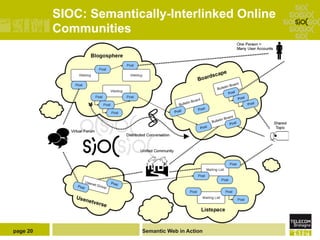
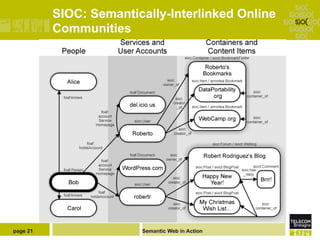
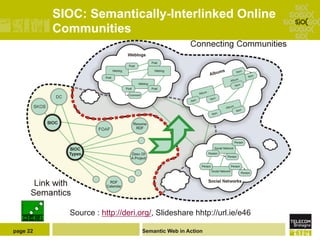
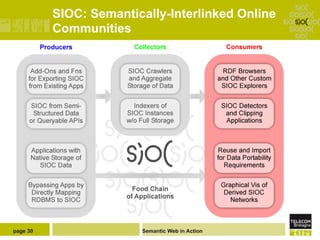
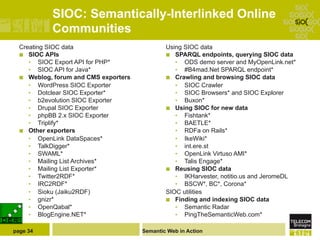
          ¢    SIOC (pronounced "shock")
                •  Provides methods for interconnecting discussion methods such as
                   blogs, forums and mailing lists to each other.

                •  It consists of the SIOC ontology, an open-standard machine readable
                   format for expressing the information contained both explicitly and
                   implicitly in Internet discussion methods, of SIOC metadata producers
                   for a number of popular blogging platforms and
                   content management systems, and of storage and browsing/searching
                   systems for leveraging this SIOC data (Wikipedia).


          ¢    Goal of the SIOC ontology: address interoperability issues on the
                Social Web

                •  SIOC adopted in a framework of 50 applications or modules deployed
                   on over 400 sites

page 16                                 Semantic Web in Action
SIOC: Semantically-Interlinked Online
                Communities
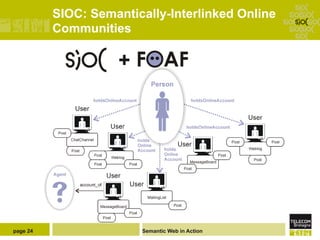
          ¢    “It just dawned on me that the burgeoning SIOC-o-sphere
                (online communities exporting and exposing content via
                SIOC Ontology) is actually: Blogosphere 2.0” – Kingsley
                Idehen, Founder and CEO of OpenLink Software

          ¢    “SIOC has the potential to become one of the foundational
                vocabularies that make Semantic Web applications useful” –
                Ivan Herman, W3C / ERCIM

          ¢    “A project that started back in 2000 called Friend-of-a-Friend
                (FOAF) represents relationships between people, as well as
                basic contact details. SIOC does this for groups: it extends
                the FOAF idea to being able to talk about whole groups of
                people. I am excited about SIOC because you can use that
                information to determine trust, to let people in.” – Tim
                Berners-Lee, Creator of the World Wide Web

          Source : John Breslin
page 17                              Semantic Web in Action
SIOC: Semantically-Interlinked Online
           Communities

          ¢  Resources

           •  http://en.wikipedia.org/wiki/SIOC

           •  http://sioc-project.org/

           •  http://wiki.sioc-project.org/index.php/Main_Page

           •  http://www.w3.org/2008/09/msnws/papers/sioc.html

           •  http://www.w3.org/Submission/2007/02/Comment

           •  http://www.w3.org/Submission/sioc-spec/

page 18                         Semantic Web in Action
SIOC: Semantically-Interlinked Online
                Communities

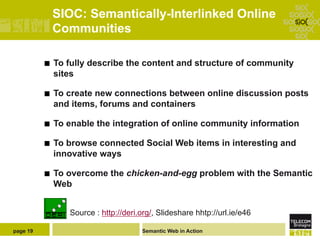
          ¢    To fully describe the content and structure of community
                sites

          ¢    To create new connections between online discussion posts
                and items, forums and containers

          ¢    To enable the integration of online community information

          ¢    To browse connected Social Web items in interesting and
                innovative ways

          ¢    To overcome the chicken-and-egg problem with the Semantic
                Web


                   Source : http://deri.org/, Slideshare hhtp://url.ie/e46

page 19                                 Semantic Web in Action
SIOC: Semantically-Interlinked Online
          Communities


page 20                 Semantic Web in Action
SIOC: Semantically-Interlinked Online
          Communities


page 21                 Semantic Web in Action
SIOC: Semantically-Interlinked Online
          Communities


            Source : http://deri.org/, Slideshare hhtp://url.ie/e46

page 22                          Semantic Web in Action
SIOC: Semantically-Interlinked Online
          Communities


            Source : http://deri.org/, Slideshare hhtp://url.ie/e46

page 23                          Semantic Web in Action
SIOC: Semantically-Interlinked Online
          Communities


page 24                 Semantic Web in Action
SIOC: Semantically-Interlinked Online
          Communities


page 25                 Semantic Web in Action
SIOC: Semantically-Interlinked Online
                Communities

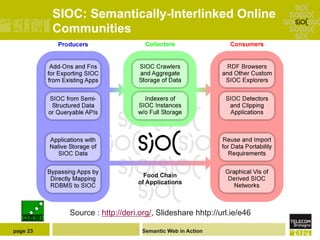
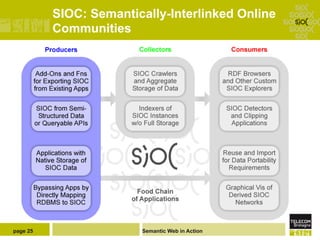
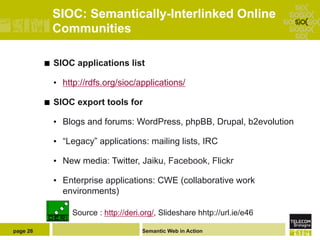
          ¢    SIOC applications list

                •  http://rdfs.org/sioc/applications/

          ¢    SIOC export tools for

                •  Blogs and forums: WordPress, phpBB, Drupal, b2evolution

                •  “Legacy” applications: mailing lists, IRC

                •  New media: Twitter, Jaiku, Facebook, Flickr

                •  Enterprise applications: CWE (collaborative work
                   environments)

                     Source : http://deri.org/, Slideshare hhtp://url.ie/e46

page 26                                   Semantic Web in Action
SIOC: Semantically-Interlinked Online
                Communities
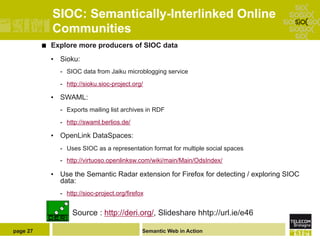
          ¢    Explore more producers of SIOC data
                •  Sioku:
                  -  SIOC data from Jaiku microblogging service

                  -  http://sioku.sioc-project.org/

                •  SWAML:
                  -  Exports mailing list archives in RDF

                  -  http://swaml.berlios.de/

                •  OpenLink DataSpaces:
                  -  Uses SIOC as a representation format for multiple social spaces
                  -  http://virtuoso.openlinksw.com/wiki/main/Main/OdsIndex/

                •  Use the Semantic Radar extension for Firefox for detecting / exploring SIOC
                   data:
                  -  http://sioc-project.org/firefox


                      Source : http://deri.org/, Slideshare hhtp://url.ie/e46

page 27                                            Semantic Web in Action
SIOC: Semantically-Interlinked Online
          Communities


page 28                 Semantic Web in Action
SIOC: Semantically-Interlinked Online
                Communities

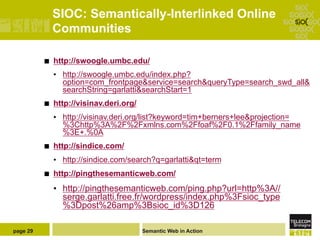
          ¢    http://swoogle.umbc.edu/
                •  http://swoogle.umbc.edu/index.php?
                   option=com_frontpage&service=search&queryType=search_swd_all&
                   searchString=garlatti&searchStart=1
          ¢    http://visinav.deri.org/
                •  http://visinav.deri.org/list?keyword=tim+berners+lee&projection=
                   %3Chttp%3A%2F%2Fxmlns.com%2Ffoaf%2F0.1%2Ffamily_name
                   %3E+.%0A
          ¢    http://sindice.com/
                •  http://sindice.com/search?q=garlatti&qt=term
          ¢    http://pingthesemanticweb.com/
                •  http://pingthesemanticweb.com/ping.php?url=http%3A//
                   serge.garlatti.free.fr/wordpress/index.php%3Fsioc_type
                   %3Dpost%26amp%3Bsioc_id%3D126

page 29                                    Semantic Web in Action
SIOC: Semantically-Interlinked Online
          Communities


page 30                 Semantic Web in Action
SIOC: Semantically-Interlinked Online
                Communities

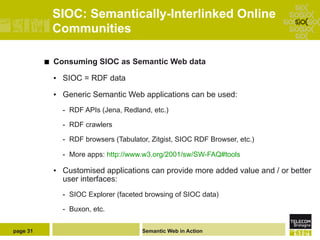
          ¢    Consuming SIOC as Semantic Web data

                •  SIOC = RDF data

                •  Generic Semantic Web applications can be used:
                  -  RDF APIs (Jena, Redland, etc.)

                  -  RDF crawlers

                  -  RDF browsers (Tabulator, Zitgist, SIOC RDF Browser, etc.)

                  -  More apps: http://www.w3.org/2001/sw/SW-FAQ#tools

                •  Customised applications can provide more added value and / or better
                   user interfaces:
                  -  SIOC Explorer (faceted browsing of SIOC data)

                  -  Buxon, etc.


page 31                                   Semantic Web in Action
SIOC: Semantically-Interlinked Online
                Communities

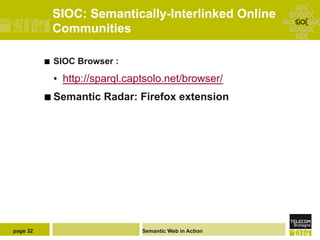
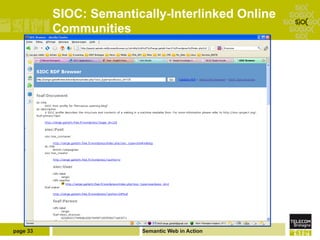
          ¢    SIOC Browser :

                •  http://sparql.captsolo.net/browser/
          ¢  Semantic     Radar: Firefox extension


page 32                            Semantic Web in Action
SIOC: Semantically-Interlinked Online
          Communities


page 33                 Semantic Web in Action
SIOC: Semantically-Interlinked Online
            Communities
  Creating SIOC data                            Using SIOC data
  ¢  SIOC APIs                                 ¢  SPARQL endpoints, querying SIOC data
      •  SIOC Export API for PHP*                   •  ODS demo server and MyOpenLink.net*
      •  SIOC API for Java*                         •  #B4mad.Net SPARQL endpoint*
  ¢  Weblog, forum and CMS exporters           ¢  Crawling and browsing SIOC data
      •  WordPress SIOC Exporter                    •  SIOC Crawler
      •  Dotclear SIOC Exporter*                    •  SIOC Browsers* and SIOC Explorer
      •  b2evolution SIOC Exporter                  •  Buxon*
      •  Drupal SIOC Exporter                   ¢  Using SIOC for new data
      •  phpBB 2.x SIOC Exporter                    •  Fishtank*
      •  Triplify*                                  •  BAETLE*
  ¢  Other exporters                               •  RDFa on Rails*
      •  OpenLink DataSpaces*                       •  IkeWiki*
      •  TalkDigger*                                •  int.ere.st
      •  SWAML*                                     •  OpenLink Virtuso AMI*
      •  Mailing List Archives*                     •  Talis Engage*
      •  Mailing List Exporter*                 ¢  Reusing SIOC data
      •  Twitter2RDF*                               •  IKHarvester, notitio.us and JeromeDL
      •  IRC2RDF*                                   •  BSCW*, BC*, Corona*
      •  Sioku (Jaiku2RDF)                      SIOC utilities
      •  gnizr*                                 ¢  Finding and indexing SIOC data
      •  OpenQabal*                                 •  Semantic Radar
      •  BlogEngine.NET*                            •  PingTheSemanticWeb.com*

page 34                                 Semantic Web in Action
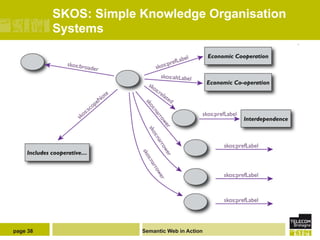
SKOS: Simple Knowledge Organisation
           Systems

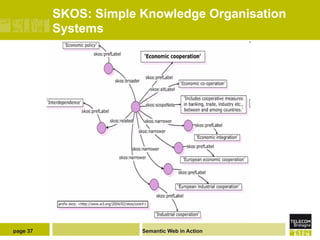
          ¢  SKOS

           •  Is a family of formal languages designed for
              representation of thesauri, classification schemes,
              taxonomies, subject-heading systems, or any other
              type of structured controlled vocabulary. SKOS is
              built upon RDF and RDFS, and its main objective is
              to enable easy publication of controlled structured
              vocabularies for the Semantic Web. SKOS is
              currently developed within the W3C framework
              (Wikipedia).


page 35                      Semantic Web in Action
SKOS: Simple Knowledge Organisation
           Systems

          ¢  Resources

           •  http://www.w3.org/TR/2008/WD-skos-primer-20080829/

           •  http://en.wikipedia.org/wiki/SKOS

           •  http://www.w3.org/2004/02/skos/

           •  http://www.lespetitescases.net/skos-l-avenir-de-la-folksonomie-
              y

           •  http://websemantique.org/SKOS

           •  http://esw.w3.org/topic/SkosDev/DataZone


page 36                          Semantic Web in Action
SKOS: Simple Knowledge Organisation
          Systems


page 37                Semantic Web in Action
SKOS: Simple Knowledge Organisation
          Systems


page 38                Semantic Web in Action
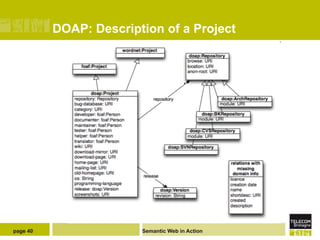
DOAP: Description of a Project

          ¢    DOAP Description of a Project
                •  Is an RDF schema and XML vocabulary to describe open-source
                   projects. It was created and initially developed by Edd Dumbill to
                   convey semantically information associated with open-source software
                   projects. It is currently used in the Mozilla Foundation's project page
                   and in several other software repositories. (Wikipedia)


          ¢    Resources

                •  http://websemantique.org/DOAP

                •  http://en.wikipedia.org/wiki/DOAP

                •  http://doapspace.org/


page 39                                  Semantic Web in Action
DOAP: Description of a Project


page 40                 Semantic Web in Action

Social web Ontologies

  • 1.
    Semantic Web inAction: Ontologies for Social Web S. Garlatti 10/09/09
  • 2.
    Outline ¢  Semantic Web ¢  Linked Data ¢  SPARQL ¢  Semantic Web & Social Web •  FOAF : Friend of Friend •  SIOC: Semantically-Interlinked Online Communities •  SKOS: Simple Knowledge Organisation Systems •  DOAP: Description of a Project page 2 Semantic Web in Action
  • 3.
    FOAF : Friendof Friend ¢  http://www.wasab.dk/morten/blog/archives/author/mortenf/ ¢  http://www.openlinksw.com/blog/~kidehen/ ¢  http://www.mkbergman.com/ ¢  http://fgiasson.com/blog/ ¢  http://virtuoso.openlinksw.com/wiki/main/Main/Ods ¢  http://www.johnbreslin.com/blog/ ¢  http://www.wikier.org/ ¢  http://swaml.berlios.de/ page 3 Semantic Web in Action
  • 4.
    Social Web :Web 3.0 Web 2.0 [SKOS] Semantic Web page 4 Semantic Web in Action
  • 5.
    Social Web :Web 3.0 “I think we could...have both Semantic Web technology supporting online communities, but at the same time also online communities can also support Semantic Web data by being the sources of people voluntarily connecting things together.” Tim Berners-Lee, ISWC2005 Podcast page 5 Semantic Web in Action
  • 6.
    FOAF : Friendof Friend ¢  FOAF (an acronym of Friend of a Friend) •  Is a machine-readable ontology describing persons, their activities and their relations to other people and objects. Anyone can use FOAF to describe him or herself. FOAF allows groups of people to describe social networks without the need for a centralised database (Wikipedia) ¢  Everyone can create their own FOAF document and link to it from their homepage ¢  FOAF documents usually contain personal info, links to friends, and other related resources page 6 Semantic Web in Action
  • 7.
    FOAF : Friendof Friend ¢ Resources •  http://www.foaf-project.org/ •  http://websemantique.org/FOAF •  http://fr.wikipedia.org/wiki/FOAF page 7 Semantic Web in Action
  • 8.
    FOAF : Friendof Friend ¢  Social vocabulary •  Information about -  Person -  Social Network / Relations -  Groups (multiple) -  FOAF can be combined with other vocabularies page 8 Semantic Web in Action
  • 9.
    FOAF : Friendof Friend ¢  Components (data) •  A way to identify persons across sites / services -  Privacy •  A way to describe social network -  Relations between people •  Email address (private) •  Hash of email (semi-public) •  URL’s (public) page 9 Semantic Web in Action
  • 10.
    FOAF : Friendof Friend ¢  Component (tools) •  Tools / services •  Data providers -  Opening up social media sites •  Data users / consumers page 10 Semantic Web in Action
  • 11.
    FOAF : Friendof Friend <rdf:RDF xmlns:rdf="http://www.w3.org/1999/02/22-rdf-syntax-ns#" xmlns:foaf="http://xmlns.com/foaf/0.1/" xmlns:rdfs="http://www.w3.org/2000/01/rdf-schema#"> <foaf:Person> <foaf:name>Jimmy Wales</foaf:name> <foaf:mbox rdf:resource="mailto:jwales@bomis.com" /> <foaf:homepage rdf:resource="http://www.jimmywales.com/" /> <foaf:nick>Jimbo</foaf:nick> <foaf:depiction rdf:resource="http://www.jimmywales.com/aus_img_small.jpg" /> <foaf:interest> <rdf:Description rdf:about="http://www.wikimedia.org" rdfs:label="Wikipedia" /> </foaf:interest> <foaf:knows> <foaf:Person> <foaf:name>Angela Beesley</foaf:name> </foaf:Person> </foaf:knows> </foaf:Person> </rdf:RDF> page 11 Semantic Web in Action
  • 12.
    FOAF : Friendof Friend page 12 Semantic Web in Action
  • 13.
    FOAF : Friendof Friend FLICKR TWITTER TRIPLES FROM Source Alexandre Passant FACEBOOK page 13 Semantic Web in Action
  • 14.
    FOAF : Friendof Friend page 14 Semantic Web in Action
  • 15.
    FOAF : Friendof Friend ¢  Some Tools •  FOAF-a-matic, by Leigh Dodds : Javascript form to generate FOAF files •  FOAFaMaticMark2, Java application for generating FOAF files. •  FoaF Explorer, FOAF browser in HTML. •  FOAFer, FOAF browser in HTML. •  FOAF.Vix to display FOAF files and to explore et their relationships. page 15 Semantic Web in Action
  • 16.
    SIOC: Semantically-Interlinked Online Communities ¢  SIOC (pronounced "shock") •  Provides methods for interconnecting discussion methods such as blogs, forums and mailing lists to each other. •  It consists of the SIOC ontology, an open-standard machine readable format for expressing the information contained both explicitly and implicitly in Internet discussion methods, of SIOC metadata producers for a number of popular blogging platforms and content management systems, and of storage and browsing/searching systems for leveraging this SIOC data (Wikipedia). ¢  Goal of the SIOC ontology: address interoperability issues on the Social Web •  SIOC adopted in a framework of 50 applications or modules deployed on over 400 sites page 16 Semantic Web in Action
  • 17.
    SIOC: Semantically-Interlinked Online Communities ¢  “It just dawned on me that the burgeoning SIOC-o-sphere (online communities exporting and exposing content via SIOC Ontology) is actually: Blogosphere 2.0” – Kingsley Idehen, Founder and CEO of OpenLink Software ¢  “SIOC has the potential to become one of the foundational vocabularies that make Semantic Web applications useful” – Ivan Herman, W3C / ERCIM ¢  “A project that started back in 2000 called Friend-of-a-Friend (FOAF) represents relationships between people, as well as basic contact details. SIOC does this for groups: it extends the FOAF idea to being able to talk about whole groups of people. I am excited about SIOC because you can use that information to determine trust, to let people in.” – Tim Berners-Lee, Creator of the World Wide Web Source : John Breslin page 17 Semantic Web in Action
  • 18.
    SIOC: Semantically-Interlinked Online Communities ¢  Resources •  http://en.wikipedia.org/wiki/SIOC •  http://sioc-project.org/ •  http://wiki.sioc-project.org/index.php/Main_Page •  http://www.w3.org/2008/09/msnws/papers/sioc.html •  http://www.w3.org/Submission/2007/02/Comment •  http://www.w3.org/Submission/sioc-spec/ page 18 Semantic Web in Action
  • 19.
    SIOC: Semantically-Interlinked Online Communities ¢  To fully describe the content and structure of community sites ¢  To create new connections between online discussion posts and items, forums and containers ¢  To enable the integration of online community information ¢  To browse connected Social Web items in interesting and innovative ways ¢  To overcome the chicken-and-egg problem with the Semantic Web Source : http://deri.org/, Slideshare hhtp://url.ie/e46 page 19 Semantic Web in Action
  • 20.
    SIOC: Semantically-Interlinked Online Communities page 20 Semantic Web in Action
  • 21.
    SIOC: Semantically-Interlinked Online Communities page 21 Semantic Web in Action
  • 22.
    SIOC: Semantically-Interlinked Online Communities Source : http://deri.org/, Slideshare hhtp://url.ie/e46 page 22 Semantic Web in Action
  • 23.
    SIOC: Semantically-Interlinked Online Communities Source : http://deri.org/, Slideshare hhtp://url.ie/e46 page 23 Semantic Web in Action
  • 24.
    SIOC: Semantically-Interlinked Online Communities page 24 Semantic Web in Action
  • 25.
    SIOC: Semantically-Interlinked Online Communities page 25 Semantic Web in Action
  • 26.
    SIOC: Semantically-Interlinked Online Communities ¢  SIOC applications list •  http://rdfs.org/sioc/applications/ ¢  SIOC export tools for •  Blogs and forums: WordPress, phpBB, Drupal, b2evolution •  “Legacy” applications: mailing lists, IRC •  New media: Twitter, Jaiku, Facebook, Flickr •  Enterprise applications: CWE (collaborative work environments) Source : http://deri.org/, Slideshare hhtp://url.ie/e46 page 26 Semantic Web in Action
  • 27.
    SIOC: Semantically-Interlinked Online Communities ¢  Explore more producers of SIOC data •  Sioku: -  SIOC data from Jaiku microblogging service -  http://sioku.sioc-project.org/ •  SWAML: -  Exports mailing list archives in RDF -  http://swaml.berlios.de/ •  OpenLink DataSpaces: -  Uses SIOC as a representation format for multiple social spaces -  http://virtuoso.openlinksw.com/wiki/main/Main/OdsIndex/ •  Use the Semantic Radar extension for Firefox for detecting / exploring SIOC data: -  http://sioc-project.org/firefox Source : http://deri.org/, Slideshare hhtp://url.ie/e46 page 27 Semantic Web in Action
  • 28.
    SIOC: Semantically-Interlinked Online Communities page 28 Semantic Web in Action
  • 29.
    SIOC: Semantically-Interlinked Online Communities ¢  http://swoogle.umbc.edu/ •  http://swoogle.umbc.edu/index.php? option=com_frontpage&service=search&queryType=search_swd_all& searchString=garlatti&searchStart=1 ¢  http://visinav.deri.org/ •  http://visinav.deri.org/list?keyword=tim+berners+lee&projection= %3Chttp%3A%2F%2Fxmlns.com%2Ffoaf%2F0.1%2Ffamily_name %3E+.%0A ¢  http://sindice.com/ •  http://sindice.com/search?q=garlatti&qt=term ¢  http://pingthesemanticweb.com/ •  http://pingthesemanticweb.com/ping.php?url=http%3A// serge.garlatti.free.fr/wordpress/index.php%3Fsioc_type %3Dpost%26amp%3Bsioc_id%3D126 page 29 Semantic Web in Action
  • 30.
    SIOC: Semantically-Interlinked Online Communities page 30 Semantic Web in Action
  • 31.
    SIOC: Semantically-Interlinked Online Communities ¢  Consuming SIOC as Semantic Web data •  SIOC = RDF data •  Generic Semantic Web applications can be used: -  RDF APIs (Jena, Redland, etc.) -  RDF crawlers -  RDF browsers (Tabulator, Zitgist, SIOC RDF Browser, etc.) -  More apps: http://www.w3.org/2001/sw/SW-FAQ#tools •  Customised applications can provide more added value and / or better user interfaces: -  SIOC Explorer (faceted browsing of SIOC data) -  Buxon, etc. page 31 Semantic Web in Action
  • 32.
    SIOC: Semantically-Interlinked Online Communities ¢  SIOC Browser : •  http://sparql.captsolo.net/browser/ ¢  Semantic Radar: Firefox extension page 32 Semantic Web in Action
  • 33.
    SIOC: Semantically-Interlinked Online Communities page 33 Semantic Web in Action
  • 34.
    SIOC: Semantically-Interlinked Online Communities Creating SIOC data Using SIOC data ¢  SIOC APIs ¢  SPARQL endpoints, querying SIOC data •  SIOC Export API for PHP* •  ODS demo server and MyOpenLink.net* •  SIOC API for Java* •  #B4mad.Net SPARQL endpoint* ¢  Weblog, forum and CMS exporters ¢  Crawling and browsing SIOC data •  WordPress SIOC Exporter •  SIOC Crawler •  Dotclear SIOC Exporter* •  SIOC Browsers* and SIOC Explorer •  b2evolution SIOC Exporter •  Buxon* •  Drupal SIOC Exporter ¢  Using SIOC for new data •  phpBB 2.x SIOC Exporter •  Fishtank* •  Triplify* •  BAETLE* ¢  Other exporters •  RDFa on Rails* •  OpenLink DataSpaces* •  IkeWiki* •  TalkDigger* •  int.ere.st •  SWAML* •  OpenLink Virtuso AMI* •  Mailing List Archives* •  Talis Engage* •  Mailing List Exporter* ¢  Reusing SIOC data •  Twitter2RDF* •  IKHarvester, notitio.us and JeromeDL •  IRC2RDF* •  BSCW*, BC*, Corona* •  Sioku (Jaiku2RDF) SIOC utilities •  gnizr* ¢  Finding and indexing SIOC data •  OpenQabal* •  Semantic Radar •  BlogEngine.NET* •  PingTheSemanticWeb.com* page 34 Semantic Web in Action
  • 35.
    SKOS: Simple KnowledgeOrganisation Systems ¢  SKOS •  Is a family of formal languages designed for representation of thesauri, classification schemes, taxonomies, subject-heading systems, or any other type of structured controlled vocabulary. SKOS is built upon RDF and RDFS, and its main objective is to enable easy publication of controlled structured vocabularies for the Semantic Web. SKOS is currently developed within the W3C framework (Wikipedia). page 35 Semantic Web in Action
  • 36.
    SKOS: Simple KnowledgeOrganisation Systems ¢  Resources •  http://www.w3.org/TR/2008/WD-skos-primer-20080829/ •  http://en.wikipedia.org/wiki/SKOS •  http://www.w3.org/2004/02/skos/ •  http://www.lespetitescases.net/skos-l-avenir-de-la-folksonomie- y •  http://websemantique.org/SKOS •  http://esw.w3.org/topic/SkosDev/DataZone page 36 Semantic Web in Action
  • 37.
    SKOS: Simple KnowledgeOrganisation Systems page 37 Semantic Web in Action
  • 38.
    SKOS: Simple KnowledgeOrganisation Systems page 38 Semantic Web in Action
  • 39.
    DOAP: Description ofa Project ¢  DOAP Description of a Project •  Is an RDF schema and XML vocabulary to describe open-source projects. It was created and initially developed by Edd Dumbill to convey semantically information associated with open-source software projects. It is currently used in the Mozilla Foundation's project page and in several other software repositories. (Wikipedia) ¢  Resources •  http://websemantique.org/DOAP •  http://en.wikipedia.org/wiki/DOAP •  http://doapspace.org/ page 39 Semantic Web in Action
  • 40.
    DOAP: Description ofa Project page 40 Semantic Web in Action