Learning
Learning, Learning Agent, Learning
Environment
Elavarasi.K
AP/CSE
S.A Engineering College
Learning:
• An agent tries to improve its behavior through
observation, reasoning, or reflection
• learning from experience
• memorization of past percepts, states, and actions
• generalizations, identification of similar experiences
• forecasting
• prediction of changes in the environment
• theories
• generation of complex models based on observations and reasoning
• Learning is essential for unknown environments,
• i.e., when designer lacks omniscience
• (is the capacity to know everything that there is to know.)
• Learning is useful as a system construction method,
• i.e., expose the agent to reality rather than trying to write it down
• Learning modifies the agent's decision mechanisms to
improve performance
Learning
Learning Agents
• Based on previous agent designs, such as reflexive, model-
based, goal-based agents
• those aspects of agents are encapsulated into the performance
element of a learning agent
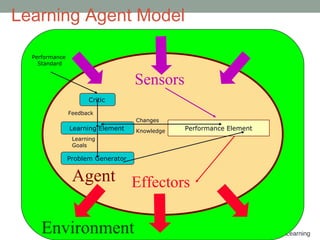
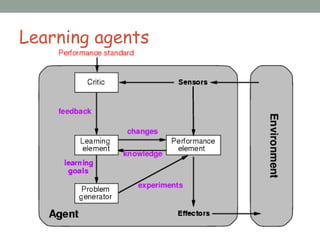
• A learning agent has an additional learning element
• usually used in combination with a critic and a problem generator for
better learning
• Most agents learn from examples
• inductive learning
Learning
Learning Agent Model
Sensors
Effectors
Performance Element
Critic
Learning Element
Problem Generator
Agent
Environment
Performance
Standard
Feedback
Learning
Goals
Changes
Knowledge
Learning agents
Learning
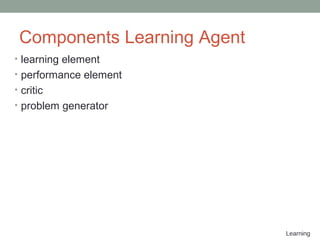
Components Learning Agent
• learning element
• performance element
• critic
• problem generator
Learning
Learning Element
•Responsible for making improvements
•Uses knowledge about the agent and feedback on its actions to
improve performance
Performance Element
•Selects external actions
•Collects percepts, decides on actions
•Incorporated most aspects of our previous agent design
Learning
Critic
•Informs the learning element about the performance of the
action
•must use a fixed standard of performance
• should be from the outside
• an internal standard could be modified to improve performance
• sometimes used by humans to justify or disguise low performance
Problem Generator
•Suggests actions that might lead to new experiences
•It may lead to some sub-optimal decisions in the short run
• in the long run, hopefully better actions may be discovered otherwise
no exploration would occur
Learning
Forms of Learning• Supervised learning
• An agent tries to find a function that matches examples from a sample
set
• each example provides an input together with the correct output
• a teacher provides feedback on the outcome
• the teacher can be an outside entity, or part of the environment
• Unsupervised learning
• the agent tries to learn from patterns without corresponding output
values
• Reinforcement learning
• the agent does not know the exact output for an input, but it receives
feedback on the desirability of its behavior
• the feedback can come from an outside entity, the environment, or the
agent itself
• the feedback may be delayed, and not follow the respective action
immediately
Learning
Feedback
• provides information about the actual outcome of actions
• supervised learning
• both the input and the output of a component can be perceived by the
agent directly
• the output may be provided by a teacher
• reinforcement learning
• feedback concerning the desirability of the agent’s behavior is availab
• not in the form of the correct output
• may not be directly attributable to a particular action
• feedback may occur only after a sequence of actions
• the agent or component knows that it did something right (or wrong),
but not what action caused it
Learning
Learning and Decision Trees
• based on a set of attributes as input, predicted output value,
the decision is learned
• it is called classification learning for discrete values
• Boolean or binary classification
• output values are true or false
• conceptually the simplest case, but still quite powerful
• making decisions
• a sequence of test is performed, testing the value of one of the
attributes in each step
• when a leaf node is reached, its value is returned
• good correspondence to human decision-making
Learning
Boolean Decision Trees
• compute yes/no decisions based on sets of desirable or
undesirable properties of an object or a situation
• each node in the tree reflects one yes/no decision based on a
test of the value of one property of the object
• the root node is the starting point
• leaf nodes represent the possible final decisions
• branches are labeled with possible values
• the learning aspect is to predict the value of a goal
predicate (also called goal concept)
• a hypothesis is formulated as a function that defines the goal
predicate
Learning
Terminology• example or sample
• describes the values of the attributes and the goal
• a positive sample has the value true for the goal predicate, a negative
sample false
• sample set
• collection of samples used for training and validation
• training
• the training set consists of samples used for constructing the decision
tree
• validation
• the test set is used to determine if the decision tree performs correctly
• ideally, the test set is different from the training set

Learning

  • 1.
    Learning Learning, Learning Agent,Learning Environment Elavarasi.K AP/CSE S.A Engineering College
  • 2.
    Learning: • An agenttries to improve its behavior through observation, reasoning, or reflection • learning from experience • memorization of past percepts, states, and actions • generalizations, identification of similar experiences • forecasting • prediction of changes in the environment • theories • generation of complex models based on observations and reasoning
  • 3.
    • Learning isessential for unknown environments, • i.e., when designer lacks omniscience • (is the capacity to know everything that there is to know.) • Learning is useful as a system construction method, • i.e., expose the agent to reality rather than trying to write it down • Learning modifies the agent's decision mechanisms to improve performance
  • 4.
    Learning Learning Agents • Basedon previous agent designs, such as reflexive, model- based, goal-based agents • those aspects of agents are encapsulated into the performance element of a learning agent • A learning agent has an additional learning element • usually used in combination with a critic and a problem generator for better learning • Most agents learn from examples • inductive learning
  • 5.
    Learning Learning Agent Model Sensors Effectors PerformanceElement Critic Learning Element Problem Generator Agent Environment Performance Standard Feedback Learning Goals Changes Knowledge
  • 6.
  • 7.
    Learning Components Learning Agent •learning element • performance element • critic • problem generator
  • 8.
    Learning Learning Element •Responsible formaking improvements •Uses knowledge about the agent and feedback on its actions to improve performance Performance Element •Selects external actions •Collects percepts, decides on actions •Incorporated most aspects of our previous agent design
  • 9.
    Learning Critic •Informs the learningelement about the performance of the action •must use a fixed standard of performance • should be from the outside • an internal standard could be modified to improve performance • sometimes used by humans to justify or disguise low performance Problem Generator •Suggests actions that might lead to new experiences •It may lead to some sub-optimal decisions in the short run • in the long run, hopefully better actions may be discovered otherwise no exploration would occur
  • 10.
    Learning Forms of Learning•Supervised learning • An agent tries to find a function that matches examples from a sample set • each example provides an input together with the correct output • a teacher provides feedback on the outcome • the teacher can be an outside entity, or part of the environment • Unsupervised learning • the agent tries to learn from patterns without corresponding output values • Reinforcement learning • the agent does not know the exact output for an input, but it receives feedback on the desirability of its behavior • the feedback can come from an outside entity, the environment, or the agent itself • the feedback may be delayed, and not follow the respective action immediately
  • 11.
    Learning Feedback • provides informationabout the actual outcome of actions • supervised learning • both the input and the output of a component can be perceived by the agent directly • the output may be provided by a teacher • reinforcement learning • feedback concerning the desirability of the agent’s behavior is availab • not in the form of the correct output • may not be directly attributable to a particular action • feedback may occur only after a sequence of actions • the agent or component knows that it did something right (or wrong), but not what action caused it
  • 12.
    Learning Learning and DecisionTrees • based on a set of attributes as input, predicted output value, the decision is learned • it is called classification learning for discrete values • Boolean or binary classification • output values are true or false • conceptually the simplest case, but still quite powerful • making decisions • a sequence of test is performed, testing the value of one of the attributes in each step • when a leaf node is reached, its value is returned • good correspondence to human decision-making
  • 13.
    Learning Boolean Decision Trees •compute yes/no decisions based on sets of desirable or undesirable properties of an object or a situation • each node in the tree reflects one yes/no decision based on a test of the value of one property of the object • the root node is the starting point • leaf nodes represent the possible final decisions • branches are labeled with possible values • the learning aspect is to predict the value of a goal predicate (also called goal concept) • a hypothesis is formulated as a function that defines the goal predicate
  • 14.
    Learning Terminology• example orsample • describes the values of the attributes and the goal • a positive sample has the value true for the goal predicate, a negative sample false • sample set • collection of samples used for training and validation • training • the training set consists of samples used for constructing the decision tree • validation • the test set is used to determine if the decision tree performs correctly • ideally, the test set is different from the training set