Item
Analysis
Item Analysis
is a process of examining the
student’s response to
individual item in the test. It
consists of different
procedures for assessing the
quality of the test items of
the students
There are two types of item
analysis:

- Quantitative Item Analysis
- Qualitative Item Analysis
Difficulty Index

refers to the proportion of
the number of students in
the upper and lower groups
who answered an item
correctly.
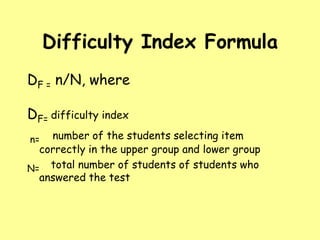
Difficulty Index Formula
DF = n/N, where
DF= difficulty index
number of the students selecting item
correctly in the upper group and lower group
N= total number of students of students who
answered the test
n=
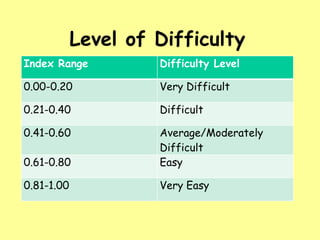
Level of Difficulty
Index Range

Difficulty Level

0.00-0.20

Very Difficult

0.21-0.40

Difficult

0.41-0.60
0.61-0.80

Average/Moderately
Difficult
Easy

0.81-1.00

Very Easy
Discrimination Index

The power of the item to
discriminate the students
between those who scored
high and those who scored
low in the overall test.
Types of Discrimination Index

1. Positive Discrimination
2. Negative Discrimination
3. Zero Discrimination
Positive Discrimination
happens when more students
in the upper group got the
item correctly than those
students in the lower
group.
Negative Discrimination
occurs when more students
in the lower group got the
item correctly than the
students in the upper group
Zero Discrimination

happens when a number of
students in the upper
group and lower group
who answer the test
correctly are equal
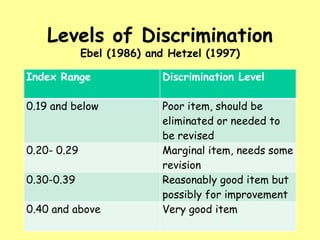
Levels of Discrimination
Ebel (1986) and Hetzel (1997)

Index Range

Discrimination Level

0.19 and below

Poor item, should be
eliminated or needed to
be revised
Marginal item, needs some
revision
Reasonably good item but
possibly for improvement
Very good item

0.20- 0.29
0.30-0.39
0.40 and above
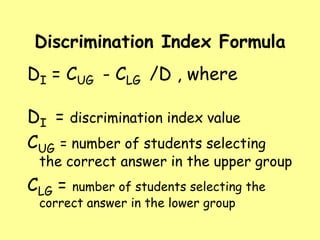
Discrimination Index Formula

DI = CUG - CLG /D , where
DI = discrimination index value
CUG = number of students selecting

the correct answer in the upper group

CLG =

number of students selecting the
correct answer in the lower group
Analysis of Response Options
Another way to evaluate the
performance of the entire test
item is through the analysis of
the response options. It is very
important to examine the
performance of each option in a
multiple-choice item.
Distracter Analysis

Distracter- term used for
the incorrect options in the
multiple-choice type of
test while the correct
answer represents the key
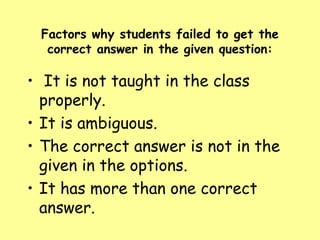
Factors why students failed to get the
correct answer in the given question:

• It is not taught in the class
properly.
• It is ambiguous.
• The correct answer is not in the
given in the options.
• It has more than one correct
answer.
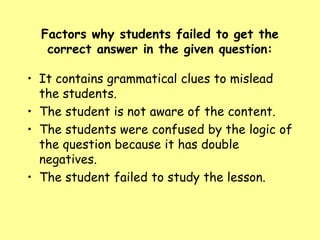
Factors why students failed to get the
correct answer in the given question:

• It contains grammatical clues to mislead
the students.
• The student is not aware of the content.
• The students were confused by the logic of
the question because it has double
negatives.
• The student failed to study the lesson.
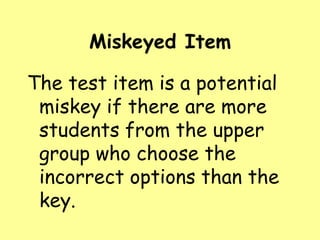
Miskeyed Item

The test item is a potential
miskey if there are more
students from the upper
group who choose the
incorrect options than the
key.
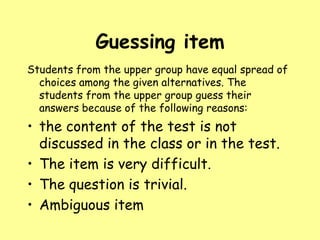
Guessing item
Students from the upper group have equal spread of
choices among the given alternatives. The
students from the upper group guess their
answers because of the following reasons:

• the content of the test is not
discussed in the class or in the test.
• The item is very difficult.
• The question is trivial.
• Ambiguous item
Ambiguous item

This happens when more
students from the upper
group choose equally an
incorrect option and the
keyed answer.
Qualitative Item Analysis

is a process in which the
teacher or expert carefully
proofreads the test before
it is administered.
(Zurawski R.M.)
Thank You
And GodBless

Item analysis

  • 1.
  • 2.
    Item Analysis is aprocess of examining the student’s response to individual item in the test. It consists of different procedures for assessing the quality of the test items of the students
  • 3.
    There are twotypes of item analysis: - Quantitative Item Analysis - Qualitative Item Analysis
  • 4.
    Difficulty Index refers tothe proportion of the number of students in the upper and lower groups who answered an item correctly.
  • 5.
    Difficulty Index Formula DF= n/N, where DF= difficulty index number of the students selecting item correctly in the upper group and lower group N= total number of students of students who answered the test n=
  • 6.
    Level of Difficulty IndexRange Difficulty Level 0.00-0.20 Very Difficult 0.21-0.40 Difficult 0.41-0.60 0.61-0.80 Average/Moderately Difficult Easy 0.81-1.00 Very Easy
  • 7.
    Discrimination Index The powerof the item to discriminate the students between those who scored high and those who scored low in the overall test.
  • 8.
    Types of DiscriminationIndex 1. Positive Discrimination 2. Negative Discrimination 3. Zero Discrimination
  • 9.
    Positive Discrimination happens whenmore students in the upper group got the item correctly than those students in the lower group.
  • 10.
    Negative Discrimination occurs whenmore students in the lower group got the item correctly than the students in the upper group
  • 11.
    Zero Discrimination happens whena number of students in the upper group and lower group who answer the test correctly are equal
  • 12.
    Levels of Discrimination Ebel(1986) and Hetzel (1997) Index Range Discrimination Level 0.19 and below Poor item, should be eliminated or needed to be revised Marginal item, needs some revision Reasonably good item but possibly for improvement Very good item 0.20- 0.29 0.30-0.39 0.40 and above
  • 13.
    Discrimination Index Formula DI= CUG - CLG /D , where DI = discrimination index value CUG = number of students selecting the correct answer in the upper group CLG = number of students selecting the correct answer in the lower group
  • 14.
    Analysis of ResponseOptions Another way to evaluate the performance of the entire test item is through the analysis of the response options. It is very important to examine the performance of each option in a multiple-choice item.
  • 15.
    Distracter Analysis Distracter- termused for the incorrect options in the multiple-choice type of test while the correct answer represents the key
  • 16.
    Factors why studentsfailed to get the correct answer in the given question: • It is not taught in the class properly. • It is ambiguous. • The correct answer is not in the given in the options. • It has more than one correct answer.
  • 17.
    Factors why studentsfailed to get the correct answer in the given question: • It contains grammatical clues to mislead the students. • The student is not aware of the content. • The students were confused by the logic of the question because it has double negatives. • The student failed to study the lesson.
  • 18.
    Miskeyed Item The testitem is a potential miskey if there are more students from the upper group who choose the incorrect options than the key.
  • 19.
    Guessing item Students fromthe upper group have equal spread of choices among the given alternatives. The students from the upper group guess their answers because of the following reasons: • the content of the test is not discussed in the class or in the test. • The item is very difficult. • The question is trivial. • Ambiguous item
  • 20.
    Ambiguous item This happenswhen more students from the upper group choose equally an incorrect option and the keyed answer.
  • 21.
    Qualitative Item Analysis isa process in which the teacher or expert carefully proofreads the test before it is administered. (Zurawski R.M.)
  • 22.