Making it Manageable Effective Teaching of Low Literacy Achievers Liz Oldridge  R.T.Literacy  Nelson Liz Oldridge NZRA 2009
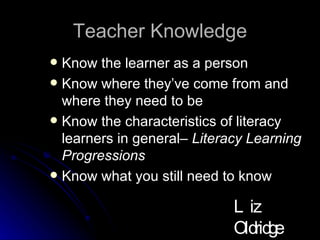
Teacher Knowledge Know the learner as a person Know where they’ve come from and where they need to be  Know the characteristics of literacy learners in general–  Literacy Learning Progressions Know what you still need to know Liz Oldridge NZRA 2009
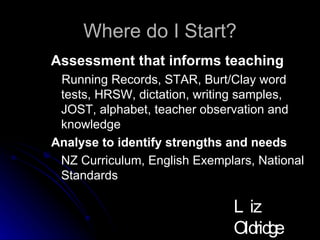
Where do I Start? Assessment that informs teaching Running Records, STAR, Burt/Clay word tests, HRSW, dictation, writing samples, JOST, alphabet, teacher observation and knowledge Analyse to identify strengths and needs NZ Curriculum, English Exemplars, National Standards Liz Oldridge NZRA 2009
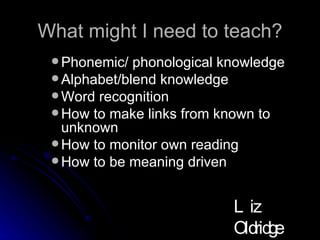
What might I need to teach? Phonemic/ phonological knowledge Alphabet/blend knowledge Word recognition How to make links from known to unknown How to monitor own reading How to be meaning driven Liz Oldridge NZRA 2009
What might I need to teach? How to check for sense How to locate recognisable chunks in words How to read through words How to check that predictions fit all sources of information How to make connections with and gain meaning from text Liz Oldridge NZRA 2009
What might I need to teach? How to be sure of what is known Fluent, well phrased reading Vocabulary Detail: accuracy with known words, endings and punctuation Liz Oldridge NZRA 2009
Phonemic awareness and phonological knowledge Activities to practise hearing, segmenting and manipulating sounds in words- picture cards Syllabification and rhyme- poetry, rhyming texts, talking about words Reinforce letter/sound relationships: matching words with sounds, isolating or substituting sounds in a word, blending individual sounds in words, endings  Integrate teaching of reading and writing by incorporating writing for sounds into phonics instruction Liz Oldridge NZRA 2009
Phonics cont. Expose students to poems, rhymes, chants, songs and repeated readings of shared books Provide activities focussing on syllable, onset-rime and phonemic manipulation  Move from larger to smaller units of sound e.g.. From syllables to sub syllables (onset-rime) to phonemes Use a mix of oral (poetry, songs etc) and concrete (clapping or moving counters) activities There is no sequence of instruction. Students don’t need to ‘get’ one type of operation before having experience in another Liz Oldridge NZRA 2009
But wait, there’s more Research has shown that low progress readers are often weaker in phonemic awareness and  training in it has been said to improve reading  levels. (Juel, Griffith and Gough, 1986) Intensive training can improve the word reading  skills of children who are struggling with literacy  but it is more effective when combined with  training in other reading skills and not taught in  isolation. Liz Oldridge NZRA 2009
Where can I look for help? Effective Literacy Practice in Years 1 to 4. pp 32-37 and 43-45 Effective Literacy Practice in Years 5 to 8. pp 30-32 Sounds and Words Ready to Read Support Material – Sound Sense pp 2-6 and p 17 Liz Oldridge NZRA 2009
Word Recognition Deliberately teach high  frequency words Highlight words in different contexts around the room Read and write them Reread easy material with simple language structure Use flash cards, magnetic letters, memory and board games As students increase the number of words they recognise, they begin to read without having to decode and can give more attention to comprehension.  Teaching Reading Comp. p64. Liz Oldridge NZRA 2009
Classroom Practice Provide shared, guided and personal reading opportunities Provide daily writing opportunities Build word charts Word cards for sorting Cut-up sentences Take any opportunity to reinforce high frequency words using the think aloud approach to model identification of known words in text reading  Liz Oldridge NZRA 2009
Vocabulary Vocabulary difficulty strongly influences the readability of text Teaching vocabulary can improve students’ comprehension For students experiencing difficulties in literacy, vocabulary knowledge is often a major stumbling block Teaching shouldn’t be systematic and sequential but instead children should study letters, sounds and words in reading and writing contexts Liz Oldridge NZRA 2009
How to help students acquire vocabulary Provide many opportunities for talk Provide opportunities to use new words in speaking, listening, reading and writing Reading ‘mileage’ an important factor Repeated exposure to new words is needed to consolidate vocabulary knowledge Provide explanations of the meanings of words while reading to children Liz Oldridge NZRA 2009
Context based Instruction Explicitly focus on, and discuss new vocabulary selected from texts children will read Model strategies to explore meanings of new words Provide meaningful practice and specific feedback Use co-operative problem solving ‘ What kinds of words would we expect to be in this text?’ Liz Oldridge NZRA 2009
Text Introduction Make sure you’ve read it and are familiar with the language and concepts Introduce the text type Introduce the storyline/concepts Introduce vocabulary that you know will be tricky Text selection crucial Prior knowledge- may not be of particular topic, but students need to be able to make a connection Liz Oldridge NZRA 2009
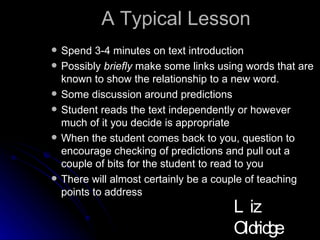
A Typical Lesson Spend 3-4 minutes on text introduction Possibly  briefly  make some links using words that are known to show the relationship to a new word.  Some discussion around predictions Student reads the text independently or however much of it you decide is appropriate When the student comes back to you, question to encourage checking of predictions and pull out a couple of bits for the student to read to you There will almost certainly be a couple of teaching points to address Liz Oldridge NZRA 2009
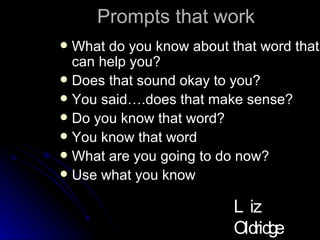
Prompts that work What do you know about that word that can help you? Does that sound okay to you? You said….does that make sense? Do you know that word? You know that word What are you going to do now? Use what you know Liz Oldridge NZRA 2009
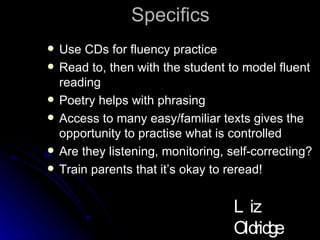
Specifics Use CDs for fluency practice Read to, then with the student to model fluent reading Poetry helps with phrasing Access to many easy/familiar texts gives the opportunity to practise what is controlled Are they listening, monitoring, self-correcting? Train parents that it’s okay to reread! Liz Oldridge NZRA 2009
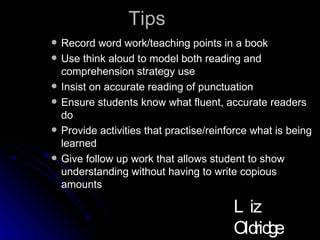
Tips Record word work/teaching points in a book Use think aloud to model both reading and comprehension strategy use Insist on accurate reading of punctuation Ensure students know what fluent, accurate readers do Provide activities that practise/reinforce what is being learned Give follow up work that allows student to show understanding without having to write copious amounts Liz Oldridge NZRA 2009
Pointers Making the lesson manageable for you ensures that it happens Directly following the guided reading session, the student rereads the text/the parts they have read.  Rereading is so much more than practice.  Reread in pairs and make sure feedback is according to agreed success criteria. See  Teaching Reading comprehension.  Liz Oldridge NZRA 2009
Struggling writers Is it poor writing or poor spelling? Teacher expectation  Child and teacher may have a different perception of the purpose of writing Focus more on what the child is trying to do or say than on what we’re trying to teach Liz Oldridge NZRA 2009
Shared Understandings Model writing in smaller groups Provide explicit discussion of purposes for modelling Write with the child Pair the child with a more fluent writer to produce a joint text Provide intensive individual instruction in deep and surface features Liz Oldridge NZRA 2009
Being explicit Show the connection between reading, writing and spelling Teach for, and provide practice in proofreading to enhance these connections Model  the use of classroom resources – child’s own text, a dictionary, any teacher written list, general classroom resources and specific teacher written resources  Teach a core writing vocabulary Model clear articulation of words Liz Oldridge NZRA 2009
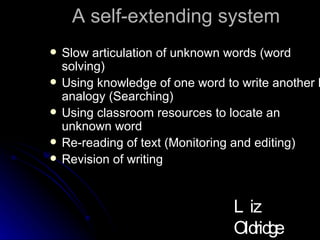
A self-extending system Slow articulation of unknown words (word solving) Using knowledge of one word to write another by analogy (Searching) Using classroom resources to locate an unknown word Re-reading of text (Monitoring and editing) Revision of writing Liz Oldridge NZRA 2009
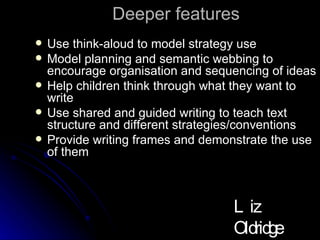
Deeper features Use think-aloud to model strategy use Model planning and semantic webbing to encourage organisation and sequencing of ideas Help children think through what they want to write Use shared and guided writing to teach text structure and different strategies/conventions Provide writing frames and demonstrate the use of them Liz Oldridge NZRA 2009
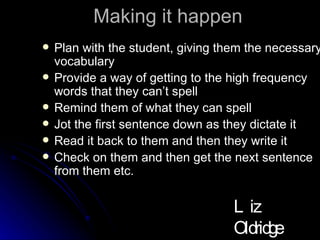
Making it happen Plan with the student, giving them the necessary vocabulary Provide a way of getting to the high frequency words that they can’t spell Remind them of what they can spell Jot the first sentence down as they dictate it Read it back to them and then they write it Check on them and then get the next sentence from them etc. Liz Oldridge NZRA 2009
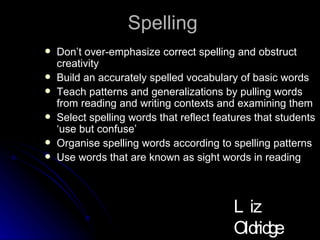
Spelling  Don’t over-emphasize correct spelling and obstruct creativity Build an accurately spelled vocabulary of basic words Teach patterns and generalizations by pulling words from reading and writing contexts and examining them  Select spelling words that reflect features that students ‘use but confuse’ Organise spelling words according to spelling patterns Use words that are known as sight words in reading Liz Oldridge NZRA 2009
Teacher- Aides ‘  Never do anything for the child that they can do for themselves .’  Be deliberate and specific; write prompts on cards Model and monitor Ensure that what is done, is what you want done; no adjusting of the programme! Utilise aides with other learners; low achievers need the teacher Liz Oldridge NZRA 2009
Finally…..be wary of commercial programmes Know why you need it and be sure it is what you need!  Ensure that you don’t try to make the child fit the programme The right programme may be useful for  some  students for  some  time Liz Oldridge NZRA 2009

Making it manageable final

  • 1.
    Making it ManageableEffective Teaching of Low Literacy Achievers Liz Oldridge R.T.Literacy Nelson Liz Oldridge NZRA 2009
  • 2.
    Teacher Knowledge Knowthe learner as a person Know where they’ve come from and where they need to be Know the characteristics of literacy learners in general– Literacy Learning Progressions Know what you still need to know Liz Oldridge NZRA 2009
  • 3.
    Where do IStart? Assessment that informs teaching Running Records, STAR, Burt/Clay word tests, HRSW, dictation, writing samples, JOST, alphabet, teacher observation and knowledge Analyse to identify strengths and needs NZ Curriculum, English Exemplars, National Standards Liz Oldridge NZRA 2009
  • 4.
    What might Ineed to teach? Phonemic/ phonological knowledge Alphabet/blend knowledge Word recognition How to make links from known to unknown How to monitor own reading How to be meaning driven Liz Oldridge NZRA 2009
  • 5.
    What might Ineed to teach? How to check for sense How to locate recognisable chunks in words How to read through words How to check that predictions fit all sources of information How to make connections with and gain meaning from text Liz Oldridge NZRA 2009
  • 6.
    What might Ineed to teach? How to be sure of what is known Fluent, well phrased reading Vocabulary Detail: accuracy with known words, endings and punctuation Liz Oldridge NZRA 2009
  • 7.
    Phonemic awareness andphonological knowledge Activities to practise hearing, segmenting and manipulating sounds in words- picture cards Syllabification and rhyme- poetry, rhyming texts, talking about words Reinforce letter/sound relationships: matching words with sounds, isolating or substituting sounds in a word, blending individual sounds in words, endings Integrate teaching of reading and writing by incorporating writing for sounds into phonics instruction Liz Oldridge NZRA 2009
  • 8.
    Phonics cont. Exposestudents to poems, rhymes, chants, songs and repeated readings of shared books Provide activities focussing on syllable, onset-rime and phonemic manipulation Move from larger to smaller units of sound e.g.. From syllables to sub syllables (onset-rime) to phonemes Use a mix of oral (poetry, songs etc) and concrete (clapping or moving counters) activities There is no sequence of instruction. Students don’t need to ‘get’ one type of operation before having experience in another Liz Oldridge NZRA 2009
  • 9.
    But wait, there’smore Research has shown that low progress readers are often weaker in phonemic awareness and training in it has been said to improve reading levels. (Juel, Griffith and Gough, 1986) Intensive training can improve the word reading skills of children who are struggling with literacy but it is more effective when combined with training in other reading skills and not taught in isolation. Liz Oldridge NZRA 2009
  • 10.
    Where can Ilook for help? Effective Literacy Practice in Years 1 to 4. pp 32-37 and 43-45 Effective Literacy Practice in Years 5 to 8. pp 30-32 Sounds and Words Ready to Read Support Material – Sound Sense pp 2-6 and p 17 Liz Oldridge NZRA 2009
  • 11.
    Word Recognition Deliberatelyteach high frequency words Highlight words in different contexts around the room Read and write them Reread easy material with simple language structure Use flash cards, magnetic letters, memory and board games As students increase the number of words they recognise, they begin to read without having to decode and can give more attention to comprehension. Teaching Reading Comp. p64. Liz Oldridge NZRA 2009
  • 12.
    Classroom Practice Provideshared, guided and personal reading opportunities Provide daily writing opportunities Build word charts Word cards for sorting Cut-up sentences Take any opportunity to reinforce high frequency words using the think aloud approach to model identification of known words in text reading Liz Oldridge NZRA 2009
  • 13.
    Vocabulary Vocabulary difficultystrongly influences the readability of text Teaching vocabulary can improve students’ comprehension For students experiencing difficulties in literacy, vocabulary knowledge is often a major stumbling block Teaching shouldn’t be systematic and sequential but instead children should study letters, sounds and words in reading and writing contexts Liz Oldridge NZRA 2009
  • 14.
    How to helpstudents acquire vocabulary Provide many opportunities for talk Provide opportunities to use new words in speaking, listening, reading and writing Reading ‘mileage’ an important factor Repeated exposure to new words is needed to consolidate vocabulary knowledge Provide explanations of the meanings of words while reading to children Liz Oldridge NZRA 2009
  • 15.
    Context based InstructionExplicitly focus on, and discuss new vocabulary selected from texts children will read Model strategies to explore meanings of new words Provide meaningful practice and specific feedback Use co-operative problem solving ‘ What kinds of words would we expect to be in this text?’ Liz Oldridge NZRA 2009
  • 16.
    Text Introduction Makesure you’ve read it and are familiar with the language and concepts Introduce the text type Introduce the storyline/concepts Introduce vocabulary that you know will be tricky Text selection crucial Prior knowledge- may not be of particular topic, but students need to be able to make a connection Liz Oldridge NZRA 2009
  • 17.
    A Typical LessonSpend 3-4 minutes on text introduction Possibly briefly make some links using words that are known to show the relationship to a new word. Some discussion around predictions Student reads the text independently or however much of it you decide is appropriate When the student comes back to you, question to encourage checking of predictions and pull out a couple of bits for the student to read to you There will almost certainly be a couple of teaching points to address Liz Oldridge NZRA 2009
  • 18.
    Prompts that workWhat do you know about that word that can help you? Does that sound okay to you? You said….does that make sense? Do you know that word? You know that word What are you going to do now? Use what you know Liz Oldridge NZRA 2009
  • 19.
    Specifics Use CDsfor fluency practice Read to, then with the student to model fluent reading Poetry helps with phrasing Access to many easy/familiar texts gives the opportunity to practise what is controlled Are they listening, monitoring, self-correcting? Train parents that it’s okay to reread! Liz Oldridge NZRA 2009
  • 20.
    Tips Record wordwork/teaching points in a book Use think aloud to model both reading and comprehension strategy use Insist on accurate reading of punctuation Ensure students know what fluent, accurate readers do Provide activities that practise/reinforce what is being learned Give follow up work that allows student to show understanding without having to write copious amounts Liz Oldridge NZRA 2009
  • 21.
    Pointers Making thelesson manageable for you ensures that it happens Directly following the guided reading session, the student rereads the text/the parts they have read. Rereading is so much more than practice. Reread in pairs and make sure feedback is according to agreed success criteria. See Teaching Reading comprehension. Liz Oldridge NZRA 2009
  • 22.
    Struggling writers Isit poor writing or poor spelling? Teacher expectation Child and teacher may have a different perception of the purpose of writing Focus more on what the child is trying to do or say than on what we’re trying to teach Liz Oldridge NZRA 2009
  • 23.
    Shared Understandings Modelwriting in smaller groups Provide explicit discussion of purposes for modelling Write with the child Pair the child with a more fluent writer to produce a joint text Provide intensive individual instruction in deep and surface features Liz Oldridge NZRA 2009
  • 24.
    Being explicit Showthe connection between reading, writing and spelling Teach for, and provide practice in proofreading to enhance these connections Model the use of classroom resources – child’s own text, a dictionary, any teacher written list, general classroom resources and specific teacher written resources Teach a core writing vocabulary Model clear articulation of words Liz Oldridge NZRA 2009
  • 25.
    A self-extending systemSlow articulation of unknown words (word solving) Using knowledge of one word to write another by analogy (Searching) Using classroom resources to locate an unknown word Re-reading of text (Monitoring and editing) Revision of writing Liz Oldridge NZRA 2009
  • 26.
    Deeper features Usethink-aloud to model strategy use Model planning and semantic webbing to encourage organisation and sequencing of ideas Help children think through what they want to write Use shared and guided writing to teach text structure and different strategies/conventions Provide writing frames and demonstrate the use of them Liz Oldridge NZRA 2009
  • 27.
    Making it happenPlan with the student, giving them the necessary vocabulary Provide a way of getting to the high frequency words that they can’t spell Remind them of what they can spell Jot the first sentence down as they dictate it Read it back to them and then they write it Check on them and then get the next sentence from them etc. Liz Oldridge NZRA 2009
  • 28.
    Spelling Don’tover-emphasize correct spelling and obstruct creativity Build an accurately spelled vocabulary of basic words Teach patterns and generalizations by pulling words from reading and writing contexts and examining them Select spelling words that reflect features that students ‘use but confuse’ Organise spelling words according to spelling patterns Use words that are known as sight words in reading Liz Oldridge NZRA 2009
  • 29.
    Teacher- Aides ‘ Never do anything for the child that they can do for themselves .’ Be deliberate and specific; write prompts on cards Model and monitor Ensure that what is done, is what you want done; no adjusting of the programme! Utilise aides with other learners; low achievers need the teacher Liz Oldridge NZRA 2009
  • 30.
    Finally…..be wary ofcommercial programmes Know why you need it and be sure it is what you need! Ensure that you don’t try to make the child fit the programme The right programme may be useful for some students for some time Liz Oldridge NZRA 2009