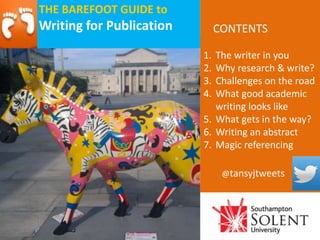
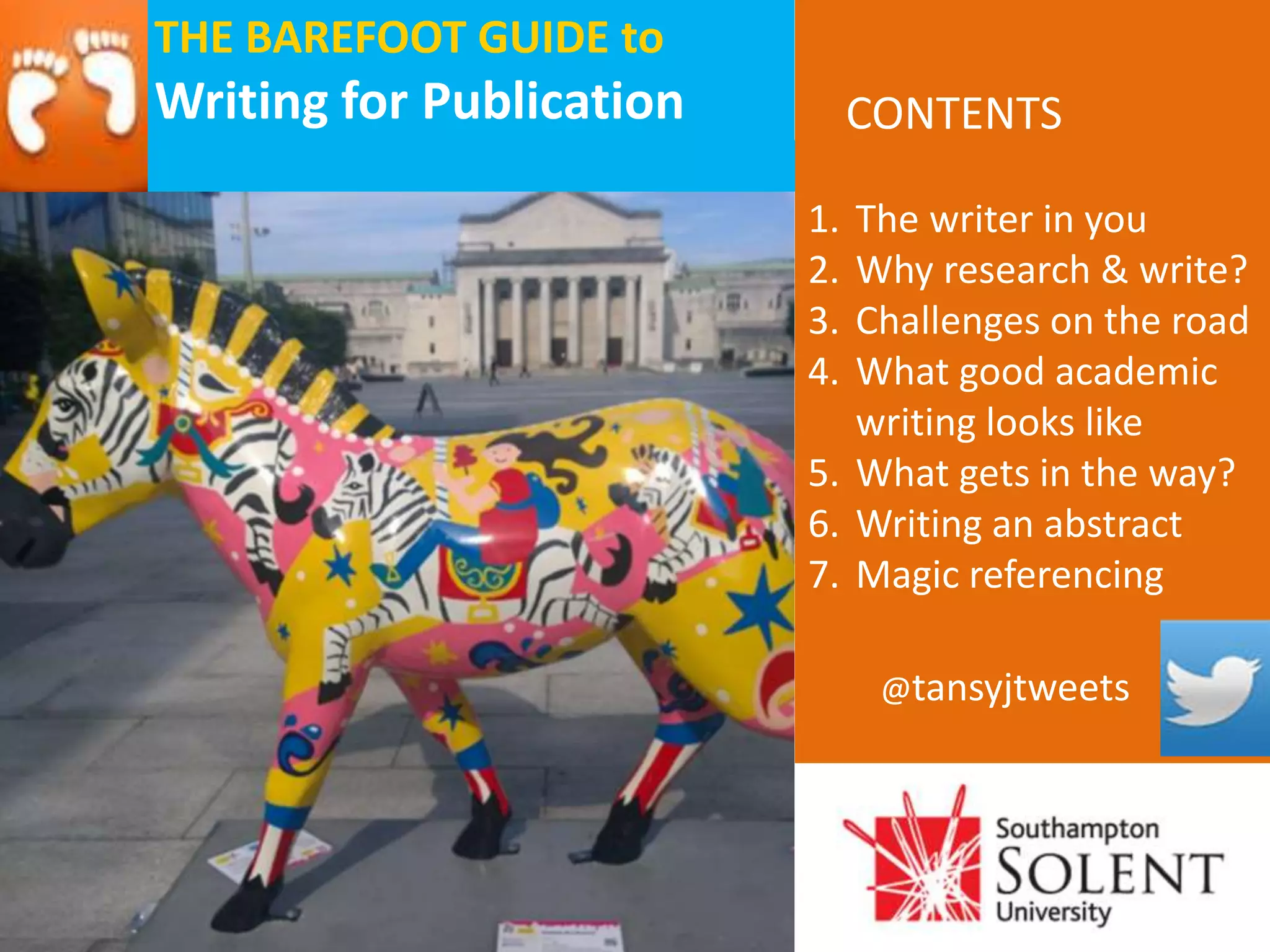
CONTENTS
1. The writer in you
2. Why research & write?
3. Challenges on the road
4. What good academic
writing looks like
5. What gets in the way?
6. Writing an abstract
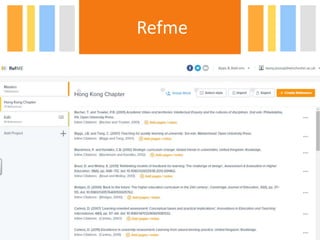
7. Magic referencing
@tansyjtweets
THE BAREFOOT GUIDE to
Writing for Publication
Finding the writer in you
• Choose a picture which appeals to you.
• Don’t think too much about it, just go for one
that speaks to you.
Your jottings
• Why did you choose this picture?
• How does the picture speak to you as an academic?
• How does the picture relate to your feelings as a
researcher?
• How does it relate to your feelings about writing?
Talk to someone
• Find a partner. Talk to him or her about your
picture and your jottings (5 mins)
• Swap around and listen to your partner’s
musings.
Private dimensions
Voyage of discovery
It’s about learning
The challenge
The excitement
The satisfaction
Fame and fortune
Public dimensions
It’s about collaboration
Joining a community
Sharing the learning
Publishing
Contributing to knowledge
Because we ask students to..
Why do research?
Because we have to…
Five reasons to get writing:
• It is what we do.
• Thinking happens when we write.
• It vivifies our teaching; it makes it cutting
edge.
• It enables us to share our discoveries.
• ‘Mastery’ comes out of the furnace of writing.
Why write?
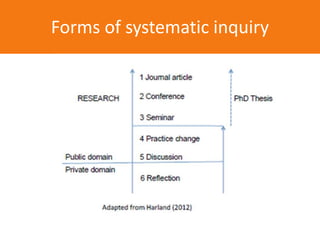
Forms of systematic inquiry
The stark realities
• 90%+ rejection: of the 5% published, only 40%
cited (HE)
• Journal articles are the number one currency
• 50 million + published
• Who reads them? Data from citations +
downloads.
https://scholar.google.co.uk/
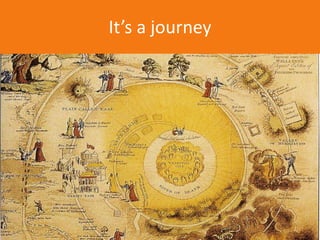
It’s a journey
It’s a discipline
Writing is learnt
• What words or phrases spring to mind?
• What is good academic writing?
• How do you know it when you see it?
What does good academic writing look
like?
Impressing other academics with your erudition
OR
Communicating?
Writing for your mum
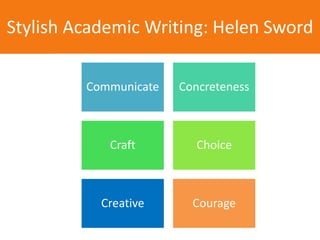
Communicate Concreteness
Craft Choice
Creative Courage
Stylish Academic Writing: Helen Sword
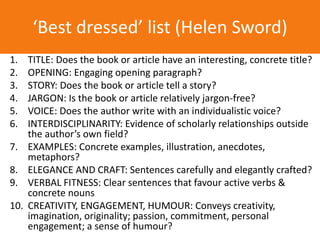
1. TITLE: Does the book or article have an interesting, concrete title?
2. OPENING: Engaging opening paragraph?
3. STORY: Does the book or article tell a story?
4. JARGON: Is the book or article relatively jargon-free?
5. VOICE: Does the author write with an individualistic voice?
6. INTERDISCIPLINARITY: Evidence of scholarly relationships outside
the author’s own field?
7. EXAMPLES: Concrete examples, illustration, anecdotes,
metaphors?
8. ELEGANCE AND CRAFT: Sentences carefully and elegantly crafted?
9. VERBAL FITNESS: Clear sentences that favour active verbs &
concrete nouns
10. CREATIVITY, ENGAGEMENT, HUMOUR: Conveys creativity,
imagination, originality; passion, commitment, personal
engagement; a sense of humour?
‘Best dressed’ list (Helen Sword)
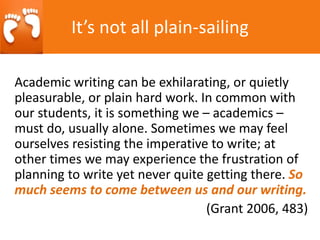
Academic writing can be exhilarating, or quietly
pleasurable, or plain hard work. In common with
our students, it is something we – academics –
must do, usually alone. Sometimes we may feel
ourselves resisting the imperative to write; at
other times we may experience the frustration of
planning to write yet never quite getting there. So
much seems to come between us and our writing.
(Grant 2006, 483)
It’s not all plain-sailing
What gets in the way of your academic
writing?
Overcoming obstacles
or
Binge or daily grind…
On writing
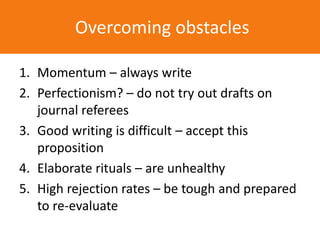
1. Momentum – always write
2. Perfectionism? – do not try out drafts on
journal referees
3. Good writing is difficult – accept this
proposition
4. Elaborate rituals – are unhealthy
5. High rejection rates – be tough and prepared
to re-evaluate
Overcoming obstacles
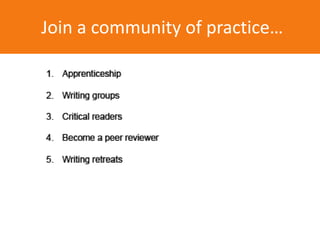
A community of writersJoin a community of practice…
Exercise 3
What should be included in the abstract of a
journal article?
Writing an abstract
What an abstract should look like
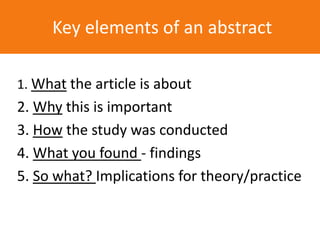
1. What the article is about
2. Why this is important
3. How the study was conducted
4. What you found - findings
5. So what? Implications for theory/practice
Key elements of an abstract
Abstract 1
Evidence from 73 programmes in 14 U.K universities sheds light on the typical
student experience of assessment over a three-year undergraduate degree. A
previous small-scale study in three universities characterised programme
assessment environments using a similar method. The current study analyses data
about assessment patterns using descriptive statistical methods, drawing on a large
sample in a wider range of universities than the original study. Findings
demonstrate a wide range of practice across programmes: from 12 summative
assessments on one programme to 227 on another; from 87% by examination to
none on others. While variations cast doubt on the comparability of U.K degrees,
programme assessment patterns are complex. Further analysis distinguishes
common assessment patterns across the sample. Typically, students encounter
eight times as much summative as formative assessment, a dozen different types of
assessment, more than three quarters by coursework. The presence of high
summative and low formative assessment diets is likely to compound students’
grade-orientation, reinforcing narrow and instrumental approaches to learning.
High varieties of assessment are probable contributors to student confusion about
goals and standards. Making systematic headway to improve student learning from
assessment requires a programmatic and evidence-led approach to design,
characterised by dialogue and social practice.
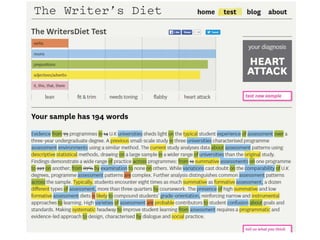
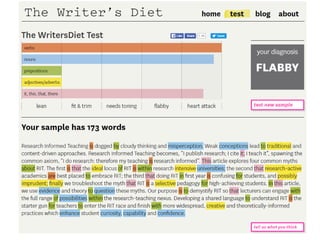
How does it fare?
http://writersdiet.com/?page_id=4
Abstract 2
Research Informed Teaching is dogged by cloudy thinking and misperception.
Weak conceptions lead to traditional and content-driven approaches. RIT
becomes, “I publish research; I cite it; I teach it”, spawning the common axiom, “I
do research: therefore my teaching is research informed”. This article explores
four common myths about RIT. The first is that the ideal locus of RIT is within
research-intensive universities; the second that research-active academics are
best placed to embrace RIT; the third that doing RIT in first year is confusing for
students, and possibly imprudent; finally we troubleshoot the myth that RIT is a
selective pedagogy for high-achieving students. In this article, we use evidence
and theory to question these myths. Our purpose is to demystify RIT so that
lecturers can engage with the full range of possibilities within the research-
teaching nexus. Developing a shared language to understand RIT is the starter gun
for teachers to enter the RIT race and finish with more widespread, creative and
theoretically-informed practices which enhance student curiosity, capability and
confidence.
RefmeRefme
Becker, H. (2007) Writing for Social Scientists. Chicago. University of Chicago Press.
Boice, R. (1990) Professors as Writers: A self-help guide to productive writing.
Oklahoma. New Forum.
Grant, B. (2006) Writing in the company of other women: exceeding the boundaries,
Studies in Higher Education, 31:4, 483-495.
Jessop and Penny (1999) A story behind a story: Developing strategies for making
sense of teacher narratives. International Journal of Social Research Methodology.
2:3. 213-230.
Richardson, L. (1990) Writing Strategies: reaching diverse audiences. Thousand Oaks.
California. Sage.
Helen Sword (2013) Stylish Academic Writing. Cambridge. MA. Harvard University
Press.
Helen Sword (2013) https://www.youtube.com/watch?v=nQsRvAVSVeM
Sword, H. (2009) Writing higher education differently: a manifesto on style, Studies
in Higher Education, 34:3, 319-336.
References

Barefoot guide to writing for publication

  • 1.
    CONTENTS 1. The writerin you 2. Why research & write? 3. Challenges on the road 4. What good academic writing looks like 5. What gets in the way? 6. Writing an abstract 7. Magic referencing @tansyjtweets THE BAREFOOT GUIDE to Writing for Publication
  • 2.
    Finding the writerin you • Choose a picture which appeals to you. • Don’t think too much about it, just go for one that speaks to you.
  • 3.
    Your jottings • Whydid you choose this picture? • How does the picture speak to you as an academic? • How does the picture relate to your feelings as a researcher? • How does it relate to your feelings about writing?
  • 4.
    Talk to someone •Find a partner. Talk to him or her about your picture and your jottings (5 mins) • Swap around and listen to your partner’s musings.
  • 5.
    Private dimensions Voyage ofdiscovery It’s about learning The challenge The excitement The satisfaction Fame and fortune Public dimensions It’s about collaboration Joining a community Sharing the learning Publishing Contributing to knowledge Because we ask students to.. Why do research?
  • 6.
  • 7.
    Five reasons toget writing: • It is what we do. • Thinking happens when we write. • It vivifies our teaching; it makes it cutting edge. • It enables us to share our discoveries. • ‘Mastery’ comes out of the furnace of writing. Why write?
  • 8.
  • 9.
    The stark realities •90%+ rejection: of the 5% published, only 40% cited (HE) • Journal articles are the number one currency • 50 million + published • Who reads them? Data from citations + downloads. https://scholar.google.co.uk/
  • 10.
  • 11.
  • 12.
  • 13.
    • What wordsor phrases spring to mind? • What is good academic writing? • How do you know it when you see it? What does good academic writing look like?
  • 14.
    Impressing other academicswith your erudition OR Communicating? Writing for your mum
  • 15.
    Communicate Concreteness Craft Choice CreativeCourage Stylish Academic Writing: Helen Sword
  • 16.
    1. TITLE: Doesthe book or article have an interesting, concrete title? 2. OPENING: Engaging opening paragraph? 3. STORY: Does the book or article tell a story? 4. JARGON: Is the book or article relatively jargon-free? 5. VOICE: Does the author write with an individualistic voice? 6. INTERDISCIPLINARITY: Evidence of scholarly relationships outside the author’s own field? 7. EXAMPLES: Concrete examples, illustration, anecdotes, metaphors? 8. ELEGANCE AND CRAFT: Sentences carefully and elegantly crafted? 9. VERBAL FITNESS: Clear sentences that favour active verbs & concrete nouns 10. CREATIVITY, ENGAGEMENT, HUMOUR: Conveys creativity, imagination, originality; passion, commitment, personal engagement; a sense of humour? ‘Best dressed’ list (Helen Sword)
  • 17.
    Academic writing canbe exhilarating, or quietly pleasurable, or plain hard work. In common with our students, it is something we – academics – must do, usually alone. Sometimes we may feel ourselves resisting the imperative to write; at other times we may experience the frustration of planning to write yet never quite getting there. So much seems to come between us and our writing. (Grant 2006, 483) It’s not all plain-sailing
  • 18.
    What gets inthe way of your academic writing? Overcoming obstacles
  • 19.
  • 20.
    On writing 1. Momentum– always write 2. Perfectionism? – do not try out drafts on journal referees 3. Good writing is difficult – accept this proposition 4. Elaborate rituals – are unhealthy 5. High rejection rates – be tough and prepared to re-evaluate Overcoming obstacles
  • 21.
    A community ofwritersJoin a community of practice…
  • 22.
    Exercise 3 What shouldbe included in the abstract of a journal article? Writing an abstract
  • 23.
    What an abstractshould look like 1. What the article is about 2. Why this is important 3. How the study was conducted 4. What you found - findings 5. So what? Implications for theory/practice Key elements of an abstract
  • 24.
    Abstract 1 Evidence from73 programmes in 14 U.K universities sheds light on the typical student experience of assessment over a three-year undergraduate degree. A previous small-scale study in three universities characterised programme assessment environments using a similar method. The current study analyses data about assessment patterns using descriptive statistical methods, drawing on a large sample in a wider range of universities than the original study. Findings demonstrate a wide range of practice across programmes: from 12 summative assessments on one programme to 227 on another; from 87% by examination to none on others. While variations cast doubt on the comparability of U.K degrees, programme assessment patterns are complex. Further analysis distinguishes common assessment patterns across the sample. Typically, students encounter eight times as much summative as formative assessment, a dozen different types of assessment, more than three quarters by coursework. The presence of high summative and low formative assessment diets is likely to compound students’ grade-orientation, reinforcing narrow and instrumental approaches to learning. High varieties of assessment are probable contributors to student confusion about goals and standards. Making systematic headway to improve student learning from assessment requires a programmatic and evidence-led approach to design, characterised by dialogue and social practice.
  • 25.
    How does itfare? http://writersdiet.com/?page_id=4
  • 27.
    Abstract 2 Research InformedTeaching is dogged by cloudy thinking and misperception. Weak conceptions lead to traditional and content-driven approaches. RIT becomes, “I publish research; I cite it; I teach it”, spawning the common axiom, “I do research: therefore my teaching is research informed”. This article explores four common myths about RIT. The first is that the ideal locus of RIT is within research-intensive universities; the second that research-active academics are best placed to embrace RIT; the third that doing RIT in first year is confusing for students, and possibly imprudent; finally we troubleshoot the myth that RIT is a selective pedagogy for high-achieving students. In this article, we use evidence and theory to question these myths. Our purpose is to demystify RIT so that lecturers can engage with the full range of possibilities within the research- teaching nexus. Developing a shared language to understand RIT is the starter gun for teachers to enter the RIT race and finish with more widespread, creative and theoretically-informed practices which enhance student curiosity, capability and confidence.
  • 29.
  • 30.
    Becker, H. (2007)Writing for Social Scientists. Chicago. University of Chicago Press. Boice, R. (1990) Professors as Writers: A self-help guide to productive writing. Oklahoma. New Forum. Grant, B. (2006) Writing in the company of other women: exceeding the boundaries, Studies in Higher Education, 31:4, 483-495. Jessop and Penny (1999) A story behind a story: Developing strategies for making sense of teacher narratives. International Journal of Social Research Methodology. 2:3. 213-230. Richardson, L. (1990) Writing Strategies: reaching diverse audiences. Thousand Oaks. California. Sage. Helen Sword (2013) Stylish Academic Writing. Cambridge. MA. Harvard University Press. Helen Sword (2013) https://www.youtube.com/watch?v=nQsRvAVSVeM Sword, H. (2009) Writing higher education differently: a manifesto on style, Studies in Higher Education, 34:3, 319-336. References