“It was not enough to chase the cost accountants out of
the plants. The problem was to chase cost accounting from
my people's minds”
~ Taiichi Ohno, Creator of the Toyota Production System
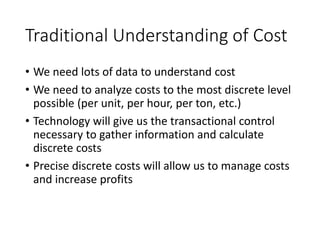
Traditional Understanding of Cost
• We need lots of data to understand cost
• We need to analyze costs to the most discrete level
possible (per unit, per hour, per ton, etc.)
• Technology will give us the transactional control
necessary to gather information and calculate
discrete costs
• Precise discrete costs will allow us to manage costs
and increase profits
Traditional Understanding of Cost
• We need lots of data to understand cost
• We need to analyze costs to the most discrete level
possible (per unit, per hour, per ton, etc.)
• Technology will give us the transactional control
necessary to gather information and calculate
discrete costs
• Precise discrete costs will allow us to manage costs
and increase profits
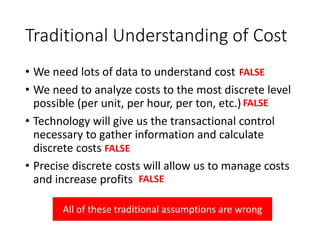
FALSE
FALSE
FALSE
FALSE
All of these traditional assumptions are wrong
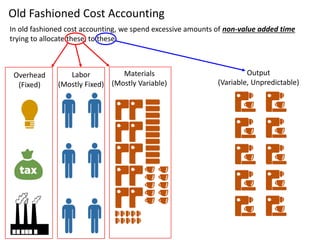
Overhead
(Fixed)
Labor
(Mostly Fixed)
Materials
(Mostly Variable)
Old Fashioned Cost Accounting
Output
(Variable, Unpredictable)
In old fashioned cost accounting, we spend excessive amounts of non-value added time
trying to allocate these, to these.
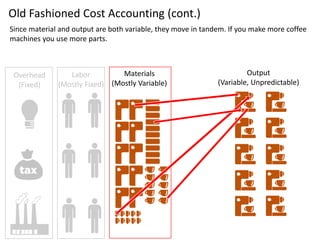
Overhead
(Fixed)
Labor
(Mostly Fixed)
Materials
(Mostly Variable)
Old Fashioned Cost Accounting (cont.)
Output
(Variable, Unpredictable)
Since material and output are both variable, they move in tandem. If you make more coffee
machines you use more parts.
Overhead
(Fixed)
Labor
(Mostly Fixed)
Materials
(Mostly Variable)
Old Fashioned Cost Accounting (cont.)
Output
(Variable, Unpredictable)
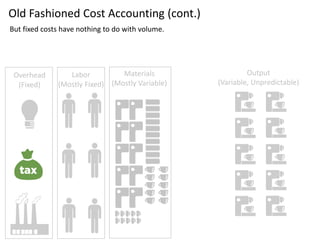
But fixed costs have nothing to do with volume.
Overhead
(Fixed)
Old Fashioned Cost Accounting (cont.)
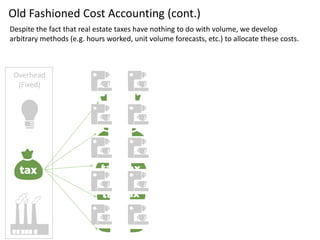
Despite the fact that real estate taxes have nothing to do with volume, we develop
arbitrary methods (e.g. hours worked, unit volume forecasts, etc.) to allocate these costs.
Overhead
(Fixed)
Old Fashioned Cost Accounting (cont.)
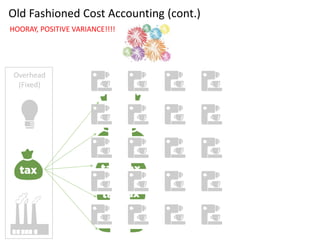
HOORAY, POSITIVE VARIANCE!!!!
Overhead
(Fixed)
Old Fashioned Cost Accounting (cont.)
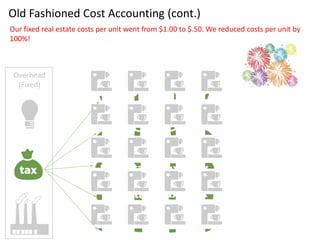
Our fixed real estate costs per unit went from $1.00 to $.50. We reduced costs per unit by
100%!
Overhead
(Fixed)
Old Fashioned Cost Accounting (cont.)
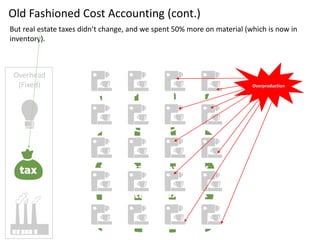
But real estate taxes didn’t change, and we spent 50% more on material (which is now in
inventory).
Overproduction
Overhead
(Fixed)
Old Fashioned Cost Accounting (cont.)
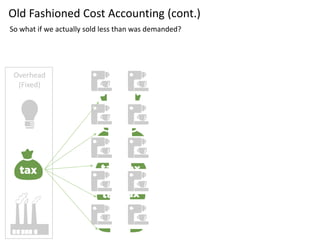
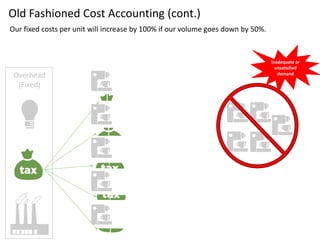
So what if we actually sold less than was demanded?
Overhead
(Fixed)
Old Fashioned Cost Accounting (cont.)
Our fixed costs per unit will increase by 100% if our volume goes down by 50%.
Inadequate or
unsatisfied
demand
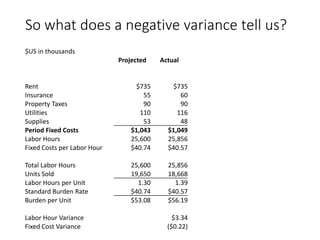
So what does a negative variance tell us?
$US in thousands
Projected Actual
Rent $735 $735
Insurance 55 60
Property Taxes 90 90
Utilities 110 116
Supplies 53 48
Period Fixed Costs $1,043 $1,049
Labor Hours 25,600 25,856
Fixed Costs per Labor Hour $40.74 $40.57
Total Labor Hours 25,600 25,856
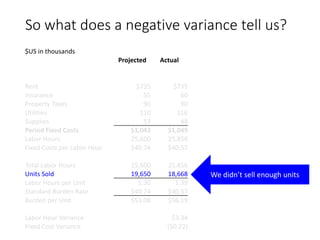
Units Sold 19,650 18,668
Labor Hours per Unit 1.30 1.39
Standard Burden Rate $40.74 $40.57
Burden per Unit $53.08 $56.19
Labor Hour Variance $3.34
Fixed Cost Variance ($0.22)
So what does a negative variance tell us?
$US in thousands
Projected Actual
Rent $735 $735
Insurance 55 60
Property Taxes 90 90
Utilities 110 116
Supplies 53 48
Period Fixed Costs $1,043 $1,049
Labor Hours 25,600 25,856
Fixed Costs per Labor Hour $40.74 $40.57
Total Labor Hours 25,600 25,856
Units Sold 19,650 18,668
Labor Hours per Unit 1.30 1.39
Standard Burden Rate $40.74 $40.57
Burden per Unit $53.08 $56.19
Labor Hour Variance $3.34
Fixed Cost Variance ($0.22)
We didn’t sell enough units
Old fashioned cost accounting (recap)
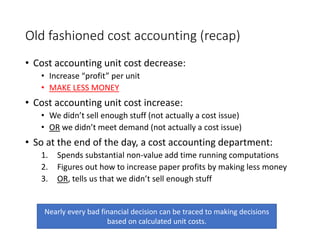
• Cost accounting unit cost decrease:
• Increase “profit” per unit
• MAKE LESS MONEY
• Cost accounting unit cost increase:
• We didn’t sell enough stuff (not actually a cost issue)
• OR we didn’t meet demand (not actually a cost issue)
• So at the end of the day, a cost accounting department:
1. Spends substantial non-value add time running computations
2. Figures out how to increase paper profits by making less money
3. OR, tells us that we didn’t sell enough stuff
Nearly every bad financial decision can be traced to making decisions
based on calculated unit costs.
Lean Accounting Recap
• In a Just-in-Time system:
• You do not overproduce (creating positive variances)
• You do not underproduce (creating negative variances)
• The essence of JIT is:
• Produce exactly what is needed
• Delivery it exactly when it is needed
• Not late
• Not early
• With perfect built-in quality (“jidoka”)
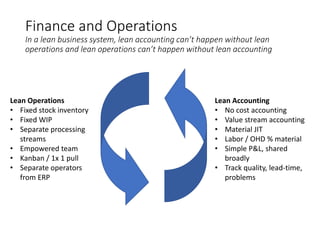
Finance and Operations
In a lean business system, lean accounting can’t happen without lean
operations and lean operations can’t happen without lean accounting
Lean Operations
• Fixed stock inventory
• Fixed WIP
• Separate processing
streams
• Empowered team
• Kanban / 1x 1 pull
• Separate operators
from ERP
Lean Accounting
• No cost accounting
• Value stream accounting
• Material JIT
• Labor / OHD % material
• Simple P&L, shared
broadly
• Track quality, lead-time,
problems
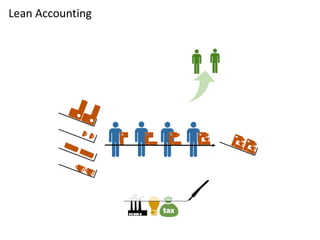
Lean Accounting
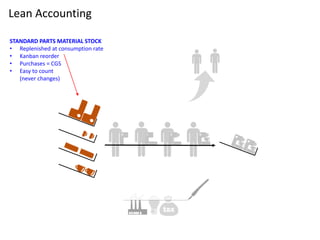
Lean Accounting
STANDARD PARTS MATERIAL STOCK
• Replenished at consumption rate
• Kanban reorder
• Purchases = CGS
• Easy to count
(never changes)
Lean Accounting
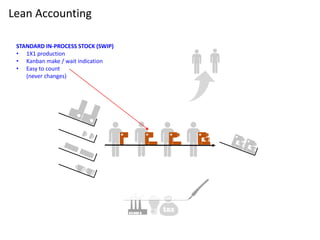
STANDARD IN-PROCESS STOCK (SWIP)
• 1X1 production
• Kanban make / wait indication
• Easy to count
(never changes)
Lean Accounting
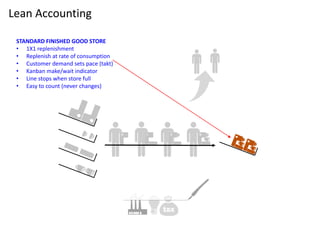
STANDARD FINISHED GOOD STORE
• 1X1 replenishment
• Replenish at rate of consumption
• Customer demand sets pace (takt)
• Kanban make/wait indicator
• Line stops when store full
• Easy to count (never changes)
Lean Accounting
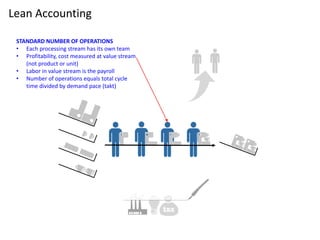
STANDARD NUMBER OF OPERATIONS
• Each processing stream has its own team
• Profitability, cost measured at value stream
(not product or unit)
• Labor in value stream is the payroll
• Number of operations equals total cycle
time divided by demand pace (takt)
Lean Accounting
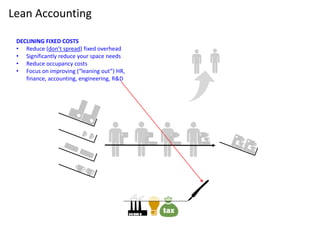
DECLINING FIXED COSTS
• Reduce (don’t spread) fixed overhead
• Significantly reduce your space needs
• Reduce occupancy costs
• Focus on improving (“leaning out”) HR,
finance, accounting, engineering, R&D
Lean Accounting
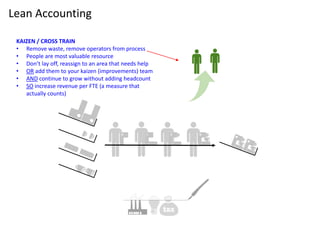
KAIZEN / CROSS TRAIN
• Remove waste, remove operators from process
• People are most valuable resource
• Don’t lay off, reassign to an area that needs help
• OR add them to your kaizen (improvements) team
• AND continue to grow without adding headcount
• SO increase revenue per FTE (a measure that
actually counts)
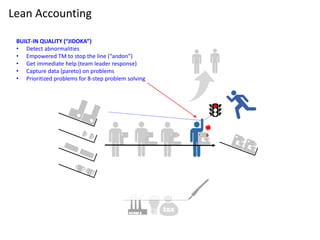
Lean Accounting
BUILT-IN QUALITY (“JIDOKA”)
• Detect abnormalities
• Empowered TM to stop the line (“andon”)
• Get immediate help (team leader response)
• Capture data (pareto) on problems
• Prioritized problems for 8-step problem solving
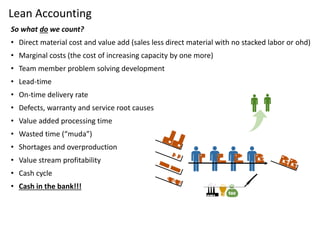
Lean Accounting
So what do we count?
• Direct material cost and value add (sales less direct material with no stacked labor or ohd)
• Marginal costs (the cost of increasing capacity by one more)
• Team member problem solving development
• Lead-time
• On-time delivery rate
• Defects, warranty and service root causes
• Value added processing time
• Wasted time (“muda”)
• Shortages and overproduction
• Value stream profitability
• Cash cycle
• Cash in the bank!!!
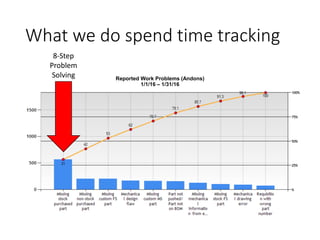
What we do spend time tracking
8-Step
Problem
Solving Reported Work Problems (Andons)
1/1/16 – 1/31/16
“The first rule of any technology used in a business is that
automation applied to an efficient operation will magnify
the efficiency. The second is that automation applied to an
inefficient operation will magnify the inefficiency.”
~ Bill Gates, Founder of Microsoft
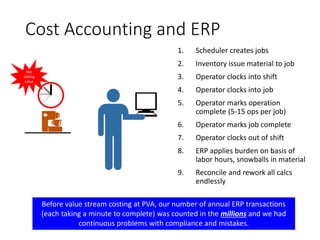
Cost Accounting and ERP
1. Scheduler creates jobs
2. Inventory issue material to job
3. Operator clocks into shift
4. Operator clocks into job
5. Operator marks operation
complete (5-15 ops per job)
6. Operator marks job complete
7. Operator clocks out of shift
8. ERP applies burden on basis of
labor hours, snowballs in material
9. Reconcile and rework all calcs
endlessly
Not
adding
value
Before value stream costing at PVA, our number of annual ERP transactions
(each taking a minute to complete) was counted in the millions and we had
continuous problems with compliance and mistakes.
The rules of automation apply to ERP:
Before value stream costing at PVA, our number of annual ERP transactions
(each taking a minute to complete) was counted in the millions and we had
continuous problems with compliance and mistakes.
• Separate man’s work from computer’s work!
• Ok to have a machine (ERP) serve or
wait on a man
• ERP should detect problems and
notify (e.g. no supplier confirmation)
• Don’t make man work for machine (ERP)
• Systems that require monitoring
• Systems that require constant input and
maintenance
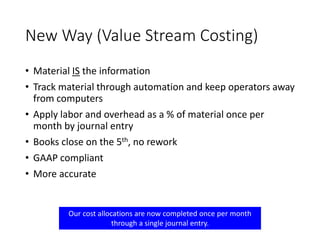
New Way (Value Stream Costing)
• Material IS the information
• Track material through automation and keep operators away
from computers
• Apply labor and overhead as a % of material once per
month by journal entry
• Books close on the 5th, no rework
• GAAP compliant
• More accurate
Our cost allocations are now completed once per month
through a single journal entry.
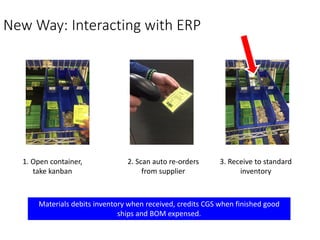
New Way: Interacting with ERP
1. Open container,
take kanban
2. Scan auto re-orders
from supplier
3. Receive to standard
inventory
Materials debits inventory when received, credits CGS when finished good
ships and BOM expensed. All reordering, labor and cost allocations done in the
background by the computer.
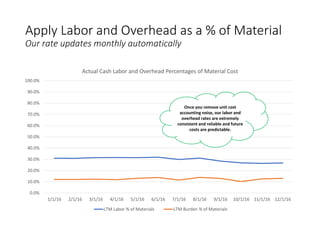
Apply Labor and Overhead as a % of Material
Our rate updates monthly automatically
0.0%
10.0%
20.0%
30.0%
40.0%
50.0%
60.0%
70.0%
80.0%
90.0%
100.0%
1/1/16 2/1/16 3/1/16 4/1/16 5/1/16 6/1/16 7/1/16 8/1/16 9/1/16 10/1/16 11/1/16 12/1/16
Actual Cash Labor and Overhead Percentages of Material Cost
LTM Labor % of Materials LTM Burden % of Materials
Once you remove unit cost
accounting noise, our labor and
overhead rates are extremely
consistent and reliable and future
costs are predictable.
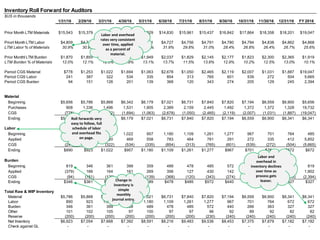
Inventory Roll Forward for Auditors
$US in thousands
1/31/16 2/29/16 3/31/16 4/30/16 5/31/16 6/30/16 7/31/16 8/31/16 9/30/16 10/31/16 11/30/16 12/31/16 FY 2016
Prior Month LTM Materials $15,543 $15,379 $15,038 $14,916 $14,929 $14,830 $15,961 $15,437 $16,842 $17,864 $18,358 $18,201 $19,047
Priort Month LTM Labor $4,809 $4,747 $4,730 $4,706 $4,701 $4,727 $4,756 $4,791 $4,780 $4,794 $4,838 $4,862 $4,868
LTM Labor % of Materials 30.9% 30.9% 31.5% 31.6% 31.5% 31.9% 29.8% 31.0% 28.4% 26.8% 26.4% 26.7% 25.6%
Prior Monthl LTM Burden $1,870 $1,855 $1,849 $1,768 $1,949 $2,037 $1,829 $2,145 $2,177 $1,823 $2,300 $2,365 $1,919
LTM Burden % of Materials 12.0% 12.1% 12.3% 11.9% 13.1% 13.7% 11.5% 13.9% 12.9% 10.2% 12.5% 13.0% 10.1%
Period CGS Material $778 $1,253 $1,022 $1,694 $1,063 $2,678 $1,050 $2,465 $2,119 $2,007 $1,031 $1,887 $19,047
Period CGS Labor 241 387 322 534 335 854 313 765 601 539 272 504 5,665
Period CGS Burden 94 151 126 201 139 368 120 343 274 205 129 245 2,394
Material
Beginning $5,656 $5,786 $5,868 $6,342 $6,179 $7,021 $6,731 $7,840 $7,820 $7,194 $6,559 $6,900 $5,656
Purchases 908 1,336 1,496 1,531 1,905 2,389 2,159 2,445 1,492 1,372 1,372 1,328 19,732
CGS (778) (1,253) (1,022) (1,694) (1,063) (2,678) (1,050) (2,465) (2,119) (2,007) (1,031) (1,887) (19,047)
Ending $5,786 $5,868 $6,342 $6,179 $7,021 $6,731 $7,840 $7,820 $7,194 $6,559 $6,900 $6,341 $6,341
Labor
Beginning 485 890 923 1,022 957 1,180 1,109 1,261 1,277 967 701 764 485
Applied 645 421 420 469 558 783 464 781 291 272 335 412 5,852
CGS (241) (387) (322) (534) (335) (854) (313) (765) (601) (539) (272) (504) (5,665)
Ending $890 $923 $1,022 $957 $1,180 $1,109 $1,261 $1,277 $967 $701 $764 $672 $672
Burden
Beginning 819 346 361 399 359 489 478 485 572 440 266 363 819
Applied (379) 166 164 161 269 356 127 430 142 31 226 209 1,902
CGS (94) (151) (126) (201) (139) (368) (120) (343) (274) (205) (129) (245) (2,394)
Ending $346 $361 $399 $359 $489 $478 $485 $572 $440 $266 $363 $327 $327
Total Raw & WIP Inventory
Material $5,786 $5,868 $6,342 $6,179 $7,021 $6,731 $7,840 $7,820 $7,194 $6,559 $6,900 $6,341 $6,341
Labor 890 923 1,022 957 1,180 1,109 1,261 1,277 967 701 764 672 672
Burden 346 361 399 359 489 478 485 572 440 266 363 327 327
Other 101 102 105 97 100 97 97 96 92 89 92 82 82
Reserve (200) (200) (200) (200) (200) (200) (200) (230) (240) (240) (240) (240) (240)
Net Inventory $6,923 $7,054 $7,668 $7,392 $8,591 $8,216 $9,483 $9,536 $8,453 $7,375 $7,879 $7,182 $7,182
Check against GL - - - - - - - - - - - - -
Labor and
overhead in
inventory declines
over time as
process gets
leaner.
Roll forwards very
easy to follow, full
schedule of labor
and overhead fits
on page.
Labor and overhead
rates very consistent
over time, applied
as a percent of
material.
Change in
inventory is
simple
monthly
journal entry.
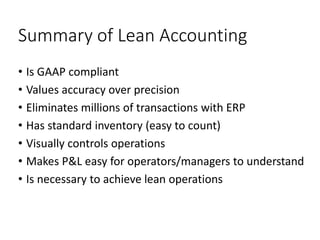
Summary of Lean Accounting
• Is GAAP compliant
• Values accuracy over precision
• Eliminates millions of transactions with ERP
• Has standard inventory (easy to count)
• Visually controls operations
• Makes P&L easy for operators/managers to understand
• Is necessary to achieve lean operations
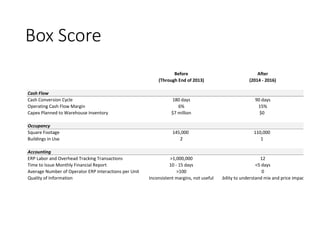
Box Score
Before After
(Through End of 2013) (2014 - 2016)
Cash Flow
Cash Conversion Cycle 180 days 90 days
Operating Cash Flow Margin 6% 15%
Capex Planned to Warehouse Inventory $7 million $0
Occupancy
Square Footage 145,000 110,000
Buildings in Use 2 1
Accounting
ERP Labor and Overhead Tracking Transactions >1,000,000 12
Time to Issue Monthly Financial Report 10 - 15 days <5 days
Average Number of Operator ERP Interactions per Unit >100 0
Quality of Information Inconsistent margins, not useful Ability to understand mix and price impac
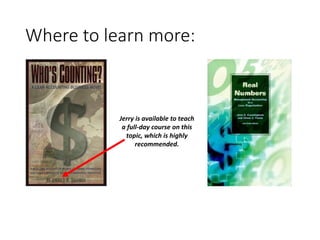
Where to learn more:
Jerry is available to teach
a full-day course on this
topic, which is highly
recommended.

Lean Accounting Case Study

  • 1.
    “It was notenough to chase the cost accountants out of the plants. The problem was to chase cost accounting from my people's minds” ~ Taiichi Ohno, Creator of the Toyota Production System
  • 2.
    Traditional Understanding ofCost • We need lots of data to understand cost • We need to analyze costs to the most discrete level possible (per unit, per hour, per ton, etc.) • Technology will give us the transactional control necessary to gather information and calculate discrete costs • Precise discrete costs will allow us to manage costs and increase profits
  • 3.
    Traditional Understanding ofCost • We need lots of data to understand cost • We need to analyze costs to the most discrete level possible (per unit, per hour, per ton, etc.) • Technology will give us the transactional control necessary to gather information and calculate discrete costs • Precise discrete costs will allow us to manage costs and increase profits FALSE FALSE FALSE FALSE All of these traditional assumptions are wrong
  • 4.
    Overhead (Fixed) Labor (Mostly Fixed) Materials (Mostly Variable) OldFashioned Cost Accounting Output (Variable, Unpredictable) In old fashioned cost accounting, we spend excessive amounts of non-value added time trying to allocate these, to these.
  • 5.
    Overhead (Fixed) Labor (Mostly Fixed) Materials (Mostly Variable) OldFashioned Cost Accounting (cont.) Output (Variable, Unpredictable) Since material and output are both variable, they move in tandem. If you make more coffee machines you use more parts.
  • 6.
    Overhead (Fixed) Labor (Mostly Fixed) Materials (Mostly Variable) OldFashioned Cost Accounting (cont.) Output (Variable, Unpredictable) But fixed costs have nothing to do with volume.
  • 7.
    Overhead (Fixed) Old Fashioned CostAccounting (cont.) Despite the fact that real estate taxes have nothing to do with volume, we develop arbitrary methods (e.g. hours worked, unit volume forecasts, etc.) to allocate these costs.
  • 8.
    Overhead (Fixed) Old Fashioned CostAccounting (cont.) HOORAY, POSITIVE VARIANCE!!!!
  • 9.
    Overhead (Fixed) Old Fashioned CostAccounting (cont.) Our fixed real estate costs per unit went from $1.00 to $.50. We reduced costs per unit by 100%!
  • 10.
    Overhead (Fixed) Old Fashioned CostAccounting (cont.) But real estate taxes didn’t change, and we spent 50% more on material (which is now in inventory). Overproduction
  • 11.
    Overhead (Fixed) Old Fashioned CostAccounting (cont.) So what if we actually sold less than was demanded?
  • 12.
    Overhead (Fixed) Old Fashioned CostAccounting (cont.) Our fixed costs per unit will increase by 100% if our volume goes down by 50%. Inadequate or unsatisfied demand
  • 13.
    So what doesa negative variance tell us? $US in thousands Projected Actual Rent $735 $735 Insurance 55 60 Property Taxes 90 90 Utilities 110 116 Supplies 53 48 Period Fixed Costs $1,043 $1,049 Labor Hours 25,600 25,856 Fixed Costs per Labor Hour $40.74 $40.57 Total Labor Hours 25,600 25,856 Units Sold 19,650 18,668 Labor Hours per Unit 1.30 1.39 Standard Burden Rate $40.74 $40.57 Burden per Unit $53.08 $56.19 Labor Hour Variance $3.34 Fixed Cost Variance ($0.22)
  • 14.
    So what doesa negative variance tell us? $US in thousands Projected Actual Rent $735 $735 Insurance 55 60 Property Taxes 90 90 Utilities 110 116 Supplies 53 48 Period Fixed Costs $1,043 $1,049 Labor Hours 25,600 25,856 Fixed Costs per Labor Hour $40.74 $40.57 Total Labor Hours 25,600 25,856 Units Sold 19,650 18,668 Labor Hours per Unit 1.30 1.39 Standard Burden Rate $40.74 $40.57 Burden per Unit $53.08 $56.19 Labor Hour Variance $3.34 Fixed Cost Variance ($0.22) We didn’t sell enough units
  • 15.
    Old fashioned costaccounting (recap) • Cost accounting unit cost decrease: • Increase “profit” per unit • MAKE LESS MONEY • Cost accounting unit cost increase: • We didn’t sell enough stuff (not actually a cost issue) • OR we didn’t meet demand (not actually a cost issue) • So at the end of the day, a cost accounting department: 1. Spends substantial non-value add time running computations 2. Figures out how to increase paper profits by making less money 3. OR, tells us that we didn’t sell enough stuff Nearly every bad financial decision can be traced to making decisions based on calculated unit costs.
  • 16.
    Lean Accounting Recap •In a Just-in-Time system: • You do not overproduce (creating positive variances) • You do not underproduce (creating negative variances) • The essence of JIT is: • Produce exactly what is needed • Delivery it exactly when it is needed • Not late • Not early • With perfect built-in quality (“jidoka”)
  • 17.
    Finance and Operations Ina lean business system, lean accounting can’t happen without lean operations and lean operations can’t happen without lean accounting Lean Operations • Fixed stock inventory • Fixed WIP • Separate processing streams • Empowered team • Kanban / 1x 1 pull • Separate operators from ERP Lean Accounting • No cost accounting • Value stream accounting • Material JIT • Labor / OHD % material • Simple P&L, shared broadly • Track quality, lead-time, problems
  • 18.
  • 19.
    Lean Accounting STANDARD PARTSMATERIAL STOCK • Replenished at consumption rate • Kanban reorder • Purchases = CGS • Easy to count (never changes)
  • 20.
    Lean Accounting STANDARD IN-PROCESSSTOCK (SWIP) • 1X1 production • Kanban make / wait indication • Easy to count (never changes)
  • 21.
    Lean Accounting STANDARD FINISHEDGOOD STORE • 1X1 replenishment • Replenish at rate of consumption • Customer demand sets pace (takt) • Kanban make/wait indicator • Line stops when store full • Easy to count (never changes)
  • 22.
    Lean Accounting STANDARD NUMBEROF OPERATIONS • Each processing stream has its own team • Profitability, cost measured at value stream (not product or unit) • Labor in value stream is the payroll • Number of operations equals total cycle time divided by demand pace (takt)
  • 23.
    Lean Accounting DECLINING FIXEDCOSTS • Reduce (don’t spread) fixed overhead • Significantly reduce your space needs • Reduce occupancy costs • Focus on improving (“leaning out”) HR, finance, accounting, engineering, R&D
  • 24.
    Lean Accounting KAIZEN /CROSS TRAIN • Remove waste, remove operators from process • People are most valuable resource • Don’t lay off, reassign to an area that needs help • OR add them to your kaizen (improvements) team • AND continue to grow without adding headcount • SO increase revenue per FTE (a measure that actually counts)
  • 25.
    Lean Accounting BUILT-IN QUALITY(“JIDOKA”) • Detect abnormalities • Empowered TM to stop the line (“andon”) • Get immediate help (team leader response) • Capture data (pareto) on problems • Prioritized problems for 8-step problem solving
  • 26.
    Lean Accounting So whatdo we count? • Direct material cost and value add (sales less direct material with no stacked labor or ohd) • Marginal costs (the cost of increasing capacity by one more) • Team member problem solving development • Lead-time • On-time delivery rate • Defects, warranty and service root causes • Value added processing time • Wasted time (“muda”) • Shortages and overproduction • Value stream profitability • Cash cycle • Cash in the bank!!!
  • 27.
    What we dospend time tracking 8-Step Problem Solving Reported Work Problems (Andons) 1/1/16 – 1/31/16
  • 28.
    “The first ruleof any technology used in a business is that automation applied to an efficient operation will magnify the efficiency. The second is that automation applied to an inefficient operation will magnify the inefficiency.” ~ Bill Gates, Founder of Microsoft
  • 29.
    Cost Accounting andERP 1. Scheduler creates jobs 2. Inventory issue material to job 3. Operator clocks into shift 4. Operator clocks into job 5. Operator marks operation complete (5-15 ops per job) 6. Operator marks job complete 7. Operator clocks out of shift 8. ERP applies burden on basis of labor hours, snowballs in material 9. Reconcile and rework all calcs endlessly Not adding value Before value stream costing at PVA, our number of annual ERP transactions (each taking a minute to complete) was counted in the millions and we had continuous problems with compliance and mistakes.
  • 30.
    The rules ofautomation apply to ERP: Before value stream costing at PVA, our number of annual ERP transactions (each taking a minute to complete) was counted in the millions and we had continuous problems with compliance and mistakes. • Separate man’s work from computer’s work! • Ok to have a machine (ERP) serve or wait on a man • ERP should detect problems and notify (e.g. no supplier confirmation) • Don’t make man work for machine (ERP) • Systems that require monitoring • Systems that require constant input and maintenance
  • 31.
    New Way (ValueStream Costing) • Material IS the information • Track material through automation and keep operators away from computers • Apply labor and overhead as a % of material once per month by journal entry • Books close on the 5th, no rework • GAAP compliant • More accurate Our cost allocations are now completed once per month through a single journal entry.
  • 32.
    New Way: Interactingwith ERP 1. Open container, take kanban 2. Scan auto re-orders from supplier 3. Receive to standard inventory Materials debits inventory when received, credits CGS when finished good ships and BOM expensed. All reordering, labor and cost allocations done in the background by the computer.
  • 33.
    Apply Labor andOverhead as a % of Material Our rate updates monthly automatically 0.0% 10.0% 20.0% 30.0% 40.0% 50.0% 60.0% 70.0% 80.0% 90.0% 100.0% 1/1/16 2/1/16 3/1/16 4/1/16 5/1/16 6/1/16 7/1/16 8/1/16 9/1/16 10/1/16 11/1/16 12/1/16 Actual Cash Labor and Overhead Percentages of Material Cost LTM Labor % of Materials LTM Burden % of Materials Once you remove unit cost accounting noise, our labor and overhead rates are extremely consistent and reliable and future costs are predictable.
  • 34.
    Inventory Roll Forwardfor Auditors $US in thousands 1/31/16 2/29/16 3/31/16 4/30/16 5/31/16 6/30/16 7/31/16 8/31/16 9/30/16 10/31/16 11/30/16 12/31/16 FY 2016 Prior Month LTM Materials $15,543 $15,379 $15,038 $14,916 $14,929 $14,830 $15,961 $15,437 $16,842 $17,864 $18,358 $18,201 $19,047 Priort Month LTM Labor $4,809 $4,747 $4,730 $4,706 $4,701 $4,727 $4,756 $4,791 $4,780 $4,794 $4,838 $4,862 $4,868 LTM Labor % of Materials 30.9% 30.9% 31.5% 31.6% 31.5% 31.9% 29.8% 31.0% 28.4% 26.8% 26.4% 26.7% 25.6% Prior Monthl LTM Burden $1,870 $1,855 $1,849 $1,768 $1,949 $2,037 $1,829 $2,145 $2,177 $1,823 $2,300 $2,365 $1,919 LTM Burden % of Materials 12.0% 12.1% 12.3% 11.9% 13.1% 13.7% 11.5% 13.9% 12.9% 10.2% 12.5% 13.0% 10.1% Period CGS Material $778 $1,253 $1,022 $1,694 $1,063 $2,678 $1,050 $2,465 $2,119 $2,007 $1,031 $1,887 $19,047 Period CGS Labor 241 387 322 534 335 854 313 765 601 539 272 504 5,665 Period CGS Burden 94 151 126 201 139 368 120 343 274 205 129 245 2,394 Material Beginning $5,656 $5,786 $5,868 $6,342 $6,179 $7,021 $6,731 $7,840 $7,820 $7,194 $6,559 $6,900 $5,656 Purchases 908 1,336 1,496 1,531 1,905 2,389 2,159 2,445 1,492 1,372 1,372 1,328 19,732 CGS (778) (1,253) (1,022) (1,694) (1,063) (2,678) (1,050) (2,465) (2,119) (2,007) (1,031) (1,887) (19,047) Ending $5,786 $5,868 $6,342 $6,179 $7,021 $6,731 $7,840 $7,820 $7,194 $6,559 $6,900 $6,341 $6,341 Labor Beginning 485 890 923 1,022 957 1,180 1,109 1,261 1,277 967 701 764 485 Applied 645 421 420 469 558 783 464 781 291 272 335 412 5,852 CGS (241) (387) (322) (534) (335) (854) (313) (765) (601) (539) (272) (504) (5,665) Ending $890 $923 $1,022 $957 $1,180 $1,109 $1,261 $1,277 $967 $701 $764 $672 $672 Burden Beginning 819 346 361 399 359 489 478 485 572 440 266 363 819 Applied (379) 166 164 161 269 356 127 430 142 31 226 209 1,902 CGS (94) (151) (126) (201) (139) (368) (120) (343) (274) (205) (129) (245) (2,394) Ending $346 $361 $399 $359 $489 $478 $485 $572 $440 $266 $363 $327 $327 Total Raw & WIP Inventory Material $5,786 $5,868 $6,342 $6,179 $7,021 $6,731 $7,840 $7,820 $7,194 $6,559 $6,900 $6,341 $6,341 Labor 890 923 1,022 957 1,180 1,109 1,261 1,277 967 701 764 672 672 Burden 346 361 399 359 489 478 485 572 440 266 363 327 327 Other 101 102 105 97 100 97 97 96 92 89 92 82 82 Reserve (200) (200) (200) (200) (200) (200) (200) (230) (240) (240) (240) (240) (240) Net Inventory $6,923 $7,054 $7,668 $7,392 $8,591 $8,216 $9,483 $9,536 $8,453 $7,375 $7,879 $7,182 $7,182 Check against GL - - - - - - - - - - - - - Labor and overhead in inventory declines over time as process gets leaner. Roll forwards very easy to follow, full schedule of labor and overhead fits on page. Labor and overhead rates very consistent over time, applied as a percent of material. Change in inventory is simple monthly journal entry.
  • 35.
    Summary of LeanAccounting • Is GAAP compliant • Values accuracy over precision • Eliminates millions of transactions with ERP • Has standard inventory (easy to count) • Visually controls operations • Makes P&L easy for operators/managers to understand • Is necessary to achieve lean operations
  • 36.
    Box Score Before After (ThroughEnd of 2013) (2014 - 2016) Cash Flow Cash Conversion Cycle 180 days 90 days Operating Cash Flow Margin 6% 15% Capex Planned to Warehouse Inventory $7 million $0 Occupancy Square Footage 145,000 110,000 Buildings in Use 2 1 Accounting ERP Labor and Overhead Tracking Transactions >1,000,000 12 Time to Issue Monthly Financial Report 10 - 15 days <5 days Average Number of Operator ERP Interactions per Unit >100 0 Quality of Information Inconsistent margins, not useful Ability to understand mix and price impac
  • 37.
    Where to learnmore: Jerry is available to teach a full-day course on this topic, which is highly recommended.