HOW TO MAKE A P&L
Ty Crandall
CEO, Credit Suite
(877) 600-2487
info@creditsuite.com
www.creditsuite.com/ein
What is a P&L?
A P&L (Profit and Loss statement) is, according to Investopedia:
“… [A] financial statement that summarizes the revenues, costs
and expenses incurred during a specific period of time, usually a
fiscal quarter or year.These records provide information about a
company's ability – or lack thereof – to generate profit by
increasing revenue, reducing costs, or both.The P&L statement is
also referred to as 'statement of profit and loss', 'income
statement,' 'statement of operations,' 'statement of financial
results,' and 'income and expense statement.'”
See: https://www.investopedia.com/terms/p/plstatement.asp
www.creditsuite.com/ein
• The P&L (AKA the income statement), is one
of three quarterly and annual statements a
company makes as to its financial health.
The other two are:
– The cash flow statement
– The balance sheet
• Numerous blank P&L forms are online to help
• Here’s one:
https://view.officeapps.live.com/op/view.aspx
?src=https://businesscreditblogger.com/wp-
content/uploads/2015/02/Profit-and-Loss-
Statement-Worksheet.xlswww.creditsuite.com/ein
What is a P&L?
What does a P&L show?
• The idea is to show changes in
accounts
• This is over a specific time frame
• In that way, it’s similar to your
cash flow statement
• Contrast this with the balance
sheet, which is more of a
snapshot
www.creditsuite.com/ein
Why Do You Want To Make A P&L?
• Apart from the obvious – someone asked for one
• That someone can be a lender (lenders will just about
always want a P&L)
• It’s also to give you a handle on the money your
business has
• You know how much capital is coming in …
• … and going out
www.creditsuite.com/ein
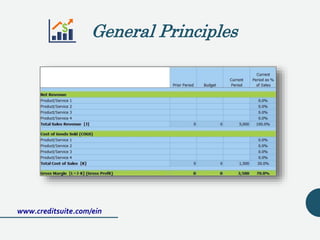
• Start with Net Revenue (the “top line”)
• This is the money coming in from sales
• Subtract the Cost of Goods Sold
• COGS is the hard costs associated with producing
your product/service
• Those can be materials, equipment, etc.
www.creditsuite.com/ein
General Principles
www.creditsuite.com/ein
General Principles
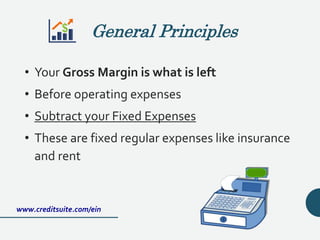
• Your Gross Margin is what is left
• Before operating expenses
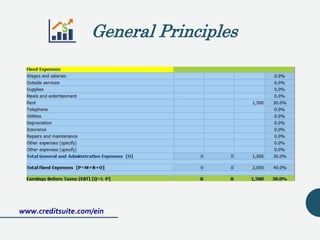
• Subtract your Fixed Expenses
• These are fixed regular expenses like insurance
and rent
www.creditsuite.com/ein
General Principles
www.creditsuite.com/ein
General Principles
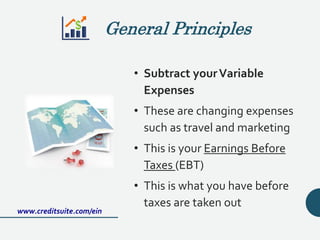
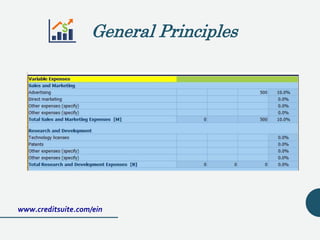
• Subtract yourVariable
Expenses
• These are changing expenses
such as travel and marketing
• This is your Earnings Before
Taxes (EBT)
• This is what you have before
taxes are taken out
www.creditsuite.com/ein
General Principles
www.creditsuite.com/ein
General Principles
• Subtract your taxes
• These are expenses you have got to pay
• The amount which is left over is your Net Income
(the “bottom line”)
• This will show if your company is profitable, losing
money, or breaking even
www.creditsuite.com/ein
General Principles
www.creditsuite.com/ein
General Principles
Principles
• It’s important to compare P&L statements over time
• Profits can rise and fall
• Or variable expenses will vary
• If profits are going up, but so are costs, then the
bottom line might remain more or less the same
• But you won’t know that without the detail inherent
in a P&L
www.creditsuite.com/ein
What else can you use a P&L for?
• One thing you can do is
calculate Gross Profit Margin
• This is a company’s total sales
revenue minus COGS
• Divided by total sales revenue
• Expressed as a percentage
www.creditsuite.com/ein
Gross Profit Margin
• The gross margin number represents the portion of each dollar of revenue that a
company keeps as gross profit
• If a company's gross margin for the most recent quarter is 45%, that means it
retains $0.45 from each dollar of revenue generated
• The company spends the rest asCOGS
• Because COGS have already been taken into account, remaining funds can go to
paying off debts, general and administrative expenses, interest expenses, and any
distributions to shareholders
• Figure gross profit margin with this equation:
(revenue – COGS)/revenue
www.creditsuite.com/ein
Operating Profit Margin
• A P&L can also be used to calculate a
business’s Operating Profit Margin
• Operating profit margin is a margin
ratio
• It is used to measure a company's
pricing strategy and operational
efficiency
• It is a measurement of what proportion
of whatever of a company's revenue is
left over after paying for variable costs
of production like wages, raw
materials, and the like
www.creditsuite.com/ein
• Operating Profit Margin is calculated by dividing a company’s operating
income (AKA its operating profit) within a given period by its net sales
during the same period
• Operating income refers to the profit which a company keeps after
removing operating expenses (like COGS and wages) and depreciation
• Net sales means the total value of sales minus the value of returned
goods, any allowances for damaged and missing goods, and discount
sales
• The equation is: operating income/net sales
www.creditsuite.com/ein
Operating Profit Margin
Net Profit Margin
• Profit margin is a portion of a category of
profitability ratios calculated as net income divided
by revenue, or net profits divided by sales
• Net income or net profit may be determined by
subtracting all of a company’s expenses, such as
operating costs, material costs (like raw materials)
and tax costs from total revenue
• Profit margins are shown as a percentage and they
effectively measure how much from each dollar of
sales a company keeps in earnings
• A 20% profit margin, therefore, means a company
has a net income of $0.20 per dollar of total
revenue earned
www.creditsuite.com/ein
• Net profit margin is the ratio of net profits to revenues for a company or for
a business segment
• It is often expressed as a percentage
• Net profit margins show how much of each dollar collected by a company
as revenue translates into profit
• Calculate net profit margin by figuring: net margin = net profit/revenue
www.creditsuite.com/ein
Net Profit Margin
Operating Ratio
• Operating ratio shows the
efficiency of a company's
management; it does this by
comparing operating expense
to net sales
• The lower the ratio, then the
greater the organization's ability
to generate profit if revenues go
down
• When using this ratio, investors
should note that it doesn't take
debt repayment or expansion
into account
www.creditsuite.com/ein
• Operating ratio measures operational efficiency
• It is often used, with return on assets and return on
equity, as a measurement of a company's efficient use
of capital and managerial resources
• Tracking the operating ratio over time allows for the
identification of trends in operational efficiency
• Trend analysis can help to identify issues and allow for
timely course corrections
www.creditsuite.com/ein
Operating Ratio
• A rising operating ratio means an inefficient
operating environment may need to
implement cost controls to improve its
margin
• A falling operating ratio means an efficient
operating environment has operating
expenses which are increasingly a smaller
percentage of sales
• The equation is: operating expense/net
sales
www.creditsuite.com/ein
Operating Ratio
Trends
• Analysts love trends for good reason
• Reviewing comparable time periods (years or quarters, usually),
you can home in on what is making your business profitable –
or causing a loss
• Seeing a trend can provide you with the opportunity to correct
things before they worsen
• Or you can do more of what’s helping your business succeed
www.creditsuite.com/ein
The Power of Knowing Your Numbers
• The power of knowing your
numbers is vital to running a
profitable business
• You can make any necessary
adjustments to show a profit
• Numbers do not lie!
• They tell everything about the
health of a business
www.creditsuite.com/ein
• Knowing your numbers means you have a huge
advantage over those who do not
• Your profit and loss statement tells a story of your
business
• Understanding the story behind your numbers can
be an extremely important factor for achieving
success
www.creditsuite.com/ein
The Power of Knowing Your Numbers
Recap – How to make a P&L
• Know your numbers
• Put together revenue, fixed
and variable costs
• Take taxes and COGS into
consideration
• Several P&L forms are online
to help
• We can help
www.creditsuite.com/ein
Contact Us for More Information
877-600-2487
info@creditsuite.com
How to make a P&L
www.creditsuite.com/ein

How to make a P & L

  • 1.
  • 2.
    Ty Crandall CEO, CreditSuite (877) 600-2487 info@creditsuite.com www.creditsuite.com/ein
  • 3.
    What is aP&L? A P&L (Profit and Loss statement) is, according to Investopedia: “… [A] financial statement that summarizes the revenues, costs and expenses incurred during a specific period of time, usually a fiscal quarter or year.These records provide information about a company's ability – or lack thereof – to generate profit by increasing revenue, reducing costs, or both.The P&L statement is also referred to as 'statement of profit and loss', 'income statement,' 'statement of operations,' 'statement of financial results,' and 'income and expense statement.'” See: https://www.investopedia.com/terms/p/plstatement.asp www.creditsuite.com/ein
  • 4.
    • The P&L(AKA the income statement), is one of three quarterly and annual statements a company makes as to its financial health. The other two are: – The cash flow statement – The balance sheet • Numerous blank P&L forms are online to help • Here’s one: https://view.officeapps.live.com/op/view.aspx ?src=https://businesscreditblogger.com/wp- content/uploads/2015/02/Profit-and-Loss- Statement-Worksheet.xlswww.creditsuite.com/ein What is a P&L?
  • 5.
    What does aP&L show? • The idea is to show changes in accounts • This is over a specific time frame • In that way, it’s similar to your cash flow statement • Contrast this with the balance sheet, which is more of a snapshot www.creditsuite.com/ein
  • 6.
    Why Do YouWant To Make A P&L? • Apart from the obvious – someone asked for one • That someone can be a lender (lenders will just about always want a P&L) • It’s also to give you a handle on the money your business has • You know how much capital is coming in … • … and going out www.creditsuite.com/ein
  • 7.
    • Start withNet Revenue (the “top line”) • This is the money coming in from sales • Subtract the Cost of Goods Sold • COGS is the hard costs associated with producing your product/service • Those can be materials, equipment, etc. www.creditsuite.com/ein General Principles
  • 8.
  • 9.
    • Your GrossMargin is what is left • Before operating expenses • Subtract your Fixed Expenses • These are fixed regular expenses like insurance and rent www.creditsuite.com/ein General Principles
  • 10.
  • 11.
    • Subtract yourVariable Expenses •These are changing expenses such as travel and marketing • This is your Earnings Before Taxes (EBT) • This is what you have before taxes are taken out www.creditsuite.com/ein General Principles
  • 12.
  • 13.
    • Subtract yourtaxes • These are expenses you have got to pay • The amount which is left over is your Net Income (the “bottom line”) • This will show if your company is profitable, losing money, or breaking even www.creditsuite.com/ein General Principles
  • 14.
  • 15.
    Principles • It’s importantto compare P&L statements over time • Profits can rise and fall • Or variable expenses will vary • If profits are going up, but so are costs, then the bottom line might remain more or less the same • But you won’t know that without the detail inherent in a P&L www.creditsuite.com/ein
  • 16.
    What else canyou use a P&L for? • One thing you can do is calculate Gross Profit Margin • This is a company’s total sales revenue minus COGS • Divided by total sales revenue • Expressed as a percentage www.creditsuite.com/ein
  • 17.
    Gross Profit Margin •The gross margin number represents the portion of each dollar of revenue that a company keeps as gross profit • If a company's gross margin for the most recent quarter is 45%, that means it retains $0.45 from each dollar of revenue generated • The company spends the rest asCOGS • Because COGS have already been taken into account, remaining funds can go to paying off debts, general and administrative expenses, interest expenses, and any distributions to shareholders • Figure gross profit margin with this equation: (revenue – COGS)/revenue www.creditsuite.com/ein
  • 18.
    Operating Profit Margin •A P&L can also be used to calculate a business’s Operating Profit Margin • Operating profit margin is a margin ratio • It is used to measure a company's pricing strategy and operational efficiency • It is a measurement of what proportion of whatever of a company's revenue is left over after paying for variable costs of production like wages, raw materials, and the like www.creditsuite.com/ein
  • 19.
    • Operating ProfitMargin is calculated by dividing a company’s operating income (AKA its operating profit) within a given period by its net sales during the same period • Operating income refers to the profit which a company keeps after removing operating expenses (like COGS and wages) and depreciation • Net sales means the total value of sales minus the value of returned goods, any allowances for damaged and missing goods, and discount sales • The equation is: operating income/net sales www.creditsuite.com/ein Operating Profit Margin
  • 20.
    Net Profit Margin •Profit margin is a portion of a category of profitability ratios calculated as net income divided by revenue, or net profits divided by sales • Net income or net profit may be determined by subtracting all of a company’s expenses, such as operating costs, material costs (like raw materials) and tax costs from total revenue • Profit margins are shown as a percentage and they effectively measure how much from each dollar of sales a company keeps in earnings • A 20% profit margin, therefore, means a company has a net income of $0.20 per dollar of total revenue earned www.creditsuite.com/ein
  • 21.
    • Net profitmargin is the ratio of net profits to revenues for a company or for a business segment • It is often expressed as a percentage • Net profit margins show how much of each dollar collected by a company as revenue translates into profit • Calculate net profit margin by figuring: net margin = net profit/revenue www.creditsuite.com/ein Net Profit Margin
  • 22.
    Operating Ratio • Operatingratio shows the efficiency of a company's management; it does this by comparing operating expense to net sales • The lower the ratio, then the greater the organization's ability to generate profit if revenues go down • When using this ratio, investors should note that it doesn't take debt repayment or expansion into account www.creditsuite.com/ein
  • 23.
    • Operating ratiomeasures operational efficiency • It is often used, with return on assets and return on equity, as a measurement of a company's efficient use of capital and managerial resources • Tracking the operating ratio over time allows for the identification of trends in operational efficiency • Trend analysis can help to identify issues and allow for timely course corrections www.creditsuite.com/ein Operating Ratio
  • 24.
    • A risingoperating ratio means an inefficient operating environment may need to implement cost controls to improve its margin • A falling operating ratio means an efficient operating environment has operating expenses which are increasingly a smaller percentage of sales • The equation is: operating expense/net sales www.creditsuite.com/ein Operating Ratio
  • 25.
    Trends • Analysts lovetrends for good reason • Reviewing comparable time periods (years or quarters, usually), you can home in on what is making your business profitable – or causing a loss • Seeing a trend can provide you with the opportunity to correct things before they worsen • Or you can do more of what’s helping your business succeed www.creditsuite.com/ein
  • 26.
    The Power ofKnowing Your Numbers • The power of knowing your numbers is vital to running a profitable business • You can make any necessary adjustments to show a profit • Numbers do not lie! • They tell everything about the health of a business www.creditsuite.com/ein
  • 27.
    • Knowing yournumbers means you have a huge advantage over those who do not • Your profit and loss statement tells a story of your business • Understanding the story behind your numbers can be an extremely important factor for achieving success www.creditsuite.com/ein The Power of Knowing Your Numbers
  • 28.
    Recap – Howto make a P&L • Know your numbers • Put together revenue, fixed and variable costs • Take taxes and COGS into consideration • Several P&L forms are online to help • We can help www.creditsuite.com/ein
  • 29.
    Contact Us forMore Information 877-600-2487 info@creditsuite.com How to make a P&L www.creditsuite.com/ein