Lean product development 101
mark geene @mgeene
Confidential & Proprietary
LEAN Product development PRINCIPLES
What’s “Lean”?
Creating the maximum value while applying the fewest amount
of resources (e.g., people, capital)
Confidential & Proprietary
LEAN Product development PRINCIPLES
1. Build the right thing; By iterating
2. Discover problems by talking to customers
3. Determine Problem/Solution Fit with an MVP
4. More features are not the answer
5. Measure Results … AARRR
Confidential & Proprietary
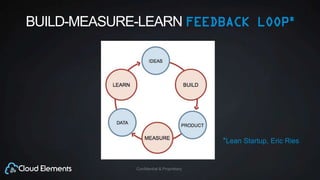
BUILD-MEASURE-LEARN FEEDBACK LOOP*
*Lean Startup, Eric Ries
Confidential & Proprietary
Problem/solution fit
• Is this a problem worth solving?
• Must-Have (Is it something customers/users need?)
• Viable (Will they pay for it?)
• Feasible (Can it be solved with available resources?)
• Minimum Viable Product (MVP)
• Purpose is to address problem/solution fit
• Minimum set of features required to learn from “earlyvangelists”
• Visionary Early Adopters are the initial targets for MVP
• Visionary customers can “fill in the gaps” on missing features if the MVP product
solves a real problem
• “Do the smallest thing possible to learn”
• Test your hypothesis, learn and iterate
Running Lean, Ash Maurya & Lean Startup, Eric Ries
Confidential & Proprietary
product/market fit
• Is this something (lots of) people want?
• How well does my product solve the problem?
• What value does it deliver over other alternatives?
• Will they pay for it?
• Qualitative Discovery
• Quantitative Discovery
Running Lean, Ash Maurya
Confidential & Proprietary
STARTUP METRICS FOR pirates*
• Acquisition – Are users finding you?
• Activation – Do users have a great first experience?
• Retention – Do users come back?
• Referral – Do users like it enough to tell others?
• Revenue – Are users willing to pay for it?
* Dave McClure, 500 Startups
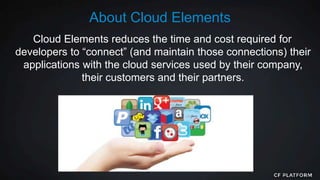
Cloud Elements reduces the time and cost required for
developers to “connect” (and maintain those connections) their
applications with the cloud services used by their company,
their customers and their partners.
About Cloud Elements
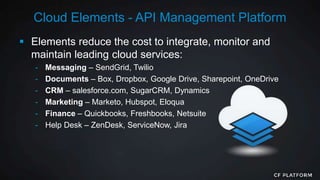
 Elements reduce the cost to integrate, monitor and
maintain leading cloud services:
- Messaging – SendGrid, Twilio
- Documents – Box, Dropbox, Google Drive, Sharepoint, OneDrive
- CRM – salesforce.com, SugarCRM, Dynamics
- Marketing – Marketo, Hubspot, Eloqua
- Finance – Quickbooks, Freshbooks, Netsuite
- Help Desk – ZenDesk, ServiceNow, Jira
Cloud Elements - API Management Platform
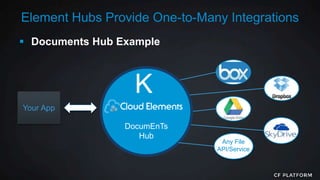
 Documents Hub Example
Element Hubs Provide One-to-Many Integrations
DocumEnTs
Hub
K
Any File
API/Service
Your App
Confidential & Proprietary
5 STEP MVP process
1. Form a hypothesis that you want to test
 “Developers spend too much time integrating cloud
services”
2. Develop a small set of questions to illuminate the
problem (measurable)
 How many services have you integrated?
 How many do you plan to integrate?
 Which services?
 How much time did it take to integrate each?
 How much time do you spend maintaining each?
Confidential & Proprietary
5 Step MVP Process
3. Use your MVP to assess impact on the hypothesis
 Reduce time spent integrating by 50% or more
 Pricing spread cost over 3 years
4. Use early adopters to find the high impact use cases
 App developers who need to integrate to multiple
providers of the same service
 Managing tens, hundreds, thousands of different
user accounts for each service
5. Prioritize Release-1 based on the above
 Focus on a narrower but high impact use case
 Don’t be afraid to step away from features
Confidential & Proprietary
Sleep machine example
Problem: Help people who live in noisy areas to sleep better
Hypothesis: Customers would rather use their iPhone than
dedicated sleep machines or alarm clocks
• 90+ Sounds Available
• Mix your own sleep tracks
• Beautiful digital clock
• Alarm with favorite songs
• Captures sleep data and analytics
Confidential & Proprietary
AGILE MVP PLANNING
1. Who are the users?
 Define user personas
2. What are all of the key features that I can think of?
 Identify the Epics
3. What is my objective for the MVP release?
 Document the hypothesis you are testing
4. Which Epics are required for my MVP?
 Prioritize Epics
Confidential & Proprietary
AGILE MVP PLANNING
5. What do these prioritized features/epics need to do?
 Identify all of the user stories you can think of
 INVEST (Independent, Negotiable, Valuable, Estimated, Small,
Testable)
 Assign each one to an Epic or create new Epics
6. Is this story required to determine Problem/Solution Fit?
 MVP Test Every Story
7. How long will it take to develop my MVP
 Estimate “points” for each user story
 Estimate “capacity” for your development team
Confidential & Proprietary
AGILE MVP PLANNING
8. What should we work on next?
 Organize stories into 2-Week Sprints
 Groom each story with acceptance criteria
9. How are we doing?
 Sprint Demo Reviews after every Sprint
10. What if my priorities change?
 Every 2 weeks prioritize stories for the next sprint
 Take into account market feedback
Release, Get Feedback, Repeat
Confidential & Proprietary
THE MVP TEST
Test each user story to determine if it belongs in the MVP
• Does it support the MVP hypothesis and objective?
• Is it essential to your primary use case?
• Is it essential to solving the highest value problem?
• Are your customers saying this is a “must have”?
• Focus on your “visionary” customers
• Don’t get dragged around by one or two vocal clients
• Can I fit it into a two-month development effort?
• How does it stack up against your other MVP priorities
• Draw a line in the sand for a release date and then cull what
doesn’t fit
Confidential & Proprietary
Common MISTAKES
1. Include too many features; start new ones too soon
2. Lack timely visibility to development progress
3. Not quantitatively capturing feedback from users and
customers
4. Focused on “your solution” and not on “their problems”
5. Your development team is too optimistic leading to too
many commitments
6. Lack of a product roadmap leads to any client being a good
client
7. Chasing the competition
Confidential & Proprietary
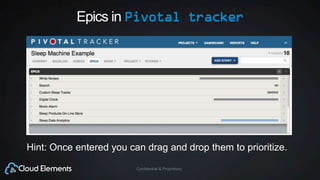
Epics in Pivotal tracker
Hint: Once entered you can drag and drop them to prioritize.
Confidential & Proprietary
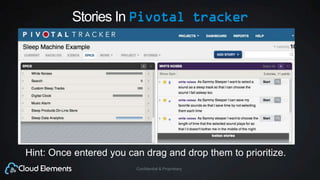
Stories In Pivotal tracker
Hint: Once entered you can drag and drop them to prioritize.
Confidential & Proprietary
Writing user stories
• As a [Persona]. I want to [capability or function],
so that [result or benefit]
• INVEST
• Independent
• Negotiable
• Valuable
• Estimated
• Small
• Testable
Confidential & Proprietary
summary
• Apply Lean Product Management & Development
Principles from Day 1
• Don’t over-engineer; get to MVP in two months or less
• Manage your priorities at the Epic level downward to
focus and save time in managing your backlog
• Your priorities and plan WILL change … Embrace it

Lean Product Development 101

  • 1.
    Lean product development101 mark geene @mgeene
  • 2.
    Confidential & Proprietary LEANProduct development PRINCIPLES What’s “Lean”? Creating the maximum value while applying the fewest amount of resources (e.g., people, capital)
  • 3.
    Confidential & Proprietary LEANProduct development PRINCIPLES 1. Build the right thing; By iterating 2. Discover problems by talking to customers 3. Determine Problem/Solution Fit with an MVP 4. More features are not the answer 5. Measure Results … AARRR
  • 4.
    Confidential & Proprietary BUILD-MEASURE-LEARNFEEDBACK LOOP* *Lean Startup, Eric Ries
  • 5.
    Confidential & Proprietary Problem/solutionfit • Is this a problem worth solving? • Must-Have (Is it something customers/users need?) • Viable (Will they pay for it?) • Feasible (Can it be solved with available resources?) • Minimum Viable Product (MVP) • Purpose is to address problem/solution fit • Minimum set of features required to learn from “earlyvangelists” • Visionary Early Adopters are the initial targets for MVP • Visionary customers can “fill in the gaps” on missing features if the MVP product solves a real problem • “Do the smallest thing possible to learn” • Test your hypothesis, learn and iterate Running Lean, Ash Maurya & Lean Startup, Eric Ries
  • 6.
    Confidential & Proprietary product/marketfit • Is this something (lots of) people want? • How well does my product solve the problem? • What value does it deliver over other alternatives? • Will they pay for it? • Qualitative Discovery • Quantitative Discovery Running Lean, Ash Maurya
  • 7.
    Confidential & Proprietary STARTUPMETRICS FOR pirates* • Acquisition – Are users finding you? • Activation – Do users have a great first experience? • Retention – Do users come back? • Referral – Do users like it enough to tell others? • Revenue – Are users willing to pay for it? * Dave McClure, 500 Startups
  • 8.
    Cloud Elements reducesthe time and cost required for developers to “connect” (and maintain those connections) their applications with the cloud services used by their company, their customers and their partners. About Cloud Elements
  • 9.
     Elements reducethe cost to integrate, monitor and maintain leading cloud services: - Messaging – SendGrid, Twilio - Documents – Box, Dropbox, Google Drive, Sharepoint, OneDrive - CRM – salesforce.com, SugarCRM, Dynamics - Marketing – Marketo, Hubspot, Eloqua - Finance – Quickbooks, Freshbooks, Netsuite - Help Desk – ZenDesk, ServiceNow, Jira Cloud Elements - API Management Platform
  • 10.
     Documents HubExample Element Hubs Provide One-to-Many Integrations DocumEnTs Hub K Any File API/Service Your App
  • 11.
    Confidential & Proprietary 5STEP MVP process 1. Form a hypothesis that you want to test  “Developers spend too much time integrating cloud services” 2. Develop a small set of questions to illuminate the problem (measurable)  How many services have you integrated?  How many do you plan to integrate?  Which services?  How much time did it take to integrate each?  How much time do you spend maintaining each?
  • 12.
    Confidential & Proprietary 5Step MVP Process 3. Use your MVP to assess impact on the hypothesis  Reduce time spent integrating by 50% or more  Pricing spread cost over 3 years 4. Use early adopters to find the high impact use cases  App developers who need to integrate to multiple providers of the same service  Managing tens, hundreds, thousands of different user accounts for each service 5. Prioritize Release-1 based on the above  Focus on a narrower but high impact use case  Don’t be afraid to step away from features
  • 13.
    Confidential & Proprietary Sleepmachine example Problem: Help people who live in noisy areas to sleep better Hypothesis: Customers would rather use their iPhone than dedicated sleep machines or alarm clocks • 90+ Sounds Available • Mix your own sleep tracks • Beautiful digital clock • Alarm with favorite songs • Captures sleep data and analytics
  • 14.
    Confidential & Proprietary AGILEMVP PLANNING 1. Who are the users?  Define user personas 2. What are all of the key features that I can think of?  Identify the Epics 3. What is my objective for the MVP release?  Document the hypothesis you are testing 4. Which Epics are required for my MVP?  Prioritize Epics
  • 15.
    Confidential & Proprietary AGILEMVP PLANNING 5. What do these prioritized features/epics need to do?  Identify all of the user stories you can think of  INVEST (Independent, Negotiable, Valuable, Estimated, Small, Testable)  Assign each one to an Epic or create new Epics 6. Is this story required to determine Problem/Solution Fit?  MVP Test Every Story 7. How long will it take to develop my MVP  Estimate “points” for each user story  Estimate “capacity” for your development team
  • 16.
    Confidential & Proprietary AGILEMVP PLANNING 8. What should we work on next?  Organize stories into 2-Week Sprints  Groom each story with acceptance criteria 9. How are we doing?  Sprint Demo Reviews after every Sprint 10. What if my priorities change?  Every 2 weeks prioritize stories for the next sprint  Take into account market feedback Release, Get Feedback, Repeat
  • 17.
    Confidential & Proprietary THEMVP TEST Test each user story to determine if it belongs in the MVP • Does it support the MVP hypothesis and objective? • Is it essential to your primary use case? • Is it essential to solving the highest value problem? • Are your customers saying this is a “must have”? • Focus on your “visionary” customers • Don’t get dragged around by one or two vocal clients • Can I fit it into a two-month development effort? • How does it stack up against your other MVP priorities • Draw a line in the sand for a release date and then cull what doesn’t fit
  • 18.
    Confidential & Proprietary CommonMISTAKES 1. Include too many features; start new ones too soon 2. Lack timely visibility to development progress 3. Not quantitatively capturing feedback from users and customers 4. Focused on “your solution” and not on “their problems” 5. Your development team is too optimistic leading to too many commitments 6. Lack of a product roadmap leads to any client being a good client 7. Chasing the competition
  • 19.
    Confidential & Proprietary Epicsin Pivotal tracker Hint: Once entered you can drag and drop them to prioritize.
  • 20.
    Confidential & Proprietary StoriesIn Pivotal tracker Hint: Once entered you can drag and drop them to prioritize.
  • 21.
    Confidential & Proprietary Writinguser stories • As a [Persona]. I want to [capability or function], so that [result or benefit] • INVEST • Independent • Negotiable • Valuable • Estimated • Small • Testable
  • 22.
    Confidential & Proprietary summary •Apply Lean Product Management & Development Principles from Day 1 • Don’t over-engineer; get to MVP in two months or less • Manage your priorities at the Epic level downward to focus and save time in managing your backlog • Your priorities and plan WILL change … Embrace it

Editor's Notes

  • #3 Build. What’s Lean then click to the answer
  • #4 Build one bullet at a time
  • #9 Fonts and title
  • #10 Can we get a graphical version?
  • #11 Please udate with the final version of this graphic
  • #12 Build each step on a click
  • #13 Build each step on a click