A Minimal Viable Product that works
How to test your assumptions
without wasting your time
Olga Pavlovsky @Lplatebigcheese
FFWDLondon 01 July 2014
What are you trying to do?
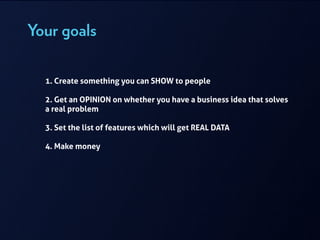
Your goals
!
1. Create something you can SHOW to people
!
2. Get an OPINION on whether you have a business idea that solves
a real problem
!
3. Set the list of features which will get REAL DATA
!
4. Make money
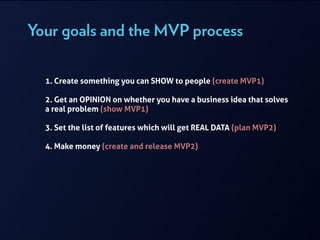
Your goals and the MVP process
!
1. Create something you can SHOW to people (create MVP1)
!
2. Get an OPINION on whether you have a business idea that solves
a real problem (show MVP1)
!
3. Set the list of features which will get REAL DATA (plan MVP2)
!
4. Make money (create and release MVP2)
What are you NOT trying to do?
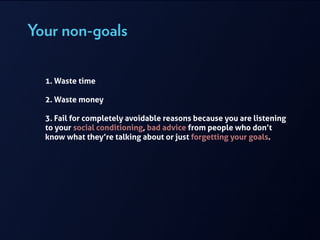
Your non-goals
!
1. Waste time
!
2. Waste money
!
3. Fail for completely avoidable reasons because you are listening
to your social conditioning, bad advice from people who don’t
know what they’re talking about or just forgetting your goals.
Why can I help you?
[insert life story here]
Lessons you can learn from my life lessons
!
1. Be resourceful
!
2. Time and place is sometimes more important than product
!
3. Sales and “the pitch” of the vision is as important as the product
Most common mistakes I see founders
making
!
1. Spending time on creation of the product instead of doing one
big thing they don’t like to do: selling
!
2. Communicating features and not the vision when they talk
about the product
!
3. Getting defensive about problems people point out, not
learning from feedback
!
Everything in life is a trade-off.
The MVP is really easy to hide behind.
The sales pitch is not easy to refine and deliver.
But you must do both to succeed as fast as you can.
!
Remember: the goal of MVP1 is to gather OPINION
!
The last picture I want to paint
What’s the different between:
!
!
!
Tetris in 1984
!
Grand Theft Auto V in 2013
Success is a process
How to build Tetris, not GTV
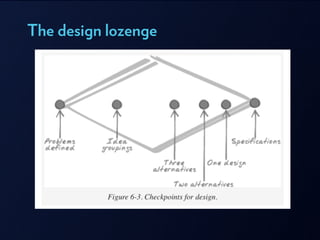
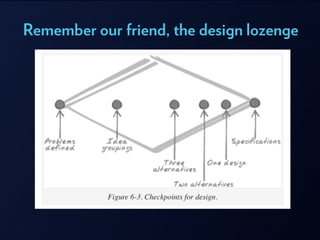
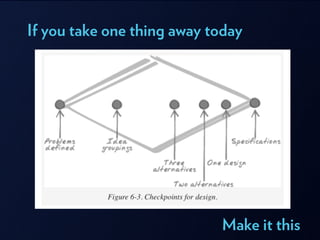
The design lozenge
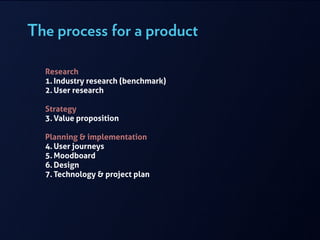
The process for a product
Research
1. Industry research (benchmark)
2. User research


Strategy
3. Value proposition


Planning & implementation
4. User journeys
5. Moodboard
6. Design
7. Technology & project plan
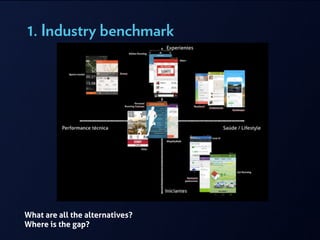
1. Industry benchmark
What are all the alternatives?
Where is the gap?
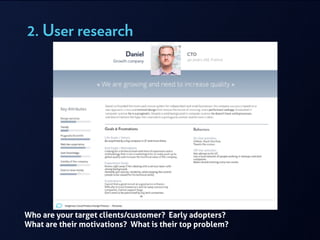
2. User research
Who are your target clients/customer? Early adopters?
What are their motivations? What is their top problem?
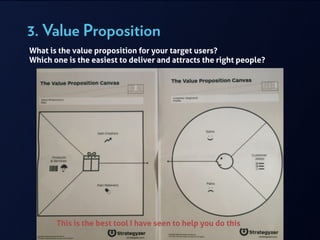
3. Value Proposition
What is the value proposition for your target users?
Which one is the easiest to deliver and attracts the right people?
This is the best tool I have seen to help you do this
3. Value Proposition
This is now your vision.
!
Invest time in the pitch.
!
Go and tell everyone about it. Do it as soon as possible.
!
Listen to their feedback. Iterate.
!
!
Methodologies and guides
!
Customer Development - Steve Blank
!
(Ultra) Lean Startup - Eric Reis
!
Dream, Design, Surf - Marcelo Bravo
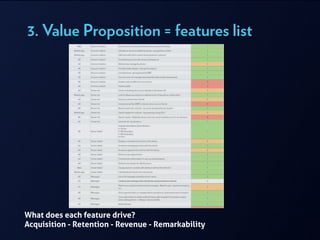
3. Value Proposition = features list
What does each feature drive?
Acquisition - Retention - Revenue - Remarkability
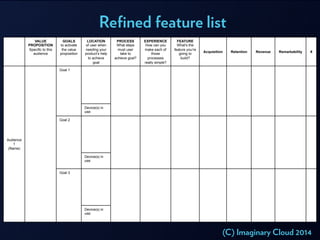
Refined feature list
VALUE
PROPOSITION
Specific to this
audience
GOALS
to activate
the value
proposition
LOCATION
of user when
needing your
product’s help
to achieve
goal
PROCESS
What steps
must user
take to
achieve goal?
EXPERIENCE
How can you
make each of
those
processes
really simple?
FEATURE
What’s the
feature you’re
going to
build?
Acquisition Retention Revenue Remarkability #
Audience
1
(Name)
Goal 1
Device(s) in
use:
Goal 2
Device(s) in
use:
Goal 3
Device(s) in
use:
(C) Imaginary Cloud 2014
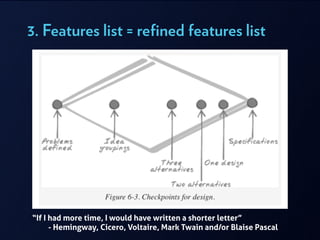
3. Features list = refined features list
“If I had more time, I would have written a shorter letter”
- Hemingway, Cicero, Voltaire, Mark Twain and/or Blaise Pascal
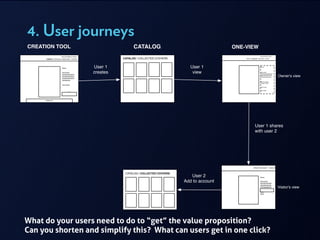
4. User journeys
What do your users need to do to “get” the value proposition?
Can you shorten and simplify this? What can users get in one click?
CATALOG | COLLECTED COVVERS
Description
blablablablablablablabl
ablablablablablablabla
blablablablablablabla
Name
Sharing options
Private | Public
View Mode
Edit Covver
CREATE | CATALOG | DISCOVER | STORE
Account Name | Inbox
Description
blablablablablabl
ablablablablabla
blablablablablabl
ablablablablabla
Name
View
Mode
ADD TO MY ACCOUNT
CREATE ACCOUNT | SIGN UP
CATALOG ONE-VIEWCREATION TOOL
Owner's view
User 1 shares
with user 2
Description
blablablablablabla
blablablablablabla
blablablablablabla
blablablabla
Name
View Mode
ADD INSIDE PAGES
CREATE | CATALOG | DISCOVER | STORE
Account Name | Inbox
Toolbar V2
User 1
creates
User 1
view
User 2
Add to account
Visitor's view
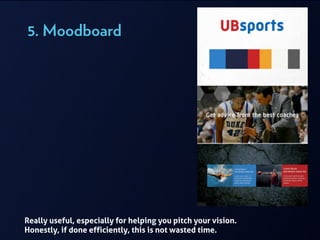
5. Moodboard
Really useful, especially for helping you pitch your vision.
Honestly, if done efficiently, this is not wasted time.
6. Graphic Design
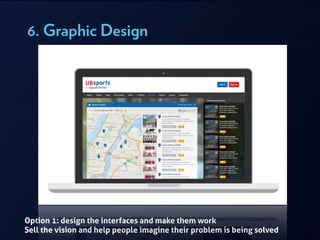
Option 1: design the interfaces and make them work
Sell the vision and help people imagine their problem is being solved
6. Graphic Design
For MVP1, graphic design should be as far as you go.
For MVP2, design should be as simple as possible, but you should use a pro.
Option 2
!
Design a Brochure
Use Hippoprint or MOO to print
!
!
Design a landing page with video
Use Launchrock and YouTube
!
6. Graphic Design: Tools for mock ups
There are literally hundreds of tools which can help you create sketches
and wireframes which are “interactive”.
!
You need to choose one which matches your team capabilities and needs:
!
Ask:
1. Will I, or a qualified designer be using it?
2. Will I be doing this for the web or mobile?
3. Will I be branding it, or just telling a nice story?
4. Will the OPINIONS I gather from MVP1 help me decide to move onto
MPV2 where I gather real data by trying to sell people something?
!
Now…
Get out of the office and ask:
!
Do people really have the problem you’re convinced is there?
How do they solve it now?
Would they pay to solve it?
How much would they pay to solve it?
Observe: who will actually pay to solve it?
!
!
Survey as many people as possible. 

Be honest with yourself about the results.
!
But remember: this is just OPINION
Now, go out and test MVP1
DO NOT go straight to MVP2
If all goes well, if you prove your
assumptions through OPINION…
!
Then GO TO MVP2
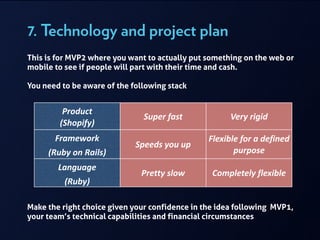
7. Technology and project plan
This is for MVP2 where you want to actually put something on the web or
mobile to see if people will part with their time and cash.
!
You need to be aware of the following stack
!
!
!
!
!
!
!
!
!
!
!
!
Make the right choice given your confidence in the idea following MVP1,
your team’s technical capabilities and financial circumstances
Product	
  

(Shopify)
Super	
  fast Very	
  rigid
Framework	
  
(Ruby	
  on	
  Rails)
Speeds	
  you	
  up
Flexible	
  for	
  a	
  defined	
  
purpose
Language	
  
(Ruby)
Pretty	
  slow Completely	
  flexible
Remember our friend, the design lozenge
How much should you spend on MVPs?
MVP1: keep it to a few hundred pounds at most.
!
MVP2: try to keep it to one month of development, or maximum of two.
[NB if you have a CTO or are really approaching this with a solid
understanding of technology, the architecture will take more time. But I
strongly recommend your first features take just a month or two to build).
!
!
Why should you keep the spend low?
In my experience, two things usually happen:
1. You will throw the first product away
2. You will discover you could have done things much, much more
simply than you did, and you’ll change a lot.
!
!
!
!
How much do real people spend?
I have observed that there is a calculation that can be done to see if your
MVP costs are aligned with your place in the product’s journey.
!
!
MVP cost = customer expectations + idea confidence + circumstances
!
!
£2,000 = (huge problem, low expectations) + (founder new to market) 

+ (needs investment to continue building product)
!
!
£100,000 = (customers are CEOs of banks) 

+ (founder has excellent connections) + (founder has cash to invest)
!
In both cases, it took about 12 months of full time work from day 1 for the
businesses to be self-sufficient (i.e. allowing the founders to focus on
them full time)
If you take one thing away today
Make it this
And build Tetris
not GTV
Thank you!
@Lplatebigcheese
Olga Pavlovsky
COO, @Imaginary_Cloud

A Minimal Viable Product that works

  • 1.
    A Minimal ViableProduct that works How to test your assumptions without wasting your time Olga Pavlovsky @Lplatebigcheese FFWDLondon 01 July 2014
  • 2.
    What are youtrying to do?
  • 3.
    Your goals ! 1. Createsomething you can SHOW to people ! 2. Get an OPINION on whether you have a business idea that solves a real problem ! 3. Set the list of features which will get REAL DATA ! 4. Make money
  • 4.
    Your goals andthe MVP process ! 1. Create something you can SHOW to people (create MVP1) ! 2. Get an OPINION on whether you have a business idea that solves a real problem (show MVP1) ! 3. Set the list of features which will get REAL DATA (plan MVP2) ! 4. Make money (create and release MVP2)
  • 5.
    What are youNOT trying to do?
  • 6.
    Your non-goals ! 1. Wastetime ! 2. Waste money ! 3. Fail for completely avoidable reasons because you are listening to your social conditioning, bad advice from people who don’t know what they’re talking about or just forgetting your goals.
  • 7.
    Why can Ihelp you?
  • 8.
  • 9.
    Lessons you canlearn from my life lessons ! 1. Be resourceful ! 2. Time and place is sometimes more important than product ! 3. Sales and “the pitch” of the vision is as important as the product
  • 10.
    Most common mistakesI see founders making ! 1. Spending time on creation of the product instead of doing one big thing they don’t like to do: selling ! 2. Communicating features and not the vision when they talk about the product ! 3. Getting defensive about problems people point out, not learning from feedback ! Everything in life is a trade-off. The MVP is really easy to hide behind. The sales pitch is not easy to refine and deliver. But you must do both to succeed as fast as you can. ! Remember: the goal of MVP1 is to gather OPINION !
  • 11.
    The last pictureI want to paint What’s the different between: ! ! ! Tetris in 1984 ! Grand Theft Auto V in 2013
  • 12.
    Success is aprocess
  • 13.
    How to buildTetris, not GTV
  • 14.
  • 15.
    The process fora product Research 1. Industry research (benchmark) 2. User research 
 Strategy 3. Value proposition 
 Planning & implementation 4. User journeys 5. Moodboard 6. Design 7. Technology & project plan
  • 16.
    1. Industry benchmark Whatare all the alternatives? Where is the gap?
  • 17.
    2. User research Whoare your target clients/customer? Early adopters? What are their motivations? What is their top problem?
  • 18.
    3. Value Proposition Whatis the value proposition for your target users? Which one is the easiest to deliver and attracts the right people? This is the best tool I have seen to help you do this
  • 19.
    3. Value Proposition Thisis now your vision. ! Invest time in the pitch. ! Go and tell everyone about it. Do it as soon as possible. ! Listen to their feedback. Iterate. ! ! Methodologies and guides ! Customer Development - Steve Blank ! (Ultra) Lean Startup - Eric Reis ! Dream, Design, Surf - Marcelo Bravo
  • 20.
    3. Value Proposition= features list What does each feature drive? Acquisition - Retention - Revenue - Remarkability
  • 21.
    Refined feature list VALUE PROPOSITION Specificto this audience GOALS to activate the value proposition LOCATION of user when needing your product’s help to achieve goal PROCESS What steps must user take to achieve goal? EXPERIENCE How can you make each of those processes really simple? FEATURE What’s the feature you’re going to build? Acquisition Retention Revenue Remarkability # Audience 1 (Name) Goal 1 Device(s) in use: Goal 2 Device(s) in use: Goal 3 Device(s) in use: (C) Imaginary Cloud 2014
  • 22.
    3. Features list= refined features list “If I had more time, I would have written a shorter letter” - Hemingway, Cicero, Voltaire, Mark Twain and/or Blaise Pascal
  • 23.
    4. User journeys Whatdo your users need to do to “get” the value proposition? Can you shorten and simplify this? What can users get in one click? CATALOG | COLLECTED COVVERS CATALOG | COLLECTED COVVERS Description blablablablablablablabl ablablablablablablabla blablablablablablabla Name Sharing options Private | Public View Mode Edit Covver CREATE | CATALOG | DISCOVER | STORE Account Name | Inbox Description blablablablablabl ablablablablabla blablablablablabl ablablablablabla Name View Mode ADD TO MY ACCOUNT CREATE ACCOUNT | SIGN UP CATALOG ONE-VIEWCREATION TOOL Owner's view User 1 shares with user 2 Description blablablablablabla blablablablablabla blablablablablabla blablablabla Name View Mode ADD INSIDE PAGES CREATE | CATALOG | DISCOVER | STORE Account Name | Inbox Toolbar V2 User 1 creates User 1 view User 2 Add to account Visitor's view
  • 24.
    5. Moodboard Really useful,especially for helping you pitch your vision. Honestly, if done efficiently, this is not wasted time.
  • 25.
    6. Graphic Design Option1: design the interfaces and make them work Sell the vision and help people imagine their problem is being solved
  • 26.
    6. Graphic Design ForMVP1, graphic design should be as far as you go. For MVP2, design should be as simple as possible, but you should use a pro. Option 2 ! Design a Brochure Use Hippoprint or MOO to print ! ! Design a landing page with video Use Launchrock and YouTube !
  • 27.
    6. Graphic Design:Tools for mock ups There are literally hundreds of tools which can help you create sketches and wireframes which are “interactive”. ! You need to choose one which matches your team capabilities and needs: ! Ask: 1. Will I, or a qualified designer be using it? 2. Will I be doing this for the web or mobile? 3. Will I be branding it, or just telling a nice story? 4. Will the OPINIONS I gather from MVP1 help me decide to move onto MPV2 where I gather real data by trying to sell people something? !
  • 28.
    Now… Get out ofthe office and ask: ! Do people really have the problem you’re convinced is there? How do they solve it now? Would they pay to solve it? How much would they pay to solve it? Observe: who will actually pay to solve it? ! ! Survey as many people as possible. 
 Be honest with yourself about the results. ! But remember: this is just OPINION
  • 29.
    Now, go outand test MVP1 DO NOT go straight to MVP2
  • 30.
    If all goeswell, if you prove your assumptions through OPINION… ! Then GO TO MVP2
  • 31.
    7. Technology andproject plan This is for MVP2 where you want to actually put something on the web or mobile to see if people will part with their time and cash. ! You need to be aware of the following stack ! ! ! ! ! ! ! ! ! ! ! ! Make the right choice given your confidence in the idea following MVP1, your team’s technical capabilities and financial circumstances Product  
 (Shopify) Super  fast Very  rigid Framework   (Ruby  on  Rails) Speeds  you  up Flexible  for  a  defined   purpose Language   (Ruby) Pretty  slow Completely  flexible
  • 32.
    Remember our friend,the design lozenge
  • 33.
    How much shouldyou spend on MVPs? MVP1: keep it to a few hundred pounds at most. ! MVP2: try to keep it to one month of development, or maximum of two. [NB if you have a CTO or are really approaching this with a solid understanding of technology, the architecture will take more time. But I strongly recommend your first features take just a month or two to build). ! ! Why should you keep the spend low? In my experience, two things usually happen: 1. You will throw the first product away 2. You will discover you could have done things much, much more simply than you did, and you’ll change a lot. ! ! ! !
  • 34.
    How much doreal people spend? I have observed that there is a calculation that can be done to see if your MVP costs are aligned with your place in the product’s journey. ! ! MVP cost = customer expectations + idea confidence + circumstances ! ! £2,000 = (huge problem, low expectations) + (founder new to market) 
 + (needs investment to continue building product) ! ! £100,000 = (customers are CEOs of banks) 
 + (founder has excellent connections) + (founder has cash to invest) ! In both cases, it took about 12 months of full time work from day 1 for the businesses to be self-sufficient (i.e. allowing the founders to focus on them full time)
  • 35.
    If you takeone thing away today Make it this
  • 36.
  • 37.