HomeAway’s Core API
Or how I learned to stop worrying and love the abstraction layer…
My History
Gordon Weakliem
Professional dev for 21 years
Mostly in the travel industry
CORBA, COM, SOAP, REST…
I started with VRBO.com in February,
2007.
HomeAway’s History
Founded in 2005
Went public in June 2011 (NASDAQ:AWAY)
20+ Acquisitions
 Mostly full-stack “listing sites”
 Diverse tech stacks and teams
 Old code bases
 World-wide dev teams
Complex Marketplace + Products
VRBO’s History
 Started in 1995 advertising our founder’s ski condo.
 By 2006, we were a mix of ASP and ASP.NET in a
roughly 3 tier architecture talking to SQL Server.
 At the time of the HomeAway acquisition in 2006,
there were 4 full time developers. This grew to a
manager, 8 dev + 2 QA in the next couple years.
 VRBO had 65,000 active listings and was growing
100% YOY.
Growth through acquisition
We’re a long way from advertising a ski
condo from a basement server.
How do you integrate all these companies?
Platform Evolution
Pub/Sub – initial consolidation strategy
Solves distribution – enabled growth
Evolution to platform
Apps need single (logical) SoR per
resource type
Apps need a clean abstraction
Must interop with 200+ existing apps
Growing Pains
 During the pub-sub era:
 The architecture was baroque.
 It was really painful to figure out why things went
wrong.
 Listing sites had to implement missing
infrastructure themselves – administration,
caching. Feature set wasn’t unified across
brands.
 There were some shared services (inquiries,
reviews) but each one implemented their own
provisioning, interface standards, and API
conventions.
HomeAway’s Core API
REST API
Unified Architecture
XML/JSON over HTTP (polyglot access)
Many teams contributing
Façade over existing systems
Java/Spring/Jersey/Mybatis/MS SQL
REST API!
Why?
HTTP methods – standard verbs
Resources – standardize nouns
URLs – standardize references
Layered – enterprise features globally
Focused on interface/contract, not on
implementation
api.homeaway.com
API Architecture
API endpoint API endpoint API endpoint
Legacy app
Legacy svc
Legacy svc Legacy app
app app app
cache
oauth
versioning
etc…
Access routed
through a single
hostname at the
load balancer
Endpoints service
a set of nouns,
routed by URL
path
Enterprise
features layered
in across the API
API endpoints
coexist with
legacy apps
and services
The “Grand Vision” of Platform
We designed the API we wanted
but couldn’t build (right away)
We built it anyways
As a façade to the existing systems
New App development benefits
Minimized Risk for Legacy Sunsets
API -> Platform Refactoring
API
Application
Application
Application
REST – Constraints (a refresher)
Client-Server
Stateless
Cacheable
Layers
Uniform Interface!!
Urls
Manipulation
mime-types
HATEOAS
Code on Demand
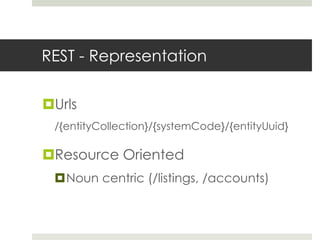
REST - Representation
Urls
/{entityCollection}/{systemCode}/{entityUuid}
Resource Oriented
Noun centric (/listings, /accounts)
REST - Representation
HATEOAS / Strongly Linked
REST - Representation
Resource representations are
XML / JSON
Defined by an XSD
.NET, ruby, python, javascript bindings
Declarative Validation
REST - Representation
Versioning
X-HomeAway-ApiVersion: 1.81
Version “ratchet” via bi-directional
XSL chain
REST - Representation
Version=1.2
Version=1.3
XSL
XSL
REST – State Transfer
Etags Versioning
Etag: “34310538”
Etags Optimistic Concurrency
If-Match: “34310538”
REST – State Transfer
Caching
Conditional GETs
If-None-Match: “34310538”
Expires: Thu, 29 Aug 2013 04:45:54 GMT
Last-Modified: Wed, 28 Aug 2013 18:00:00 GMT
Cache-Control: max-age=60, must-revalidate
Authentication
OAuth2-based Authentication
Authorization / ACL
Self-serve provisioning for credentials
Access to certain features requires a
review
Implemented as a Filter (layered!)
api-framework
Large company
250+ developers
APIs existed before our “grand vision”
We could not have got this far without
a good foundation.
api-framework
Rails, Sinatra, Django, web.py, JAX-RS
are general purpose web frameworks
Teams develop unique philosophies
Organization
URL Structure
Media
api-framework
“There should be one – and
preferably only one – obvious way to
do it.”
Consistency
API developers can easily work
with(and on) any API endpoint
URL Structure
Entity Collection
System Code
Entity UUID
SubResource
URL Structure
/listings
/listings/0000
 /listings/0000/af6ffb31-ec1b-47b4-8f55-9cc33d0341dd
 /listings/0000/af6ffb31-ec1b-47b4-8f55-
9cc33d0341dd/hitCounter
 /listings/legacy?id=vrbo/980 -> an entity
URL Structure
Opaque – “thou shalt not reason
about a URL’s structure”
Provides an obvious pattern of
organization
Confined vocabulary directly related
to features in the framework
Interface Contracts
There’s a fundamental client/server
mismatch
Clients reason about APIs at the HTTP
level
Developers are deeply nested in
implementation
You could just scrape request vars…
But it’s better to define an interface
Mismatch
Easy to make to assumptions that are
not shared with clients
Leads to backwards incompatibilities
Design By Contract
Force API developers to think about
the “contract of invocation”
Preconditions / Post conditions
Fine grained requirements
Statically declared contracts
Developers do not enforce contracts
Design By Contract
Contract tightly coupled with the
interface
Change is not “free”
Forces developers to think about
backwards compatibility
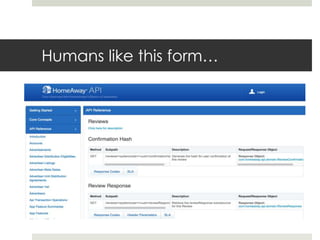
Contract Documentation
Humans like this form…
HomeAway API Stats
8,266,885,627 calls week ending 2015-03-
09
From 264,570,522 week ending 2013-03-04
99.3% of all calls < 250ms
100+ internal clients
Monitoring for errors/SLA across API
Adoption
Operational Concerns
 We rely on this API
 Outages are a big deal
 We need to be able to develop new features
quickly
 A lot of people are working on this
 It can’t be a free-for-all
 REST isn’t the end-all. Sometimes it’s inefficient
 Polling
 Following links
Filters
HomeAway ops filter
Jersey Servlet
Caching
Versioning
OAuth
Auditing
Auditing
Versioning
Caching
api-framework
code code app
Endpoint
developers
code java
methods
here
App
request/respons
e goes through
many layers of
functionality
Analytics
 We use Splunk, heavily
 Framework log format is the same for
everyone. Splunk queries work for all core
services.
 HomeAway has an entire Big Data team.
 Big Data is kind of a big deal at HomeAway
Caching
 We handle a LOT of traffic
 Connecting consumer endpoints to core API is
operationally challenging.
 In-memory caching on each box
 Elastic Search to support distributed caching
 Developers must enable caching per endpoint
Eventing (AMQP/RabbitMQ)
 POST/PUT/DELETEs are events
 API Endpoints publish events to AMQP topic
 Consumers bind Queues to the topic
Entity Search Service
 Before, developers wrote /findByXXX methods
to support search functions
 ESS – based on Elastic Search
 Dev annotates indexable
 Indexer job automatically builds indexes
 Index exposed under /search
 No free lunch – we have to maintain strict
policies around adding new indexes
Search Examples
 https://api.homeaway.com/reservations/findByEmail?email
=gweakliem@yahoo.com
 https://api.homeaway.com/reservations/search?q=contact.em
ail=%22gweakliem@yahoo.com%22
 https://api.homeaway.com/reservations/findByDate?url=/dr
uids/0060/ef151f3b-ad64-423d-9102-
10fccac084fa&start=2015-01-01&end=2015-03-31
 https://api-
stage.homeaway.com/reservations/search?q=reservationDates
.beginDate=2015-01-
01%20AND%20reservationDates.endDate=2015-03-
31%20AND%20propertyProfile.druid.rel=%22/druids/0060/ef151f3
b-ad64-423d-9102-10fccac084fa%22
Tool Support
 We have a dedicated Developer Tools team
 Manages things like github, Team City, Jira,
deployments
 End to end support, from starting the project to
deploying to production.
 Central repository for application registration
 Developers can self-serve deployment all the
way to production.
BizOps
 Our platform needs are evolving
 BizOps are the next level above the domain API
 Intended an an intermediate integration point
for services that need to combine data from
several core API entities.
 JSON is the default format because the primary
client is an AJAX client – these are consumed
by our consumer-facing sites.
Summary
Domain-specific framework provides
a consistent organizational pattern
Layers permit adding functionality
without changing code in multiple
projects
Summary
First-class contracts reduce risk of
backwards incompatibility
Derive documentation from contracts
Dedicated Tools & Data teams
Operational concerns drive certain
compromises
Thanks!
 Questions?
 Email me: gordon@vrbo.com

All Things API Presentation - Gordon Weakleim [HomeAway]

  • 1.
    HomeAway’s Core API Orhow I learned to stop worrying and love the abstraction layer…
  • 2.
    My History Gordon Weakliem Professionaldev for 21 years Mostly in the travel industry CORBA, COM, SOAP, REST… I started with VRBO.com in February, 2007.
  • 3.
    HomeAway’s History Founded in2005 Went public in June 2011 (NASDAQ:AWAY) 20+ Acquisitions  Mostly full-stack “listing sites”  Diverse tech stacks and teams  Old code bases  World-wide dev teams Complex Marketplace + Products
  • 4.
    VRBO’s History  Startedin 1995 advertising our founder’s ski condo.  By 2006, we were a mix of ASP and ASP.NET in a roughly 3 tier architecture talking to SQL Server.  At the time of the HomeAway acquisition in 2006, there were 4 full time developers. This grew to a manager, 8 dev + 2 QA in the next couple years.  VRBO had 65,000 active listings and was growing 100% YOY.
  • 5.
    Growth through acquisition We’rea long way from advertising a ski condo from a basement server. How do you integrate all these companies?
  • 6.
    Platform Evolution Pub/Sub –initial consolidation strategy Solves distribution – enabled growth Evolution to platform Apps need single (logical) SoR per resource type Apps need a clean abstraction Must interop with 200+ existing apps
  • 7.
    Growing Pains  Duringthe pub-sub era:  The architecture was baroque.  It was really painful to figure out why things went wrong.  Listing sites had to implement missing infrastructure themselves – administration, caching. Feature set wasn’t unified across brands.  There were some shared services (inquiries, reviews) but each one implemented their own provisioning, interface standards, and API conventions.
  • 8.
    HomeAway’s Core API RESTAPI Unified Architecture XML/JSON over HTTP (polyglot access) Many teams contributing Façade over existing systems Java/Spring/Jersey/Mybatis/MS SQL
  • 9.
    REST API! Why? HTTP methods– standard verbs Resources – standardize nouns URLs – standardize references Layered – enterprise features globally Focused on interface/contract, not on implementation
  • 10.
    api.homeaway.com API Architecture API endpointAPI endpoint API endpoint Legacy app Legacy svc Legacy svc Legacy app app app app cache oauth versioning etc… Access routed through a single hostname at the load balancer Endpoints service a set of nouns, routed by URL path Enterprise features layered in across the API API endpoints coexist with legacy apps and services
  • 11.
    The “Grand Vision”of Platform We designed the API we wanted but couldn’t build (right away) We built it anyways As a façade to the existing systems New App development benefits Minimized Risk for Legacy Sunsets
  • 12.
    API -> PlatformRefactoring API Application Application Application
  • 13.
    REST – Constraints(a refresher) Client-Server Stateless Cacheable Layers Uniform Interface!! Urls Manipulation mime-types HATEOAS Code on Demand
  • 14.
  • 15.
  • 16.
    REST - Representation Resourcerepresentations are XML / JSON Defined by an XSD .NET, ruby, python, javascript bindings Declarative Validation
  • 17.
    REST - Representation Versioning X-HomeAway-ApiVersion:1.81 Version “ratchet” via bi-directional XSL chain
  • 18.
  • 19.
    REST – StateTransfer Etags Versioning Etag: “34310538” Etags Optimistic Concurrency If-Match: “34310538”
  • 20.
    REST – StateTransfer Caching Conditional GETs If-None-Match: “34310538” Expires: Thu, 29 Aug 2013 04:45:54 GMT Last-Modified: Wed, 28 Aug 2013 18:00:00 GMT Cache-Control: max-age=60, must-revalidate
  • 21.
    Authentication OAuth2-based Authentication Authorization /ACL Self-serve provisioning for credentials Access to certain features requires a review Implemented as a Filter (layered!)
  • 22.
    api-framework Large company 250+ developers APIsexisted before our “grand vision” We could not have got this far without a good foundation.
  • 23.
    api-framework Rails, Sinatra, Django,web.py, JAX-RS are general purpose web frameworks Teams develop unique philosophies Organization URL Structure Media
  • 24.
    api-framework “There should beone – and preferably only one – obvious way to do it.” Consistency API developers can easily work with(and on) any API endpoint
  • 25.
    URL Structure Entity Collection SystemCode Entity UUID SubResource
  • 26.
    URL Structure /listings /listings/0000  /listings/0000/af6ffb31-ec1b-47b4-8f55-9cc33d0341dd /listings/0000/af6ffb31-ec1b-47b4-8f55- 9cc33d0341dd/hitCounter  /listings/legacy?id=vrbo/980 -> an entity
  • 27.
    URL Structure Opaque –“thou shalt not reason about a URL’s structure” Provides an obvious pattern of organization Confined vocabulary directly related to features in the framework
  • 28.
    Interface Contracts There’s afundamental client/server mismatch Clients reason about APIs at the HTTP level Developers are deeply nested in implementation
  • 29.
    You could justscrape request vars…
  • 30.
    But it’s betterto define an interface
  • 31.
    Mismatch Easy to maketo assumptions that are not shared with clients Leads to backwards incompatibilities
  • 32.
    Design By Contract ForceAPI developers to think about the “contract of invocation” Preconditions / Post conditions Fine grained requirements Statically declared contracts Developers do not enforce contracts
  • 33.
    Design By Contract Contracttightly coupled with the interface Change is not “free” Forces developers to think about backwards compatibility
  • 34.
  • 35.
  • 36.
    HomeAway API Stats 8,266,885,627calls week ending 2015-03- 09 From 264,570,522 week ending 2013-03-04 99.3% of all calls < 250ms 100+ internal clients Monitoring for errors/SLA across API
  • 37.
  • 38.
    Operational Concerns  Werely on this API  Outages are a big deal  We need to be able to develop new features quickly  A lot of people are working on this  It can’t be a free-for-all  REST isn’t the end-all. Sometimes it’s inefficient  Polling  Following links
  • 39.
    Filters HomeAway ops filter JerseyServlet Caching Versioning OAuth Auditing Auditing Versioning Caching api-framework code code app Endpoint developers code java methods here App request/respons e goes through many layers of functionality
  • 40.
    Analytics  We useSplunk, heavily  Framework log format is the same for everyone. Splunk queries work for all core services.  HomeAway has an entire Big Data team.  Big Data is kind of a big deal at HomeAway
  • 41.
    Caching  We handlea LOT of traffic  Connecting consumer endpoints to core API is operationally challenging.  In-memory caching on each box  Elastic Search to support distributed caching  Developers must enable caching per endpoint
  • 42.
    Eventing (AMQP/RabbitMQ)  POST/PUT/DELETEsare events  API Endpoints publish events to AMQP topic  Consumers bind Queues to the topic
  • 43.
    Entity Search Service Before, developers wrote /findByXXX methods to support search functions  ESS – based on Elastic Search  Dev annotates indexable  Indexer job automatically builds indexes  Index exposed under /search  No free lunch – we have to maintain strict policies around adding new indexes
  • 44.
    Search Examples  https://api.homeaway.com/reservations/findByEmail?email =gweakliem@yahoo.com https://api.homeaway.com/reservations/search?q=contact.em ail=%22gweakliem@yahoo.com%22  https://api.homeaway.com/reservations/findByDate?url=/dr uids/0060/ef151f3b-ad64-423d-9102- 10fccac084fa&start=2015-01-01&end=2015-03-31  https://api- stage.homeaway.com/reservations/search?q=reservationDates .beginDate=2015-01- 01%20AND%20reservationDates.endDate=2015-03- 31%20AND%20propertyProfile.druid.rel=%22/druids/0060/ef151f3 b-ad64-423d-9102-10fccac084fa%22
  • 45.
    Tool Support  Wehave a dedicated Developer Tools team  Manages things like github, Team City, Jira, deployments  End to end support, from starting the project to deploying to production.  Central repository for application registration  Developers can self-serve deployment all the way to production.
  • 46.
    BizOps  Our platformneeds are evolving  BizOps are the next level above the domain API  Intended an an intermediate integration point for services that need to combine data from several core API entities.  JSON is the default format because the primary client is an AJAX client – these are consumed by our consumer-facing sites.
  • 47.
    Summary Domain-specific framework provides aconsistent organizational pattern Layers permit adding functionality without changing code in multiple projects
  • 48.
    Summary First-class contracts reducerisk of backwards incompatibility Derive documentation from contracts Dedicated Tools & Data teams Operational concerns drive certain compromises
  • 49.

Editor's Notes

  • #10 I’m just going to give a very high-level overview here – René will go more into detail…
  • #12 Add a visual showing consolidation
  • #14 REST – 6 constraints Client-Server, Stateless, Cacheable, Layered System, Code on demand (optional), Uniform Interface (Id of resources, manipulation of resources through these representations, self-descriptive messages, HATEAOS)
  • #26  It’s important to note that URL structure is not necessarily a simplification for clients. Roy Fielding notes this explicitly “A REST API must not define fixed resource names or hierarchies
  • #28 It’s important to note that URL structure is not necessarily a simplification for clients. Roy Fielding notes this explicitly “A REST API must not define fixed resource names or hierarchies
  • #37 splunk, logging, resource SLA