LEAN PRACTICES
FOR EFFECTIVE
PROJECT
MANAGEMENT
Presented by,
Vimal Raj K
PROJECT MANAGEMENT ?
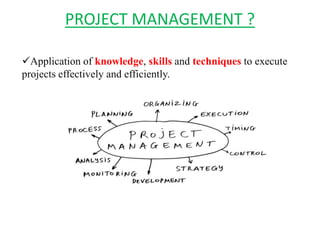
Application of knowledge, skills and techniques to execute
projects effectively and efficiently.
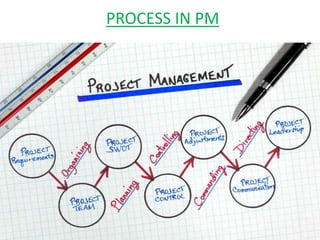
PROCESS IN PM
EFFECTIVE MANAGEMENT
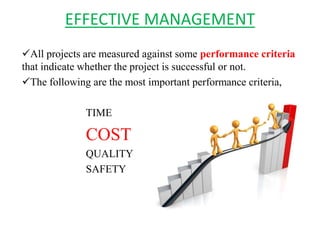
All projects are measured against some performance criteria
that indicate whether the project is successful or not.
The following are the most important performance criteria,
TIME
COST
QUALITY
SAFETY
COST EFFECTIVE
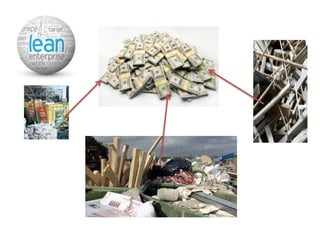
 For cost effective project management we should focus on
each and every aspects and the key point we have to focus is
wastage.
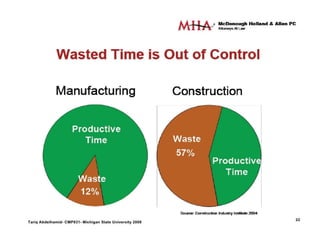
 Waste generated as a result of design & specifications
 Waste generated by construction activities
WASTAGE BY SPECIFICATION & DESIGN
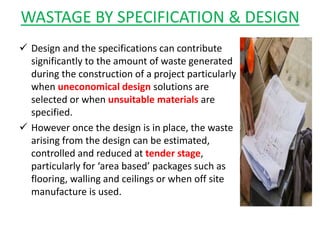
 Design and the specifications can contribute
significantly to the amount of waste generated
during the construction of a project particularly
when uneconomical design solutions are
selected or when unsuitable materials are
specified.
 However once the design is in place, the waste
arising from the design can be estimated,
controlled and reduced at tender stage,
particularly for ‘area based’ packages such as
flooring, walling and ceilings or when off site
manufacture is used.
WASTAGE BY CONSTRUCTION
ACTIVITIES
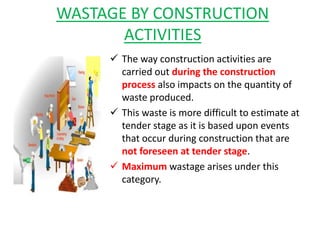
 The way construction activities are
carried out during the construction
process also impacts on the quantity of
waste produced.
 This waste is more difficult to estimate at
tender stage as it is based upon events
that occur during construction that are
not foreseen at tender stage.
 Maximum wastage arises under this
category.
How to
reduce
these
waste?
??????
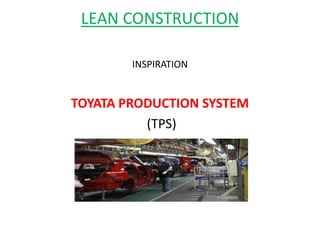
LEAN CONSTRUCTION
INSPIRATION
TOYATA PRODUCTION SYSTEM
(TPS)
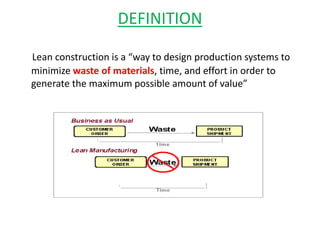
DEFINITION
Lean construction is a “way to design production systems to
minimize waste of materials, time, and effort in order to
generate the maximum possible amount of value”
LEAN TOOLS
Value stream mapping
Waste walk & Reduction
Building Information
Modeling(BIM)
5 Whys
A3 reports
Poke-a-yoke
Partnering
Last Planner
TOOLS FOR REDUCTION OF WASTE
Value stream mapping –
identifying the waste.
Last Planner – minimizing the
waste.
IDENTIFY WASTE
??????????
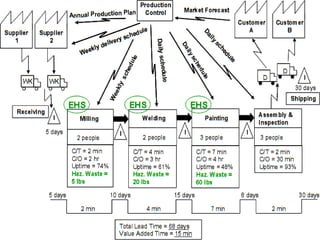
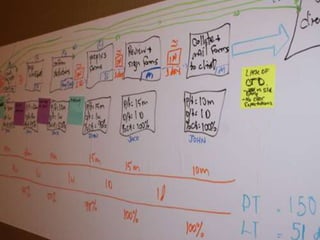
VALUE STREAM MAPPING
 Value stream mapping is a lean-management method for
analyzing the current state and designing a future state for
the series of events that take a product or service from its
beginning through to the customer.
 At Toyota, it is known as "material and information flow
mapping".
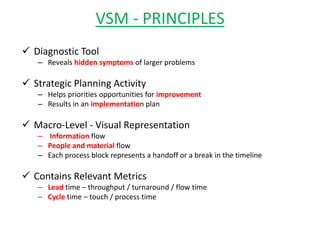
VSM - PRINCIPLES
 Diagnostic Tool
– Reveals hidden symptoms of larger problems
 Strategic Planning Activity
– Helps priorities opportunities for improvement
– Results in an implementation plan
 Macro-Level - Visual Representation
– Information flow
– People and material flow
– Each process block represents a handoff or a break in the timeline
 Contains Relevant Metrics
– Lead time – throughput / turnaround / flow time
– Cycle time – touch / process time
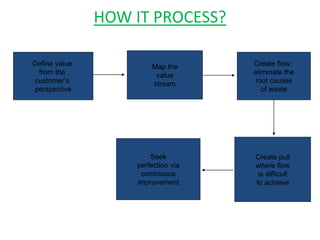
HOW IT PROCESS?
Define value
from the
customer’s
perspective
Map the
value
stream
Create flow;
eliminate the
root causes
of waste
Create pull
where flow
is difficult
to achieve
Seek
perfection via
continuous
improvement
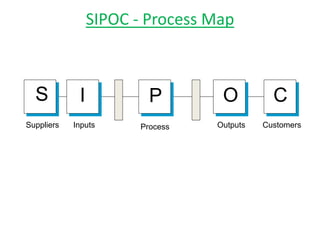
SIPOC - Process Map
S I O CP
Suppliers Inputs Process Outputs Customers
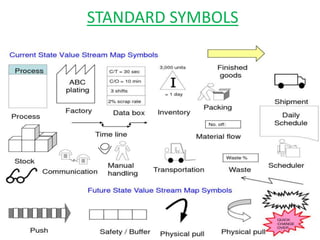
STANDARD SYMBOLS
21
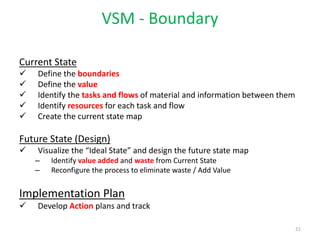
VSM - Boundary
Current State
 Define the boundaries
 Define the value
 Identify the tasks and flows of material and information between them
 Identify resources for each task and flow
 Create the current state map
Future State (Design)
 Visualize the “Ideal State” and design the future state map
– Identify value added and waste from Current State
– Reconfigure the process to eliminate waste / Add Value
Implementation Plan
 Develop Action plans and track
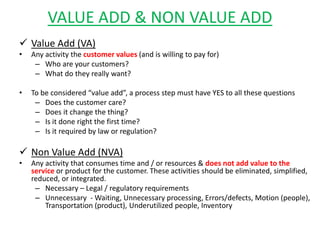
VALUE ADD & NON VALUE ADD
 Value Add (VA)
• Any activity the customer values (and is willing to pay for)
– Who are your customers?
– What do they really want?
• To be considered “value add”, a process step must have YES to all these questions
– Does the customer care?
– Does it change the thing?
– Is it done right the first time?
– Is it required by law or regulation?
 Non Value Add (NVA)
• Any activity that consumes time and / or resources & does not add value to the
service or product for the customer. These activities should be eliminated, simplified,
reduced, or integrated.
– Necessary – Legal / regulatory requirements
– Unnecessary - Waiting, Unnecessary processing, Errors/defects, Motion (people),
Transportation (product), Underutilized people, Inventory
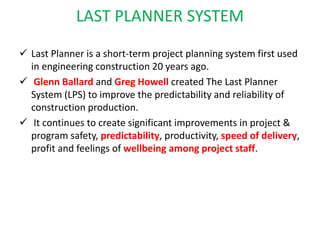
LAST PLANNER SYSTEM
 Last Planner is a short-term project planning system first used
in engineering construction 20 years ago.
 Glenn Ballard and Greg Howell created The Last Planner
System (LPS) to improve the predictability and reliability of
construction production.
 It continues to create significant improvements in project &
program safety, predictability, productivity, speed of delivery,
profit and feelings of wellbeing among project staff.
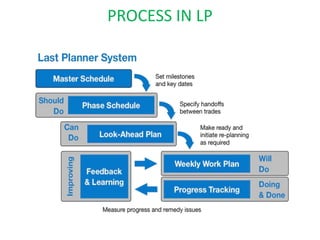
PROCESS IN LP
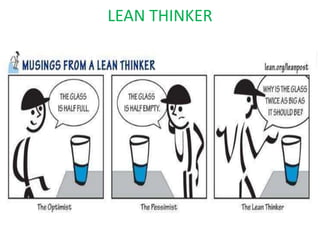
LEAN THINKER
The impossible is often the untried
Great ideas need
landing gears as well
as wings
Lean practices for effective project management

Lean practices for effective project management

  • 1.
  • 2.
    PROJECT MANAGEMENT ? Applicationof knowledge, skills and techniques to execute projects effectively and efficiently.
  • 3.
  • 4.
    EFFECTIVE MANAGEMENT All projectsare measured against some performance criteria that indicate whether the project is successful or not. The following are the most important performance criteria, TIME COST QUALITY SAFETY
  • 5.
    COST EFFECTIVE  Forcost effective project management we should focus on each and every aspects and the key point we have to focus is wastage.  Waste generated as a result of design & specifications  Waste generated by construction activities
  • 6.
    WASTAGE BY SPECIFICATION& DESIGN  Design and the specifications can contribute significantly to the amount of waste generated during the construction of a project particularly when uneconomical design solutions are selected or when unsuitable materials are specified.  However once the design is in place, the waste arising from the design can be estimated, controlled and reduced at tender stage, particularly for ‘area based’ packages such as flooring, walling and ceilings or when off site manufacture is used.
  • 7.
    WASTAGE BY CONSTRUCTION ACTIVITIES The way construction activities are carried out during the construction process also impacts on the quantity of waste produced.  This waste is more difficult to estimate at tender stage as it is based upon events that occur during construction that are not foreseen at tender stage.  Maximum wastage arises under this category.
  • 9.
  • 11.
  • 12.
    DEFINITION Lean construction isa “way to design production systems to minimize waste of materials, time, and effort in order to generate the maximum possible amount of value”
  • 13.
    LEAN TOOLS Value streammapping Waste walk & Reduction Building Information Modeling(BIM) 5 Whys A3 reports Poke-a-yoke Partnering Last Planner
  • 14.
    TOOLS FOR REDUCTIONOF WASTE Value stream mapping – identifying the waste. Last Planner – minimizing the waste.
  • 15.
  • 16.
    VALUE STREAM MAPPING Value stream mapping is a lean-management method for analyzing the current state and designing a future state for the series of events that take a product or service from its beginning through to the customer.  At Toyota, it is known as "material and information flow mapping".
  • 17.
    VSM - PRINCIPLES Diagnostic Tool – Reveals hidden symptoms of larger problems  Strategic Planning Activity – Helps priorities opportunities for improvement – Results in an implementation plan  Macro-Level - Visual Representation – Information flow – People and material flow – Each process block represents a handoff or a break in the timeline  Contains Relevant Metrics – Lead time – throughput / turnaround / flow time – Cycle time – touch / process time
  • 18.
    HOW IT PROCESS? Definevalue from the customer’s perspective Map the value stream Create flow; eliminate the root causes of waste Create pull where flow is difficult to achieve Seek perfection via continuous improvement
  • 19.
    SIPOC - ProcessMap S I O CP Suppliers Inputs Process Outputs Customers
  • 20.
  • 21.
    21 VSM - Boundary CurrentState  Define the boundaries  Define the value  Identify the tasks and flows of material and information between them  Identify resources for each task and flow  Create the current state map Future State (Design)  Visualize the “Ideal State” and design the future state map – Identify value added and waste from Current State – Reconfigure the process to eliminate waste / Add Value Implementation Plan  Develop Action plans and track
  • 22.
    VALUE ADD &NON VALUE ADD  Value Add (VA) • Any activity the customer values (and is willing to pay for) – Who are your customers? – What do they really want? • To be considered “value add”, a process step must have YES to all these questions – Does the customer care? – Does it change the thing? – Is it done right the first time? – Is it required by law or regulation?  Non Value Add (NVA) • Any activity that consumes time and / or resources & does not add value to the service or product for the customer. These activities should be eliminated, simplified, reduced, or integrated. – Necessary – Legal / regulatory requirements – Unnecessary - Waiting, Unnecessary processing, Errors/defects, Motion (people), Transportation (product), Underutilized people, Inventory
  • 25.
    LAST PLANNER SYSTEM Last Planner is a short-term project planning system first used in engineering construction 20 years ago.  Glenn Ballard and Greg Howell created The Last Planner System (LPS) to improve the predictability and reliability of construction production.  It continues to create significant improvements in project & program safety, predictability, productivity, speed of delivery, profit and feelings of wellbeing among project staff.
  • 26.
  • 27.
  • 28.
    The impossible isoften the untried Great ideas need landing gears as well as wings