© 2013 AdobeSystems Incorporated. All Rights Reserved. AdobeConfidential.
Digital Transformation is about Strategy. Not
Technology
1
SERVING DIGITAL MARKETING VISIONARIES
Our Mission
LCG’s mission is to help our clients
transform their digital futures
by developing, deploying and optimizing
sustainable, competitive advantages.
2
Best Practices for Improving your return on MarTech
1. Understand your Data Readiness Posture
2. Implement a Data Layer
3. Use a Tag Management System
4. Audit tags monthly
5. Benchmark
6. Establish an owner for your data (Steering Committee, CDO, etc…)
7. Develop Personas, Segments and Customer Journeys
8. Understand what is normal
9. Establish reports, dashboards and alerts by stakeholder group
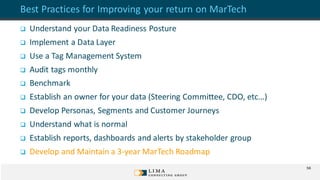
10. Develop and Maintain a 3-year MarTech Roadmap
3
Best Practices for Improving your return on MarTech
Understand your Data Readiness Posture
Implement a Data Layer
Use a Tag Management System
Audit tags monthly
Benchmark
4
© 2013 Adobe Systems Incorporated. All Rights Reserved. Adobe Confidential.
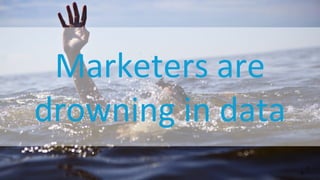
Marketers are
drowning in data
5
5
© 2013 Adobe Systems Incorporated. All Rights Reserved. Adobe Confidential.
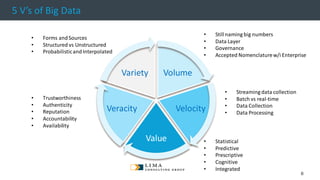
5 V’s of Big Data
Volume
Velocity
Value
Veracity
Variety
• Statistical
• Predictive
• Prescriptive
• Cognitive
• Integrated
• Trustworthiness
• Authenticity
• Reputation
• Accountability
• Availability
• Forms andSources
• Structured vs Unstructured
• ProbabilisticandInterpolated
• Streaming data collection
• Batch vs real-time
• Data Collection
• Data Processing
• Stillnaming big numbers
• Data Layer
• Governance
• Accepted Nomenclaturew/i Enterprise
6
© 2013 Adobe Systems Incorporated. All Rights Reserved. Adobe Confidential.
EnsightenAgility 2014© All
rights reserved. 7
© 2013 Adobe Systems Incorporated. All Rights Reserved. Adobe Confidential.
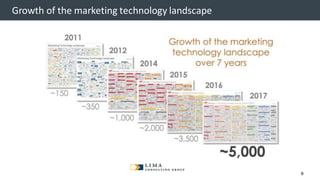
Growth of the marketing technology landscape
8
© 2013 AdobeSystems Incorporated. All Rights Reserved. AdobeConfidential.
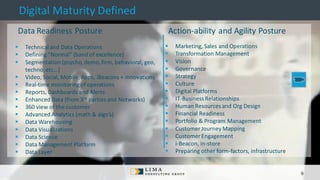
Digital Maturity Defined
Data Readiness Posture Action-ability and Agility Posture
▪ Technical and Data Operations
▪ Defining “Normal” (band of excellence)
▪ Segmentation (psycho,demo,firm, behavioral, geo,
techno,etc…)
▪ Video, Social, Mobile, Apps, iBeacons + innovations
▪ Real-time monitoringof operations
▪ Reports, Dashboards and Alerts
▪ Enhanced Data (from 3rd parties and Networks)
▪ 360 view of the customer
▪ Advanced Analytics (math & algo’s)
▪ Data Warehousing
▪ Data Visualizations
▪ Data Science
▪ Data Management Platform
▪ Data Layer
▪ Marketing, Sales and Operations
▪ Transformation Management
▪ Vision
▪ Governance
▪ Strategy
▪ Culture
▪ Digital Platforms
▪ IT-BusinessRelationships
▪ Human Resourcesand Org Design
▪ Financial Readiness
▪ Portfolio & Program Management
▪ Customer Journey Mapping
▪ Customer Engagement
▪ i-Beacon, in-store
▪ Preparing other form-factors, infrastructure
9
© 2013 Adobe Systems Incorporated. All Rights Reserved. Adobe Confidential.
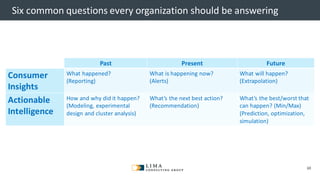
Six common questions every organization should be answering
Past Present Future
Consumer
Insights
What happened?
(Reporting)
What is happening now?
(Alerts)
What will happen?
(Extrapolation)
Actionable
Intelligence
How and why did it happen?
(Modeling, experimental
design and cluster analysis)
What’s the next best action?
(Recommendation)
What’s the best/worst that
can happen? (Min/Max)
(Prediction, optimization,
simulation)
10
© 2013 Adobe Systems Incorporated. All Rights Reserved. Adobe Confidential.
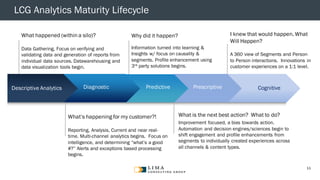
LCG Analytics Maturity Lifecycle
I knew that would happen. What
Will Happen?
A 360 view of Segments and Person
to Person interactions. Innovations in
customer experiences on a 1:1 level.
Descriptive Analytics Diagnostic Predictive Prescriptive Cognitive
What happened (within a silo)?
Data Gathering, Focus on verifying and
validating data and generation of reports from
individual data sources. Datawarehousing and
data visualization tools begin.
Why did it happen?
Information turned into learning &
Insights w/ focus on causality &
segments. Profile enhancement using
3rd party solutions begins.
What’s happening for my customer?!
Reporting, Analysis, Current and near real-
time. Multi-channel analytics begins. Focus on
intelligence, and determining “what’s a good
#?” Alerts and exceptions based processing
begins.
What is the next best action? What to do?
Improvement focused, a bias towards action.
Automation and decision engines/sciences begin to
shift engagement and profile enhancements from
segments to individually created experiences across
all channels & content types.
11
© 2012 Adobe Systems Incorporated. All Rights Reserved. Adobe Confidential.
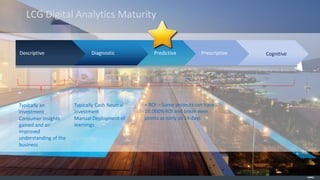
LCG Digital Analytics Maturity
Descriptive Diagnostic Predictive Prescriptive Cognitive
Typically an
Investment
Consumer Insights
gained and an
improved
understanding of the
business
Typically Cash Neutral
investment
Manual Deployment of
learnings
+ ROI – Some projects can have
10,000%ROI and break even
points as early as 14 days
12
Institute for Operations Research & Management Sciences
➢The Institutefor Operations Research and the Management Sciences
(INFORMS)is the largest society in the world for professionals in the field
of operations research (O.R.), management science, and analytics.
➢Founded in 1952
➢Free Tool found at: analyticsmaturity.informs.org
13
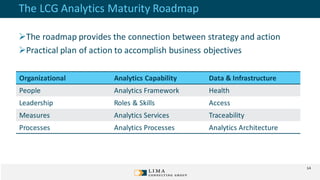
The LCG Analytics Maturity Roadmap
➢The roadmap provides the connection between strategy and action
➢Practical plan of action to accomplish business objectives
Organizational Analytics Capability Data & Infrastructure
People Analytics Framework Health
Leadership Roles & Skills Access
Measures Analytics Services Traceability
Processes Analytics Processes Analytics Architecture
14
© 2013 AdobeSystems Incorporated. All Rights Reserved. AdobeConfidential.
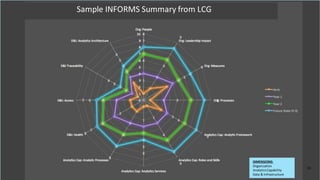
INFORMS Summary for Kemin (As-Is)
15
DIMENSIONS:
Organization
AnalyticsCapability
Data & Infrastructure
Sample INFORMS Summary from LCG
© 2013 AdobeSystems Incorporated. All Rights Reserved. AdobeConfidential.
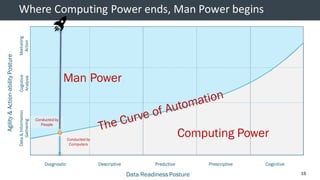
Computing Power
Man Power
Where Computing Power ends, Man Power begins
Diagnostic Descriptive Predictive Prescriptive Cognitive
Cognitive
Analysis
Marketing
Action
Agility&Action-abilityPosture
Data Readiness Posture
Data&Information
Gathering
Conducted by
People
Conducted by
Computers
16
© 2013 AdobeSystems Incorporated. All Rights Reserved. AdobeConfidential.
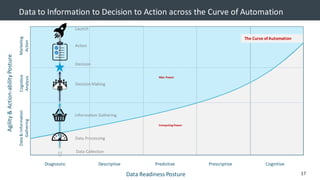
Data to Information to Decision to Action across the Curve of Automation
Diagnostic Descriptive Predictive Prescriptive Cognitive
Cognitive
Analysis
Marketing
Action
Agility&Action-abilityPosture
Data Readiness Posture
Data Collection
Data&Information
Gathering
The Curve of Automation
Information Gathering
Decision
Decision Making
Action
Data Processing
Launch
ComputingPower
Man Power
17
© 2013 AdobeSystems Incorporated. All Rights Reserved. AdobeConfidential.
Web Analytics,VOC,OnlineSurvey and Customer AnalyticsData
FirstParty EnterpriseData
2nd and 3rd Party Data
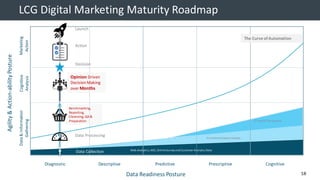
LCG Digital Marketing Maturity Roadmap
Diagnostic Descriptive Predictive Prescriptive Cognitive
Cognitive
Analysis
Marketing
Action
Agility&Action-abilityPosture
Data Readiness Posture
Data&Information
Gathering
Benchmarking,
Reporting,
Cleansing,QA &
Preparation
The Curve of Automation
Opinion Driven
Decision Making
over Months
Decision
Action
Data Processing
Launch
Data Collection
18
© 2013 AdobeSystems Incorporated. All Rights Reserved. AdobeConfidential.
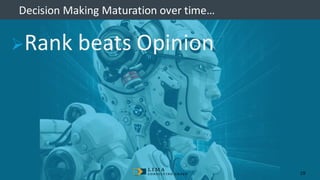
Decision Making Maturation over time…
➢Rank beats Opinion
19
© 2013 AdobeSystems Incorporated. All Rights Reserved. AdobeConfidential.
Best Practices for Improving your return on MarTech
 Understand your Data Readiness Posture
 Implement a Data Layer
 Use a Tag Management System
 Audit tags monthly
 Benchmark
20
© 2013 Adobe Systems Incorporated. All Rights Reserved. Adobe Confidential.
A solid digital foundation consist of data and governance
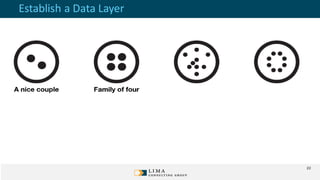
Establish a Data Layer
Tennis Match Soccer Team 3-5-2A Military Platoon Blue Angels MissingMan
Formation
22
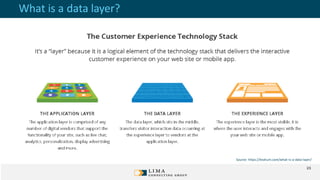
What is a data layer?
Source: https://tealium.com/what-is-a-data-layer/
23
© 2013 Adobe Systems Incorporated. All Rights Reserved. Adobe Confidential.
Best Practices for Improving your return on MarTech
 Understand your Data Readiness Posture
 Implement a Data Layer
 Use a Tag Management System
 Audit tags monthly
 Benchmark
24
© 2013 Adobe Systems Incorporated. All Rights Reserved. Adobe Confidential.
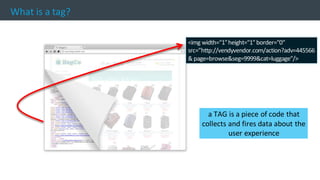
What is a tag?
a TAG is a piece of code that
collects and fires data about the
user experience
<img width="1"height="1"border="0“
src=”http://vendyvendor.com/action?adv=445566
&page=browse&seg=9999&cat=luggage"/>
© 2013 Adobe Systems Incorporated. All Rights Reserved. Adobe Confidential.
What is a Tag ManagementSystem
A Tag Management System (TMS) is similar to a content management system
(CMS) in that once implemented, it enables marketers to maintain tags the way a
CMS maintains pages.
Benefits:
▪ Marketers are less reliant on their IT departments.
▪ TMS have features for users rights administration and enterprise level
workflows.
▪ Enables marketers to improve quality, site load times, and personalized
experiences.
© 2013 Adobe Systems Incorporated. All Rights Reserved. Adobe Confidential.
Marketing Manager: “Can you add this new re-targeting pixel to the site for me? It’s just one line
of code and should be easy”
Developer: “Sure, just send me the code”
Marketing manager: “Great! Oh I need to make sure that this tag is only served to our users that
are on our secure pages, in the products folder, have been on the site for at least 2 minutes, it is
at least their 3rd visit to our site, and I need to apply that to only 3 of our 7 domains.”
(long pause)
Marketing Manager: “And for only 25% of the traffic. And for this Friday!”
Developer: “I hate you”
© 2013 Adobe Systems Incorporated. All Rights Reserved. Adobe Confidential.
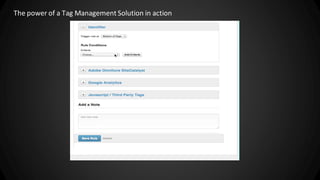
The power of a Tag Management Solution in action
Best Practices for Improving your return on MarTech
Understand your Data Readiness Posture
Implement a Data Layer
Use a Tag Management System
Audit tags monthly
Benchmark
29
Best Practices for Improving your return on MarTech
Understand your Data Readiness Posture
Implement a Data Layer
Use a Tag Management System
Audit tags monthly
Benchmark
31
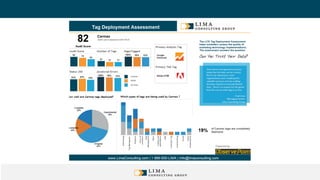
State of the Industry
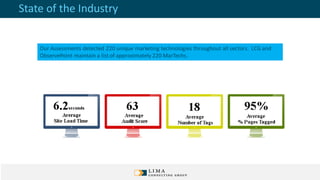
Our Assessments detected 220 unique marketing technologies throughout all sectors. LCG and
ObservePoint maintain a list of approximately 220 MarTechs.
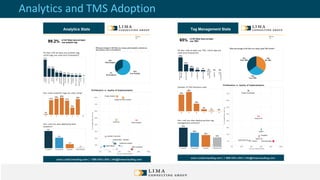
Analytics and TMS Adoption
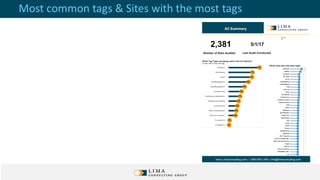
Most common tags & Sites with the most tags
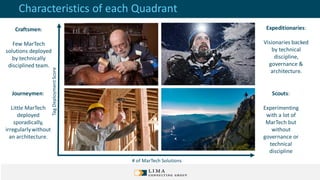
Characteristics of each Quadrant
Journeymen:
Little MarTech
deployed
sporadically,
irregularlywithout
an architecture.
Craftsmen:
Few MarTech
solutions deployed
by technically
disciplined team.
Scouts:
Experimenting
with a lot of
MarTech but
without
governance or
technical
discipline
Expeditionaries:
Visionaries backed
by technical
discipline,
governance &
architecture.
# of MarTech Solutions
TagDeploymentScore
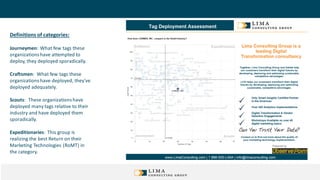
Definitions of categories:
Journeymen: What few tags these
organizations have attempted to
deploy, they deployed sporadically.
Craftsmen: What few tags these
organizations have deployed, they've
deployed adequately.
Scouts: These organizations have
deployed many tags relative to their
industry and have deployed them
sporadically.
Expeditionaries: This group is
realizing the best Return on their
Marketing Technologies (RoMT) in
the category.
Audit Score vs.
Number of Tags Craftsmen:
Journeyman:
Expeditionaries:
Scouts:
© 2013 AdobeSystems Incorporated. All Rights Reserved. AdobeConfidential.
Adobe Media Optimizer
Adobe Social
Adobe Creative Cloud
Adobe Document Cloud
Request yourfreeTag Deployment Assessment
38
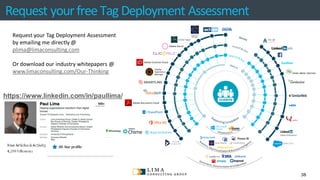
Request your Tag Deployment Assessment
by emailing me directly @
plima@limaconsulting.com
Or download our industry whitepapers @
www.limaconsulting.com/Our-Thinking
https://www.linkedin.com/in/paullima/
© 2013 AdobeSystems Incorporated. All Rights Reserved. AdobeConfidential.
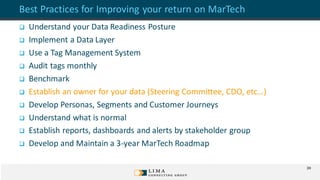
Best Practices for Improving your return on MarTech
 Understand your Data Readiness Posture
 Implement a Data Layer
 Use a Tag Management System
 Audit tags monthly
 Benchmark
 Establish an owner for your data (Steering Committee, CDO, etc…)
 Develop Personas, Segments and Customer Journeys
 Understand what is normal
 Establish reports, dashboards and alerts by stakeholder group
 Develop and Maintain a 3-year MarTech Roadmap
39
© 2013 AdobeSystems Incorporated. All Rights Reserved. AdobeConfidential.
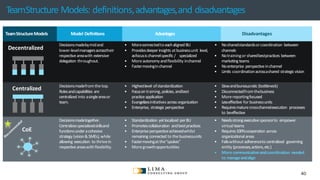
TeamStructure Models: definitions,advantages,and disadvantages
TeamStructureModels Model Definitions Advantages Disadvantages
Decisionsmadebymidand
lower-levelmanagersacrosstheir
respectiveareawith extensive
delegation throughout.
• Moreconnectedto eachaligned BU •
• Providesdeeperinsights atbusinessunit level,
asfocusischannelspecific / specialized
• Moreautonomyandflexibility inchannel
• Fastermovinginchannel
Nosharedstandardsorcoordination between
channels
• Notrainingor sharedbestpractices between
marketing teams
• Noenterprise perspectiveinchannel
• Limits coordinationacrossashared strategicvision
Decisionsmadefromthetop.
Rolesandcapabilities are
centralized into asingleareaor
team.
• Highestlevel ofstandardization
• Focuson training,policies,andbest
practiceapplication
• Evangelizesinitiativesacrossorganization
• Enterprise, strategic perspective
• Slowandbureaucratic (bottleneck)
• Disconnectedfromthebusiness
• Morereportingfocused
• Lesseffective for businessunits
• Requiresmaturecrosschannelexecution processes
to beeffective
Decisionsmadetogether.
Centralizesspecializedskillsand
functionsunderacohesive
strategy (vision& SMEs),while
allowing execution to thrivein
respectiveareaswithflexibility.
• Standardization yetlocalized perBU
• Promotescollaboration andbestpractices
• Enterpriseperspectiveachievedwhilst
remaining connected to thebusinessunits
• Fastermovingatthe“spokes”
• Moregrowthopportunities
• Needsstrongexecutivesponsorto empower
virtualteams
• Requires100%cooperation across
organizationalareas
• Failswithoutadherenceto centralized governing
entity (processes,actions,etc.)
• More communicationandcoordination needed
to manageandalign
Decentralized
Centralized
CoE
40
© 2013 AdobeSystems Incorporated. All Rights Reserved. AdobeConfidential.
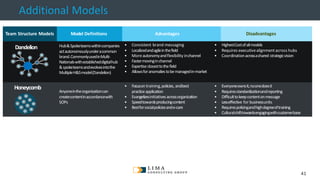
Additional Models
Team Structure Models Model Definitions Advantages Disadvantages
• Consistent brand messaging
• Localizedandagileinthefield
• Moreautonomyandflexibility inchannel
• Fastermovinginchannel
• Expertiseclosesttothefield
• Allowsforanomaliestobemanagedin-market
• HighestCostofallmodels
• Requires executivealignmentacross hubs
• Coordinationacrossashared strategicvision
Anyoneintheorganizationcan
createcontentinaccordancewith
SOPs
• Focuson training,policies, andbest
practiceapplication
• Evangelizesinitiativesacrossorganization
• Speedtowardsproducingcontent
• Bestforsocialpoliciesande-care
• Everyoneownsit,noonedoesit
• Requiresstandardizationandreporting
• Difficulttokeepcontentonmessage
• Lesseffective for businessunits
• Requirespolicingandhighdegreeoftraining
• Culturalshifttowardsengagingwithcustomerbase
Dandelion
Honeycomb
Hub&Spoketeamswithincompanies
actautonomouslyunderacommon
brand.CommonlyusedinMulti-
Nationalswithestablisheddigitalhub
&spoketeamsandevolvesintothe
MultipleH&Smodel(Dandelion)
41
© 2013 AdobeSystems Incorporated. All Rights Reserved. AdobeConfidential.
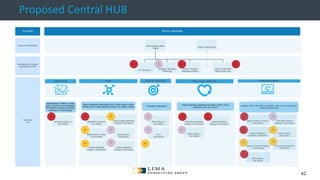
Proposed Central HUB
42
Best Practices for Improving your return on MarTech
Understand your Data Readiness Posture
Implement a Data Layer
Use a Tag Management System
Audit tags monthly
Benchmark
Establish an owner for your data (Steering Committee, CDO, etc…)
Develop Personas, Segments and Customer Journeys
Understand what is normal
Establish reports, dashboards and alerts by stakeholder group
Develop and Maintain a 3-year MarTech Roadmap
43
© 2013 Adobe Systems Incorporated. All Rights Reserved. Adobe Confidential.
Let 1,000 flowers bloom
44 44
© 2013 Adobe Systems Incorporated. All Rights Reserved. Adobe Confidential.
Don’t do the time. Avoid the crime.
Analyzing
data in
aggregate is a
crime.
45
© 2013 Adobe Systems Incorporated. All Rights Reserved. Adobe Confidential.
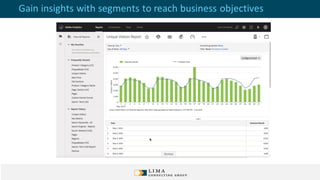
Segment, then analyze
46
Gain insights with segments to reach business objectives
Best Practices for Improving your return on MarTech
Understand your Data Readiness Posture
Implement a Data Layer
Use a Tag Management System
Audit tags monthly
Benchmark
Establish an owner for your data (Steering Committee, CDO, etc…)
Develop Personas, Segments and Customer Journeys
Understand what is normal
Establish reports, dashboards and alerts by stakeholder group
Develop and Maintain a 3-year MarTech Roadmap
48
© 2013 Adobe Systems Incorporated. All Rights Reserved. Adobe Confidential.
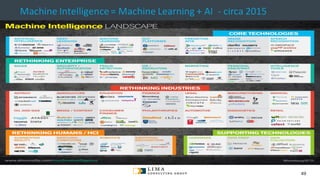
Machine Intelligence= Machine Learning + AI - circa 2015
49
© 2013 Adobe Systems Incorporated. All Rights Reserved. Adobe Confidential.
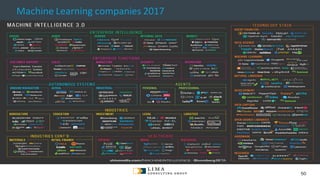
Machine Learning companies 2017
50
Exception Based Processing Requires the Definition of normal
Source: US Army Field Manual FM 7-0 Training the Force
51
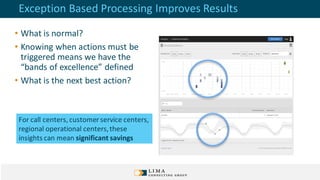
Exception Based Processing Improves Results
• What is normal?
• Knowing when actions must be
triggered means we have the
“bands of excellence” defined
• What is the next best action?
For call centers, customerservice centers,
regional operational centers,these
insights can mean significant savings
© 2013 Adobe Systems Incorporated. All Rights Reserved. Adobe Confidential.
Best Practices for Improving your return on MarTech
 Understand your Data Readiness Posture
 Implement a Data Layer
 Use a Tag Management System
 Audit tags monthly
 Benchmark
 Establish an owner for your data (Steering Committee, CDO, etc…)
 Develop Personas, Segments and Customer Journeys
 Understand what is normal
 Establish reports, dashboards and alerts by stakeholder group
 Develop and Maintain a 3-year MarTech Roadmap
54
© 2013 Adobe Systems Incorporated. All Rights Reserved. Adobe Confidential.
Beer Belly Protocol vs
Pregnancy Belly Protocol
55
© 2013 Adobe Systems Incorporated. All Rights Reserved. Adobe Confidential.
Best Practices for Improving your return on MarTech
 Understand your Data Readiness Posture
 Implement a Data Layer
 Use a Tag Management System
 Audit tags monthly
 Benchmark
 Establish an owner for your data (Steering Committee, CDO, etc…)
 Develop Personas, Segments and Customer Journeys
 Understand what is normal
 Establish reports, dashboards and alerts by stakeholder group
 Develop and Maintain a 3-year MarTech Roadmap
56
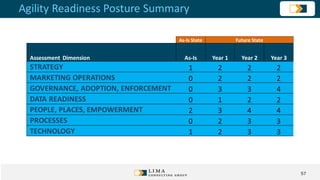
Agility Readiness Posture Summary
As-Is State Future State
Assessment Dimension As-Is Year 1 Year 2 Year 3
STRATEGY 1 2 2 2
MARKETING OPERATIONS 0 2 2 2
GOVERNANCE, ADOPTION, ENFORCEMENT 0 3 3 4
DATA READINESS 0 1 2 2
PEOPLE, PLACES, EMPOWERMENT 2 3 4 4
PROCESSES 0 2 3 3
TECHNOLOGY 1 2 3 3
57
© 2013 AdobeSystems Incorporated. All Rights Reserved. AdobeConfidential.
58
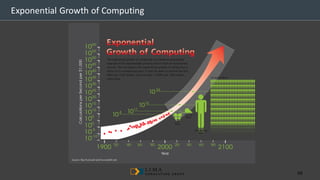
Exponential Growth of Computing
Data&Information
Gathering
Web Content Management
Capability Begins
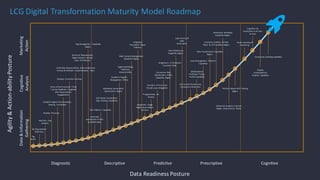
LCG Digital Transformation Maturity Model Roadmap
MarTech, Gap
Analysis
Biz Requirement
Definition
Tag Management Capability
Begins
Technical Requirements
Digital Analytics & Data
Layer Architecture
Tag
Audit
Data Warehouse
Capability Begins
Automate
Distribution of KPIs
to Stakeholders
Data Management Platform
CapabilityIntegrations of Enterprise
Customer Data
Pre-Click  Post-Click
Closed-Loop Integration
End-to-End Closed Loop
Conversion Attribution
Data Visualizations Capability
Begins
Attribution Modeling
Capability Begins
Portfolio Based MVT Testing
Begins
Conversion Rate
Optimization (CRO)
Capability Begins
Programmatic Ad
Buying
Marketing Automation
Optimization Begins
Cognitive UIs
Accessible to all User
Groups
Chief Data Responsibility, Data Governance
Policies & MarTech Implementation Team
Advanced Analytics Practice
Begins (Data Science Team)
Call Center Conversions
data Tracking Capability
SEO Platform Capability
SSO/Audience
Profiling 3rd Party
Profile Capability
Customer Analytics & Heat
Maps & UX Capability Begins
Voice of the Customer / Chat
/ Survey Feedback Integrated
with Respondent's
Engagements
Lead Scoring &
Sales
Automation
Social Listening &
Publishing
Community Building Capability
Diagnostic Descriptive Predictive Prescriptive Cognitive
Cognitive
Analysis
Marketing
Action
Agility&Action-abilityPosture
Data Readiness Posture
Establish Program
Management Office
Digital Marketing
Platforms
Responsibility
Integrated
Translation Mgmt
Platform
Develop Customer Journeys
Establish Digital Transformation
Steering Committee
Develop Personas
Implement Single
Digital Asset Mgmt
Solution
Deploy
Computational
Creative Capability
© 2013 AdobeSystems Incorporated. All Rights Reserved. AdobeConfidential.
Agility&Action-abilityPosture
Data&Information
Gathering
Cognitive
Analysis
Marketing
Action
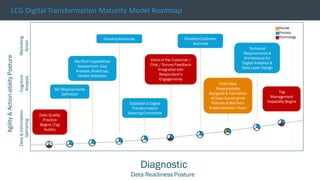
Diagnostic
Data Readiness Posture
Data Quality
Practice
Begins (Tag
Audits)
Biz Requirements
Definition
MarTech Capabilities
Assessment, Gap
Analysis, Roadmap,
Vendor Selection
Technical
Requirements &
Architecture for
Digital Analytics &
Data Layer Design
People
Technology
Process
Establish a Digital
Transformation
Steering Committee
Develop Personas
LCG Digital Transformation Maturity Model Roadmap
Develop Customer
Journeys
Chief Data
Responsibility
Assigned & Formation
of Data Governance
Policies & MarTech
Implementation Team
Tag
Management
Capability Begins
Voice of the Customer /
Chat / Survey Feedback
Integrated with
Respondent’s
Engagements
© 2013 AdobeSystems Incorporated. All Rights Reserved. AdobeConfidential.
Adobe Media Optimizer
Adobe Social
Adobe Creative Cloud
Adobe Document Cloud
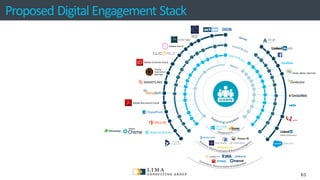
Proposed Digital Engagement Stack
61
© 2013 Adobe Systems Incorporated. All Rights Reserved. Adobe Confidential.
LCG Digital Transformation follows the Agile Methodology
Strategy, Vision &
KPIs
Priorities &
Investments
Competitive
Landscape
Governance, Adoption
& Enforcement
Regular Reviews &
Adjustments
PrototypeStrategy
Rapidly Test & Refine Products, Platforms,Campaigns, Tactics, andapproaches
Develop
customer
journey maps
Develop
Solutions and
Value
Proposition
Prototype
Minimum
viable product
Outline
business plan,
operating
model and
roadmap
Business Model
Products
Processes
Scale up Successes
Iterative
Deployment
Developnew capabilities
People, Places
and Culture
Business
transformation
Data Readiness
Systems &
Infrastructure
Financial
Readiness
Marketing
Operations
62

RoMT - Part 2 Marketing Technology Webinar

  • 1.
    © 2013 AdobeSystemsIncorporated. All Rights Reserved. AdobeConfidential. Digital Transformation is about Strategy. Not Technology 1 SERVING DIGITAL MARKETING VISIONARIES
  • 2.
    Our Mission LCG’s missionis to help our clients transform their digital futures by developing, deploying and optimizing sustainable, competitive advantages. 2
  • 3.
    Best Practices forImproving your return on MarTech 1. Understand your Data Readiness Posture 2. Implement a Data Layer 3. Use a Tag Management System 4. Audit tags monthly 5. Benchmark 6. Establish an owner for your data (Steering Committee, CDO, etc…) 7. Develop Personas, Segments and Customer Journeys 8. Understand what is normal 9. Establish reports, dashboards and alerts by stakeholder group 10. Develop and Maintain a 3-year MarTech Roadmap 3
  • 4.
    Best Practices forImproving your return on MarTech Understand your Data Readiness Posture Implement a Data Layer Use a Tag Management System Audit tags monthly Benchmark 4
  • 5.
    © 2013 AdobeSystems Incorporated. All Rights Reserved. Adobe Confidential. Marketers are drowning in data 5 5
  • 6.
    © 2013 AdobeSystems Incorporated. All Rights Reserved. Adobe Confidential. 5 V’s of Big Data Volume Velocity Value Veracity Variety • Statistical • Predictive • Prescriptive • Cognitive • Integrated • Trustworthiness • Authenticity • Reputation • Accountability • Availability • Forms andSources • Structured vs Unstructured • ProbabilisticandInterpolated • Streaming data collection • Batch vs real-time • Data Collection • Data Processing • Stillnaming big numbers • Data Layer • Governance • Accepted Nomenclaturew/i Enterprise 6
  • 7.
    © 2013 AdobeSystems Incorporated. All Rights Reserved. Adobe Confidential. EnsightenAgility 2014© All rights reserved. 7
  • 8.
    © 2013 AdobeSystems Incorporated. All Rights Reserved. Adobe Confidential. Growth of the marketing technology landscape 8
  • 9.
    © 2013 AdobeSystemsIncorporated. All Rights Reserved. AdobeConfidential. Digital Maturity Defined Data Readiness Posture Action-ability and Agility Posture ▪ Technical and Data Operations ▪ Defining “Normal” (band of excellence) ▪ Segmentation (psycho,demo,firm, behavioral, geo, techno,etc…) ▪ Video, Social, Mobile, Apps, iBeacons + innovations ▪ Real-time monitoringof operations ▪ Reports, Dashboards and Alerts ▪ Enhanced Data (from 3rd parties and Networks) ▪ 360 view of the customer ▪ Advanced Analytics (math & algo’s) ▪ Data Warehousing ▪ Data Visualizations ▪ Data Science ▪ Data Management Platform ▪ Data Layer ▪ Marketing, Sales and Operations ▪ Transformation Management ▪ Vision ▪ Governance ▪ Strategy ▪ Culture ▪ Digital Platforms ▪ IT-BusinessRelationships ▪ Human Resourcesand Org Design ▪ Financial Readiness ▪ Portfolio & Program Management ▪ Customer Journey Mapping ▪ Customer Engagement ▪ i-Beacon, in-store ▪ Preparing other form-factors, infrastructure 9
  • 10.
    © 2013 AdobeSystems Incorporated. All Rights Reserved. Adobe Confidential. Six common questions every organization should be answering Past Present Future Consumer Insights What happened? (Reporting) What is happening now? (Alerts) What will happen? (Extrapolation) Actionable Intelligence How and why did it happen? (Modeling, experimental design and cluster analysis) What’s the next best action? (Recommendation) What’s the best/worst that can happen? (Min/Max) (Prediction, optimization, simulation) 10
  • 11.
    © 2013 AdobeSystems Incorporated. All Rights Reserved. Adobe Confidential. LCG Analytics Maturity Lifecycle I knew that would happen. What Will Happen? A 360 view of Segments and Person to Person interactions. Innovations in customer experiences on a 1:1 level. Descriptive Analytics Diagnostic Predictive Prescriptive Cognitive What happened (within a silo)? Data Gathering, Focus on verifying and validating data and generation of reports from individual data sources. Datawarehousing and data visualization tools begin. Why did it happen? Information turned into learning & Insights w/ focus on causality & segments. Profile enhancement using 3rd party solutions begins. What’s happening for my customer?! Reporting, Analysis, Current and near real- time. Multi-channel analytics begins. Focus on intelligence, and determining “what’s a good #?” Alerts and exceptions based processing begins. What is the next best action? What to do? Improvement focused, a bias towards action. Automation and decision engines/sciences begin to shift engagement and profile enhancements from segments to individually created experiences across all channels & content types. 11
  • 12.
    © 2012 AdobeSystems Incorporated. All Rights Reserved. Adobe Confidential. LCG Digital Analytics Maturity Descriptive Diagnostic Predictive Prescriptive Cognitive Typically an Investment Consumer Insights gained and an improved understanding of the business Typically Cash Neutral investment Manual Deployment of learnings + ROI – Some projects can have 10,000%ROI and break even points as early as 14 days 12
  • 13.
    Institute for OperationsResearch & Management Sciences ➢The Institutefor Operations Research and the Management Sciences (INFORMS)is the largest society in the world for professionals in the field of operations research (O.R.), management science, and analytics. ➢Founded in 1952 ➢Free Tool found at: analyticsmaturity.informs.org 13
  • 14.
    The LCG AnalyticsMaturity Roadmap ➢The roadmap provides the connection between strategy and action ➢Practical plan of action to accomplish business objectives Organizational Analytics Capability Data & Infrastructure People Analytics Framework Health Leadership Roles & Skills Access Measures Analytics Services Traceability Processes Analytics Processes Analytics Architecture 14
  • 15.
    © 2013 AdobeSystemsIncorporated. All Rights Reserved. AdobeConfidential. INFORMS Summary for Kemin (As-Is) 15 DIMENSIONS: Organization AnalyticsCapability Data & Infrastructure Sample INFORMS Summary from LCG
  • 16.
    © 2013 AdobeSystemsIncorporated. All Rights Reserved. AdobeConfidential. Computing Power Man Power Where Computing Power ends, Man Power begins Diagnostic Descriptive Predictive Prescriptive Cognitive Cognitive Analysis Marketing Action Agility&Action-abilityPosture Data Readiness Posture Data&Information Gathering Conducted by People Conducted by Computers 16
  • 17.
    © 2013 AdobeSystemsIncorporated. All Rights Reserved. AdobeConfidential. Data to Information to Decision to Action across the Curve of Automation Diagnostic Descriptive Predictive Prescriptive Cognitive Cognitive Analysis Marketing Action Agility&Action-abilityPosture Data Readiness Posture Data Collection Data&Information Gathering The Curve of Automation Information Gathering Decision Decision Making Action Data Processing Launch ComputingPower Man Power 17
  • 18.
    © 2013 AdobeSystemsIncorporated. All Rights Reserved. AdobeConfidential. Web Analytics,VOC,OnlineSurvey and Customer AnalyticsData FirstParty EnterpriseData 2nd and 3rd Party Data LCG Digital Marketing Maturity Roadmap Diagnostic Descriptive Predictive Prescriptive Cognitive Cognitive Analysis Marketing Action Agility&Action-abilityPosture Data Readiness Posture Data&Information Gathering Benchmarking, Reporting, Cleansing,QA & Preparation The Curve of Automation Opinion Driven Decision Making over Months Decision Action Data Processing Launch Data Collection 18
  • 19.
    © 2013 AdobeSystemsIncorporated. All Rights Reserved. AdobeConfidential. Decision Making Maturation over time… ➢Rank beats Opinion 19
  • 20.
    © 2013 AdobeSystemsIncorporated. All Rights Reserved. AdobeConfidential. Best Practices for Improving your return on MarTech  Understand your Data Readiness Posture  Implement a Data Layer  Use a Tag Management System  Audit tags monthly  Benchmark 20
  • 21.
    © 2013 AdobeSystems Incorporated. All Rights Reserved. Adobe Confidential. A solid digital foundation consist of data and governance
  • 22.
    Establish a DataLayer Tennis Match Soccer Team 3-5-2A Military Platoon Blue Angels MissingMan Formation 22
  • 23.
    What is adata layer? Source: https://tealium.com/what-is-a-data-layer/ 23
  • 24.
    © 2013 AdobeSystems Incorporated. All Rights Reserved. Adobe Confidential. Best Practices for Improving your return on MarTech  Understand your Data Readiness Posture  Implement a Data Layer  Use a Tag Management System  Audit tags monthly  Benchmark 24
  • 25.
    © 2013 AdobeSystems Incorporated. All Rights Reserved. Adobe Confidential. What is a tag? a TAG is a piece of code that collects and fires data about the user experience <img width="1"height="1"border="0“ src=”http://vendyvendor.com/action?adv=445566 &page=browse&seg=9999&cat=luggage"/>
  • 26.
    © 2013 AdobeSystems Incorporated. All Rights Reserved. Adobe Confidential. What is a Tag ManagementSystem A Tag Management System (TMS) is similar to a content management system (CMS) in that once implemented, it enables marketers to maintain tags the way a CMS maintains pages. Benefits: ▪ Marketers are less reliant on their IT departments. ▪ TMS have features for users rights administration and enterprise level workflows. ▪ Enables marketers to improve quality, site load times, and personalized experiences.
  • 27.
    © 2013 AdobeSystems Incorporated. All Rights Reserved. Adobe Confidential. Marketing Manager: “Can you add this new re-targeting pixel to the site for me? It’s just one line of code and should be easy” Developer: “Sure, just send me the code” Marketing manager: “Great! Oh I need to make sure that this tag is only served to our users that are on our secure pages, in the products folder, have been on the site for at least 2 minutes, it is at least their 3rd visit to our site, and I need to apply that to only 3 of our 7 domains.” (long pause) Marketing Manager: “And for only 25% of the traffic. And for this Friday!” Developer: “I hate you”
  • 28.
    © 2013 AdobeSystems Incorporated. All Rights Reserved. Adobe Confidential. The power of a Tag Management Solution in action
  • 29.
    Best Practices forImproving your return on MarTech Understand your Data Readiness Posture Implement a Data Layer Use a Tag Management System Audit tags monthly Benchmark 29
  • 31.
    Best Practices forImproving your return on MarTech Understand your Data Readiness Posture Implement a Data Layer Use a Tag Management System Audit tags monthly Benchmark 31
  • 32.
    State of theIndustry Our Assessments detected 220 unique marketing technologies throughout all sectors. LCG and ObservePoint maintain a list of approximately 220 MarTechs.
  • 33.
  • 34.
    Most common tags& Sites with the most tags
  • 35.
    Characteristics of eachQuadrant Journeymen: Little MarTech deployed sporadically, irregularlywithout an architecture. Craftsmen: Few MarTech solutions deployed by technically disciplined team. Scouts: Experimenting with a lot of MarTech but without governance or technical discipline Expeditionaries: Visionaries backed by technical discipline, governance & architecture. # of MarTech Solutions TagDeploymentScore
  • 36.
    Definitions of categories: Journeymen:What few tags these organizations have attempted to deploy, they deployed sporadically. Craftsmen: What few tags these organizations have deployed, they've deployed adequately. Scouts: These organizations have deployed many tags relative to their industry and have deployed them sporadically. Expeditionaries: This group is realizing the best Return on their Marketing Technologies (RoMT) in the category.
  • 37.
    Audit Score vs. Numberof Tags Craftsmen: Journeyman: Expeditionaries: Scouts:
  • 38.
    © 2013 AdobeSystemsIncorporated. All Rights Reserved. AdobeConfidential. Adobe Media Optimizer Adobe Social Adobe Creative Cloud Adobe Document Cloud Request yourfreeTag Deployment Assessment 38 Request your Tag Deployment Assessment by emailing me directly @ plima@limaconsulting.com Or download our industry whitepapers @ www.limaconsulting.com/Our-Thinking https://www.linkedin.com/in/paullima/
  • 39.
    © 2013 AdobeSystemsIncorporated. All Rights Reserved. AdobeConfidential. Best Practices for Improving your return on MarTech  Understand your Data Readiness Posture  Implement a Data Layer  Use a Tag Management System  Audit tags monthly  Benchmark  Establish an owner for your data (Steering Committee, CDO, etc…)  Develop Personas, Segments and Customer Journeys  Understand what is normal  Establish reports, dashboards and alerts by stakeholder group  Develop and Maintain a 3-year MarTech Roadmap 39
  • 40.
    © 2013 AdobeSystemsIncorporated. All Rights Reserved. AdobeConfidential. TeamStructure Models: definitions,advantages,and disadvantages TeamStructureModels Model Definitions Advantages Disadvantages Decisionsmadebymidand lower-levelmanagersacrosstheir respectiveareawith extensive delegation throughout. • Moreconnectedto eachaligned BU • • Providesdeeperinsights atbusinessunit level, asfocusischannelspecific / specialized • Moreautonomyandflexibility inchannel • Fastermovinginchannel Nosharedstandardsorcoordination between channels • Notrainingor sharedbestpractices between marketing teams • Noenterprise perspectiveinchannel • Limits coordinationacrossashared strategicvision Decisionsmadefromthetop. Rolesandcapabilities are centralized into asingleareaor team. • Highestlevel ofstandardization • Focuson training,policies,andbest practiceapplication • Evangelizesinitiativesacrossorganization • Enterprise, strategic perspective • Slowandbureaucratic (bottleneck) • Disconnectedfromthebusiness • Morereportingfocused • Lesseffective for businessunits • Requiresmaturecrosschannelexecution processes to beeffective Decisionsmadetogether. Centralizesspecializedskillsand functionsunderacohesive strategy (vision& SMEs),while allowing execution to thrivein respectiveareaswithflexibility. • Standardization yetlocalized perBU • Promotescollaboration andbestpractices • Enterpriseperspectiveachievedwhilst remaining connected to thebusinessunits • Fastermovingatthe“spokes” • Moregrowthopportunities • Needsstrongexecutivesponsorto empower virtualteams • Requires100%cooperation across organizationalareas • Failswithoutadherenceto centralized governing entity (processes,actions,etc.) • More communicationandcoordination needed to manageandalign Decentralized Centralized CoE 40
  • 41.
    © 2013 AdobeSystemsIncorporated. All Rights Reserved. AdobeConfidential. Additional Models Team Structure Models Model Definitions Advantages Disadvantages • Consistent brand messaging • Localizedandagileinthefield • Moreautonomyandflexibility inchannel • Fastermovinginchannel • Expertiseclosesttothefield • Allowsforanomaliestobemanagedin-market • HighestCostofallmodels • Requires executivealignmentacross hubs • Coordinationacrossashared strategicvision Anyoneintheorganizationcan createcontentinaccordancewith SOPs • Focuson training,policies, andbest practiceapplication • Evangelizesinitiativesacrossorganization • Speedtowardsproducingcontent • Bestforsocialpoliciesande-care • Everyoneownsit,noonedoesit • Requiresstandardizationandreporting • Difficulttokeepcontentonmessage • Lesseffective for businessunits • Requirespolicingandhighdegreeoftraining • Culturalshifttowardsengagingwithcustomerbase Dandelion Honeycomb Hub&Spoketeamswithincompanies actautonomouslyunderacommon brand.CommonlyusedinMulti- Nationalswithestablisheddigitalhub &spoketeamsandevolvesintothe MultipleH&Smodel(Dandelion) 41
  • 42.
    © 2013 AdobeSystemsIncorporated. All Rights Reserved. AdobeConfidential. Proposed Central HUB 42
  • 43.
    Best Practices forImproving your return on MarTech Understand your Data Readiness Posture Implement a Data Layer Use a Tag Management System Audit tags monthly Benchmark Establish an owner for your data (Steering Committee, CDO, etc…) Develop Personas, Segments and Customer Journeys Understand what is normal Establish reports, dashboards and alerts by stakeholder group Develop and Maintain a 3-year MarTech Roadmap 43
  • 44.
    © 2013 AdobeSystems Incorporated. All Rights Reserved. Adobe Confidential. Let 1,000 flowers bloom 44 44
  • 45.
    © 2013 AdobeSystems Incorporated. All Rights Reserved. Adobe Confidential. Don’t do the time. Avoid the crime. Analyzing data in aggregate is a crime. 45
  • 46.
    © 2013 AdobeSystems Incorporated. All Rights Reserved. Adobe Confidential. Segment, then analyze 46
  • 47.
    Gain insights withsegments to reach business objectives
  • 48.
    Best Practices forImproving your return on MarTech Understand your Data Readiness Posture Implement a Data Layer Use a Tag Management System Audit tags monthly Benchmark Establish an owner for your data (Steering Committee, CDO, etc…) Develop Personas, Segments and Customer Journeys Understand what is normal Establish reports, dashboards and alerts by stakeholder group Develop and Maintain a 3-year MarTech Roadmap 48
  • 49.
    © 2013 AdobeSystems Incorporated. All Rights Reserved. Adobe Confidential. Machine Intelligence= Machine Learning + AI - circa 2015 49
  • 50.
    © 2013 AdobeSystems Incorporated. All Rights Reserved. Adobe Confidential. Machine Learning companies 2017 50
  • 51.
    Exception Based ProcessingRequires the Definition of normal Source: US Army Field Manual FM 7-0 Training the Force 51
  • 52.
    Exception Based ProcessingImproves Results • What is normal? • Knowing when actions must be triggered means we have the “bands of excellence” defined • What is the next best action? For call centers, customerservice centers, regional operational centers,these insights can mean significant savings
  • 53.
    © 2013 AdobeSystems Incorporated. All Rights Reserved. Adobe Confidential.
  • 54.
    © 2013 AdobeSystems Incorporated. All Rights Reserved. Adobe Confidential. Best Practices for Improving your return on MarTech  Understand your Data Readiness Posture  Implement a Data Layer  Use a Tag Management System  Audit tags monthly  Benchmark  Establish an owner for your data (Steering Committee, CDO, etc…)  Develop Personas, Segments and Customer Journeys  Understand what is normal  Establish reports, dashboards and alerts by stakeholder group  Develop and Maintain a 3-year MarTech Roadmap 54
  • 55.
    © 2013 AdobeSystems Incorporated. All Rights Reserved. Adobe Confidential. Beer Belly Protocol vs Pregnancy Belly Protocol 55
  • 56.
    © 2013 AdobeSystems Incorporated. All Rights Reserved. Adobe Confidential. Best Practices for Improving your return on MarTech  Understand your Data Readiness Posture  Implement a Data Layer  Use a Tag Management System  Audit tags monthly  Benchmark  Establish an owner for your data (Steering Committee, CDO, etc…)  Develop Personas, Segments and Customer Journeys  Understand what is normal  Establish reports, dashboards and alerts by stakeholder group  Develop and Maintain a 3-year MarTech Roadmap 56
  • 57.
    Agility Readiness PostureSummary As-Is State Future State Assessment Dimension As-Is Year 1 Year 2 Year 3 STRATEGY 1 2 2 2 MARKETING OPERATIONS 0 2 2 2 GOVERNANCE, ADOPTION, ENFORCEMENT 0 3 3 4 DATA READINESS 0 1 2 2 PEOPLE, PLACES, EMPOWERMENT 2 3 4 4 PROCESSES 0 2 3 3 TECHNOLOGY 1 2 3 3 57
  • 58.
    © 2013 AdobeSystemsIncorporated. All Rights Reserved. AdobeConfidential. 58 Exponential Growth of Computing
  • 59.
    Data&Information Gathering Web Content Management CapabilityBegins LCG Digital Transformation Maturity Model Roadmap MarTech, Gap Analysis Biz Requirement Definition Tag Management Capability Begins Technical Requirements Digital Analytics & Data Layer Architecture Tag Audit Data Warehouse Capability Begins Automate Distribution of KPIs to Stakeholders Data Management Platform CapabilityIntegrations of Enterprise Customer Data Pre-Click  Post-Click Closed-Loop Integration End-to-End Closed Loop Conversion Attribution Data Visualizations Capability Begins Attribution Modeling Capability Begins Portfolio Based MVT Testing Begins Conversion Rate Optimization (CRO) Capability Begins Programmatic Ad Buying Marketing Automation Optimization Begins Cognitive UIs Accessible to all User Groups Chief Data Responsibility, Data Governance Policies & MarTech Implementation Team Advanced Analytics Practice Begins (Data Science Team) Call Center Conversions data Tracking Capability SEO Platform Capability SSO/Audience Profiling 3rd Party Profile Capability Customer Analytics & Heat Maps & UX Capability Begins Voice of the Customer / Chat / Survey Feedback Integrated with Respondent's Engagements Lead Scoring & Sales Automation Social Listening & Publishing Community Building Capability Diagnostic Descriptive Predictive Prescriptive Cognitive Cognitive Analysis Marketing Action Agility&Action-abilityPosture Data Readiness Posture Establish Program Management Office Digital Marketing Platforms Responsibility Integrated Translation Mgmt Platform Develop Customer Journeys Establish Digital Transformation Steering Committee Develop Personas Implement Single Digital Asset Mgmt Solution Deploy Computational Creative Capability
  • 60.
    © 2013 AdobeSystemsIncorporated. All Rights Reserved. AdobeConfidential. Agility&Action-abilityPosture Data&Information Gathering Cognitive Analysis Marketing Action Diagnostic Data Readiness Posture Data Quality Practice Begins (Tag Audits) Biz Requirements Definition MarTech Capabilities Assessment, Gap Analysis, Roadmap, Vendor Selection Technical Requirements & Architecture for Digital Analytics & Data Layer Design People Technology Process Establish a Digital Transformation Steering Committee Develop Personas LCG Digital Transformation Maturity Model Roadmap Develop Customer Journeys Chief Data Responsibility Assigned & Formation of Data Governance Policies & MarTech Implementation Team Tag Management Capability Begins Voice of the Customer / Chat / Survey Feedback Integrated with Respondent’s Engagements
  • 61.
    © 2013 AdobeSystemsIncorporated. All Rights Reserved. AdobeConfidential. Adobe Media Optimizer Adobe Social Adobe Creative Cloud Adobe Document Cloud Proposed Digital Engagement Stack 61
  • 62.
    © 2013 AdobeSystems Incorporated. All Rights Reserved. Adobe Confidential. LCG Digital Transformation follows the Agile Methodology Strategy, Vision & KPIs Priorities & Investments Competitive Landscape Governance, Adoption & Enforcement Regular Reviews & Adjustments PrototypeStrategy Rapidly Test & Refine Products, Platforms,Campaigns, Tactics, andapproaches Develop customer journey maps Develop Solutions and Value Proposition Prototype Minimum viable product Outline business plan, operating model and roadmap Business Model Products Processes Scale up Successes Iterative Deployment Developnew capabilities People, Places and Culture Business transformation Data Readiness Systems & Infrastructure Financial Readiness Marketing Operations 62