ACHIEVING LEAN EXCELLENCE
IN A NON-MANUFACTURING SUPPLY CHAIN
ELM VALLE
RESOURCES GLOBAL PROFESSIONALS
March 2012
Agenda
 Introductions
 Six Sigma v. Lean
 Industry Trend
 Barriers
 Why Supply Chain
 Value Stream and Methodology
2
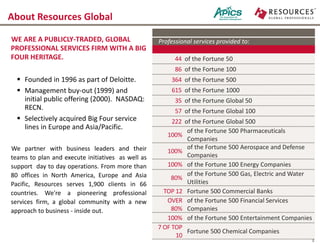
WE ARE A PUBLICLY-TRADED, GLOBAL
PROFESSIONAL SERVICES FIRM WITH A BIG
FOUR HERITAGE.
 Founded in 1996 as part of Deloitte.
 Management buy-out (1999) and
initial public offering (2000). NASDAQ:
RECN.
 Selectively acquired Big Four service
lines in Europe and Asia/Pacific.
We partner with business leaders and their
teams to plan and execute initiatives as well as
support day to day operations. From more than
80 offices in North America, Europe and Asia
Pacific, Resources serves 1,900 clients in 66
countries. We're a pioneering professional
services firm, a global community with a new
approach to business - inside out.
About Resources Global
3
Professional services provided to:
44 of the Fortune 50
86 of the Fortune 100
364 of the Fortune 500
615 of the Fortune 1000
35 of the Fortune Global 50
57 of the Fortune Global 100
222 of the Fortune Global 500
100%
of the Fortune 500 Pharmaceuticals
Companies
100%
of the Fortune 500 Aerospace and Defense
Companies
100% of the Fortune 100 Energy Companies
80%
of the Fortune 500 Gas, Electric and Water
Utilities
TOP 12 Fortune 500 Commercial Banks
OVER
80%
of the Fortune 500 Financial Services
Companies
100% of the Fortune 500 Entertainment Companies
7 OF TOP
10
Fortune 500 Chemical Companies
4
About Myself
Elm Valle
 Six years U.S. Army Officer
 Experienced Consultant with Resources Global and BIG 4 FIRMS
 Global Supply Chain Experience with Retail, Oil & Gas, and Chemical
 MBA, Lean Six Sigma Black Belt, Project Management Certified
 Membership: Lean Enterprise Institute, APICS, The Hackett Group, The Aberdeen
Group
 15 Years of Operations Experience [Domestic and International]
5
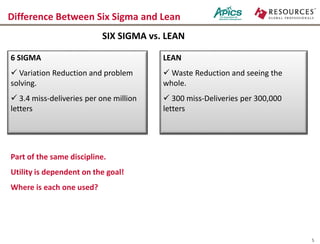
Difference Between Six Sigma and Lean
SIX SIGMA vs. LEAN
LEAN
 Waste Reduction and seeing the
whole.
 300 miss-Deliveries per 300,000
letters
6 SIGMA
 Variation Reduction and problem
solving.
 3.4 miss-deliveries per one million
letters
Part of the same discipline.
Utility is dependent on the goal!
Where is each one used?
6
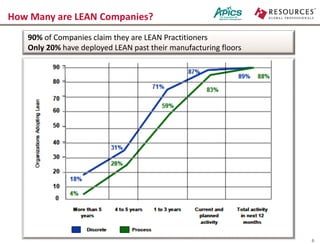
How Many are LEAN Companies?
90% of Companies claim they are LEAN Practitioners
Only 20% have deployed LEAN past their manufacturing floors
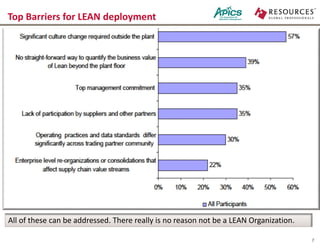
Top Barriers for LEAN deployment
7
All of these can be addressed. There really is no reason not be a LEAN Organization.
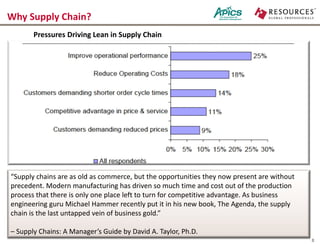
Why Supply Chain?
8
“Supply chains are as old as commerce, but the opportunities they now present are without
precedent. Modern manufacturing has driven so much time and cost out of the production
process that there is only one place left to turn for competitive advantage. As business
engineering guru Michael Hammer recently put it in his new book, The Agenda, the supply
chain is the last untapped vein of business gold.”
– Supply Chains: A Manager’s Guide by David A. Taylor, Ph.D.
Pressures Driving Lean in Supply Chain
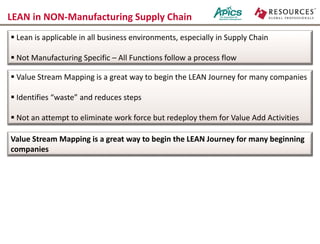
LEAN in NON-Manufacturing Supply Chain
 Lean is applicable in all business environments, especially in Supply Chain
 Not Manufacturing Specific – All Functions follow a process flow
 Value Stream Mapping is a great way to begin the LEAN Journey for many companies
 Identifies “waste” and reduces steps
 Not an attempt to eliminate work force but redeploy them for Value Add Activities
Value Stream Mapping is a great way to begin the LEAN Journey for many beginning
companies
10
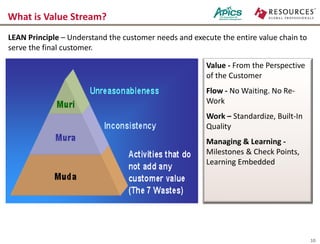
What is Value Stream?
Value - From the Perspective
of the Customer
Flow - No Waiting. No Re-
Work
Work – Standardize, Built-In
Quality
Managing & Learning -
Milestones & Check Points,
Learning Embedded
LEAN Principle – Understand the customer needs and execute the entire value chain to
serve the final customer.
The Formula for Success
Cross Functional Participation with Key Stakeholder
Remove jargon and confusing terminology
Target Pain points in Supply Chain
 PO Processing Time and Cost
 Logistical Bottlenecks
 Supplier Performance
 Inventory Levels to Business Needs
 What are others?
Execute Low Hanging Fruit
Train the “EASY TOOLS” – 5 S, Spaghetti Diagrams, & VSM,
Methodology
 Brand, Marketing, Champion, and Socialize
 Project Plan and Timeline
 Current State Mapping
 Determine Value Stream
 Identify the Wastes
 Map Future State
 Quick Wins & Low Hanging Fruit
 Measure, Control, Improve
 Incremental Progress
 Leadership Support and Buy In
How do I do a LEAN VSM Project?
13
Mapping the Current State
The Do’s and Don’ts of Process Mapping.
Do’s
 DO map the process as it actually happens
 DO talk to the other people who are involved in the process
 DO define the beginning and end of the process before you start
 DO the process map at a high level. Keep it simple and illustrative
 DO work in a team. Seek advice
Do Not’s
 DON’T map the process as you think it happens or as you think it ought to happen. Do
not interpret
 DON’T restrict your process map to activities relating to the department that primarily
runs the process
 DON’T attempt to start process mapping before having identified the process’
beginning and end
 DON’T get bogged down with too much detail
 DON’T struggle on your own
14
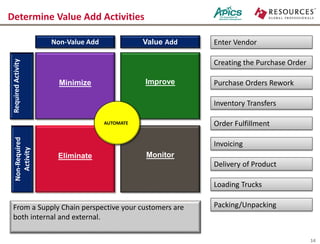
Determine Value Add Activities
Minimize
Non-Value Add
RequiredActivity
Eliminate
Improve
Monitor
Value Add
Non-Required
Activity
AUTOMATE
Purchase Orders Rework
Enter Vendor
Invoicing
Inventory Transfers
Delivery of Product
Creating the Purchase Order
Order Fulfillment
From a Supply Chain perspective your customers are
both internal and external.
Loading Trucks
Packing/Unpacking
15
Future State Mapping
 Eliminate Steps & handoffs
 Combine Steps
 Create parallel paths
 Alter sequencing
 Implement Pull
 Reduce / eliminate batches
 Improve quality
 Create organized workplace
 Reduced change over
 Create standard work
 Eliminate unnecessary approvals
 Eliminate NVA
 Co-locate functions based on flow
[cross functional teams]
 Improve Status
 Leverage Automation
16
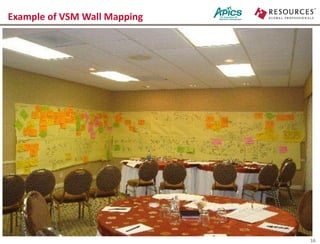
Example of VSM Wall Mapping
17
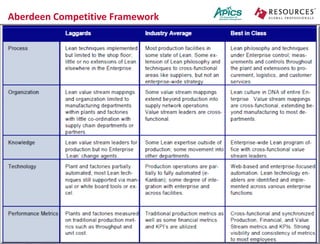
Aberdeen Competitive Framework
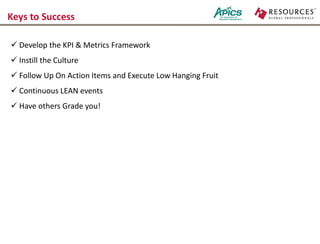
Keys to Success
 Develop the KPI & Metrics Framework
 Instill the Culture
 Follow Up On Action Items and Execute Low Hanging Fruit
 Continuous LEAN events
 Have others Grade you!
CONTACTS & REFERENCES
ELM VALLE
Consultant Supply Chain & Information Management
Elm.valle@resources-usa.com
281.451.1806
RICK COCHRAN
Senior Client Services Director
Rick.Cochran@resources-us.com
713.403.1967
19
REFERENCES
The Lean Supply Chain Report, The Aberdeen Group
Value Stream Mapping for the Office and Services, Peter Walsh
20
BACK UP: Muri and Mura
Muri is all the unreasonable work that management imposes on workers and machines
because of poor organization, such as carrying heavy weights, moving things around,
dangerous tasks, even working significantly faster than usual. It is pushing a person or a
machine beyond its natural limits. This may simply be asking a greater level of
performance from a process than it can handle without taking shortcuts and informally
modifying decision criteria. Muri also includes bad working conditions, and it will often
push a resource to work harder than its natural limits. Unreasonable work is almost
always a cause of multiple variations. Lean focuses on the planning of processes to avoid
muri and on the preparation and planning of the process, or what work can be avoided
proactively by design.
Mura is the variation and inconsistency in quality and volume in both products and
human conditions. Lean focuses on how the work design is implemented and the
elimination of fluctuation at the scheduling or operations level, such as quality and
volume.

LEAN in a Non Manufacturing Environment

  • 1.
    ACHIEVING LEAN EXCELLENCE INA NON-MANUFACTURING SUPPLY CHAIN ELM VALLE RESOURCES GLOBAL PROFESSIONALS March 2012
  • 2.
    Agenda  Introductions  SixSigma v. Lean  Industry Trend  Barriers  Why Supply Chain  Value Stream and Methodology 2
  • 3.
    WE ARE APUBLICLY-TRADED, GLOBAL PROFESSIONAL SERVICES FIRM WITH A BIG FOUR HERITAGE.  Founded in 1996 as part of Deloitte.  Management buy-out (1999) and initial public offering (2000). NASDAQ: RECN.  Selectively acquired Big Four service lines in Europe and Asia/Pacific. We partner with business leaders and their teams to plan and execute initiatives as well as support day to day operations. From more than 80 offices in North America, Europe and Asia Pacific, Resources serves 1,900 clients in 66 countries. We're a pioneering professional services firm, a global community with a new approach to business - inside out. About Resources Global 3 Professional services provided to: 44 of the Fortune 50 86 of the Fortune 100 364 of the Fortune 500 615 of the Fortune 1000 35 of the Fortune Global 50 57 of the Fortune Global 100 222 of the Fortune Global 500 100% of the Fortune 500 Pharmaceuticals Companies 100% of the Fortune 500 Aerospace and Defense Companies 100% of the Fortune 100 Energy Companies 80% of the Fortune 500 Gas, Electric and Water Utilities TOP 12 Fortune 500 Commercial Banks OVER 80% of the Fortune 500 Financial Services Companies 100% of the Fortune 500 Entertainment Companies 7 OF TOP 10 Fortune 500 Chemical Companies
  • 4.
    4 About Myself Elm Valle Six years U.S. Army Officer  Experienced Consultant with Resources Global and BIG 4 FIRMS  Global Supply Chain Experience with Retail, Oil & Gas, and Chemical  MBA, Lean Six Sigma Black Belt, Project Management Certified  Membership: Lean Enterprise Institute, APICS, The Hackett Group, The Aberdeen Group  15 Years of Operations Experience [Domestic and International]
  • 5.
    5 Difference Between SixSigma and Lean SIX SIGMA vs. LEAN LEAN  Waste Reduction and seeing the whole.  300 miss-Deliveries per 300,000 letters 6 SIGMA  Variation Reduction and problem solving.  3.4 miss-deliveries per one million letters Part of the same discipline. Utility is dependent on the goal! Where is each one used?
  • 6.
    6 How Many areLEAN Companies? 90% of Companies claim they are LEAN Practitioners Only 20% have deployed LEAN past their manufacturing floors
  • 7.
    Top Barriers forLEAN deployment 7 All of these can be addressed. There really is no reason not be a LEAN Organization.
  • 8.
    Why Supply Chain? 8 “Supplychains are as old as commerce, but the opportunities they now present are without precedent. Modern manufacturing has driven so much time and cost out of the production process that there is only one place left to turn for competitive advantage. As business engineering guru Michael Hammer recently put it in his new book, The Agenda, the supply chain is the last untapped vein of business gold.” – Supply Chains: A Manager’s Guide by David A. Taylor, Ph.D. Pressures Driving Lean in Supply Chain
  • 9.
    LEAN in NON-ManufacturingSupply Chain  Lean is applicable in all business environments, especially in Supply Chain  Not Manufacturing Specific – All Functions follow a process flow  Value Stream Mapping is a great way to begin the LEAN Journey for many companies  Identifies “waste” and reduces steps  Not an attempt to eliminate work force but redeploy them for Value Add Activities Value Stream Mapping is a great way to begin the LEAN Journey for many beginning companies
  • 10.
    10 What is ValueStream? Value - From the Perspective of the Customer Flow - No Waiting. No Re- Work Work – Standardize, Built-In Quality Managing & Learning - Milestones & Check Points, Learning Embedded LEAN Principle – Understand the customer needs and execute the entire value chain to serve the final customer.
  • 11.
    The Formula forSuccess Cross Functional Participation with Key Stakeholder Remove jargon and confusing terminology Target Pain points in Supply Chain  PO Processing Time and Cost  Logistical Bottlenecks  Supplier Performance  Inventory Levels to Business Needs  What are others? Execute Low Hanging Fruit Train the “EASY TOOLS” – 5 S, Spaghetti Diagrams, & VSM,
  • 12.
    Methodology  Brand, Marketing,Champion, and Socialize  Project Plan and Timeline  Current State Mapping  Determine Value Stream  Identify the Wastes  Map Future State  Quick Wins & Low Hanging Fruit  Measure, Control, Improve  Incremental Progress  Leadership Support and Buy In How do I do a LEAN VSM Project?
  • 13.
    13 Mapping the CurrentState The Do’s and Don’ts of Process Mapping. Do’s  DO map the process as it actually happens  DO talk to the other people who are involved in the process  DO define the beginning and end of the process before you start  DO the process map at a high level. Keep it simple and illustrative  DO work in a team. Seek advice Do Not’s  DON’T map the process as you think it happens or as you think it ought to happen. Do not interpret  DON’T restrict your process map to activities relating to the department that primarily runs the process  DON’T attempt to start process mapping before having identified the process’ beginning and end  DON’T get bogged down with too much detail  DON’T struggle on your own
  • 14.
    14 Determine Value AddActivities Minimize Non-Value Add RequiredActivity Eliminate Improve Monitor Value Add Non-Required Activity AUTOMATE Purchase Orders Rework Enter Vendor Invoicing Inventory Transfers Delivery of Product Creating the Purchase Order Order Fulfillment From a Supply Chain perspective your customers are both internal and external. Loading Trucks Packing/Unpacking
  • 15.
    15 Future State Mapping Eliminate Steps & handoffs  Combine Steps  Create parallel paths  Alter sequencing  Implement Pull  Reduce / eliminate batches  Improve quality  Create organized workplace  Reduced change over  Create standard work  Eliminate unnecessary approvals  Eliminate NVA  Co-locate functions based on flow [cross functional teams]  Improve Status  Leverage Automation
  • 16.
    16 Example of VSMWall Mapping
  • 17.
  • 18.
    Keys to Success Develop the KPI & Metrics Framework  Instill the Culture  Follow Up On Action Items and Execute Low Hanging Fruit  Continuous LEAN events  Have others Grade you!
  • 19.
    CONTACTS & REFERENCES ELMVALLE Consultant Supply Chain & Information Management Elm.valle@resources-usa.com 281.451.1806 RICK COCHRAN Senior Client Services Director Rick.Cochran@resources-us.com 713.403.1967 19 REFERENCES The Lean Supply Chain Report, The Aberdeen Group Value Stream Mapping for the Office and Services, Peter Walsh
  • 20.
    20 BACK UP: Muriand Mura Muri is all the unreasonable work that management imposes on workers and machines because of poor organization, such as carrying heavy weights, moving things around, dangerous tasks, even working significantly faster than usual. It is pushing a person or a machine beyond its natural limits. This may simply be asking a greater level of performance from a process than it can handle without taking shortcuts and informally modifying decision criteria. Muri also includes bad working conditions, and it will often push a resource to work harder than its natural limits. Unreasonable work is almost always a cause of multiple variations. Lean focuses on the planning of processes to avoid muri and on the preparation and planning of the process, or what work can be avoided proactively by design. Mura is the variation and inconsistency in quality and volume in both products and human conditions. Lean focuses on how the work design is implemented and the elimination of fluctuation at the scheduling or operations level, such as quality and volume.