CNIPMMR


                                                                     Lean Manufacturing
                            Pilot project no. RO/03/B/F/PP-175017
                                                                    -cost cutting methods-


"This project has been funded with support from the European Commission. This publication
[communication] reflects the views only of the author, and the Commission cannot be held
responsible for any use which may be made of the information contained therein."
                                   TRAINING MODULE

                       LEAN MANUFACTURING
                    - COST CUTTING METHODS -
                                 MODULE DEVELOPED BY:
    The National Council of Small and Medium Sized Private Enterprises of
                            Romania (CNIPMMR)
Contents:
•   INTRODUCTION
a) Introduction into the topic
b) Terms used
c) Scope
d) Categories of users
e) Details on the organisation who created this module
•   MODULE CONTENT
CHAPTER 1: METHODS FOR GATHERING AND ANALYZING THE DATA NECESSARY
TO CUT COSTS
    1.1.   WASTE
    1.2.   LEAN ASSESSMENT
    1.3.   LEAN INDICATORS
    Example of OEE calculation
    1.4.   VSM - VALUE STREAM MAP
CHAPTER 2: METHODS OF CUTTING COSTS BY REORGANIZING PRODUCTION
PROCESSES
    2.1.   JUST IN TIME (JIT) PRODUCTION.
    2.2.   KANBAN SYSTEMS.
    Example of Kanban calculation model
    Example of setting the minimum batch level
    2.3.   JIDOKA
Training module: Lean Manufacturing–Cost cutting methods    Pilot Project no. RO/03/B/F/PP-175017
    2.4.   POKA YOKE
    2.5.   SINGLE MINUTE EXCHANGE OF DIE (SMED).
    2.6.   STANDARDIZED WORK
    2.7.   TOTAL PRODUCTIVE MAINTENANCE (TPM)
    2.8.   5 S AND VISUAL MANAGEMENT
CHAPTER 3. IMPLEMENTATION OF IMPROVEMENTS
    3.1.   FUTURE VALUE STREAM MAPPING
    Example of calculation
    3.2.   SYSTEM OF LEAN INDICATORS
    3.3.   TRANSITION TO A LEAN ENTERPRISE
•   CASE STUDIES, EXAMPLES
    Example of Work Sampling application
    Example of visual management
•   BIBLIOGRAPHY

                INTRODUCTION
    a) Introduction into the topic
      As early as the late 1800s, when the manufacturing production of automobiles began
developing, characterized by high quality manual production, which was, nonetheless, very
expensive and of poor productivity, and which was intended for a small share of consumers,
it was felt the need to pass onto mass production. Thus, in the 1920’s, Henry Ford launched
mass production of automobiles. Mass production was characterized by assembly lines
where low-skilled workers made hundreds of identical, low quality products and with prices
affordable for an average family.
       As you know, mass production in all fields evolved so much, that early as the 1980s
the consumer’s perception of product value was given by low cost, availability of high quality
products and manufacturers’ flexibility to produce according to the market demands. After the
year 2000, the consumer’s perception of product value has been given by the flexibility of
production, high quality associated with low costs and availability. To put it otherwise, in
order to survive in a global market, companies must obtain profit, renew contracts and grow.
For all these to happen, companies must be the best at ensuring delivery of fine products, at
competitive prices and earlier than the competition.
      Lean Manufacturing is currently the most important management method for
manufacturing companies. The method is used together with the quality tool referred to as “6
sigma”, it is based on Toyota Production System, it was adjusted by Womack and Jones, in
1995, to Western companies, and it refers to real basic capabilities. Applying Lean
Manufacturing leads to exceptional results, with no complex systems required, therefore, it is
also an adequate method for SMEs with limited resources.
      Lean Manufacturing means flexible assembly lines or cells, more complex tasks,
highly-skilled workers, better-made products, wider variety of interchangeable parts,
mandatory excellent quality, low costs due to the improvement of the manufacturing process,
international markets and world-wide competition. Lean Manufacturing, or production at
minimum costs, is a production philosophy that determines a reduction of the duration from
customer’s order to delivery of the product by eliminating waste.
     The implementation of LEAN concepts has become a survival strategy in a
production environment in which COST cutting is a market reality.
      If current results of your company do not satisfy you, you can find out answers to many
                                                 2/44
Training module: Lean Manufacturing–Cost cutting methods       Pilot Project no. RO/03/B/F/PP-175017
of your problems by coming into the Lean world. If you want to introduce improved long-term
production management methods, which will help you identify waste in you organization and
increase productive capacity and simultaneously cutting production costs, by going over this
module you can familiarize with several Lean Manufacturing concepts which, after
implementation, shall lead to:
            Cutting to half the time of the human effort in workshops
            Cutting to half finished product defects
            Cutting to one third the production preparation time
            Cutting to half the production area, obtaining the same results
            Cutting to one tenth or less the unfinished production.
     Here are several goals that can be accomplished by applying the Lean Manufacturing
method:
            Organizing the production flow and setting the work pace in accordance with the
            Lean Manufacturing method
            Establishing a production plan by forecasting market demands
            Continuously improving the production flow as often as possible
            Verifying market demands to control production (it should not be produced more
            than what the market demands)
            Transmitting customer orders to a single production process.
            Distributing production (of distinctive products), by the end of each production
            process
            Creating an "initial pull" for delivery of a small production, compatible with the
            development of the production process, instead of releasing larger batches of
            products
            Reducing the time necessary for preparing production, simultaneously increasing
            flexibility, quality and efficiency and cutting costs.
            Quantifying waste, analyzing it and the actions to be taken to implement methods
            to raise the efficiency of the production process
            Methods to cut waste, establishing the types of waste and measuring it
            Necessity for an actual performance measurement system
            Establishing a methodology for planning and implementing the performance
            measurement system
            Determining system characteristics by actually measuring performances
            Action to be taken to develop de process
            Implementing the "5 S" method
            Training and involving the entire personnel
            Standardizing (making uniform) the work procedures.
    b) Terms used
Lean Approach: A 5 step thinking process proposed by James Womack and Dean Jones,
           authors of the “Lean Thinking” manual, to guide managers in their attempts to
           introduce the Lean principles into production. The 5 principles are:
               1. Setting the value of each product family from final customer’s point of view.
               2. Identifying all activities on the value stream of each product family,

                                                 3/44
Training module: Lean Manufacturing–Cost cutting methods     Pilot Project no. RO/03/B/F/PP-175017
               eliminating as much as possible those waste-generating activities.
               3. Ranking value-adding activities in a sequence (flow) of clearly identified
               steps, so that the product should reach the final customer through a process
               which should be as continuous as possible.
               4. After the value stream is established and introduced, each internal or
               external customer/beneficiary can apply the “pull” system to “pull” the product
               from the production line.
               5. After the value is set, the value-adding activities identified and those
               generating waste eliminated, and the value stream set and introduced, the
               process can be operationalized and repeated until it reaches the optimal level,
               of maximum value and no waste.
ABC Analysis: Is a tool for dividing items necessary in a production process into groups,
           according to the demand for those items. Lean specialists use these analyses
           to select the items for which to create inventories and their sizes. “A” type items
           are very often necessary in the production process, “B” type items are of
           medium level necessity and “C” type are less necessary.
Andon:         In Japan, in the past, Andon worked as a flashlight, a remote signalling sign or
               even a business sign. Nowadays, in production, the Andon is an audio and
               visual control device. For example, if an Andon device has three colour areas
               (red, green and orange), and the orange area sends visual and audio signals, it
               means that there is a problem requiring special attention or that an operator
               must replenish a material which was exhausted. Therefore, the Andon is a
               visual management-specific tool, consisting of placing lights on machineries or
               on production lines, in order to indicate the process operation status. The most
               common visual signal codes are: Green: normal operation, Yellow:
               changeover or scheduled maintenance; Red: abnormal, machine down. These
               visual signalling codes are usually combined with audible signal codes.
Waiting:       Waste occurring when people and machineries do not work / add value, waiting
               for a previous process to be completed or for a material to arrive.
Kaizen workshops: Represents the activity of a Kaizen group (which usually lasts 5 days),
           in which a team identifies and implements an improvement to a process. A
           classical example is creating continuous flow cells within a week. In order to
           achieve an improvement, the Kaizen team (including experts, consultants, but
           also operators and line managers) analyze, implement, test and standardize
           cell workstations. First, the group members study the continuous flow
           principles, and then they assess the existing conditions and plan the
           workstations necessary. Then, they pass onto moving machineries and tools to
           the new workstations and to testing the newly created flow. After improvement,
           the process is standardized and the Kaizen team reports the outcomes to the
           top management.
Takt time (time necessary to process a container of items): The time necessary to
             complete a container of items in a production area. The calculus formula is:
             takt time = available operating time x quantity of products planned to be
             processed. For example, if the available operating time (daily working hours
             divided by the daily customer demand is of 1 minute, and the quantity planned
             to be processed is of 20 pieces, then the takt time = 1 minute * 20 items = 20
             minutes.
4Ms:           The factors that a production system uses to add value for customers. The first
               three factors are resources, and the last one represents the value for the
               customer. In the Lean system the 4 factors refer to:
               1. Materials – without defects or shortcomings

                                                 4/44
Training module: Lean Manufacturing–Cost cutting methods       Pilot Project no. RO/03/B/F/PP-175017
               2. Machineries – without malfunctions, operation deficiencies or unscheduled
               stops
               3. Manpower – adequate work skills, necessary competencies, punctuality and
               low absenteeism
               4. Methods – standardized processes, maintenance and management.
5 S:           The 5 S process or simply the 5 S is a program structured to obtain
               systematically: organization, cleanness and standardization at the workplace.
               The content of the 5 S is the following:
               1. Seiri (Sorting) – The first step of the process refers to the action of removing
               unwanted and unneeded materials from the workplace. The main idea is to
               make sure that every material left at the workplace is indispensable for that
               respective work.
               2. Seiton (Straighten) – The second step of the process refers to efficiency.
               This step consists of storing each element in a preestablished location, in order
               to be easily accessible and brought back to the same location as quickly as
               possible. If everyone has quick access to all elements and materials, the
               workflow shall become more efficient, and therefore the personnel shall
               become more productive.
               3. Seiso (Shine) – is the third step of the process, consisting of cleaning the
               workplace, making it “shine”. Cleaning should be carried out by all employees,
               from managers to operators. All areas forming the workplace must be cleaned,
               without exception.
               4. Seiketsu (Standardization) – The forth step of the process consists of
               defining the standards to which the personnel should relate when measuring
               and maintaining cleanness. An important ingredient of seiketsu is visual
               management. A uniform and standardized colour coding of the various
               elements can be an efficient way to identify abnormalities in a workplace.
               5. Shitsuke (Sustain change) – The last step of the process is discipline. It
               supposes the common will to maintain order and to follow the other 4S as a
               lifestyle. The Shitsuke foundation is elimination of bad habits and generalization
               of positive habits.
7 wastes: The 7 wastes of production are, according to Taichi Ohno’s classification:
               1. Overproduction: producing more than necessary for the downstream / client
               process. It is the worst kind of waste, as it directly causes the other 6 types of
               wastes.
               2. Waiting: operators interrupt work due to malfunctions of machineries or
               equipment, delays in delivery of materials / layouts / parts necessary for
               processing.
               3. Transportation: unnecessary conveyance of parts and products, such as
               from the processing line to the warehouse and from there again to the
               workshop – to the next processing process, when it is more rational to place
               the next process in immediate vicinity of the first processing workstation.
               4. Processing: carrying out unnecessary or incorrect operations due to poor
               quality equipment or carelessness.
               5. Inventories: storing more than the minimum necessary for the operation of a
               pull production system .
               6. Movement: operators make unnecessary movements – such as looking for
               parts, equipment, documents, repeated movement of tools, etc.
               7. Defects: inspection, reprocessing, scraps.
                                                 5/44
Training module: Lean Manufacturing–Cost cutting methods      Pilot Project no. RO/03/B/F/PP-175017
Cell:          A layout of workstations that process a product in a tight sequence, so that
               parts and/or documents should be processed in an almost continuous flow, unit
               by unit or in small batches, which should be maintained during the entire
               sequence of processing operations. The U-shaped cell is widely used because
               it reduces distance between operations and allows operators to carry out
               various combinations of labour tasks. In Lean production, the ability to reassign
               tasks is very important, because it can change the number of workers
               necessary for one cell, function of the demand of products.
Deming Cycle (PDCA – Plan, Do, Check and Act): The PDCA cycle can be used to
          coordinate the efforts for continuous improvement. The cycle proves and
          underlines the fact that improvement programs should start with a careful
          planning, they should focus on actual activities, and they should end with the
          control of the results obtained, so that the entire cycle should begin all over
          again. The content of the 4 phases of the cycle are:
               1. Plan – aims at improving the operations performed; before starting the
               planning action, the causes that generate problems should be identified and
               solutions to eliminate such problems should be set.
               2. Do whatever necessary to solve the problems, first at a small, experimental
               scale. Thus, interruptions in current activity are minimum while testing the
               functionality of the changes made.
               3. Check the results obtained upon implementing those respective
               experimental changes: whether the expected results are obtained or not. Also,
               a continuous control defines key activities (regardless whether they are
               experiments of the solutions proposed), thus facilitating awareness of the
               quality of the results obtained and identifying new problems that could occur.
               4. Act – generalization / large scale implementation of changes, if the
               experiment was successful.
Efficiency: Satisfying all customer necessities with minimum of resources. Apparent
            efficiency vs. Real efficiency: Taichi Ohno distinguishes between apparent and
            real efficiency by giving the example of some workers who produce 100
            products a day. If after improving the process, they produce 120 products a
            day, then it results an increase in efficiency with 20%. This thing is real if, and
            only if the demand increases with 20%. If the demand remains stable at 100
            products, the only manner to increase the efficiency of the process is to
            determine a way in which the same number of products can be obtained with
            less effort and capital.
Product family: A set of products and variants of the same product, which can be obtained
           through a sequence of similar processing processes, on similar machineries.
           The significance of product families for Lean specialists is the fact that they
           represent the starting point for value stream mapping. It must be noted that
           product families can be defined from every customer’s perspective (next
           customer or external customer) within an enlarged value stream, departing
           from the final customer to intermediary customer, along the production process.
Each Part, Every Interval (EPEI): The rate at which various (batches of) parts are
           manufactured in a production system or process. If a machine passes to
           another type of production according to a previously established sequence so
           that the planned number of parts of a certain type should be produced every 3
           days than the EPEI is of three days. As a general rule, it is advisable for EPEI
           to be as short as possible, in order to produce items in smaller batches and to
           minimize inventories of unfinished products. The EPEI of a machine depends
           on the production changeover time and of the number of items scheduled to be
           processed by that respective machine. A machine that requires longer

                                                 6/44
Training module: Lean Manufacturing–Cost cutting methods     Pilot Project no. RO/03/B/F/PP-175017
               production changeover time and which produces products in large batches
               shall automatically have longer EPEI.
Continuous flow production: It can defined as production and transfer of one item (or of a
           small and uniform batch of items) at a time, from one process to the next, along
           the entire production line, as continuously as possible, each supplying
           operation producing just as much as required for the following operation (client
           operation). The continuous flow can be achieved in several ways – from the
           automatic assembly line to the manual workstations placed in cells.
Materials flow: Movement of the physical elements through the entire value stream.
Value stream: Includes the activities that makeup a process, necessary to bring up a
           product, from concept to launch and from order to delivery. The stream value
           comprises activities that process product manufacturing information, as well as
           the actual activities in which materials are processed until they reach the
           physical form of that product.
Value Stream Map (VSM): A chart which includes all steps necessary for a continuous flow
            of information and materials, from reception of an order to the delivery of the
            product. Value Stream Mapping can be a repetitive process, as a requirement
            for improving the production process. The value stream map of the current
            state includes the steps that a product currently takes from order to delivery, in
            order to determine the existing conditions for obtaining that respective product.
            The future value stream map can capitalize the improvement opportunities
            identified in the current map, in order to achieve a superior performance level.
            In some cases, it is advisable to make an ideal map, which should highlight the
            improvement opportunities generated by the introduction of all Lean-specific
            methods.
Heijunka:      Levelling the type and production quantity for a certain period of time. Through
               this action, the production obtained shall satisfy efficiently customer demands,
               simultaneously determining results such as minimization of inventories, of the
               cost of capital, labour and lead time throughout the entire value stream. As far
               as the levelling of the production quantity is concerned, let’s assume that a
               manufacturer receives orders for 500 products a week, but broken-down
               distinctively on days, as it follows: an order for 200 products on Monday, 100
               on Tuesday, 50 on Wednesday, 100 on Thursday and 50 on Friday. In order to
               level production, the manufacturer can create a buffer stock ready for delivery,
               so that to meet the demand for products on Monday, and then level the
               manufactured volume at 100 pieces a day, throughout the entire week.
Jidoka:        Entails stopping a production line automatically when an error (incompliance) is
               detected. It consists of providing machineries and operators with the ability to
               detect abnormalities occurred in the system, so that the process could be
               immediately discontinued. This method requires that all processes carried out
               have an adequate quality and it also makes possible to organize labour
               (manpower and machineries) more efficiently. Jidoka is one of the two
               fundamental concepts of the Toyota Production System, next to JIT. Jidoka is
               focused on the causes that determine the problems affecting the system. This
               leads to an improvement of processes, respectively assuring product quality by
               eliminating problem-generating causes.
Just In Time (JIT): A production system that produces and delivers only as much as it is
            needed, only when it is needed and only in the quantity requested by the
            customer. JIT and Jidoka are the two fundamental concepts of the Toyota
            Production System. JIT is based on the Heijunka concept (production levelling)
            and includes the following three elements: the pull production system, total
            available operating time and continuous flow. The purpose of JIT is to
            eliminate wastes entirely, to achieve the best quality possible, the lowest costs
                                                 7/44
Training module: Lean Manufacturing–Cost cutting methods       Pilot Project no. RO/03/B/F/PP-175017
               possible and the shortest production and delivery terms possible. Although a
               simple principle, the JIT system requires a sustained discipline and endeavours
               to analyze and synthesize production process-related data, for an efficient
               implementation. The idea for the JIT system belongs to Kiichiro Toyota, the
               founder of Toyota Motor Corporation, in the 1930s.
Kanban:        A method to control the quantity of products on the line (by organizing a system
               of cards, signals, buffer stocks, …). Kanban is the Japanese word for a label-
               like document, attached to a product on the production line. Nowadays, Kanban
               means any signalling device that gives authorization and instructions for
               production and/or conveyance of items in a pull system. Kanban cards are the
               best known and the most popular examples for transmitting signals throughout
               the production flow. Kanban cards have usually the form of a cardboard note,
               possibly with a plastic cover (for protection), containing data such as: item
               name / code, number of product items, the internal or external supplier process,
               quantity scheduled to be obtained, “address” of the storage area / location,
               “address” of the client process. Kanban cards have two major functions in the
               production process: the first consists of signalling from the downstream
               workstation to the upstream workstation to start producing the items necessary
               and the second consists of warning workers to move items to the following
               processing workstation, so that they should reach destination just before the
               moment they can be processed. The first function is called Production
               Kanban, and the second is called Conveyance Kanban).
Lean Manufacturing: Production philosophy that determines a reduction of the duration
          from customer’s order to delivery of the product by eliminating waste.
Large batches and Production line: An approach specific to the “push” mass production, in
            which a large batch of items is entirely processed and then moved to the
            following process, regardless whether items are necessary at that time, where
            they usually wait in line until they can be processed.
Product Family Matrix: A chart built to identify product families and similar processes /
           machinery necessary.
Total Productive Maintenance (TPM): A series of methods, originally designed to ensure a
            continuous operation of machineries involved in production processes, so that
            production should never be interrupted. TPC includes the following
            maintenance policies:
               1. Corrective – when a machine breaks down, the situation is remedied as
               quickly as possible.
               2. Preventive – regular maintenance, which prevents occurrence of possible
               malfunctions.
               3. Predictive – instead of periodical inspections carried out at regular intervals,
               the “vital signs” of equipment are examined, and the evolution and best
               moments for preventive interventions are determined accordingly.
               4. Detective – applies to all types of devices that work only in certain situations
               and do no include the devices that signal the interruption of operation (such as:
               fire alarms or smoke detectors). Such devices require periodical inspection, in
               order to see whether they are still operational.
Muda:          Waste (in Japanese). Any activity that consumes resources without adding
               value for the customer; within this general category, it is useful to distinguish
               between two types of muda, respectively:
                  type 1, consists of activities that cannot eliminated immediately
                  type 2, respectively activities that can be quickly eliminated through Kaizen
               actions.
                                                 8/44
Training module: Lean Manufacturing–Cost cutting methods     Pilot Project no. RO/03/B/F/PP-175017
Standardized work: Establishing precise procedures for each individual operator who is
            involved in a production flow, based on the following three elements:
               1. Available operating time – is the rate at which products must be made in a
               process so that to satisfy customer demands.
               2. Precise sequence of processes that the operator carries out during the
               available operating time
               3. Standard stock necessary for the production process to be carried out
               adequately and without interruption.
Production levelling: Refers to levelling the type and quantity of production over a certain
            period of time. This allows obtaining a production volume that satisfies
            customer demands more efficiently, simultaneously minimizing inventories, cost
            of capital, labour and total lead time throughout the entire value stream.
Multi-machine handling: A work practice in which a worker operates several machines in a
            production process carried out in a unitary space (production cell). Requires the
            separation of the human labour from machine work and it is facilitated by the
            application of the Jidoka method.
Automation: Ensures the interruption of the production process when a problem or a
           malfunction occurs. In case of an automatic line, the automatic shut-down
           supposes installation of sensors and switches to stop the production line when
           an abnormality is detected. In case of a manual line, a shut-down system is
           usually installed in a fixed position.
Waste:         Any activity that consumes resources / increases product cost, without adding
               value for the customer. Most activities can be considered waste from
               customer’s perception and they are divided into two categories:
               1. The first type of wastes does not add value, but cannot be avoided, due to
               current technology and production assets (such as invoicing, inter-operational
               packaging, certain inter-operational conveyance operations, etc.)
               2. The second type of wastes does not add value and must be eliminated
               quickly.
Single Piece Production Planning: A detailed plan for each batch / item used in the
            production process, containing all elements relevant to an error and waste-free
            process management. This is a basic tool of the Toyota Production System.
Poka Yoke: A mistake proofing method - includes possibilities of visual or other type of
           signalling which indicate the specific status of a process, power / movement
           limitation devices, assembly devices, marking of the best position for
           conveyance, colour code used for assembly cables, etc. Thus, Poka Yoke is
           the first step in detecting and preventing errors that could affect the system.
           Poka – yoke is a product / production process designing technique, which
           prevents the occurrence of errors by designing processes, equipment and tools
           so that no operation could be possibly made incorrectly. In short, Poka Yoke
           entails: prevention of errors; detection in real time of abnormalities the moment
           they appear; immediate interruption of processes to prevent further
           malfunctions, removal of the original, malfunction –generating cause, before
           resuming the production process.
First In, First Out (FIFO): The principle and practice of maintaining production in a precise
              order, in an adequate sequence, by making sure that the first item entering a
              processing operation or a storage area is also the first one leaving (this
              principle ensures that stored items do not loose their properties and that quality
              problems are not evaded by selecting only good items for delivery).
              Compliance with the FIFO rules is an essential requisite for implementation of
              the “pull” production system.
                                                 9/44
Training module: Lean Manufacturing–Cost cutting methods     Pilot Project no. RO/03/B/F/PP-175017
Production preparation: A strict method of designing production processes for a new
           product or completely re-designing the production processes for an existing
           product, for which customer requirements had been modified substantially. An
           inter-departmental team examines the entire production process, develops a
           series of alternatives for each production process and evaluates them from the
           perspective of the Lean criteria.
Leading process: Is defined as that process of the value stream that sets the production
           pace for the entire flow (the leading process should not be mistaken for the
           process that determines a narrow space – the one “restricting” downstream
           processes due to capacity shortages upstream). The leading process is often
           located in the value stream in the closest point to the final customer, which is
           often the final assembly cell, where specific customization of the product for a
           certain customer begins. Nevertheless, if the product is continuously moving
           throughout the value stream according to the FIFO rule, then the leading
           process can be represented by the upstream process.
Mass production: A production system developed in the 1920s, in order to organize and
          manage the production system, processing operations, relations with suppliers,
          customers, respectively. The particulars of this production system are:
               1. Processes are designed sequentially rather than simultaneously.
               2. Production processes are strictly ranked, with separate jobs for production
               planning and execution.
               3. Finished products as well as raw materials are delivered in large batches, at
               various time intervals, function of the durations, often uncontrolled, of
               processing / replenishment.
               4. Information is managed in systems with several hierarchical levels, setting
               the production level for each operation downstream the production process.
Lean Production: Is a production management and organization system oriented towards
           developing products, production processes and relations with customers and
           suppliers so that it should require less human effort, less floor space, less
           capital, less lead time. Upon an adequate application of the Lean system, the
           products resulted have less flaws and better meet customer requirements, in
           comparison with the traditional production system. This production system is
           based on the methods developed by Toyota company after the Second World
           War. Once accomplished, the lean production system requires half of the
           human efforts, half of the production space or half of the investment capital
           traditionally required to obtain products of certain quality, in the conditions in
           which a wider variety of products can be made in smaller quantities and with
           lesser flaws than in the mass production system.
Reprocessing: Remaking a faulty product.
Shojinka:      Flexible production cells (mix & volume).
Toyota Production System (TPS): Production system developed by Toyota to obtain best
           quality, lowest cost and shortest production time, simultaneously eliminating
           wastes for the products made. TPS is based on two fundamental concepts,
           namely: JIT and Jidoka. Moreover, it uses other methods such as: standard
           work, Kaizen, PDCA cycle.
“PULL” Production System: The Pull production system tends to eliminate overproduction
           and is one of the three major components of the JIT system, next to available
           operating time and continuous flow. In the “Pull” system, a downstream
           operation provides information to the upstream operation (often by means of
           the Kanban card) regarding what item or materials are necessary for
           processing, in what quantity, when and where they are necessary. The
                                                 10/44
Training module: Lean Manufacturing–Cost cutting methods       Pilot Project no. RO/03/B/F/PP-175017
               upstream supplier process starts processing items only when the downstream
               client process signals the “need” for items (for example, by means of a Kanban
               card). The “Pull” production system is the opposite of the “Push” system. “Pull”
               system entails “pulling” the product from the production line, at the pace set by
               customer demand. In order to reduce the risk of interruption of production as a
               consequence of an incorrect sizing of batches, occurrence of malfunctions,
               etc., certain tactical buffer stocks are provided, allowing the control of the
               stocks of unfinished products.
“PUSH” Production System: The product is “pushed” along the production process, in
          batches that are large enough to:
               A. Satisfy current and future demands
               B. Compensate for problems that might occur during the course of the process.
SMED:          SMED - Single Minute Exchange of Die, is a quick and efficient method to
               make changeovers in production. SMED method is used to set a process and
               to tune it until it is brought to normal operation, with minimum waste, with a
               view to manufacture a certain product. In specialized literature, this method is
               also known as “Quick Changeover”. SMED is a concept according to which any
               changeover in production can and must last less than 10 minutes. Recently,
               they speak of a more advanced concept: OTED – One Touch Exchange of Die,
               which entails that production changeovers should last less than 100 seconds.
               The process of reducing the time necessary to prepare production changeover,
               from the processing of the last item of the previous product until the processing
               of the first good item of the next product. The basic steps in reducing this
               preparation time are:
               1. Measuring the total time for setting and adjustment to the current state
               2. Identifying internal and external operations, calculating individual times
               3. Converting, to the extent to which it is possible, as many internal operations
               as possible into external operations
               4. Reducing the time for the internal operations left
               5. Reducing the time for the external operations
               6. Standardizing the new procedure.
Standard inventory: Quantity of products necessary before each operation, so that the
           production process should be carried out adequately. The size of the standard
           inventory depends on the extent of the variations in the downstream client
           process (creating the need for a buffer stock) and the capacity of the upstream
           supplier process (creating the need for a safety stock). An adequate Lean
           practice is to determine the size of the standard inventory for a process and
           afterwards to diminish continuously that dimension, but not before reducing the
           variability of the downstream client process and increasing the production
           capacity of the upstream supplier process.
Inventory:     Products and excess materials (and information) that cannot be consumed
               immediately, present along the stream value in various processing operations.
               Physical inventories are often characterized by the position they have along the
               value stream. Thus, there can be identified inventories of raw materials /
               materials / information, inventories of unfinished / in-process inventories,
               inventories of finished products that appear in various stages along the value
               stream.
Supermarket: Term taken over from business practices, to define the location and
           organization for storing a buffer intended to satisfy the requirements of the
           downstream processes. Supermarkets are usually placed next to the upstream
                                                 11/44
Training module: Lean Manufacturing–Cost cutting methods     Pilot Project no. RO/03/B/F/PP-175017
               suppler processes, so that to be able to see and fill the requirements for items
               of the downstream client processes. Each item or material has a well
               established place, so that the number of items necessary for processing the
               downstream client process should be easily added. The moment an item or a
               material is depleted, the worker shall inform the upstream supplier process of
               this by means of a specific signal (Kanban card or empty container / space)
Overproduction: To produce more, faster or sooner than it is necessary for the following
           operation. Ohno considers overproduction the worst king of waste, as it
           generates and hides consecutive wastes such as unnecessary stocks, flaws,
           waiting and conveyance in excess.
Production Cycle Time: The actual time necessary to complete an operation within a
           process. The total production cycle time includes all operations necessary,
           which must be correlated with the available operating time (which contains, in
           addition to the total production cycle time, also indirect productive times), so
           that waste caused by overproduction should be eliminated.
Available Operating Time: The available operating time can be defined as the maximum
            time available to complete a product, so that customer demand should be met
            on time. It can be considered the beat of the Lean system (the takt / rhythm of
            processes)
Total Production Time (Takt Time): Time necessary from reception of orders until their
           delivery. The following example is useful for explaining better the use of this
           category of time:
               Available Operating Time = Takt Time = Average Daily Demand for a
               Product = Daily Available Production Time / Daily Requirements
               If a production line must make 5000 items during an 8 hour shift, then the
               Available operating time (production takt time) = 8 hours / 5000 items = 0,0016
               hours / item = 5,76 seconds per item.
               Therefore, the 5,76 seconds per item is the maximum time available to
               manufacture the necessary 5000 items during an 8 hour shift, so that to deliver
               the product on time, in compliance with client requirements.
               It should be differentiated between the available operating time (the time
               given by the customer to deliver a product), the production cycle time
               (technological time directly necessary to process the product) and total
               production time (duration that includes direct and indirect production times
               and which can be superior or inferior to the available operating time).
Cost target: Represents the maximum cost for developing and producing a product, within a
             sub-supplier chain, so that final customer’s quality requirements should be met
             and manufacturers obtain an acceptable yield for the investment made. Toyota
             developed this cost targeting strategy for a small group of suppliers with which
             it had long-term relations. Thus, Toyota, together with these suppliers,
             assessed a fair / equitable price for a material supplied, upon estimating
             customers’ opinion on the value of the finished product and then, starting from
             the price considered the customer to be acceptable, it assessed iteratively, in
             reverse direction, the costs of all partners along the value stream, so that their
             necessities for marginal productivity be also satisfied.
Conveyance: Moving the product from the place where it was manufactured to the place
          where it is needed. The distance covered can induce waste, as well as
          unnecessary conveyance.
Visual factory – Andon: The capacity to understand the status of a production area within 5
             minutes or less, through a simple observation, without using computers and
             without talking with anybody.
                                                 12/44
Training module: Lean Manufacturing–Cost cutting methods       Pilot Project no. RO/03/B/F/PP-175017
Value:         The value of the products, as perceived by customers and reflected in the sale
               price and market demand.
               Value-adding activities: are those activities considered by the customer to add
               value to that respective product.
               Non-value-adding activities: any other activity which generates costs, but does
               not add value to the product, from customer’s perception.
    c) Scope
     The business environment of Romania, in continuous development, requires from
SMEs an ongoing adjustment to market demands, especially in the conditions of Romania’s
accession to the European Union. Market globalization leads to an increase in competition.
There is no divine right to stay in business; therefore, small and medium-sized enterprises of
Romania should become aware that the key to survival is competitiveness.
      Enhancing the productivity of the SMEs that operate in the manufacturing field, as well
as cutting production costs is possible by applying the Lean Manufacturing method. These
arguments are the reason for which companies, firms, organizations in industrial
manufacturing and logistic planning, but also of the economic and social fields should
become familiar and should apply Lean concepts, which lay at the basis of production
managements and which means survival in a global market.
    d) Categories of users
      The top and medium level managers – general manager, deputy manager, sales
manager, human resources, marketing consultants, area managers in SME with businesses
in production, services, retail and distribution, consultants, entrepreneurs, specialized
personnel in the financial field, employees.
    e) Details on the organisation who created the module
         The National Council of Small and Medium Sized Private Enterprises of Romania
(CNIPMMR) with headquarters in Bucharest, 1-3 Valter Mărăcineanu St., 1st Entrance, 1st
floor, sector 1, Postal code 010155, is a confederation of associations of SMEs (employers’
association representative at national level - www.cnipmmr.ro). One of the missions of our
organization is to provide professional services, which should lead to an improvement in the
activity of small and medium sized enterprises of Romania.
  Taking into consideration the extensive experience of cooperation with entrepreneurs and
based on the knowledge of the business environment of Romania, CNIPMMR, through the
Project Department, makes available to SMEs and SME associations, in addition to support
services, such as facilitation of information and assistance regarding irredeemable financing
sources, other financing access services and training and vocational services.
    As lifelong learning represents a prerequisite tool without which one cannot keep up with
the new challenges and requirements of the environment in which every organization carries
out its business, the objective of these vocational and training services is the lifelong
learning and improvement of the employees:
         Development of business skills of the SME personnel with a view to the adjustment to
         the global market and to Romania’s accession to EU;
         Improvement of the economic and technical performances of SMEs by increasing the
         vocational training of the personnel;
         Increase of the number of successful entrepreneurs.
      The vocational training services consist of a series of training modules authorized by
the National Council for Adult Vocational Training (CNFPA), which enables us to issue
diplomas/certificates recognized by the Ministry of Labour, Social Solidarity and Family and
by the Ministry of Education and Research. The course offer consists of: Project
Management, SME Management (course consisting of 7 modules specialized in:
                                                 13/44
Training module: Lean Manufacturing–Cost cutting methods    Pilot Project no. RO/03/B/F/PP-175017
PRODUCTIVITY AND INVESTMENT MANAGEMENT, PROCUREMENT MANAGER,
FINANCIAL MANAGEMENT FOR MANAGERS IN NON-FINANCIAL SECTORS,
MANAGEMENT OF THE PRODUCTION PROCESS, CHANGE MANAGEMENT, RISK
MANAGEMENT, ENTERPRISE RESOURCES MANAGEMENT), NEGOTIATIONS –
TECHNIQUES AND PROCEDURES OF MANAGERIAL AND ORGANIZATIONAL
COMMUNICATION, PROBLEM SOLVING WITH TRIZ METHODOLOGY.
     Other courses offered by CNIPMMR refer to: Techniques for Finding and Keeping a
Job, Launching Income Generating Businesses, Development of the Entrepreneurship,
Business Plan and Company Activity Strategy, Social Responsibility of SMEs
    MODULE CONTENT
CHAPTER 1: METHODS FOR GATHERING AND ANALYZING THE DATA NECESSARY
TO CUT COSTS
      Lean Manufacturing is a systematic approach to identifying and eliminating waste (non
value-added-activities) through continuous improvement of the production flux of the product
based on client’s demand, pursuing perfection. (The MEP Lean Network).
       Lean production is a time-based philosophy. By reducing production time new products
can be introduced faster on the market, as well as shorter time between the expenditure and
collection of money (collection of the cash flow).
Learning objectives:
            Identifying waste / waste causes
            Lean evaluation / Lean measurements
            Becoming aware of the current situation of the value stream and of the analysis
            methods for cutting costs
1.1.    WASTE
      Waste means any element that raises the product cost, without adding value for the
customer. Waste can be caused by many factors, such as: machinery location, excessive
setup time, uncompetitive production process, poor preventive maintenance, uncontrolled
work methods, lack of personnel training, boredom, production planning, lack of organization
at the workplace, lack of quality and trust in suppliers, lack of concern (responsibility),
transmitting faulty items to the production flow, lack of communication of improvements,
overproduction, large stocks, conveyance/transportation, non-value added processes,
waiting time, counting, etc..
       Lean Manufacturing is a system that imposes 7 types of waste:
       1. Overproduction: producing more, sooner, faster than required by the next process.
       2. Transportation: moving the product from where it was produced to where it is
          necessary. The distance represents a waste.
       3. Reprocessing: remaking a faulty product. Materials, manpower, machinery used to
          remove flaws raise the total cost of the product.
       4. Movement: every movement of individuals or machineries that do not add value to
          the product.
       5. Waiting: when individuals and machineries are inactive, waiting for the previous
          process to be completed.
       6. Inventories: products that cannot be consumed immediately. The inventory is a
          necessary evil. Inventories should be in small quantities; therefore an alternative
          method should be selected to minimize inventories. Inventories conceal the reality
          and determine managers to make wrong decisions.
       7. Processing works which is not necessary.

                                                 14/44
Training module: Lean Manufacturing–Cost cutting methods        Pilot Project no. RO/03/B/F/PP-175017
       In any enterprise, three types of activities can be identified:
                   Value-adding activities (VA) – are those activities which, in the eye of the
                   final consumer, make a product or a service more valuable;
                   Non-value adding activities (NVA) – are those activities which, in final
                   consumer’s perspective, don’t make a product or a service more valuable.
                   Nonetheless, not all non-value adding activities can be eliminated; they can
                   be divided into:
                       o   non-value adding activities, some of which are indispensable and
                           others necessary to certain extent – are those activities which, from
                           final consumer’s perspective, don’t add value to product or service,
                           but which are necessary (invoicing, inspection, work safety actions,
                           etc.).
                       o   non-value adding activities that are not necessary in the current
                           conditions.
       In the case of a physical product     (production or logistic flow), the ration between the
rates corresponding to the three types       of activities and the duration of overall production
cycle, within a regular company (but not     an international one), is of approximately: 5% value-
adding activity, 60% non-value adding        activity and 35% necessary but non-value adding
activity.
        In the case of an informational environment (e.g.. administrative office, distribution
process, data processing), the ratio between the rates corresponding to the three types of
activities and the duration of the overall production cycles, within a regular company (but not
an international one), is of approximately: 1% value-adding activity, 49% non-value adding
activity and 50% necessary, but non-value adding activity.
1.2.    LEAN ASSESSMENT
      In order to find out whether your company is Lean or if you want to find out how “Lean”
you are, you must find answers to the questions “Where are you now”” and “Where do you
want to go?”. In other works, you should visualize the current situation, with its strengths and
the weaknesses that must be mended. Then decide whether to adopt an improvement cycle,
a quick and accurate action plan, flexible in time, to accomplish the objectives set.
      As a Lean assessment tool, you can use an assessment questionnaire, then trace the
“radar chart”, highlighting the current situation and the desired situation.
      The assessment questionnaire includes a list of aspects, for the description of which
questions on categories of interests are asked, then a score is granted for each answer that
is adequate to the situation and a total is identified, representing a certain ranking, on a scale
from 0 to 100%. Assessed areas refer to:
        Inventories – e.g.: size of the inventory of finished product, for unfinished production,
        materials, speed of turnover, etc.
        Team – e.g.: type of organization, waging system, work safety system, turnover of
        labour, etc.
        Processes – e.g.: how many large machineries or single-process areas are there
        (through which more than 50% of the product must pass); types of processes, batch
        sizes, production changeover time, product variety, etc.
        Maintenance – e.g.: registration / availability of data on equipment (operating, repairs
        history and spare parts, manuals and spare parts), types of maintenance used,
        frequency of malfunctions, existence of a preventive intervention plan, etc.
        Layout and material handling – e.g..: the amount of the total floor space used to place
        and handle materials, the amount of floor space of an enterprise, organized according
        to functional criteria or cells / process types, degree of efficiency in general
                                                 15/44
Training module: Lean Manufacturing–Cost cutting methods          Pilot Project no. RO/03/B/F/PP-175017
        administration, appearance of the enterprise, cleanness, etc.
        Suppliers – e.g.: average number of suppliers for each raw material or purchased
        material, replenishment rate, specific procurement clauses; percentage of the raw
        material and products purchased from skilled suppliers, and which do not require
        qualitative acceptance, etc.
        Setup– e.g..: the general average setup time (in minutes) for the most importance
        piece of equipment, the percentage of operators trained to apply quick setup
        techniques, existence of a work procedure, etc.
        Quality – e.g..: percentage of the total employees who were trained to apply statistical
        control techniques, percentage of statistically controlled operations, general rate of
        non-compliances, etc.
        Scheduling / control – e.g..: percentage of the production run that “flows” directly from
        one operation to the next (with no intermediate warehousing), degree of compliance
        with delivery terms, etc.
        Visual management – e.g.: notice boards in the enterprise, available posted data, rate
        of information update, etc.
      An example of Index table for scores obtained in such an assessment:
                                          No. of                          STRATEGIC
                                                                                           SECTION
      SECTION             POINTS       questions    AVERAGE        %       IMPACT
                                                                                           TARGET
                                        / section                          FACTOR
 1.0 Inventory/stocks              0            3          0.00     0%            11.0%        99.0%
 2.0 Team                          0            6          0.00     0%             9.5%        85.5%
 3.0 Processes                     0            6          0.00     0%            11.0%        99.0%
 4.0 Maintenance                   0            5          0.00     0%             8.0%        72.0%
 5.0 Layout and
                                   0            5          0.00     0%            11.1%       100.0%
 material handling
 6.0 Suppliers                     0            5          0.00     0%             9.0%        81.0%
 7.0 Setup                         0            3          0.00     0%            11.1%       100.0%
 8.0 Quality                       0            4          0.00     0%            10.0%        90.0%
 9.0 Scheduling /
 control                           0            3          0.00     0%             9.0%        81.0%
 10.0 Visual mgmt                  0            3          0.00     0%            10.0%        90.0%
             Company:    xxx                                      SUM:            100%
                 Date:   01/01/2005                               MAX:            11.1%
       The strategic impact factor allows each enterprise to set the priority areas, with weights
by which the scores obtained are multiplied, so that results could be compared in the Radar
chart, which illustrates the situation and objectives and shows the priority action fields.
      Here is an example of radar chart, according to the score obtained after analyzing the
categories illustrated above:


                                                 16/44
Training module: Lean Manufacturing–Cost cutting methods                             Pilot Project no. RO/03/B/F/PP-175017
                                                     1.0 Inventory
                                                     100%                                         Lean Profile

                                                     90%
                                  10.0 Visual mgmt                     2.0 Team
                                                     80%

                                                     70%

                                                     60%

                                                     50%

                                                     40%

                      9.0 Scheduling                 30%                            3.0 Process

                                                     20%

                                                     10%

                                                      0%


                         8.0 Quality                                                4.0 Maintenance


                                         7.0 Setup                     5.0 Layout


                                                        TARGET
                                                     6.0 Suppliers                ACTUAL
      The assessment questionnaire should be adapted to the type of company / branch, as
the “Lean” level starts with general questions, adjusted to the needs of the company, branch,
the important factors of the score list being adaptable to needs.
      Lean assessment is carried out taking into account also the socio-technical system,
that is elements correlated internally (internal system) with the environment. Lean
assessment is carried out in order to accomplish a common objective. For the purpose of the
Lean assessment, input into the internal system, the environment and expected output are
taken into consideration. Input into the internal system is defined as work, materials, capital,
energy, information, which are the correlations, influences and continuous interactions of the
internal system with the continuously changing environment. The environment is represented
by the society, the natural environment, market, technology, government, etc. Expected
outputs can be products / services, but also undesirable outputs such as pollution, loss,
waste.
      Lean assessment can be carried out by means of other measurements and analyses,
upon which data are gathered and analyzed, feedback for control of problems is immediately
obtained, and actions are taken based on data on improvement of performances. The
biggest problem in many organizations is the lack of action based on the data gathered,
although they are gathered and reported.
1.3.    LEAN INDICATORS
      There are four key elements in the production environment: productivity, quality,
safety and costs. The typical indicators for Lean production refer to these four elements and
consist of determining the time from reception of an order until its delivery, speed of turnover,
duration until the first product of a certain kind is obtained, the rate of on-time deliveries,
overall equipment efficiency (OEE).
Productivity
       Overall productivity is the ratio between the quantity of products (output) made in a
system during a certain period and with a quantity of resources (input) used within the same
period of time. Total productivity is the quantitative measure for the results obtained pursuant
to the use of those respective resources. Total output / Total input.
      Partial productivity is the ratio between outputs and inputs specific to distinctive
factors. Thus, it can be determined:
          Labour productivity: total output / man-hour used
          Materials productivity: total output / materials consumed
          Capital productivity: total output / cost of capital
          Energy productivity: total output / consumption of energy

                                                               17/44
Training module: Lean Manufacturing–Cost cutting methods       Pilot Project no. RO/03/B/F/PP-175017
      The difference between productivity, efficiency and effectiveness is the following:
                   o   Efficiency: How well is the input used?
                   o   Effectiveness: How good are the results?
                   o   Productivity: Out-put-input ratio
      Productivity should reflect the capacity to produce what it is necessary, when it is
necessary, where it is necessary, in the volume and percentage necessary, in the most
financially efficient manner. It is very important that the Input factor, which should eliminate
the non-productive time and the Kanban waiting time (a long Kanban waiting time shows an
unbalance between processes).
     In accordance with the Lean principle, the enhancement of the value created should be
made with the same, or even less resources.
Quality
     Productive performance is determined in many cases by machineries / equipment or
by human intervention: raw materials, inspections, interventions in case of malfunctions, etc.
      The REAL performance of piece of equipment can be determined by several method,
but a sage and accurate estimation is given by the overall equipment effectiveness (OEE),
according to which, specific TPM (Total Productive Maintenance) methods are applied.
      When calculating the OEE, it should be taken into consideration the availability (how
much per cent of the overall effectiveness is availability), process efficiency (how much per
cent of the overall equipment effectiveness is the process efficiency) and percentage of
good products (how much per cent of the overall equipment effectiveness is good
products).
  Availability: is diminished because of the time during which the equipment did not
  operate, although it could have been available – operating time vs. loading time.
                                                Operating time
                               Availability =                  x 100
                                                 Loading time
Useful estimations:
    Loading time = (Usual works hours + extra hours) – (scheduled idle time + over-capacity)
Note: It should be performed a critical review of the idle time scheduled!
    Operating time = Loading time – idle time
Note: Consideration should be given to malfunctions, lack of power, lack of personnel, lack or
raw materials, lack of tools, setups, cleaning, …..
  Process efficiency (performance): possible causes for which the equipment does not
  function, and it is not obtained a sufficient production, can be due to inactivity caused by
  need for personnel, interference with other machineries, low operating speed,
  adjustments, tests, small interruptions, training hours, etc.
                            Teoretical cycle time / product x no. of products
             Efficiency =                                                     x 100
                                             Operating time
Note: You should know how the work hours are used and what is the cycle time for a product
or the average cycle time:
  Percentage of good products (quality): Net operating time (functioning) = net running
  time – time lost due to malfunctions
                                                 No. of products − No. of scraps
           Percentage of good products =                                         x 100
                                                         No. of products

                                                 18/44
Training module: Lean Manufacturing–Cost cutting methods         Pilot Project no. RO/03/B/F/PP-175017
OEE – overall equipment effectiveness
      Real performance of a piece of equipment or the synthetic efficiency for a work load
of 8 hours is given by the formula:
                                       D   B C D
                                         =  x x , where:
                                       A   A B C
-    A is the loading time
-    B is the operating time or the gross running time
-    C is the net operating time
-    D is the useful operating time:
                             B                 C               D
                               = availability;   = efficiency;   = quality
                             A                 B               C
     The conclusion reached by the Japanese Lean specialists after carrying out these
measurements is that "Equipment in our factories is used at half of their capacity. There is no
reason that yours should be different". (Yamashina 1989)
Example of OEE calculation
        A. Daily production time = 60 min. x 8 hours = 480 min.
        B. Daily schedule idle time (starting manufacturing, scheduled maintenances,
           interruptions for meetings) = 20 min.
        C. Daily loading time = A – B = 460 min.
        D. Downtime loss (if it lasted 20 min., preparation 20 min., setup 20 min.) = 60 min.
        E. Daily operating time = C – D = 400 min.
        G. Daily production = 400 items
        H. Good pieces factor = 98%
        I. Theoretical cycle time = 0,5 min./piece
        J. Actual cycle time = 0,8 min./piece
Based on these data, the following results are obtained:
         F. Actual run rate = J x G = 0,8 x 400 = 320 min.
         T. Availability E / C x 100 = 400/460 x 100 = 87%
         M. Speed rate = I / J x 100 = 0,5/0,8 x 100 = 62,5%
         N. Net operating rate = F / E x 100 = (0,8 x 400)/400 x 100 = 80%
         L. Process efficiency= M x N x 100 = 0,625 x 0,800 x 100 = 50%
OEE = Overall plant productivity = T x L x H x 100 = 0,87 x 0,50 x 0,98 x 100 = 42,6%


     On-time delivery measures the capacity of the value stream to ship products to
customer at the moment requested by the customer. The indicators that can be used are:
    Time between the input of raw materials and output of products: is determined by the
    quantity of inventory on the value stream, expressed in days or running hours or by the
    overall inventory quantity referred to product shipment rate, speed of turnover.
    Quality indicators: rate of good pieces, time lapsed until the first good piece is obtained.

                                                 19/44
Training module: Lean Manufacturing–Cost cutting methods      Pilot Project no. RO/03/B/F/PP-175017
  Not taken into consideration are the reprocessed products, and the evaluation of these
  indicators is carried out in various process phases, not just at the end.
1.4.    VSM - VALUE STREAM MAP
      The analysis of the current situation is carried out in order to obtain a clear ad common
image of the “target system” of the unit under analysis, referred to its “current state” and to
provide input for planning change required to accomplish the objectives planned.
      The purpose of the analysis is to define the existence of the business in which we are
involved, why do we exist, what do we do, how do we act, the way in which we add value to
business and customers, while accomplishing our objective. In order to become familiar with
the current situation, a set of tools is used.
       Examples of methods of analysis of the current situation:
        Assessments at organizational level: tools used, Baldrige or EFQM criteria for
        excellence in performances, SWOT analysis, internal strengths and weaknesses,
        opportunities and external threats.
        Assessment of the production system: focus on the use of team practices by the
        employees in the production / service field.
        Assessment of the management: 360 degree assessment of management
        practices.
        Input/output analysis refers to:
            ▫   Suppliers: entities (groups, functions or organizations) which provide input to
                the team.
            ▫   Input: materials, equipment, information, individuals, financial resources, etc.
                needed by the team to carry out processes.
            ▫   Value added processes: processes that the team carries out in order to
                transform input into output – a process adding value to input by transforming it
                or by using it to produce something new.
      Examples: repairing of a product, delivery of products, processing a customer’s order,
preparing an annual statement, making a product, preparing and organizing a training
course, identifying training necessities, establishing design quotas, mail delivery etc.
            ▫   Output: products or services created by the team; what is handed over to the
                customer.
            ▫   Customers: individual or group who receives and uses the output made by
                the team. Regardless whether it is an internal or external customer, it uses the
                output provided by the team
                Internal customer – product or services user (s) within the organization.
                External customer – user of a global product or service of the organization,
                from outside that organization (usually referred to as “final user” or
                “consumer”).
        Value analysis: quantifies various types of waste. It is used to quantify types of
        waste such as those caused by overproduction, waiting, transport, processes that
        add additional costs, inventories, various unnecessary conveyances (movements),
        scraps.
      The method can be applied successfully to productive (manufacturing) environment, to
analyze production process performances, as well as to non-productive environments, to
analyze overheads (OVA - Overhead Value Analysis), or time management.
        Work Sampling (the snapshot observation method): it is applied in order to obtain
        a snapshot of the current situation, but also because “You cannot manage what you
        do not measure”, in accordance with the theory formulated by Prof. Em. Carl R.

                                                 20/44
Training module: Lean Manufacturing–Cost cutting methods             Pilot Project no. RO/03/B/F/PP-175017
        Lindenmeyer.
      Here are several principles on which this method is based:
            ▫    The method entails a non-continuous observation, that is sampling of
                 observation situations. Random, short observations are made within a precise
                 period of time, on previously established routs, which should not be unique.
            ▫    For the measurements to be as precise as possible (with an error rate as low
                 as possible), the personnel should be informed, not only the person directly
                 involved in making observations. .
      The method can be applied by carrying out the following steps:
           1. STEP 1: it is made a preliminary investigation, to determine the values to be
              analyzed.
      For example, in the case of a warehouse, it should be taken into consideration the
handling of goods, the time necessary to enter data into computers, absence of various
members of the personnel during the work day, for various reasons, the time during which
nothing is made, various other elements, function of what we want to measure.
           2. STEP 2: it is conceived a data gathering and reporting form, which should
              include observation lines and columns for the elements observed.
      Here is an example of observation sheet referred to as "snapshot observation sheet":
       Object: _____________________                                    Date: ______________
                Moment              A        B            C      D         E         F        G
                  T1
                  T2
                  T3
                  T4
       Total
                  %
           3. STEP 3: it is determined the number of observations, function of the degree of
              precision accepted.
       The number of observations function of the degree of precision expected is determined
with the formula:
                                               4. p.(100 − p )
                                          n=
                                                      a2
  Where:
           n = number of necessary observations
           p = the highest rate of testing observation
           a = the precision expected (error)
           The factor “4” corresponds to a degree of trust of 0,95.
      If we want another limit of the degree of trust, we should use the formula:
                                                      2


                                        N =⎜
                                             ⎛ Z α ⎞ q(1 − q)
                                                   ⎟
                                             ⎝ v ⎠
    Where: α is the degree of precision, v is the admissible error margin, q is the estimated
                                                 21/44
Training module: Lean Manufacturing–Cost cutting methods           Pilot Project no. RO/03/B/F/PP-175017
    value.
             4. STEP 4: the duration of snapshot observations is determined.
       If the duration is too short, it is not representative and therefore, it must be extended.
The pace at which observations are made (how many observations are made in a day and at
what interval) is established according to the daily number of possible observations and the
total number of necessary observations. For example, for a number of 20 observations that
can be made within a day (function of the area to be covered, the duration of the route, the
distance between the locations included in the route) and a number of 400 observations
necessary to reach an acceptable precision, 20 days are required to provide them.
             5. STEP 5: determination of the moments of random observations (which should
                lead to results free from systematic deviation). It can be used any software that
                generates random numbers or tables of random numbers.
       For example, for a 10 min. tour (route), respectively 6 tours that can be made in one
hour, it means that 48 tours can be made in an 8 hour shift (08.00-16.00). Therefore, the
work day is divided into 48 intervals, numbered from 1 to 48, it is drawn a table with 50
random numbers and these numbers are transformed into hours/min. In order to establish
the moments (time) at which the observation tour can begin, the moments thus identified are
entered chronologically in the reporting form and then the tours that should be made during
the planned breaks are eliminated.
             6. STEP 6: the actual observations are made.
      Observations are made in “snapshot” manner, at pre-determined moments, varying the
routes (preestablished variants) as much as possible, in order to eliminate to the maximum
extent the risk of entering into certain easily noticeable behavioural patters. After each
observation, a line of the “snapshot observation sheet” is filled in. At the end of the
observations period, the rate for the element traced is calculated with the formula:
                                                    Ai
                                             Ci =      x100
                                                    B
                 where,
                          Ci = rate of the activity i, i = 1 ... n, n – number of observations
                          Ai = number of observations (appearances) for activity i
                          B = total number of observations (for all activities)
             7. STEP 7: it is calculated the precision (error) with which observations were
                made.
       If there were not sufficient observations, and a low accuracy is not admissible,
additional observations should be made.

                                                    p.(100 − p)
                                          a = 2.
                                                         n
                 where: a = current precision
                          p = current rate (of the activities studied)
                          n = number of observations
             8. STEP 8: results analysis
                                                     2
                                               ⎛z⎞
                                           n = ⎜ ⎟ p (1 − p )
                                               ⎝e⎠


                                                   22/44
Training module: Lean Manufacturing–Cost cutting methods             Pilot Project no. RO/03/B/F/PP-175017
                where:
                         n = number of observations
                         z = coefficient of plausible probability (degree of trust) that the result
                         estimated (p = weight of the element studied) should be within the
                         limits of an admissible error; to be taken from special tables.
                         e = relative admissible error
       Z=                              Z=                              Z=
       2,58 for a precision of 99%     1,96 for a precision of 95%     1,40 for a precision of 85%
       2,33 for a precision of 98%     1,70 for a precision of 92%     1,00 for a precision of 68%
       2,00 for a precision of 95,5%   1,65 for a precision of 90%
      Value stream mapping is carried out with the help of the results obtained by applying
one or all the analysis tools previously mentioned (or other specific tools). The value stream
map includes all actions (both value added, as well as non-value added) currently performed
to make the product run through the main specific technological processes.
      In order to map the value stream, you should take into consideration the material flow
(external procurement sources, inventories, production plan made according to the estimated
market demand, production process, means of transportation, working personnel) and the
information flow (manual and electronic information flows) that include all elements
concurring at the accomplishment of a production processes in a company.
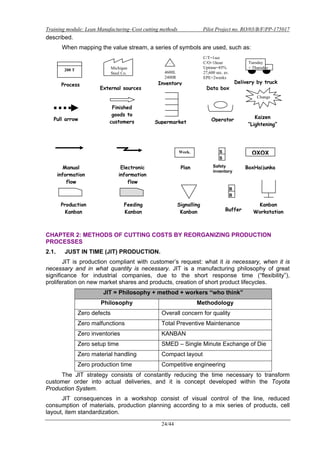
       The stream value map is a visual representation of the value stream, with all aspects
clearly illustrated.
      In the following, it is presented a sample:


      Then, all elements represented in the value stream map are associated with durations
– production cycle time, inventory consumption time, setup time, etc., so that by the end we
should be able to determine the overall time necessary for a product to run through the flow
                                                 23/44
Training module: Lean Manufacturing–Cost cutting methods                  Pilot Project no. RO/03/B/F/PP-175017
described.
        When mapping the value stream, a series of symbols are used, such as:
                                                                          C/T=1sec
                                                                          C/O=1hour                  Tuesday
                                                       I
                                Michigan                                  Uptime=85%                 + Thursday
         200 T
                                Steel Co.            4600L                27,600 sec. av.
                                                     2400R                EPE=2weeks
                                                   Inventory                                    Delivery by truck
        Process
                         External sources                                  Data box
                                                                                                         Change
                                                                                                           d
                              Finished
                              goods to
   Pull arrow                                                                 Operator                  Kaizen
                             customers            Supermarket                                        “Lightening”


                                                             Week.                 S                  OXOX
                                                                                   S

          Manual                     Electronic               Plan             Safety               BoxHaijunka
                                                                               inventory
       information                  information
           flow                         flow
                                                                                            B
                                                                                            B

        Production                     Feeding               Signalling                                 Kanban
          Kanban                       Kanban                 Kanban                   Buffer          Workstation


CHAPTER 2: METHODS OF CUTTING COSTS BY REORGANIZING PRODUCTION
PROCESSES
2.1.      JUST IN TIME (JIT) PRODUCTION.
       JIT is production compliant with customer’s request: what it is necessary, when it is
necessary and in what quantity is necessary. JIT is a manufacturing philosophy of great
significance for industrial companies, due to the short response time (“flexibility”),
proliferation on new market shares and products, creation of short product lifecycles.
                          JIT = Philosophy + method + workers “who think”
                         Philosophy                                  Methodology
                 Zero defects                       Overall concern for quality
                 Zero malfunctions                  Total Preventive Maintenance
                 Zero inventories                   KANBAN
                 Zero setup time                    SMED – Single Minute Exchange of Die
                 Zero material handling             Compact layout
                 Zero production time               Competitive engineering
     The JIT strategy consists of constantly reducing the time necessary to transform
customer order into actual deliveries, and it is concept developed within the Toyota
Production System.
      JIT consequences in a workshop consist of visual control of the line, reduced
consumption of materials, production planning according to a mix series of products, cell
layout, item standardization.
                                                    24/44
Training module: Lean Manufacturing–Cost cutting methods     Pilot Project no. RO/03/B/F/PP-175017
      Just In Time production has two basic principles: continuous production flow and
the “Pull” system.
     Continuous production flow is necessary because batch production is too slow to
answer the takt time requested by the customer, and lead to excessive inventories, which
prevent the detection in due time of the non-compliances occurred during the production
process .
       JIT or processing in continuous unitary flow (item by item), is made in accordance with
the following principles:
        Production is structured as a synchronized chain in which each individual has a
        balanced work volume, as referred to his/her supplier and customer in this chain.
        All individuals finish work at the same time. The product is moved downstream, in a
        synchronized manner.
        Each individual has the power to stop the production process, whenever he/she
        notices a defect.
        The takt time sets the production pace so that it matches the sales pace.
      The total operating time (takt time) is the work time (total of seconds available in a
working day) referred to the volume of necessary products (daily production demand). The
production pace is given by the Cycle time, which is the actual time necessary for a worker
to complete a cycle within his/her process.
       In order to balance the cycle times of various processes, it is used a method called
Heijunka, which focuses on levelling production. Production cells can be created to fit a very
irregular demand. In this case, a buffer of finished products is used to level the production
plan running.
       Manufacturing cells usually entail workstations placed close to each other, arranged in
U-shapes, serviced by multiple-skilled workers, with flexible processes – a product or a sub-
assembly can be produced, multiple ranges of products. Cells can have workstations inter-
related with other work cells or sub-cells, which means that cells become flexible (Shojinka –
flexible production cells), thus, a wide variety of products can be made with basic technology
and unspecialized machineries.
       In cells, the load per worker is flexible, and the number of workers can be modified in
order to adapt the capacity to the necessary of products. Equipment should be flexible
(multifunctional machineries).
      Amongst the benefits of using production cells, we can mention:
        It is allowed the flow of a single item, due to the improvement of the first run of the
        product (enhanced quality due to a quick feedback)
        It helps obtaining a better Kanban
        It reduces the need to move items due to an improvement of the cycle time
        It increases productivity due to unit cost savings
        It signals problems, so that the causes should be quickly and completely removed
        It allows a better use of the floor space.
      Within work cells, teams have increased powers and are self-managed. Supervisors
do not manage the team, but they rather coach, train and motivate it. Teams meet on daily
for 10 – 15 minutes and review the production objectives for that respective day, review
works tasks and assign to team members, special instructions, quality and production
problems, what are the emergency plans in case of non-attendance, reasons for early
leaving of personnel., schedules of extra hours and partial substitutions, daily update of the
weekly situation, major events, such as customer visits. In other words, advanced teams are
involved in member selection criteria, in implementation of the production process, in
                                                 25/44
Training module: Lean Manufacturing–Cost cutting methods        Pilot Project no. RO/03/B/F/PP-175017
evaluating the employees and performance-related problems.
       “Push” production system is a traditional production system, in which the product is
“pushed” through the production process, in batches large enough to satisfy current and
future demands and to compensate for problems that might occur during the process. The
Push System starts with the kick-off of the production based on a plant which is prepared
based on existing orders, but also on forecasted ones (from customers). The specific way of
thinking in this situation is “We make it, they (the management) will sell it eventually!”.
       The market demands determined for some time now, the emergence of a “Pull”
production system, in which downstream processes pull from upstream what they need
and when they need it. Upstream processes then make up the materials consumed. The
product can be pulled through the production system at the takt time, which is at the
downstream limit of the entire process. Finished products are made by levelling production
with the help of tactical buffer inventories collected in a Kanban system of starting processing
processes, a system that offers control over the entire unfinished production inventory
existing on the flow.
       The “Pull system” starts when the customer purchases products, in case of repeated
orders or when the customer places an order for a new product. This system focuses on the
idea “If they demand it, we shall produce it”.
       The “pull” system allows small batch production. Thus, inventories are reduced by
minimizing the number of Kanban card on the flow and the production enters a continuous
flow, with continuous movement of small batches of material or of the production obtained.
       Small batch production has many advantages, because it reduces inventories, requires
less floor space, hence smaller capital investments, brings processes closer to each other, it
makes easier to detect quality problems, and it creates interdependency between processes.
      Other advantages are given by the reduction of the setup time. Small batches require
shorter setup, thus the setup times can be reduced from hours to minutes. For this purpose,
Shingo developed the SMED (Single Minute Exchange of Dies) system, in which tool
changeovers are made in less than 10 minutes.
      According to the SMED principles, in order to cut setup time it is required:
        To separate the internal setup from the external one.
        To transform the internal setup into external (off line).
        To rationalize all setup aspects.
        To carry out setup activities simultaneously, until they are completely removed.
       Here are several setup reduction techniques: presetting the setups required, use of
quick fastening devices, use of locks, prevent non-alignments, eliminate certain tools,
interchangeable sets, easier movements, etc.
      Small batch production requires mix series of products. JIT allows simultaneous
production or assembly or a series of distinctive product using the same production
equipment. This is known as production in mixed series of products such as: A A B A A C A
A B A A B A A C A A B A A C A B, or other similar.
     The result is the repetitive flow production, against the traditional, large batch
production. The production in mixed series requires smaller batches and shorter setups.
       Launch of production plans the manufacture of the same mixed series of products,
every day, during a certain period of time, or different sequences of mixed series. Machine
load can be changed from one month to another, but it shall remain the same each day of a
certain period of time, which allows simultaneously meeting several orders and reducing the
inventories of finished products.
      Here are several application principles for the production in mixed series:

                                                 26/44
Training module: Lean Manufacturing–Cost cutting methods      Pilot Project no. RO/03/B/F/PP-175017
         Redundancy of orders should present certain amount of regularity. This type of
         production is specific only to repetitive orders.
         The method called „generic Kanban” controls variations in order volume for the
         mixed-mode production. The generic Kanban represents a fixed amount of work (e.g..
         8 hours) which is used to achieve the daily plan of mixed series that must be
         produced.
         The system must be dimensioned so that to respond automatically to volume
         variations, by adjusting the number and rate of Kanban cards.
2.2.     KANBAN SYSTEMS.
      Kanban is the generic name that refers to a signalling system that uses cards through
which it transmits information regarding the necessity to replenish a workstation. The Kanban
system correlates all operations on the production flow by means of cards, signals, buffers.
For a good functioning of the Kanban system, the card signalling system is used
simultaneously with a Kanban area or other methods of the same category.
        There are two main functional systems for Kanban:
           1. The system with a single card: Production Card
           2. The system with two cards: Transportation Card and Production Card.
      The alternative forms of the Kanban functional system, which can be used according to
the particulars of the production process are:
       Two-bin: is the method of using a bin as a buffer in the production process and a bin for
       transportation, While the buffer is being consumed, the empty bin is transported to/from
       the upstream workstation, for replenishment with items for the next consumption. In
       case of larger productions or unitary flows, this method offers the “Kanban area”
       alternative, which means visual delimitation of the floor space in which the product can
       be placed. As a convention, if the Kanban area is not empty, the upstream workstation
       cannot be replenished.
       CONWIP (Constant Work in Process): represents the constant quantity of products
       on the line, for a single technological line, regardless the mixes series of products
       (production is levelled, the quantity of product on the line does not vary).
        “Bucket Brigade”: is a self-organized team work method. Tasks are divided
       (approximately) proportionally along a line that is almost 100% manual, usually
       (assembly, packaging, delivery of orders), with a number of “stops” (workstations)
       exceeding that of the team workers. Workers move along the line and carry out a part of
       the tasks in a single way / forward. When the last worker finishes its task, he/she moves
       upstream and takes over the tasks of his/her predecessor; in his/her turn, the latter
       slides upstream and does the same thing, and so on. It is not allowed to skip a
       workstation and workers are lined up from the slowest (the beginning of the line) to the
       fastest (the end of the line).
       The advantages of using bucket brigades come from the fact that it represents a very
simple and self-organized way of dividing work in a team in which members’ performances
are relatively distinctive. Lines are automatically balanced without loosing pace and the
maximum productivity is obtained, with a minimum unfinished production, with no jams on
the line. Thus, it is obtained maximum production, at the level specific to the fastest operator
(the last one on the line). By comparison with areas of normal assembly, due to the better
production rate, this method determines an increase in productivity by 30%!


                                                 27/44
Training module: Lean Manufacturing–Cost cutting methods        Pilot Project no. RO/03/B/F/PP-175017


      The method is applicable especially to assembly lines and to large volume goods (as
orders are received during the entire process).
      The method was created based on the organization model observed at the level of the
work behaviour in bees and ants. (Bartholdi, 1995)
     Generic Kanban: controls variations in the volume of orders for mixed-mode
     production. Generic Kanban is the fixed quantity of work (e.g. 8 hours) used to achieve
     the daily plan of mixed series that must be produced.
       Kanban signalling systems are quite complex processes, which require sustained
efforts to dimension and verify the solutions selected by testing and repeated improvements.
This module is an overview of the main concepts on which Lean Manufacturing, as
production cost cutting method, is based; in order to perfect these methods, you should
contact the Association of ROMANIAN LEAN EXPERTS, (www.lean.ro).
Example of Kanban calculation model
How many Kanban cards are necessary in one cycle?
                              AD(WT + PT )(1 + SS )
Number of Kanban cards=
                                     CQ
      Where,
        AD = Average daily demand
        WT = waiting time by the workstation
        PT = processing cycle time
        CQ = container quantity
        SS = safety stock
Example of calculation
        Average demand = 1000 pieces / day
        Processing time = waiting time = 1 hour (= 1 hour / 8 hours = 0,125 days)
        Container volume = 50 pieces
        Safety stock = 0 pieces
                Number of cards = [1000 (0.125 + 0.125) (1 + 0)] / 50 = 250 / 50 = 5
Example of setting the minimum batch level
Hypotheses:
A cupping press should process 3 marks in 2 shifts daily. From mark 1, 150 units per day
must be produced, mark 2 - 270 units per day, mark 3 - 100 unit per day. The processing
cycle time = 1’ per piece. The production changeover time (setup) for each mark is of 45 min.
each. Kanban measure = 10 for each type.

                                                 28/44
Training module: Lean Manufacturing–Cost cutting methods        Pilot Project no. RO/03/B/F/PP-175017
Calculation:
       Available setup time = working day (16h) – total operating time (520 min.) = 960
       – 520 =440 min.
       Max. no. of daily setups = available setup (440 min.)/(45 min.) = 9.8 setups/day
       If each day 3 types of marks must be produced, then the max. no. of setups
       available each day = 9.8/3 = 3.26 setups
       Batch size for mark1 = B = D/S = 150/3.26 = 46 pieces (=> 5 kanban)
       Batch size for mark 2 = B = D/S = 270/3.26 = 83 pieces (=> 9 kanban)
       Batch size for mark 3 = B = D/S = 100/3.26 = 31 pieces (=> 3 kanban)
These numbers should be rounded off to a kanban unit, by adding or subtracting, according to
experience and level of discipline in the enterprise.


2.3.    JIDOKA
     JIDOKA means quality incorporated. The method consists of automatic stopping a line
when errors are detected.
       Here are several grounds taken into consideration when applying this method:
machineries are not that intelligent to be able to work and stop by themselves; people are
served by machineries, not the other way around; quality is incorporated, not inspected;
efficiency – human efforts are separated from machine work, people are free to carry out
the value adding work.
2.4.    POKA YOKE
      POKA YOKE is a method used to prevent occurrence of accidental errors in the
manufacturing process. The method is used to detect errors, to prevent errors and it
represents a way of obtaining zero defects
2.5.    SINGLE MINUTE EXCHANGE OF DIE (SMED).
      Is an industrial engineering method to reduce setup time. It is based on the SMED
(Single Minute Exchange of Die) method, invented by the Japanese engineer Shigeo Shingo.
      SMED is an industrial strategy which is currently applied in many developed
companies. Due to SMED, position on the marked is strengthened, by continuously
improving quality, efficiency and increasing flexibility. Flexibility, or response time to changes
in the market demand, is characterized by flexibility in innovation, flexibility of the product
mix, volume flexibility.
      The obstacles in the way of production flow, which, in order to be modern and flexible
should "flow", can be: batch size, unbalanced processes, uncontrolled processes, errors-
defects in products, lack of multifunctional personnel, lack or raw materials.
      The basic methodology in cutting the setup time is characterized by 4 basic activities:
preparation for setup, change of tools / parts, setup / adjustment, readjustment:
Type of activity       Details
Preparation for        Bringing and warehousing components and tools, cleaning the
setup                  machinery, transportation from point A to point B during the setup,
                       administrative aspects (sheets to fill in, authorizations), maintaining
                       tools, etc.
Change of tools /      Technical activities, including the removal of a part from a machine and
parts                  the mounting of new part on the machinery (new parts necessary to
                       manufacture a new products, as well as parts removed in order to carry
                                                 29/44
Training module: Lean Manufacturing–Cost cutting methods         Pilot Project no. RO/03/B/F/PP-175017
                       out other activities, and which afterwards are mounted again, such as
                       protection housing).
Setup /                Changing machine parameters to the specific value, in accordance with
adjustment             the new specifications of the product (temperature, height, width, speed,
                       etc.).
Re-adjustment          All activities that must be carried out because the setup / adjustment
                       was not adequate at the first operation (trail operations, fine tuning,
                       control of test products, etc.). The quality of the basic setup / adjustment
                       activity can determine the number of re-adjustment activities necessary.
Perturbations /        Represents all activities occurring during setup, but which are not
problems               considered “normal” setup activities. They are activities which are not
                       normally included in setup instructions, such as: searching for tools,
                       technical errors, activities that must be repeated because of incorrect
                       sequences of activities (e.g. the operator forgot a part and must
                       dismount and remount a component.

      When applying SMED, it should be taken into consideration the mixed (existing)
phase, the separation phase (identifies and separates activities that must be carried out
when the machine is idle / operates – online / offline), transfer phase (converting activities
carried out when the machinery is offline into activities that can be carried out when the
machinery is online) and the improved phase (cutting activities that must be carried out when
the machinery is offline).
      Mix (existent) phase is the phase in which the following situations may occur:
             The process is stopped during the entire setup time
             There are no setup instructions and various setup methods are used
             There is not distinction between online / offline
             Tools and accessories are not maintained, inspected, prepared and warehoused
             adequately
             Setup is made by trials, reason for which errors occur
             Several readjustments are made for trail products (setup operations).
       Phase of separation of online from offline is applied after video / photo records are
made, it is analyzed the setup, various activities, movements, parties involved, accessories,
etc.; all activities are identified and divided into ONLINE activities (internal – made while the
machinery is idle) and OFFLINE activities (external –made while the machinery is operating).
Checklists are made for the preparation phase, as well as for all tools, accessories, parts
necessary for the machinery during the setup operation. Then, each identified activity is
analyzed by asking the question: “Must the machinery be idle for this activity or not?”
       Transfer phase (transforms Online activities into Offline) consists of applying the
solutions found upon studying the checklists regarding activities, parties, accessories, etc.,
standardizing and homogenization of activities, assigning personnel when the time comes.
Other necessary actions: determining the technical adjustments before starting the setup by
mounting accessories, brackets and devices, by assembling and previously adjusting
machinery components, using modular machinery components.
      Improvement phase (Online / Offline reduction) consists of minimizing the two
types of activities (online and offline). These activities can be minimized by
             Eliminating activities by modifying the technical blueprints of the machinery /
             product / dies / devices, standardizing components, etc.
             Using a functioning (quick) gripping
             Using electrical and pneumatic tools
                                                 30/44
Training module: Lean Manufacturing–Cost cutting methods     Pilot Project no. RO/03/B/F/PP-175017
             Using universal machinery parts
             Using hydraulic, pneumatic or electromagnetic gripping
             Using adjustment brackets such as guides, templates, stops, digital reading,
             verniers, step-by-step engines
             Improving measurement and calibration methods, by using product control
             methods
             Eliminating trial operations
             Using simultaneous work
             Using traditional organizational techniques.
      Offline activities can be minimized by:
             Carrying out setup kits
             Improving transportation and storage of machinery sub-assemblies and tools
             Using traditional engineering techniques
      The phase is considered improved when:
             Online / Offline activities are minimized
             Hydraulic, pneumatic and magnetic gripping devices had been introduced
             Auxiliary adjustment devices are available.
             There are setup kits, the standard setup method is established, as well as the
             setup instructions
             Setup is simplified; special skills, such as the requirements that the setup be
             carried out by operators, are no longer necessary
             Activities can be carried out in parallel
             Trail and re-adjustment operations are carried out immediately, the standard
             setup time being short
      The effects of SMED improvement are materialized in reduction of the product
(series) changeover time, short term productivity, increased machinery capacity, elimination
or setup errors, improvement of quality and safety, increased flexibility of material means, but
also of operators, simplification of systems, models .
     “Make the same setup 3 times; if you obtain 3 times the same results, then there are
no more problems; if you obtain only 2 positive results, the change the method.” (Shigeo
SHINGO)
      Consequences of applying SMED to a production system can be:
             Cutting the setup time necessary and, accordingly, cutting the time necessary to
             pass from one mark to another
             Improving the capability of the processing cycle of the first mark made
             (standardization of the first setup)
             Improving repeatability of production changeover and setup operations
             Meeting variable market demands, by ensuring several variants of the same
             product, even when the demand is for small quantities
             Short innovation time, quick adaptability to new or modified products
             Short and precise delivery time, high quality despite the frequent setups
             Small or zero inventories
             Lean Production: the customer pulls the products from the flow.
                                                 31/44
Training module: Lean Manufacturing–Cost cutting methods     Pilot Project no. RO/03/B/F/PP-175017
      In order to apply SMED in an organization, it is required a downwards approach and
management’s commitment, which should set the project goal: the desired setup time, the
average setup performance to be achieved. The project team must be also created, including
the production manager, product specialist, mechanical engineer, production supervisor,
technical and maintenance personnel, machinery operators, machinery settler-ups.
2.6.    STANDARDIZED WORK
     Standardized work reflects the best practices and represents the basis for continuous
improvement. Here are several thoughts of Henry Ford on work standardization:
“To standardize a method is to chose out of the many methods the best one, and use it.
Standardization means nothing unless it means standardizing towards improvement”.
"Today’s standardization, instead of being a barricade against improvement, is the necessary
foundation on which tomorrow’s improvement will be based".
"If you think of “standardization”, the best that you know today, but which is to be improved
tomorrow – you get somewhere. But if you think of standards as restrictions, then progress
stops.” Henry Ford, 1926, Today & Tomorrow
      Reference documents necessary to implement the elements that lay at the basis of
work standards shall be drafted for each operation / sequence of work operations, shall be
posted at the workplace in visible places and shall be debated and developed together with
workers.
2.7.    TOTAL PRODUCTIVE MAINTENANCE (TPM)
      TPM (Total Productive Maintenance) is an approach structured for maintaining
manufacturing equipment and ensuring stability of the production process. Equipment
maintenance according to a precise schedule shall allow it to function long periods of time
without unplanned shut-down, fewer quality problems in the production process. This way,
the conditions necessary for full exploitation of the Lean production (optimal rate production)
are obtained.
     The maintenance of the production process must be ensured in order to cut the costs
caused by:
             Waste generated by various unexpected breakdowns
             Waste generated by setups and adjustments
             Waste caused by inactivity and minor shut-downs
             Quality flaws and reprocessing
             Waste generated by low speed
             Waste associated with the start of a new production process.
      TPM means first hand maintenance carried out by operators. Cleaning also means
inspecting screws, nuts, lubricating, filters, cracks, etc. When preparing the standard
maintenance plan, it should be started with the 5 S, a method which is still approached. TPM
includes preventive maintenance (scheduled on monthly, annual basis, on analyses of
previous breakdowns / history data; in order to ensure it, spare parts should exist in
warehouses) and predictive maintenance (which is carried out based on the control of
working conditions – vibrations, oil analysis, noise and temperature measurement,
maximizing equipment effectiveness - OEE).
2.8.    5 S AND VISUAL MANAGEMENT
      5 S or visual factory – Andon is “the capacity to understand the status of a production
area within 5 minutes or less, through a simple observation, without using computers and
without talking with anybody.”
       5 S helps improving productivity, represents the basis for all improvements, supports

                                                 32/44
Training module: Lean Manufacturing–Cost cutting methods           Pilot Project no. RO/03/B/F/PP-175017
positive motivation of employees, it ensures a pleasant working environment, less quality
problems, it improves company image.
         5 S represent:
 Japanese             English                    Definition                        Example
 Seiri           Sorting and          Sorting and eliminating              Throwing away scraps,
                 Filtering            unnecessary elements                 waste
 Seiton          Systematized         Clear arrangement and                Finding an object in
                 Storage              identification                       maximum 30 seconds
 Seiso           Shine, cleaning      Daily cleaning and inspection        Individual cleaning
                                                                           responsibilities
 Seiketsu        Standardization      Rules continuously                   Transparent storage
                                      communicated and observed
 Shitsuke        Sustaining           Motivation to maintain the           5S applied daily
                 change               level reached

      In order to implement the 5 S, it is required the preparation for application, initial audit,
education, execution of the 5 S, improvement. 5 S is NOT an activity of several weeks; in
order to give results, it is required a continuous implementation, during the entire life of the
company, of the 5 principles: sorting, systematizing, shining, standardization and sustaining.
      Preparation for application consists of defining the adequate culture for the
company, designating the coordination group, raising management’s awareness, setting the
goal and the duration of the project, assigning work areas and responsibilities. A pilot project
should be developed, containing the implementation plan + available and necessary
resources, setting a slogan to catch personnel’s attention, presenting results through notice
boards.
      Initial audit includes the audit sheet, assignment of the audit team, start-up level,
objectives to be accomplished, taking pictures from a fixed spot.
      Then, it is required training, education of all individuals involved, by using images of
the organization. First improvement proposals should come from the public and should be
put into writing, as well as all the questions and existing doubts. The pilot project
implementation plan should be discussed with those who should put it into practice.
         Execution of the 5 S: sorting, storage, shining, standardizing, sustaining, safety.
       Sorting is a method of freeing floor space at the workplace and eliminating all
unnecessary objects, such as schedules, test parts, drawings, old or broken tools,
accessories, unused materials, etc. The sorting process has impact at the level of the way of
thinking of the workplace, eliminating the syndrome “it works this way, too”.
      Techniques used: Colour labelling unnecessary objects, according to the operations to
be executed. Labelled objects are moved to a storage place, where it shall be assessed their
usefulness for other workplaces. Unnecessary objects shall be returned to those who
brought them, shall be warehoused, sold, given away or simply thrown away. “Garbage”
areas shall be created.
     Result obtained: less time necessary to search for parts and tools, increased safety,
improvement of productivity and quality.
       Storage means establishing locations (boundaries). The second step of the 5S refers
to placing in order those objects that are necessary at the workplace, so that they should be
easily found / identified, and in a logical order, to facilitate their use. Fixed locations, such as
containers, modular shelves, cabinets with transparent doors , boards, painting floors along
access paths, trash cans for all kind of materials and tools; they should be stored according
to the rate at which they are used. As long as their location is easy to understand by
                                                 33/44
Training module: Lean Manufacturing–Cost cutting methods      Pilot Project no. RO/03/B/F/PP-175017
everyone, abnormal situations shall be noticed immediately.
       Shining means initial cleaning and the cleaning of everything representing the
workplace: floor, machineries, cabinets, etc. All sources of dirt should be detected, leakages
should be mended, sufficient cleaning materials should be provided at the each workplace.
This is the only way to ensure product quality and people’s safety.
      Standardization means maintaining the situation reached by establishing rules, habits
and standard procedures. Standardized work is obtained by finding the best work methods
from various people, for the same machinery or work bench; by using standardized
equipments, such as containers, files of different colours, etc.; by posting standard works
procedures to notice boards (visual management); by using checklists.
       Sustaining seeks to ensure discipline and everyone’s commitment to maintain the
results obtained. If change is not sustained, everything can quickly revert to a situation
similar to the initial one. For the 5 S method to be successfully implemented, improvements
should not be launched all at the same time. It should be developed an environment in which
continuous improvement culture represents the standard. Initiatives should be encouraged
and rewarded. Time should be allotted to the involvement in improvement, as this is possible
only with the cooperation of all employees involved in the implementation of the pilot project.
Management’s commitments should also exist, encouraging training actions for participation
of employees to 5 S, communication of all actions and results of the audit of the 5 S. In order
to carry out the audit, audit teams should be formed of members from various departments,
who shall carry out inspections on regular basis (the shift or team leader shall carry out daily
inspections, the section head shall carry out weekly or monthly inspections and the top
management shall carry out inspections on quarterly basis).
      A six S is Security and safety at workplace, which are ensured by using adequate /
adequately marked tools, using protection equipment, where necessary (overalls, gloves,
goggles, masks, helmets, etc.); by maintaining access halls free; by storing protection
equipment in preestablished and easily accessible places. Care should be given to check
whether material is spread on the floor, unlevelled floors, sharp corners, unmarked
suspended stocks.
       Therefore, the 5 S does not mean only cleaning, but also organization and safety at
the workplace, marking, labelling, audit to determine progress and maintain the improved
results.
      5 S benefits are:
             Increased productivity due to an increase in product and process quality,
             elimination of the time spent searching for tools, reduction of idle machinery
             time, faster identification of problems
             Improved safety at workplace
             Quick identification of nonconforming products or workplaces
             Raising employees’ morale, introducing best practices, promoting better
             communication at workplace, delegating responsibilities to improve the
             workplace.
       Visual management allows signalling that conditions which can lead to a abnormal
situation, so that is should be possible to apply corrective actions.
      Examples of abnormal situations: an operator does not apply work instructions,
continuous setup of a machinery, job ticket found on the floor, several shelves found empty
in the warehouse, products that are not delivered on time to the downstream workstation,
container in an unlabelled area, lack of cleaning, too many stocks at a workstation, an
operation who sorts items prior to processing or who waits, etc.
      Implementation of visual control signals refers to:
        Boards recording the production achieved, excluding the production planned
                                                 34/44
Training module: Lean Manufacturing–Cost cutting methods      Pilot Project no. RO/03/B/F/PP-175017
        Clear marking of the places where interoperational stocks can wait
        Workstation indicators, product delivery and storage indicators
        Pictures / drawings and information to identify finished products
        Board recording results, as well as the operator who achieved them
        Maintenance schedules
        Performance indicators, quality indicators
        Work instructions.
      Type of signals in the production department: red, orange or green flashing lights,
warning sound signals, noise caused by operating machinery, etc.
      The visual management is based on the definition of some indicators, which the entire
company personnel should know and understand. These indicators can be grouped into five
(or six) categories known as 5 M or 6 M: manpower (operators), machinery materials,
methods, measurements and medium (organization).
      Due to the visual control, clear information can be interchanged immediately between
operations and management levels.
CHAPTER 3. IMPLEMENTATION OF IMPROVEMENTS
      In Chapter 1, in which are presented various methods for collecting and analyzing data
necessary to cut costs, we presented concepts regarding the value stream mapping in its
current state and several types of analysis to help us determine the current situation of the
company we manage or whose employees we are.
      Upon analyzing the current state and determining the analysis results, we can find
improvement solutions, by applying the methods presented in Chapter 2. In this chapter, we
shall approach the implementation of the changes necessary to obtain the objectives
planned.
3.1.    FUTURE VALUE STREAM MAPPING
      The objectives set are defined by mapping the future value stream. The guidelines to
create such a map up to the future state are based on the observation of the following
recommendations:
        Always producing at the takt time.
        Develop a continuous flow, wherever and whenever necessary
        Use supermarkets (buffer stock) to control production where a continuous flow cannot
        be extended upstream.
        Try sending customer order only to the leading production process.
        Distribute the manufacture of various products uniformly in time, starting with the
        process that gives the production pace (leading process).
        Create an “initial pull” to release and pull small and homogeneous batches of items
        towards the leading process (instead of releasing large batches of items).
        Develop the ability to make “each product in each established period” in the
        processes upstream the leading process.
       In order to develop the future state, information should exist on several key aspects:
product manufacturing, materials flow, information flow, improvement support, by
finding answers to the following question.
               What is the takt time for the product family chosen, according to the size of the
               demand?
       The takt time is given by the ratio between the available production time per shift and
                                                 35/44
Training module: Lean Manufacturing–Cost cutting methods              Pilot Project no. RO/03/B/F/PP-175017
the rate of consumer demand per shift. For example, if for the manufacture of an automobile,
we establish that the takt time is 3600 sec / 45 parts = 80 seconds. This means that a
customer shall buy an automobile every 80 seconds. This is the target pace for
manufacturing an automobile and its components.
               Will you choose a finished product supermarket from which the customer shall
               receive the products?

        Example: Making a Supermarket
                                                     Demand


                Process                              Delivery


               Will products go directly to delivery?

            Example: Making direct deliveries

                                         Customer demand


               Process                                     Delivery


               Will the flow be continuous?
      Continuous flow means that there are no intermediary stocks.
                  Assembly                      Control                        Delivery

                                  FIFO                          FIFO                         Custo


                                             FLOW

               Where can continuous flow process be used (materials continuous flow?
               Where should a “pull” supermarket be used in order to control the production in
               the upstream processes?
     Usually a supermarket is required to control production where the continuous flow
cannot be extended upstream.
               What single point of the production chain (leading process) should be
               scheduled? Where is the information flow from the customer first received?
        It is advisable to try sending customer orders only to one of the production processes
(usually called leading process). This way it is scheduled only one point of the information
flow “from order to delivery” – this point is the leading process. Material transfers from the
leading process downstream, to the finished production should take place in a continuous
flow. The leading process is that process of the product flow which is located closest to the
upstream of the “order to delivery” flow. The manufacture of product is then distributed
uniformly in time, downstream the leading process, at a preestablished pace. Thus, an initial
“pull” is created, by releasing and pulling small and homogeneous batches of items from the

                                                 36/44
Training module: Lean Manufacturing–Cost cutting methods        Pilot Project no. RO/03/B/F/PP-175017
leading process, instead of working with large batches of items.
Example of calculation
If the takt time is of 30 seconds, and the size of a container is of 20 pieces, then:
            Pitch = 30 sec x 20 pieces = 10 minutes
Thus, every 10 minutes:
    a) the leading process receives an order to produce the quantity corresponding to a
       package / container
    b) delivers the quantity of a package, finished.
If the pitch is currently of 20 minutes, then each product is made 3 times an hour.

3.2.    SYSTEM OF LEAN INDICATORS
       In Chapter 1 – METHODS FOR GATHERING AND ANALYZING DATA NECESSARY
TO CUT COSTS, one of the objectives studies was the Lean assessment with the help of
certain Leans specific aspects. Another way to answer the question "How Lean we are?", is
the Lean assessment with the help of the system of Lean indicators.
     For starters, let’s see what possible results can be obtained by applying Lean in the
production system. Some results aim at:
               Reducing to half the working time, finished products flaws and floor space,
               obtaining the same results
               Reducing 10 times the unfinished productions
               Savings made by implementing the suggestions made by the employees
               Intangible benefits: raising employees’ morale, increasing work discipline,
               stronger cohesion between company departments, increasing customers
               satisfaction and their trust. Source: The Machine that Changed the World,
               Womack and Jones, 1990
       By measuring the indicators, we can determine the degree of improvement of
performances. The Lean indicators are total productivity, partial productivity, efficiency and
effectiveness, presented in Chapter 1.
       The system of Lean indicators can also include:
        Value of current inventories on the production flow
        Duration of depletion of inventories on the production flow
        Total production time (value adding time)
        Lead time
        Delivery time
        Useful operating time
        Overall equipment effectiveness (OEE)
        Number of defects in a million
        Number of good products from the first try
        Balanced Score Card
        Speed of turnover.
     In order to identify the system of indicators necessary to perform a Lean assessment,
we must:
                                                 37/44
Training module: Lean Manufacturing–Cost cutting methods       Pilot Project no. RO/03/B/F/PP-175017
        Involve the individuals responsible with change implementation in the production-
        specific activities
        Ensure collection and update of data, whenever necessary
        Ensure data collection where it is most useful
        Communicate data to those who need them, to the individuals who can make things
        work
        Achieve an easy data collection and trustworthy procedure.
       Method to establish the Lean indicators:
        From the general list of indicators, it is established a list of indicators that correspond
        to customer-related objectives or to other improvement objectives to be applied to the
        current plan
        Insuring the launching of the dialogue with the chain of command, up to the highest
        level and back, in order to know for sure that this list is necessary and accepted by
        the entire chain of command.
        Determination of a precise way of measuring the indicators.
        Collect current data at the workplace. Assumptions should not be used.
3.3.    TRANSITION TO A LEAN ENTERPRISE
       In order to transform the traditional enterprise into a Lean enterprise, we should take
into consideration the differences between the “push” production processes, where activities
are not correlated, nor directed, and the Lean enterprise processes, where activities are
correlated and directed, as well as the cultural differences, in order to meet the standards
and discipline specific to the Lean enterprise
       The traditional culture is characterized by the fact that instructions come from up
downwards in the organization, and the responsibilities are assigned especially to upper
levels. Other features: discontinuous improvement of processes, due to the fact that
inefficiency rules, limited communication of the financial problems of the company, limited
personal and professional satisfaction, existence of boundaries between positions.
      The culture in a Lean enterprise is different by the fact that decisions are made at all
levels (within clearly specified limits), the personnel is involved in continuous quest for
perfection, it is dedicated and participative, proud to belong to that respective organization.
The financial aspects of the company are known in detail by entire personnel, labour offers
professional and personal satisfaction and there are no boundaries between positions.
      If we decided to apply change management to switch to a Lean enterprise, then we
should begin by executing the improvement plan. Change does not always mean success! At
the beginning, more than 50% of the implementation team efforts are condemned to failure.
Almost 90% of production process redesign efforts have no results, because there are
common errors/problems within various types of change methodologies.
       The recipe for a successful change resides in the three key factors that should be
present in change as well as in transition: pain (is a mandatory reason for change,
dissatisfaction with the current state), vision (a clear vision of the future situation wanted)
and step-by-step action (an understanding of the next steps necessary to advance towards
that respective vision).
       Here are several theories on change and progress assessment, which should be taken
into consideration when we decide to apply the transition to Lean production:
        Clear definition of the need for change – this should guide and serve as basis /
        reference for future actions
        Defining the mission, vision and other unique and specific performance key areas

                                                 38/44
Training module: Lean Manufacturing–Cost cutting methods    Pilot Project no. RO/03/B/F/PP-175017
        Understanding the equivalent finality: there are many ways to achieve the final result
        wanted
        The will to accept the “project” (the chosen path) and to make all endeavors for an
        efficient implementation / execution
        The process can be as important and the finished product itself – negotiation of the
        property against product quality
        The role of learning by trial and error.
      Enterprise Engineering and Research Laboratory of the Industrial Department and
Systems Engineering of Virginia Technologies, Blacksburg VA (USA), developed a
transformation methodology, as a tool for managing transformation and organizational
change efforts.
      The transformation methodology is based on the understanding of the need for
change, of the analysis of the current state and design of processes, systems and
transformation structures. The transformation methodology consists of setting the direction
for change, defining development initiatives, in carrying out and implementing initiatives, in
reviewing progress and results, and in creating the infrastructure for change.
      Need for change: the starter of the need for change is the "burning platform", which
defines “what must be changed, improved”.
       The need for change can be initially caused by the existence of an opportunity or
threat; this can be an important urgent event or a slow decline. The change releasers can be
related to internal factors, such as people, processes, technology, etc., or external factors,
such as customers, competition, company, regulations, etc.
      The organizational change cannot begin until the management acknowledges and
creates a common vision of the need for change, which should be more important than costs
and uncertainty.
      Analysis of the current state aims at creating a clear and common vision of the
“target system” in the unit analyzed, of “what we do” and to provide input for change and
improvement planning, by creating a clear and common vision of “where we are today”. The
tools used to define the target system can be the analysis of inputs/output, analysis of
mission – goal + value added.
      The goal analysis defines why we exist, what we do, in what business we are involved.
      The value added analysis defines the manner in which we add value to the business
and customer, while achieving our goal.
       Design of processes, system and transformation systems can include structuring
of a team to make the change and the appointment of a management team, as agent of
change and improvement, setting the project team, executing a performance measurement
form, training (education/preparation) actions, assurance of communication tools, etc.
       The role of the managerial team consists of defining the “burning platform” (the need
for change), defining and communicating the vision and the direction, which is the key
performance field of the organization. The managerial team identifies the global strategies to
execute the vision and uses performance measurement to evaluate organization’s progress,
it makes available the resources necessary and supports the change efforts, setting
directions, guidelines, feedback and approvals for the improvement teams created.
      A strong management is essential for an efficient change and consists of defining
management from a perspective focused on conduct, search for competitive change
opportunities, growth, innovation and improvement, experimentation and assumption of risk
and learning from inherent risks.
     Leadership’s role in change is to offer the other the possibility to act, to encourage
cooperation, to trace the path, offer examples, motivate, acknowledge individual
                                                 39/44
Training module: Lean Manufacturing–Cost cutting methods     Pilot Project no. RO/03/B/F/PP-175017
contributions, celebrate team’s accomplishments.
      The change agent’s role consists of making available resources, knowledge, tools and
feedback to the groups and individuals involved in change, so that to make change and
progress possible.
        Definition of vision and values: vision defines the future state wanted, describes
something that is not present. Vision can be focused on products / services, customers,
technology, etc. and it can describe changes in products/services, customer, technologies,
etc. A vision should be unique for the organization, specific, inciting, but also feasible.
Values are principles, rules, norms or accepted conducts, according to which we chose to
live, to make decisions.
      Definition of the key performance areas: the key performance areas are the fields in
which we excel, thus offering a “bridge” between mission and vision. Key performance areas
have as mission the goal and the values added and the vision. They must be unique for the
“target system”, balanced and comprehensive, they must offer a focus tool, which should
change with the mission, vision and environment.
        Team’s pact defines what makes the team and how. It serves as contract with
sponsors/leaders and it must be a live document, updated whenever it is necessary, used to
guide the team. A clear and comprehensive pact can help the team pass quickly over the
initial phase and to create the conditions for success.
      General checklist for the team’s pact:
        Mission/goal: defines the reason for which the team exists.
        Objectives/results: represents what the team does to accomplish objectives
        (outcomes, products, plans, etc.).
        Sponsor: defines the person who gives the team responsibility, guidance, approval
        and/or resources.
        Limits: define the goal and area, constraints, limits or parameters for making
        decisions.
        Indicators: define success.
        Membership: defines who is parts of the team (permanently, by turns, ad-hoc).
        Team processes: defines how the team will operate (meetings, decision-making
        processes, interaction with other groups/teams).
        Team’s principles: defines the team rules regarding acceptable behaviour from its
        members.
        Team roles: define the roles within the team.
        Team self-evaluation: defines the manner in which the team will evaluate and
        improve performances.
       Progress: in order to know whether we evolve, we should initiate a performance
review process, we should improve and update action plans and we should learn from
mistakes. Learning by means of performance analysis sessions helps finding the answers we
look for:
        What is the current performance level of final result indicators and of management
        indicators?
        Is there a disparity between the expected and the real level?
        Are the results obtained good, bad, improving, or worsening?
        Are the data collection procedures, measurement schedules and analysis procedures
        satisfying?

                                                 40/44
Training module: Lean Manufacturing–Cost cutting methods        Pilot Project no. RO/03/B/F/PP-175017
        What did we learn about management indicators?
        What initiatives do we have to improve performances? Is it necessary to adjust
        initiatives or action plans?
        Were there actually communicated the results, problem causes, plan adjustments,
        new teachings and needs for resources by using multiple channels?
       In order for answers obtained to be clear, and to eliminate the possibility of falsifying /
interpreting, it is essential to standardize the tools and reporting forms.
      In conclusion, the performance analysis process is made of the analysis of final results
indicators, analysis of management indicators, breakdown of indicators according to the
points of interest and tracing of the action plan.
       Evidence of the evolution towards Lean: we can say that the Lean Manufacturing
method was successfully implemented in the production process when the production
process is characterized by smaller batches, shorter lead times with whom we obtain
increased production capacity with better results, faster speed of turnover and lesser
inventories of raw materials, semi-finished and finished products. When larger areas are
available to better organize the workplace, increased quality by reducing scraps,
reprocessing and higher efficiency. When the value stream is optimized, systematic
preventive maintenance assured, so that setup should not constitute a problem. Assurance
of visual control efficiency, to obtain a predictable and consistent quality, improved
participation of the personnel and its high spirits.
    CASE STUDIES, EXAMPLES
Example of Work Sampling application
- How much per cent of the time is a warehouse personnel actually involved in
  loading/unloading materials?
Exercise: A manager wants to evaluate the time that the individuals in a warehouse use to re-
label prices on merchandise. The manager wants an accuracy of 98%, so that the result
should comply with the 5% error limit, referred to the real value. What number of
observations is necessary?
e = 0,05                z = 2,33                p=?
It is considered p = 0,5
N = (2,33/0,05) 2 x 0,5 (1-0,5) = 542,89 or 543
From 20 observations, 2 operators were found labelling (p=2/20 = 0,10)
n is recalculated = (2,33/0,05) 2 x 0,1 (1-0,1) = 195,44 or 196
- What is the structure of a team leader’s time?
- How does the staff in office A use time?
Example: an employee solves order entering 8h/day, uses 85% of time, must processes 150
orders at a 100% rate.
 In order to assess the efficiency of an employee, it is determined the standard time:
                            Total time.(%) × Rate% 480' × 0,85 × 1
           - Normal time =                         =               = 2,72' / order
                            number of orders input      150
           - Personal time 10 %
           - Standard time:
                                  Normal time × 100 2,72' × 100
                   Std . time =                    =            = 3,02' / order
                                   100 − Reward %    100 − 10
                                                 41/44
Training module: Lean Manufacturing–Cost cutting methods                Pilot Project no. RO/03/B/F/PP-175017
- How much per cent of the working time do nurses use to attend patients and how much
  for administrative tasks?
- How much per cent of time are the pillars used (with/without load)?
- Who uses transportation equipment?
- What is the average number of individuals who wait at the A window?
- How much per cent of the time is the A machinery shut-down?
Example of visual management
Productivity
                    100%


                     80%


                     60%


                     40%


                     20%


                     0%
                           1   2   3   4   5   6   7   8   9     1   11   1   13   14   15

                                                                                             Number of weeks
Example of visual control – Inventories:

                                                                  Green zone


                                                                     Red zone


The visual level for inventories is chosen in such a manner that if the level never reaches the
read area then you have too much inventory (Source: Greif – The Visual Factory)
Example of visual control – Deliveries:


        Monday Tuesday Wednesday Thursday                      Friday
Batches are arranged according to the input date. Delivery delays can be immediately
detected. (Source: Greif – The Visual Factory)

                                                   42/44
Training module: Lean Manufacturing–Cost cutting methods        Pilot Project no. RO/03/B/F/PP-175017
Example of visual control – Production cycle


Production starts in week 23        Production starts in week 24    Production starts in week 25
Each week, the identification card is labeled with a different colour. This way, it is obvious
when the production is behind. (Source: Greif – The Visual Factory)


     Stock for a
        week


                                     Part A                Part B          Part C

Example of visual control – Production Mix Inventory
The width of the storage area for each type of product is proportional with the quantity
delivered. Thus, the height represents the delivery period for the inventory left. The limit
starts the alert. (Source: Greif – The Visual Factory)
Example of visual control – Monitoring


                      Phase 1


            (1) Standard values are entered into distinctive table of indicators . (Source: Greif
                – The Visual Factory)

                      Phase 2


            (2) Standard valued are marked on indicators. (Source: Greif – The Visual
                Factory)
                   Phase 3


            (3) Standard values are marked with colours on that respective tool, so that each
                indicator should be monitored separately. (Source: Greif – The Visual
                Factory)
                                                 43/44
Training module: Lean Manufacturing–Cost cutting methods     Pilot Project no. RO/03/B/F/PP-175017


                     Phase 4


            (4) Two standard values with less apparent display, event at distance, are
                compared. (Source: Greif – The Visual Factory)

                     Phase 5


            (5) When one of the tools deviates from the standard, an alarm system is activated
                (predecessor of the automatic control = JIDOKA) (Source: Greif – The Visual
                Factory)


    BIBLIOGRAPHY
Allen, J., Robinson, C., Stewart, D., "Lean Manufacturing - a plant floor guide", Society of
Manufacturing Engineers, 2001
Bicheno, J., "The new Lean Toolbox - towards fast, flexible flow", PICSIE Books, 2004
Ford, H., Today & Tomorrow, 1926
Harris, R., Harris, C., Wilson E., "Making Materials Flow - a lean material handling guide for
operations, production-control, and engineering professionals" Version 1.0, The Lean
Enterprise Institute, 2003
Jones, D., Womack, J., "Seeing the Whole - mapping the extended value stream", The Lean
Enterprise Institute, 2002
Kotter, J.P., Leading Change, 1996
Liker, J.K., "Becoming Lean - inside stories of U.S. Manufacturers", Productivity Press, 1998
Marchwinski, C., Shook, J., "Lean Lexicon - a graphical glossary for Lean Thinkers" Second
Edition Version 2.0, The Lean Enterprise Institute, 2004
Rother, M., Harris, R., "Creating Continuous Flow - an action guide for managers, engineers
& production associations" Version 1.0, Lean Enterprise Institute, 2001
Rother, M., Shook, J., "Learning to See - value-stream mapping to create value and eliminate
muda" Version 1.3, Lean Enterprise Institute, 2003
Smalley, A., "Creating Level Pull - A lean production-system improvement guide for
production-control, operations, and engineering professionals" Version 1.0, Lean Enterprise
Institute, 2004
Womack, J., Jones, D., The Machine that Changed the World, Roos 1990
Womack, J.P., Jones D.T., "Lean Thinking - Banish waste and create wealth in your
corporation", Free Press Business 2003
http://www.lean.org
http://www.lean.ro

                                                 44/44

Lean Manufacturing Cost Cutting Methods

  • 1.
    CNIPMMR Lean Manufacturing Pilot project no. RO/03/B/F/PP-175017 -cost cutting methods- "This project has been funded with support from the European Commission. This publication [communication] reflects the views only of the author, and the Commission cannot be held responsible for any use which may be made of the information contained therein." TRAINING MODULE LEAN MANUFACTURING - COST CUTTING METHODS - MODULE DEVELOPED BY: The National Council of Small and Medium Sized Private Enterprises of Romania (CNIPMMR) Contents: • INTRODUCTION a) Introduction into the topic b) Terms used c) Scope d) Categories of users e) Details on the organisation who created this module • MODULE CONTENT CHAPTER 1: METHODS FOR GATHERING AND ANALYZING THE DATA NECESSARY TO CUT COSTS 1.1. WASTE 1.2. LEAN ASSESSMENT 1.3. LEAN INDICATORS Example of OEE calculation 1.4. VSM - VALUE STREAM MAP CHAPTER 2: METHODS OF CUTTING COSTS BY REORGANIZING PRODUCTION PROCESSES 2.1. JUST IN TIME (JIT) PRODUCTION. 2.2. KANBAN SYSTEMS. Example of Kanban calculation model Example of setting the minimum batch level 2.3. JIDOKA
  • 2.
    Training module: LeanManufacturing–Cost cutting methods Pilot Project no. RO/03/B/F/PP-175017 2.4. POKA YOKE 2.5. SINGLE MINUTE EXCHANGE OF DIE (SMED). 2.6. STANDARDIZED WORK 2.7. TOTAL PRODUCTIVE MAINTENANCE (TPM) 2.8. 5 S AND VISUAL MANAGEMENT CHAPTER 3. IMPLEMENTATION OF IMPROVEMENTS 3.1. FUTURE VALUE STREAM MAPPING Example of calculation 3.2. SYSTEM OF LEAN INDICATORS 3.3. TRANSITION TO A LEAN ENTERPRISE • CASE STUDIES, EXAMPLES Example of Work Sampling application Example of visual management • BIBLIOGRAPHY INTRODUCTION a) Introduction into the topic As early as the late 1800s, when the manufacturing production of automobiles began developing, characterized by high quality manual production, which was, nonetheless, very expensive and of poor productivity, and which was intended for a small share of consumers, it was felt the need to pass onto mass production. Thus, in the 1920’s, Henry Ford launched mass production of automobiles. Mass production was characterized by assembly lines where low-skilled workers made hundreds of identical, low quality products and with prices affordable for an average family. As you know, mass production in all fields evolved so much, that early as the 1980s the consumer’s perception of product value was given by low cost, availability of high quality products and manufacturers’ flexibility to produce according to the market demands. After the year 2000, the consumer’s perception of product value has been given by the flexibility of production, high quality associated with low costs and availability. To put it otherwise, in order to survive in a global market, companies must obtain profit, renew contracts and grow. For all these to happen, companies must be the best at ensuring delivery of fine products, at competitive prices and earlier than the competition. Lean Manufacturing is currently the most important management method for manufacturing companies. The method is used together with the quality tool referred to as “6 sigma”, it is based on Toyota Production System, it was adjusted by Womack and Jones, in 1995, to Western companies, and it refers to real basic capabilities. Applying Lean Manufacturing leads to exceptional results, with no complex systems required, therefore, it is also an adequate method for SMEs with limited resources. Lean Manufacturing means flexible assembly lines or cells, more complex tasks, highly-skilled workers, better-made products, wider variety of interchangeable parts, mandatory excellent quality, low costs due to the improvement of the manufacturing process, international markets and world-wide competition. Lean Manufacturing, or production at minimum costs, is a production philosophy that determines a reduction of the duration from customer’s order to delivery of the product by eliminating waste. The implementation of LEAN concepts has become a survival strategy in a production environment in which COST cutting is a market reality. If current results of your company do not satisfy you, you can find out answers to many 2/44
  • 3.
    Training module: LeanManufacturing–Cost cutting methods Pilot Project no. RO/03/B/F/PP-175017 of your problems by coming into the Lean world. If you want to introduce improved long-term production management methods, which will help you identify waste in you organization and increase productive capacity and simultaneously cutting production costs, by going over this module you can familiarize with several Lean Manufacturing concepts which, after implementation, shall lead to: Cutting to half the time of the human effort in workshops Cutting to half finished product defects Cutting to one third the production preparation time Cutting to half the production area, obtaining the same results Cutting to one tenth or less the unfinished production. Here are several goals that can be accomplished by applying the Lean Manufacturing method: Organizing the production flow and setting the work pace in accordance with the Lean Manufacturing method Establishing a production plan by forecasting market demands Continuously improving the production flow as often as possible Verifying market demands to control production (it should not be produced more than what the market demands) Transmitting customer orders to a single production process. Distributing production (of distinctive products), by the end of each production process Creating an "initial pull" for delivery of a small production, compatible with the development of the production process, instead of releasing larger batches of products Reducing the time necessary for preparing production, simultaneously increasing flexibility, quality and efficiency and cutting costs. Quantifying waste, analyzing it and the actions to be taken to implement methods to raise the efficiency of the production process Methods to cut waste, establishing the types of waste and measuring it Necessity for an actual performance measurement system Establishing a methodology for planning and implementing the performance measurement system Determining system characteristics by actually measuring performances Action to be taken to develop de process Implementing the "5 S" method Training and involving the entire personnel Standardizing (making uniform) the work procedures. b) Terms used Lean Approach: A 5 step thinking process proposed by James Womack and Dean Jones, authors of the “Lean Thinking” manual, to guide managers in their attempts to introduce the Lean principles into production. The 5 principles are: 1. Setting the value of each product family from final customer’s point of view. 2. Identifying all activities on the value stream of each product family, 3/44
  • 4.
    Training module: LeanManufacturing–Cost cutting methods Pilot Project no. RO/03/B/F/PP-175017 eliminating as much as possible those waste-generating activities. 3. Ranking value-adding activities in a sequence (flow) of clearly identified steps, so that the product should reach the final customer through a process which should be as continuous as possible. 4. After the value stream is established and introduced, each internal or external customer/beneficiary can apply the “pull” system to “pull” the product from the production line. 5. After the value is set, the value-adding activities identified and those generating waste eliminated, and the value stream set and introduced, the process can be operationalized and repeated until it reaches the optimal level, of maximum value and no waste. ABC Analysis: Is a tool for dividing items necessary in a production process into groups, according to the demand for those items. Lean specialists use these analyses to select the items for which to create inventories and their sizes. “A” type items are very often necessary in the production process, “B” type items are of medium level necessity and “C” type are less necessary. Andon: In Japan, in the past, Andon worked as a flashlight, a remote signalling sign or even a business sign. Nowadays, in production, the Andon is an audio and visual control device. For example, if an Andon device has three colour areas (red, green and orange), and the orange area sends visual and audio signals, it means that there is a problem requiring special attention or that an operator must replenish a material which was exhausted. Therefore, the Andon is a visual management-specific tool, consisting of placing lights on machineries or on production lines, in order to indicate the process operation status. The most common visual signal codes are: Green: normal operation, Yellow: changeover or scheduled maintenance; Red: abnormal, machine down. These visual signalling codes are usually combined with audible signal codes. Waiting: Waste occurring when people and machineries do not work / add value, waiting for a previous process to be completed or for a material to arrive. Kaizen workshops: Represents the activity of a Kaizen group (which usually lasts 5 days), in which a team identifies and implements an improvement to a process. A classical example is creating continuous flow cells within a week. In order to achieve an improvement, the Kaizen team (including experts, consultants, but also operators and line managers) analyze, implement, test and standardize cell workstations. First, the group members study the continuous flow principles, and then they assess the existing conditions and plan the workstations necessary. Then, they pass onto moving machineries and tools to the new workstations and to testing the newly created flow. After improvement, the process is standardized and the Kaizen team reports the outcomes to the top management. Takt time (time necessary to process a container of items): The time necessary to complete a container of items in a production area. The calculus formula is: takt time = available operating time x quantity of products planned to be processed. For example, if the available operating time (daily working hours divided by the daily customer demand is of 1 minute, and the quantity planned to be processed is of 20 pieces, then the takt time = 1 minute * 20 items = 20 minutes. 4Ms: The factors that a production system uses to add value for customers. The first three factors are resources, and the last one represents the value for the customer. In the Lean system the 4 factors refer to: 1. Materials – without defects or shortcomings 4/44
  • 5.
    Training module: LeanManufacturing–Cost cutting methods Pilot Project no. RO/03/B/F/PP-175017 2. Machineries – without malfunctions, operation deficiencies or unscheduled stops 3. Manpower – adequate work skills, necessary competencies, punctuality and low absenteeism 4. Methods – standardized processes, maintenance and management. 5 S: The 5 S process or simply the 5 S is a program structured to obtain systematically: organization, cleanness and standardization at the workplace. The content of the 5 S is the following: 1. Seiri (Sorting) – The first step of the process refers to the action of removing unwanted and unneeded materials from the workplace. The main idea is to make sure that every material left at the workplace is indispensable for that respective work. 2. Seiton (Straighten) – The second step of the process refers to efficiency. This step consists of storing each element in a preestablished location, in order to be easily accessible and brought back to the same location as quickly as possible. If everyone has quick access to all elements and materials, the workflow shall become more efficient, and therefore the personnel shall become more productive. 3. Seiso (Shine) – is the third step of the process, consisting of cleaning the workplace, making it “shine”. Cleaning should be carried out by all employees, from managers to operators. All areas forming the workplace must be cleaned, without exception. 4. Seiketsu (Standardization) – The forth step of the process consists of defining the standards to which the personnel should relate when measuring and maintaining cleanness. An important ingredient of seiketsu is visual management. A uniform and standardized colour coding of the various elements can be an efficient way to identify abnormalities in a workplace. 5. Shitsuke (Sustain change) – The last step of the process is discipline. It supposes the common will to maintain order and to follow the other 4S as a lifestyle. The Shitsuke foundation is elimination of bad habits and generalization of positive habits. 7 wastes: The 7 wastes of production are, according to Taichi Ohno’s classification: 1. Overproduction: producing more than necessary for the downstream / client process. It is the worst kind of waste, as it directly causes the other 6 types of wastes. 2. Waiting: operators interrupt work due to malfunctions of machineries or equipment, delays in delivery of materials / layouts / parts necessary for processing. 3. Transportation: unnecessary conveyance of parts and products, such as from the processing line to the warehouse and from there again to the workshop – to the next processing process, when it is more rational to place the next process in immediate vicinity of the first processing workstation. 4. Processing: carrying out unnecessary or incorrect operations due to poor quality equipment or carelessness. 5. Inventories: storing more than the minimum necessary for the operation of a pull production system . 6. Movement: operators make unnecessary movements – such as looking for parts, equipment, documents, repeated movement of tools, etc. 7. Defects: inspection, reprocessing, scraps. 5/44
  • 6.
    Training module: LeanManufacturing–Cost cutting methods Pilot Project no. RO/03/B/F/PP-175017 Cell: A layout of workstations that process a product in a tight sequence, so that parts and/or documents should be processed in an almost continuous flow, unit by unit or in small batches, which should be maintained during the entire sequence of processing operations. The U-shaped cell is widely used because it reduces distance between operations and allows operators to carry out various combinations of labour tasks. In Lean production, the ability to reassign tasks is very important, because it can change the number of workers necessary for one cell, function of the demand of products. Deming Cycle (PDCA – Plan, Do, Check and Act): The PDCA cycle can be used to coordinate the efforts for continuous improvement. The cycle proves and underlines the fact that improvement programs should start with a careful planning, they should focus on actual activities, and they should end with the control of the results obtained, so that the entire cycle should begin all over again. The content of the 4 phases of the cycle are: 1. Plan – aims at improving the operations performed; before starting the planning action, the causes that generate problems should be identified and solutions to eliminate such problems should be set. 2. Do whatever necessary to solve the problems, first at a small, experimental scale. Thus, interruptions in current activity are minimum while testing the functionality of the changes made. 3. Check the results obtained upon implementing those respective experimental changes: whether the expected results are obtained or not. Also, a continuous control defines key activities (regardless whether they are experiments of the solutions proposed), thus facilitating awareness of the quality of the results obtained and identifying new problems that could occur. 4. Act – generalization / large scale implementation of changes, if the experiment was successful. Efficiency: Satisfying all customer necessities with minimum of resources. Apparent efficiency vs. Real efficiency: Taichi Ohno distinguishes between apparent and real efficiency by giving the example of some workers who produce 100 products a day. If after improving the process, they produce 120 products a day, then it results an increase in efficiency with 20%. This thing is real if, and only if the demand increases with 20%. If the demand remains stable at 100 products, the only manner to increase the efficiency of the process is to determine a way in which the same number of products can be obtained with less effort and capital. Product family: A set of products and variants of the same product, which can be obtained through a sequence of similar processing processes, on similar machineries. The significance of product families for Lean specialists is the fact that they represent the starting point for value stream mapping. It must be noted that product families can be defined from every customer’s perspective (next customer or external customer) within an enlarged value stream, departing from the final customer to intermediary customer, along the production process. Each Part, Every Interval (EPEI): The rate at which various (batches of) parts are manufactured in a production system or process. If a machine passes to another type of production according to a previously established sequence so that the planned number of parts of a certain type should be produced every 3 days than the EPEI is of three days. As a general rule, it is advisable for EPEI to be as short as possible, in order to produce items in smaller batches and to minimize inventories of unfinished products. The EPEI of a machine depends on the production changeover time and of the number of items scheduled to be processed by that respective machine. A machine that requires longer 6/44
  • 7.
    Training module: LeanManufacturing–Cost cutting methods Pilot Project no. RO/03/B/F/PP-175017 production changeover time and which produces products in large batches shall automatically have longer EPEI. Continuous flow production: It can defined as production and transfer of one item (or of a small and uniform batch of items) at a time, from one process to the next, along the entire production line, as continuously as possible, each supplying operation producing just as much as required for the following operation (client operation). The continuous flow can be achieved in several ways – from the automatic assembly line to the manual workstations placed in cells. Materials flow: Movement of the physical elements through the entire value stream. Value stream: Includes the activities that makeup a process, necessary to bring up a product, from concept to launch and from order to delivery. The stream value comprises activities that process product manufacturing information, as well as the actual activities in which materials are processed until they reach the physical form of that product. Value Stream Map (VSM): A chart which includes all steps necessary for a continuous flow of information and materials, from reception of an order to the delivery of the product. Value Stream Mapping can be a repetitive process, as a requirement for improving the production process. The value stream map of the current state includes the steps that a product currently takes from order to delivery, in order to determine the existing conditions for obtaining that respective product. The future value stream map can capitalize the improvement opportunities identified in the current map, in order to achieve a superior performance level. In some cases, it is advisable to make an ideal map, which should highlight the improvement opportunities generated by the introduction of all Lean-specific methods. Heijunka: Levelling the type and production quantity for a certain period of time. Through this action, the production obtained shall satisfy efficiently customer demands, simultaneously determining results such as minimization of inventories, of the cost of capital, labour and lead time throughout the entire value stream. As far as the levelling of the production quantity is concerned, let’s assume that a manufacturer receives orders for 500 products a week, but broken-down distinctively on days, as it follows: an order for 200 products on Monday, 100 on Tuesday, 50 on Wednesday, 100 on Thursday and 50 on Friday. In order to level production, the manufacturer can create a buffer stock ready for delivery, so that to meet the demand for products on Monday, and then level the manufactured volume at 100 pieces a day, throughout the entire week. Jidoka: Entails stopping a production line automatically when an error (incompliance) is detected. It consists of providing machineries and operators with the ability to detect abnormalities occurred in the system, so that the process could be immediately discontinued. This method requires that all processes carried out have an adequate quality and it also makes possible to organize labour (manpower and machineries) more efficiently. Jidoka is one of the two fundamental concepts of the Toyota Production System, next to JIT. Jidoka is focused on the causes that determine the problems affecting the system. This leads to an improvement of processes, respectively assuring product quality by eliminating problem-generating causes. Just In Time (JIT): A production system that produces and delivers only as much as it is needed, only when it is needed and only in the quantity requested by the customer. JIT and Jidoka are the two fundamental concepts of the Toyota Production System. JIT is based on the Heijunka concept (production levelling) and includes the following three elements: the pull production system, total available operating time and continuous flow. The purpose of JIT is to eliminate wastes entirely, to achieve the best quality possible, the lowest costs 7/44
  • 8.
    Training module: LeanManufacturing–Cost cutting methods Pilot Project no. RO/03/B/F/PP-175017 possible and the shortest production and delivery terms possible. Although a simple principle, the JIT system requires a sustained discipline and endeavours to analyze and synthesize production process-related data, for an efficient implementation. The idea for the JIT system belongs to Kiichiro Toyota, the founder of Toyota Motor Corporation, in the 1930s. Kanban: A method to control the quantity of products on the line (by organizing a system of cards, signals, buffer stocks, …). Kanban is the Japanese word for a label- like document, attached to a product on the production line. Nowadays, Kanban means any signalling device that gives authorization and instructions for production and/or conveyance of items in a pull system. Kanban cards are the best known and the most popular examples for transmitting signals throughout the production flow. Kanban cards have usually the form of a cardboard note, possibly with a plastic cover (for protection), containing data such as: item name / code, number of product items, the internal or external supplier process, quantity scheduled to be obtained, “address” of the storage area / location, “address” of the client process. Kanban cards have two major functions in the production process: the first consists of signalling from the downstream workstation to the upstream workstation to start producing the items necessary and the second consists of warning workers to move items to the following processing workstation, so that they should reach destination just before the moment they can be processed. The first function is called Production Kanban, and the second is called Conveyance Kanban). Lean Manufacturing: Production philosophy that determines a reduction of the duration from customer’s order to delivery of the product by eliminating waste. Large batches and Production line: An approach specific to the “push” mass production, in which a large batch of items is entirely processed and then moved to the following process, regardless whether items are necessary at that time, where they usually wait in line until they can be processed. Product Family Matrix: A chart built to identify product families and similar processes / machinery necessary. Total Productive Maintenance (TPM): A series of methods, originally designed to ensure a continuous operation of machineries involved in production processes, so that production should never be interrupted. TPC includes the following maintenance policies: 1. Corrective – when a machine breaks down, the situation is remedied as quickly as possible. 2. Preventive – regular maintenance, which prevents occurrence of possible malfunctions. 3. Predictive – instead of periodical inspections carried out at regular intervals, the “vital signs” of equipment are examined, and the evolution and best moments for preventive interventions are determined accordingly. 4. Detective – applies to all types of devices that work only in certain situations and do no include the devices that signal the interruption of operation (such as: fire alarms or smoke detectors). Such devices require periodical inspection, in order to see whether they are still operational. Muda: Waste (in Japanese). Any activity that consumes resources without adding value for the customer; within this general category, it is useful to distinguish between two types of muda, respectively: type 1, consists of activities that cannot eliminated immediately type 2, respectively activities that can be quickly eliminated through Kaizen actions. 8/44
  • 9.
    Training module: LeanManufacturing–Cost cutting methods Pilot Project no. RO/03/B/F/PP-175017 Standardized work: Establishing precise procedures for each individual operator who is involved in a production flow, based on the following three elements: 1. Available operating time – is the rate at which products must be made in a process so that to satisfy customer demands. 2. Precise sequence of processes that the operator carries out during the available operating time 3. Standard stock necessary for the production process to be carried out adequately and without interruption. Production levelling: Refers to levelling the type and quantity of production over a certain period of time. This allows obtaining a production volume that satisfies customer demands more efficiently, simultaneously minimizing inventories, cost of capital, labour and total lead time throughout the entire value stream. Multi-machine handling: A work practice in which a worker operates several machines in a production process carried out in a unitary space (production cell). Requires the separation of the human labour from machine work and it is facilitated by the application of the Jidoka method. Automation: Ensures the interruption of the production process when a problem or a malfunction occurs. In case of an automatic line, the automatic shut-down supposes installation of sensors and switches to stop the production line when an abnormality is detected. In case of a manual line, a shut-down system is usually installed in a fixed position. Waste: Any activity that consumes resources / increases product cost, without adding value for the customer. Most activities can be considered waste from customer’s perception and they are divided into two categories: 1. The first type of wastes does not add value, but cannot be avoided, due to current technology and production assets (such as invoicing, inter-operational packaging, certain inter-operational conveyance operations, etc.) 2. The second type of wastes does not add value and must be eliminated quickly. Single Piece Production Planning: A detailed plan for each batch / item used in the production process, containing all elements relevant to an error and waste-free process management. This is a basic tool of the Toyota Production System. Poka Yoke: A mistake proofing method - includes possibilities of visual or other type of signalling which indicate the specific status of a process, power / movement limitation devices, assembly devices, marking of the best position for conveyance, colour code used for assembly cables, etc. Thus, Poka Yoke is the first step in detecting and preventing errors that could affect the system. Poka – yoke is a product / production process designing technique, which prevents the occurrence of errors by designing processes, equipment and tools so that no operation could be possibly made incorrectly. In short, Poka Yoke entails: prevention of errors; detection in real time of abnormalities the moment they appear; immediate interruption of processes to prevent further malfunctions, removal of the original, malfunction –generating cause, before resuming the production process. First In, First Out (FIFO): The principle and practice of maintaining production in a precise order, in an adequate sequence, by making sure that the first item entering a processing operation or a storage area is also the first one leaving (this principle ensures that stored items do not loose their properties and that quality problems are not evaded by selecting only good items for delivery). Compliance with the FIFO rules is an essential requisite for implementation of the “pull” production system. 9/44
  • 10.
    Training module: LeanManufacturing–Cost cutting methods Pilot Project no. RO/03/B/F/PP-175017 Production preparation: A strict method of designing production processes for a new product or completely re-designing the production processes for an existing product, for which customer requirements had been modified substantially. An inter-departmental team examines the entire production process, develops a series of alternatives for each production process and evaluates them from the perspective of the Lean criteria. Leading process: Is defined as that process of the value stream that sets the production pace for the entire flow (the leading process should not be mistaken for the process that determines a narrow space – the one “restricting” downstream processes due to capacity shortages upstream). The leading process is often located in the value stream in the closest point to the final customer, which is often the final assembly cell, where specific customization of the product for a certain customer begins. Nevertheless, if the product is continuously moving throughout the value stream according to the FIFO rule, then the leading process can be represented by the upstream process. Mass production: A production system developed in the 1920s, in order to organize and manage the production system, processing operations, relations with suppliers, customers, respectively. The particulars of this production system are: 1. Processes are designed sequentially rather than simultaneously. 2. Production processes are strictly ranked, with separate jobs for production planning and execution. 3. Finished products as well as raw materials are delivered in large batches, at various time intervals, function of the durations, often uncontrolled, of processing / replenishment. 4. Information is managed in systems with several hierarchical levels, setting the production level for each operation downstream the production process. Lean Production: Is a production management and organization system oriented towards developing products, production processes and relations with customers and suppliers so that it should require less human effort, less floor space, less capital, less lead time. Upon an adequate application of the Lean system, the products resulted have less flaws and better meet customer requirements, in comparison with the traditional production system. This production system is based on the methods developed by Toyota company after the Second World War. Once accomplished, the lean production system requires half of the human efforts, half of the production space or half of the investment capital traditionally required to obtain products of certain quality, in the conditions in which a wider variety of products can be made in smaller quantities and with lesser flaws than in the mass production system. Reprocessing: Remaking a faulty product. Shojinka: Flexible production cells (mix & volume). Toyota Production System (TPS): Production system developed by Toyota to obtain best quality, lowest cost and shortest production time, simultaneously eliminating wastes for the products made. TPS is based on two fundamental concepts, namely: JIT and Jidoka. Moreover, it uses other methods such as: standard work, Kaizen, PDCA cycle. “PULL” Production System: The Pull production system tends to eliminate overproduction and is one of the three major components of the JIT system, next to available operating time and continuous flow. In the “Pull” system, a downstream operation provides information to the upstream operation (often by means of the Kanban card) regarding what item or materials are necessary for processing, in what quantity, when and where they are necessary. The 10/44
  • 11.
    Training module: LeanManufacturing–Cost cutting methods Pilot Project no. RO/03/B/F/PP-175017 upstream supplier process starts processing items only when the downstream client process signals the “need” for items (for example, by means of a Kanban card). The “Pull” production system is the opposite of the “Push” system. “Pull” system entails “pulling” the product from the production line, at the pace set by customer demand. In order to reduce the risk of interruption of production as a consequence of an incorrect sizing of batches, occurrence of malfunctions, etc., certain tactical buffer stocks are provided, allowing the control of the stocks of unfinished products. “PUSH” Production System: The product is “pushed” along the production process, in batches that are large enough to: A. Satisfy current and future demands B. Compensate for problems that might occur during the course of the process. SMED: SMED - Single Minute Exchange of Die, is a quick and efficient method to make changeovers in production. SMED method is used to set a process and to tune it until it is brought to normal operation, with minimum waste, with a view to manufacture a certain product. In specialized literature, this method is also known as “Quick Changeover”. SMED is a concept according to which any changeover in production can and must last less than 10 minutes. Recently, they speak of a more advanced concept: OTED – One Touch Exchange of Die, which entails that production changeovers should last less than 100 seconds. The process of reducing the time necessary to prepare production changeover, from the processing of the last item of the previous product until the processing of the first good item of the next product. The basic steps in reducing this preparation time are: 1. Measuring the total time for setting and adjustment to the current state 2. Identifying internal and external operations, calculating individual times 3. Converting, to the extent to which it is possible, as many internal operations as possible into external operations 4. Reducing the time for the internal operations left 5. Reducing the time for the external operations 6. Standardizing the new procedure. Standard inventory: Quantity of products necessary before each operation, so that the production process should be carried out adequately. The size of the standard inventory depends on the extent of the variations in the downstream client process (creating the need for a buffer stock) and the capacity of the upstream supplier process (creating the need for a safety stock). An adequate Lean practice is to determine the size of the standard inventory for a process and afterwards to diminish continuously that dimension, but not before reducing the variability of the downstream client process and increasing the production capacity of the upstream supplier process. Inventory: Products and excess materials (and information) that cannot be consumed immediately, present along the stream value in various processing operations. Physical inventories are often characterized by the position they have along the value stream. Thus, there can be identified inventories of raw materials / materials / information, inventories of unfinished / in-process inventories, inventories of finished products that appear in various stages along the value stream. Supermarket: Term taken over from business practices, to define the location and organization for storing a buffer intended to satisfy the requirements of the downstream processes. Supermarkets are usually placed next to the upstream 11/44
  • 12.
    Training module: LeanManufacturing–Cost cutting methods Pilot Project no. RO/03/B/F/PP-175017 suppler processes, so that to be able to see and fill the requirements for items of the downstream client processes. Each item or material has a well established place, so that the number of items necessary for processing the downstream client process should be easily added. The moment an item or a material is depleted, the worker shall inform the upstream supplier process of this by means of a specific signal (Kanban card or empty container / space) Overproduction: To produce more, faster or sooner than it is necessary for the following operation. Ohno considers overproduction the worst king of waste, as it generates and hides consecutive wastes such as unnecessary stocks, flaws, waiting and conveyance in excess. Production Cycle Time: The actual time necessary to complete an operation within a process. The total production cycle time includes all operations necessary, which must be correlated with the available operating time (which contains, in addition to the total production cycle time, also indirect productive times), so that waste caused by overproduction should be eliminated. Available Operating Time: The available operating time can be defined as the maximum time available to complete a product, so that customer demand should be met on time. It can be considered the beat of the Lean system (the takt / rhythm of processes) Total Production Time (Takt Time): Time necessary from reception of orders until their delivery. The following example is useful for explaining better the use of this category of time: Available Operating Time = Takt Time = Average Daily Demand for a Product = Daily Available Production Time / Daily Requirements If a production line must make 5000 items during an 8 hour shift, then the Available operating time (production takt time) = 8 hours / 5000 items = 0,0016 hours / item = 5,76 seconds per item. Therefore, the 5,76 seconds per item is the maximum time available to manufacture the necessary 5000 items during an 8 hour shift, so that to deliver the product on time, in compliance with client requirements. It should be differentiated between the available operating time (the time given by the customer to deliver a product), the production cycle time (technological time directly necessary to process the product) and total production time (duration that includes direct and indirect production times and which can be superior or inferior to the available operating time). Cost target: Represents the maximum cost for developing and producing a product, within a sub-supplier chain, so that final customer’s quality requirements should be met and manufacturers obtain an acceptable yield for the investment made. Toyota developed this cost targeting strategy for a small group of suppliers with which it had long-term relations. Thus, Toyota, together with these suppliers, assessed a fair / equitable price for a material supplied, upon estimating customers’ opinion on the value of the finished product and then, starting from the price considered the customer to be acceptable, it assessed iteratively, in reverse direction, the costs of all partners along the value stream, so that their necessities for marginal productivity be also satisfied. Conveyance: Moving the product from the place where it was manufactured to the place where it is needed. The distance covered can induce waste, as well as unnecessary conveyance. Visual factory – Andon: The capacity to understand the status of a production area within 5 minutes or less, through a simple observation, without using computers and without talking with anybody. 12/44
  • 13.
    Training module: LeanManufacturing–Cost cutting methods Pilot Project no. RO/03/B/F/PP-175017 Value: The value of the products, as perceived by customers and reflected in the sale price and market demand. Value-adding activities: are those activities considered by the customer to add value to that respective product. Non-value-adding activities: any other activity which generates costs, but does not add value to the product, from customer’s perception. c) Scope The business environment of Romania, in continuous development, requires from SMEs an ongoing adjustment to market demands, especially in the conditions of Romania’s accession to the European Union. Market globalization leads to an increase in competition. There is no divine right to stay in business; therefore, small and medium-sized enterprises of Romania should become aware that the key to survival is competitiveness. Enhancing the productivity of the SMEs that operate in the manufacturing field, as well as cutting production costs is possible by applying the Lean Manufacturing method. These arguments are the reason for which companies, firms, organizations in industrial manufacturing and logistic planning, but also of the economic and social fields should become familiar and should apply Lean concepts, which lay at the basis of production managements and which means survival in a global market. d) Categories of users The top and medium level managers – general manager, deputy manager, sales manager, human resources, marketing consultants, area managers in SME with businesses in production, services, retail and distribution, consultants, entrepreneurs, specialized personnel in the financial field, employees. e) Details on the organisation who created the module The National Council of Small and Medium Sized Private Enterprises of Romania (CNIPMMR) with headquarters in Bucharest, 1-3 Valter Mărăcineanu St., 1st Entrance, 1st floor, sector 1, Postal code 010155, is a confederation of associations of SMEs (employers’ association representative at national level - www.cnipmmr.ro). One of the missions of our organization is to provide professional services, which should lead to an improvement in the activity of small and medium sized enterprises of Romania. Taking into consideration the extensive experience of cooperation with entrepreneurs and based on the knowledge of the business environment of Romania, CNIPMMR, through the Project Department, makes available to SMEs and SME associations, in addition to support services, such as facilitation of information and assistance regarding irredeemable financing sources, other financing access services and training and vocational services. As lifelong learning represents a prerequisite tool without which one cannot keep up with the new challenges and requirements of the environment in which every organization carries out its business, the objective of these vocational and training services is the lifelong learning and improvement of the employees: Development of business skills of the SME personnel with a view to the adjustment to the global market and to Romania’s accession to EU; Improvement of the economic and technical performances of SMEs by increasing the vocational training of the personnel; Increase of the number of successful entrepreneurs. The vocational training services consist of a series of training modules authorized by the National Council for Adult Vocational Training (CNFPA), which enables us to issue diplomas/certificates recognized by the Ministry of Labour, Social Solidarity and Family and by the Ministry of Education and Research. The course offer consists of: Project Management, SME Management (course consisting of 7 modules specialized in: 13/44
  • 14.
    Training module: LeanManufacturing–Cost cutting methods Pilot Project no. RO/03/B/F/PP-175017 PRODUCTIVITY AND INVESTMENT MANAGEMENT, PROCUREMENT MANAGER, FINANCIAL MANAGEMENT FOR MANAGERS IN NON-FINANCIAL SECTORS, MANAGEMENT OF THE PRODUCTION PROCESS, CHANGE MANAGEMENT, RISK MANAGEMENT, ENTERPRISE RESOURCES MANAGEMENT), NEGOTIATIONS – TECHNIQUES AND PROCEDURES OF MANAGERIAL AND ORGANIZATIONAL COMMUNICATION, PROBLEM SOLVING WITH TRIZ METHODOLOGY. Other courses offered by CNIPMMR refer to: Techniques for Finding and Keeping a Job, Launching Income Generating Businesses, Development of the Entrepreneurship, Business Plan and Company Activity Strategy, Social Responsibility of SMEs MODULE CONTENT CHAPTER 1: METHODS FOR GATHERING AND ANALYZING THE DATA NECESSARY TO CUT COSTS Lean Manufacturing is a systematic approach to identifying and eliminating waste (non value-added-activities) through continuous improvement of the production flux of the product based on client’s demand, pursuing perfection. (The MEP Lean Network). Lean production is a time-based philosophy. By reducing production time new products can be introduced faster on the market, as well as shorter time between the expenditure and collection of money (collection of the cash flow). Learning objectives: Identifying waste / waste causes Lean evaluation / Lean measurements Becoming aware of the current situation of the value stream and of the analysis methods for cutting costs 1.1. WASTE Waste means any element that raises the product cost, without adding value for the customer. Waste can be caused by many factors, such as: machinery location, excessive setup time, uncompetitive production process, poor preventive maintenance, uncontrolled work methods, lack of personnel training, boredom, production planning, lack of organization at the workplace, lack of quality and trust in suppliers, lack of concern (responsibility), transmitting faulty items to the production flow, lack of communication of improvements, overproduction, large stocks, conveyance/transportation, non-value added processes, waiting time, counting, etc.. Lean Manufacturing is a system that imposes 7 types of waste: 1. Overproduction: producing more, sooner, faster than required by the next process. 2. Transportation: moving the product from where it was produced to where it is necessary. The distance represents a waste. 3. Reprocessing: remaking a faulty product. Materials, manpower, machinery used to remove flaws raise the total cost of the product. 4. Movement: every movement of individuals or machineries that do not add value to the product. 5. Waiting: when individuals and machineries are inactive, waiting for the previous process to be completed. 6. Inventories: products that cannot be consumed immediately. The inventory is a necessary evil. Inventories should be in small quantities; therefore an alternative method should be selected to minimize inventories. Inventories conceal the reality and determine managers to make wrong decisions. 7. Processing works which is not necessary. 14/44
  • 15.
    Training module: LeanManufacturing–Cost cutting methods Pilot Project no. RO/03/B/F/PP-175017 In any enterprise, three types of activities can be identified: Value-adding activities (VA) – are those activities which, in the eye of the final consumer, make a product or a service more valuable; Non-value adding activities (NVA) – are those activities which, in final consumer’s perspective, don’t make a product or a service more valuable. Nonetheless, not all non-value adding activities can be eliminated; they can be divided into: o non-value adding activities, some of which are indispensable and others necessary to certain extent – are those activities which, from final consumer’s perspective, don’t add value to product or service, but which are necessary (invoicing, inspection, work safety actions, etc.). o non-value adding activities that are not necessary in the current conditions. In the case of a physical product (production or logistic flow), the ration between the rates corresponding to the three types of activities and the duration of overall production cycle, within a regular company (but not an international one), is of approximately: 5% value- adding activity, 60% non-value adding activity and 35% necessary but non-value adding activity. In the case of an informational environment (e.g.. administrative office, distribution process, data processing), the ratio between the rates corresponding to the three types of activities and the duration of the overall production cycles, within a regular company (but not an international one), is of approximately: 1% value-adding activity, 49% non-value adding activity and 50% necessary, but non-value adding activity. 1.2. LEAN ASSESSMENT In order to find out whether your company is Lean or if you want to find out how “Lean” you are, you must find answers to the questions “Where are you now”” and “Where do you want to go?”. In other works, you should visualize the current situation, with its strengths and the weaknesses that must be mended. Then decide whether to adopt an improvement cycle, a quick and accurate action plan, flexible in time, to accomplish the objectives set. As a Lean assessment tool, you can use an assessment questionnaire, then trace the “radar chart”, highlighting the current situation and the desired situation. The assessment questionnaire includes a list of aspects, for the description of which questions on categories of interests are asked, then a score is granted for each answer that is adequate to the situation and a total is identified, representing a certain ranking, on a scale from 0 to 100%. Assessed areas refer to: Inventories – e.g.: size of the inventory of finished product, for unfinished production, materials, speed of turnover, etc. Team – e.g.: type of organization, waging system, work safety system, turnover of labour, etc. Processes – e.g.: how many large machineries or single-process areas are there (through which more than 50% of the product must pass); types of processes, batch sizes, production changeover time, product variety, etc. Maintenance – e.g.: registration / availability of data on equipment (operating, repairs history and spare parts, manuals and spare parts), types of maintenance used, frequency of malfunctions, existence of a preventive intervention plan, etc. Layout and material handling – e.g..: the amount of the total floor space used to place and handle materials, the amount of floor space of an enterprise, organized according to functional criteria or cells / process types, degree of efficiency in general 15/44
  • 16.
    Training module: LeanManufacturing–Cost cutting methods Pilot Project no. RO/03/B/F/PP-175017 administration, appearance of the enterprise, cleanness, etc. Suppliers – e.g.: average number of suppliers for each raw material or purchased material, replenishment rate, specific procurement clauses; percentage of the raw material and products purchased from skilled suppliers, and which do not require qualitative acceptance, etc. Setup– e.g..: the general average setup time (in minutes) for the most importance piece of equipment, the percentage of operators trained to apply quick setup techniques, existence of a work procedure, etc. Quality – e.g..: percentage of the total employees who were trained to apply statistical control techniques, percentage of statistically controlled operations, general rate of non-compliances, etc. Scheduling / control – e.g..: percentage of the production run that “flows” directly from one operation to the next (with no intermediate warehousing), degree of compliance with delivery terms, etc. Visual management – e.g.: notice boards in the enterprise, available posted data, rate of information update, etc. An example of Index table for scores obtained in such an assessment: No. of STRATEGIC SECTION SECTION POINTS questions AVERAGE % IMPACT TARGET / section FACTOR 1.0 Inventory/stocks 0 3 0.00 0% 11.0% 99.0% 2.0 Team 0 6 0.00 0% 9.5% 85.5% 3.0 Processes 0 6 0.00 0% 11.0% 99.0% 4.0 Maintenance 0 5 0.00 0% 8.0% 72.0% 5.0 Layout and 0 5 0.00 0% 11.1% 100.0% material handling 6.0 Suppliers 0 5 0.00 0% 9.0% 81.0% 7.0 Setup 0 3 0.00 0% 11.1% 100.0% 8.0 Quality 0 4 0.00 0% 10.0% 90.0% 9.0 Scheduling / control 0 3 0.00 0% 9.0% 81.0% 10.0 Visual mgmt 0 3 0.00 0% 10.0% 90.0% Company: xxx SUM: 100% Date: 01/01/2005 MAX: 11.1% The strategic impact factor allows each enterprise to set the priority areas, with weights by which the scores obtained are multiplied, so that results could be compared in the Radar chart, which illustrates the situation and objectives and shows the priority action fields. Here is an example of radar chart, according to the score obtained after analyzing the categories illustrated above: 16/44
  • 17.
    Training module: LeanManufacturing–Cost cutting methods Pilot Project no. RO/03/B/F/PP-175017 1.0 Inventory 100% Lean Profile 90% 10.0 Visual mgmt 2.0 Team 80% 70% 60% 50% 40% 9.0 Scheduling 30% 3.0 Process 20% 10% 0% 8.0 Quality 4.0 Maintenance 7.0 Setup 5.0 Layout TARGET 6.0 Suppliers ACTUAL The assessment questionnaire should be adapted to the type of company / branch, as the “Lean” level starts with general questions, adjusted to the needs of the company, branch, the important factors of the score list being adaptable to needs. Lean assessment is carried out taking into account also the socio-technical system, that is elements correlated internally (internal system) with the environment. Lean assessment is carried out in order to accomplish a common objective. For the purpose of the Lean assessment, input into the internal system, the environment and expected output are taken into consideration. Input into the internal system is defined as work, materials, capital, energy, information, which are the correlations, influences and continuous interactions of the internal system with the continuously changing environment. The environment is represented by the society, the natural environment, market, technology, government, etc. Expected outputs can be products / services, but also undesirable outputs such as pollution, loss, waste. Lean assessment can be carried out by means of other measurements and analyses, upon which data are gathered and analyzed, feedback for control of problems is immediately obtained, and actions are taken based on data on improvement of performances. The biggest problem in many organizations is the lack of action based on the data gathered, although they are gathered and reported. 1.3. LEAN INDICATORS There are four key elements in the production environment: productivity, quality, safety and costs. The typical indicators for Lean production refer to these four elements and consist of determining the time from reception of an order until its delivery, speed of turnover, duration until the first product of a certain kind is obtained, the rate of on-time deliveries, overall equipment efficiency (OEE). Productivity Overall productivity is the ratio between the quantity of products (output) made in a system during a certain period and with a quantity of resources (input) used within the same period of time. Total productivity is the quantitative measure for the results obtained pursuant to the use of those respective resources. Total output / Total input. Partial productivity is the ratio between outputs and inputs specific to distinctive factors. Thus, it can be determined: Labour productivity: total output / man-hour used Materials productivity: total output / materials consumed Capital productivity: total output / cost of capital Energy productivity: total output / consumption of energy 17/44
  • 18.
    Training module: LeanManufacturing–Cost cutting methods Pilot Project no. RO/03/B/F/PP-175017 The difference between productivity, efficiency and effectiveness is the following: o Efficiency: How well is the input used? o Effectiveness: How good are the results? o Productivity: Out-put-input ratio Productivity should reflect the capacity to produce what it is necessary, when it is necessary, where it is necessary, in the volume and percentage necessary, in the most financially efficient manner. It is very important that the Input factor, which should eliminate the non-productive time and the Kanban waiting time (a long Kanban waiting time shows an unbalance between processes). In accordance with the Lean principle, the enhancement of the value created should be made with the same, or even less resources. Quality Productive performance is determined in many cases by machineries / equipment or by human intervention: raw materials, inspections, interventions in case of malfunctions, etc. The REAL performance of piece of equipment can be determined by several method, but a sage and accurate estimation is given by the overall equipment effectiveness (OEE), according to which, specific TPM (Total Productive Maintenance) methods are applied. When calculating the OEE, it should be taken into consideration the availability (how much per cent of the overall effectiveness is availability), process efficiency (how much per cent of the overall equipment effectiveness is the process efficiency) and percentage of good products (how much per cent of the overall equipment effectiveness is good products). Availability: is diminished because of the time during which the equipment did not operate, although it could have been available – operating time vs. loading time. Operating time Availability = x 100 Loading time Useful estimations: Loading time = (Usual works hours + extra hours) – (scheduled idle time + over-capacity) Note: It should be performed a critical review of the idle time scheduled! Operating time = Loading time – idle time Note: Consideration should be given to malfunctions, lack of power, lack of personnel, lack or raw materials, lack of tools, setups, cleaning, ….. Process efficiency (performance): possible causes for which the equipment does not function, and it is not obtained a sufficient production, can be due to inactivity caused by need for personnel, interference with other machineries, low operating speed, adjustments, tests, small interruptions, training hours, etc. Teoretical cycle time / product x no. of products Efficiency = x 100 Operating time Note: You should know how the work hours are used and what is the cycle time for a product or the average cycle time: Percentage of good products (quality): Net operating time (functioning) = net running time – time lost due to malfunctions No. of products − No. of scraps Percentage of good products = x 100 No. of products 18/44
  • 19.
    Training module: LeanManufacturing–Cost cutting methods Pilot Project no. RO/03/B/F/PP-175017 OEE – overall equipment effectiveness Real performance of a piece of equipment or the synthetic efficiency for a work load of 8 hours is given by the formula: D B C D = x x , where: A A B C - A is the loading time - B is the operating time or the gross running time - C is the net operating time - D is the useful operating time: B C D = availability; = efficiency; = quality A B C The conclusion reached by the Japanese Lean specialists after carrying out these measurements is that "Equipment in our factories is used at half of their capacity. There is no reason that yours should be different". (Yamashina 1989) Example of OEE calculation A. Daily production time = 60 min. x 8 hours = 480 min. B. Daily schedule idle time (starting manufacturing, scheduled maintenances, interruptions for meetings) = 20 min. C. Daily loading time = A – B = 460 min. D. Downtime loss (if it lasted 20 min., preparation 20 min., setup 20 min.) = 60 min. E. Daily operating time = C – D = 400 min. G. Daily production = 400 items H. Good pieces factor = 98% I. Theoretical cycle time = 0,5 min./piece J. Actual cycle time = 0,8 min./piece Based on these data, the following results are obtained: F. Actual run rate = J x G = 0,8 x 400 = 320 min. T. Availability E / C x 100 = 400/460 x 100 = 87% M. Speed rate = I / J x 100 = 0,5/0,8 x 100 = 62,5% N. Net operating rate = F / E x 100 = (0,8 x 400)/400 x 100 = 80% L. Process efficiency= M x N x 100 = 0,625 x 0,800 x 100 = 50% OEE = Overall plant productivity = T x L x H x 100 = 0,87 x 0,50 x 0,98 x 100 = 42,6% On-time delivery measures the capacity of the value stream to ship products to customer at the moment requested by the customer. The indicators that can be used are: Time between the input of raw materials and output of products: is determined by the quantity of inventory on the value stream, expressed in days or running hours or by the overall inventory quantity referred to product shipment rate, speed of turnover. Quality indicators: rate of good pieces, time lapsed until the first good piece is obtained. 19/44
  • 20.
    Training module: LeanManufacturing–Cost cutting methods Pilot Project no. RO/03/B/F/PP-175017 Not taken into consideration are the reprocessed products, and the evaluation of these indicators is carried out in various process phases, not just at the end. 1.4. VSM - VALUE STREAM MAP The analysis of the current situation is carried out in order to obtain a clear ad common image of the “target system” of the unit under analysis, referred to its “current state” and to provide input for planning change required to accomplish the objectives planned. The purpose of the analysis is to define the existence of the business in which we are involved, why do we exist, what do we do, how do we act, the way in which we add value to business and customers, while accomplishing our objective. In order to become familiar with the current situation, a set of tools is used. Examples of methods of analysis of the current situation: Assessments at organizational level: tools used, Baldrige or EFQM criteria for excellence in performances, SWOT analysis, internal strengths and weaknesses, opportunities and external threats. Assessment of the production system: focus on the use of team practices by the employees in the production / service field. Assessment of the management: 360 degree assessment of management practices. Input/output analysis refers to: ▫ Suppliers: entities (groups, functions or organizations) which provide input to the team. ▫ Input: materials, equipment, information, individuals, financial resources, etc. needed by the team to carry out processes. ▫ Value added processes: processes that the team carries out in order to transform input into output – a process adding value to input by transforming it or by using it to produce something new. Examples: repairing of a product, delivery of products, processing a customer’s order, preparing an annual statement, making a product, preparing and organizing a training course, identifying training necessities, establishing design quotas, mail delivery etc. ▫ Output: products or services created by the team; what is handed over to the customer. ▫ Customers: individual or group who receives and uses the output made by the team. Regardless whether it is an internal or external customer, it uses the output provided by the team Internal customer – product or services user (s) within the organization. External customer – user of a global product or service of the organization, from outside that organization (usually referred to as “final user” or “consumer”). Value analysis: quantifies various types of waste. It is used to quantify types of waste such as those caused by overproduction, waiting, transport, processes that add additional costs, inventories, various unnecessary conveyances (movements), scraps. The method can be applied successfully to productive (manufacturing) environment, to analyze production process performances, as well as to non-productive environments, to analyze overheads (OVA - Overhead Value Analysis), or time management. Work Sampling (the snapshot observation method): it is applied in order to obtain a snapshot of the current situation, but also because “You cannot manage what you do not measure”, in accordance with the theory formulated by Prof. Em. Carl R. 20/44
  • 21.
    Training module: LeanManufacturing–Cost cutting methods Pilot Project no. RO/03/B/F/PP-175017 Lindenmeyer. Here are several principles on which this method is based: ▫ The method entails a non-continuous observation, that is sampling of observation situations. Random, short observations are made within a precise period of time, on previously established routs, which should not be unique. ▫ For the measurements to be as precise as possible (with an error rate as low as possible), the personnel should be informed, not only the person directly involved in making observations. . The method can be applied by carrying out the following steps: 1. STEP 1: it is made a preliminary investigation, to determine the values to be analyzed. For example, in the case of a warehouse, it should be taken into consideration the handling of goods, the time necessary to enter data into computers, absence of various members of the personnel during the work day, for various reasons, the time during which nothing is made, various other elements, function of what we want to measure. 2. STEP 2: it is conceived a data gathering and reporting form, which should include observation lines and columns for the elements observed. Here is an example of observation sheet referred to as "snapshot observation sheet": Object: _____________________ Date: ______________ Moment A B C D E F G T1 T2 T3 T4 Total % 3. STEP 3: it is determined the number of observations, function of the degree of precision accepted. The number of observations function of the degree of precision expected is determined with the formula: 4. p.(100 − p ) n= a2 Where: n = number of necessary observations p = the highest rate of testing observation a = the precision expected (error) The factor “4” corresponds to a degree of trust of 0,95. If we want another limit of the degree of trust, we should use the formula: 2 N =⎜ ⎛ Z α ⎞ q(1 − q) ⎟ ⎝ v ⎠ Where: α is the degree of precision, v is the admissible error margin, q is the estimated 21/44
  • 22.
    Training module: LeanManufacturing–Cost cutting methods Pilot Project no. RO/03/B/F/PP-175017 value. 4. STEP 4: the duration of snapshot observations is determined. If the duration is too short, it is not representative and therefore, it must be extended. The pace at which observations are made (how many observations are made in a day and at what interval) is established according to the daily number of possible observations and the total number of necessary observations. For example, for a number of 20 observations that can be made within a day (function of the area to be covered, the duration of the route, the distance between the locations included in the route) and a number of 400 observations necessary to reach an acceptable precision, 20 days are required to provide them. 5. STEP 5: determination of the moments of random observations (which should lead to results free from systematic deviation). It can be used any software that generates random numbers or tables of random numbers. For example, for a 10 min. tour (route), respectively 6 tours that can be made in one hour, it means that 48 tours can be made in an 8 hour shift (08.00-16.00). Therefore, the work day is divided into 48 intervals, numbered from 1 to 48, it is drawn a table with 50 random numbers and these numbers are transformed into hours/min. In order to establish the moments (time) at which the observation tour can begin, the moments thus identified are entered chronologically in the reporting form and then the tours that should be made during the planned breaks are eliminated. 6. STEP 6: the actual observations are made. Observations are made in “snapshot” manner, at pre-determined moments, varying the routes (preestablished variants) as much as possible, in order to eliminate to the maximum extent the risk of entering into certain easily noticeable behavioural patters. After each observation, a line of the “snapshot observation sheet” is filled in. At the end of the observations period, the rate for the element traced is calculated with the formula: Ai Ci = x100 B where, Ci = rate of the activity i, i = 1 ... n, n – number of observations Ai = number of observations (appearances) for activity i B = total number of observations (for all activities) 7. STEP 7: it is calculated the precision (error) with which observations were made. If there were not sufficient observations, and a low accuracy is not admissible, additional observations should be made. p.(100 − p) a = 2. n where: a = current precision p = current rate (of the activities studied) n = number of observations 8. STEP 8: results analysis 2 ⎛z⎞ n = ⎜ ⎟ p (1 − p ) ⎝e⎠ 22/44
  • 23.
    Training module: LeanManufacturing–Cost cutting methods Pilot Project no. RO/03/B/F/PP-175017 where: n = number of observations z = coefficient of plausible probability (degree of trust) that the result estimated (p = weight of the element studied) should be within the limits of an admissible error; to be taken from special tables. e = relative admissible error Z= Z= Z= 2,58 for a precision of 99% 1,96 for a precision of 95% 1,40 for a precision of 85% 2,33 for a precision of 98% 1,70 for a precision of 92% 1,00 for a precision of 68% 2,00 for a precision of 95,5% 1,65 for a precision of 90% Value stream mapping is carried out with the help of the results obtained by applying one or all the analysis tools previously mentioned (or other specific tools). The value stream map includes all actions (both value added, as well as non-value added) currently performed to make the product run through the main specific technological processes. In order to map the value stream, you should take into consideration the material flow (external procurement sources, inventories, production plan made according to the estimated market demand, production process, means of transportation, working personnel) and the information flow (manual and electronic information flows) that include all elements concurring at the accomplishment of a production processes in a company. The stream value map is a visual representation of the value stream, with all aspects clearly illustrated. In the following, it is presented a sample: Then, all elements represented in the value stream map are associated with durations – production cycle time, inventory consumption time, setup time, etc., so that by the end we should be able to determine the overall time necessary for a product to run through the flow 23/44
  • 24.
    Training module: LeanManufacturing–Cost cutting methods Pilot Project no. RO/03/B/F/PP-175017 described. When mapping the value stream, a series of symbols are used, such as: C/T=1sec C/O=1hour Tuesday I Michigan Uptime=85% + Thursday 200 T Steel Co. 4600L 27,600 sec. av. 2400R EPE=2weeks Inventory Delivery by truck Process External sources Data box Change d Finished goods to Pull arrow Operator Kaizen customers Supermarket “Lightening” Week. S OXOX S Manual Electronic Plan Safety BoxHaijunka inventory information information flow flow B B Production Feeding Signalling Kanban Kanban Kanban Kanban Buffer Workstation CHAPTER 2: METHODS OF CUTTING COSTS BY REORGANIZING PRODUCTION PROCESSES 2.1. JUST IN TIME (JIT) PRODUCTION. JIT is production compliant with customer’s request: what it is necessary, when it is necessary and in what quantity is necessary. JIT is a manufacturing philosophy of great significance for industrial companies, due to the short response time (“flexibility”), proliferation on new market shares and products, creation of short product lifecycles. JIT = Philosophy + method + workers “who think” Philosophy Methodology Zero defects Overall concern for quality Zero malfunctions Total Preventive Maintenance Zero inventories KANBAN Zero setup time SMED – Single Minute Exchange of Die Zero material handling Compact layout Zero production time Competitive engineering The JIT strategy consists of constantly reducing the time necessary to transform customer order into actual deliveries, and it is concept developed within the Toyota Production System. JIT consequences in a workshop consist of visual control of the line, reduced consumption of materials, production planning according to a mix series of products, cell layout, item standardization. 24/44
  • 25.
    Training module: LeanManufacturing–Cost cutting methods Pilot Project no. RO/03/B/F/PP-175017 Just In Time production has two basic principles: continuous production flow and the “Pull” system. Continuous production flow is necessary because batch production is too slow to answer the takt time requested by the customer, and lead to excessive inventories, which prevent the detection in due time of the non-compliances occurred during the production process . JIT or processing in continuous unitary flow (item by item), is made in accordance with the following principles: Production is structured as a synchronized chain in which each individual has a balanced work volume, as referred to his/her supplier and customer in this chain. All individuals finish work at the same time. The product is moved downstream, in a synchronized manner. Each individual has the power to stop the production process, whenever he/she notices a defect. The takt time sets the production pace so that it matches the sales pace. The total operating time (takt time) is the work time (total of seconds available in a working day) referred to the volume of necessary products (daily production demand). The production pace is given by the Cycle time, which is the actual time necessary for a worker to complete a cycle within his/her process. In order to balance the cycle times of various processes, it is used a method called Heijunka, which focuses on levelling production. Production cells can be created to fit a very irregular demand. In this case, a buffer of finished products is used to level the production plan running. Manufacturing cells usually entail workstations placed close to each other, arranged in U-shapes, serviced by multiple-skilled workers, with flexible processes – a product or a sub- assembly can be produced, multiple ranges of products. Cells can have workstations inter- related with other work cells or sub-cells, which means that cells become flexible (Shojinka – flexible production cells), thus, a wide variety of products can be made with basic technology and unspecialized machineries. In cells, the load per worker is flexible, and the number of workers can be modified in order to adapt the capacity to the necessary of products. Equipment should be flexible (multifunctional machineries). Amongst the benefits of using production cells, we can mention: It is allowed the flow of a single item, due to the improvement of the first run of the product (enhanced quality due to a quick feedback) It helps obtaining a better Kanban It reduces the need to move items due to an improvement of the cycle time It increases productivity due to unit cost savings It signals problems, so that the causes should be quickly and completely removed It allows a better use of the floor space. Within work cells, teams have increased powers and are self-managed. Supervisors do not manage the team, but they rather coach, train and motivate it. Teams meet on daily for 10 – 15 minutes and review the production objectives for that respective day, review works tasks and assign to team members, special instructions, quality and production problems, what are the emergency plans in case of non-attendance, reasons for early leaving of personnel., schedules of extra hours and partial substitutions, daily update of the weekly situation, major events, such as customer visits. In other words, advanced teams are involved in member selection criteria, in implementation of the production process, in 25/44
  • 26.
    Training module: LeanManufacturing–Cost cutting methods Pilot Project no. RO/03/B/F/PP-175017 evaluating the employees and performance-related problems. “Push” production system is a traditional production system, in which the product is “pushed” through the production process, in batches large enough to satisfy current and future demands and to compensate for problems that might occur during the process. The Push System starts with the kick-off of the production based on a plant which is prepared based on existing orders, but also on forecasted ones (from customers). The specific way of thinking in this situation is “We make it, they (the management) will sell it eventually!”. The market demands determined for some time now, the emergence of a “Pull” production system, in which downstream processes pull from upstream what they need and when they need it. Upstream processes then make up the materials consumed. The product can be pulled through the production system at the takt time, which is at the downstream limit of the entire process. Finished products are made by levelling production with the help of tactical buffer inventories collected in a Kanban system of starting processing processes, a system that offers control over the entire unfinished production inventory existing on the flow. The “Pull system” starts when the customer purchases products, in case of repeated orders or when the customer places an order for a new product. This system focuses on the idea “If they demand it, we shall produce it”. The “pull” system allows small batch production. Thus, inventories are reduced by minimizing the number of Kanban card on the flow and the production enters a continuous flow, with continuous movement of small batches of material or of the production obtained. Small batch production has many advantages, because it reduces inventories, requires less floor space, hence smaller capital investments, brings processes closer to each other, it makes easier to detect quality problems, and it creates interdependency between processes. Other advantages are given by the reduction of the setup time. Small batches require shorter setup, thus the setup times can be reduced from hours to minutes. For this purpose, Shingo developed the SMED (Single Minute Exchange of Dies) system, in which tool changeovers are made in less than 10 minutes. According to the SMED principles, in order to cut setup time it is required: To separate the internal setup from the external one. To transform the internal setup into external (off line). To rationalize all setup aspects. To carry out setup activities simultaneously, until they are completely removed. Here are several setup reduction techniques: presetting the setups required, use of quick fastening devices, use of locks, prevent non-alignments, eliminate certain tools, interchangeable sets, easier movements, etc. Small batch production requires mix series of products. JIT allows simultaneous production or assembly or a series of distinctive product using the same production equipment. This is known as production in mixed series of products such as: A A B A A C A A B A A B A A C A A B A A C A B, or other similar. The result is the repetitive flow production, against the traditional, large batch production. The production in mixed series requires smaller batches and shorter setups. Launch of production plans the manufacture of the same mixed series of products, every day, during a certain period of time, or different sequences of mixed series. Machine load can be changed from one month to another, but it shall remain the same each day of a certain period of time, which allows simultaneously meeting several orders and reducing the inventories of finished products. Here are several application principles for the production in mixed series: 26/44
  • 27.
    Training module: LeanManufacturing–Cost cutting methods Pilot Project no. RO/03/B/F/PP-175017 Redundancy of orders should present certain amount of regularity. This type of production is specific only to repetitive orders. The method called „generic Kanban” controls variations in order volume for the mixed-mode production. The generic Kanban represents a fixed amount of work (e.g.. 8 hours) which is used to achieve the daily plan of mixed series that must be produced. The system must be dimensioned so that to respond automatically to volume variations, by adjusting the number and rate of Kanban cards. 2.2. KANBAN SYSTEMS. Kanban is the generic name that refers to a signalling system that uses cards through which it transmits information regarding the necessity to replenish a workstation. The Kanban system correlates all operations on the production flow by means of cards, signals, buffers. For a good functioning of the Kanban system, the card signalling system is used simultaneously with a Kanban area or other methods of the same category. There are two main functional systems for Kanban: 1. The system with a single card: Production Card 2. The system with two cards: Transportation Card and Production Card. The alternative forms of the Kanban functional system, which can be used according to the particulars of the production process are: Two-bin: is the method of using a bin as a buffer in the production process and a bin for transportation, While the buffer is being consumed, the empty bin is transported to/from the upstream workstation, for replenishment with items for the next consumption. In case of larger productions or unitary flows, this method offers the “Kanban area” alternative, which means visual delimitation of the floor space in which the product can be placed. As a convention, if the Kanban area is not empty, the upstream workstation cannot be replenished. CONWIP (Constant Work in Process): represents the constant quantity of products on the line, for a single technological line, regardless the mixes series of products (production is levelled, the quantity of product on the line does not vary). “Bucket Brigade”: is a self-organized team work method. Tasks are divided (approximately) proportionally along a line that is almost 100% manual, usually (assembly, packaging, delivery of orders), with a number of “stops” (workstations) exceeding that of the team workers. Workers move along the line and carry out a part of the tasks in a single way / forward. When the last worker finishes its task, he/she moves upstream and takes over the tasks of his/her predecessor; in his/her turn, the latter slides upstream and does the same thing, and so on. It is not allowed to skip a workstation and workers are lined up from the slowest (the beginning of the line) to the fastest (the end of the line). The advantages of using bucket brigades come from the fact that it represents a very simple and self-organized way of dividing work in a team in which members’ performances are relatively distinctive. Lines are automatically balanced without loosing pace and the maximum productivity is obtained, with a minimum unfinished production, with no jams on the line. Thus, it is obtained maximum production, at the level specific to the fastest operator (the last one on the line). By comparison with areas of normal assembly, due to the better production rate, this method determines an increase in productivity by 30%! 27/44
  • 28.
    Training module: LeanManufacturing–Cost cutting methods Pilot Project no. RO/03/B/F/PP-175017 The method is applicable especially to assembly lines and to large volume goods (as orders are received during the entire process). The method was created based on the organization model observed at the level of the work behaviour in bees and ants. (Bartholdi, 1995) Generic Kanban: controls variations in the volume of orders for mixed-mode production. Generic Kanban is the fixed quantity of work (e.g. 8 hours) used to achieve the daily plan of mixed series that must be produced. Kanban signalling systems are quite complex processes, which require sustained efforts to dimension and verify the solutions selected by testing and repeated improvements. This module is an overview of the main concepts on which Lean Manufacturing, as production cost cutting method, is based; in order to perfect these methods, you should contact the Association of ROMANIAN LEAN EXPERTS, (www.lean.ro). Example of Kanban calculation model How many Kanban cards are necessary in one cycle? AD(WT + PT )(1 + SS ) Number of Kanban cards= CQ Where, AD = Average daily demand WT = waiting time by the workstation PT = processing cycle time CQ = container quantity SS = safety stock Example of calculation Average demand = 1000 pieces / day Processing time = waiting time = 1 hour (= 1 hour / 8 hours = 0,125 days) Container volume = 50 pieces Safety stock = 0 pieces Number of cards = [1000 (0.125 + 0.125) (1 + 0)] / 50 = 250 / 50 = 5 Example of setting the minimum batch level Hypotheses: A cupping press should process 3 marks in 2 shifts daily. From mark 1, 150 units per day must be produced, mark 2 - 270 units per day, mark 3 - 100 unit per day. The processing cycle time = 1’ per piece. The production changeover time (setup) for each mark is of 45 min. each. Kanban measure = 10 for each type. 28/44
  • 29.
    Training module: LeanManufacturing–Cost cutting methods Pilot Project no. RO/03/B/F/PP-175017 Calculation: Available setup time = working day (16h) – total operating time (520 min.) = 960 – 520 =440 min. Max. no. of daily setups = available setup (440 min.)/(45 min.) = 9.8 setups/day If each day 3 types of marks must be produced, then the max. no. of setups available each day = 9.8/3 = 3.26 setups Batch size for mark1 = B = D/S = 150/3.26 = 46 pieces (=> 5 kanban) Batch size for mark 2 = B = D/S = 270/3.26 = 83 pieces (=> 9 kanban) Batch size for mark 3 = B = D/S = 100/3.26 = 31 pieces (=> 3 kanban) These numbers should be rounded off to a kanban unit, by adding or subtracting, according to experience and level of discipline in the enterprise. 2.3. JIDOKA JIDOKA means quality incorporated. The method consists of automatic stopping a line when errors are detected. Here are several grounds taken into consideration when applying this method: machineries are not that intelligent to be able to work and stop by themselves; people are served by machineries, not the other way around; quality is incorporated, not inspected; efficiency – human efforts are separated from machine work, people are free to carry out the value adding work. 2.4. POKA YOKE POKA YOKE is a method used to prevent occurrence of accidental errors in the manufacturing process. The method is used to detect errors, to prevent errors and it represents a way of obtaining zero defects 2.5. SINGLE MINUTE EXCHANGE OF DIE (SMED). Is an industrial engineering method to reduce setup time. It is based on the SMED (Single Minute Exchange of Die) method, invented by the Japanese engineer Shigeo Shingo. SMED is an industrial strategy which is currently applied in many developed companies. Due to SMED, position on the marked is strengthened, by continuously improving quality, efficiency and increasing flexibility. Flexibility, or response time to changes in the market demand, is characterized by flexibility in innovation, flexibility of the product mix, volume flexibility. The obstacles in the way of production flow, which, in order to be modern and flexible should "flow", can be: batch size, unbalanced processes, uncontrolled processes, errors- defects in products, lack of multifunctional personnel, lack or raw materials. The basic methodology in cutting the setup time is characterized by 4 basic activities: preparation for setup, change of tools / parts, setup / adjustment, readjustment: Type of activity Details Preparation for Bringing and warehousing components and tools, cleaning the setup machinery, transportation from point A to point B during the setup, administrative aspects (sheets to fill in, authorizations), maintaining tools, etc. Change of tools / Technical activities, including the removal of a part from a machine and parts the mounting of new part on the machinery (new parts necessary to manufacture a new products, as well as parts removed in order to carry 29/44
  • 30.
    Training module: LeanManufacturing–Cost cutting methods Pilot Project no. RO/03/B/F/PP-175017 out other activities, and which afterwards are mounted again, such as protection housing). Setup / Changing machine parameters to the specific value, in accordance with adjustment the new specifications of the product (temperature, height, width, speed, etc.). Re-adjustment All activities that must be carried out because the setup / adjustment was not adequate at the first operation (trail operations, fine tuning, control of test products, etc.). The quality of the basic setup / adjustment activity can determine the number of re-adjustment activities necessary. Perturbations / Represents all activities occurring during setup, but which are not problems considered “normal” setup activities. They are activities which are not normally included in setup instructions, such as: searching for tools, technical errors, activities that must be repeated because of incorrect sequences of activities (e.g. the operator forgot a part and must dismount and remount a component. When applying SMED, it should be taken into consideration the mixed (existing) phase, the separation phase (identifies and separates activities that must be carried out when the machine is idle / operates – online / offline), transfer phase (converting activities carried out when the machinery is offline into activities that can be carried out when the machinery is online) and the improved phase (cutting activities that must be carried out when the machinery is offline). Mix (existent) phase is the phase in which the following situations may occur: The process is stopped during the entire setup time There are no setup instructions and various setup methods are used There is not distinction between online / offline Tools and accessories are not maintained, inspected, prepared and warehoused adequately Setup is made by trials, reason for which errors occur Several readjustments are made for trail products (setup operations). Phase of separation of online from offline is applied after video / photo records are made, it is analyzed the setup, various activities, movements, parties involved, accessories, etc.; all activities are identified and divided into ONLINE activities (internal – made while the machinery is idle) and OFFLINE activities (external –made while the machinery is operating). Checklists are made for the preparation phase, as well as for all tools, accessories, parts necessary for the machinery during the setup operation. Then, each identified activity is analyzed by asking the question: “Must the machinery be idle for this activity or not?” Transfer phase (transforms Online activities into Offline) consists of applying the solutions found upon studying the checklists regarding activities, parties, accessories, etc., standardizing and homogenization of activities, assigning personnel when the time comes. Other necessary actions: determining the technical adjustments before starting the setup by mounting accessories, brackets and devices, by assembling and previously adjusting machinery components, using modular machinery components. Improvement phase (Online / Offline reduction) consists of minimizing the two types of activities (online and offline). These activities can be minimized by Eliminating activities by modifying the technical blueprints of the machinery / product / dies / devices, standardizing components, etc. Using a functioning (quick) gripping Using electrical and pneumatic tools 30/44
  • 31.
    Training module: LeanManufacturing–Cost cutting methods Pilot Project no. RO/03/B/F/PP-175017 Using universal machinery parts Using hydraulic, pneumatic or electromagnetic gripping Using adjustment brackets such as guides, templates, stops, digital reading, verniers, step-by-step engines Improving measurement and calibration methods, by using product control methods Eliminating trial operations Using simultaneous work Using traditional organizational techniques. Offline activities can be minimized by: Carrying out setup kits Improving transportation and storage of machinery sub-assemblies and tools Using traditional engineering techniques The phase is considered improved when: Online / Offline activities are minimized Hydraulic, pneumatic and magnetic gripping devices had been introduced Auxiliary adjustment devices are available. There are setup kits, the standard setup method is established, as well as the setup instructions Setup is simplified; special skills, such as the requirements that the setup be carried out by operators, are no longer necessary Activities can be carried out in parallel Trail and re-adjustment operations are carried out immediately, the standard setup time being short The effects of SMED improvement are materialized in reduction of the product (series) changeover time, short term productivity, increased machinery capacity, elimination or setup errors, improvement of quality and safety, increased flexibility of material means, but also of operators, simplification of systems, models . “Make the same setup 3 times; if you obtain 3 times the same results, then there are no more problems; if you obtain only 2 positive results, the change the method.” (Shigeo SHINGO) Consequences of applying SMED to a production system can be: Cutting the setup time necessary and, accordingly, cutting the time necessary to pass from one mark to another Improving the capability of the processing cycle of the first mark made (standardization of the first setup) Improving repeatability of production changeover and setup operations Meeting variable market demands, by ensuring several variants of the same product, even when the demand is for small quantities Short innovation time, quick adaptability to new or modified products Short and precise delivery time, high quality despite the frequent setups Small or zero inventories Lean Production: the customer pulls the products from the flow. 31/44
  • 32.
    Training module: LeanManufacturing–Cost cutting methods Pilot Project no. RO/03/B/F/PP-175017 In order to apply SMED in an organization, it is required a downwards approach and management’s commitment, which should set the project goal: the desired setup time, the average setup performance to be achieved. The project team must be also created, including the production manager, product specialist, mechanical engineer, production supervisor, technical and maintenance personnel, machinery operators, machinery settler-ups. 2.6. STANDARDIZED WORK Standardized work reflects the best practices and represents the basis for continuous improvement. Here are several thoughts of Henry Ford on work standardization: “To standardize a method is to chose out of the many methods the best one, and use it. Standardization means nothing unless it means standardizing towards improvement”. "Today’s standardization, instead of being a barricade against improvement, is the necessary foundation on which tomorrow’s improvement will be based". "If you think of “standardization”, the best that you know today, but which is to be improved tomorrow – you get somewhere. But if you think of standards as restrictions, then progress stops.” Henry Ford, 1926, Today & Tomorrow Reference documents necessary to implement the elements that lay at the basis of work standards shall be drafted for each operation / sequence of work operations, shall be posted at the workplace in visible places and shall be debated and developed together with workers. 2.7. TOTAL PRODUCTIVE MAINTENANCE (TPM) TPM (Total Productive Maintenance) is an approach structured for maintaining manufacturing equipment and ensuring stability of the production process. Equipment maintenance according to a precise schedule shall allow it to function long periods of time without unplanned shut-down, fewer quality problems in the production process. This way, the conditions necessary for full exploitation of the Lean production (optimal rate production) are obtained. The maintenance of the production process must be ensured in order to cut the costs caused by: Waste generated by various unexpected breakdowns Waste generated by setups and adjustments Waste caused by inactivity and minor shut-downs Quality flaws and reprocessing Waste generated by low speed Waste associated with the start of a new production process. TPM means first hand maintenance carried out by operators. Cleaning also means inspecting screws, nuts, lubricating, filters, cracks, etc. When preparing the standard maintenance plan, it should be started with the 5 S, a method which is still approached. TPM includes preventive maintenance (scheduled on monthly, annual basis, on analyses of previous breakdowns / history data; in order to ensure it, spare parts should exist in warehouses) and predictive maintenance (which is carried out based on the control of working conditions – vibrations, oil analysis, noise and temperature measurement, maximizing equipment effectiveness - OEE). 2.8. 5 S AND VISUAL MANAGEMENT 5 S or visual factory – Andon is “the capacity to understand the status of a production area within 5 minutes or less, through a simple observation, without using computers and without talking with anybody.” 5 S helps improving productivity, represents the basis for all improvements, supports 32/44
  • 33.
    Training module: LeanManufacturing–Cost cutting methods Pilot Project no. RO/03/B/F/PP-175017 positive motivation of employees, it ensures a pleasant working environment, less quality problems, it improves company image. 5 S represent: Japanese English Definition Example Seiri Sorting and Sorting and eliminating Throwing away scraps, Filtering unnecessary elements waste Seiton Systematized Clear arrangement and Finding an object in Storage identification maximum 30 seconds Seiso Shine, cleaning Daily cleaning and inspection Individual cleaning responsibilities Seiketsu Standardization Rules continuously Transparent storage communicated and observed Shitsuke Sustaining Motivation to maintain the 5S applied daily change level reached In order to implement the 5 S, it is required the preparation for application, initial audit, education, execution of the 5 S, improvement. 5 S is NOT an activity of several weeks; in order to give results, it is required a continuous implementation, during the entire life of the company, of the 5 principles: sorting, systematizing, shining, standardization and sustaining. Preparation for application consists of defining the adequate culture for the company, designating the coordination group, raising management’s awareness, setting the goal and the duration of the project, assigning work areas and responsibilities. A pilot project should be developed, containing the implementation plan + available and necessary resources, setting a slogan to catch personnel’s attention, presenting results through notice boards. Initial audit includes the audit sheet, assignment of the audit team, start-up level, objectives to be accomplished, taking pictures from a fixed spot. Then, it is required training, education of all individuals involved, by using images of the organization. First improvement proposals should come from the public and should be put into writing, as well as all the questions and existing doubts. The pilot project implementation plan should be discussed with those who should put it into practice. Execution of the 5 S: sorting, storage, shining, standardizing, sustaining, safety. Sorting is a method of freeing floor space at the workplace and eliminating all unnecessary objects, such as schedules, test parts, drawings, old or broken tools, accessories, unused materials, etc. The sorting process has impact at the level of the way of thinking of the workplace, eliminating the syndrome “it works this way, too”. Techniques used: Colour labelling unnecessary objects, according to the operations to be executed. Labelled objects are moved to a storage place, where it shall be assessed their usefulness for other workplaces. Unnecessary objects shall be returned to those who brought them, shall be warehoused, sold, given away or simply thrown away. “Garbage” areas shall be created. Result obtained: less time necessary to search for parts and tools, increased safety, improvement of productivity and quality. Storage means establishing locations (boundaries). The second step of the 5S refers to placing in order those objects that are necessary at the workplace, so that they should be easily found / identified, and in a logical order, to facilitate their use. Fixed locations, such as containers, modular shelves, cabinets with transparent doors , boards, painting floors along access paths, trash cans for all kind of materials and tools; they should be stored according to the rate at which they are used. As long as their location is easy to understand by 33/44
  • 34.
    Training module: LeanManufacturing–Cost cutting methods Pilot Project no. RO/03/B/F/PP-175017 everyone, abnormal situations shall be noticed immediately. Shining means initial cleaning and the cleaning of everything representing the workplace: floor, machineries, cabinets, etc. All sources of dirt should be detected, leakages should be mended, sufficient cleaning materials should be provided at the each workplace. This is the only way to ensure product quality and people’s safety. Standardization means maintaining the situation reached by establishing rules, habits and standard procedures. Standardized work is obtained by finding the best work methods from various people, for the same machinery or work bench; by using standardized equipments, such as containers, files of different colours, etc.; by posting standard works procedures to notice boards (visual management); by using checklists. Sustaining seeks to ensure discipline and everyone’s commitment to maintain the results obtained. If change is not sustained, everything can quickly revert to a situation similar to the initial one. For the 5 S method to be successfully implemented, improvements should not be launched all at the same time. It should be developed an environment in which continuous improvement culture represents the standard. Initiatives should be encouraged and rewarded. Time should be allotted to the involvement in improvement, as this is possible only with the cooperation of all employees involved in the implementation of the pilot project. Management’s commitments should also exist, encouraging training actions for participation of employees to 5 S, communication of all actions and results of the audit of the 5 S. In order to carry out the audit, audit teams should be formed of members from various departments, who shall carry out inspections on regular basis (the shift or team leader shall carry out daily inspections, the section head shall carry out weekly or monthly inspections and the top management shall carry out inspections on quarterly basis). A six S is Security and safety at workplace, which are ensured by using adequate / adequately marked tools, using protection equipment, where necessary (overalls, gloves, goggles, masks, helmets, etc.); by maintaining access halls free; by storing protection equipment in preestablished and easily accessible places. Care should be given to check whether material is spread on the floor, unlevelled floors, sharp corners, unmarked suspended stocks. Therefore, the 5 S does not mean only cleaning, but also organization and safety at the workplace, marking, labelling, audit to determine progress and maintain the improved results. 5 S benefits are: Increased productivity due to an increase in product and process quality, elimination of the time spent searching for tools, reduction of idle machinery time, faster identification of problems Improved safety at workplace Quick identification of nonconforming products or workplaces Raising employees’ morale, introducing best practices, promoting better communication at workplace, delegating responsibilities to improve the workplace. Visual management allows signalling that conditions which can lead to a abnormal situation, so that is should be possible to apply corrective actions. Examples of abnormal situations: an operator does not apply work instructions, continuous setup of a machinery, job ticket found on the floor, several shelves found empty in the warehouse, products that are not delivered on time to the downstream workstation, container in an unlabelled area, lack of cleaning, too many stocks at a workstation, an operation who sorts items prior to processing or who waits, etc. Implementation of visual control signals refers to: Boards recording the production achieved, excluding the production planned 34/44
  • 35.
    Training module: LeanManufacturing–Cost cutting methods Pilot Project no. RO/03/B/F/PP-175017 Clear marking of the places where interoperational stocks can wait Workstation indicators, product delivery and storage indicators Pictures / drawings and information to identify finished products Board recording results, as well as the operator who achieved them Maintenance schedules Performance indicators, quality indicators Work instructions. Type of signals in the production department: red, orange or green flashing lights, warning sound signals, noise caused by operating machinery, etc. The visual management is based on the definition of some indicators, which the entire company personnel should know and understand. These indicators can be grouped into five (or six) categories known as 5 M or 6 M: manpower (operators), machinery materials, methods, measurements and medium (organization). Due to the visual control, clear information can be interchanged immediately between operations and management levels. CHAPTER 3. IMPLEMENTATION OF IMPROVEMENTS In Chapter 1, in which are presented various methods for collecting and analyzing data necessary to cut costs, we presented concepts regarding the value stream mapping in its current state and several types of analysis to help us determine the current situation of the company we manage or whose employees we are. Upon analyzing the current state and determining the analysis results, we can find improvement solutions, by applying the methods presented in Chapter 2. In this chapter, we shall approach the implementation of the changes necessary to obtain the objectives planned. 3.1. FUTURE VALUE STREAM MAPPING The objectives set are defined by mapping the future value stream. The guidelines to create such a map up to the future state are based on the observation of the following recommendations: Always producing at the takt time. Develop a continuous flow, wherever and whenever necessary Use supermarkets (buffer stock) to control production where a continuous flow cannot be extended upstream. Try sending customer order only to the leading production process. Distribute the manufacture of various products uniformly in time, starting with the process that gives the production pace (leading process). Create an “initial pull” to release and pull small and homogeneous batches of items towards the leading process (instead of releasing large batches of items). Develop the ability to make “each product in each established period” in the processes upstream the leading process. In order to develop the future state, information should exist on several key aspects: product manufacturing, materials flow, information flow, improvement support, by finding answers to the following question. What is the takt time for the product family chosen, according to the size of the demand? The takt time is given by the ratio between the available production time per shift and 35/44
  • 36.
    Training module: LeanManufacturing–Cost cutting methods Pilot Project no. RO/03/B/F/PP-175017 the rate of consumer demand per shift. For example, if for the manufacture of an automobile, we establish that the takt time is 3600 sec / 45 parts = 80 seconds. This means that a customer shall buy an automobile every 80 seconds. This is the target pace for manufacturing an automobile and its components. Will you choose a finished product supermarket from which the customer shall receive the products? Example: Making a Supermarket Demand Process Delivery Will products go directly to delivery? Example: Making direct deliveries Customer demand Process Delivery Will the flow be continuous? Continuous flow means that there are no intermediary stocks. Assembly Control Delivery FIFO FIFO Custo FLOW Where can continuous flow process be used (materials continuous flow? Where should a “pull” supermarket be used in order to control the production in the upstream processes? Usually a supermarket is required to control production where the continuous flow cannot be extended upstream. What single point of the production chain (leading process) should be scheduled? Where is the information flow from the customer first received? It is advisable to try sending customer orders only to one of the production processes (usually called leading process). This way it is scheduled only one point of the information flow “from order to delivery” – this point is the leading process. Material transfers from the leading process downstream, to the finished production should take place in a continuous flow. The leading process is that process of the product flow which is located closest to the upstream of the “order to delivery” flow. The manufacture of product is then distributed uniformly in time, downstream the leading process, at a preestablished pace. Thus, an initial “pull” is created, by releasing and pulling small and homogeneous batches of items from the 36/44
  • 37.
    Training module: LeanManufacturing–Cost cutting methods Pilot Project no. RO/03/B/F/PP-175017 leading process, instead of working with large batches of items. Example of calculation If the takt time is of 30 seconds, and the size of a container is of 20 pieces, then: Pitch = 30 sec x 20 pieces = 10 minutes Thus, every 10 minutes: a) the leading process receives an order to produce the quantity corresponding to a package / container b) delivers the quantity of a package, finished. If the pitch is currently of 20 minutes, then each product is made 3 times an hour. 3.2. SYSTEM OF LEAN INDICATORS In Chapter 1 – METHODS FOR GATHERING AND ANALYZING DATA NECESSARY TO CUT COSTS, one of the objectives studies was the Lean assessment with the help of certain Leans specific aspects. Another way to answer the question "How Lean we are?", is the Lean assessment with the help of the system of Lean indicators. For starters, let’s see what possible results can be obtained by applying Lean in the production system. Some results aim at: Reducing to half the working time, finished products flaws and floor space, obtaining the same results Reducing 10 times the unfinished productions Savings made by implementing the suggestions made by the employees Intangible benefits: raising employees’ morale, increasing work discipline, stronger cohesion between company departments, increasing customers satisfaction and their trust. Source: The Machine that Changed the World, Womack and Jones, 1990 By measuring the indicators, we can determine the degree of improvement of performances. The Lean indicators are total productivity, partial productivity, efficiency and effectiveness, presented in Chapter 1. The system of Lean indicators can also include: Value of current inventories on the production flow Duration of depletion of inventories on the production flow Total production time (value adding time) Lead time Delivery time Useful operating time Overall equipment effectiveness (OEE) Number of defects in a million Number of good products from the first try Balanced Score Card Speed of turnover. In order to identify the system of indicators necessary to perform a Lean assessment, we must: 37/44
  • 38.
    Training module: LeanManufacturing–Cost cutting methods Pilot Project no. RO/03/B/F/PP-175017 Involve the individuals responsible with change implementation in the production- specific activities Ensure collection and update of data, whenever necessary Ensure data collection where it is most useful Communicate data to those who need them, to the individuals who can make things work Achieve an easy data collection and trustworthy procedure. Method to establish the Lean indicators: From the general list of indicators, it is established a list of indicators that correspond to customer-related objectives or to other improvement objectives to be applied to the current plan Insuring the launching of the dialogue with the chain of command, up to the highest level and back, in order to know for sure that this list is necessary and accepted by the entire chain of command. Determination of a precise way of measuring the indicators. Collect current data at the workplace. Assumptions should not be used. 3.3. TRANSITION TO A LEAN ENTERPRISE In order to transform the traditional enterprise into a Lean enterprise, we should take into consideration the differences between the “push” production processes, where activities are not correlated, nor directed, and the Lean enterprise processes, where activities are correlated and directed, as well as the cultural differences, in order to meet the standards and discipline specific to the Lean enterprise The traditional culture is characterized by the fact that instructions come from up downwards in the organization, and the responsibilities are assigned especially to upper levels. Other features: discontinuous improvement of processes, due to the fact that inefficiency rules, limited communication of the financial problems of the company, limited personal and professional satisfaction, existence of boundaries between positions. The culture in a Lean enterprise is different by the fact that decisions are made at all levels (within clearly specified limits), the personnel is involved in continuous quest for perfection, it is dedicated and participative, proud to belong to that respective organization. The financial aspects of the company are known in detail by entire personnel, labour offers professional and personal satisfaction and there are no boundaries between positions. If we decided to apply change management to switch to a Lean enterprise, then we should begin by executing the improvement plan. Change does not always mean success! At the beginning, more than 50% of the implementation team efforts are condemned to failure. Almost 90% of production process redesign efforts have no results, because there are common errors/problems within various types of change methodologies. The recipe for a successful change resides in the three key factors that should be present in change as well as in transition: pain (is a mandatory reason for change, dissatisfaction with the current state), vision (a clear vision of the future situation wanted) and step-by-step action (an understanding of the next steps necessary to advance towards that respective vision). Here are several theories on change and progress assessment, which should be taken into consideration when we decide to apply the transition to Lean production: Clear definition of the need for change – this should guide and serve as basis / reference for future actions Defining the mission, vision and other unique and specific performance key areas 38/44
  • 39.
    Training module: LeanManufacturing–Cost cutting methods Pilot Project no. RO/03/B/F/PP-175017 Understanding the equivalent finality: there are many ways to achieve the final result wanted The will to accept the “project” (the chosen path) and to make all endeavors for an efficient implementation / execution The process can be as important and the finished product itself – negotiation of the property against product quality The role of learning by trial and error. Enterprise Engineering and Research Laboratory of the Industrial Department and Systems Engineering of Virginia Technologies, Blacksburg VA (USA), developed a transformation methodology, as a tool for managing transformation and organizational change efforts. The transformation methodology is based on the understanding of the need for change, of the analysis of the current state and design of processes, systems and transformation structures. The transformation methodology consists of setting the direction for change, defining development initiatives, in carrying out and implementing initiatives, in reviewing progress and results, and in creating the infrastructure for change. Need for change: the starter of the need for change is the "burning platform", which defines “what must be changed, improved”. The need for change can be initially caused by the existence of an opportunity or threat; this can be an important urgent event or a slow decline. The change releasers can be related to internal factors, such as people, processes, technology, etc., or external factors, such as customers, competition, company, regulations, etc. The organizational change cannot begin until the management acknowledges and creates a common vision of the need for change, which should be more important than costs and uncertainty. Analysis of the current state aims at creating a clear and common vision of the “target system” in the unit analyzed, of “what we do” and to provide input for change and improvement planning, by creating a clear and common vision of “where we are today”. The tools used to define the target system can be the analysis of inputs/output, analysis of mission – goal + value added. The goal analysis defines why we exist, what we do, in what business we are involved. The value added analysis defines the manner in which we add value to the business and customer, while achieving our goal. Design of processes, system and transformation systems can include structuring of a team to make the change and the appointment of a management team, as agent of change and improvement, setting the project team, executing a performance measurement form, training (education/preparation) actions, assurance of communication tools, etc. The role of the managerial team consists of defining the “burning platform” (the need for change), defining and communicating the vision and the direction, which is the key performance field of the organization. The managerial team identifies the global strategies to execute the vision and uses performance measurement to evaluate organization’s progress, it makes available the resources necessary and supports the change efforts, setting directions, guidelines, feedback and approvals for the improvement teams created. A strong management is essential for an efficient change and consists of defining management from a perspective focused on conduct, search for competitive change opportunities, growth, innovation and improvement, experimentation and assumption of risk and learning from inherent risks. Leadership’s role in change is to offer the other the possibility to act, to encourage cooperation, to trace the path, offer examples, motivate, acknowledge individual 39/44
  • 40.
    Training module: LeanManufacturing–Cost cutting methods Pilot Project no. RO/03/B/F/PP-175017 contributions, celebrate team’s accomplishments. The change agent’s role consists of making available resources, knowledge, tools and feedback to the groups and individuals involved in change, so that to make change and progress possible. Definition of vision and values: vision defines the future state wanted, describes something that is not present. Vision can be focused on products / services, customers, technology, etc. and it can describe changes in products/services, customer, technologies, etc. A vision should be unique for the organization, specific, inciting, but also feasible. Values are principles, rules, norms or accepted conducts, according to which we chose to live, to make decisions. Definition of the key performance areas: the key performance areas are the fields in which we excel, thus offering a “bridge” between mission and vision. Key performance areas have as mission the goal and the values added and the vision. They must be unique for the “target system”, balanced and comprehensive, they must offer a focus tool, which should change with the mission, vision and environment. Team’s pact defines what makes the team and how. It serves as contract with sponsors/leaders and it must be a live document, updated whenever it is necessary, used to guide the team. A clear and comprehensive pact can help the team pass quickly over the initial phase and to create the conditions for success. General checklist for the team’s pact: Mission/goal: defines the reason for which the team exists. Objectives/results: represents what the team does to accomplish objectives (outcomes, products, plans, etc.). Sponsor: defines the person who gives the team responsibility, guidance, approval and/or resources. Limits: define the goal and area, constraints, limits or parameters for making decisions. Indicators: define success. Membership: defines who is parts of the team (permanently, by turns, ad-hoc). Team processes: defines how the team will operate (meetings, decision-making processes, interaction with other groups/teams). Team’s principles: defines the team rules regarding acceptable behaviour from its members. Team roles: define the roles within the team. Team self-evaluation: defines the manner in which the team will evaluate and improve performances. Progress: in order to know whether we evolve, we should initiate a performance review process, we should improve and update action plans and we should learn from mistakes. Learning by means of performance analysis sessions helps finding the answers we look for: What is the current performance level of final result indicators and of management indicators? Is there a disparity between the expected and the real level? Are the results obtained good, bad, improving, or worsening? Are the data collection procedures, measurement schedules and analysis procedures satisfying? 40/44
  • 41.
    Training module: LeanManufacturing–Cost cutting methods Pilot Project no. RO/03/B/F/PP-175017 What did we learn about management indicators? What initiatives do we have to improve performances? Is it necessary to adjust initiatives or action plans? Were there actually communicated the results, problem causes, plan adjustments, new teachings and needs for resources by using multiple channels? In order for answers obtained to be clear, and to eliminate the possibility of falsifying / interpreting, it is essential to standardize the tools and reporting forms. In conclusion, the performance analysis process is made of the analysis of final results indicators, analysis of management indicators, breakdown of indicators according to the points of interest and tracing of the action plan. Evidence of the evolution towards Lean: we can say that the Lean Manufacturing method was successfully implemented in the production process when the production process is characterized by smaller batches, shorter lead times with whom we obtain increased production capacity with better results, faster speed of turnover and lesser inventories of raw materials, semi-finished and finished products. When larger areas are available to better organize the workplace, increased quality by reducing scraps, reprocessing and higher efficiency. When the value stream is optimized, systematic preventive maintenance assured, so that setup should not constitute a problem. Assurance of visual control efficiency, to obtain a predictable and consistent quality, improved participation of the personnel and its high spirits. CASE STUDIES, EXAMPLES Example of Work Sampling application - How much per cent of the time is a warehouse personnel actually involved in loading/unloading materials? Exercise: A manager wants to evaluate the time that the individuals in a warehouse use to re- label prices on merchandise. The manager wants an accuracy of 98%, so that the result should comply with the 5% error limit, referred to the real value. What number of observations is necessary? e = 0,05 z = 2,33 p=? It is considered p = 0,5 N = (2,33/0,05) 2 x 0,5 (1-0,5) = 542,89 or 543 From 20 observations, 2 operators were found labelling (p=2/20 = 0,10) n is recalculated = (2,33/0,05) 2 x 0,1 (1-0,1) = 195,44 or 196 - What is the structure of a team leader’s time? - How does the staff in office A use time? Example: an employee solves order entering 8h/day, uses 85% of time, must processes 150 orders at a 100% rate. In order to assess the efficiency of an employee, it is determined the standard time: Total time.(%) × Rate% 480' × 0,85 × 1 - Normal time = = = 2,72' / order number of orders input 150 - Personal time 10 % - Standard time: Normal time × 100 2,72' × 100 Std . time = = = 3,02' / order 100 − Reward % 100 − 10 41/44
  • 42.
    Training module: LeanManufacturing–Cost cutting methods Pilot Project no. RO/03/B/F/PP-175017 - How much per cent of the working time do nurses use to attend patients and how much for administrative tasks? - How much per cent of time are the pillars used (with/without load)? - Who uses transportation equipment? - What is the average number of individuals who wait at the A window? - How much per cent of the time is the A machinery shut-down? Example of visual management Productivity 100% 80% 60% 40% 20% 0% 1 2 3 4 5 6 7 8 9 1 11 1 13 14 15 Number of weeks Example of visual control – Inventories: Green zone Red zone The visual level for inventories is chosen in such a manner that if the level never reaches the read area then you have too much inventory (Source: Greif – The Visual Factory) Example of visual control – Deliveries: Monday Tuesday Wednesday Thursday Friday Batches are arranged according to the input date. Delivery delays can be immediately detected. (Source: Greif – The Visual Factory) 42/44
  • 43.
    Training module: LeanManufacturing–Cost cutting methods Pilot Project no. RO/03/B/F/PP-175017 Example of visual control – Production cycle Production starts in week 23 Production starts in week 24 Production starts in week 25 Each week, the identification card is labeled with a different colour. This way, it is obvious when the production is behind. (Source: Greif – The Visual Factory) Stock for a week Part A Part B Part C Example of visual control – Production Mix Inventory The width of the storage area for each type of product is proportional with the quantity delivered. Thus, the height represents the delivery period for the inventory left. The limit starts the alert. (Source: Greif – The Visual Factory) Example of visual control – Monitoring Phase 1 (1) Standard values are entered into distinctive table of indicators . (Source: Greif – The Visual Factory) Phase 2 (2) Standard valued are marked on indicators. (Source: Greif – The Visual Factory) Phase 3 (3) Standard values are marked with colours on that respective tool, so that each indicator should be monitored separately. (Source: Greif – The Visual Factory) 43/44
  • 44.
    Training module: LeanManufacturing–Cost cutting methods Pilot Project no. RO/03/B/F/PP-175017 Phase 4 (4) Two standard values with less apparent display, event at distance, are compared. (Source: Greif – The Visual Factory) Phase 5 (5) When one of the tools deviates from the standard, an alarm system is activated (predecessor of the automatic control = JIDOKA) (Source: Greif – The Visual Factory) BIBLIOGRAPHY Allen, J., Robinson, C., Stewart, D., "Lean Manufacturing - a plant floor guide", Society of Manufacturing Engineers, 2001 Bicheno, J., "The new Lean Toolbox - towards fast, flexible flow", PICSIE Books, 2004 Ford, H., Today & Tomorrow, 1926 Harris, R., Harris, C., Wilson E., "Making Materials Flow - a lean material handling guide for operations, production-control, and engineering professionals" Version 1.0, The Lean Enterprise Institute, 2003 Jones, D., Womack, J., "Seeing the Whole - mapping the extended value stream", The Lean Enterprise Institute, 2002 Kotter, J.P., Leading Change, 1996 Liker, J.K., "Becoming Lean - inside stories of U.S. Manufacturers", Productivity Press, 1998 Marchwinski, C., Shook, J., "Lean Lexicon - a graphical glossary for Lean Thinkers" Second Edition Version 2.0, The Lean Enterprise Institute, 2004 Rother, M., Harris, R., "Creating Continuous Flow - an action guide for managers, engineers & production associations" Version 1.0, Lean Enterprise Institute, 2001 Rother, M., Shook, J., "Learning to See - value-stream mapping to create value and eliminate muda" Version 1.3, Lean Enterprise Institute, 2003 Smalley, A., "Creating Level Pull - A lean production-system improvement guide for production-control, operations, and engineering professionals" Version 1.0, Lean Enterprise Institute, 2004 Womack, J., Jones, D., The Machine that Changed the World, Roos 1990 Womack, J.P., Jones D.T., "Lean Thinking - Banish waste and create wealth in your corporation", Free Press Business 2003 http://www.lean.org http://www.lean.ro 44/44