UNIVERSITI KUALA LUMPUR 
MALAYSIAN INSTITUTE OF INDUSTRIAL TECHNOLOGY 
JFB 30103 MINTENANCA PLANNING CONTROL: 
LEAN MANUFACTURING 
PREPARED BY : SYED SHAHRUL NIZAM BIN SYED AHMAD 
57296113596 
BET FAME / 01 
LECTURER’s NAME : EN ADNAN BIN BAKRI
WHAT IS LEAN MANUFACTURING 
Lean Production or Lean Manufacturing is a 
manufacturing/production system best characterized as relentlessly 
eliminating waste from all of its’ activities and operations. 
Lean strives to produce products (and deliver services): 
1. On-Time 
2. Using as few resources as possible 
3. Better than competitors 
4. Faster & Cheaper than competitors 
5. While Eliminating as MuchWaste as Possible
WHAT IS LEAN MANUFACTURING 
Lean production is aimed at the elimination of waste in 
every area of production including customer relations, 
product design, supplier networks and factory management 
Its goal is to incorporate less human effort, less inventory, 
less time to develop products, and less 
space to becomehighly responsive to customer demand 
while producing top quality products in the most efficient and 
economical manner possible.
FUNCTION OF LEAN MANUFACTURING 
Production Flow 
Products, workflow, equipment and support 
It is focused on defining products, equipment and 
workflows that can be produced in small lot production 
runs being “pulled’ by downstream 
customer demands 
It is oriented to getting the product to the customer in 
the shortest period of time and at the lowest cost with 
superior quality and customer satisfaction
FUNCTION OF LEAN MANUFACTURING 
Planning 
The separation of: 
Material Requirement Planning (MRP) System function: 
(Reconciliation – the process of high-level demand planning 
and scheduling) form 
Day-to-day planning functions (Regulation – the process of 
regulating command and control sequences within a pull-process 
environment capable of controlling “workable work” 
for each production unit and production cell. 
MRP must also project intermediate and long-range procurement 
objectives to suppliers. 
The day-to-day and shift-by-shift operations will need a real-time 
Plant Operations Control system (POC) 
satisfaction
FUNCTION OF LEAN MANUFACTURING 
Organization 
Lean Production demands a re-thinking of the structure, 
role and responsibility of each individual within the 
organization. 
The formation of Production Units operating as 
“Business Units” & Flat Organization will help to 
understand the needs of their customers and organize all 
resources, products and capabilities to support and add 
value to its customers needs and expectations.
FUNCTION OF LEAN MANUFACTURING 
Performance Measures 
Performance Measures must be developed in a hierarchy 
that is cascaded upward and downward within the 
organization. 
The measures should be understandable, simple to 
administer and enable management and team members to 
easily make decisions and take action when appropriate.
LEAN GOALS AND STRATEGY 
Improve quality : To stay competitive in today's 
marketplace, a company must understand its customers' 
wants and needs and design processes to meet their 
expectations and requirements. 
Eliminate waste : Waste is any activity that consumes 
time, resources, or space but does not add any value to 
the product or service.
APPLICATION
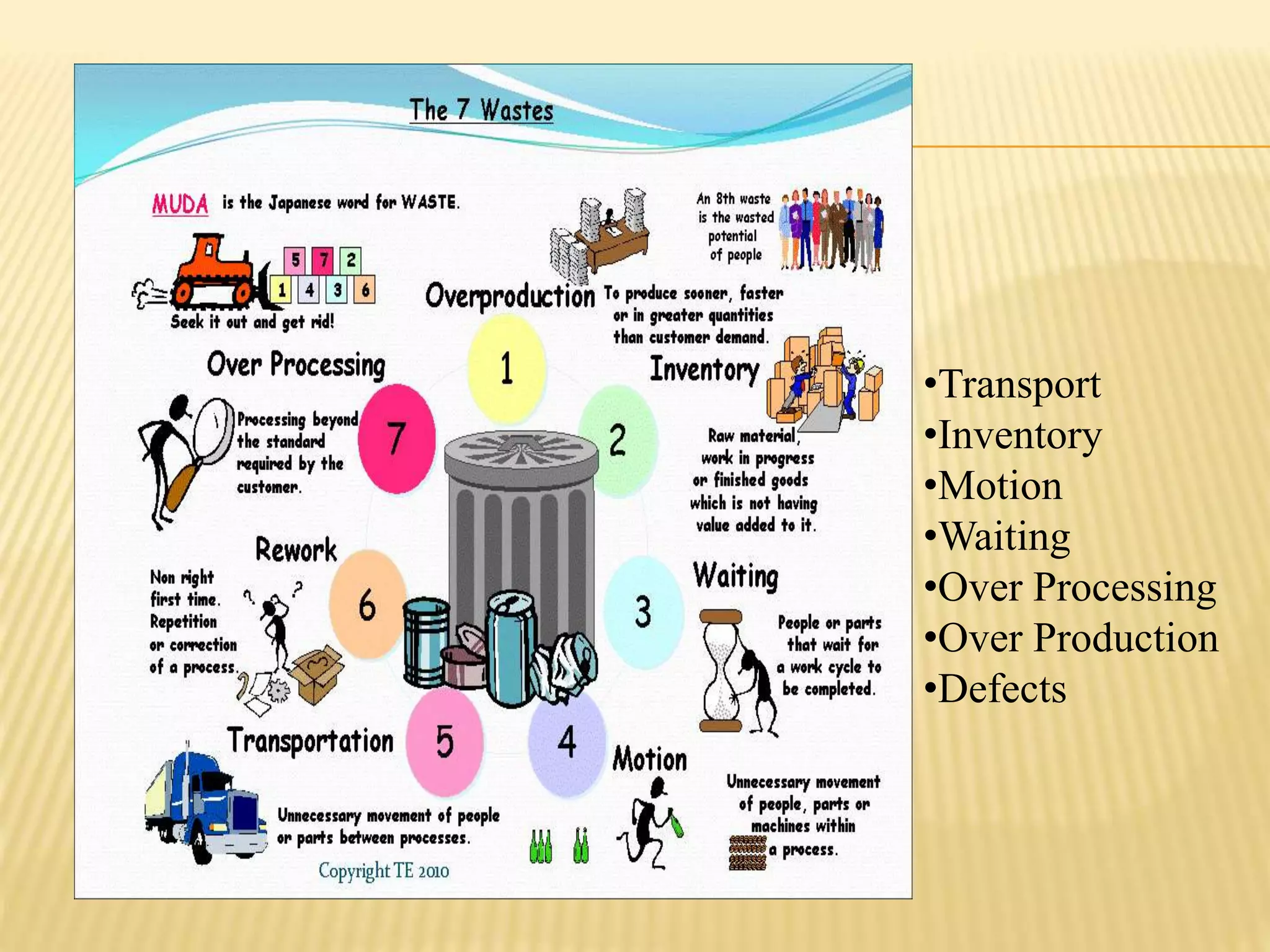
•Transport 
•Inventory 
•Motion 
•Waiting 
•Over Processing 
•Over Production 
•Defects
TRANSPORT 
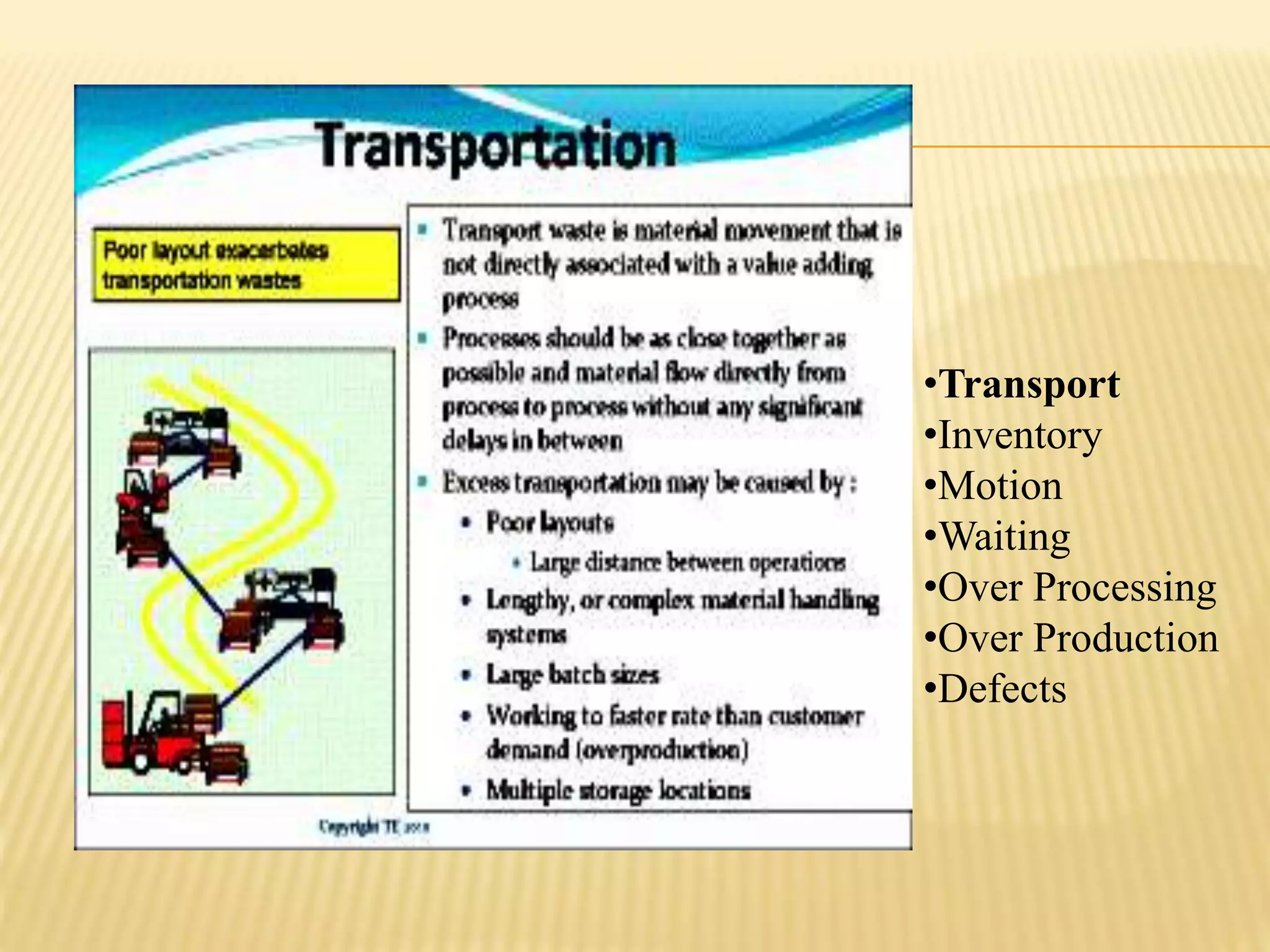
Transport is one of the seven waste of lean manufacturing, it is the 
movement of products from one location to another. 
This transportation adds no value to the product, it does not transform it 
and the customer would not be happy in paying for it! 
Examples of wastes of Transport 
1. The transport of product from one functional area such as pressing, to 
another area such as welding. 
2. The use of material handling devices to move batches of material from 
one machine to another within a work cell. 
3. The shipment of product from one “functional” factory to another. 
4. The transportation of “cheaper” components from one country to 
another.
•Transport 
•Inventory 
•Motion 
•Waiting 
•Over Processing 
•Over Production 
•Defects
INVENTORY 
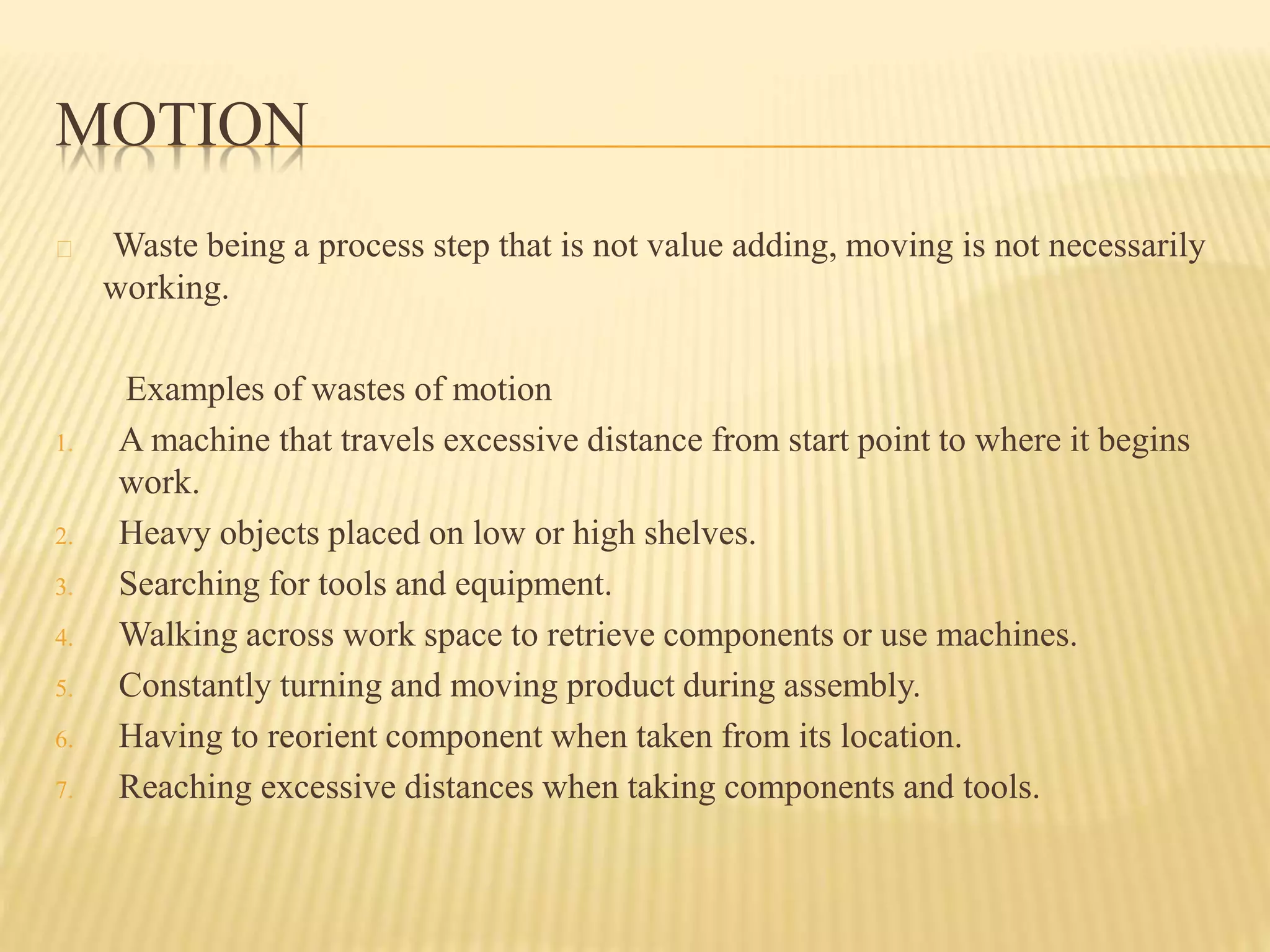
Inventory is the raw materials, work in progress (WIP) and 
finished goods stock that is held. 
Inventory can be observed in many areas of a business, as either 
raw materials that have been ordered in excess of customer 
requirements due to mistrust of suppliers or to take advantage of 
“bulk discounts” to the large amounts of finished goods sitting in 
your warehouse just in case a customer orders them
•Transport 
•Inventory 
•Motion 
•Waiting 
•Over Processing 
•Over Production 
•Defects
MOTION 
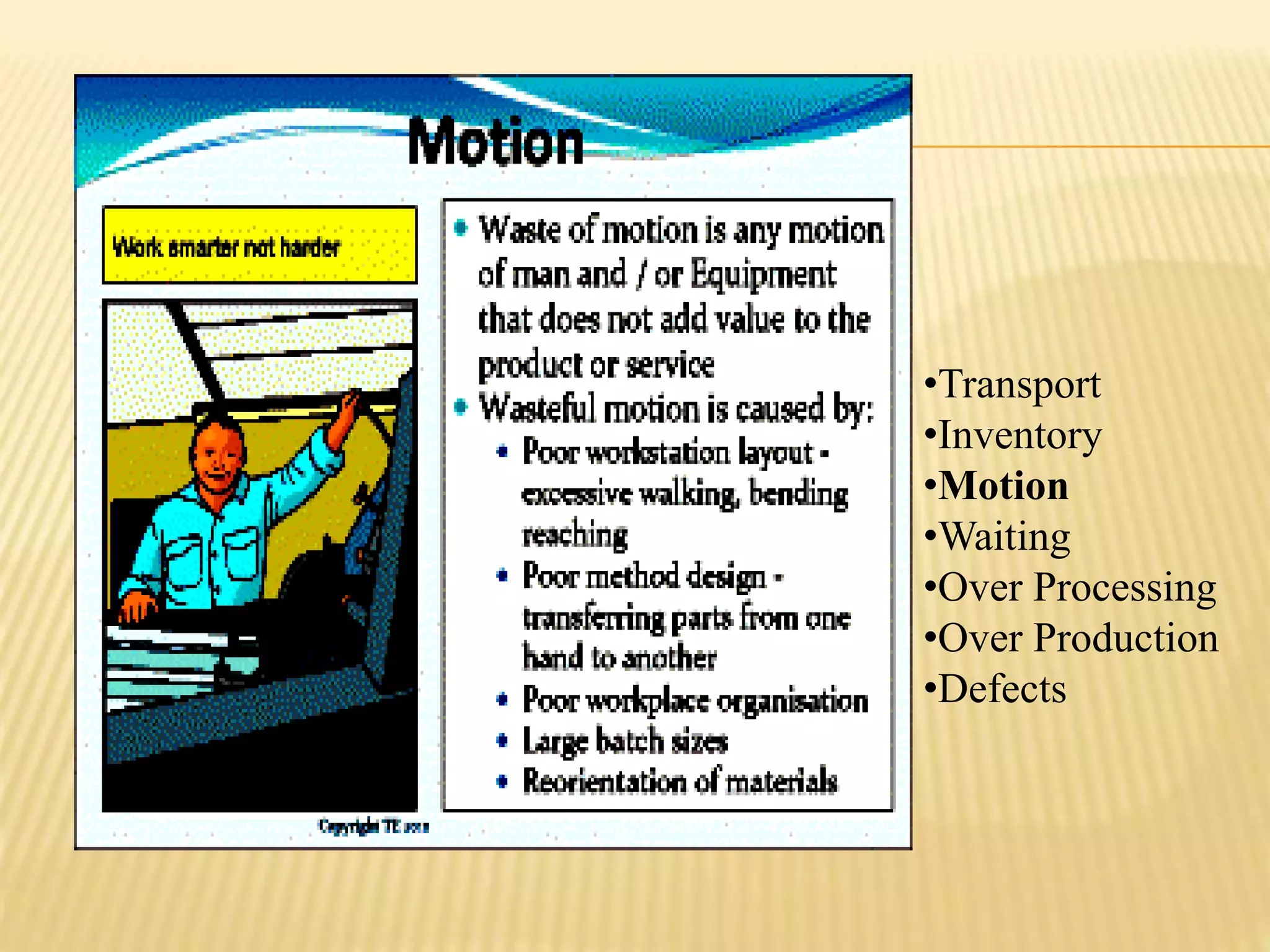
Waste being a process step that is not value adding, moving is not necessarily 
working. 
Examples of wastes of motion 
1. A machine that travels excessive distance from start point to where it begins 
work. 
2. Heavy objects placed on low or high shelves. 
3. Searching for tools and equipment. 
4. Walking across work space to retrieve components or use machines. 
5. Constantly turning and moving product during assembly. 
6. Having to reorient component when taken from its location. 
7. Reaching excessive distances when taking components and tools.
•Transport 
•Inventory 
•Motion 
•Waiting 
•Over Processing 
•Over Production 
•Defects
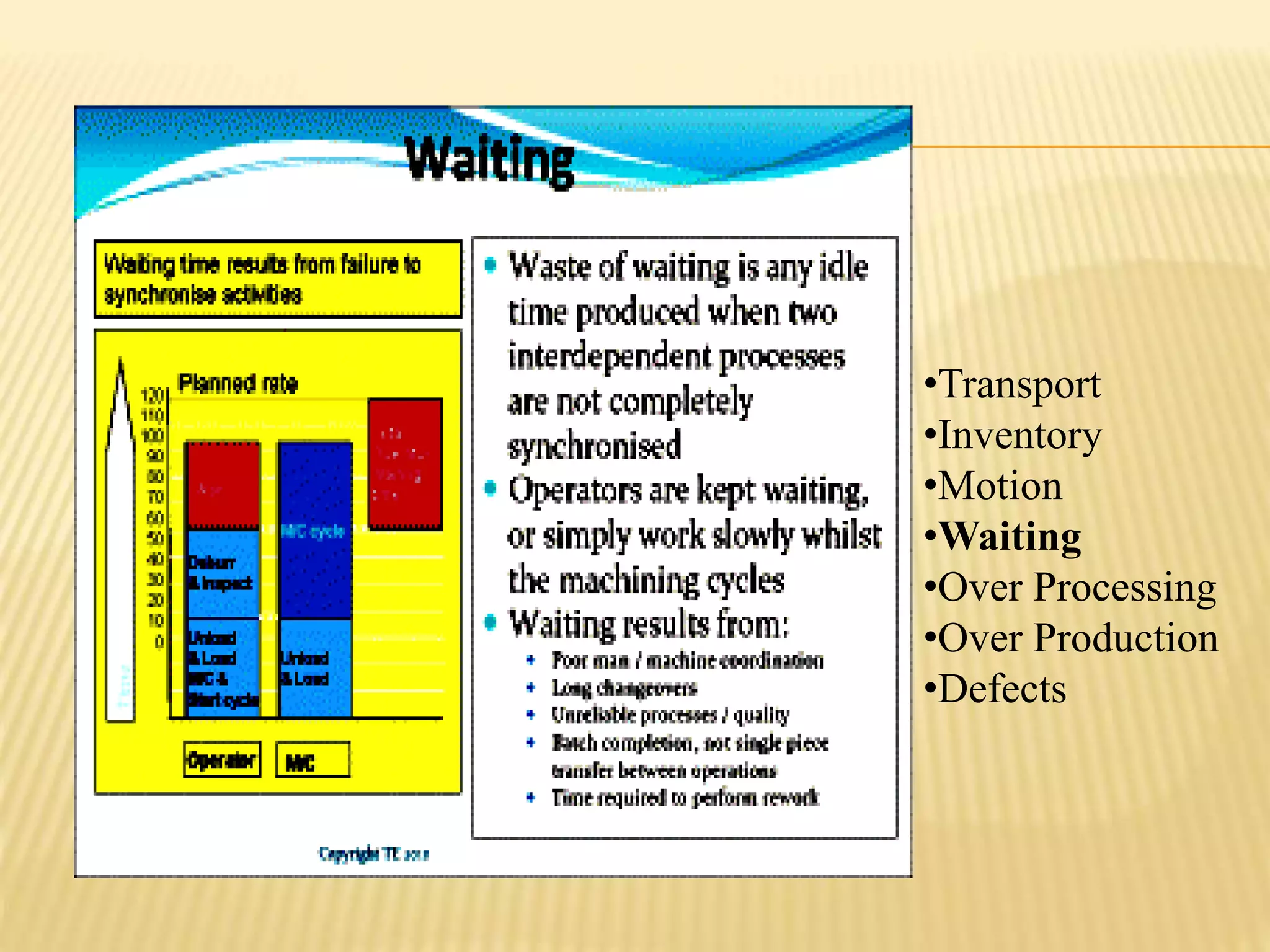
WAITING 
It is the act of doing nothing or working slowly whilst waiting for a 
previous step in the process 
Mostly they are waiting for one another, which often happens because 
they have non-aligned objective. 
Examples of wastes of Waiting 
1. Operators / Machines standing idle whilst they wait for a previous 
processes production to be sorted due to quality problems. 
2. Waiting for a breakdown to be resolved. 
3. Waiting for the forklift truck to deliver a batch of components. 
4. Waiting for information from the engineering department. 
5. Waiting to be told which product is required next.
•Transport 
•Inventory 
•Motion 
•Waiting 
•Over Processing 
•Over Production 
•Defects
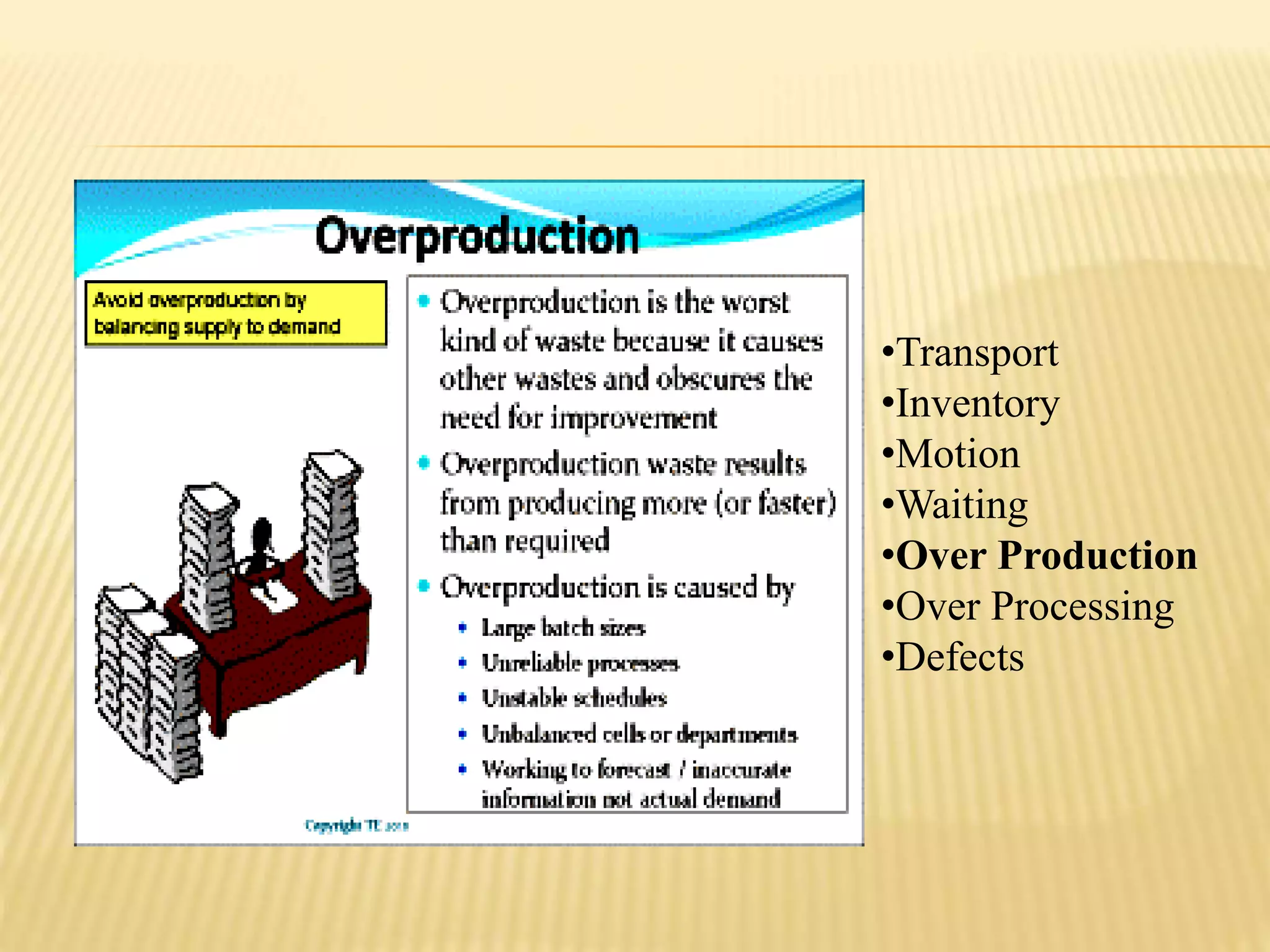
OVER PRODUCTION 
overproduction is making products in too great a quantity or before it is actually 
needed leading to excessive inventory. 
However, producing more than "just enough" or "just-in-time" inventory drives 
up the costs of inventory and results in scrap if demand does not equal supply 
— wasting all the value if the excess products must be scrapped or sold at a loss
•Transport 
•Inventory 
•Motion 
•Waiting 
•Over Production 
•Over Processing 
•Defects
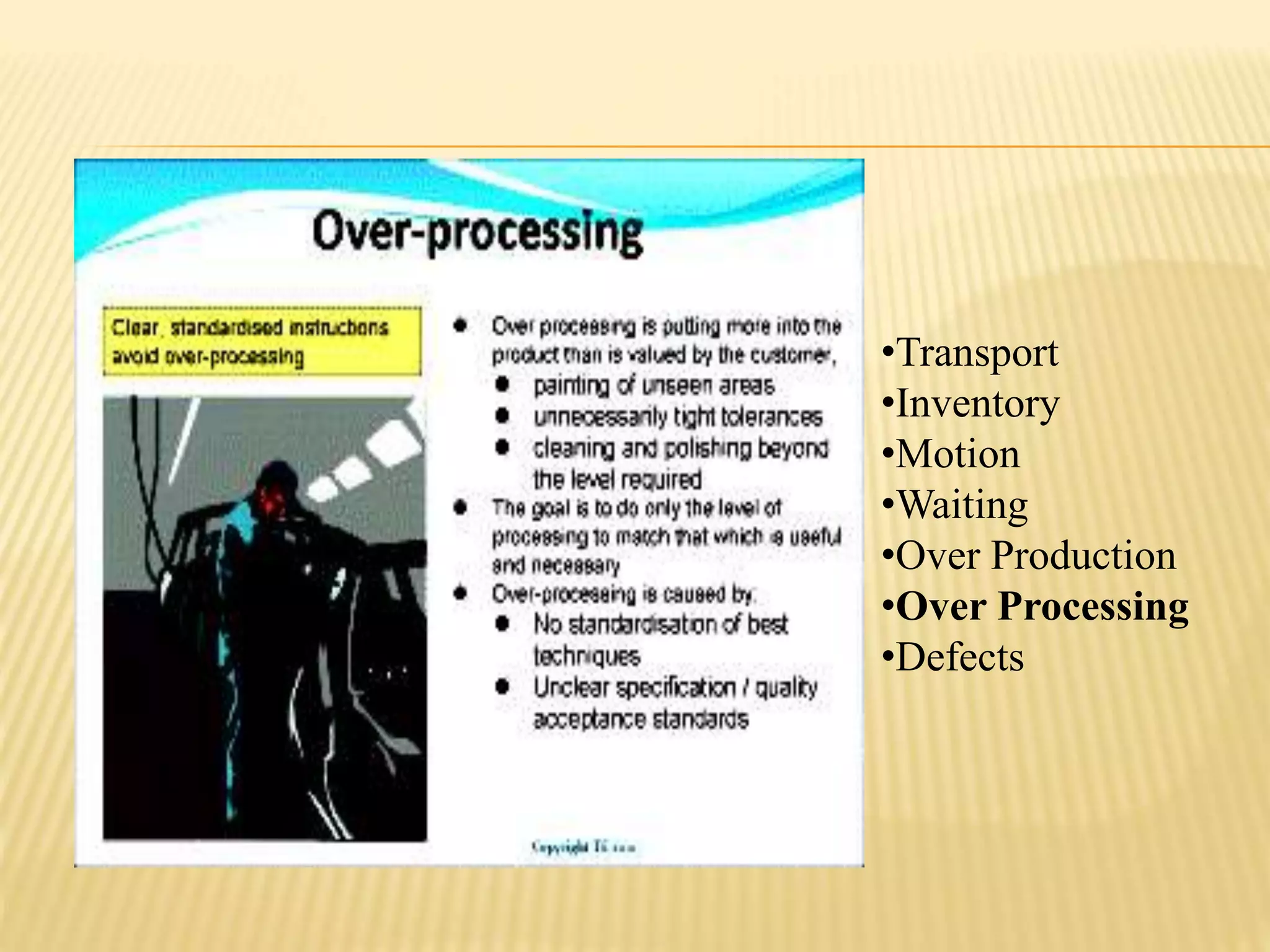
OVER PROCESS 
Overprocessing is adding more value to a product than the 
customer actually requires such as painting areas that will never be 
seen or be exposed to corrosion. 
Examples of wastes of Overprocessing 
1. Painting areas that will never be seen or be affected by corrosion. 
2. Over polishing an area that does not require it. 
3. Tolerances that are too tight.
•Transport 
•Inventory 
•Motion 
•Waiting 
•Over Production 
•Over Processing 
•Defects
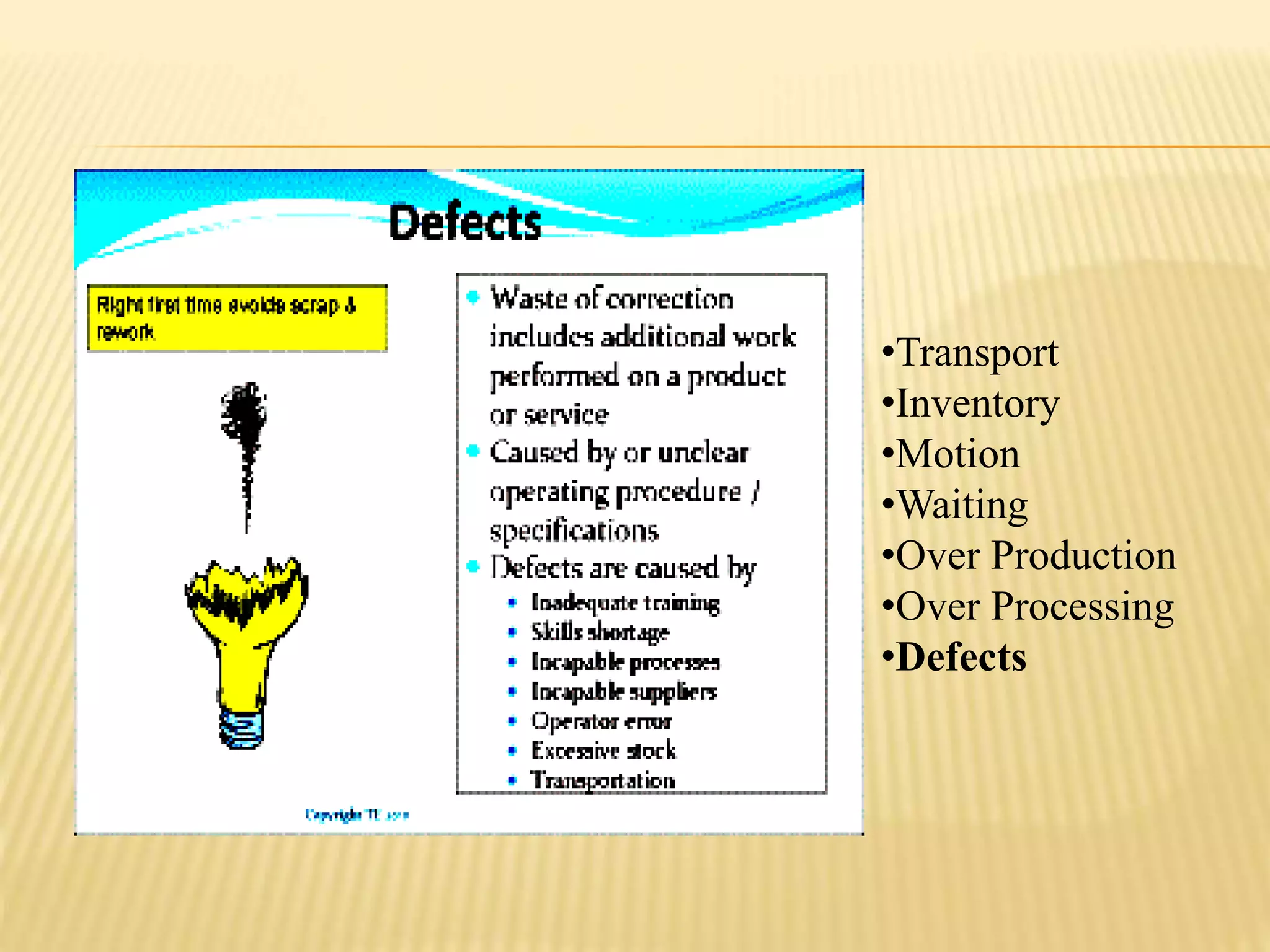
DEFECT 
Defects are when products or service deviate from what the 
customer requires or the specification. When you talk about waste 
most people think of defects rather than the other wastes such as 
waiting and transportation. 
Examples of wastes of Defects 
1. Scrap produced by poorly maintained fixtures. 
2. Parts assembled with the incorrect orientation. 
3. Missing screws and other fixing due to lack of controls.
•Transport 
•Inventory 
•Motion 
•Waiting 
•Over Production 
•Over Processing 
•Defects
Lean manufanturing

Lean manufanturing

  • 1.
    UNIVERSITI KUALA LUMPUR MALAYSIAN INSTITUTE OF INDUSTRIAL TECHNOLOGY JFB 30103 MINTENANCA PLANNING CONTROL: LEAN MANUFACTURING PREPARED BY : SYED SHAHRUL NIZAM BIN SYED AHMAD 57296113596 BET FAME / 01 LECTURER’s NAME : EN ADNAN BIN BAKRI
  • 2.
    WHAT IS LEANMANUFACTURING Lean Production or Lean Manufacturing is a manufacturing/production system best characterized as relentlessly eliminating waste from all of its’ activities and operations. Lean strives to produce products (and deliver services): 1. On-Time 2. Using as few resources as possible 3. Better than competitors 4. Faster & Cheaper than competitors 5. While Eliminating as MuchWaste as Possible
  • 3.
    WHAT IS LEANMANUFACTURING Lean production is aimed at the elimination of waste in every area of production including customer relations, product design, supplier networks and factory management Its goal is to incorporate less human effort, less inventory, less time to develop products, and less space to becomehighly responsive to customer demand while producing top quality products in the most efficient and economical manner possible.
  • 4.
    FUNCTION OF LEANMANUFACTURING Production Flow Products, workflow, equipment and support It is focused on defining products, equipment and workflows that can be produced in small lot production runs being “pulled’ by downstream customer demands It is oriented to getting the product to the customer in the shortest period of time and at the lowest cost with superior quality and customer satisfaction
  • 5.
    FUNCTION OF LEANMANUFACTURING Planning The separation of: Material Requirement Planning (MRP) System function: (Reconciliation – the process of high-level demand planning and scheduling) form Day-to-day planning functions (Regulation – the process of regulating command and control sequences within a pull-process environment capable of controlling “workable work” for each production unit and production cell. MRP must also project intermediate and long-range procurement objectives to suppliers. The day-to-day and shift-by-shift operations will need a real-time Plant Operations Control system (POC) satisfaction
  • 6.
    FUNCTION OF LEANMANUFACTURING Organization Lean Production demands a re-thinking of the structure, role and responsibility of each individual within the organization. The formation of Production Units operating as “Business Units” & Flat Organization will help to understand the needs of their customers and organize all resources, products and capabilities to support and add value to its customers needs and expectations.
  • 7.
    FUNCTION OF LEANMANUFACTURING Performance Measures Performance Measures must be developed in a hierarchy that is cascaded upward and downward within the organization. The measures should be understandable, simple to administer and enable management and team members to easily make decisions and take action when appropriate.
  • 8.
    LEAN GOALS ANDSTRATEGY Improve quality : To stay competitive in today's marketplace, a company must understand its customers' wants and needs and design processes to meet their expectations and requirements. Eliminate waste : Waste is any activity that consumes time, resources, or space but does not add any value to the product or service.
  • 9.
  • 10.
    •Transport •Inventory •Motion •Waiting •Over Processing •Over Production •Defects
  • 11.
    TRANSPORT Transport isone of the seven waste of lean manufacturing, it is the movement of products from one location to another. This transportation adds no value to the product, it does not transform it and the customer would not be happy in paying for it! Examples of wastes of Transport 1. The transport of product from one functional area such as pressing, to another area such as welding. 2. The use of material handling devices to move batches of material from one machine to another within a work cell. 3. The shipment of product from one “functional” factory to another. 4. The transportation of “cheaper” components from one country to another.
  • 12.
    •Transport •Inventory •Motion •Waiting •Over Processing •Over Production •Defects
  • 13.
    INVENTORY Inventory isthe raw materials, work in progress (WIP) and finished goods stock that is held. Inventory can be observed in many areas of a business, as either raw materials that have been ordered in excess of customer requirements due to mistrust of suppliers or to take advantage of “bulk discounts” to the large amounts of finished goods sitting in your warehouse just in case a customer orders them
  • 14.
    •Transport •Inventory •Motion •Waiting •Over Processing •Over Production •Defects
  • 15.
    MOTION Waste beinga process step that is not value adding, moving is not necessarily working. Examples of wastes of motion 1. A machine that travels excessive distance from start point to where it begins work. 2. Heavy objects placed on low or high shelves. 3. Searching for tools and equipment. 4. Walking across work space to retrieve components or use machines. 5. Constantly turning and moving product during assembly. 6. Having to reorient component when taken from its location. 7. Reaching excessive distances when taking components and tools.
  • 16.
    •Transport •Inventory •Motion •Waiting •Over Processing •Over Production •Defects
  • 17.
    WAITING It isthe act of doing nothing or working slowly whilst waiting for a previous step in the process Mostly they are waiting for one another, which often happens because they have non-aligned objective. Examples of wastes of Waiting 1. Operators / Machines standing idle whilst they wait for a previous processes production to be sorted due to quality problems. 2. Waiting for a breakdown to be resolved. 3. Waiting for the forklift truck to deliver a batch of components. 4. Waiting for information from the engineering department. 5. Waiting to be told which product is required next.
  • 18.
    •Transport •Inventory •Motion •Waiting •Over Processing •Over Production •Defects
  • 19.
    OVER PRODUCTION overproductionis making products in too great a quantity or before it is actually needed leading to excessive inventory. However, producing more than "just enough" or "just-in-time" inventory drives up the costs of inventory and results in scrap if demand does not equal supply — wasting all the value if the excess products must be scrapped or sold at a loss
  • 20.
    •Transport •Inventory •Motion •Waiting •Over Production •Over Processing •Defects
  • 21.
    OVER PROCESS Overprocessingis adding more value to a product than the customer actually requires such as painting areas that will never be seen or be exposed to corrosion. Examples of wastes of Overprocessing 1. Painting areas that will never be seen or be affected by corrosion. 2. Over polishing an area that does not require it. 3. Tolerances that are too tight.
  • 22.
    •Transport •Inventory •Motion •Waiting •Over Production •Over Processing •Defects
  • 23.
    DEFECT Defects arewhen products or service deviate from what the customer requires or the specification. When you talk about waste most people think of defects rather than the other wastes such as waiting and transportation. Examples of wastes of Defects 1. Scrap produced by poorly maintained fixtures. 2. Parts assembled with the incorrect orientation. 3. Missing screws and other fixing due to lack of controls.
  • 24.
    •Transport •Inventory •Motion •Waiting •Over Production •Over Processing •Defects