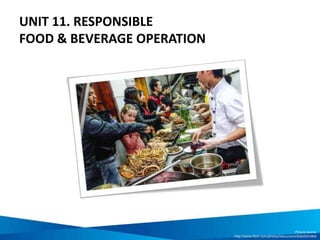
UNIT 11. RESPONSIBLE
FOOD & BEVERAGE OPERATION
Picture source:
http://www.flickr.com/photos/obscuranet/8262022383/
Unit outline
Objectives
By the end of the unit participants will be able to:
• Describe the meaning and importance of
sustainability in food and beverage operation
• Implement environmental responsibility provisions
in food and beverage including practicing low
energy use, being water wise and minimising waste
• Explain importance of sourcing and providing good,
sustainable food and beverage products
• Explain how to implement social responsibility in
food and beverage operation
Topics
1. Understanding
responsible food and
beverage operation
2. Managing resources
more efficiently
3. Sourcing good food
responsibly
4. Looking after
customers and the
community
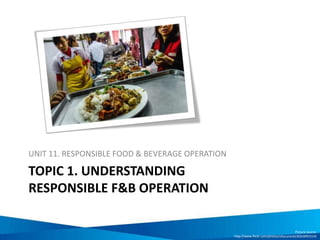
TOPIC 1. UNDERSTANDING
RESPONSIBLE F&B OPERATION
UNIT 11. RESPONSIBLE FOOD & BEVERAGE OPERATION
Picture source:
http://www.flickr.com/photos/obscuranet/8263091514/
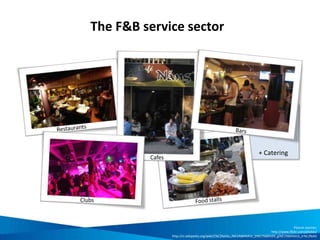
+ Catering
The F&B service sector
Picture sources:
http://www.flickr.com/photos/
http://vi.wikipedia.org/wiki/C%C3%A2u_l%E1%BA%A1c_b%E1%BB%99_gi%E1%BA%A3i_tr%C3%AD
Cafes
Clubs
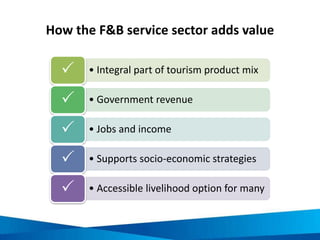
How the F&B service sector adds value
• Integral part of tourism product mix
• Government revenue
• Jobs and income
• Supports socio-economic strategies
• Accessible livelihood option for many
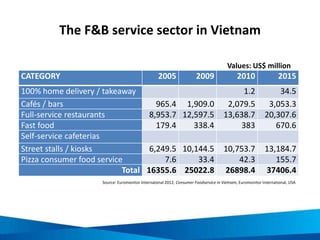
The F&B service sector in Vietnam
Source: Euromonitor Internatonal 2012, Consumer Foodservice in Vietnam, Euromonitor International, USA
CATEGORY 2005 2009 2010 2015
100% home delivery / takeaway 1.2 34.5
Cafés / bars 965.4 1,909.0 2,079.5 3,053.3
Full-service restaurants 8,953.7 12,597.5 13,638.7 20,307.6
Fast food 179.4 338.4 383 670.6
Self-service cafeterias
Street stalls / kiosks 6,249.5 10,144.5 10,753.7 13,184.7
Pizza consumer food service 7.6 33.4 42.3 155.7
Total 16355.6 25022.8 26898.4 37406.4
Values: US$ million
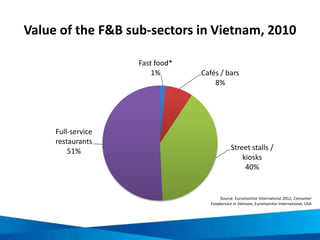
Value of the F&B sub-sectors in Vietnam, 2010
Fast food*
1% Cafés / bars
8%
Street stalls /
kiosks
40%
Full-service
restaurants
51%
Source: Euromonitor Internatonal 2012, Consumer
Foodservice in Vietnam, Euromonitor International, USA
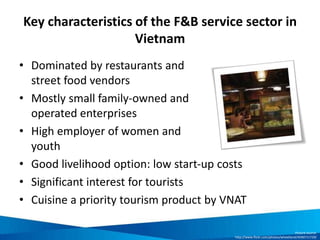
Key characteristics of the F&B service sector in
Vietnam
• Dominated by restaurants and
street food vendors
• Mostly small family-owned and
operated enterprises
• High employer of women and
youth
• Good livelihood option: low start-up costs
• Significant interest for tourists
• Cuisine a priority tourism product by VNAT
Picture source:
http://www.flickr.com/photos/wheatland/4590711729/
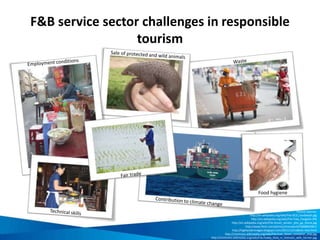
F&B service sector challenges in responsible
tourism
Picture sources:
http://en.wikipedia.org/wiki/File:OCD_handwash.jpg
http://en.wikipedia.org/wiki/File:Tree_Pangolin.JPG
http://en.wikipedia.org/wiki/File:Street_vendor_pho_ga_Hanoi.jpg
http://www.flickr.com/photos/transworld/3668859481/
http://highlanderimages.blogspot.com/2011/12/rubbish-man.html
http://commons.wikimedia.org/wiki/File:Ever_Given_container_ship.jpg
http://commons.wikimedia.org/wiki/File:Paddy_field_in_Vietnam_with_farmer.jpg
Food hygiene
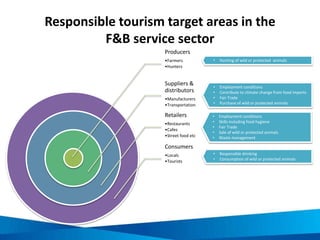
Responsible tourism target areas in the
F&B service sector
Producers
•Farmers
•Hunters
Suppliers &
distributors
•Manufacturers
•Transportation
Retailers
•Restaurants
•Cafes
•Street food etc
Consumers
•Locals
•Tourists
• Hunting of wild or protected animals
• Employment conditions
• Contribute to climate change from food imports
• Fair Trade
• Purchase of wild or protected animals
• Employment conditions
• Skills including food hygiene
• Fair Trade
• Sale of wild or protected animals
• Waste management
• Responsible drinking
• Consumption of wild or protected animals
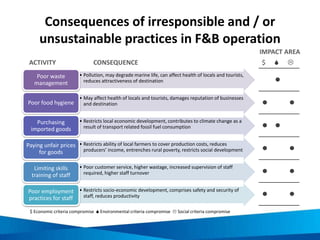
Consequences of irresponsible and / or
unsustainable practices in F&B operation
• Pollution, may degrade marine life, can affect health of locals and
tourists, reduces attractiveness of destination
Poor waste
management
• May affect health of locals and tourists, damages reputation of businesses
and destinationPoor food hygiene
• Restricts local economic development, contributes to climate change as a
result of transport related fossil fuel consumption
Purchasing
imported goods
• Restricts ability of local farmers to cover production costs, reduces
producers’ income, entrenches rural poverty, restricts social development
Paying unfair prices
for goods
• Poor customer service, higher wastage, increased supervision of staff
required, higher staff turnover
Limiting skills
training of staff
• Restricts socio-economic development, comprises safety and security of
staff, reduces productivity
Poor employment
practices for staff
ACTIVITY CONSEQUENCE $  

 
 
 
 
 
$ Economic criteria compromise  Environmental criteria compromise  Social criteria compromise
IMPACT AREA
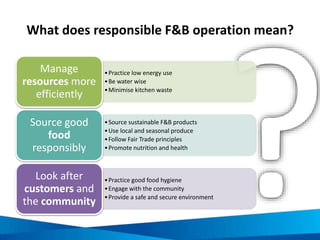
What does responsible F&B operation mean?
•Practice low energy use
•Be water wise
•Minimise kitchen waste
Manage
resources more
efficiently
•Source sustainable F&B products
•Use local and seasonal produce
•Follow Fair Trade principles
•Promote nutrition and health
Source good
food
responsibly
•Practice good food hygiene
•Engage with the community
•Provide a safe and secure environment
Look after
customers and
the community
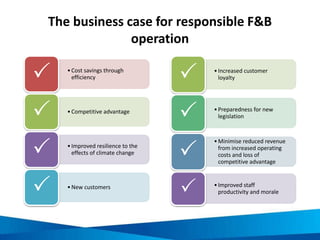
The business case for responsible F&B
operation
•Cost savings through
efficiency
•Competitive advantage

•Improved resilience to the
effects of climate change
•New customers

•Increased customer
loyalty
•Preparedness for new
legislation
•Minimise reduced revenue
from increased operating
costs and loss of
competitive advantage

•Improved staff
productivity and morale
TOPIC 2. MANAGING
RESOURCES MORE EFFICIENTLY
UNIT 11. RESPONSIBLE FOOD & BEVERAGE OPERATION
Picture source:
http://www.flickr.com/photos/10451396@N00/429388973/
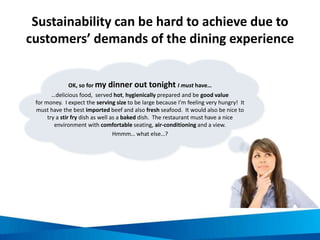
Sustainability can be hard to achieve due to
customers’ demands of the dining experience
OK, so for my dinner out tonight I must have…
…delicious food, served hot, hygienically prepared and be good value
for money. I expect the serving size to be large because I’m feeling very hungry! It
must have the best imported beef and also fresh seafood. It would also be nice to
try a stir fry dish as well as a baked dish. The restaurant must have a nice
environment with comfortable seating, air-conditioning and a view.
Hmmm… what else…?
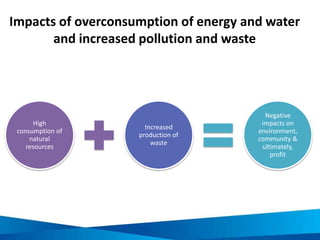
Impacts of overconsumption of energy and water
and increased pollution and waste
High
consumption of
natural
resources
Increased
production of
waste
Negative
impacts on
environment,
community &
ultimately,
profit
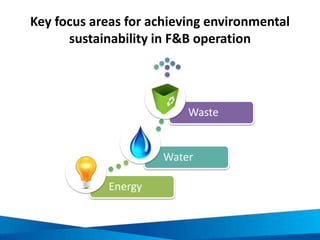
Key focus areas for achieving environmental
sustainability in F&B operation
Energy
Water
Waste
Energy, water, waste
reduction
Patterns of
use
Equipment
External
factors
The key elements of energy, water and waste
minimisation
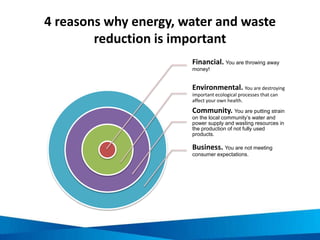
Financial. You are throwing away
money!
Environmental. You are destroying
important ecological processes that can
affect your own health.
Community. You are putting strain
on the local community’s water and
power supply and wasting resources in
the production of not fully used
products.
Business. You are not meeting
consumer expectations.
4 reasons why energy, water and waste
reduction is important
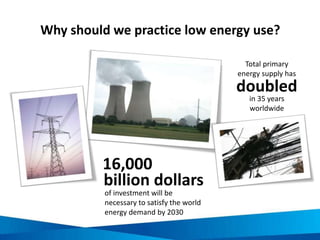
Why should we practice low energy use?
Total primary
energy supply has
doubled
in 35 years
worldwide
of investment will be
necessary to satisfy the world
energy demand by 2030
billion dollars
16,000
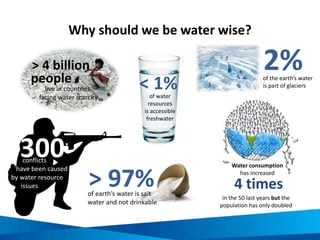
Why should we be water wise?
of earth’s water is salt
water and not drinkable
< 1%of water
resources
is accessible
freshwater
of the earth’s water
is part of glaciers
2%
300conflicts
have been caused
by water resource
issues
Water consumption
has increased
4 times
in the 50 last years but the
population has only doubled
> 4 billion
live in countries
facing water scarcity
people
> 97%
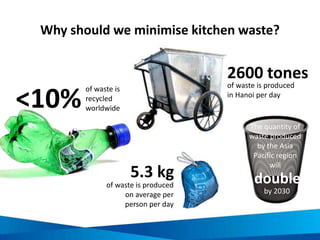
Why should we minimise kitchen waste?
2600 tones
of waste is produced
in Hanoi per day
5.3 kg
of waste is produced
on average per
person per day
The quantity of
waste produced
by the Asia
Pacific region
will
double
by 2030
of waste is
recycled
worldwide<10%
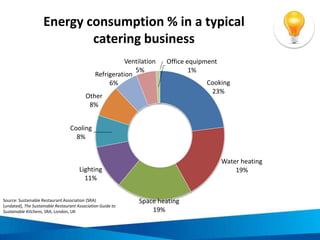
Energy consumption % in a typical
catering business
Cooking
23%
Water heating
19%
Space heating
19%
Lighting
11%
Cooling
8%
Other
8%
Refrigeration
6%
Ventilation
5%
Office equipment
1%
Source: Sustainable Restaurant Association (SRA)
[undated], The Sustainable Restaurant Association Guide to
Sustainable Kitchens, SRA, London, UK
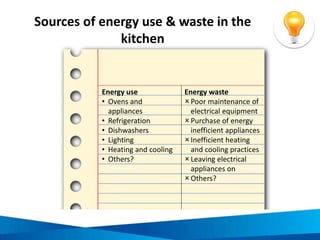
Sources of energy use & waste in the
kitchen
Energy use
• Ovens and
appliances
• Refrigeration
• Dishwashers
• Lighting
• Heating and cooling
• Others?
Energy waste
Poor maintenance of
electrical equipment
Purchase of energy
inefficient appliances
Inefficient heating
and cooling practices
Leaving electrical
appliances on
Others?
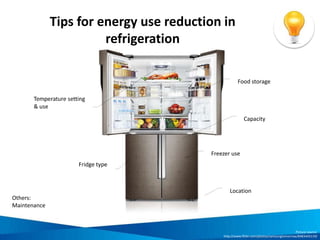
Tips for energy use reduction in
refrigeration
Capacity
Location
Picture source:
http://www.flickr.com/photos/samsungtomorrow/8483445119/
Freezer use
Food storage
Others:
Maintenance
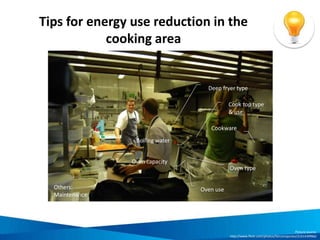
Tips for energy use reduction in the
cooking area
Picture source:
http://www.flickr.com/photos/faircompanies/2161439966/
Oven type
Cook top type
& use
Oven useOthers:
Maintenance
Deep fryer type
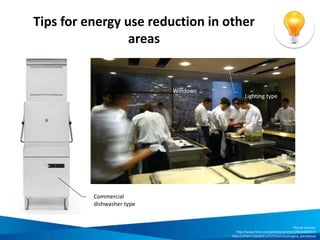
Tips for energy use reduction in other
areas
Picture sources:
http://www.flickr.com/photos/sammicsl/8650606917/
http://umami.typepad.com/umami/eatingout_barcelona/
Commercial
dishwasher type
Lighting type
Windows
Sources of water use & waste in the
kitchen
Water use
• Food preparation
• Sinks and taps
• Dishwashers
• Others ?
Water waste
Dripping taps
Leaking pipes
Excessively high
water pressure
Water inefficient
appliances
Bad methods in food
preparation
Others?
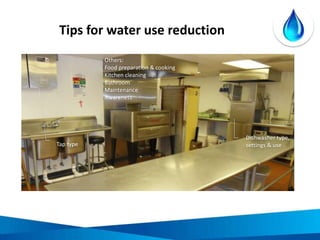
Tips for water use reduction
Tap type
Others:
Food preparation & cooking
Kitchen cleaning
Bathroom
Maintenance
Awareness
Dishwasher
type, settings &
use
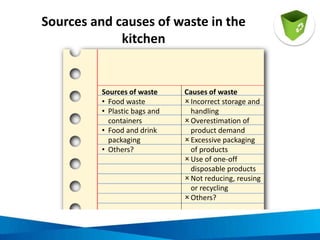
Sources and causes of waste in the
kitchen
Sources of waste
• Food waste
• Plastic bags and
containers
• Food and drink
packaging
• Others?
Causes of waste
Incorrect storage and
handling
Overestimation of
product demand
Excessive packaging
of products
Use of one-off
disposable products
Not reducing, reusing
or recycling
Others?
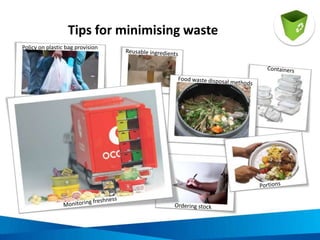
Tips for minimising waste
Policy on plastic bag provision
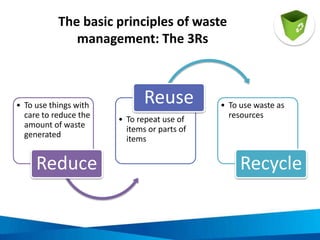
The basic principles of waste
management: The 3Rs
• To use things with
care to reduce the
amount of waste
generated
Reduce
• To repeat use of
items or parts of
items
Reuse • To use waste as
resources
Recycle
TOPIC 3. SOURCING GOOD FOOD RESPONSIBLY
UNIT 11. RESPONSIBLE FOOD & BEVERAGE OPERATION
Picture source:
http://sr.wikipedia.org/wiki/Organska_poljoprivreda
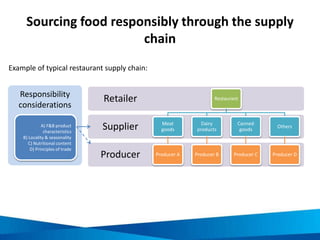
Sourcing food responsibly through the supply
chain
Producer
Supplier
Retailer Restaurant
Meat
goods
Producer A
Dairy
products
Producer B
Canned
goods
Producer C
Others
Producer D
Responsibility
considerations
A) F&B product
characteristics
B) Locality & seasonality
C) Nutritional content
D) Principles of trade
Example of typical restaurant supply chain:
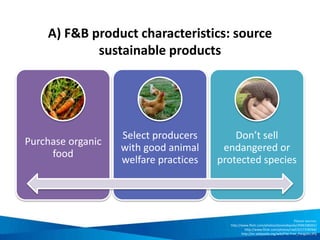
A) F&B product characteristics: source
sustainable products
Purchase organic
food
Select producers
with good animal
welfare practices
Don’t sell
endangered or
protected species
Picture sources:
http://www.flickr.com/photos/stevendepolo/3996198265/
http://www.flickr.com/photos/ciwf/3217378769/
http://en.wikipedia.org/wiki/File:Tree_Pangolin.JPG
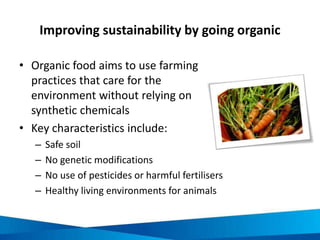
Improving sustainability by going organic
• Organic food aims to use farming
practices that care for the
environment without relying on
synthetic chemicals
• Key characteristics include:
– Safe soil
– No genetic modifications
– No use of pesticides or harmful fertilisers
– Healthy living environments for animals
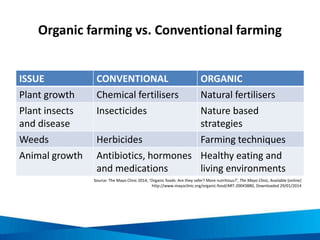
Organic farming vs. Conventional farming
ISSUE CONVENTIONAL ORGANIC
Plant growth Chemical fertilisers Natural fertilisers
Plant insects
and disease
Insecticides Nature based
strategies
Weeds Herbicides Farming techniques
Animal growth Antibiotics, hormones
and medications
Healthy eating and
living environments
Source: The Mayo Clinic 2014, ‘Organic foods: Are they safer? More nutritious?’, The Mayo Clinic, Available [online]
http://www.mayoclinic.org/organic-food/ART-20043880, Downloaded 29/01/2014
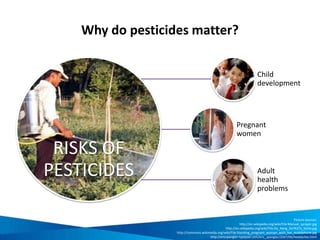
Why do pesticides matter?
RISKS OF
PESTICIDES
Child
development
Pregnant
women
Adult
health
problems
Picture sources:
http://en.wikipedia.org/wiki/File:Manual_sprayer.jpg
http://en.wikipedia.org/wiki/File:Da_Nang_Girl%27s_Smile.jpg
http://commons.wikimedia.org/wiki/File:Standing_pregnant_woman_with_her_mobilphone.jpg
http://ericspangler.typepad.com/eric_spangler/2007/06/headaches.html
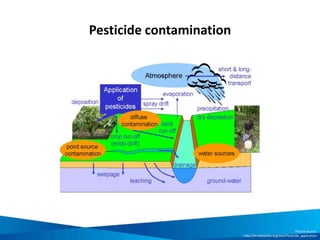
Pesticide contamination
Picture source:
http://en.wikipedia.org/wiki/Pesticide_application
Benefits of organic food
• Organic food contains fewer pesticides

• Organic food is often fresher

• Organic farming is better for the environment

• Organically raised animals are not given
antibiotics, growth hormones or fed animal by-products
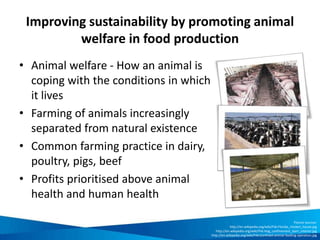
Improving sustainability by promoting animal
welfare in food production
• Animal welfare - How an animal is
coping with the conditions in which
it lives
• Farming of animals increasingly
separated from natural existence
• Common farming practice in
dairy, poultry, pigs, beef
• Profits prioritised above animal
health and human health
Picture sources:
http://en.wikipedia.org/wiki/File:Florida_chicken_house.jpg
http://en.wikipedia.org/wiki/File:Hog_confinement_barn_interior.jpg
http://en.wikipedia.org/wiki/File:Confined-animal-feeding-operation.jpg
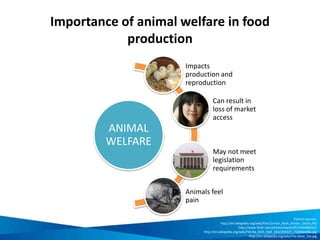
Importance of animal welfare in food
production
ANIMAL
WELFARE
Impacts
production and
reproduction
Can result in
loss of market
access
May not meet
legislation
requirements
Animals feel
pain
Picture sources:
http://en.wikipedia.org/wiki/File:Cornish_Rock_broiler_chicks.JPG
http://www.flickr.com/photos/wanhoff/3356485016/
http://en.wikipedia.org/wiki/File:Ba_Dinh_Hall_1462359227_71b04ee08a.jpg
http://en.wikipedia.org/wiki/File:Silver_fox.jpg
General signs of pain in livestock
Vocalisation
Grindingteeth
Reluctanceto
move
Rapid/shallow
breathing
Isolationfrom
group
Footstamping
Abnormal
posture
Headtucked/
eyesclosed
Decreased
production
Cattle     
Pigs      
Sheep    
Goats       
Poultry   
Source: State Government of Victoria 2013, ‘Animal Welfare for Livestock Producers’, Department of Environment and Primary Industries, Available [online]:
http://www.dpi.vic.gov.au/agriculture/farming-management/production-livestock-care/animal-welfare-for-livestock-producers, Downloaded: 30/01/2014
Improving sustainability by not selling
protected or endangered species
• The world is experiencing an extinction
crisis
• Plant and animal species are needed for
healthy ecosystems
• Plants and animals provide other
important benefits to society including:
– Medicine
– Crop pollination
– Pest control
– Carbon storage
Picture source:
http://en.wikipedia.org/wiki/File:Hoolock_hoolock_001.jpg
The many values of biodiversity
Agricultural Medicinal Ecological
Commercial Aesthetic Legal
Picture source:
http://www.fws.gov/midwest/endangered/plants/dwarflak.html
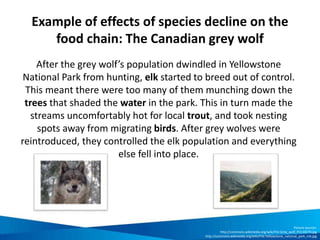
Example of effects of species decline on the
food chain: The Canadian grey wolf
After the grey wolf’s population dwindled in Yellowstone
National Park from hunting, elk started to breed out of control.
This meant there were too many of them munching down the
trees that shaded the water in the park. This in turn made the
streams uncomfortably hot for local trout, and took nesting
spots away from migrating birds. After grey wolves were
reintroduced, they controlled the elk population and everything
else fell into place.
Picture sources:
http://commons.wikimedia.org/wiki/File:Grey_wolf_P1130270.jpg
http://commons.wikimedia.org/wiki/File:Yellowstone_national_park_m6.jpg
B) Source local and seasonal produce
What is local produce?
• Foods and beverages that
are produced in the local
region
What is seasonal produce?
• Food that is harvested at
particular times or seasons
in the year
Picture source:
http://commons.wikimedia.org/wiki/File:Fair_trade_bananen.jpg
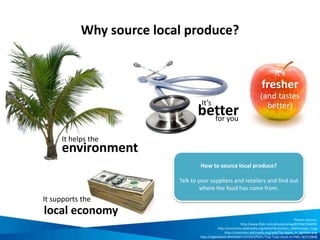
Why source local produce?
How to source local produce?
Talk to your suppliers and retailers and find out
where the food has come from.
Picture sources:
http://www.flickr.com/photos/amagill/3366720659/
http://commons.wikimedia.org/wiki/File:Doctors_stethoscope_1.jpg
http://commons.wikimedia.org/wiki/File:Apple_in_lightbox.png
http://digitaltwist.deviantart.com/art/Palm-Tree-Tube-Stock-VI-PNG-182723848
better
It supports the
local economy
It’s
for you
It’s
fresher
(and tastes
better)
It helps the
environment
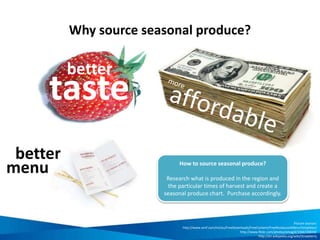
Why source seasonal produce?
Picture sources:
http://www.serif.com/int/au/FreeDownloads/FreeContent/FreeRestaurantMenuTemplates/
http://www.flickr.com/photos/amagill/3366720659/
http://en.wikipedia.org/wiki/Strawberry
better
menu
taste
better
How to source seasonal produce?
Research what is produced in the region and
the particular times of harvest and create a
seasonal produce chart. Purchase accordingly.
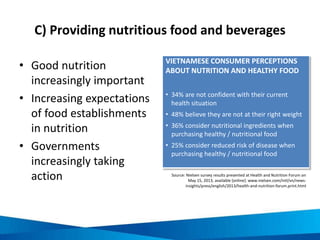
C) Providing nutritious food and beverages
• Good nutrition
increasingly important
• Increasing expectations
of food establishments
in nutrition
• Governments
increasingly taking
action
VIETNAMESE CONSUMER PERCEPTIONS
ABOUT NUTRITION AND HEALTHY FOOD
• 34% are not confident with their current
health situation
• 48% believe they are not at their right weight
• 36% consider nutritional ingredients when
purchasing healthy / nutritional food
• 25% consider reduced risk of disease when
purchasing healthy / nutritional food
Source: Nielsen survey results presented at Health and Nutrition Forum on
May 15, 2013, available [online]: www.nielsen.com/intl/vn/news-
insights/press/english/2013/health-and-nutrition-forum.print.html
World Health Organisation’s recommendations
on healthy eating
Energy Achieve energy balance
Fat Limit intake. Shift from saturated fats to unsaturated
fats. Eliminate trans-fatty acids
Fruit &
vegetables
Increase consumption. Include legumes, whole
grains and nuts
Sugar Limit intake of refined sugars
Salt Limit consumption from all sources and ensure it is
iodized
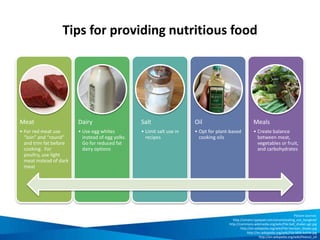
Tips for providing nutritious food
Picture sources:
http://umami.typepad.com/umami/eating_out_bangkok/
http://commons.wikimedia.org/wiki/File:Salt_shaker.agr.jpg
http://en.wikipedia.org/wiki/File:Venison_Steaks.jpg
http://en.wikipedia.org/wiki/File:Milk-bottle.jpg
http://en.wikipedia.org/wiki/Peanut_oil
Meat
• For red meat use
“loin” and “round”
and trim fat before
cooking. For
poultry, use light
meat instead of dark
meat
Dairy
• Use egg whites
instead of egg yolks.
Go for reduced fat
dairy options
Salt
• Limit salt use in
recipes
Oil
• Opt for plant-based
cooking oils
Meals
• Create balance
between meat,
vegetables or fruit,
and carbohydrates
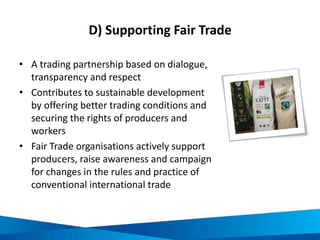
D) Supporting Fair Trade
• A trading partnership based on dialogue,
transparency and respect
• Contributes to sustainable development
by offering better trading conditions and
securing the rights of producers and
workers
• Fair Trade organisations actively support
producers, raise awareness and campaign
for changes in the rules and practice of
conventional international trade
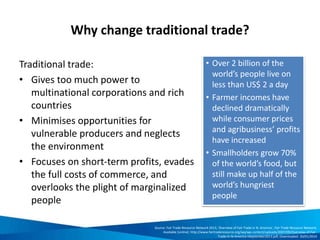
Why change traditional trade?
• Over 2 billion of the
world’s people live on
less than US$ 2 a day
• Farmer incomes have
declined dramatically
while consumer prices
and agribusiness’ profits
have increased
• Smallholders grow 70%
of the world’s food, but
still make up half of the
world’s hungriest
people
Traditional trade:
• Gives too much power to
multinational corporations and rich
countries
• Minimises opportunities for
vulnerable producers and neglects
the environment
• Focuses on short-term profits, evades
the full costs of commerce, and
overlooks the plight of marginalized
people
Source: Fair Trade Resource Network 2013, ‘Overview of Fair Trade in N. America’, Fair Trade Resource
Network, Available [online]: http://www.fairtraderesource.org/wp/wp-content/uploads/2007/09/Overview-of-
Fair-Trade-in-N-America-vSeptember2013.pdf, Downloaded: 30/01/2014
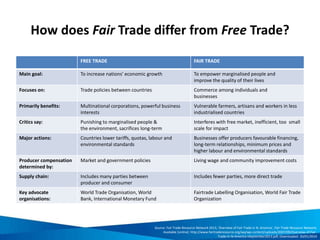
How does Fair Trade differ from Free Trade?
FREE TRADE FAIR TRADE
Main goal: To increase nations’ economic growth To empower marginalised people and
improve the quality of their lives
Focuses on: Trade policies between countries Commerce among individuals and
businesses
Primarily benefits: Multinational corporations, powerful business
interests
Vulnerable farmers, artisans and workers in less
industrialised countries
Critics say: Punishing to marginalised people &
the environment, sacrifices long-term
Interferes with free market, inefficient, too small
scale for impact
Major actions: Countries lower tariffs, quotas, labour and
environmental standards
Businesses offer producers favourable financing,
long-term relationships, minimum prices and
higher labour and environmental standards
Producer compensation
determined by:
Market and government policies Living wage and community improvement costs
Supply chain: Includes many parties between
producer and consumer
Includes fewer parties, more direct trade
Key advocate
organisations:
World Trade Organisation, World
Bank, International Monetary Fund
Fairtrade Labelling Organisation, World Fair Trade
Organization
Source: Fair Trade Resource Network 2013, ‘Overview of Fair Trade in N. America’, Fair Trade Resource
Network, Available [online]: http://www.fairtraderesource.org/wp/wp-content/uploads/2007/09/Overview-of-
Fair-Trade-in-N-America-vSeptember2013.pdf, Downloaded: 30/01/2014
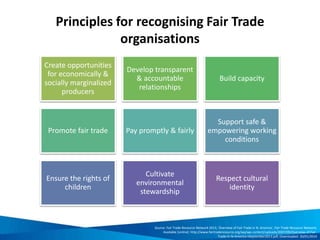
Principles for recognising Fair Trade
organisations
Create opportunities
for economically &
socially marginalized
producers
Develop transparent
& accountable
relationships
Build capacity
Promote fair trade Pay promptly & fairly
Support safe &
empowering working
conditions
Ensure the rights of
children
Cultivate
environmental
stewardship
Respect cultural
identity
Source: Fair Trade Resource Network 2013, ‘Overview of Fair Trade in N. America’, Fair Trade Resource
Network, Available [online]: http://www.fairtraderesource.org/wp/wp-content/uploads/2007/09/Overview-of-
Fair-Trade-in-N-America-vSeptember2013.pdf, Downloaded: 30/01/2014
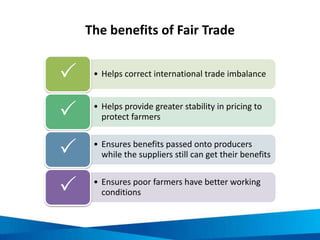
The benefits of Fair Trade
• Helps correct international trade imbalance
• Helps provide greater stability in pricing to
protect farmers
• Ensures benefits passed onto producers
while the suppliers still can get their benefits
• Ensures poor farmers have better working
conditions
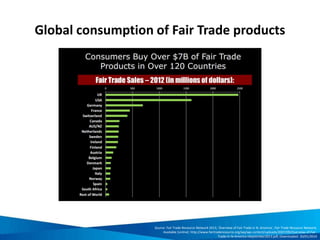
Global consumption of Fair Trade products
Source: Fair Trade Resource Network 2013, ‘Overview of Fair Trade in N. America’, Fair Trade Resource Network,
Available [online]: http://www.fairtraderesource.org/wp/wp-content/uploads/2007/09/Overview-of-Fair-
Trade-in-N-America-vSeptember2013.pdf, Downloaded: 30/01/2014
TOPIC 4: LOOKING AFTER
CUSTOMERS AND THE COMMUNITY
UNIT 11. RESPONSIBLE FOOD & BEVERAGE OPERATION
Picture source:
http://en.wikipedia.org/wiki/Apron
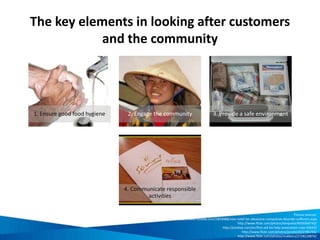
The key elements in looking after customers
and the community
1. Ensure good food hygiene 2. Engage the community 3. Provide a safe environment
4. Communicate responsible
activities
Picture sources:
http://www.rttnews.com/1859088/new-relief-for-obsessive-compulsive-disorder-sufferers.aspx
http://www.flickr.com/photos/lonqueta/4039364743/
http://pixabay.com/en/first-aid-kit-help-association-case-62643/
http://www.flickr.com/photos/jonolist/622785755/
http://www.flickr.com/photos/makkens/2728218876/
1. Ensuring good food hygiene
• Minimises the
spread of
disease
Protects
customers
• Maintains
trust, avoids
potential legal
cases
Protects
business
Applying good food hygiene
FOOD
HYGIENE
TARGET
AREAS
Personal
hygiene
•Clothes
•Hair
•Hands
•Health
Kitchen
cleanliness
•Benches
•Floors
•Cooking utensils,
bowls etc
Food
preparation
•Vegetables and fruit
•Raw food
•Thawing food
Food storage
•Meat, fish and fresh
organic food
•Perishable food
•Detecting spoilt food
Standard food storage times
Source: AVA 2010, ‘Food Storage Chart: How Long Can We Keep our Food?’, Agri-Food & Veterinary Authority of Singapore, Available [online]:
http://www.ava.gov.sg/FoodSector/FoodSafetyEducation/Resources/Food%20Storage%20Chart/index.htm, Downloaded: 1/2/2014
PRODUCT REFRIGERATOR (4⁰C) FREEZER (-18⁰C)
Fresh eggs 3-5 weeks Don’t freeze
Fresh milk (opened) 2-3 days Don’t freeze
Bacon 7 days 1 month
Raw sausage 1-2 days 1 month
Fresh beef, veal, lamb, pork 3-5 days 6-12 months
Fresh poultry 1-2 days 6-12 months
Raw seafood 1-3 days 2-5 months
Cooked seafood 3-4 days 4-6 months
Frozen meals - 3-4 months
Meat and seafood salads 3-5 days Don’t freeze
Soups and stews 3-4 days 1-3 months
2. Engage the community
• Integral to sustainability
• Increasingly demanded by
governments
• Engaging with the community also:
– Responds to consumer demand
– Sets businesses apart from the
competition
– Generates positive publicity
– Creates meaningful connections ->
customer loyalty
Picture sources:
http://www.flickr.com/photos/lonqueta/4039364743/
Ways to engage the community
Offering internships Volunteering
Supporting community
projects
Supporting charities Donations
Picture sources:
http://www.flickr.com/photos/fabliaux/191474496/
http://www.flickr.com/photos/trungnq/291541184/
http://www.flickr.com/photos/healthebay/9862448183/
http://www.flickr.com/photos/ifrc/2762472914/
http://www.flickr.com/photos/isleconcierge/3546959708/
3. Providing a safe and secure environment
• Ensuring customer safety
meets social responsibility
objectives
• Aims to minimise the
incidence of accidents, theft
and robbery, violence and
aggression, and disruptions to
the community
Key components in providing a safe and secure
environment
SAFE & SECURE
ENVIRONMENT
TARGET AREAS
Cleanliness
Service of
alcohol
Noise
Violence &
aggression
Security
Drinker intervention steps
Source: Alcohol Advisory Council of New Zealand (ALAC) 2009, Where’s the line? Understanding your role
and responsibility in drinker intervention, ALAC, New Zealand
4. Communicating responsible activities
• Let others know the great things you’re doing to be
sustainable
• Benefits include:
– Generates awareness of sustainability issues
– Builds support for the cause
– Sells products
– Improves reputation
– Differentiates from competitors
• Use a multi-pronged attack
Ways to get your responsible messages out
Website
Brochures
or flyers
Service
staff
Press
release
Tips for effective communication of
responsibility messages
Emphasise local & seasonal produce
in the menu
Weave local
supply chain
into the
business’
“story”
Highlight
organic food
in dish
descriptions
Convey
sustainability
messages and
work on the
website
Example of good sustainability marketing:
Joma Café, Hanoi
Great, but
just 1 thing
to improve..
Xin trân trọng cảm ơn!
Thank you!

Unit 11: Responsible Food And Beverage Operation

  • 1.
    UNIT 11. RESPONSIBLE FOOD& BEVERAGE OPERATION Picture source: http://www.flickr.com/photos/obscuranet/8262022383/
  • 2.
    Unit outline Objectives By theend of the unit participants will be able to: • Describe the meaning and importance of sustainability in food and beverage operation • Implement environmental responsibility provisions in food and beverage including practicing low energy use, being water wise and minimising waste • Explain importance of sourcing and providing good, sustainable food and beverage products • Explain how to implement social responsibility in food and beverage operation Topics 1. Understanding responsible food and beverage operation 2. Managing resources more efficiently 3. Sourcing good food responsibly 4. Looking after customers and the community
  • 3.
    TOPIC 1. UNDERSTANDING RESPONSIBLEF&B OPERATION UNIT 11. RESPONSIBLE FOOD & BEVERAGE OPERATION Picture source: http://www.flickr.com/photos/obscuranet/8263091514/
  • 4.
    + Catering The F&Bservice sector Picture sources: http://www.flickr.com/photos/ http://vi.wikipedia.org/wiki/C%C3%A2u_l%E1%BA%A1c_b%E1%BB%99_gi%E1%BA%A3i_tr%C3%AD Cafes Clubs
  • 5.
    How the F&Bservice sector adds value • Integral part of tourism product mix • Government revenue • Jobs and income • Supports socio-economic strategies • Accessible livelihood option for many
  • 6.
    The F&B servicesector in Vietnam Source: Euromonitor Internatonal 2012, Consumer Foodservice in Vietnam, Euromonitor International, USA CATEGORY 2005 2009 2010 2015 100% home delivery / takeaway 1.2 34.5 Cafés / bars 965.4 1,909.0 2,079.5 3,053.3 Full-service restaurants 8,953.7 12,597.5 13,638.7 20,307.6 Fast food 179.4 338.4 383 670.6 Self-service cafeterias Street stalls / kiosks 6,249.5 10,144.5 10,753.7 13,184.7 Pizza consumer food service 7.6 33.4 42.3 155.7 Total 16355.6 25022.8 26898.4 37406.4 Values: US$ million
  • 7.
    Value of theF&B sub-sectors in Vietnam, 2010 Fast food* 1% Cafés / bars 8% Street stalls / kiosks 40% Full-service restaurants 51% Source: Euromonitor Internatonal 2012, Consumer Foodservice in Vietnam, Euromonitor International, USA
  • 8.
    Key characteristics ofthe F&B service sector in Vietnam • Dominated by restaurants and street food vendors • Mostly small family-owned and operated enterprises • High employer of women and youth • Good livelihood option: low start-up costs • Significant interest for tourists • Cuisine a priority tourism product by VNAT Picture source: http://www.flickr.com/photos/wheatland/4590711729/
  • 9.
    F&B service sectorchallenges in responsible tourism Picture sources: http://en.wikipedia.org/wiki/File:OCD_handwash.jpg http://en.wikipedia.org/wiki/File:Tree_Pangolin.JPG http://en.wikipedia.org/wiki/File:Street_vendor_pho_ga_Hanoi.jpg http://www.flickr.com/photos/transworld/3668859481/ http://highlanderimages.blogspot.com/2011/12/rubbish-man.html http://commons.wikimedia.org/wiki/File:Ever_Given_container_ship.jpg http://commons.wikimedia.org/wiki/File:Paddy_field_in_Vietnam_with_farmer.jpg Food hygiene
  • 10.
    Responsible tourism targetareas in the F&B service sector Producers •Farmers •Hunters Suppliers & distributors •Manufacturers •Transportation Retailers •Restaurants •Cafes •Street food etc Consumers •Locals •Tourists • Hunting of wild or protected animals • Employment conditions • Contribute to climate change from food imports • Fair Trade • Purchase of wild or protected animals • Employment conditions • Skills including food hygiene • Fair Trade • Sale of wild or protected animals • Waste management • Responsible drinking • Consumption of wild or protected animals
  • 11.
    Consequences of irresponsibleand / or unsustainable practices in F&B operation • Pollution, may degrade marine life, can affect health of locals and tourists, reduces attractiveness of destination Poor waste management • May affect health of locals and tourists, damages reputation of businesses and destinationPoor food hygiene • Restricts local economic development, contributes to climate change as a result of transport related fossil fuel consumption Purchasing imported goods • Restricts ability of local farmers to cover production costs, reduces producers’ income, entrenches rural poverty, restricts social development Paying unfair prices for goods • Poor customer service, higher wastage, increased supervision of staff required, higher staff turnover Limiting skills training of staff • Restricts socio-economic development, comprises safety and security of staff, reduces productivity Poor employment practices for staff ACTIVITY CONSEQUENCE $              $ Economic criteria compromise  Environmental criteria compromise  Social criteria compromise IMPACT AREA
  • 12.
    What does responsibleF&B operation mean? •Practice low energy use •Be water wise •Minimise kitchen waste Manage resources more efficiently •Source sustainable F&B products •Use local and seasonal produce •Follow Fair Trade principles •Promote nutrition and health Source good food responsibly •Practice good food hygiene •Engage with the community •Provide a safe and secure environment Look after customers and the community
  • 13.
    The business casefor responsible F&B operation •Cost savings through efficiency •Competitive advantage  •Improved resilience to the effects of climate change •New customers  •Increased customer loyalty •Preparedness for new legislation •Minimise reduced revenue from increased operating costs and loss of competitive advantage  •Improved staff productivity and morale
  • 14.
    TOPIC 2. MANAGING RESOURCESMORE EFFICIENTLY UNIT 11. RESPONSIBLE FOOD & BEVERAGE OPERATION Picture source: http://www.flickr.com/photos/10451396@N00/429388973/
  • 15.
    Sustainability can behard to achieve due to customers’ demands of the dining experience OK, so for my dinner out tonight I must have… …delicious food, served hot, hygienically prepared and be good value for money. I expect the serving size to be large because I’m feeling very hungry! It must have the best imported beef and also fresh seafood. It would also be nice to try a stir fry dish as well as a baked dish. The restaurant must have a nice environment with comfortable seating, air-conditioning and a view. Hmmm… what else…?
  • 16.
    Impacts of overconsumptionof energy and water and increased pollution and waste High consumption of natural resources Increased production of waste Negative impacts on environment, community & ultimately, profit
  • 17.
    Key focus areasfor achieving environmental sustainability in F&B operation Energy Water Waste
  • 18.
    Energy, water, waste reduction Patternsof use Equipment External factors The key elements of energy, water and waste minimisation
  • 19.
    Financial. You arethrowing away money! Environmental. You are destroying important ecological processes that can affect your own health. Community. You are putting strain on the local community’s water and power supply and wasting resources in the production of not fully used products. Business. You are not meeting consumer expectations. 4 reasons why energy, water and waste reduction is important
  • 20.
    Why should wepractice low energy use? Total primary energy supply has doubled in 35 years worldwide of investment will be necessary to satisfy the world energy demand by 2030 billion dollars 16,000
  • 21.
    Why should webe water wise? of earth’s water is salt water and not drinkable < 1%of water resources is accessible freshwater of the earth’s water is part of glaciers 2% 300conflicts have been caused by water resource issues Water consumption has increased 4 times in the 50 last years but the population has only doubled > 4 billion live in countries facing water scarcity people > 97%
  • 22.
    Why should weminimise kitchen waste? 2600 tones of waste is produced in Hanoi per day 5.3 kg of waste is produced on average per person per day The quantity of waste produced by the Asia Pacific region will double by 2030 of waste is recycled worldwide<10%
  • 23.
    Energy consumption %in a typical catering business Cooking 23% Water heating 19% Space heating 19% Lighting 11% Cooling 8% Other 8% Refrigeration 6% Ventilation 5% Office equipment 1% Source: Sustainable Restaurant Association (SRA) [undated], The Sustainable Restaurant Association Guide to Sustainable Kitchens, SRA, London, UK
  • 24.
    Sources of energyuse & waste in the kitchen Energy use • Ovens and appliances • Refrigeration • Dishwashers • Lighting • Heating and cooling • Others? Energy waste Poor maintenance of electrical equipment Purchase of energy inefficient appliances Inefficient heating and cooling practices Leaving electrical appliances on Others?
  • 25.
    Tips for energyuse reduction in refrigeration Capacity Location Picture source: http://www.flickr.com/photos/samsungtomorrow/8483445119/ Freezer use Food storage Others: Maintenance
  • 26.
    Tips for energyuse reduction in the cooking area Picture source: http://www.flickr.com/photos/faircompanies/2161439966/ Oven type Cook top type & use Oven useOthers: Maintenance Deep fryer type
  • 27.
    Tips for energyuse reduction in other areas Picture sources: http://www.flickr.com/photos/sammicsl/8650606917/ http://umami.typepad.com/umami/eatingout_barcelona/ Commercial dishwasher type Lighting type Windows
  • 28.
    Sources of wateruse & waste in the kitchen Water use • Food preparation • Sinks and taps • Dishwashers • Others ? Water waste Dripping taps Leaking pipes Excessively high water pressure Water inefficient appliances Bad methods in food preparation Others?
  • 29.
    Tips for wateruse reduction Tap type Others: Food preparation & cooking Kitchen cleaning Bathroom Maintenance Awareness Dishwasher type, settings & use
  • 30.
    Sources and causesof waste in the kitchen Sources of waste • Food waste • Plastic bags and containers • Food and drink packaging • Others? Causes of waste Incorrect storage and handling Overestimation of product demand Excessive packaging of products Use of one-off disposable products Not reducing, reusing or recycling Others?
  • 31.
    Tips for minimisingwaste Policy on plastic bag provision
  • 32.
    The basic principlesof waste management: The 3Rs • To use things with care to reduce the amount of waste generated Reduce • To repeat use of items or parts of items Reuse • To use waste as resources Recycle
  • 33.
    TOPIC 3. SOURCINGGOOD FOOD RESPONSIBLY UNIT 11. RESPONSIBLE FOOD & BEVERAGE OPERATION Picture source: http://sr.wikipedia.org/wiki/Organska_poljoprivreda
  • 34.
    Sourcing food responsiblythrough the supply chain Producer Supplier Retailer Restaurant Meat goods Producer A Dairy products Producer B Canned goods Producer C Others Producer D Responsibility considerations A) F&B product characteristics B) Locality & seasonality C) Nutritional content D) Principles of trade Example of typical restaurant supply chain:
  • 35.
    A) F&B productcharacteristics: source sustainable products Purchase organic food Select producers with good animal welfare practices Don’t sell endangered or protected species Picture sources: http://www.flickr.com/photos/stevendepolo/3996198265/ http://www.flickr.com/photos/ciwf/3217378769/ http://en.wikipedia.org/wiki/File:Tree_Pangolin.JPG
  • 36.
    Improving sustainability bygoing organic • Organic food aims to use farming practices that care for the environment without relying on synthetic chemicals • Key characteristics include: – Safe soil – No genetic modifications – No use of pesticides or harmful fertilisers – Healthy living environments for animals
  • 37.
    Organic farming vs.Conventional farming ISSUE CONVENTIONAL ORGANIC Plant growth Chemical fertilisers Natural fertilisers Plant insects and disease Insecticides Nature based strategies Weeds Herbicides Farming techniques Animal growth Antibiotics, hormones and medications Healthy eating and living environments Source: The Mayo Clinic 2014, ‘Organic foods: Are they safer? More nutritious?’, The Mayo Clinic, Available [online] http://www.mayoclinic.org/organic-food/ART-20043880, Downloaded 29/01/2014
  • 38.
    Why do pesticidesmatter? RISKS OF PESTICIDES Child development Pregnant women Adult health problems Picture sources: http://en.wikipedia.org/wiki/File:Manual_sprayer.jpg http://en.wikipedia.org/wiki/File:Da_Nang_Girl%27s_Smile.jpg http://commons.wikimedia.org/wiki/File:Standing_pregnant_woman_with_her_mobilphone.jpg http://ericspangler.typepad.com/eric_spangler/2007/06/headaches.html
  • 39.
  • 40.
    Benefits of organicfood • Organic food contains fewer pesticides  • Organic food is often fresher  • Organic farming is better for the environment  • Organically raised animals are not given antibiotics, growth hormones or fed animal by-products
  • 41.
    Improving sustainability bypromoting animal welfare in food production • Animal welfare - How an animal is coping with the conditions in which it lives • Farming of animals increasingly separated from natural existence • Common farming practice in dairy, poultry, pigs, beef • Profits prioritised above animal health and human health Picture sources: http://en.wikipedia.org/wiki/File:Florida_chicken_house.jpg http://en.wikipedia.org/wiki/File:Hog_confinement_barn_interior.jpg http://en.wikipedia.org/wiki/File:Confined-animal-feeding-operation.jpg
  • 42.
    Importance of animalwelfare in food production ANIMAL WELFARE Impacts production and reproduction Can result in loss of market access May not meet legislation requirements Animals feel pain Picture sources: http://en.wikipedia.org/wiki/File:Cornish_Rock_broiler_chicks.JPG http://www.flickr.com/photos/wanhoff/3356485016/ http://en.wikipedia.org/wiki/File:Ba_Dinh_Hall_1462359227_71b04ee08a.jpg http://en.wikipedia.org/wiki/File:Silver_fox.jpg
  • 43.
    General signs ofpain in livestock Vocalisation Grindingteeth Reluctanceto move Rapid/shallow breathing Isolationfrom group Footstamping Abnormal posture Headtucked/ eyesclosed Decreased production Cattle      Pigs       Sheep     Goats        Poultry    Source: State Government of Victoria 2013, ‘Animal Welfare for Livestock Producers’, Department of Environment and Primary Industries, Available [online]: http://www.dpi.vic.gov.au/agriculture/farming-management/production-livestock-care/animal-welfare-for-livestock-producers, Downloaded: 30/01/2014
  • 44.
    Improving sustainability bynot selling protected or endangered species • The world is experiencing an extinction crisis • Plant and animal species are needed for healthy ecosystems • Plants and animals provide other important benefits to society including: – Medicine – Crop pollination – Pest control – Carbon storage Picture source: http://en.wikipedia.org/wiki/File:Hoolock_hoolock_001.jpg
  • 45.
    The many valuesof biodiversity Agricultural Medicinal Ecological Commercial Aesthetic Legal Picture source: http://www.fws.gov/midwest/endangered/plants/dwarflak.html
  • 46.
    Example of effectsof species decline on the food chain: The Canadian grey wolf After the grey wolf’s population dwindled in Yellowstone National Park from hunting, elk started to breed out of control. This meant there were too many of them munching down the trees that shaded the water in the park. This in turn made the streams uncomfortably hot for local trout, and took nesting spots away from migrating birds. After grey wolves were reintroduced, they controlled the elk population and everything else fell into place. Picture sources: http://commons.wikimedia.org/wiki/File:Grey_wolf_P1130270.jpg http://commons.wikimedia.org/wiki/File:Yellowstone_national_park_m6.jpg
  • 47.
    B) Source localand seasonal produce What is local produce? • Foods and beverages that are produced in the local region What is seasonal produce? • Food that is harvested at particular times or seasons in the year Picture source: http://commons.wikimedia.org/wiki/File:Fair_trade_bananen.jpg
  • 48.
    Why source localproduce? How to source local produce? Talk to your suppliers and retailers and find out where the food has come from. Picture sources: http://www.flickr.com/photos/amagill/3366720659/ http://commons.wikimedia.org/wiki/File:Doctors_stethoscope_1.jpg http://commons.wikimedia.org/wiki/File:Apple_in_lightbox.png http://digitaltwist.deviantart.com/art/Palm-Tree-Tube-Stock-VI-PNG-182723848 better It supports the local economy It’s for you It’s fresher (and tastes better) It helps the environment
  • 49.
    Why source seasonalproduce? Picture sources: http://www.serif.com/int/au/FreeDownloads/FreeContent/FreeRestaurantMenuTemplates/ http://www.flickr.com/photos/amagill/3366720659/ http://en.wikipedia.org/wiki/Strawberry better menu taste better How to source seasonal produce? Research what is produced in the region and the particular times of harvest and create a seasonal produce chart. Purchase accordingly.
  • 50.
    C) Providing nutritiousfood and beverages • Good nutrition increasingly important • Increasing expectations of food establishments in nutrition • Governments increasingly taking action VIETNAMESE CONSUMER PERCEPTIONS ABOUT NUTRITION AND HEALTHY FOOD • 34% are not confident with their current health situation • 48% believe they are not at their right weight • 36% consider nutritional ingredients when purchasing healthy / nutritional food • 25% consider reduced risk of disease when purchasing healthy / nutritional food Source: Nielsen survey results presented at Health and Nutrition Forum on May 15, 2013, available [online]: www.nielsen.com/intl/vn/news- insights/press/english/2013/health-and-nutrition-forum.print.html
  • 51.
    World Health Organisation’srecommendations on healthy eating Energy Achieve energy balance Fat Limit intake. Shift from saturated fats to unsaturated fats. Eliminate trans-fatty acids Fruit & vegetables Increase consumption. Include legumes, whole grains and nuts Sugar Limit intake of refined sugars Salt Limit consumption from all sources and ensure it is iodized
  • 52.
    Tips for providingnutritious food Picture sources: http://umami.typepad.com/umami/eating_out_bangkok/ http://commons.wikimedia.org/wiki/File:Salt_shaker.agr.jpg http://en.wikipedia.org/wiki/File:Venison_Steaks.jpg http://en.wikipedia.org/wiki/File:Milk-bottle.jpg http://en.wikipedia.org/wiki/Peanut_oil Meat • For red meat use “loin” and “round” and trim fat before cooking. For poultry, use light meat instead of dark meat Dairy • Use egg whites instead of egg yolks. Go for reduced fat dairy options Salt • Limit salt use in recipes Oil • Opt for plant-based cooking oils Meals • Create balance between meat, vegetables or fruit, and carbohydrates
  • 53.
    D) Supporting FairTrade • A trading partnership based on dialogue, transparency and respect • Contributes to sustainable development by offering better trading conditions and securing the rights of producers and workers • Fair Trade organisations actively support producers, raise awareness and campaign for changes in the rules and practice of conventional international trade
  • 54.
    Why change traditionaltrade? • Over 2 billion of the world’s people live on less than US$ 2 a day • Farmer incomes have declined dramatically while consumer prices and agribusiness’ profits have increased • Smallholders grow 70% of the world’s food, but still make up half of the world’s hungriest people Traditional trade: • Gives too much power to multinational corporations and rich countries • Minimises opportunities for vulnerable producers and neglects the environment • Focuses on short-term profits, evades the full costs of commerce, and overlooks the plight of marginalized people Source: Fair Trade Resource Network 2013, ‘Overview of Fair Trade in N. America’, Fair Trade Resource Network, Available [online]: http://www.fairtraderesource.org/wp/wp-content/uploads/2007/09/Overview-of- Fair-Trade-in-N-America-vSeptember2013.pdf, Downloaded: 30/01/2014
  • 55.
    How does FairTrade differ from Free Trade? FREE TRADE FAIR TRADE Main goal: To increase nations’ economic growth To empower marginalised people and improve the quality of their lives Focuses on: Trade policies between countries Commerce among individuals and businesses Primarily benefits: Multinational corporations, powerful business interests Vulnerable farmers, artisans and workers in less industrialised countries Critics say: Punishing to marginalised people & the environment, sacrifices long-term Interferes with free market, inefficient, too small scale for impact Major actions: Countries lower tariffs, quotas, labour and environmental standards Businesses offer producers favourable financing, long-term relationships, minimum prices and higher labour and environmental standards Producer compensation determined by: Market and government policies Living wage and community improvement costs Supply chain: Includes many parties between producer and consumer Includes fewer parties, more direct trade Key advocate organisations: World Trade Organisation, World Bank, International Monetary Fund Fairtrade Labelling Organisation, World Fair Trade Organization Source: Fair Trade Resource Network 2013, ‘Overview of Fair Trade in N. America’, Fair Trade Resource Network, Available [online]: http://www.fairtraderesource.org/wp/wp-content/uploads/2007/09/Overview-of- Fair-Trade-in-N-America-vSeptember2013.pdf, Downloaded: 30/01/2014
  • 56.
    Principles for recognisingFair Trade organisations Create opportunities for economically & socially marginalized producers Develop transparent & accountable relationships Build capacity Promote fair trade Pay promptly & fairly Support safe & empowering working conditions Ensure the rights of children Cultivate environmental stewardship Respect cultural identity Source: Fair Trade Resource Network 2013, ‘Overview of Fair Trade in N. America’, Fair Trade Resource Network, Available [online]: http://www.fairtraderesource.org/wp/wp-content/uploads/2007/09/Overview-of- Fair-Trade-in-N-America-vSeptember2013.pdf, Downloaded: 30/01/2014
  • 57.
    The benefits ofFair Trade • Helps correct international trade imbalance • Helps provide greater stability in pricing to protect farmers • Ensures benefits passed onto producers while the suppliers still can get their benefits • Ensures poor farmers have better working conditions
  • 58.
    Global consumption ofFair Trade products Source: Fair Trade Resource Network 2013, ‘Overview of Fair Trade in N. America’, Fair Trade Resource Network, Available [online]: http://www.fairtraderesource.org/wp/wp-content/uploads/2007/09/Overview-of-Fair- Trade-in-N-America-vSeptember2013.pdf, Downloaded: 30/01/2014
  • 59.
    TOPIC 4: LOOKINGAFTER CUSTOMERS AND THE COMMUNITY UNIT 11. RESPONSIBLE FOOD & BEVERAGE OPERATION Picture source: http://en.wikipedia.org/wiki/Apron
  • 60.
    The key elementsin looking after customers and the community 1. Ensure good food hygiene 2. Engage the community 3. Provide a safe environment 4. Communicate responsible activities Picture sources: http://www.rttnews.com/1859088/new-relief-for-obsessive-compulsive-disorder-sufferers.aspx http://www.flickr.com/photos/lonqueta/4039364743/ http://pixabay.com/en/first-aid-kit-help-association-case-62643/ http://www.flickr.com/photos/jonolist/622785755/ http://www.flickr.com/photos/makkens/2728218876/
  • 61.
    1. Ensuring goodfood hygiene • Minimises the spread of disease Protects customers • Maintains trust, avoids potential legal cases Protects business
  • 62.
    Applying good foodhygiene FOOD HYGIENE TARGET AREAS Personal hygiene •Clothes •Hair •Hands •Health Kitchen cleanliness •Benches •Floors •Cooking utensils, bowls etc Food preparation •Vegetables and fruit •Raw food •Thawing food Food storage •Meat, fish and fresh organic food •Perishable food •Detecting spoilt food
  • 63.
    Standard food storagetimes Source: AVA 2010, ‘Food Storage Chart: How Long Can We Keep our Food?’, Agri-Food & Veterinary Authority of Singapore, Available [online]: http://www.ava.gov.sg/FoodSector/FoodSafetyEducation/Resources/Food%20Storage%20Chart/index.htm, Downloaded: 1/2/2014 PRODUCT REFRIGERATOR (4⁰C) FREEZER (-18⁰C) Fresh eggs 3-5 weeks Don’t freeze Fresh milk (opened) 2-3 days Don’t freeze Bacon 7 days 1 month Raw sausage 1-2 days 1 month Fresh beef, veal, lamb, pork 3-5 days 6-12 months Fresh poultry 1-2 days 6-12 months Raw seafood 1-3 days 2-5 months Cooked seafood 3-4 days 4-6 months Frozen meals - 3-4 months Meat and seafood salads 3-5 days Don’t freeze Soups and stews 3-4 days 1-3 months
  • 64.
    2. Engage thecommunity • Integral to sustainability • Increasingly demanded by governments • Engaging with the community also: – Responds to consumer demand – Sets businesses apart from the competition – Generates positive publicity – Creates meaningful connections -> customer loyalty Picture sources: http://www.flickr.com/photos/lonqueta/4039364743/
  • 65.
    Ways to engagethe community Offering internships Volunteering Supporting community projects Supporting charities Donations Picture sources: http://www.flickr.com/photos/fabliaux/191474496/ http://www.flickr.com/photos/trungnq/291541184/ http://www.flickr.com/photos/healthebay/9862448183/ http://www.flickr.com/photos/ifrc/2762472914/ http://www.flickr.com/photos/isleconcierge/3546959708/
  • 66.
    3. Providing asafe and secure environment • Ensuring customer safety meets social responsibility objectives • Aims to minimise the incidence of accidents, theft and robbery, violence and aggression, and disruptions to the community
  • 67.
    Key components inproviding a safe and secure environment SAFE & SECURE ENVIRONMENT TARGET AREAS Cleanliness Service of alcohol Noise Violence & aggression Security
  • 68.
    Drinker intervention steps Source:Alcohol Advisory Council of New Zealand (ALAC) 2009, Where’s the line? Understanding your role and responsibility in drinker intervention, ALAC, New Zealand
  • 69.
    4. Communicating responsibleactivities • Let others know the great things you’re doing to be sustainable • Benefits include: – Generates awareness of sustainability issues – Builds support for the cause – Sells products – Improves reputation – Differentiates from competitors • Use a multi-pronged attack
  • 70.
    Ways to getyour responsible messages out Website Brochures or flyers Service staff Press release
  • 71.
    Tips for effectivecommunication of responsibility messages Emphasise local & seasonal produce in the menu Weave local supply chain into the business’ “story” Highlight organic food in dish descriptions Convey sustainability messages and work on the website
  • 72.
    Example of goodsustainability marketing: Joma Café, Hanoi Great, but just 1 thing to improve..
  • 73.
    Xin trân trọngcảm ơn! Thank you!