T05
BASIC LEAN TRAINING
Principle 5
Pursuing Perfection
Objectives
The objectives of this chapter are:
Once we stabilize the process and create
flow, we have to work ion continuous
improvement, and for that we can use
different tools that we present in this
chapter
Principle 5
Pursuing PERFECTION
 PDCA
 KPI
 A3
 (Visual) Board management
Tools:
Principle 5
We place value at the highest level when it comes to current implementations and take action.
There are many things that we do not understand, so we ask why no action was taken; have you ever
tried to do something?
In this way, we are aware of the little we know and face the faults, correcting them, the second time you
will notice another error and something else that you did not like, in such a way that you can improve
again.
So through constant improvement, or through action-based improvement, anyone can raise their level of
knowledge and practice. “
Fujio Cho, Toyota President in 2002
Principle 5
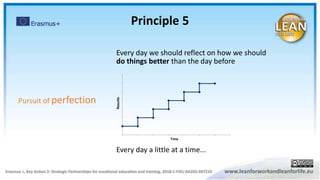
Pursuit of perfection
Every day we should reflect on how we should
do things better than the day before
Every day a little at a time...
Results
Time
Principle 5
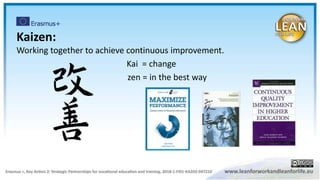
Kaizen:
Working together to achieve continuous improvement.
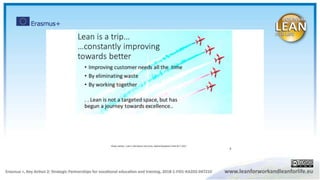
Kai = change
zen = in the best way
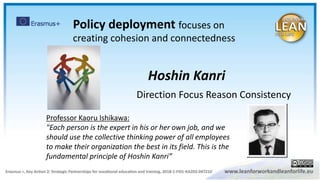
Direction Focus Reason Consistency
Hoshin Kanri
Professor Kaoru Ishikawa:
"Each person is the expert in his or her own job, and we
should use the collective thinking power of all employees
to make their organization the best in its field. This is the
fundamental principle of Hoshin Kanri”
Policy deployment focuses on
creating cohesion and connectedness
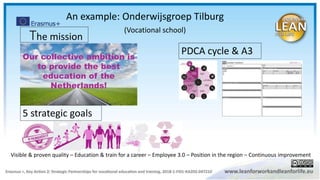
An example: Onderwijsgroep Tilburg
(Vocational school)
Our collective ambition is
to provide the best
education of the
Netherlands!
The mission
5 strategic goals
PDCA cycle & A3
Visible & proven quality – Education & train for a career – Employee 3.0 – Position in the region – Continuous improvement
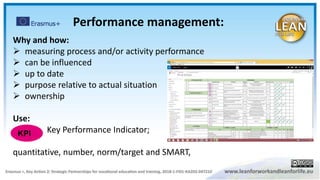
Why and how:
 measuring process and/or activity performance
 can be influenced
 up to date
 purpose relative to actual situation
 ownership
Use:
Key Performance Indicator;
quantitative, number, norm/target and SMART,
KPI
Performance management:
https://www.youtube.com/watch?v=9Co8slUvYj0
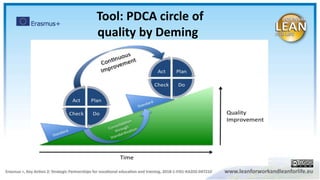
Tool: PDCA circle of
quality by Deming
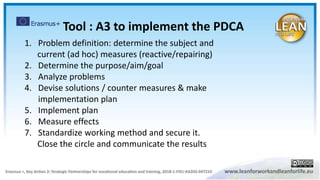
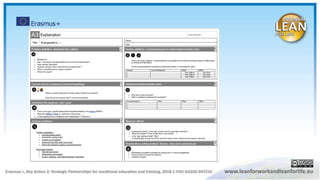
Tool : A3 to implement the PDCA
1. Problem definition: determine the subject and
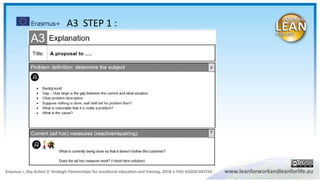
current (ad hoc) measures (reactive/repairing)
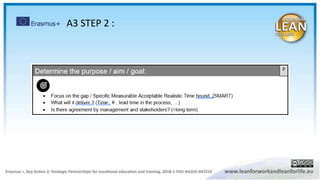
2. Determine the purpose/aim/goal
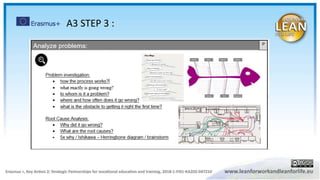
3. Analyze problems
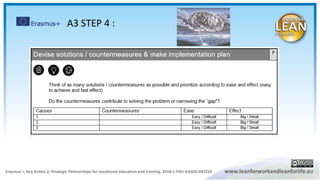
4. Devise solutions / counter measures & make
implementation plan
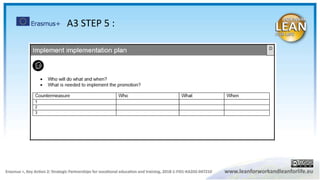
5. Implement plan
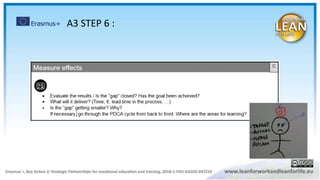
6. Measure effects
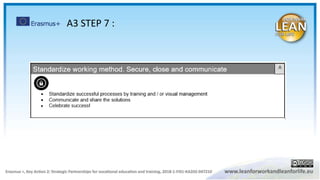
7. Standardize working method and secure it.
Close the circle and communicate the results
A3 STEP 1 :
A3 STEP 2 :
A3 STEP 3 :
A3 STEP 4 :
A3 STEP 5 :
A3 STEP 6 :
A3 STEP 7 :
https://www.youtube.com/watch?v=fqVNs2DbGVU
Board management:
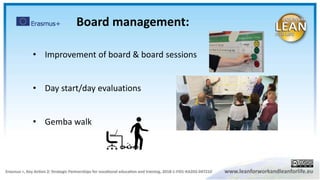
• Improvement of board & board sessions
• Day start/day evaluations
• Gemba walk
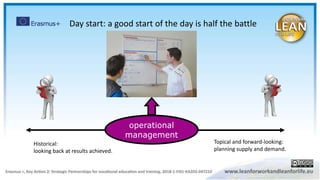
operational
management
Topical and forward-looking:
planning supply and demand.
Historical:
looking back at results achieved.
Day start: a good start of the day is half the battle
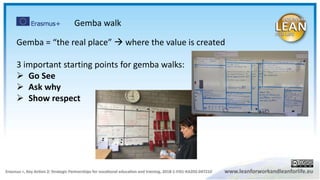
Gemba walk
Gemba = “the real place”  where the value is created
3 important starting points for gemba walks:
 Go See
 Ask why
 Show respect
 T00B-Ga Pen Game
Exercise
LEAN FOR WORK AND LEAN FOR LIFE
Train the trainer to teach Lean skills in VET

Lean for work and Lean for life - 5 - Perfection

  • 1.
    T05 BASIC LEAN TRAINING Principle5 Pursuing Perfection
  • 2.
    Objectives The objectives ofthis chapter are: Once we stabilize the process and create flow, we have to work ion continuous improvement, and for that we can use different tools that we present in this chapter
  • 3.
    Principle 5 Pursuing PERFECTION PDCA  KPI  A3  (Visual) Board management Tools:
  • 4.
  • 5.
    We place valueat the highest level when it comes to current implementations and take action. There are many things that we do not understand, so we ask why no action was taken; have you ever tried to do something? In this way, we are aware of the little we know and face the faults, correcting them, the second time you will notice another error and something else that you did not like, in such a way that you can improve again. So through constant improvement, or through action-based improvement, anyone can raise their level of knowledge and practice. “ Fujio Cho, Toyota President in 2002 Principle 5
  • 6.
    Pursuit of perfection Everyday we should reflect on how we should do things better than the day before Every day a little at a time... Results Time Principle 5
  • 7.
    Kaizen: Working together toachieve continuous improvement. Kai = change zen = in the best way
  • 8.
    Direction Focus ReasonConsistency Hoshin Kanri Professor Kaoru Ishikawa: "Each person is the expert in his or her own job, and we should use the collective thinking power of all employees to make their organization the best in its field. This is the fundamental principle of Hoshin Kanri” Policy deployment focuses on creating cohesion and connectedness
  • 9.
    An example: OnderwijsgroepTilburg (Vocational school) Our collective ambition is to provide the best education of the Netherlands! The mission 5 strategic goals PDCA cycle & A3 Visible & proven quality – Education & train for a career – Employee 3.0 – Position in the region – Continuous improvement
  • 10.
    Why and how: measuring process and/or activity performance  can be influenced  up to date  purpose relative to actual situation  ownership Use: Key Performance Indicator; quantitative, number, norm/target and SMART, KPI Performance management:
  • 11.
  • 12.
    Tool: PDCA circleof quality by Deming
  • 13.
    Tool : A3to implement the PDCA 1. Problem definition: determine the subject and current (ad hoc) measures (reactive/repairing) 2. Determine the purpose/aim/goal 3. Analyze problems 4. Devise solutions / counter measures & make implementation plan 5. Implement plan 6. Measure effects 7. Standardize working method and secure it. Close the circle and communicate the results
  • 14.
  • 15.
  • 16.
  • 17.
  • 18.
  • 19.
  • 20.
  • 22.
  • 23.
    Board management: • Improvementof board & board sessions • Day start/day evaluations • Gemba walk
  • 24.
    operational management Topical and forward-looking: planningsupply and demand. Historical: looking back at results achieved. Day start: a good start of the day is half the battle
  • 25.
    Gemba walk Gemba =“the real place”  where the value is created 3 important starting points for gemba walks:  Go See  Ask why  Show respect
  • 26.
     T00B-Ga PenGame Exercise
  • 28.
    LEAN FOR WORKAND LEAN FOR LIFE Train the trainer to teach Lean skills in VET

Editor's Notes

  • #4 Workshop with a multidisciplinary team where all people are involved (operators, team leaders, superintendents, engineers, managers ...) Gathered regularly Concrete results in a short time frame, based on a matrix of actions with assigned responsibilities In-place learning process
  • #8 4500000 Kaizen implemented in Toyorta in Japan 6.3 Kaizen per year
  • #9 Policy deployment: Direction, focus, reason coherence: this reflects why perfection is necessary . Hosin (Japanees = purpose, policy) is a term from the management philosophy. It is an annual planning phase that helps to set (business) objectieves with the aim of actually achieving them. Hoshin-systems exist in all forms. In a simple form, they can consist of forms, work instructions and action plans. It helps employees and managers to set goals and designate measurement points to check whether or not these goals have been achieved. Like many management tools Hoshin was developed in Japan, but is based on the American technology of Management by Objectives and the classic circle of Plan, Do, Check, Act (The Demming circle)
  • #10  To improve continuously the company had to create a mission. The mission is the point on the horizon. If you don’t have a mission you’re out of control. The mission of a company gives an answer to the question: What does the company want to achieve (within 4 of 5 years)? To concrete the mission you have to describe goals or aims. These goals are different aspect of the main course of the company. The goals of the company give an answer to the question; How can the company achieve it’s mission? PDCA (plan do check act) A3 : this tools helps to concrete steps to improve in the working situation. In smaller steps you will describe hoe you can achieve the goals. This is the translation of a goal or a part of a goal. It’s a tool and NOT a goal. Everywhere this tool can be of great help. It gives a guideline, a direction in the way everybody can works. It is visual and transparant.
  • #11 Performance management is about creating insight into, and steering on, the delivered performance. Performance management helps to monitor the process and the activity’s. You have to check systematic, keep it up-to-date. So you can steering on the right moment if the purpose can not be reached. Develop ownership; this is possible if the team itself make the KPI’s With regard to the operational objectives, the organization looks for KPI, with which performance is assessed and, if necessary, adjusted in time. The purpose of a Key Performance Indicator is to make the goals measurable; therefore a KPI is quantitative, it is expressed in a number and it is linked to a norm or target. The focus is on improvement. The SMART principle (specific, measurable, acceptable, realistic and time-bound) is a handy tool for drawing up KPI’s. Some examples of result KPI’s are turnover, profit, number of products, time span, production time.
  • #13 The Deming quality circle is a creative tool to achieve quality in an organization. The circle describes 4 activities that apply to all improvements in an organization. The cyclical character guarantees that quality improvement is constantly under attention. The 4 activities are: Plan : look at current work and design a plan for imporving this work. Set objectieves for this improvement. Do: implement the planned improvement in a controlled test set-up. Check: measure the result of the improvement and compare it with the original situation and test it against the set objectives. Act: adjust based on the results found at CHECK Standard: After evaluation standardization of the successful improvements can be done  consolidation The core of this vision is that every employee in a (production-) process is able in the way to assess and improve his own working method.
  • #14 The next slides will show every step with an explanation.
  • #24 Board management: Improving is a process that needs to be managed It’s the way for all employee’s, they all can participate in the continuous improvement These are some of the tools you can use.
  • #26 Gemba walk: the power of the 3 Gen Observing reality is the only way that you really solve problems. You only get to know how things are going by going to the place where products or services are produced. Go See: Is about understanding the value flow and the current bottlenecks that teams experience when flowing the value. Ask why: Encourage employees by asking questions to solve the bottlenecks (increase problem-solving capacity) Show respect: Show the right behavior, where respect for employees is very important. Teacher can see additional information about Dashboard in Thinglink