What our clients are saying
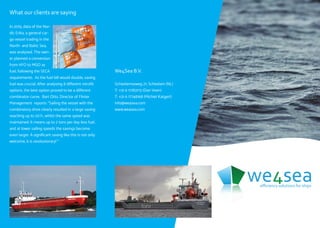
In 2015, data of the Nor-
dic Erika, a general car-
go vessel trading in the
North- and Baltic Sea,
was analysed. The own-
er planned a conversion
from HFO to MGO as
fuel, following the SECA
requirements. As the fuel bill would double, saving
fuel was crucial. After analysing 8 different retrofit
options, the best option proved to be a different
combinator curve. Bart Otto, Director of Flinter
Management reports: “Sailing the vessel with the
combinatory drive clearly resulted in a large saving
reaching up to 20%, whilst the same speed was
maintained. It means up to 2 tons per day less fuel,
and at lower sailing speeds the savings become
even larger. A significant saving like this is not only
welcome, it is revolutionary! “
efficiency solutions for ships
We4Sea B.V.
Schiedamseweg 21, Schiedam (NL)
T: +31 6 11783173 (Dan Veen)
T: +31 6 17748168 (Michiel Katgert)
info@we4sea.com
www.we4sea.com
efficiency solutions for ships
Let’s talk about efficiency
Vessels consume lots of energy. Often, over 70% of
the voyage costs of ships can be attributed to fuel
costs. New regulatory standards, such as Sulphur
Emission Control Area’s, will increase this figure even
further as it requires cleaner and more expensive
fuels for compliance. A thorough insight in fuel con-
sumption is crucial to control these costs, and drive
them downwards.
We4Sea has developed a method, that creates in-
depth insight into the fuel efficiency of ships, using
advanced tools such as energy modelling and data
analysis. We help owners to monitor and optimize
fuel costs, and introduce Data Driven Decisions in
fuel consumption for ships.
How we work
In our 20+ years’ experience in the maritime
industry, backed with our research at TU Delft
and TNO, we have seen that most ships rarely sail
as they were intended during design. Differences
can be noted in sailing speed, sailing area and fuel
type. We optimize them based on actual use, not
for intended use, giving our customers better fuel
efficiency.
We4Sea monitors your ships 24/7, using ship data,
AIS (Automatic Identification System) data and me-
teorological data (currents, waves, wind), to create
an operational profile: speed and position at any
given point in time. Secondly, we develop an energy
model of your specific ship. This model describes
the energy flows through your vessel, from the fuel
tank to the propeller. This model is different for
each ship, as the configurations, engine brands, and
setting differ per ship.
Combining the two, and using the data on the
operational profile, we can calculate how much
energy (fuel) is needed to reach the speed that
we have observed. The results of this analysis is
calculated on a continuous basis throughout the
vessels voyage, and is shown on our IT web-based
platform. This platform is accessible for our clients
by subscription.
Data shown includes ships track, fuel consumption,
fuel type used and associated cost, CO2
emissions,
speed logs, fuel-efficiency performance etc.
This data creates an in-depth insight into the ope-
rational profile of the ship, and can be the basis
of Data Driven Decisions to retrofit a ship, and
optimize fuel consumption for ships.
Retrofit: what suits you best?
The retrofitting of ships can be driven by the
need to meet new regulatory standards or by the
ship owner interest to upgrade to higher operati-
onal standards. Recent studies on the retrofitting
of ships and the development of sophisticated
simulation tools have provided new and advan-
ced capabilities to assess the performance of
green technologies or fuel saving devices in new
and existing ships. These developments are of in-
terest for ship owners for upgrading their ships to
higher environmental and operational standards.
We4Sea can perform a simulation, with the ob-
jective to find is a best suitable choice for retro-
fitting the ship to higher environmental and more
efficient operational standards, given a required
minimum Return On Investment.
efficiency solutions for ships
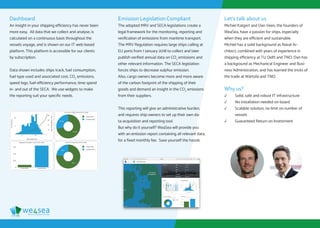
Dashboard
An insight in your shipping efficiency has never been
more easy. All data that we collect and analyse, is
calculated on a continuous basis throughout the
vessels voyage, and is shown on our IT web-based
platform. This platform is accessible for our clients
by subscription.
Data shown includes ships track, fuel consumption,
fuel type used and associated cost, CO2
emissions,
speed logs, fuel-efficiency performance, time spend
in- and out of the SECA. We use widgets to make
the reporting suit your specific needs.
Emission Legislation Compliant
The adopted MRV and SECA legislations create a
legal framework for the monitoring, reporting and
verification of emissions from maritime transport.
The MRV Regulation requires large ships calling at
EU ports from 1 January 2018 to collect and later
publish verified annual data on CO2
emissions and
other relevant information. The SECA legislation
forces ships to decrease sulphur emission.
Also, cargo owners become more and more aware
of the carbon footprint of the shipping of their
goods and demand an insight in the CO2
emissions
from their suppliers.
This reporting will give an administrative burden,
and requires ship-owners to set up their own da-
ta-acquisition and reporting tool.
But why do it yourself? We4Sea will provide you
with an emission report containing all relevant data,
for a fixed monthly fee. Save yourself the hassle.
Let’s talk about us
Michiel Katgert and Dan Veen, the founders of
We4Sea, have a passion for ships, especially
when they are efficient and sustainable.
Michiel has a solid background as Naval Ar-
chitect, combined with years of experience in
shipping efficiency at TU Delft and TNO. Dan has
a background as Mechanical Engineer and Busi-
ness Administration, and has learned the tricks of
the trade at Wärtsilä and TNO.
Why us?
√√ Solid, safe and robust IT infrastructure
√√ No installation needed on-board
√√ Scalable solution, no limit on number of
vessels
√√ Guaranteed Return on Investment

leaflet_We4Sea

  • 1.
    What our clientsare saying In 2015, data of the Nor- dic Erika, a general car- go vessel trading in the North- and Baltic Sea, was analysed. The own- er planned a conversion from HFO to MGO as fuel, following the SECA requirements. As the fuel bill would double, saving fuel was crucial. After analysing 8 different retrofit options, the best option proved to be a different combinator curve. Bart Otto, Director of Flinter Management reports: “Sailing the vessel with the combinatory drive clearly resulted in a large saving reaching up to 20%, whilst the same speed was maintained. It means up to 2 tons per day less fuel, and at lower sailing speeds the savings become even larger. A significant saving like this is not only welcome, it is revolutionary! “ efficiency solutions for ships We4Sea B.V. Schiedamseweg 21, Schiedam (NL) T: +31 6 11783173 (Dan Veen) T: +31 6 17748168 (Michiel Katgert) info@we4sea.com www.we4sea.com
  • 2.
    efficiency solutions forships Let’s talk about efficiency Vessels consume lots of energy. Often, over 70% of the voyage costs of ships can be attributed to fuel costs. New regulatory standards, such as Sulphur Emission Control Area’s, will increase this figure even further as it requires cleaner and more expensive fuels for compliance. A thorough insight in fuel con- sumption is crucial to control these costs, and drive them downwards. We4Sea has developed a method, that creates in- depth insight into the fuel efficiency of ships, using advanced tools such as energy modelling and data analysis. We help owners to monitor and optimize fuel costs, and introduce Data Driven Decisions in fuel consumption for ships. How we work In our 20+ years’ experience in the maritime industry, backed with our research at TU Delft and TNO, we have seen that most ships rarely sail as they were intended during design. Differences can be noted in sailing speed, sailing area and fuel type. We optimize them based on actual use, not for intended use, giving our customers better fuel efficiency. We4Sea monitors your ships 24/7, using ship data, AIS (Automatic Identification System) data and me- teorological data (currents, waves, wind), to create an operational profile: speed and position at any given point in time. Secondly, we develop an energy model of your specific ship. This model describes the energy flows through your vessel, from the fuel tank to the propeller. This model is different for each ship, as the configurations, engine brands, and setting differ per ship. Combining the two, and using the data on the operational profile, we can calculate how much energy (fuel) is needed to reach the speed that we have observed. The results of this analysis is calculated on a continuous basis throughout the vessels voyage, and is shown on our IT web-based platform. This platform is accessible for our clients by subscription. Data shown includes ships track, fuel consumption, fuel type used and associated cost, CO2 emissions, speed logs, fuel-efficiency performance etc. This data creates an in-depth insight into the ope- rational profile of the ship, and can be the basis of Data Driven Decisions to retrofit a ship, and optimize fuel consumption for ships. Retrofit: what suits you best? The retrofitting of ships can be driven by the need to meet new regulatory standards or by the ship owner interest to upgrade to higher operati- onal standards. Recent studies on the retrofitting of ships and the development of sophisticated simulation tools have provided new and advan- ced capabilities to assess the performance of green technologies or fuel saving devices in new and existing ships. These developments are of in- terest for ship owners for upgrading their ships to higher environmental and operational standards. We4Sea can perform a simulation, with the ob- jective to find is a best suitable choice for retro- fitting the ship to higher environmental and more efficient operational standards, given a required minimum Return On Investment.
  • 3.
    efficiency solutions forships Dashboard An insight in your shipping efficiency has never been more easy. All data that we collect and analyse, is calculated on a continuous basis throughout the vessels voyage, and is shown on our IT web-based platform. This platform is accessible for our clients by subscription. Data shown includes ships track, fuel consumption, fuel type used and associated cost, CO2 emissions, speed logs, fuel-efficiency performance, time spend in- and out of the SECA. We use widgets to make the reporting suit your specific needs. Emission Legislation Compliant The adopted MRV and SECA legislations create a legal framework for the monitoring, reporting and verification of emissions from maritime transport. The MRV Regulation requires large ships calling at EU ports from 1 January 2018 to collect and later publish verified annual data on CO2 emissions and other relevant information. The SECA legislation forces ships to decrease sulphur emission. Also, cargo owners become more and more aware of the carbon footprint of the shipping of their goods and demand an insight in the CO2 emissions from their suppliers. This reporting will give an administrative burden, and requires ship-owners to set up their own da- ta-acquisition and reporting tool. But why do it yourself? We4Sea will provide you with an emission report containing all relevant data, for a fixed monthly fee. Save yourself the hassle. Let’s talk about us Michiel Katgert and Dan Veen, the founders of We4Sea, have a passion for ships, especially when they are efficient and sustainable. Michiel has a solid background as Naval Ar- chitect, combined with years of experience in shipping efficiency at TU Delft and TNO. Dan has a background as Mechanical Engineer and Busi- ness Administration, and has learned the tricks of the trade at Wärtsilä and TNO. Why us? √√ Solid, safe and robust IT infrastructure √√ No installation needed on-board √√ Scalable solution, no limit on number of vessels √√ Guaranteed Return on Investment