



By Nazrin Parveen
Types of Leaf Modification
 Modification means a structural change due to
functional needs.
Introduction
1. Leaf Tendrils
2. Leaf Spines
3. Phyllodes
Leaf Tendril
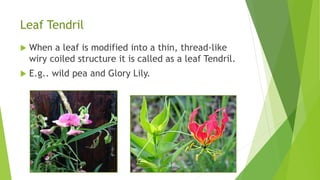
 When a leaf is modified into a thin, thread-like
wiry coiled structure it is called as a leaf Tendril.
 E.g.. wild pea and Glory Lily.
Leaf Spine
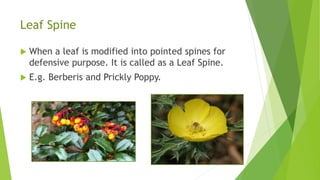
 When a leaf is modified into pointed spines for
defensive purpose. It is called as a Leaf Spine.
 E.g. Berberis and Prickly Poppy.
Phyllodes
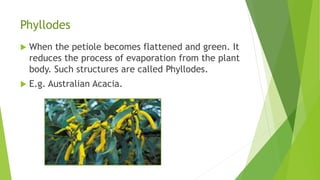
 When the petiole becomes flattened and green. It
reduces the process of evaporation from the plant
body. Such structures are called Phyllodes.
 E.g. Australian Acacia.
Insectivorous Plants
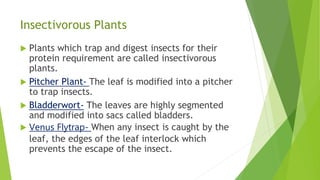
 Plants which trap and digest insects for their
protein requirement are called insectivorous
plants.
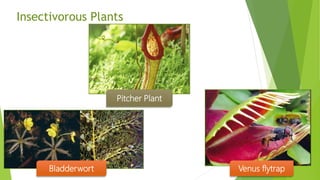
 Pitcher Plant- The leaf is modified into a pitcher
to trap insects.
 Bladderwort- The leaves are highly segmented
and modified into sacs called bladders.
 Venus Flytrap- When any insect is caught by the
leaf, the edges of the leaf interlock which
prevents the escape of the insect.
Insectivorous Plants
Pitcher Plant
Bladderwort Venus flytrap
References
 Mineral nutrition of higher plants, (second edition (1995)) .Horst Marschner.
Institute of Plant Nutrition. University of Honheim. Germany.
 Morphology of Angiosperms (1987) by John Merle Coulter, Ph.D. Head of
Department of Botany; Charles Joseph Chamberlain, Ph.D. Instructor in
Botany, The university of Chicago.
 Leaf modifications (biology discussion). Retrieved from
http://www.biologydiscussion.com/plants/modifications-of-leaves-explained-
with-diagram/6249
Leaf modification

Leaf modification

  • 1.
  • 2.
    Types of LeafModification  Modification means a structural change due to functional needs. Introduction 1. Leaf Tendrils 2. Leaf Spines 3. Phyllodes
  • 3.
    Leaf Tendril  Whena leaf is modified into a thin, thread-like wiry coiled structure it is called as a leaf Tendril.  E.g.. wild pea and Glory Lily.
  • 4.
    Leaf Spine  Whena leaf is modified into pointed spines for defensive purpose. It is called as a Leaf Spine.  E.g. Berberis and Prickly Poppy.
  • 5.
    Phyllodes  When thepetiole becomes flattened and green. It reduces the process of evaporation from the plant body. Such structures are called Phyllodes.  E.g. Australian Acacia.
  • 6.
    Insectivorous Plants  Plantswhich trap and digest insects for their protein requirement are called insectivorous plants.  Pitcher Plant- The leaf is modified into a pitcher to trap insects.  Bladderwort- The leaves are highly segmented and modified into sacs called bladders.  Venus Flytrap- When any insect is caught by the leaf, the edges of the leaf interlock which prevents the escape of the insect.
  • 7.
  • 8.
    References  Mineral nutritionof higher plants, (second edition (1995)) .Horst Marschner. Institute of Plant Nutrition. University of Honheim. Germany.  Morphology of Angiosperms (1987) by John Merle Coulter, Ph.D. Head of Department of Botany; Charles Joseph Chamberlain, Ph.D. Instructor in Botany, The university of Chicago.  Leaf modifications (biology discussion). Retrieved from http://www.biologydiscussion.com/plants/modifications-of-leaves-explained- with-diagram/6249