Leadership and Administrative Dynamics
Eckerd Fall 2011
Agenda

   Strategic    What is strategic planning? Defining
   Planning     vision, mission, goals, objectives, outputs, and units of service.
                How leaders guide staff in strategic planning exercises.

  PEST/SWOT
                Strategic planning tools reviewed in class


  Logic Model   Program planning reviewed in class


   Planning
   Exercise     Predicting future behavior and prevention.


 Memo Writing   Read memos in class.
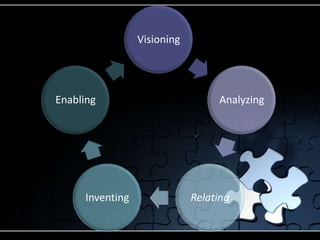
Visioning


Enabling                          Analyzing


     Inventing               Relating
Five Core Leadership Capabilities
• Visioning: Fostering individual and collective aspiration
  toward a shared vision
• Analyzing: Sense-making and strategic planning in complex
  and conflictual settings
• Relating: Building relationships and negotiating change
  across multiple stakeholders
• Inventing: Inventing new ways of working together – social
  and technical systems
• Enabling: Ensuring the tools and resources

 to implement and sustain the shared visions
Where does it go wrong?
• Imposed     vision
• Acting on assumptions – not data-
  drive decision making
• Discounting or disregarding key
  stakeholders
• If it’s not broke, why change?
• Forced internal competition for
  resources
Vision Statement
          What it is and what it is not


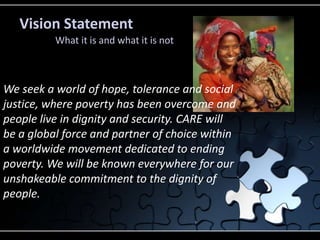
We seek a world of hope, tolerance and social
justice, where poverty has been overcome and
people live in dignity and security. CARE will
be a global force and partner of choice within
a worldwide movement dedicated to ending
poverty. We will be known everywhere for our
unshakeable commitment to the dignity of
people.
Vision Statements continued

• Weare committed to serving all
youth who come to us,
acknowledging our special
commitment to the young adults of
New York City. Our services will
address the immediate needs of
young people in crisis, and facilitate
their transition to adulthood and
self-sufficiency.
Vision Statements continued

• Tobe a national model for community
 engagement generating financial and
 voluntary contributions to meet local
 needs and make lasting improvement
 to our quality of life.
Elements of a Vision Statement
• Big Picture

• What we want to BECOME

• Clear vision provides the road to a clear
  mission statement
• One statement

• Statement is greater than what

 is possible
Mission Statement
•   Jazz at Lincoln Center is dedicated to inspiring and growing
    audiences for jazz. With the world-renowned Jazz at Lincoln
    Center Orchestra and a comprehensive array of guest
    artists, Jazz at Lincoln Center advances a unique vision for
    the continued development of the art of jazz by producing a
    year-round schedule of performance, education and
    broadcast events for audiences of all ages. These
    productions include concerts, national and international
    tours, residencies, a jazz hall of fame and concert
    series, weekly national radio programs, television
    broadcasts, recordings, publications, an annual high school
    jazz band competition and festival, a band director
    academy, jazz appreciation curriculum for students, music
    publishing, children’s concerts and classes, lectures, adult
    education courses, student and educator workshops and
    interactive websites.
Mission Statements continued
•   We who recognize God's providence and
    fidelity to His people are dedicated to
    living out His covenant among ourselves
    and those children we serve, with
    absolute respect and unconditional love.
    That commitment calls us to serve
    suffering children of the street, and to
    protect and safeguard all children. Just as
    Christ in His humanity is the visible sign
    of God's presence among His people, so
    our efforts together in the covenant
    community are a visible sign that effects
    the presence of God, working through
    the Holy Spirit among ourselves and our
    kids.
Mission Statements continued
• CARE’s mission is to serve individuals and families
  in the poorest communities in the world. Drawing
  strength from our global diversity, resources and
  experience, we promote innovative solutions and
  are advocates for global responsibility. We
  promote lasting change by:
• Strengthening capacity for self-help

• Providing economic opportunity

• Delivering relief in emergencies

• Influencing policy decisions at all levels

• Addressing discrimination in all its forms
Elements of a Mission Statement
• This answers the question: What is our business?
• Statement of purpose

• Clearly establishes reason for being

• Provides the road to establishing goals

• Staff should agree with this statement of purpose

• Resources should be allocated based on the
  mission statement
• Should establish the organizational

climate and culture
When a Mission Statement works…
• Reconciles  interests of a variety of departments,
  stakeholders and staff in general
• Motivates people to action

• Should make people passionate about “their” work

• Basis for strategic decision making
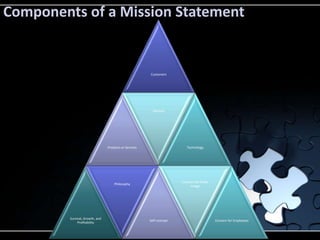
Components of a Mission Statement


                                                        Customers


                                                          Markets


                                 Products or Services                     Technology


                                                                       Concern for Public
                                     Philosophy
                                                                            Image


         Survival, Growth, and
                                                        Self-concept                        Concern for Employees
              Profitability
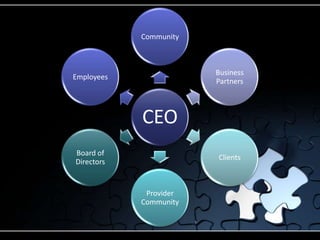
STAKEHOLDERS
Community


                        Business
Employees
                        Partners


            CEO
Board of
                        Clients
Directors


             Provider
            Community
Communities of Practice
• Groups of people who share a concern, a set of
 problems or a passion about a topic and who
 deepen their knowledge and expertise in this
 area by interacting on an ongoing basis.
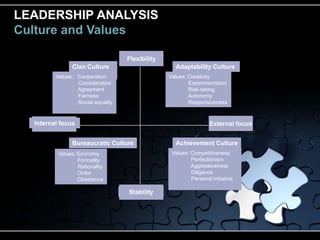
LEADERSHIP ANALYSIS
Culture and Values

                                   Flexibility
               Clan Culture                        Adaptability Culture
         Values: Cooperation                     Values: Creativity
                 Consideration                           Experimentation
                 Agreement                               Risk-taking
                 Fairness                                Autonomy
                 Social equality                         Responsiveness


  Internal focus                                                  External focus


               Bureaucratic Culture                Achievement Culture
          Values: Economy                         Values: Competitiveness
                  Formality                               Perfectionism
                  Rationality                             Aggressiveness
                  Order                                   Diligence
                  Obedience                               Personal initiative

                                   Stability
Knowledge
• Lives in the human act of knowing
• Tacit as well as explicit

• Social requiring multiple perspectives

• Dynamic – rate of change in what we know and how
  we do it is accelerating
7 principles of Community Design
• Design  for evolution.
• Open a dialogue between inside and outside
  perspectives.
• Invite different levels of participation.

• Develop both public and private community
  spaces.
• Focus on value.

• Combine familiarity and excitement.

• Create a rhythm for the community
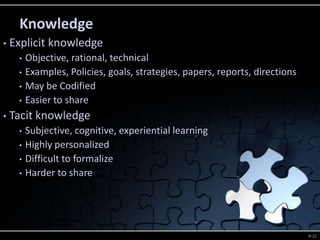
Knowledge
•   Explicit knowledge
     •   Objective, rational, technical
     •   Examples, Policies, goals, strategies, papers, reports, directions
     •   May be Codified
     •   Easier to share
•   Tacit knowledge
     •   Subjective, cognitive, experiential learning
     •   Highly personalized
     •   Difficult to formalize
     •   Harder to share


     © 2005 Prentice
     Hall, Decision                                                           9-22
What are ethics?
 • Ethos – conduct, customs or character
 • The kinds of values and morals an individual   or
   society finds appropriate or desirable.
   Northouse
 • Are ethics relative?
 • Virtue (defined): a trait of character, manifested
   in habitual action, which is good for a person to
   have.
 • Examples of Virtues:
     Benevolence, Fairness, Self-Discipline
     Self-Reliance , Honesty, Tolerance
     Conscientiousness, Loyalty, Justice
Northouse
• “Inany decision-making
 situation, ethical issues are
 either implicitly or explicitly
 involved. The choices leaders
 make and how they respond
 in a given circumstance are
 informed and directed by
 ethics.”
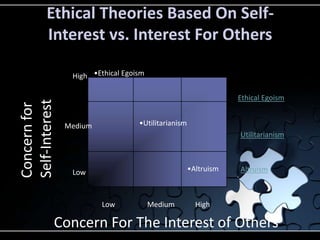
Ethical Theories Based On Self-
         Interest vs. Interest For Others

                 High •Ethical Egoism

                                                                 Ethical Egoism
Self-Interest
Concern for


                Medium             •Utilitarianism
                                                                 Utilitarianism


                 Low                                 •Altruism   Altruism


                         Low            Medium         High

            Concern For The Interest of Others
Examples
• Ethical egoism – upward aspiring manager who
  wants her team to be the best in the company
• Utilitarianism – We should create the greatest
  good (happiness) for the greatest number of
  people. (What did Rawls say about this?)
• Altruism - Leader does what is best for others

even when it conflicts with what is good
for him/her.
Virtue based ethics
• Leaders should develop virtues
  such as perseverance, public-
  spiritedness, integrity, truthfuln
  ess, fidelity, benevolence and
  humility.
Velasquez
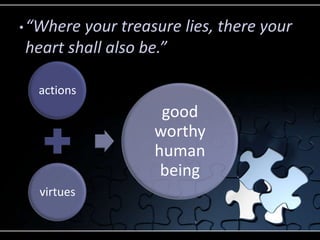
• “Whereyour treasure lies, there your
heart shall also be.”

  actions
                   good
                  worthy
                  human
                   being
  virtues
•Leadershave more
power and so more
responsibility for their
actions with others.
What do leaders do?
• Model  ethical behavior.
• Mobilize staff to face challenges.

• Maslow – leader’s role in assuring staff
  motivation and moral development.
• Move staff to a higher bar for moral
  responsibility.
Moral Environment
• How is this decided?

• What about gray areas?

• What if staff individual morals are
  not consistent with the leader’s
  desired actions.
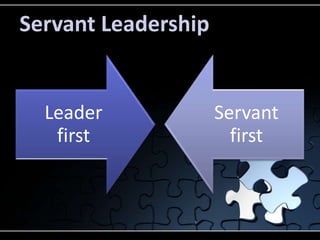
Servant Leadership


  Leader             Servant
   first               first
The BEST Test
• Do those served grow as persons? Do
 they, while being served, become
 healthier, wiser, freer, more
 autonomous, more likely themselves to
 become servants? And, what is the
 effect on the least privileged in society?
 Will they benefit or
at least not be further deprived?
Servant Leader
• Removes   inequalities
• Shifts authority to staff
• Values marketplace of ideas
• Listens
• Is Empathetic
• Establishes an unconditional
covenant with staff
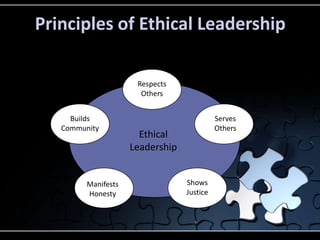
Principles of Ethical Leadership

                      Respects
                       Others


     Builds                                 Serves
   Community                                Others
                       Ethical
                     Leadership


         Manifests                Shows
         Honesty                  Justice
How do we treat staff?
• Treat
    staff as an “end”, not as a
“means to our end.”

• Discussion
Senge
• Leaders   should be stewards of the
  vision.
• Integrate vision with staff.

• These leaders see themselves as a
  part of the agency and not THE
  agency.
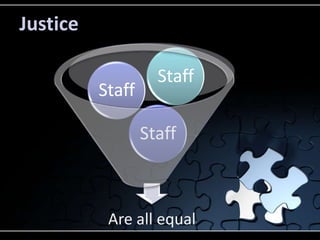
Justice

                    Staff
          Staff

                  Staff


           Are all equal
Example
• Describe an example from work
  where staff were obviously
  treated differently.
Rawls
• If
   we are “cooperating” with each other, we
 must be concerned with issues of fairness to
 promote the common interest.

•A person is required to do his part as defined
 by the rules of the institution when one has
 voluntarily accepted the benefits of
 the arrangement.
What does this mean?
• When we cooperate for mutual
  gain, we agree to restrict our
  liberties for the greater good.
• We should not gain from this
  relationship without doing our fair
  share.
Obligations
• Voluntary

• Defined by rules

• Are owed to those cooperating
  within a structure or institution.
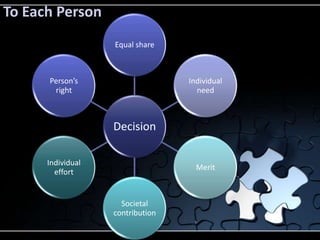
To Each Person
                   Equal share


      Person’s                    Individual
       right                        need


                   Decision

      Individual
                                    Merit
        effort


                     Societal
                   contribution
Honesty
• Do not promise what you can’t deliver.
• Do not misrepresent.
• Do not “spin” situations for your gain.
• Accept obligations.
• Accept accountability.
• Do not use “survival of the
fittest” as an excuse for being
dishonest.
Builds Community
• Leaders seek to reach out to wider
  social collectivities and seek to
  establish higher and broader
  moral purposes.
• Goals of the agency are bound up
  in the common good and
   public interest.

Lisa Sahulka - Leadership and-administrative-dynamics-sixthandseventhclass

  • 1.
    Leadership and AdministrativeDynamics Eckerd Fall 2011
  • 2.
    Agenda Strategic What is strategic planning? Defining Planning vision, mission, goals, objectives, outputs, and units of service. How leaders guide staff in strategic planning exercises. PEST/SWOT Strategic planning tools reviewed in class Logic Model Program planning reviewed in class Planning Exercise Predicting future behavior and prevention. Memo Writing Read memos in class.
  • 3.
    Visioning Enabling Analyzing Inventing Relating
  • 4.
    Five Core LeadershipCapabilities • Visioning: Fostering individual and collective aspiration toward a shared vision • Analyzing: Sense-making and strategic planning in complex and conflictual settings • Relating: Building relationships and negotiating change across multiple stakeholders • Inventing: Inventing new ways of working together – social and technical systems • Enabling: Ensuring the tools and resources to implement and sustain the shared visions
  • 5.
    Where does itgo wrong? • Imposed vision • Acting on assumptions – not data- drive decision making • Discounting or disregarding key stakeholders • If it’s not broke, why change? • Forced internal competition for resources
  • 6.
    Vision Statement What it is and what it is not We seek a world of hope, tolerance and social justice, where poverty has been overcome and people live in dignity and security. CARE will be a global force and partner of choice within a worldwide movement dedicated to ending poverty. We will be known everywhere for our unshakeable commitment to the dignity of people.
  • 7.
    Vision Statements continued •Weare committed to serving all youth who come to us, acknowledging our special commitment to the young adults of New York City. Our services will address the immediate needs of young people in crisis, and facilitate their transition to adulthood and self-sufficiency.
  • 8.
    Vision Statements continued •Tobe a national model for community engagement generating financial and voluntary contributions to meet local needs and make lasting improvement to our quality of life.
  • 9.
    Elements of aVision Statement • Big Picture • What we want to BECOME • Clear vision provides the road to a clear mission statement • One statement • Statement is greater than what is possible
  • 10.
    Mission Statement • Jazz at Lincoln Center is dedicated to inspiring and growing audiences for jazz. With the world-renowned Jazz at Lincoln Center Orchestra and a comprehensive array of guest artists, Jazz at Lincoln Center advances a unique vision for the continued development of the art of jazz by producing a year-round schedule of performance, education and broadcast events for audiences of all ages. These productions include concerts, national and international tours, residencies, a jazz hall of fame and concert series, weekly national radio programs, television broadcasts, recordings, publications, an annual high school jazz band competition and festival, a band director academy, jazz appreciation curriculum for students, music publishing, children’s concerts and classes, lectures, adult education courses, student and educator workshops and interactive websites.
  • 11.
    Mission Statements continued • We who recognize God's providence and fidelity to His people are dedicated to living out His covenant among ourselves and those children we serve, with absolute respect and unconditional love. That commitment calls us to serve suffering children of the street, and to protect and safeguard all children. Just as Christ in His humanity is the visible sign of God's presence among His people, so our efforts together in the covenant community are a visible sign that effects the presence of God, working through the Holy Spirit among ourselves and our kids.
  • 12.
    Mission Statements continued •CARE’s mission is to serve individuals and families in the poorest communities in the world. Drawing strength from our global diversity, resources and experience, we promote innovative solutions and are advocates for global responsibility. We promote lasting change by: • Strengthening capacity for self-help • Providing economic opportunity • Delivering relief in emergencies • Influencing policy decisions at all levels • Addressing discrimination in all its forms
  • 13.
    Elements of aMission Statement • This answers the question: What is our business? • Statement of purpose • Clearly establishes reason for being • Provides the road to establishing goals • Staff should agree with this statement of purpose • Resources should be allocated based on the mission statement • Should establish the organizational climate and culture
  • 14.
    When a MissionStatement works… • Reconciles interests of a variety of departments, stakeholders and staff in general • Motivates people to action • Should make people passionate about “their” work • Basis for strategic decision making
  • 15.
    Components of aMission Statement Customers Markets Products or Services Technology Concern for Public Philosophy Image Survival, Growth, and Self-concept Concern for Employees Profitability
  • 16.
  • 17.
    Community Business Employees Partners CEO Board of Clients Directors Provider Community
  • 18.
    Communities of Practice •Groups of people who share a concern, a set of problems or a passion about a topic and who deepen their knowledge and expertise in this area by interacting on an ongoing basis.
  • 19.
    LEADERSHIP ANALYSIS Culture andValues Flexibility Clan Culture Adaptability Culture Values: Cooperation Values: Creativity Consideration Experimentation Agreement Risk-taking Fairness Autonomy Social equality Responsiveness Internal focus External focus Bureaucratic Culture Achievement Culture Values: Economy Values: Competitiveness Formality Perfectionism Rationality Aggressiveness Order Diligence Obedience Personal initiative Stability
  • 20.
    Knowledge • Lives inthe human act of knowing • Tacit as well as explicit • Social requiring multiple perspectives • Dynamic – rate of change in what we know and how we do it is accelerating
  • 21.
    7 principles ofCommunity Design • Design for evolution. • Open a dialogue between inside and outside perspectives. • Invite different levels of participation. • Develop both public and private community spaces. • Focus on value. • Combine familiarity and excitement. • Create a rhythm for the community
  • 22.
    Knowledge • Explicit knowledge • Objective, rational, technical • Examples, Policies, goals, strategies, papers, reports, directions • May be Codified • Easier to share • Tacit knowledge • Subjective, cognitive, experiential learning • Highly personalized • Difficult to formalize • Harder to share © 2005 Prentice Hall, Decision 9-22
  • 23.
    What are ethics? • Ethos – conduct, customs or character • The kinds of values and morals an individual or society finds appropriate or desirable. Northouse • Are ethics relative? • Virtue (defined): a trait of character, manifested in habitual action, which is good for a person to have. • Examples of Virtues: Benevolence, Fairness, Self-Discipline Self-Reliance , Honesty, Tolerance Conscientiousness, Loyalty, Justice
  • 24.
    Northouse • “Inany decision-making situation, ethical issues are either implicitly or explicitly involved. The choices leaders make and how they respond in a given circumstance are informed and directed by ethics.”
  • 25.
    Ethical Theories BasedOn Self- Interest vs. Interest For Others High •Ethical Egoism Ethical Egoism Self-Interest Concern for Medium •Utilitarianism Utilitarianism Low •Altruism Altruism Low Medium High Concern For The Interest of Others
  • 26.
    Examples • Ethical egoism– upward aspiring manager who wants her team to be the best in the company • Utilitarianism – We should create the greatest good (happiness) for the greatest number of people. (What did Rawls say about this?) • Altruism - Leader does what is best for others even when it conflicts with what is good for him/her.
  • 27.
    Virtue based ethics •Leaders should develop virtues such as perseverance, public- spiritedness, integrity, truthfuln ess, fidelity, benevolence and humility. Velasquez
  • 28.
    • “Whereyour treasurelies, there your heart shall also be.” actions good worthy human being virtues
  • 29.
    •Leadershave more power andso more responsibility for their actions with others.
  • 30.
    What do leadersdo? • Model ethical behavior. • Mobilize staff to face challenges. • Maslow – leader’s role in assuring staff motivation and moral development. • Move staff to a higher bar for moral responsibility.
  • 31.
    Moral Environment • Howis this decided? • What about gray areas? • What if staff individual morals are not consistent with the leader’s desired actions.
  • 32.
    Servant Leadership Leader Servant first first
  • 33.
    The BEST Test •Do those served grow as persons? Do they, while being served, become healthier, wiser, freer, more autonomous, more likely themselves to become servants? And, what is the effect on the least privileged in society? Will they benefit or at least not be further deprived?
  • 34.
    Servant Leader • Removes inequalities • Shifts authority to staff • Values marketplace of ideas • Listens • Is Empathetic • Establishes an unconditional covenant with staff
  • 35.
    Principles of EthicalLeadership Respects Others Builds Serves Community Others Ethical Leadership Manifests Shows Honesty Justice
  • 36.
    How do wetreat staff? • Treat staff as an “end”, not as a “means to our end.” • Discussion
  • 37.
    Senge • Leaders should be stewards of the vision. • Integrate vision with staff. • These leaders see themselves as a part of the agency and not THE agency.
  • 38.
    Justice Staff Staff Staff Are all equal
  • 39.
    Example • Describe anexample from work where staff were obviously treated differently.
  • 40.
    Rawls • If we are “cooperating” with each other, we must be concerned with issues of fairness to promote the common interest. •A person is required to do his part as defined by the rules of the institution when one has voluntarily accepted the benefits of the arrangement.
  • 41.
    What does thismean? • When we cooperate for mutual gain, we agree to restrict our liberties for the greater good. • We should not gain from this relationship without doing our fair share.
  • 42.
    Obligations • Voluntary • Definedby rules • Are owed to those cooperating within a structure or institution.
  • 43.
    To Each Person Equal share Person’s Individual right need Decision Individual Merit effort Societal contribution
  • 44.
    Honesty • Do notpromise what you can’t deliver. • Do not misrepresent. • Do not “spin” situations for your gain. • Accept obligations. • Accept accountability. • Do not use “survival of the fittest” as an excuse for being dishonest.
  • 45.
    Builds Community • Leadersseek to reach out to wider social collectivities and seek to establish higher and broader moral purposes. • Goals of the agency are bound up in the common good and public interest.

Editor's Notes

  • #22 Help the community developInvolve outside experts, leadersQuantifying new techniques – why is the group important. What is it contributingPlace to think, reflect and consider new ideasBeat not too fast or too slow
  • #24 Virtue: is a habit, acquired over time, in particular situations, of responding appropriately and exemplifying excellence. Flourishing (excellence) has do with fulfilling all that we most have in us to become Ethics:IntuitiveAppropriate to the situationCan’t explainOccurs without deliberationInvolves emotionsSpecific history brought to bearMoralityMoralityUniversal TruthsRationalUniversal principleSubject to justificationSubject to deliberationDetached from body and emotionsDevoid of self-interestCultureHegel (1770-1831)“Situational”Ethical life (“sittlichkeit”) is embedded in culture/ social institutions and demonstrates intention, desire,or belief of collective spirit (“Geist”). Universal truthKant (1724-1804)“Categorical imperative”Requires unconditional moral action
  • #27 Utilitarianism: Bentham (1748-1832) and Mill (1806-1873)Acts are morally right when they produce the most good (greatest happiness) for the most people. Morality Universal TruthHabermas-(1924-) Frankfurt School of Critical Theoryand Discourse Ethics Rawls-Theory of Justice (Published in 1971)Social and economic inequalities are to be arranged so that they: (a) provide the greatest benefit to the least advantaged, and (b) conditions of fair equality of opportunity.
  • #28 Business Ethics: Concepts & CasesDr. Manuel G Velasquez Santa Clara UniversityCharles J. Dirksen Professor Business Ethics, Management Department
  • #31 How does a leader do this in a human services environment?
  • #33 Robert Greenleaf"The servant-leader is servant first… It begins with the natural feeling that one wants to serve, to serve first. Then conscious choice brings one to aspire to lead. That person is sharply different from one who is leader first, perhaps because of the need to assuage an unusual power drive or to acquire material possessions…The leader-first and the servant-first are two extreme types. Between them there are shadings and blends that are part of the infinite variety of human nature.""The difference manifests itself in the care taken by the servant-first to make sure that other people’s highest priority needs are being served. The best test, and difficult to administer, is: Do those served grow as persons? Do they, while being served, become healthier, wiser, freer, more autonomous, more likely themselves to become servants? And, what is the effect on the least privileged in society? Will they benefit or at least not be further deprived?"
  • #37 Staff’s unconditional worth. Respect to other’s ideas. Defer to others.Treat staff in ways that confirm the values set for the agency.
  • #39 When staff are treated different the grounds for different treatment must be clear, reasonable and based on sound moral values.
  • #41 Establish clear rules for rewarding staff.
  • #45 John Dalla Costa is the founder of the Centre for Ethical Orientation (CEO), a Toronto-based consultancy working with business, the public sector  Book the ethical imperative.