






Diversity Management Workshop
INTRODUCTION AND CHECK-IN


© Mandate Molefi HR Consultants CC
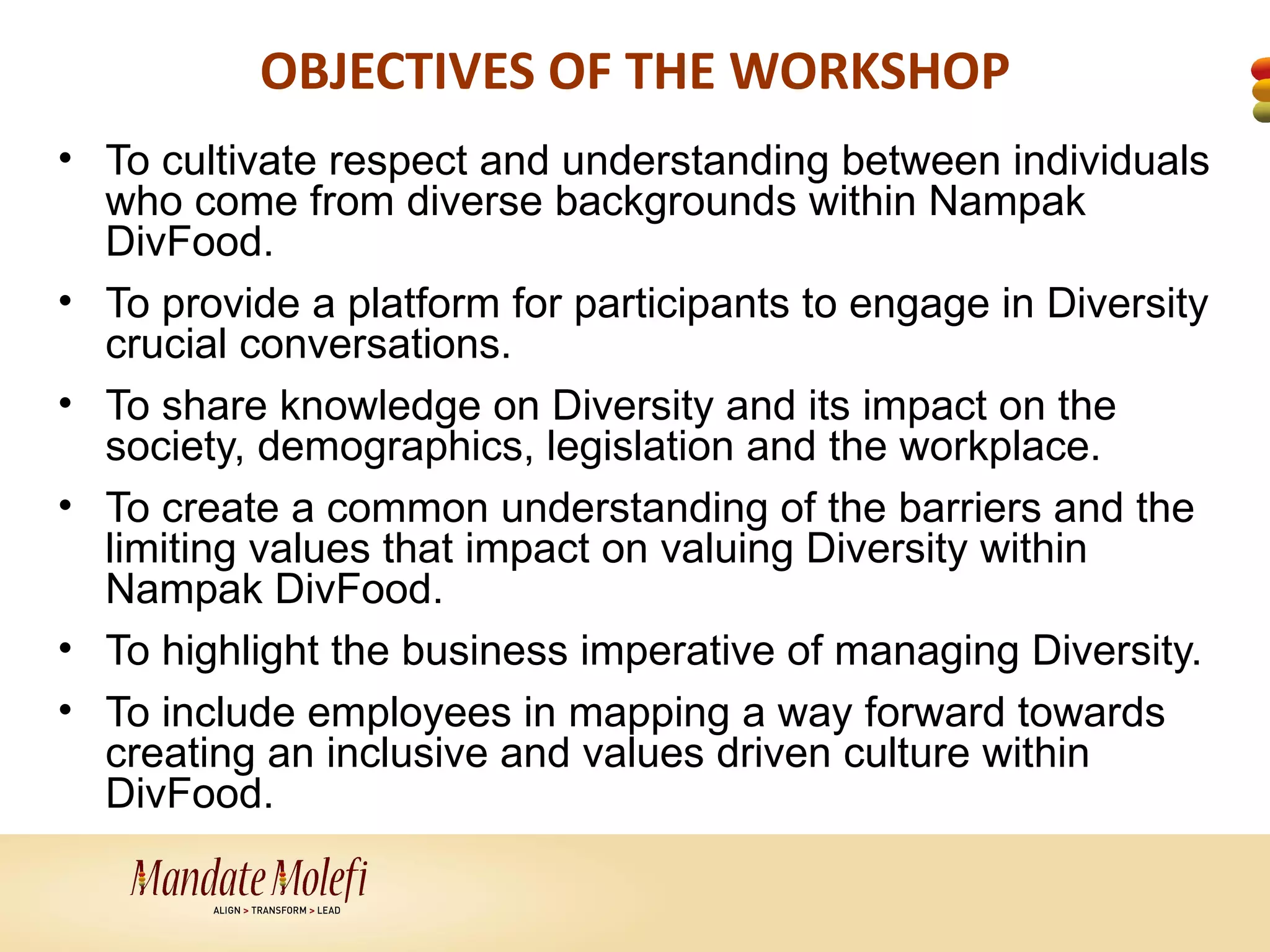
OBJECTIVES OF THE WORKSHOP
• To cultivate respect and understanding between individuals
  who come from diverse backgrounds within Nampak
  DivFood.
• To provide a platform for participants to engage in Diversity
  crucial conversations.
• To share knowledge on Diversity and its impact on the
  society, demographics, legislation and the workplace.
• To create a common understanding of the barriers and the
  limiting values that impact on valuing Diversity within
  Nampak DivFood.
• To highlight the business imperative of managing Diversity.
• To include employees in mapping a way forward towards
  creating an inclusive and values driven culture within
  DivFood.
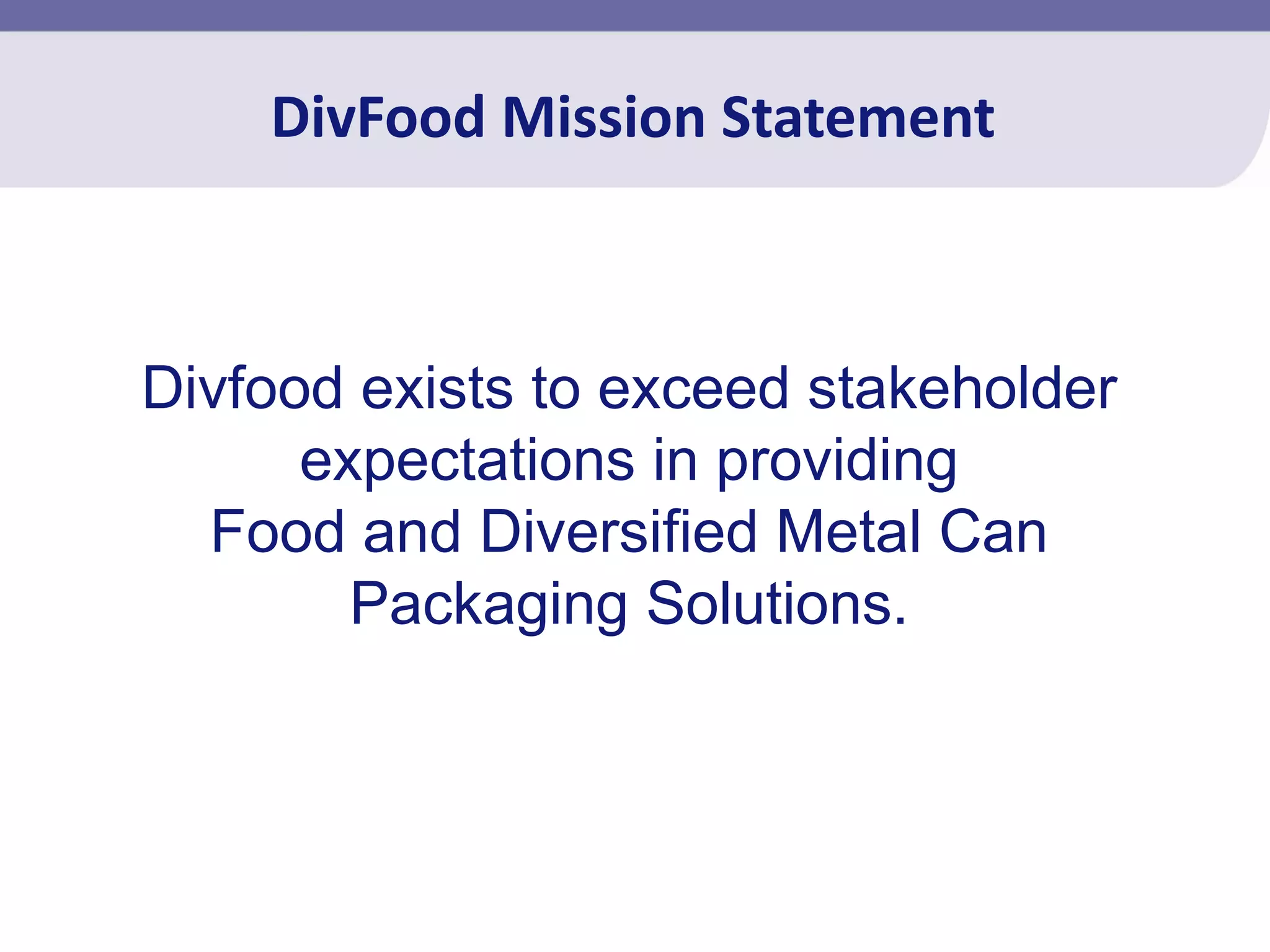
DivFood Mission Statement


Divfood exists to exceed stakeholder
      expectations in providing
  Food and Diversified Metal Can
        Packaging Solutions.
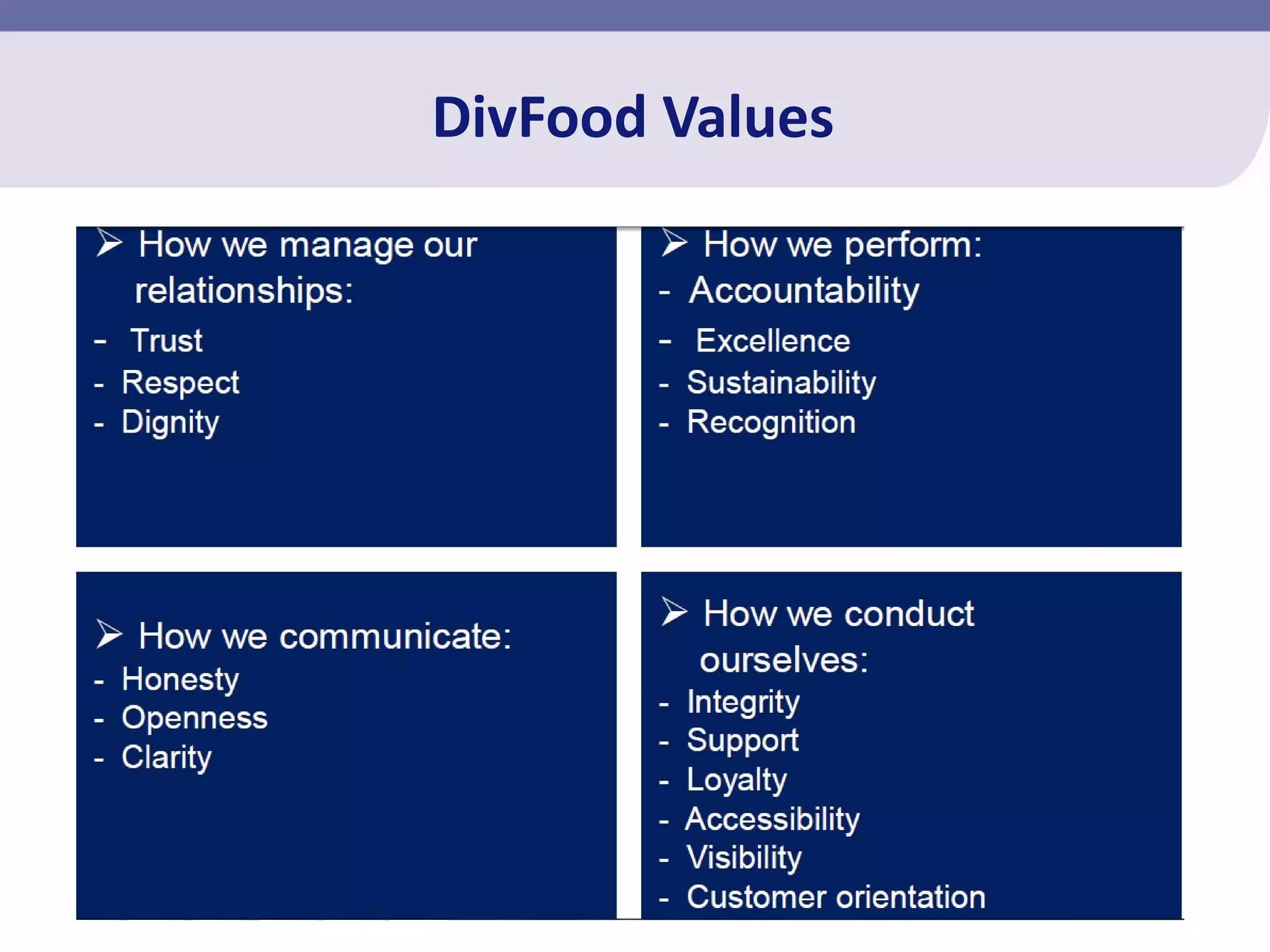
DivFood Values
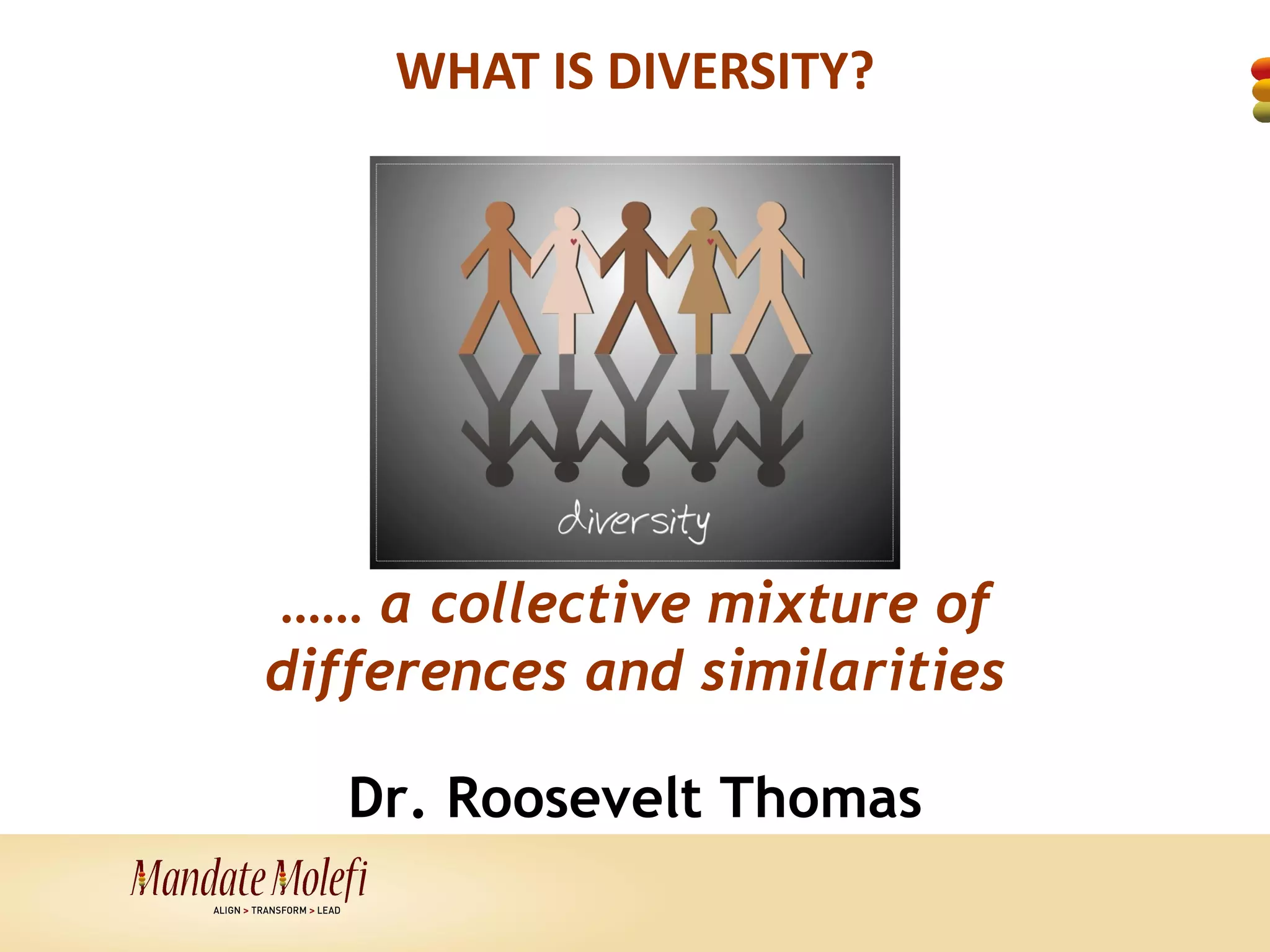
WHAT IS DIVERSITY?


…… a collective mixture of
differences and similarities

   Dr. Roosevelt Thomas
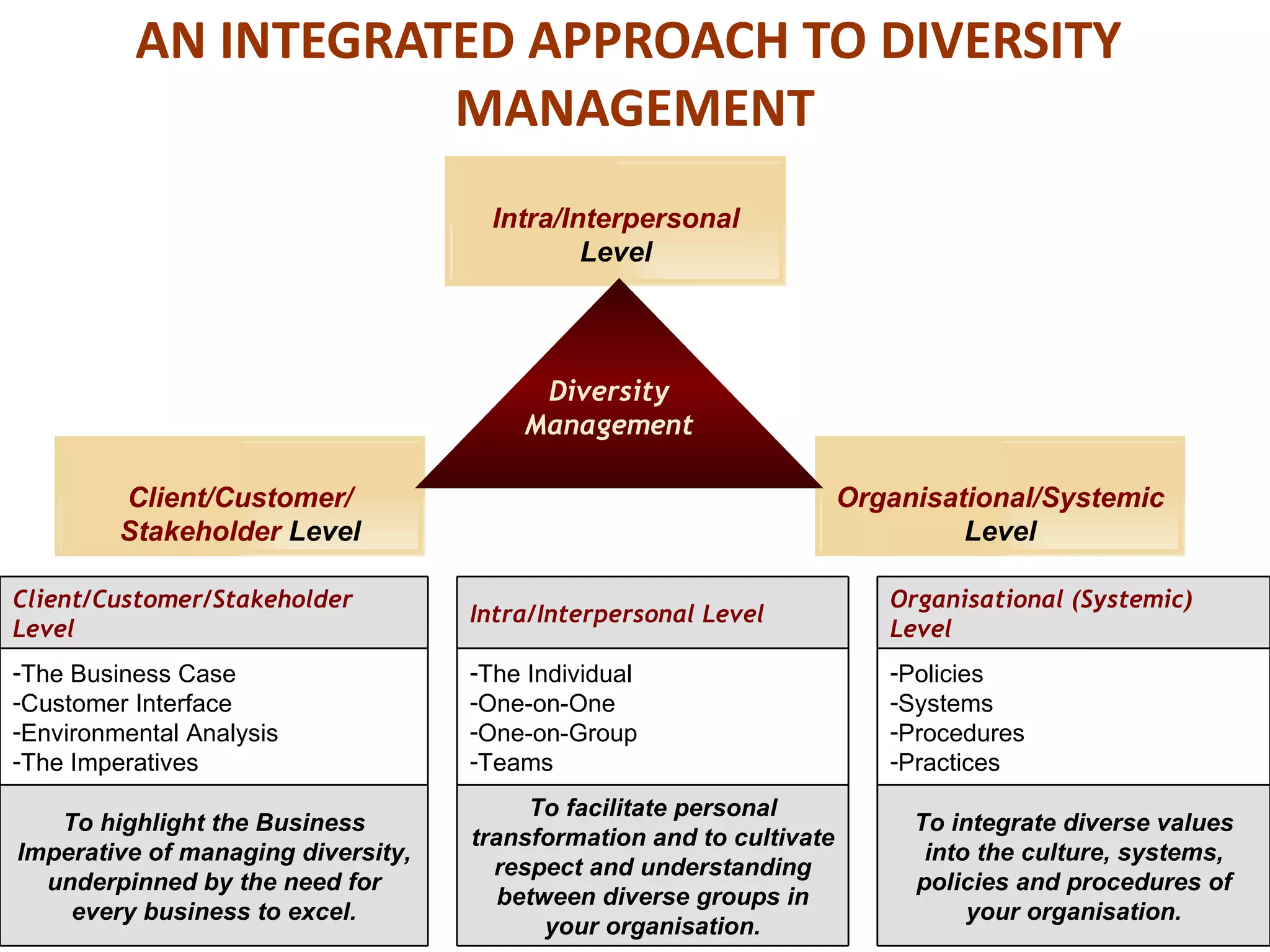
AN INTEGRATED APPROACH TO DIVERSITY
                     MANAGEMENT
                                      Intra/Interpersonal
                                              Level


                                         Diversity
                                        Management

         Client/Customer/                                             Organisational/Systemic
         Stakeholder Level                                                     Level

Client/Customer/Stakeholder                                              Organisational (Systemic)
                                    Intra/Interpersonal Level
Level                                                                    Level
-The Business Case                  -The Individual                      -Policies
-Customer Interface                 -One-on-One                          -Systems
-Environmental Analysis             -One-on-Group                        -Procedures
-The Imperatives                    -Teams                               -Practices
                                         To facilitate personal
   To highlight the Business                                               To integrate diverse values
                                    transformation and to cultivate
Imperative of managing diversity,                                           into the culture, systems,
                                      respect and understanding
  underpinned by the need for                                              policies and procedures of
                                       between diverse groups in
    every business to excel.                                                    your organisation.
                                           your organisation.
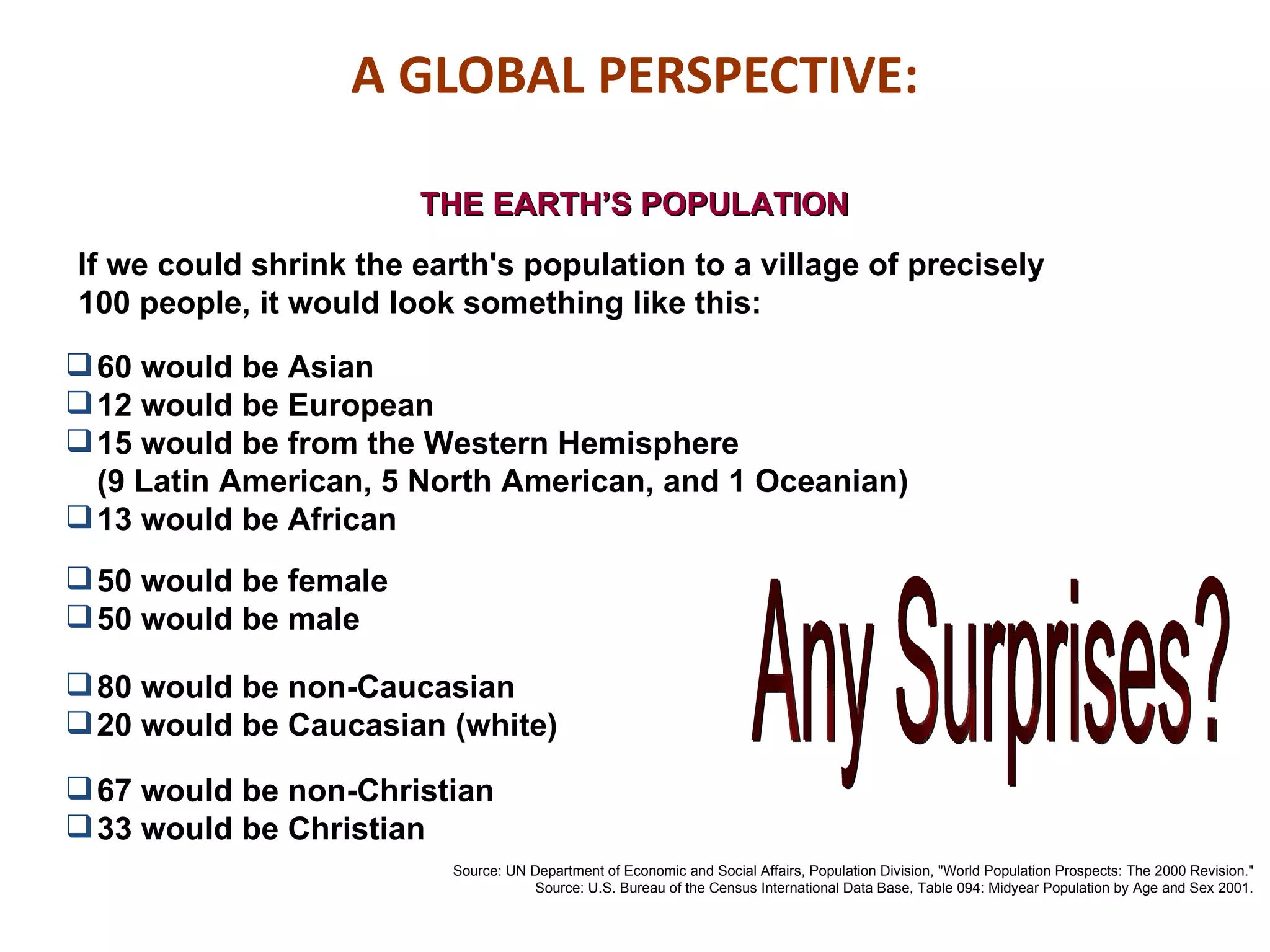
A GLOBAL PERSPECTIVE:

                       THE EARTH’S POPULATION
If we could shrink the earth's population to a village of precisely
100 people, it would look something like this:
 60 would be Asian
 12 would be European
 15 would be from the Western Hemisphere
  (9 Latin American, 5 North American, and 1 Oceanian)
 13 would be African
 50 would be female
 50 would be male

 80 would be non-Caucasian
 20 would be Caucasian (white)

 67 would be non-Christian
 33 would be Christian
                         Source: UN Department of Economic and Social Affairs, Population Division, "World Population Prospects: The 2000 Revision."
                                    Source: U.S. Bureau of the Census International Data Base, Table 094: Midyear Population by Age and Sex 2001.
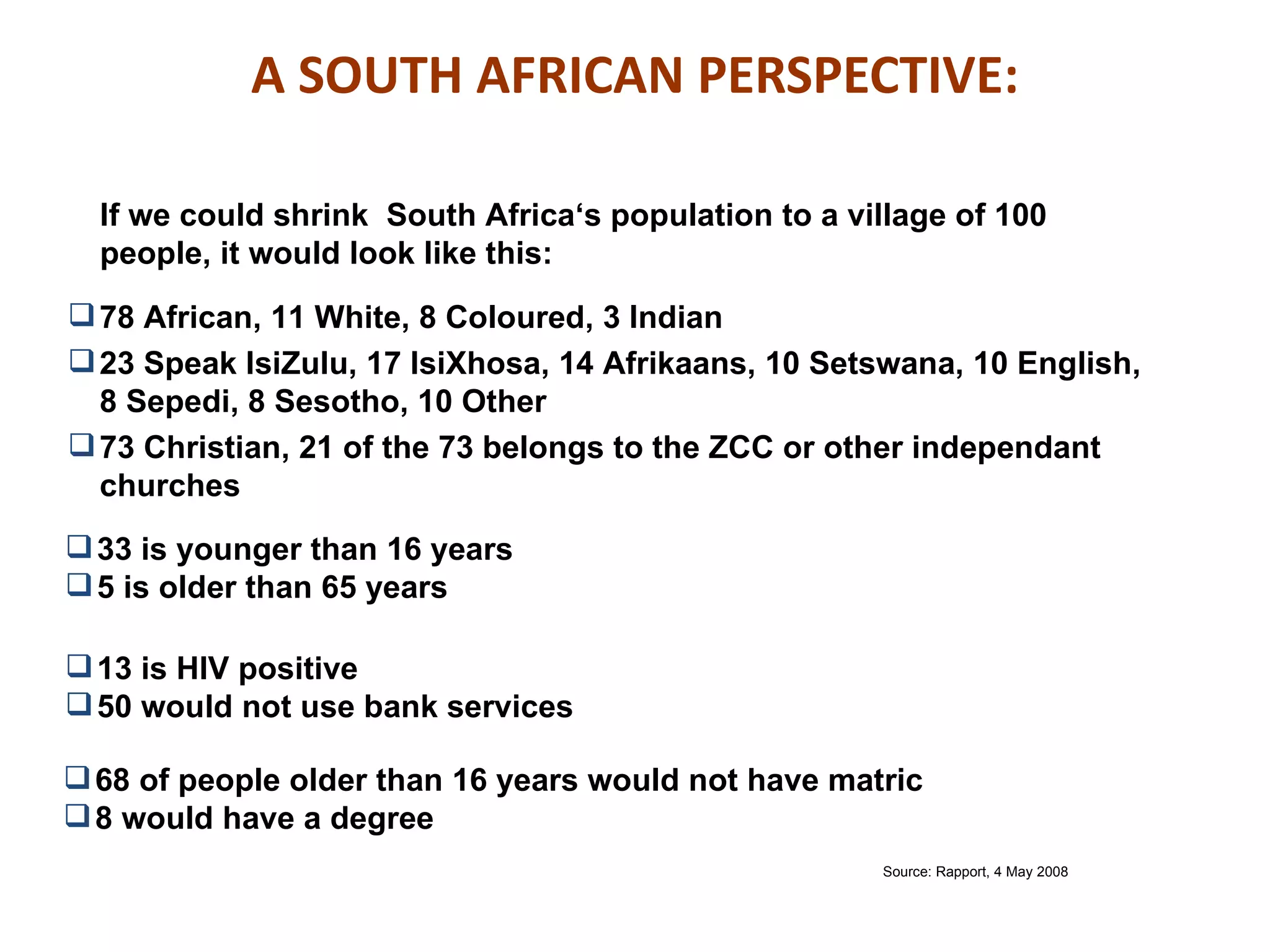
A SOUTH AFRICAN PERSPECTIVE:

  If we could shrink South Africa‘s population to a village of 100
  people, it would look like this:
 78 African, 11 White, 8 Coloured, 3 Indian
 23 Speak IsiZulu, 17 IsiXhosa, 14 Afrikaans, 10 Setswana, 10 English,
  8 Sepedi, 8 Sesotho, 10 Other
 73 Christian, 21 of the 73 belongs to the ZCC or other independant
  churches
 33 is younger than 16 years
 5 is older than 65 years

 13 is HIV positive
 50 would not use bank services

 68 of people older than 16 years would not have matric
 8 would have a degree
                                                      Source: Rapport, 4 May 2008
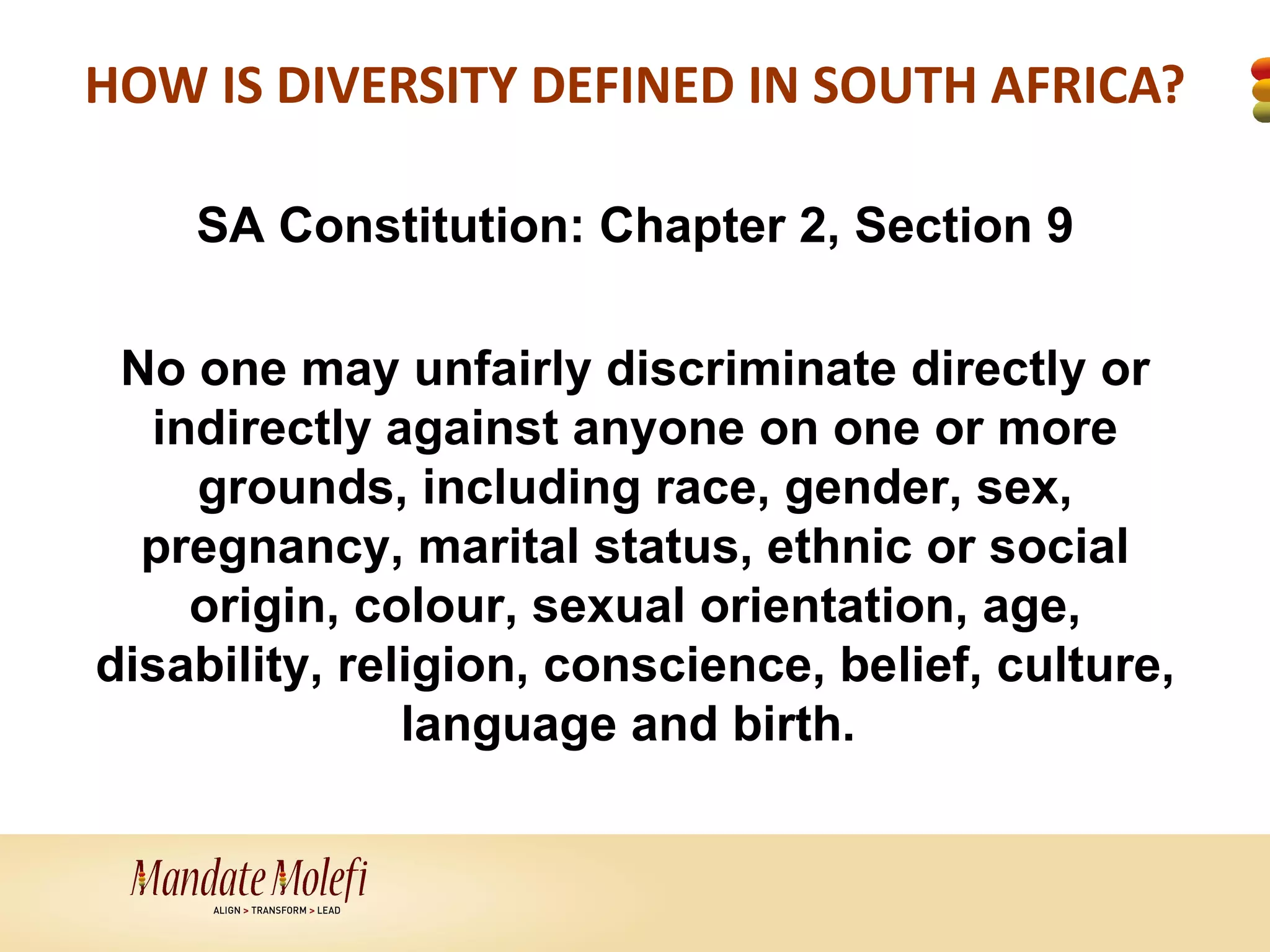
HOW IS DIVERSITY DEFINED IN SOUTH AFRICA?

    SA Constitution: Chapter 2, Section 9

 No one may unfairly discriminate directly or
  indirectly against anyone on one or more
    grounds, including race, gender, sex,
  pregnancy, marital status, ethnic or social
    origin, colour, sexual orientation, age,
disability, religion, conscience, belief, culture,
               language and birth.
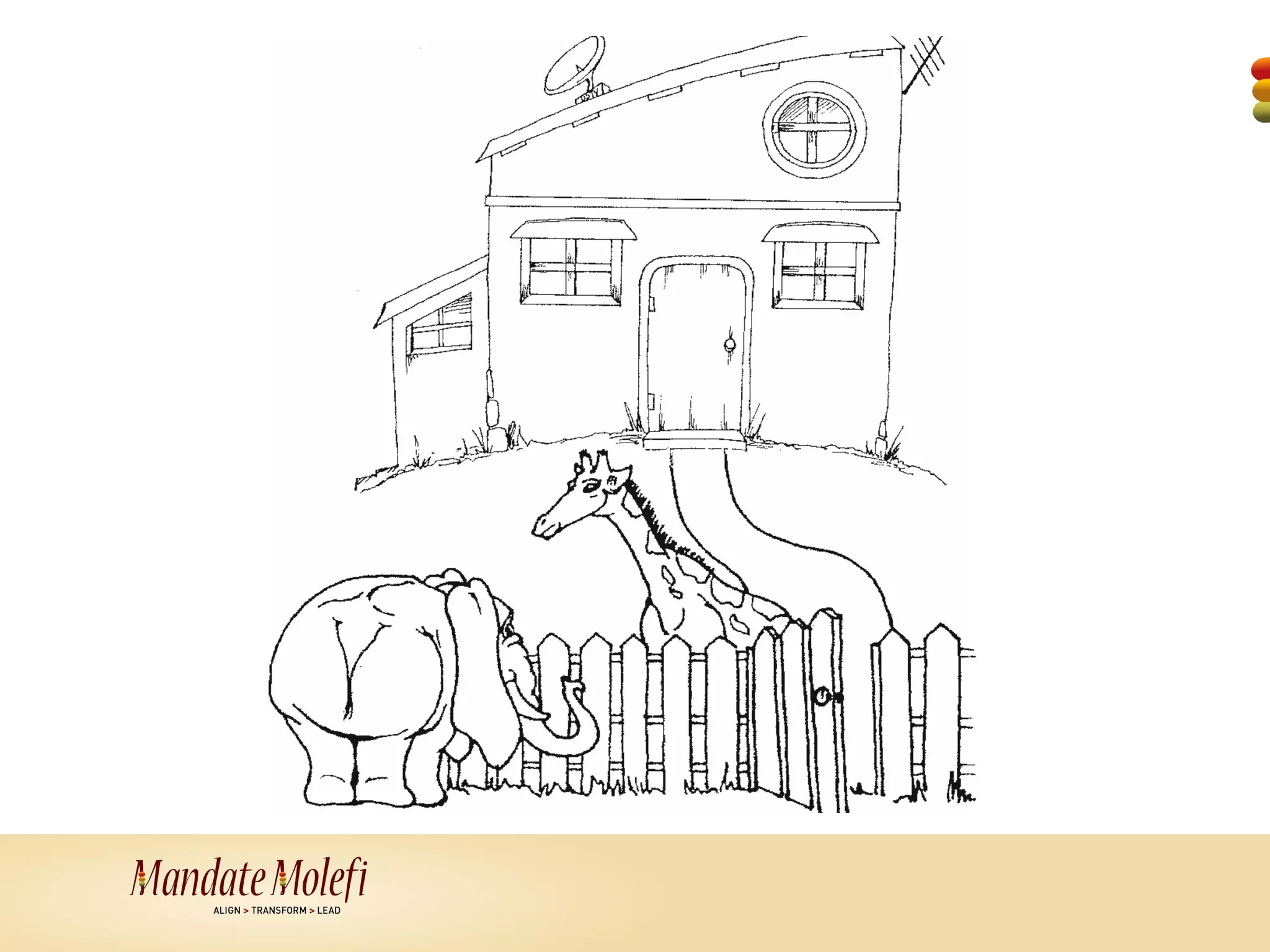
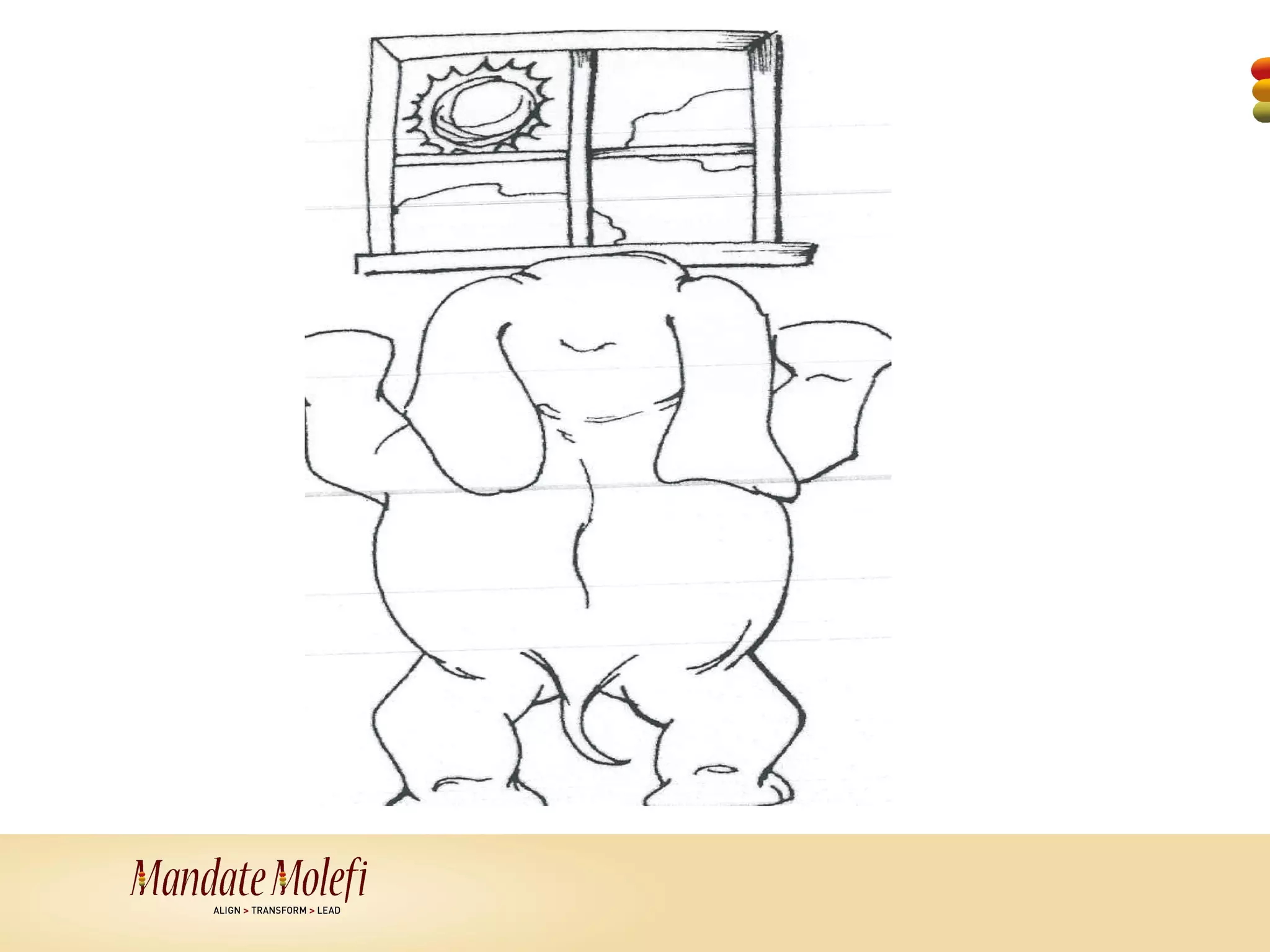
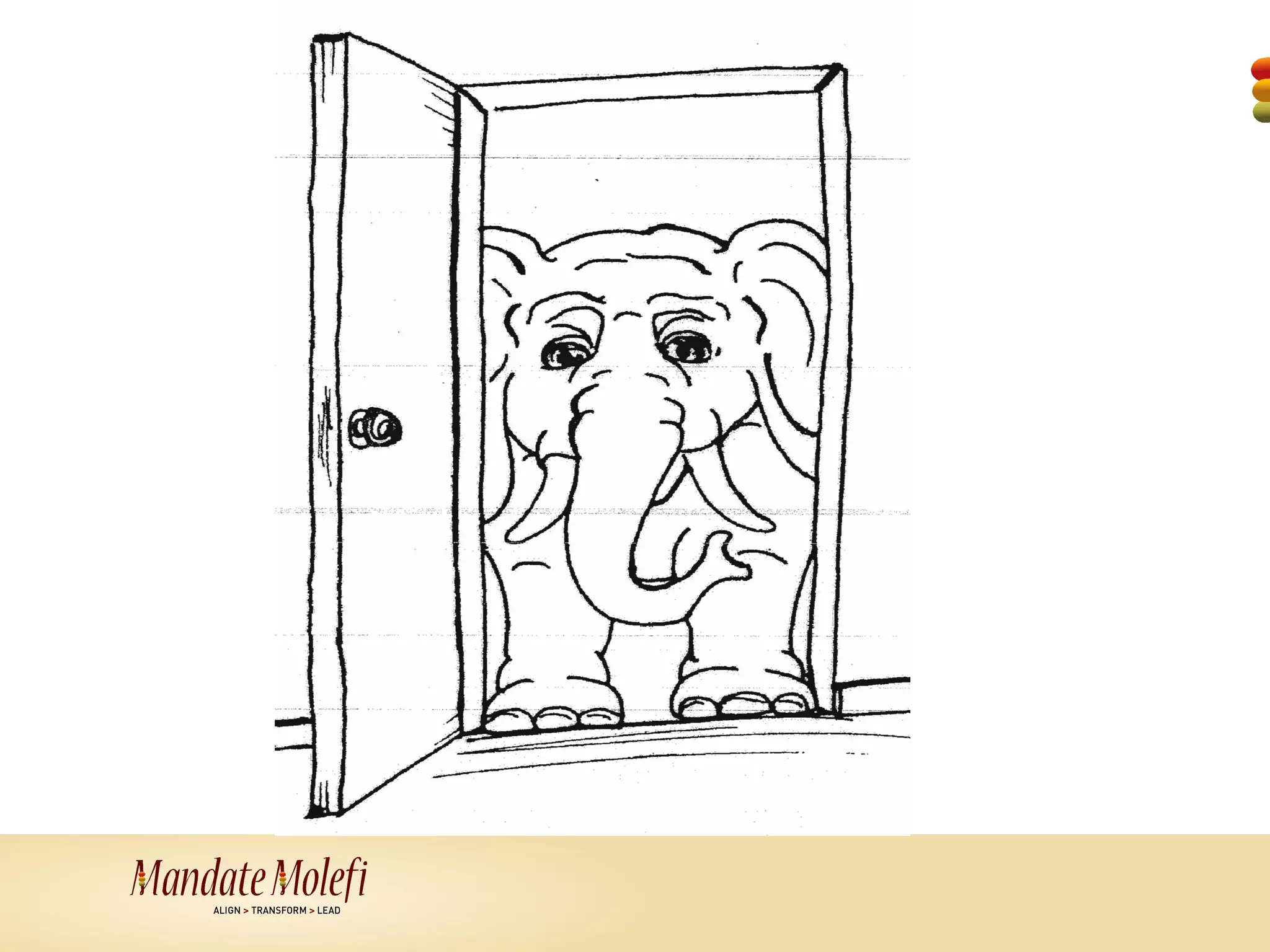
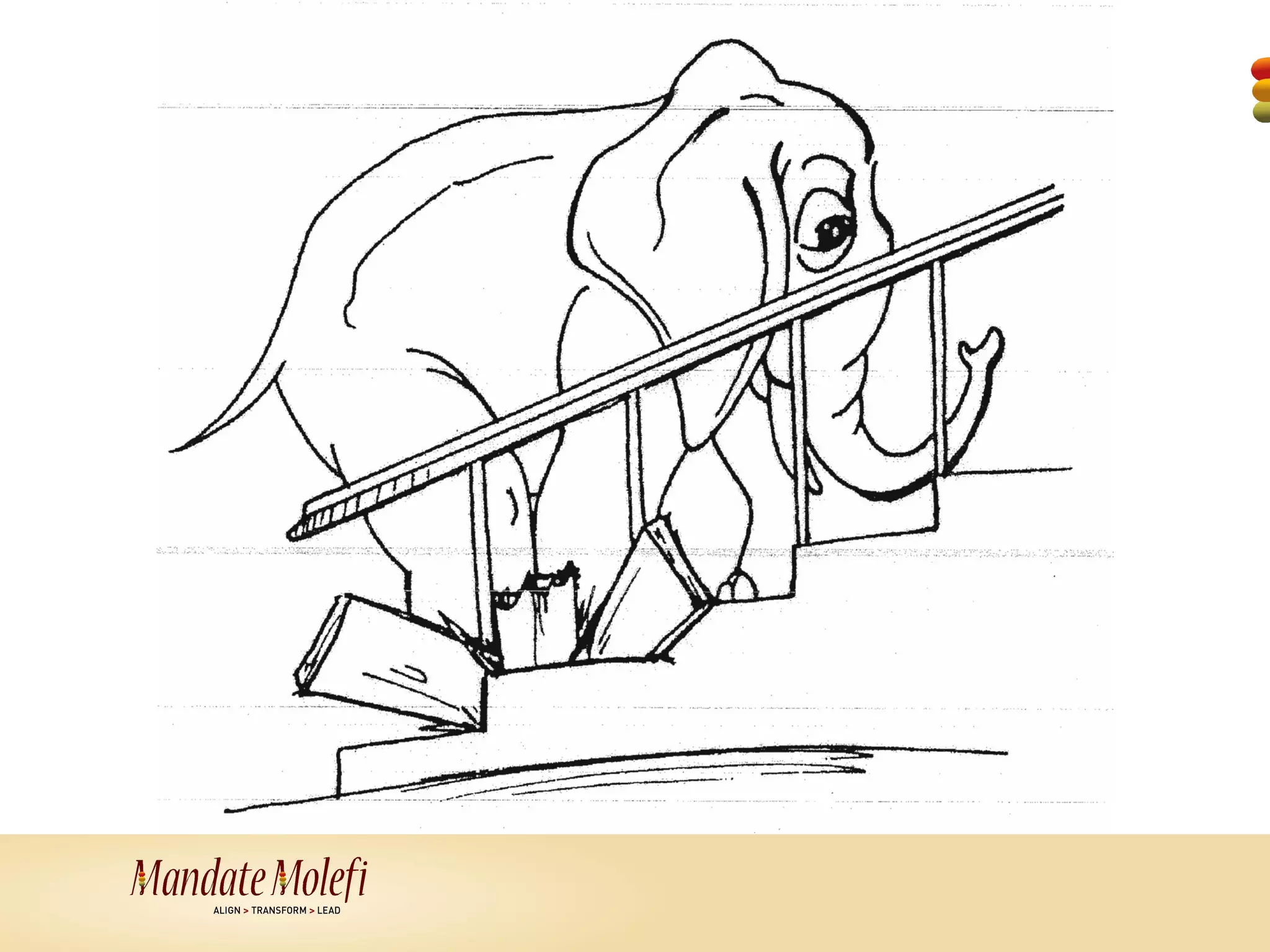
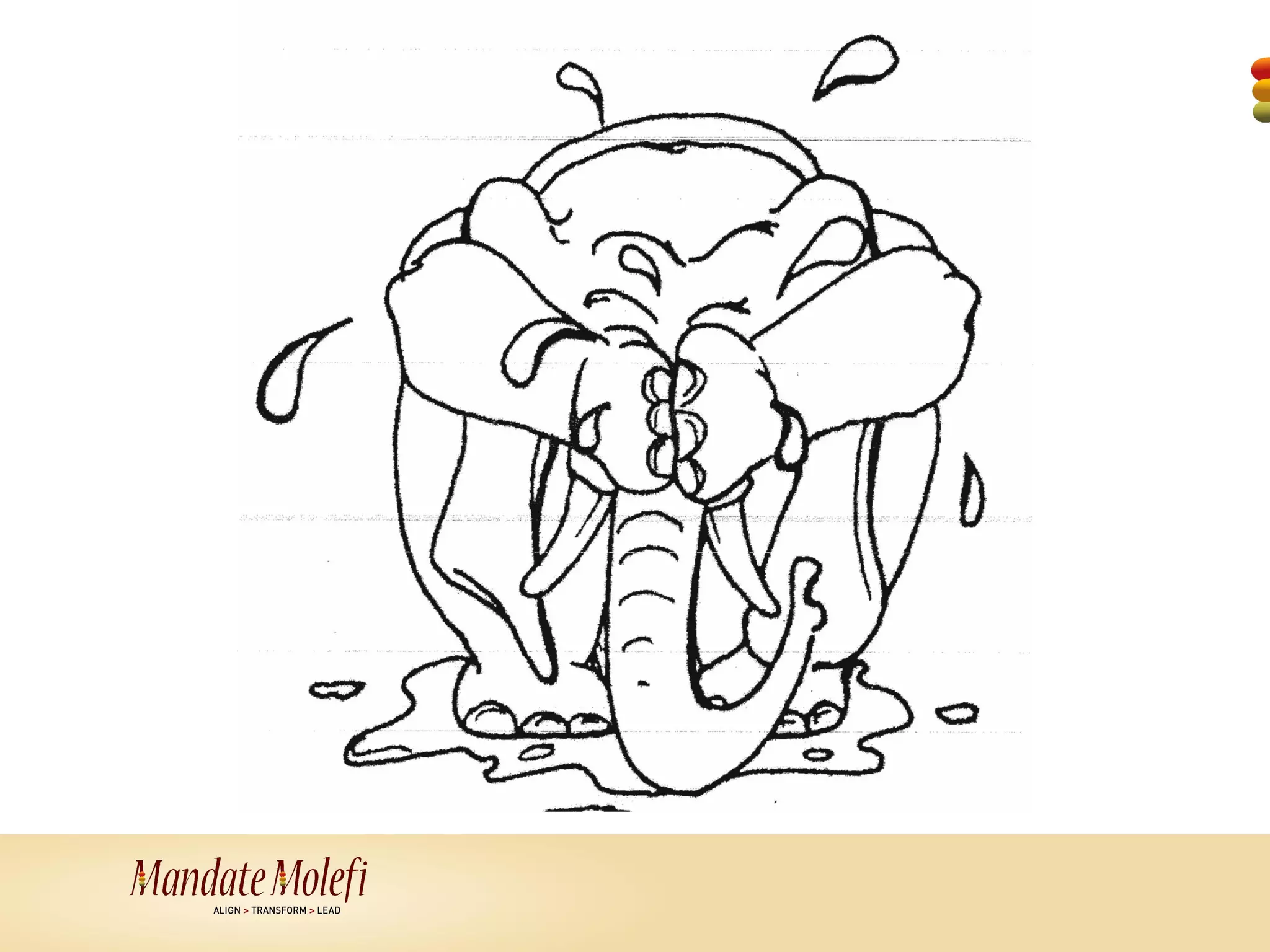
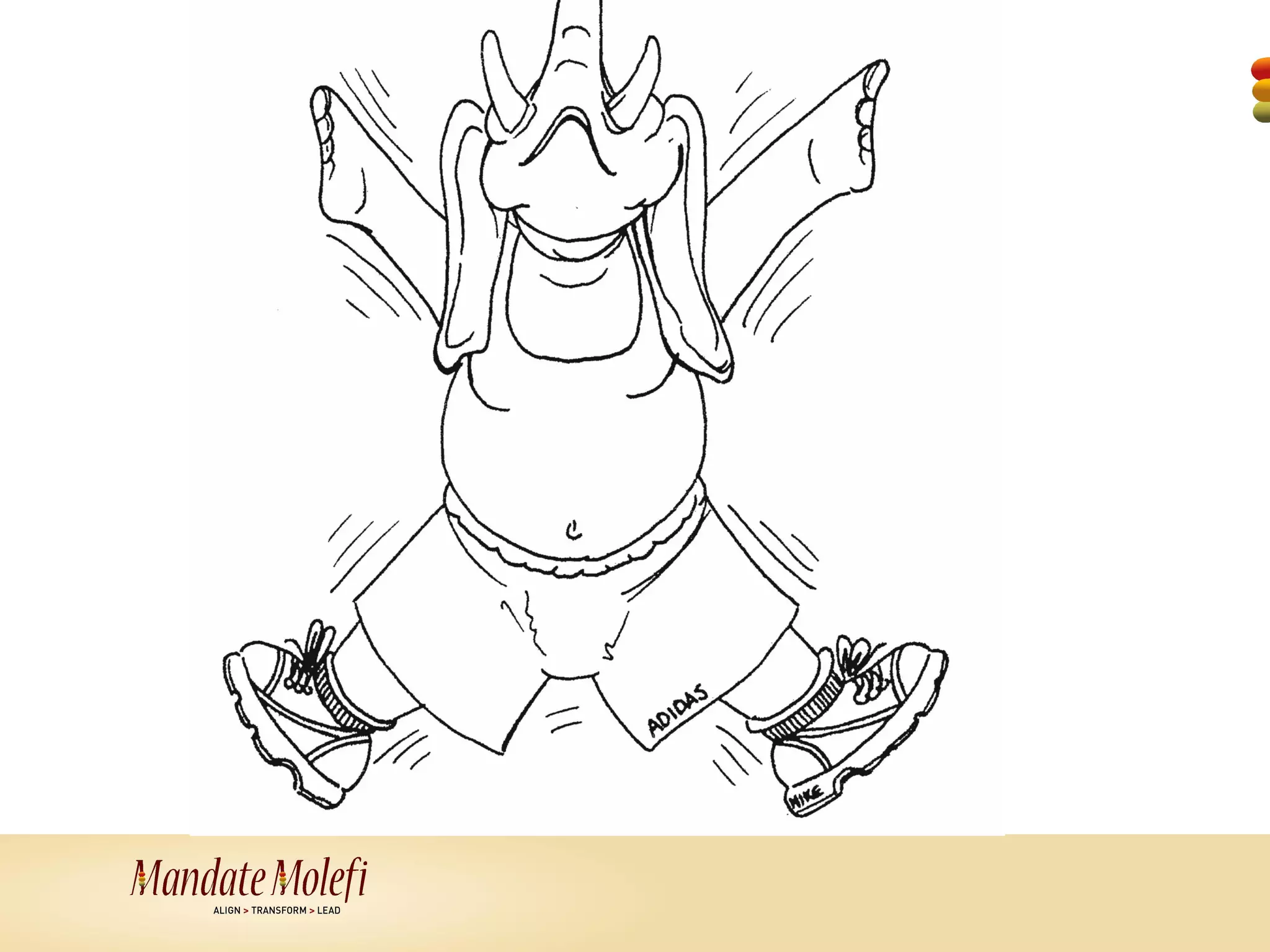
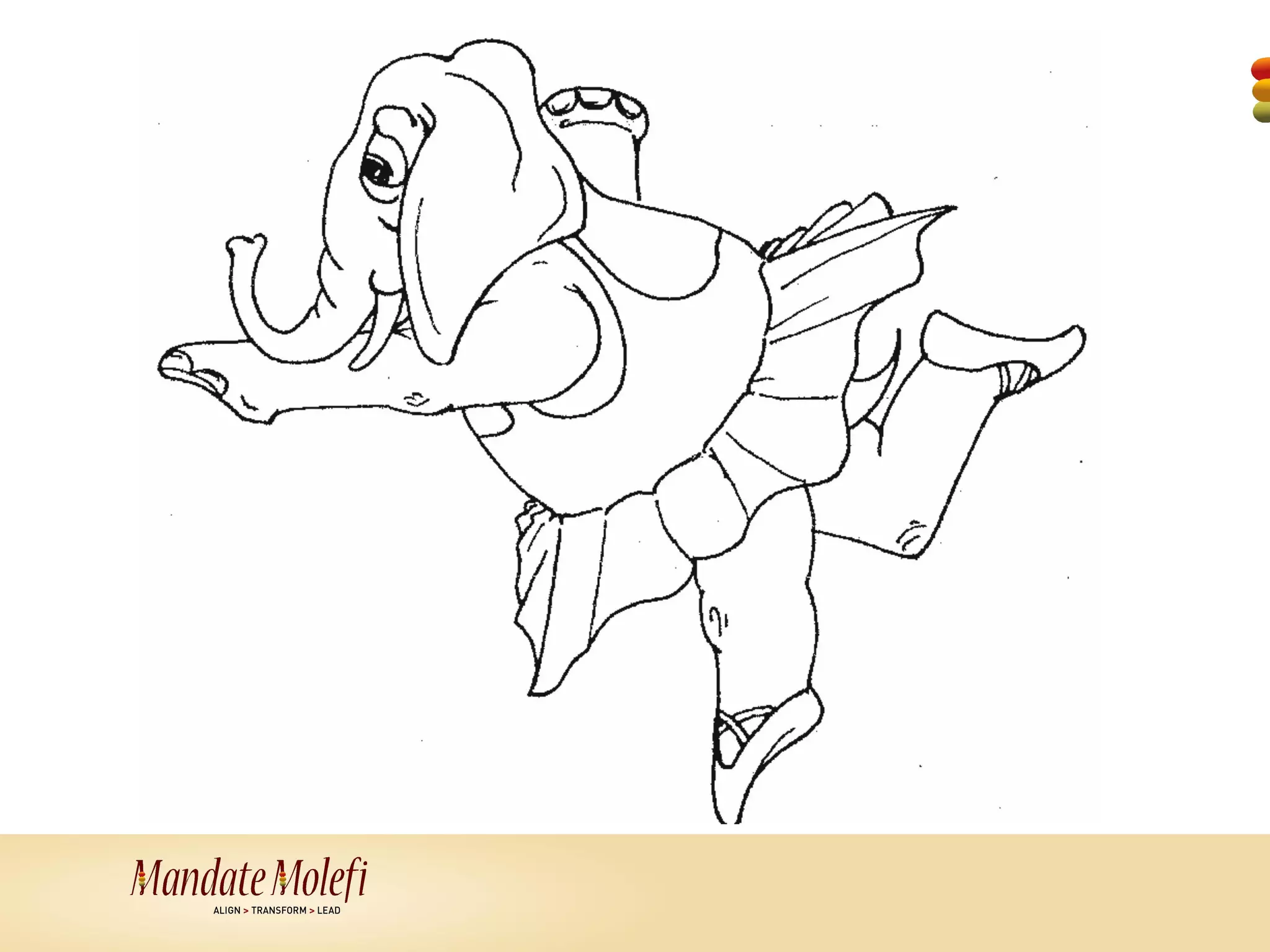
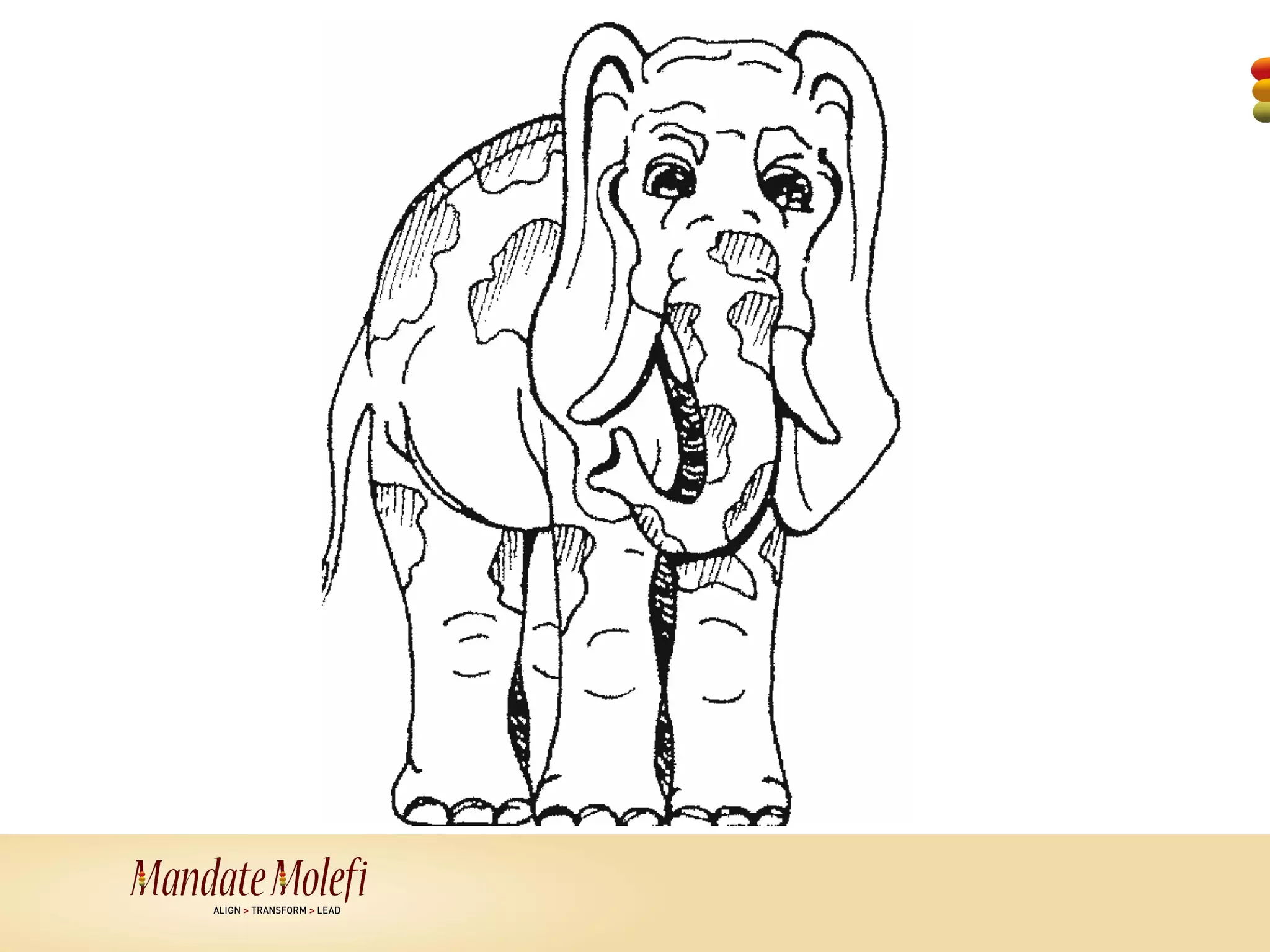
Elephant and Giraffe Story
CROSSING THE LINE


© Mandate Molefi HR Consultants CC
HOW ARE YOU FEELING RIGHT NOW?
HOW DO YOU FEEL ABOUT THE
        EXERCISE?
WHY WE HAVE MOVED?
Intrapersonal Level


  Diversity
 Management
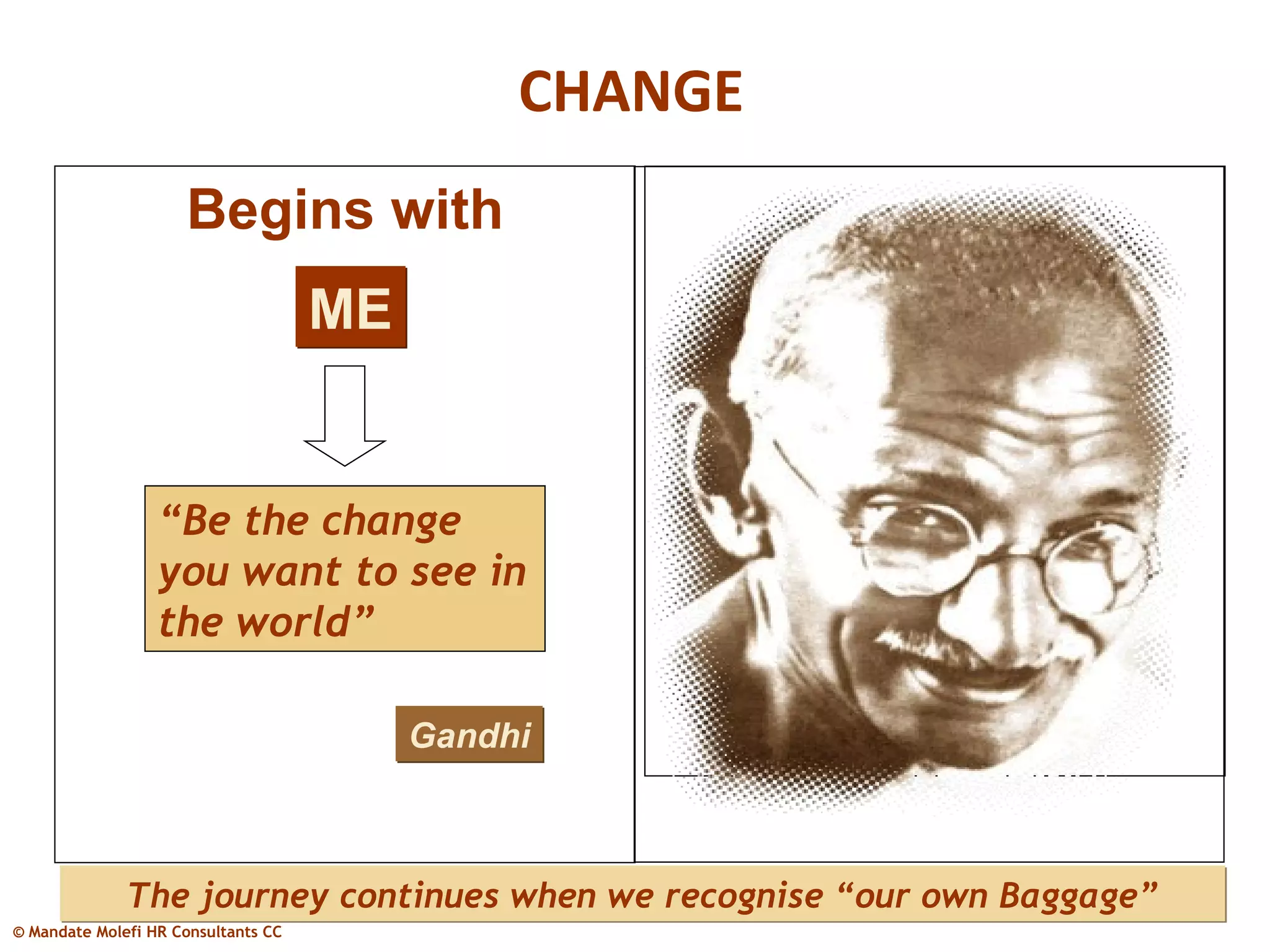
CHANGE
                     Begins with
                                     ME


                  “Be the change
                  you want to see in
                  the world”

                                          Gandhi


              The journey continues when we recognise “our own Baggage”
© Mandate Molefi HR Consultants CC
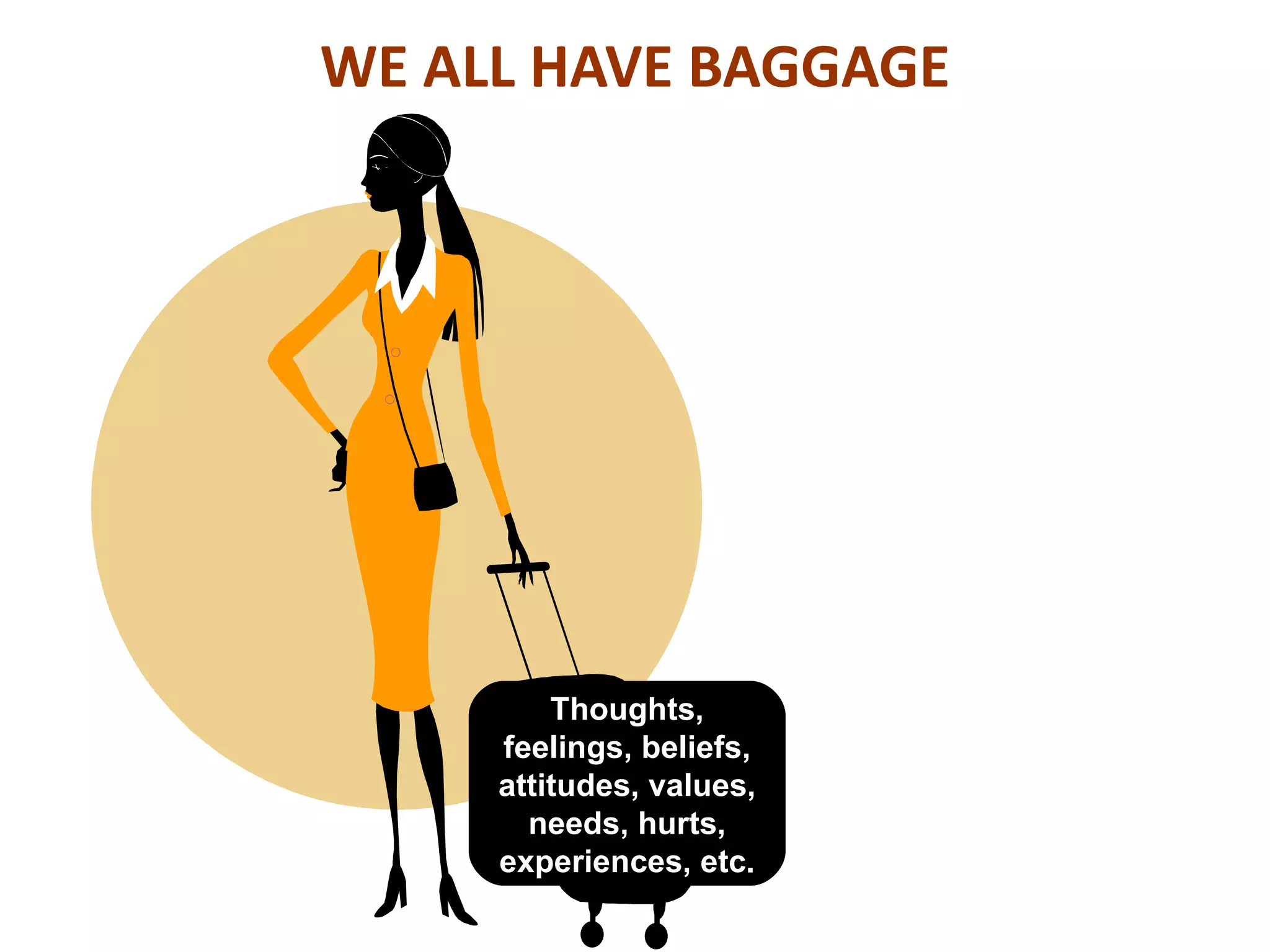
WE ALL HAVE BAGGAGE


         Thoughts,
     feelings, beliefs,
     attitudes, values,
       needs, hurts,
     experiences, etc.
THE ICEBERG


                                     Behaviour          My Early Messages


                                    Our early
                                messages inform
                                  our behaviour
                                 towards others
                                   (Thoughts,
                                Feelings, Values,
                                  Attitudes etc.)


© Mandate Molefi HR Consultants CC
REINCARNATION
REINCARNATION EXERCISE
     Achievements / Successes                 Failures / Regrets

1.                                     1.

2.                                     2.

3.                                     3.

4.                                     4.

5.                                     5.

                        Success is a result of:
Reincarnation Exercise

 SEXUAL ORIENTATION


       GENDER


        RACE


ABLE-BODIED / DISABLED
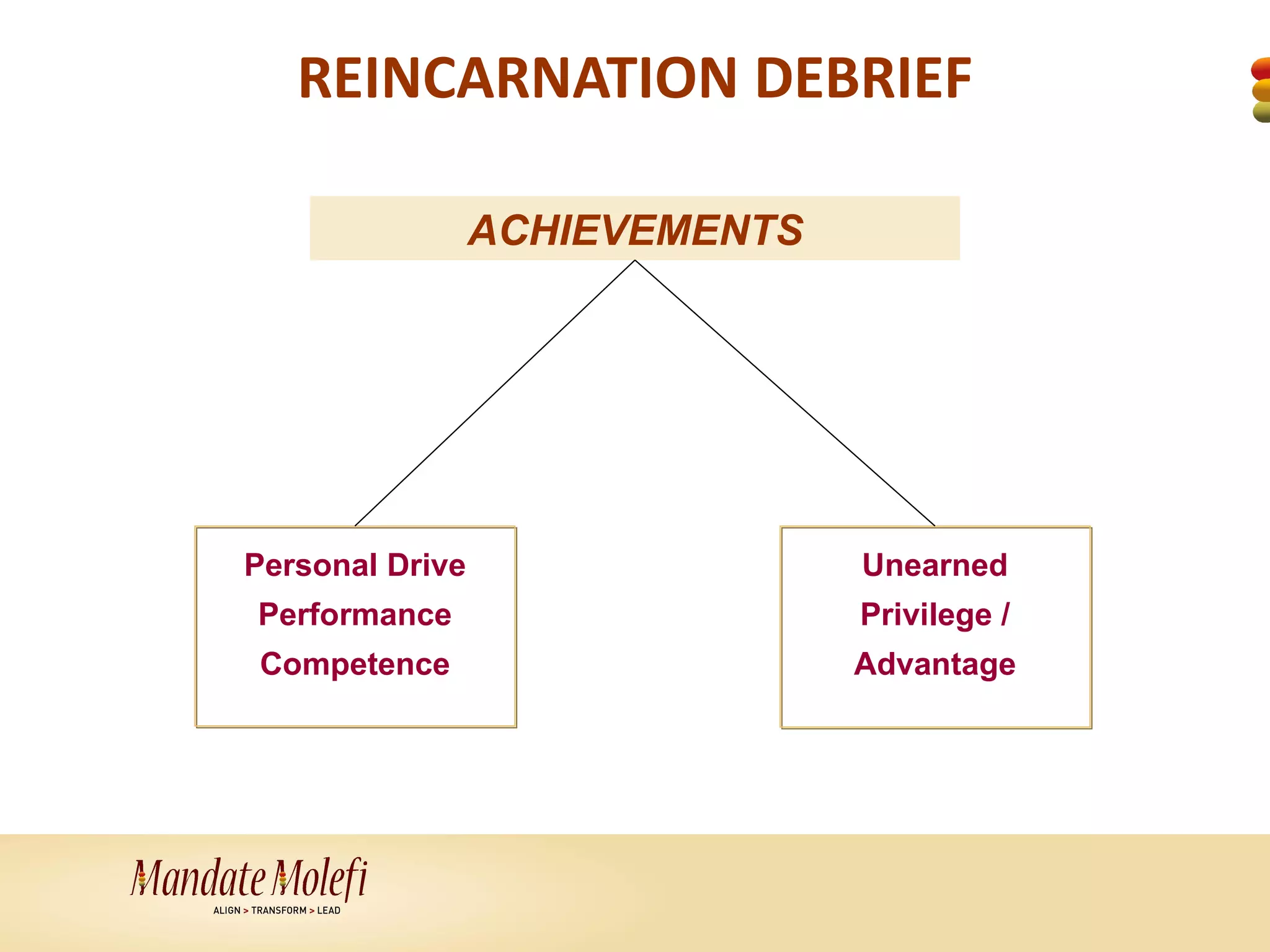
REINCARNATION DEBRIEF

                 ACHIEVEMENTS


Personal Drive                  Unearned
Performance                     Privilege /
 Competence                     Advantage
GROUP DISCUSSION


© Mandate Molefi HR Consultants
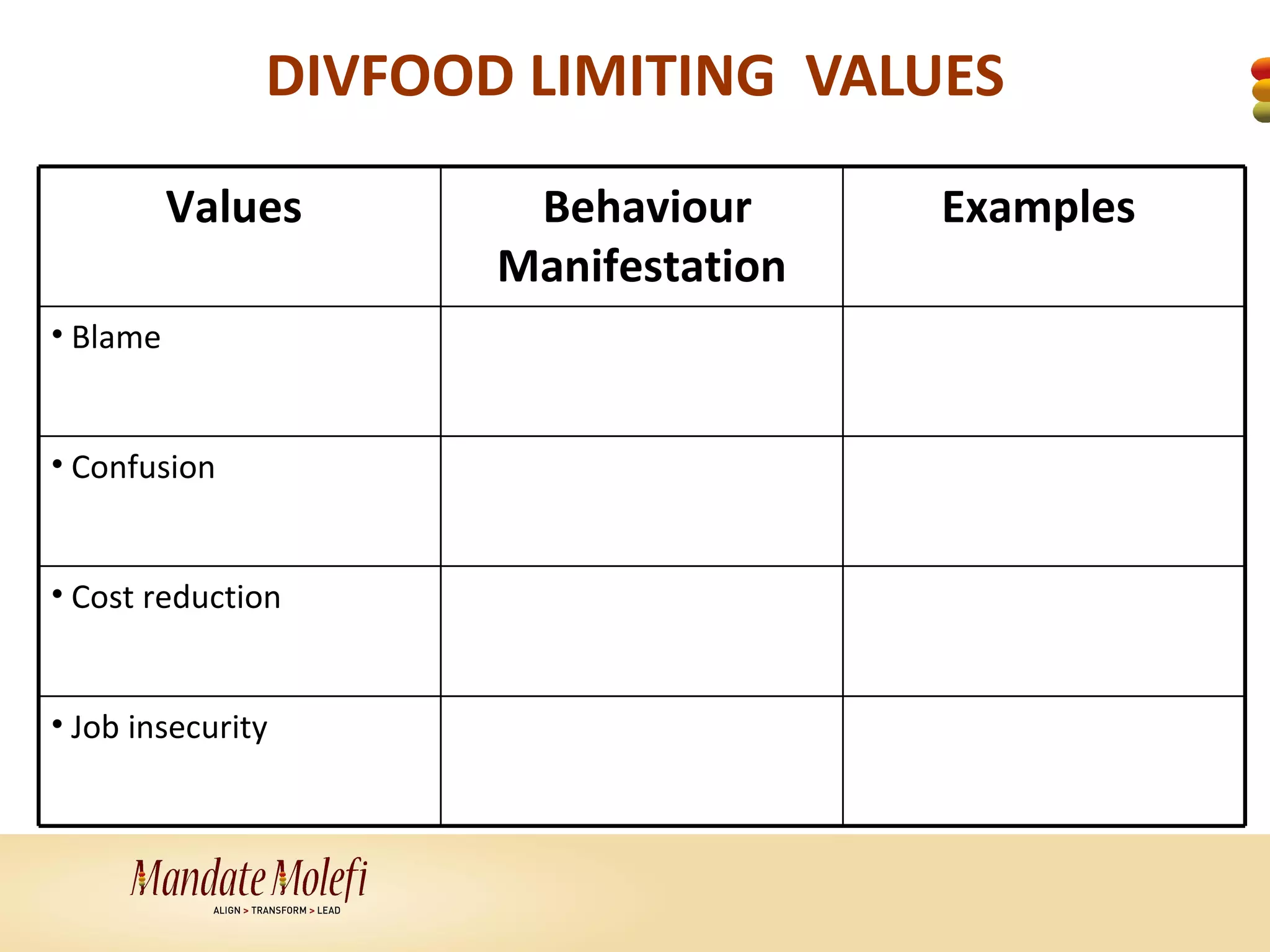
DIVFOOD LIMITING VALUES
          Values       Behaviour      Examples
                      Manifestation
• Blame


• Confusion


• Cost reduction


• Job insecurity
DIVERSITY GAME


© Mandate Molefi HR Consultants
DAY 2


© Mandate Molefi HR Consultants CC
RECAP


© Mandate Molefi HR Consultants
Employment Equity Act


© Mandate Molefi HR Consultants CC
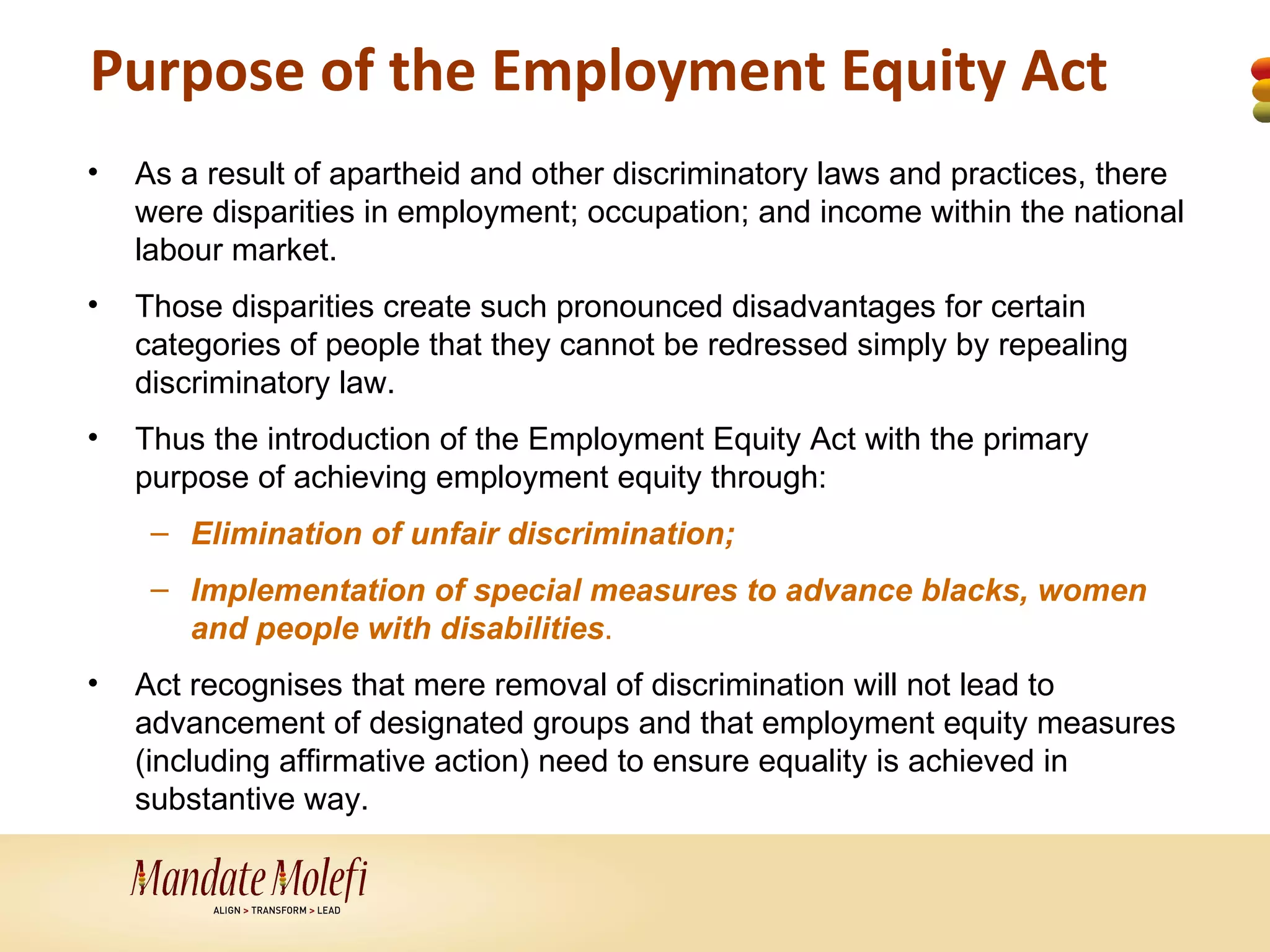
Purpose of the Employment Equity Act
•   As a result of apartheid and other discriminatory laws and practices, there
    were disparities in employment; occupation; and income within the national
    labour market.
•   Those disparities create such pronounced disadvantages for certain
    categories of people that they cannot be redressed simply by repealing
    discriminatory law.
•   Thus the introduction of the Employment Equity Act with the primary
    purpose of achieving employment equity through:
     – Elimination of unfair discrimination;
     – Implementation of special measures to advance blacks, women
       and people with disabilities.
•   Act recognises that mere removal of discrimination will not lead to
    advancement of designated groups and that employment equity measures
    (including affirmative action) need to ensure equality is achieved in
    substantive way.
Th e
E mp l o y me n t
 E q u it y A c t

  What you need to
       know:
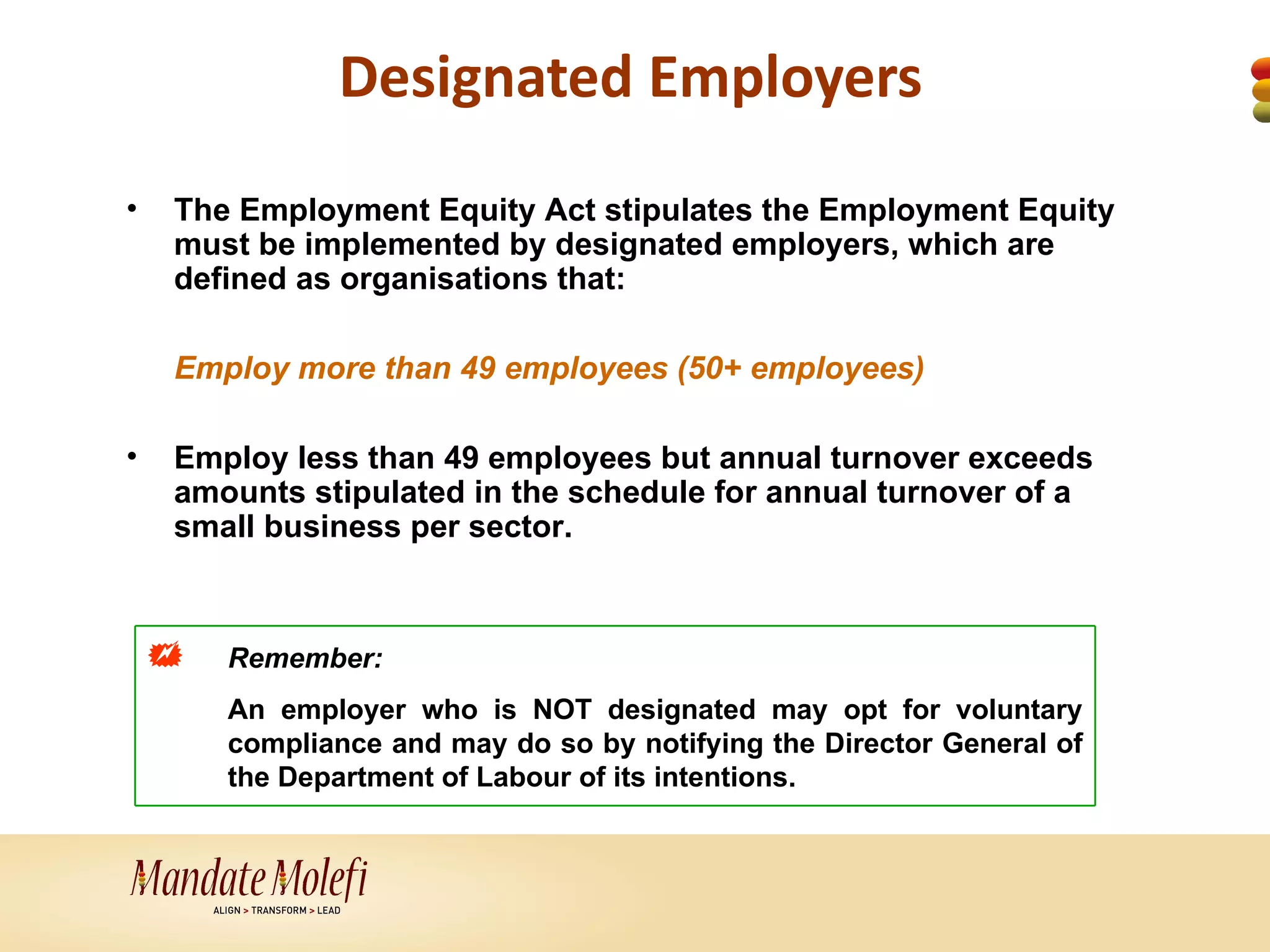
Designated Employers
•   The Employment Equity Act stipulates the Employment Equity
    must be implemented by designated employers, which are
    defined as organisations that:

    Employ more than 49 employees (50+ employees)

•   Employ less than 49 employees but annual turnover exceeds
    amounts stipulated in the schedule for annual turnover of a
    small business per sector.


       Remember:
        An employer who is NOT designated may opt for voluntary
        compliance and may do so by notifying the Director General of
        the Department of Labour of its intentions.
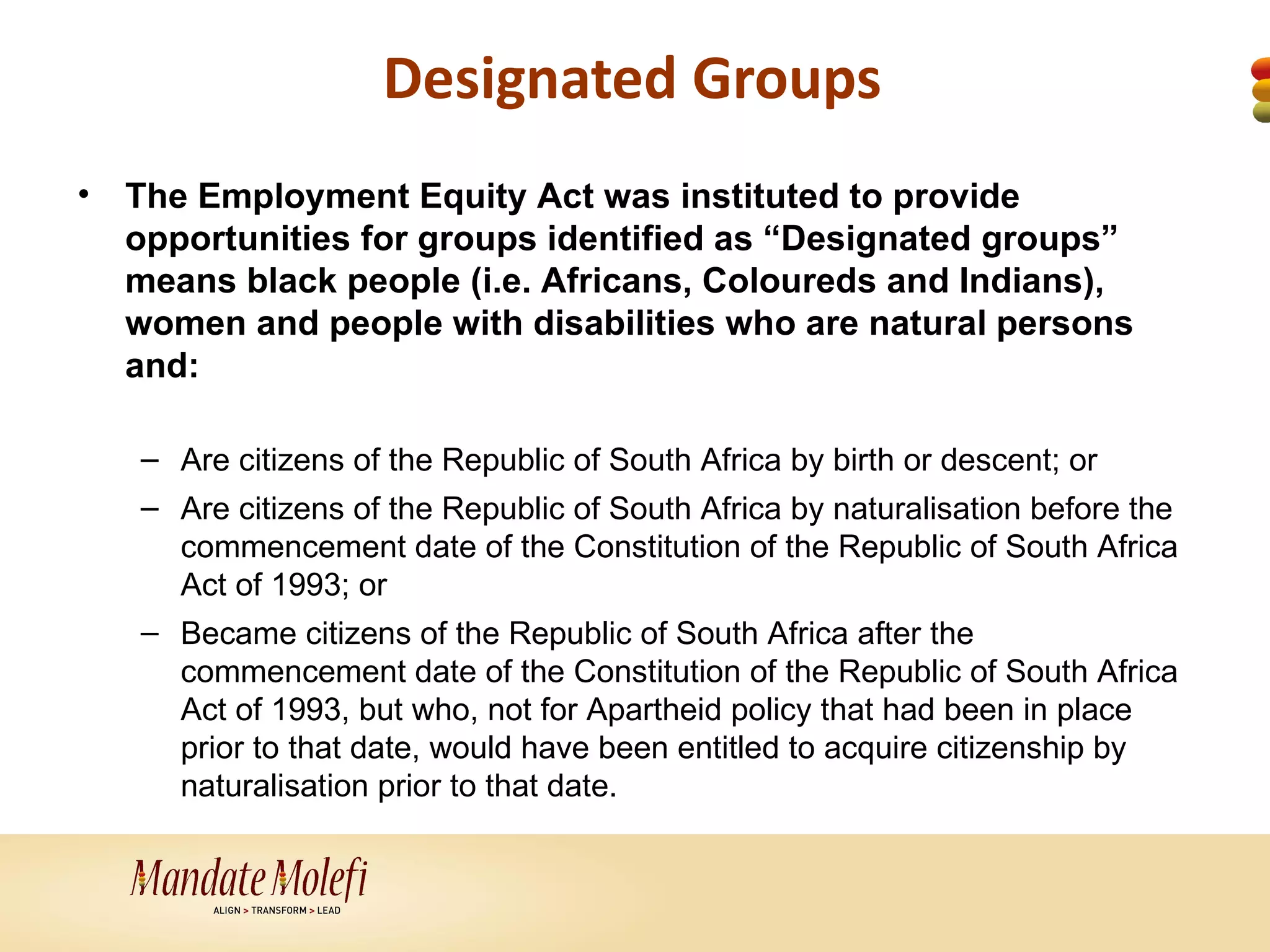
Designated Groups
•   The Employment Equity Act was instituted to provide
    opportunities for groups identified as “Designated groups”
    means black people (i.e. Africans, Coloureds and Indians),
    women and people with disabilities who are natural persons
    and:

    – Are citizens of the Republic of South Africa by birth or descent; or
    – Are citizens of the Republic of South Africa by naturalisation before the
      commencement date of the Constitution of the Republic of South Africa
      Act of 1993; or
    – Became citizens of the Republic of South Africa after the
      commencement date of the Constitution of the Republic of South Africa
      Act of 1993, but who, not for Apartheid policy that had been in place
      prior to that date, would have been entitled to acquire citizenship by
      naturalisation prior to that date.
Defining People with Disabilities:


•   People with disabilities means:

      “People who have a long term or recurring physical or mental
    impairment which substantially limits their prospects of entering
                into, or advancement in employment”

•   Includes sight; hearing; physical and mental disabilities (e.g..
    blind, deaf, in wheelchair, chronic depression, etc.)
Suitably Qualified Persons
•   The Act makes reference to “suitably qualified” persons. A person is
    considered suitably qualified as a result of any one or combination of:


     – Formal Qualification;


     – Prior Learning (NQF)


     – Relevant Experience.


•   A person is also considered suitably qualified if he/she has the
    capacity to acquire, within a reasonable time, the ability to do the job
    (“potential”).
Requirements of the Employment Equity
                        Act
In order to avoid harsh legal sanctions, designated employers are required to:

     –   Establish a consultative forum or utilize an existing forum

     –   Display a summary of the Employment Equity Act (EEA3)

     –   Formulate own targets linked to 5 year time frame

     –   Consult with all stakeholders

     –   Implement special measures to advance previously disadvantaged

     –   Achieve equitable representation among all designated groups

     –   Audit all policies, systems and procedures to remove discriminatory barriers

     –   Maintain complete transparency with all employees

     –   Assigning of a Senior Manager to act as custodian (specific guidelines in amendments)

     –   Set up mechanisms to monitor & evaluate progress
Interpersonal Level


  Diversity
 Management
CYCLE OF PREJUDICE


© Mandate Molefi HR Consultants CC
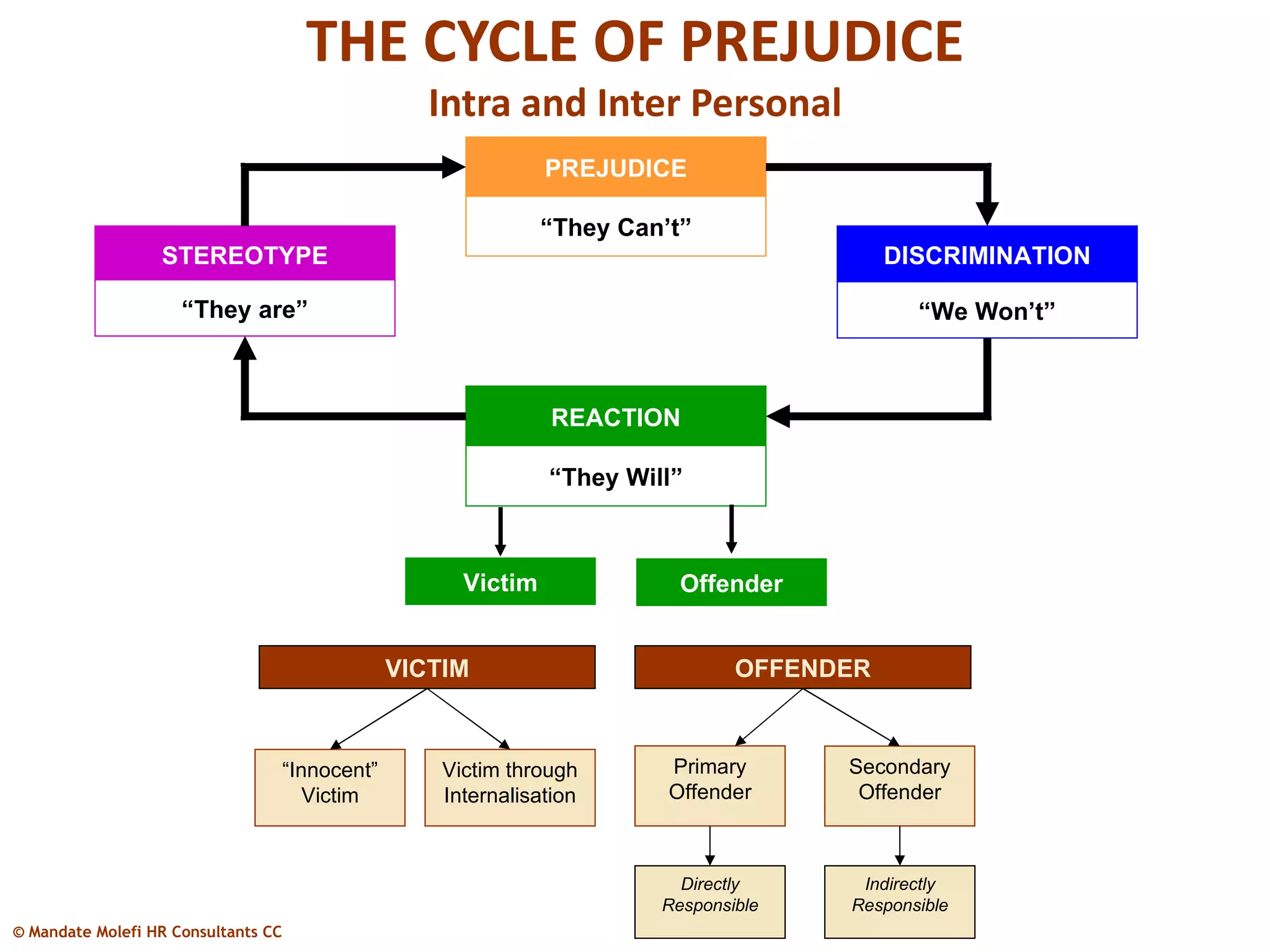
THE CYCLE OF PREJUDICE
                                                     Intra and Inter Personal
                                                                 PREJUDICE

                                                                 “They Can’t”
                  STEREOTYPE                                                                 DISCRIMINATION

                     “They are”                                                                “We Won’t”


                                                                  REACTION

                                                                 “They Will”


                                                        Victim              Offender


                                                  VICTIM                          OFFENDER


                                     “Innocent”       Victim through       Primary      Secondary
                                        Victim        Internalisation      Offender      Offender


                                                                            Directly     Indirectly
                                                                          Responsible   Responsible
© Mandate Molefi HR Consultants CC
BREAKING THE CYCLE OF PREJUDICE
                                                            Systemic
                                                            Response
                             PREJUDICE                       (Question
 Interpersonal
                                                             values on
 Responsibility
    (Question
                             “They Can’t”                  which Policies/
                                                           Procedures are
  assumptions)                                                based).


          STEREOTYPE                             DISCRIMINATION

            “They are”                             “We Won’t”


 Behavioural
Responsibility                REACTION                      Behavioural
   (Courage
      And                                                    Response
   Strength                  “They Will”                    (Ownership of
to act contrary                                               reacting to
  to expected                                                 situations
  stereotype)                                                one cannot
                         Victim       Offender                  control)
Diversity
Management


             Systemic/Organisational
                      Level
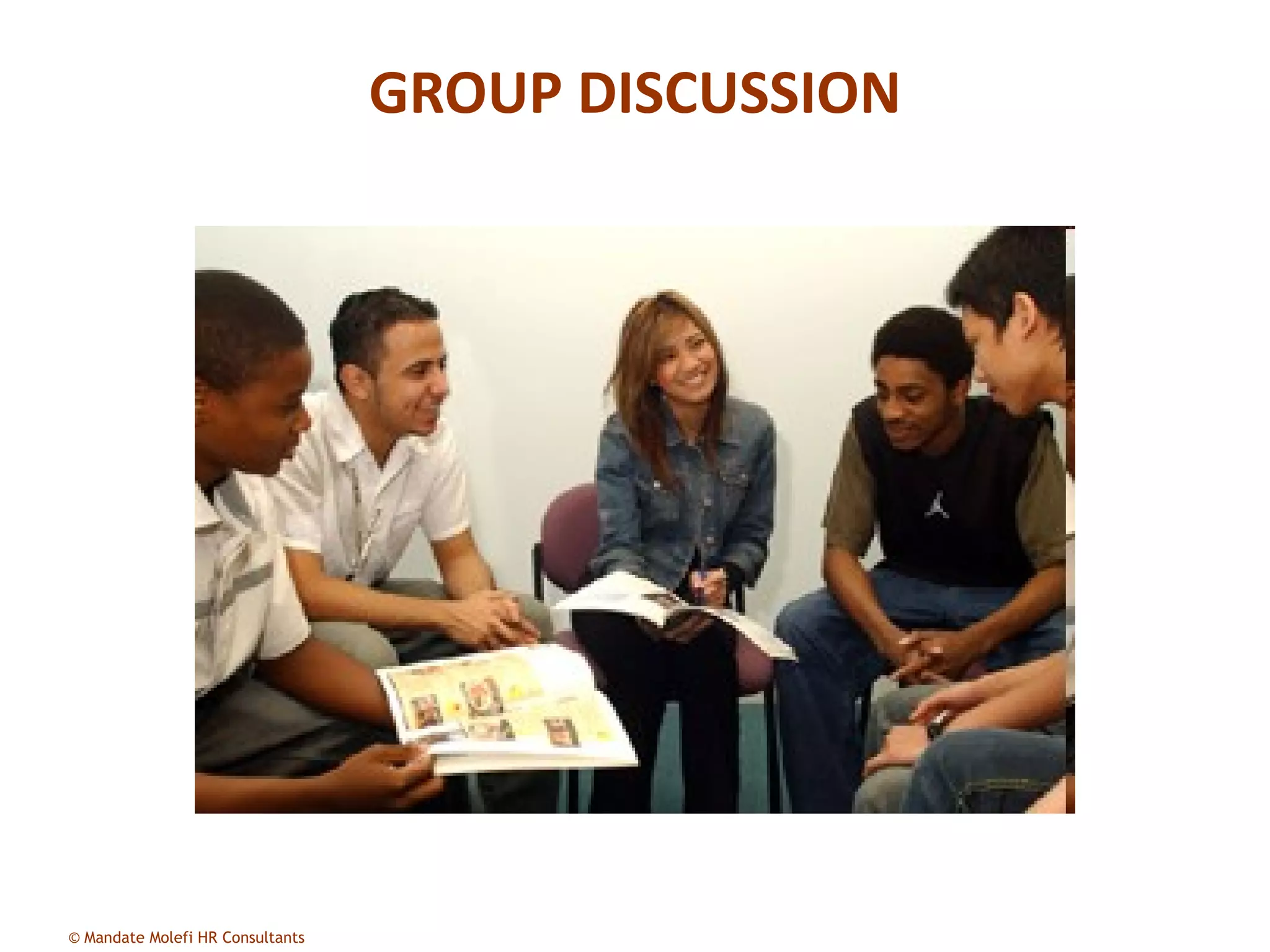
GROUP DISCUSSION


© Mandate Molefi HR Consultants
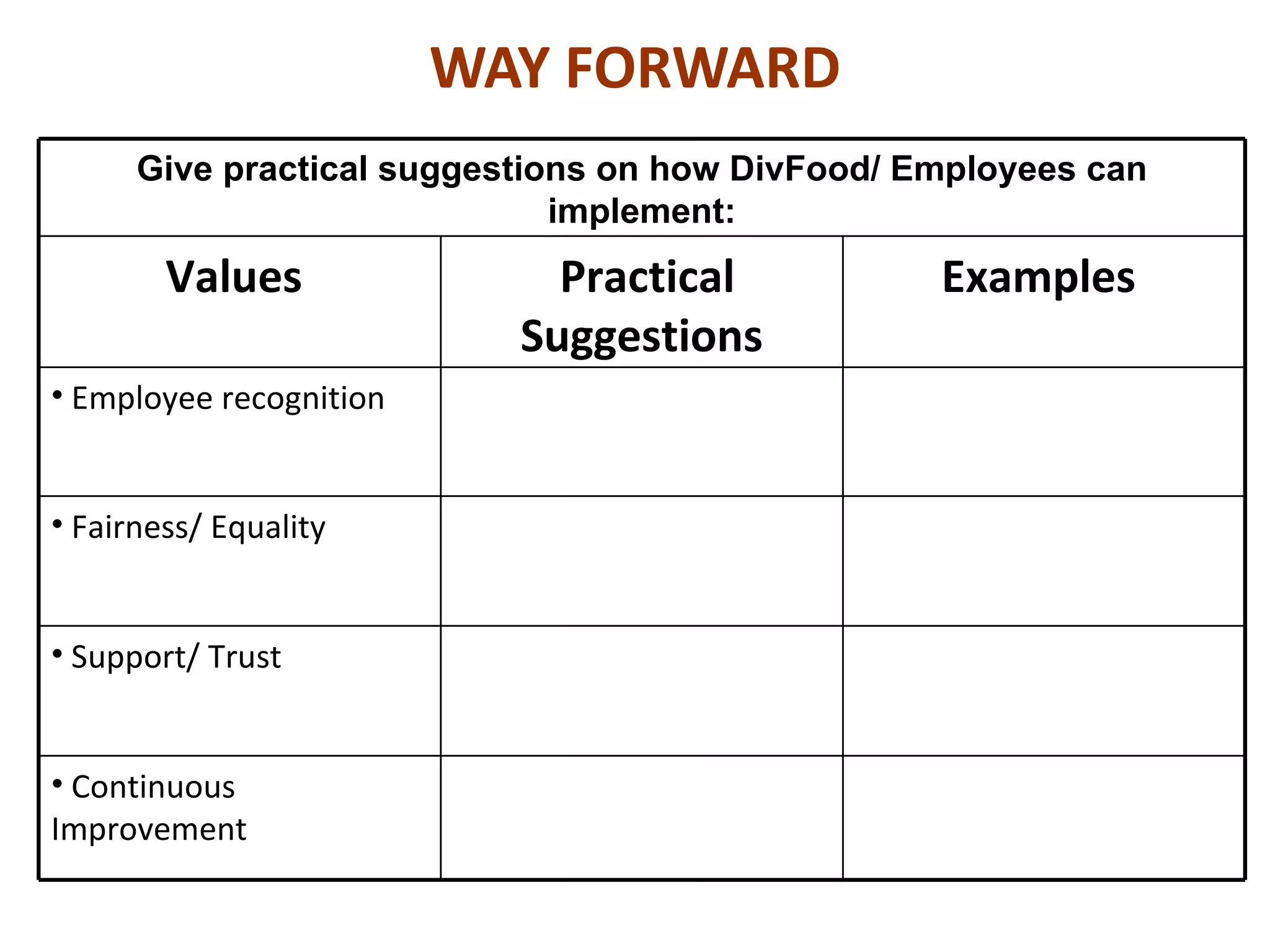
WAY FORWARD
      Give practical suggestions on how DivFood/ Employees can
                              implement:
        Values               Practical            Examples
                           Suggestions
• Employee recognition


• Fairness/ Equality


• Support/ Trust


• Continuous
Improvement
POWER, RANK & PRIVILEGE


© Mandate Molefi HR Consultants CC
RANK, POWER & PRIVILEGE

        • Rank is a conscious or unconscious, social or
          personal ability or power arising from who you
          are, culture or community support.
        • Whether you earned or inherited your rank, it
          organises much of your communication
          behaviour.


© Mandate Molefi HR Consultants CC
RANK, POWER & PRIVILEGE

        • Rank does not show in a mirror. It results in a
          subtle state of mind.
        • If you are part of a group which is the most
          favoured in your culture, you imagine that you
          are normal and anyone unlike you is marginal.
          You ignore the role that belongs to your class
          e.g. “I wasn't even around when your ancestors
          were sold as slaves” etc.


© Mandate Molefi HR Consultants CC
TYPES OF RANK

      • RANK IS CONTEXTUAL
              – Every group has its own rank structure.
              – Powers assigned to an individual changes depending on specific
                group or culture. E.g. CEO may have great deal of power at
                work – but at home may feel powerless.
              – Contextual rank is fluid.
              – We notice our contextual rank when we move to another context
                and are seen and valued differently.


© Mandate Molefi HR Consultants CC
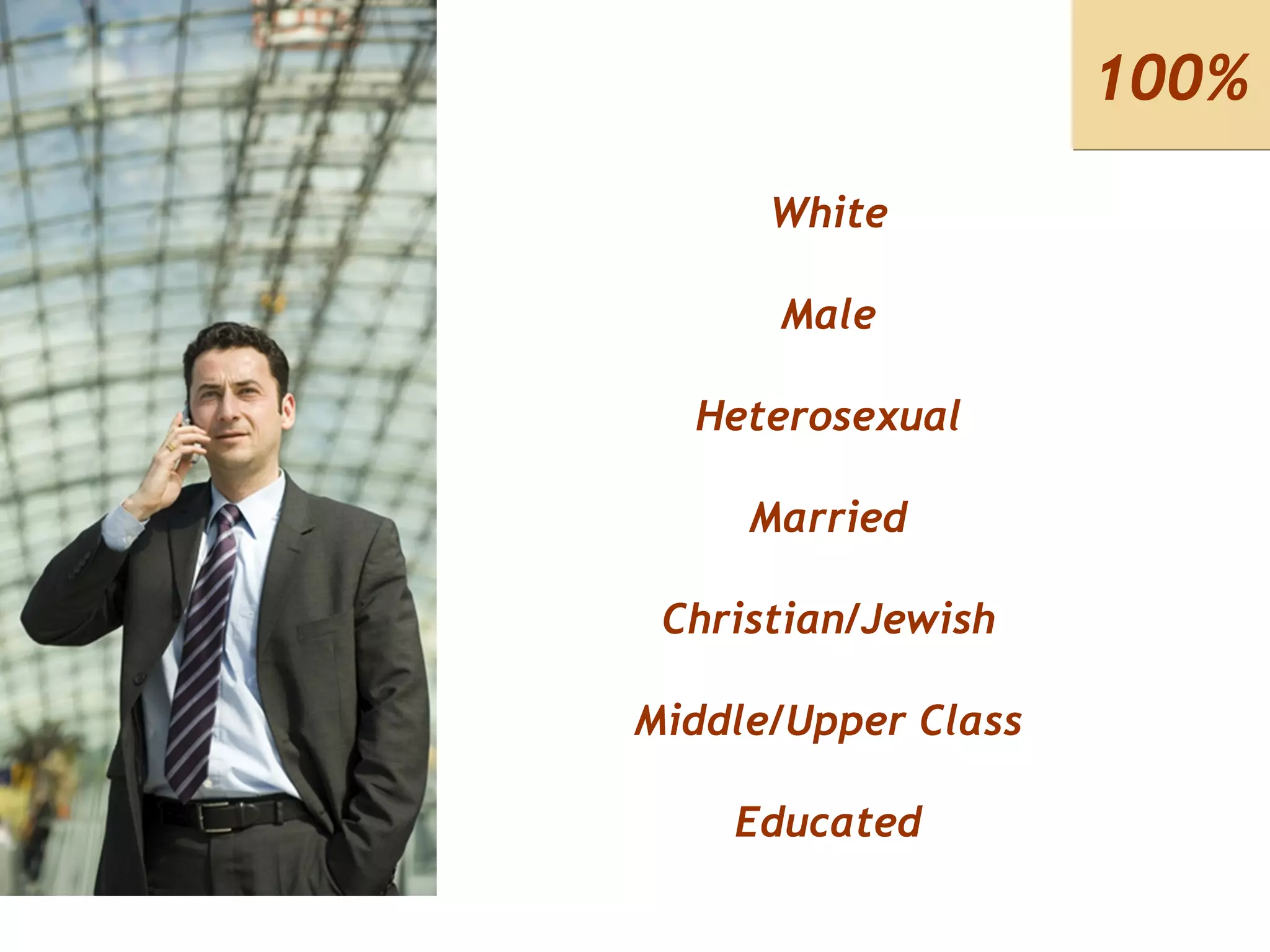
100%

      White

      Male

  Heterosexual

     Married

 Christian/Jewish

Middle/Upper Class

    Educated
-40%

      White

      Male

   Homosexual

      Single

 Christian/Jewish

Middle/Upper Class

    Educated
Rank is Contextual – in
  some cases, he would     -30%
 have higher rank and in
      others, lower        +30%
       Black

        Male

  Heterosexual

      Married

 Christian/Other

Middle/Upper Class

     Educated
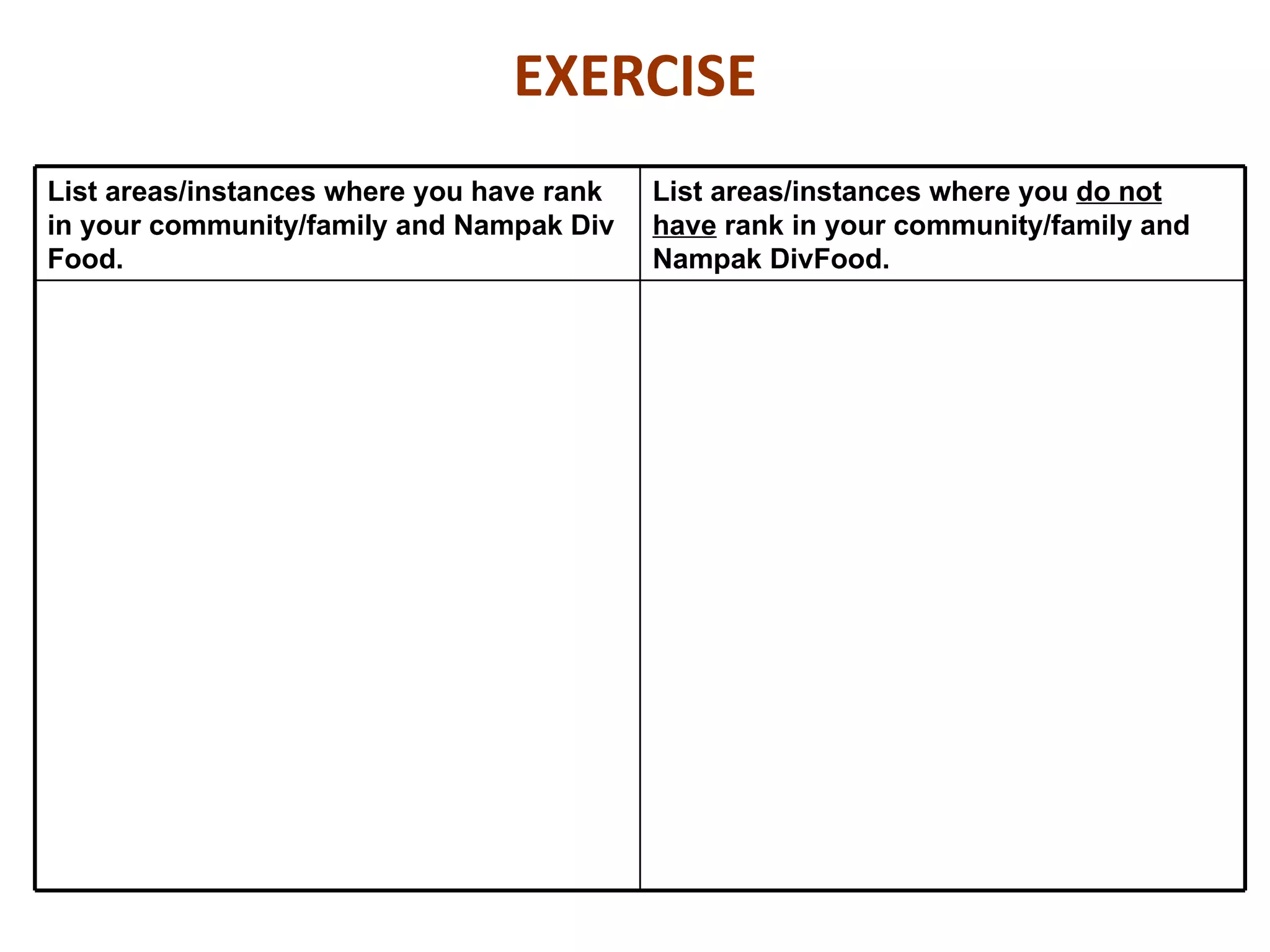
EXERCISE
List areas/instances where you have rank   List areas/instances where you do not
in your community/family and Nampak Div    have rank in your community/family and
Food.                                      Nampak DivFood.
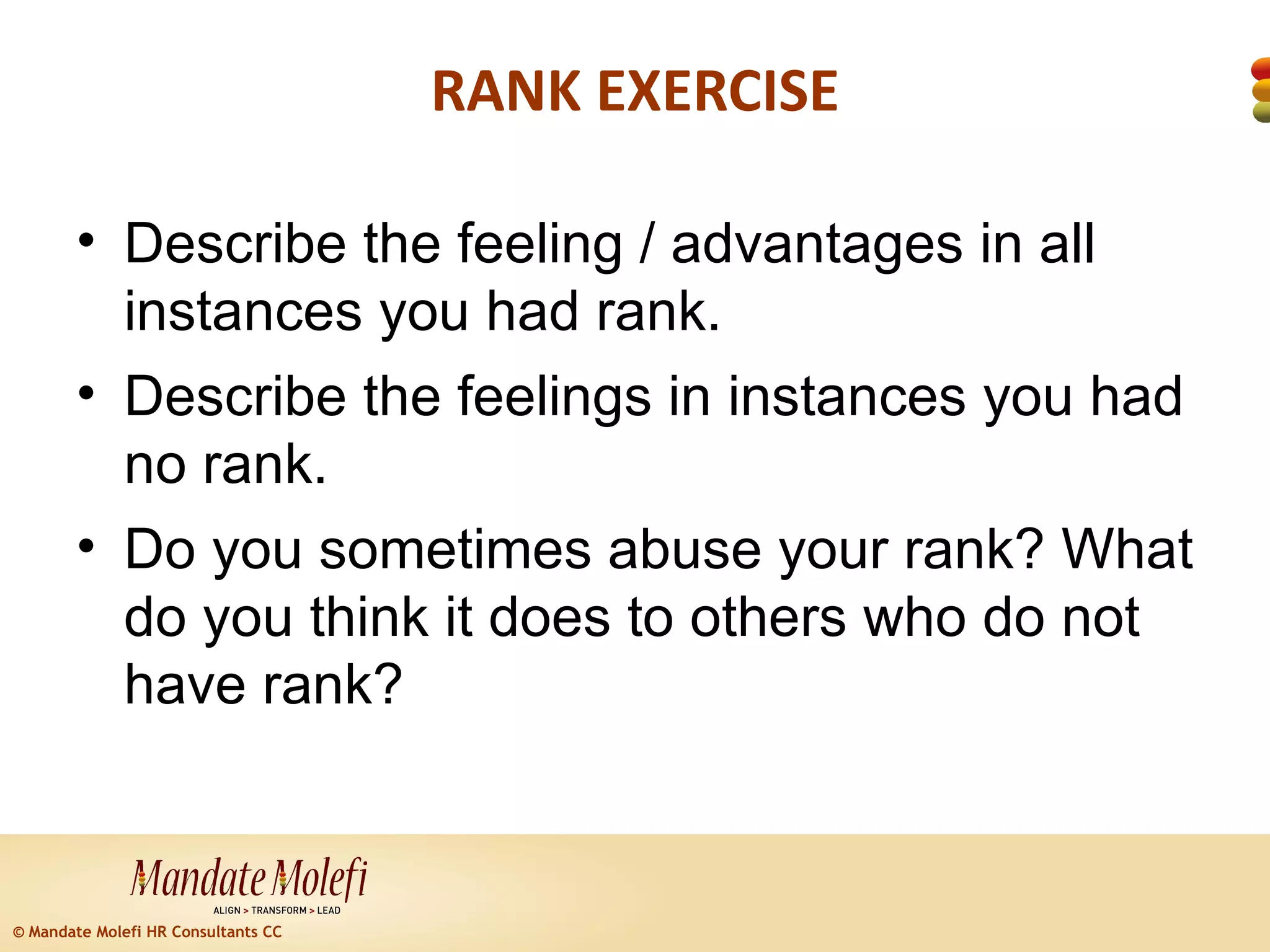
RANK EXERCISE

        • Describe the feeling / advantages in all
          instances you had rank.
        • Describe the feelings in instances you had
          no rank.
        • Do you sometimes abuse your rank? What
          do you think it does to others who do not
          have rank?


© Mandate Molefi HR Consultants CC
THERE’S NOTHING NOBLE ABOUT
               BEING SUPERIOR TO OTHER PEOPLE,
               TRUE NOBILITY COMES FROM BEING A
                BETTER PERSON THAN YOU WERE
                       YESTERDAY – Unknown.


© Mandate Molefi HR Consultants CC
CHECK-OUT


© Mandate Molefi HR Consultants CC
Workshop Feedback


• How do you feel about the workshop?

• What are your challenges?
THANK YOU
“I do not want my house to be walled in on all sides and my windows to be stuffed. I want the
culture of all lands to be blown about my house as freely as possible. But I refuse to be blown
off my feet by any.”
                                                                                Mahatma Gandhi
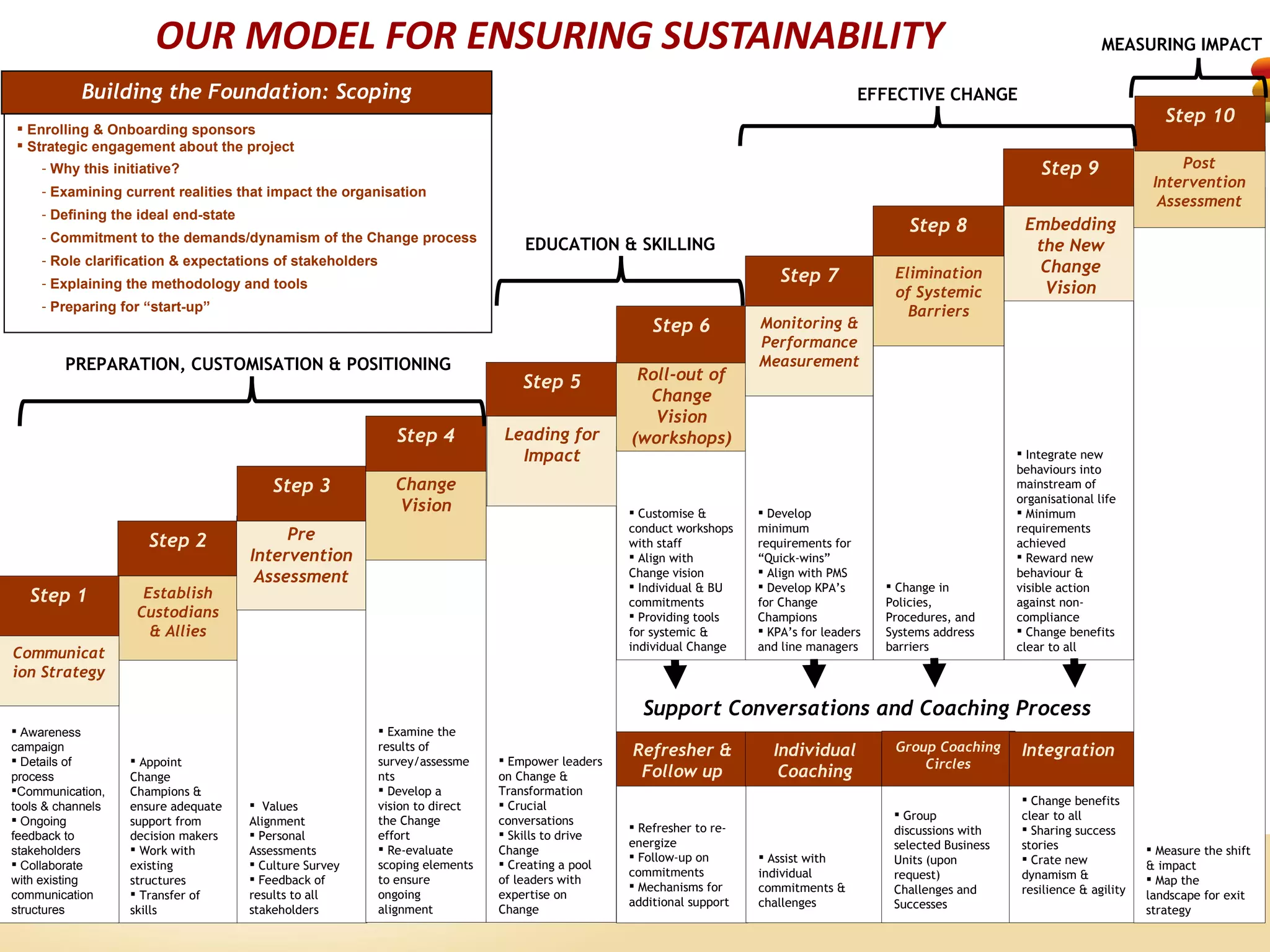
OUR MODEL FOR ENSURING SUSTAINABILITY                                                                                                                      MEASURING IMPACT

           Building the Foundation: Scoping                                                                                              EFFECTIVE CHANGE
                                                                                                                                                                                            Step 10
 Enrolling & Onboarding sponsors
 Strategic engagement about the project
     - Why this initiative?                                                                                                                                           Step 9                  Post
                                                                                                                                                                                          Intervention
     - Examining current realities that impact the organisation
                                                                                                                                                                                           Assessment
     - Defining the ideal end-state
                                                                                                                                                Step 8             Embedding
     - Commitment to the demands/dynamism of the Change process
                                                                                  EDUCATION & SKILLING                                                              the New
     - Role clarification & expectations of stakeholders
                                                                                                                                              Elimination           Change
     - Explaining the methodology and tools                                                                                Step 7
                                                                                                                                              of Systemic            Vision
     - Preparing for “start-up”                                                                                                                 Barriers
                                                                                                      Step 6           Monitoring &
                                                                                                                       Performance
         PREPARATION, CUSTOMISATION & POSITIONING                                                                      Measurement
                                                                                 Step 5            Roll-out of
                                                                                                    Change
                                                                                                     Vision
                                                              Step 4          Leading for         (workshops)
                                                                                Impact                                                                             Integrate new
                                                                                                                                                                  behaviours into
                                          Step 3             Change                                                                                               mainstream of
                                                                                                                                                                  organisational life
                                                             Vision                                Customise &         Develop                                   Minimum
                                                                                                  conduct workshops    minimum                                    requirements
                      Step 2               Pre                                                    with staff           requirements for                           achieved
                                      Intervention                                                 Align with         “Quick-wins”                                Reward new
                                                                                                  Change vision         Align with PMS                           behaviour &
                                       Assessment                                                  Individual & BU     Develop KPA’s        Change in          visible action
   Step 1            Establish
                                                                                                  commitments          for Change            Policies,            against non-
                    Custodians                                                                     Providing tools    Champions             Procedures, and      compliance
                      & Allies                                                                    for systemic &        KPA’s for leaders   Systems address       Change benefits
                                                                                                  individual Change    and line managers     barriers             clear to all
Communicat
ion Strategy

                                                                                                    Support Conversations and Coaching Process
 Awareness                                                 Examine the
campaign                                                   results of                             Refresher &            Individual           Group Coaching      Integration
 Details of        Appoint                               survey/assessme     Empower leaders                                                   Circles
process            Change                                  nts                on Change &          Follow up              Coaching
Communication,    Champions &                              Develop a        Transformation
                                       Values             vision to direct    Crucial                                                                            Change benefits
tools & channels   ensure adequate
 Ongoing                                                  the Change         conversations                                                    Group             clear to all
                   support from       Alignment                                                    Refresher to re-                          discussions with     Sharing success
feedback to        decision makers     Personal           effort              Skills to drive
                                                                                                  energize                                    selected Business   stories
stakeholders        Work with        Assessments           Re-evaluate      Change                                                                                                      Measure the shift
                                                                                                   Follow-up on        Assist with          Units (upon          Crate new
 Collaborate      existing            Culture Survey     scoping elements    Creating a pool                                                                                          & impact
                                                                                                  commitments          individual             request)            dynamism &
with existing      structures          Feedback of        to ensure          of leaders with                                                                                             Map the
                                                                                                   Mechanisms for     commitments &          Challenges and      resilience & agility
communication       Transfer of      results to all       ongoing            expertise on                                                                                               landscape for exit
                                                                                                  additional support   challenges             Successes
structures         skills             stakeholders         alignment          Change                                                                                                     strategy

Diversity Management Presentation

  • 1.
  • 2.
    INTRODUCTION AND CHECK-IN ©Mandate Molefi HR Consultants CC
  • 3.
    OBJECTIVES OF THEWORKSHOP • To cultivate respect and understanding between individuals who come from diverse backgrounds within Nampak DivFood. • To provide a platform for participants to engage in Diversity crucial conversations. • To share knowledge on Diversity and its impact on the society, demographics, legislation and the workplace. • To create a common understanding of the barriers and the limiting values that impact on valuing Diversity within Nampak DivFood. • To highlight the business imperative of managing Diversity. • To include employees in mapping a way forward towards creating an inclusive and values driven culture within DivFood.
  • 4.
    DivFood Mission Statement Divfoodexists to exceed stakeholder expectations in providing Food and Diversified Metal Can Packaging Solutions.
  • 5.
  • 6.
    WHAT IS DIVERSITY? ……a collective mixture of differences and similarities Dr. Roosevelt Thomas
  • 7.
    AN INTEGRATED APPROACHTO DIVERSITY MANAGEMENT Intra/Interpersonal Level Diversity Management Client/Customer/ Organisational/Systemic Stakeholder Level Level Client/Customer/Stakeholder Organisational (Systemic) Intra/Interpersonal Level Level Level -The Business Case -The Individual -Policies -Customer Interface -One-on-One -Systems -Environmental Analysis -One-on-Group -Procedures -The Imperatives -Teams -Practices To facilitate personal To highlight the Business To integrate diverse values transformation and to cultivate Imperative of managing diversity, into the culture, systems, respect and understanding underpinned by the need for policies and procedures of between diverse groups in every business to excel. your organisation. your organisation.
  • 8.
    A GLOBAL PERSPECTIVE: THE EARTH’S POPULATION If we could shrink the earth's population to a village of precisely 100 people, it would look something like this:  60 would be Asian  12 would be European  15 would be from the Western Hemisphere (9 Latin American, 5 North American, and 1 Oceanian)  13 would be African  50 would be female  50 would be male  80 would be non-Caucasian  20 would be Caucasian (white)  67 would be non-Christian  33 would be Christian Source: UN Department of Economic and Social Affairs, Population Division, "World Population Prospects: The 2000 Revision." Source: U.S. Bureau of the Census International Data Base, Table 094: Midyear Population by Age and Sex 2001.
  • 9.
    A SOUTH AFRICANPERSPECTIVE: If we could shrink South Africa‘s population to a village of 100 people, it would look like this:  78 African, 11 White, 8 Coloured, 3 Indian  23 Speak IsiZulu, 17 IsiXhosa, 14 Afrikaans, 10 Setswana, 10 English, 8 Sepedi, 8 Sesotho, 10 Other  73 Christian, 21 of the 73 belongs to the ZCC or other independant churches  33 is younger than 16 years  5 is older than 65 years  13 is HIV positive  50 would not use bank services  68 of people older than 16 years would not have matric  8 would have a degree Source: Rapport, 4 May 2008
  • 10.
    HOW IS DIVERSITYDEFINED IN SOUTH AFRICA? SA Constitution: Chapter 2, Section 9 No one may unfairly discriminate directly or indirectly against anyone on one or more grounds, including race, gender, sex, pregnancy, marital status, ethnic or social origin, colour, sexual orientation, age, disability, religion, conscience, belief, culture, language and birth.
  • 11.
  • 21.
    CROSSING THE LINE ©Mandate Molefi HR Consultants CC
  • 22.
    HOW ARE YOUFEELING RIGHT NOW?
  • 23.
    HOW DO YOUFEEL ABOUT THE EXERCISE?
  • 24.
  • 25.
    Intrapersonal Level Diversity Management
  • 26.
    CHANGE Begins with ME “Be the change you want to see in the world” Gandhi The journey continues when we recognise “our own Baggage” © Mandate Molefi HR Consultants CC
  • 27.
    WE ALL HAVEBAGGAGE Thoughts, feelings, beliefs, attitudes, values, needs, hurts, experiences, etc.
  • 28.
    THE ICEBERG Behaviour My Early Messages Our early messages inform our behaviour towards others (Thoughts, Feelings, Values, Attitudes etc.) © Mandate Molefi HR Consultants CC
  • 29.
  • 30.
    REINCARNATION EXERCISE Achievements / Successes Failures / Regrets 1. 1. 2. 2. 3. 3. 4. 4. 5. 5. Success is a result of:
  • 31.
    Reincarnation Exercise SEXUALORIENTATION GENDER RACE ABLE-BODIED / DISABLED
  • 32.
    REINCARNATION DEBRIEF ACHIEVEMENTS Personal Drive Unearned Performance Privilege / Competence Advantage
  • 33.
    GROUP DISCUSSION © MandateMolefi HR Consultants
  • 34.
    DIVFOOD LIMITING VALUES Values Behaviour Examples Manifestation • Blame • Confusion • Cost reduction • Job insecurity
  • 35.
    DIVERSITY GAME © MandateMolefi HR Consultants
  • 36.
    DAY 2 © MandateMolefi HR Consultants CC
  • 37.
  • 38.
    Employment Equity Act ©Mandate Molefi HR Consultants CC
  • 39.
    Purpose of theEmployment Equity Act • As a result of apartheid and other discriminatory laws and practices, there were disparities in employment; occupation; and income within the national labour market. • Those disparities create such pronounced disadvantages for certain categories of people that they cannot be redressed simply by repealing discriminatory law. • Thus the introduction of the Employment Equity Act with the primary purpose of achieving employment equity through: – Elimination of unfair discrimination; – Implementation of special measures to advance blacks, women and people with disabilities. • Act recognises that mere removal of discrimination will not lead to advancement of designated groups and that employment equity measures (including affirmative action) need to ensure equality is achieved in substantive way.
  • 40.
    Th e E mpl o y me n t E q u it y A c t What you need to know:
  • 41.
    Designated Employers • The Employment Equity Act stipulates the Employment Equity must be implemented by designated employers, which are defined as organisations that: Employ more than 49 employees (50+ employees) • Employ less than 49 employees but annual turnover exceeds amounts stipulated in the schedule for annual turnover of a small business per sector.  Remember: An employer who is NOT designated may opt for voluntary compliance and may do so by notifying the Director General of the Department of Labour of its intentions.
  • 42.
    Designated Groups • The Employment Equity Act was instituted to provide opportunities for groups identified as “Designated groups” means black people (i.e. Africans, Coloureds and Indians), women and people with disabilities who are natural persons and: – Are citizens of the Republic of South Africa by birth or descent; or – Are citizens of the Republic of South Africa by naturalisation before the commencement date of the Constitution of the Republic of South Africa Act of 1993; or – Became citizens of the Republic of South Africa after the commencement date of the Constitution of the Republic of South Africa Act of 1993, but who, not for Apartheid policy that had been in place prior to that date, would have been entitled to acquire citizenship by naturalisation prior to that date.
  • 43.
    Defining People withDisabilities: • People with disabilities means: “People who have a long term or recurring physical or mental impairment which substantially limits their prospects of entering into, or advancement in employment” • Includes sight; hearing; physical and mental disabilities (e.g.. blind, deaf, in wheelchair, chronic depression, etc.)
  • 44.
    Suitably Qualified Persons • The Act makes reference to “suitably qualified” persons. A person is considered suitably qualified as a result of any one or combination of: – Formal Qualification; – Prior Learning (NQF) – Relevant Experience. • A person is also considered suitably qualified if he/she has the capacity to acquire, within a reasonable time, the ability to do the job (“potential”).
  • 45.
    Requirements of theEmployment Equity Act In order to avoid harsh legal sanctions, designated employers are required to: – Establish a consultative forum or utilize an existing forum – Display a summary of the Employment Equity Act (EEA3) – Formulate own targets linked to 5 year time frame – Consult with all stakeholders – Implement special measures to advance previously disadvantaged – Achieve equitable representation among all designated groups – Audit all policies, systems and procedures to remove discriminatory barriers – Maintain complete transparency with all employees – Assigning of a Senior Manager to act as custodian (specific guidelines in amendments) – Set up mechanisms to monitor & evaluate progress
  • 46.
    Interpersonal Level Diversity Management
  • 47.
    CYCLE OF PREJUDICE ©Mandate Molefi HR Consultants CC
  • 48.
    THE CYCLE OFPREJUDICE Intra and Inter Personal PREJUDICE “They Can’t” STEREOTYPE DISCRIMINATION “They are” “We Won’t” REACTION “They Will” Victim Offender VICTIM OFFENDER “Innocent” Victim through Primary Secondary Victim Internalisation Offender Offender Directly Indirectly Responsible Responsible © Mandate Molefi HR Consultants CC
  • 49.
    BREAKING THE CYCLEOF PREJUDICE Systemic Response PREJUDICE (Question Interpersonal values on Responsibility (Question “They Can’t” which Policies/ Procedures are assumptions) based). STEREOTYPE DISCRIMINATION “They are” “We Won’t” Behavioural Responsibility REACTION Behavioural (Courage And Response Strength “They Will” (Ownership of to act contrary reacting to to expected situations stereotype) one cannot Victim Offender control)
  • 50.
    Diversity Management Systemic/Organisational Level
  • 51.
    GROUP DISCUSSION © MandateMolefi HR Consultants
  • 52.
    WAY FORWARD Give practical suggestions on how DivFood/ Employees can implement: Values Practical Examples Suggestions • Employee recognition • Fairness/ Equality • Support/ Trust • Continuous Improvement
  • 53.
    POWER, RANK &PRIVILEGE © Mandate Molefi HR Consultants CC
  • 54.
    RANK, POWER &PRIVILEGE • Rank is a conscious or unconscious, social or personal ability or power arising from who you are, culture or community support. • Whether you earned or inherited your rank, it organises much of your communication behaviour. © Mandate Molefi HR Consultants CC
  • 55.
    RANK, POWER &PRIVILEGE • Rank does not show in a mirror. It results in a subtle state of mind. • If you are part of a group which is the most favoured in your culture, you imagine that you are normal and anyone unlike you is marginal. You ignore the role that belongs to your class e.g. “I wasn't even around when your ancestors were sold as slaves” etc. © Mandate Molefi HR Consultants CC
  • 56.
    TYPES OF RANK • RANK IS CONTEXTUAL – Every group has its own rank structure. – Powers assigned to an individual changes depending on specific group or culture. E.g. CEO may have great deal of power at work – but at home may feel powerless. – Contextual rank is fluid. – We notice our contextual rank when we move to another context and are seen and valued differently. © Mandate Molefi HR Consultants CC
  • 57.
    100% White Male Heterosexual Married Christian/Jewish Middle/Upper Class Educated
  • 58.
    -40% White Male Homosexual Single Christian/Jewish Middle/Upper Class Educated
  • 59.
    Rank is Contextual– in some cases, he would -30% have higher rank and in others, lower +30% Black Male Heterosexual Married Christian/Other Middle/Upper Class Educated
  • 60.
    EXERCISE List areas/instances whereyou have rank List areas/instances where you do not in your community/family and Nampak Div have rank in your community/family and Food. Nampak DivFood.
  • 61.
    RANK EXERCISE • Describe the feeling / advantages in all instances you had rank. • Describe the feelings in instances you had no rank. • Do you sometimes abuse your rank? What do you think it does to others who do not have rank? © Mandate Molefi HR Consultants CC
  • 62.
    THERE’S NOTHING NOBLEABOUT BEING SUPERIOR TO OTHER PEOPLE, TRUE NOBILITY COMES FROM BEING A BETTER PERSON THAN YOU WERE YESTERDAY – Unknown. © Mandate Molefi HR Consultants CC
  • 63.
    CHECK-OUT © Mandate MolefiHR Consultants CC
  • 64.
    Workshop Feedback • Howdo you feel about the workshop? • What are your challenges?
  • 65.
    THANK YOU “I donot want my house to be walled in on all sides and my windows to be stuffed. I want the culture of all lands to be blown about my house as freely as possible. But I refuse to be blown off my feet by any.” Mahatma Gandhi
  • 66.
    OUR MODEL FORENSURING SUSTAINABILITY MEASURING IMPACT Building the Foundation: Scoping EFFECTIVE CHANGE Step 10  Enrolling & Onboarding sponsors  Strategic engagement about the project - Why this initiative? Step 9 Post Intervention - Examining current realities that impact the organisation Assessment - Defining the ideal end-state Step 8 Embedding - Commitment to the demands/dynamism of the Change process EDUCATION & SKILLING the New - Role clarification & expectations of stakeholders Elimination Change - Explaining the methodology and tools Step 7 of Systemic Vision - Preparing for “start-up” Barriers Step 6 Monitoring & Performance PREPARATION, CUSTOMISATION & POSITIONING Measurement Step 5 Roll-out of Change Vision Step 4 Leading for (workshops) Impact  Integrate new behaviours into Step 3 Change mainstream of organisational life Vision  Customise &  Develop  Minimum conduct workshops minimum requirements Step 2 Pre with staff requirements for achieved Intervention  Align with “Quick-wins”  Reward new Change vision  Align with PMS behaviour & Assessment  Individual & BU  Develop KPA’s  Change in visible action Step 1 Establish commitments for Change Policies, against non- Custodians  Providing tools Champions Procedures, and compliance & Allies for systemic &  KPA’s for leaders Systems address  Change benefits individual Change and line managers barriers clear to all Communicat ion Strategy Support Conversations and Coaching Process  Awareness  Examine the campaign results of Refresher & Individual Group Coaching Integration  Details of  Appoint survey/assessme  Empower leaders Circles process Change nts on Change & Follow up Coaching Communication, Champions &  Develop a Transformation  Values vision to direct  Crucial  Change benefits tools & channels ensure adequate  Ongoing the Change conversations  Group clear to all support from Alignment  Refresher to re- discussions with  Sharing success feedback to decision makers  Personal effort  Skills to drive energize selected Business stories stakeholders  Work with Assessments  Re-evaluate Change  Measure the shift  Follow-up on  Assist with Units (upon  Crate new  Collaborate existing  Culture Survey scoping elements  Creating a pool & impact commitments individual request) dynamism & with existing structures  Feedback of to ensure of leaders with  Map the  Mechanisms for commitments & Challenges and resilience & agility communication  Transfer of results to all ongoing expertise on landscape for exit additional support challenges Successes structures skills stakeholders alignment Change strategy

Editor's Notes

  • #9 Read Slide Any surprises? (If Caucasian/ US or European/ Christian – all minorities)   Debrief : This course will help us begin to realize how important it is to recognize that we tend to view the world through our own lenses – formed by our environment and experiences, and how important it will be to “ clean our lenses ” and think about how others may see the world.
  • #10 Read Slide Any surprises? (If Caucasian/ US or European/ Christian – all minorities)   Debrief : This course will help us begin to realize how important it is to recognize that we tend to view the world through our own lenses – formed by our environment and experiences, and how important it will be to “ clean our lenses ” and think about how others may see the world.