Chapter Eight Becoming an Effective Leader
Are Leaders Born or Made?
What Is Leadership? Many theories (trait, behavioral, etc.) Is it the same as management? A definition of leadership Formal and informal leaders Leadership and management
Trait Theory Historic findings reveal that leaders and followers  vary by - intelligence - dominance - self-confidence - level of energy and activity - task-relevant knowledge Contemporary findings show that - people tend to perceive that someone is a leader when he or   she exhibits traits associated with intelligence, masculinity, and   dominance - people want their leaders to be credible - credible leaders are honest, forward-looking, inspiring, and   competent Leadership Traits :   represent the personal characteristics that differentiate leaders from followers.
Trait Theory (continued) Gender and leadership - men and women were seen as displaying more task and   social leadership, respectively - women used a more democratic or participative style than men, and men used a more autocratic and directive style than women - men and women were equally assertive - women executives, when rated by their peers, managers and direct reports, scored higher than their male counterparts on a variety of effectiveness criteria
Key Leadership Traits to Develop Self-Confidence Trustworthiness Assertiveness Emotional Stability Sense of Humor Self-Awareness and Self-Objectivity Cognitive Skills Emotional Intelligence Passion and Enthusiasm
Transactional versus Charismatic Leadership Transactional Leadership :   focuses on the interpersonal interactions between managers and employees Transactional Leaders - use contingent rewards to motivate employees - exert corrective action only when employees   fail to obtain performance goals
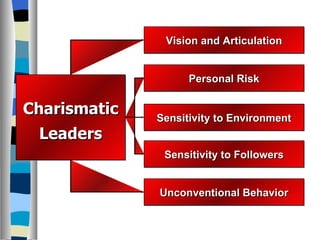
Charismatic Leaders Vision and Articulation Personal Risk Sensitivity to Environment Sensitivity to Followers Unconventional Behavior
Developing Charisma Communicate a Vision Make frequent use of metaphors and analogies Inspire trust and confidence Be highly energetic and goal oriented Be emotionally expressive and warm Make ample use of your true stories Smile frequently, even if you are unhappy Be candid Make everyone feel that he/she is important Make non-verbal signals of self-confidence Be willing to take risks
Transformational Leadership Charisma Inspiration  Intellectual stimulation Individualized consideration
Developing Team Leader Skills Build a Mission Statement Show your team members that they are trusted Encourage team members to recognize each others accomplishments Establish a sense of urgency and High Performance standards Encourage honest criticism Use team symbols Use peer evaluations Help team members see the ‘Big Picture’ Minimize formation of ‘In-groups’ and ‘Out-groups’
Servant Leadership and Superleadership Servant Leadership  represents a philosophy in which leaders focus on increased  service to others rather than to oneself. A  superleader  is someone who leads others to lead themselves by developing employees’ self-management skills. Superleaders  attempt to increase employees’ feelings of personal control and intrinsic motivation.
Developing your own Leadership Potential Acquire broad experience Model effective leaders Self-develop leadership traits Become an integrated human being (know thyself) Practice a little leadership Help your leader lead

Leadership

  • 1.
  • 2.
    Chapter Eight Becomingan Effective Leader
  • 3.
  • 4.
    What Is Leadership?Many theories (trait, behavioral, etc.) Is it the same as management? A definition of leadership Formal and informal leaders Leadership and management
  • 5.
    Trait Theory Historicfindings reveal that leaders and followers vary by - intelligence - dominance - self-confidence - level of energy and activity - task-relevant knowledge Contemporary findings show that - people tend to perceive that someone is a leader when he or she exhibits traits associated with intelligence, masculinity, and dominance - people want their leaders to be credible - credible leaders are honest, forward-looking, inspiring, and competent Leadership Traits : represent the personal characteristics that differentiate leaders from followers.
  • 6.
    Trait Theory (continued)Gender and leadership - men and women were seen as displaying more task and social leadership, respectively - women used a more democratic or participative style than men, and men used a more autocratic and directive style than women - men and women were equally assertive - women executives, when rated by their peers, managers and direct reports, scored higher than their male counterparts on a variety of effectiveness criteria
  • 7.
    Key Leadership Traitsto Develop Self-Confidence Trustworthiness Assertiveness Emotional Stability Sense of Humor Self-Awareness and Self-Objectivity Cognitive Skills Emotional Intelligence Passion and Enthusiasm
  • 8.
    Transactional versus CharismaticLeadership Transactional Leadership : focuses on the interpersonal interactions between managers and employees Transactional Leaders - use contingent rewards to motivate employees - exert corrective action only when employees fail to obtain performance goals
  • 9.
    Charismatic Leaders Visionand Articulation Personal Risk Sensitivity to Environment Sensitivity to Followers Unconventional Behavior
  • 10.
    Developing Charisma Communicatea Vision Make frequent use of metaphors and analogies Inspire trust and confidence Be highly energetic and goal oriented Be emotionally expressive and warm Make ample use of your true stories Smile frequently, even if you are unhappy Be candid Make everyone feel that he/she is important Make non-verbal signals of self-confidence Be willing to take risks
  • 11.
    Transformational Leadership CharismaInspiration Intellectual stimulation Individualized consideration
  • 12.
    Developing Team LeaderSkills Build a Mission Statement Show your team members that they are trusted Encourage team members to recognize each others accomplishments Establish a sense of urgency and High Performance standards Encourage honest criticism Use team symbols Use peer evaluations Help team members see the ‘Big Picture’ Minimize formation of ‘In-groups’ and ‘Out-groups’
  • 13.
    Servant Leadership andSuperleadership Servant Leadership represents a philosophy in which leaders focus on increased service to others rather than to oneself. A superleader is someone who leads others to lead themselves by developing employees’ self-management skills. Superleaders attempt to increase employees’ feelings of personal control and intrinsic motivation.
  • 14.
    Developing your ownLeadership Potential Acquire broad experience Model effective leaders Self-develop leadership traits Become an integrated human being (know thyself) Practice a little leadership Help your leader lead

Editor's Notes

  • #4 Leadership is an influence process; therefore, leaders are people who, by their actions, encourage a group of people to move toward a common or shared goal. A leader is an individual; leadership is the function that the individual performs. Individuals within an organization who have authority are often referred to as leaders, regardless of how they act in their jobs. But just because someone is supposed to be a formal leader in an organization, he or she may or may not exercise leadership. In fact, informal or emergent leaders can exhibit leadership even though they do not hold formal leadership positions. Harvard’s John Kotter compares management and leadership. Management, he says, is about dealing with complexity: drawing formal plans, designing organizational structures, and monitoring outcomes. Leadership, in contrast, is about coping with change. Leaders establish direction by developing a vision; then they communicate this vision to people and inspire them to overcome obstacles. Robert House of the Wharton School of Business concurs and says that mangers use formal authority to obtain compliance from organizational members. Management consists of implementing the vision and strategy provided by leaders, coordinating and staffing the organization, and handling day-to-day problems. While both management and leadership promote organizational effectiveness, most companies are over-managed and under-led.
  • #5 Leadership is an influence process; therefore, leaders are people who, by their actions, encourage a group of people to move toward a common or shared goal. A leader is an individual; leadership is the function that the individual performs. Individuals within an organization who have authority are often referred to as leaders, regardless of how they act in their jobs. But just because someone is supposed to be a formal leader in an organization, he or she may or may not exercise leadership. In fact, informal or emergent leaders can exhibit leadership even though they do not hold formal leadership positions. Harvard’s John Kotter compares management and leadership. Management, he says, is about dealing with complexity: drawing formal plans, designing organizational structures, and monitoring outcomes. Leadership, in contrast, is about coping with change. Leaders establish direction by developing a vision; then they communicate this vision to people and inspire them to overcome obstacles. Robert House of the Wharton School of Business concurs and says that mangers use formal authority to obtain compliance from organizational members. Management consists of implementing the vision and strategy provided by leaders, coordinating and staffing the organization, and handling day-to-day problems. While both management and leadership promote organizational effectiveness, most companies are over-managed and under-led.
  • #10 Charisma is a special quality of leaders whose purposes, powers and extraordinary determination differentiate them from others…this is a subjective perception, normally held by a large group