Which is true about me?
Played on the basketball team at
Vanderbilt University
Appeared on a national television show
to discuss research
Received an award for research
showing ways to improve medical care
My Favorite Leader….
In smalls groups of 3; each person
thinks about and shares the following
Describe the leader you most admire.
 Who is the person?
 What were his or her actions?
 How did followers react?
 This can be a close leader or someone you
have observed from a distance.
Great Man Leaders
Source of Power
 Organizational Position
 Physical Characteristics
Leader Behaviors
 Threats, Intimidation, Punishment
Follower Reactions
 Fear-based Compliance
 Dislike of Leader
Works for
 Short-term results
 Extreme situations
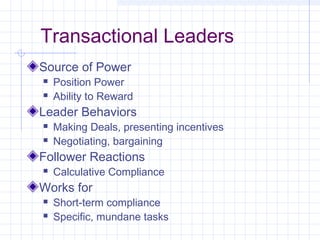
Transactional Leaders
Source of Power
 Position Power
 Ability to Reward
Leader Behaviors
 Making Deals, presenting incentives
 Negotiating, bargaining
Follower Reactions
 Calculative Compliance
Works for
 Short-term compliance
 Specific, mundane tasks
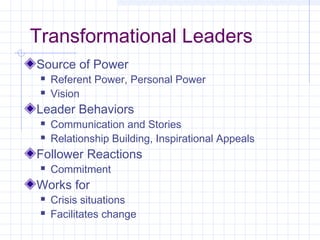
Transformational Leaders
Source of Power
 Referent Power, Personal Power
 Vision
Leader Behaviors
 Communication and Stories
 Relationship Building, Inspirational Appeals
Follower Reactions
 Commitment
Works for
 Crisis situations
 Facilitates change
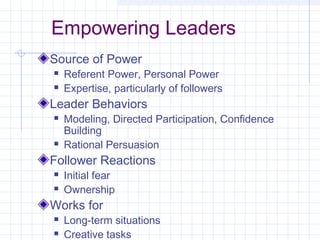
Empowering Leaders
Source of Power
 Referent Power, Personal Power
 Expertise, particularly of followers
Leader Behaviors
 Modeling, Directed Participation, Confidence
Building
 Rational Persuasion
Follower Reactions
 Initial fear
 Ownership
Works for
 Long-term situations
 Creative tasks
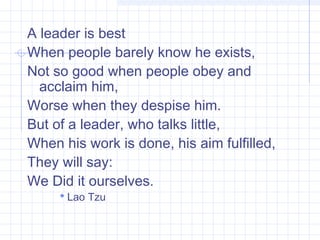
A leader is best
When people barely know he exists,
Not so good when people obey and
acclaim him,
Worse when they despise him.
But of a leader, who talks little,
When his work is done, his aim fulfilled,
They will say:
We Did it ourselves.
 Lao Tzu
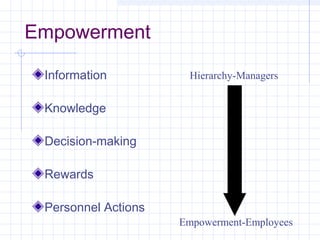
Empowerment
Information
Knowledge
Decision-making
Rewards
Personnel Actions
Empowerment-Employees
Hierarchy-Managers
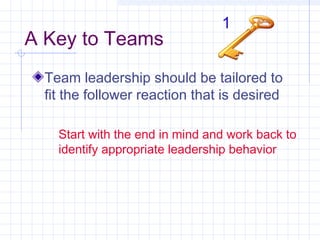
A Key to Teams
Team leadership should be tailored to
fit the follower reaction that is desired
Start with the end in mind and work back to
identify appropriate leadership behavior
1
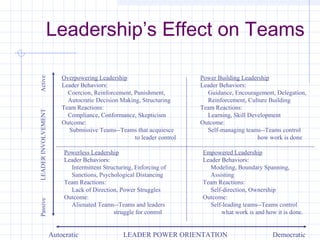
Leadership’s Effect on Teams
Overpowering Leadership
Leader Behaviors:
Coercion, Reinforcement, Punishment,
Autocratic Decision Making, Structuring
Team Reactions:
Compliance, Conformance, Skepticism
Outcome:
Submissive Teams--Teams that acquiesce
to leader control
Powerless Leadership
Leader Behaviors:
Intermittent Structuring, Enforcing of
Sanctions, Psychological Distancing
Team Reactions:
Lack of Direction, Power Struggles
Outcome:
Alienated Teams--Teams and leaders
struggle for control
Power Building Leadership
Leader Behaviors:
Guidance, Encouragement, Delegation,
Reinforcement, Culture Building
Team Reactions:
Learning, Skill Development
Outcome:
Self-managing teams--Teams control
how work is done
Empowered Leadership
Leader Behaviors:
Modeling, Boundary Spanning,
Assisting
Team Reactions:
Self-direction, Ownership
Outcome:
Self-leading teams--Teams control
what work is and how it is done.
LEADER POWER ORIENTATION DemocraticAutocratic
LEADERINVOLVEMENTPassiveActive
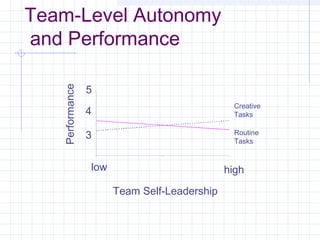
Team-Level Autonomy
and Performance
highlow
Performance
3
4
5
Team Self-Leadership
Creative
Tasks
Routine
Tasks
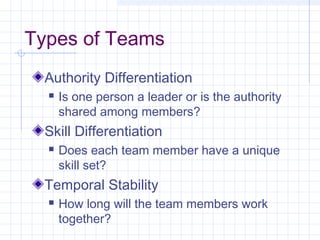
Types of Teams
Authority Differentiation
 Is one person a leader or is the authority
shared among members?
Skill Differentiation
 Does each team member have a unique
skill set?
Temporal Stability
 How long will the team members work
together?
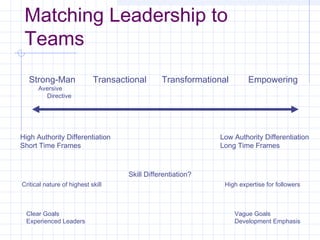
Matching Leadership to
Teams
Strong-Man Transactional Transformational Empowering
High Authority Differentiation
Short Time Frames
Low Authority Differentiation
Long Time Frames
Skill Differentiation?
Aversive
Directive
Critical nature of highest skill High expertise for followers
Clear Goals
Experienced Leaders
Vague Goals
Development Emphasis
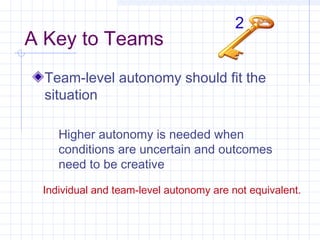
A Key to Teams
Team-level autonomy should fit the
situation
Higher autonomy is needed when
conditions are uncertain and outcomes
need to be creative
2
Individual and team-level autonomy are not equivalent.
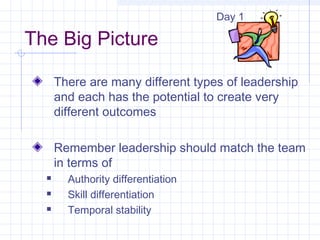
The Big Picture
There are many different types of leadership
and each has the potential to create very
different outcomes
Remember leadership should match the team
in terms of
 Authority differentiation
 Skill differentiation
 Temporal stability
Day 1

Leadership styles

  • 1.
    Which is trueabout me? Played on the basketball team at Vanderbilt University Appeared on a national television show to discuss research Received an award for research showing ways to improve medical care
  • 2.
    My Favorite Leader…. Insmalls groups of 3; each person thinks about and shares the following Describe the leader you most admire.  Who is the person?  What were his or her actions?  How did followers react?  This can be a close leader or someone you have observed from a distance.
  • 3.
    Great Man Leaders Sourceof Power  Organizational Position  Physical Characteristics Leader Behaviors  Threats, Intimidation, Punishment Follower Reactions  Fear-based Compliance  Dislike of Leader Works for  Short-term results  Extreme situations
  • 4.
    Transactional Leaders Source ofPower  Position Power  Ability to Reward Leader Behaviors  Making Deals, presenting incentives  Negotiating, bargaining Follower Reactions  Calculative Compliance Works for  Short-term compliance  Specific, mundane tasks
  • 5.
    Transformational Leaders Source ofPower  Referent Power, Personal Power  Vision Leader Behaviors  Communication and Stories  Relationship Building, Inspirational Appeals Follower Reactions  Commitment Works for  Crisis situations  Facilitates change
  • 6.
    Empowering Leaders Source ofPower  Referent Power, Personal Power  Expertise, particularly of followers Leader Behaviors  Modeling, Directed Participation, Confidence Building  Rational Persuasion Follower Reactions  Initial fear  Ownership Works for  Long-term situations  Creative tasks
  • 7.
    A leader isbest When people barely know he exists, Not so good when people obey and acclaim him, Worse when they despise him. But of a leader, who talks little, When his work is done, his aim fulfilled, They will say: We Did it ourselves.  Lao Tzu
  • 8.
  • 9.
    A Key toTeams Team leadership should be tailored to fit the follower reaction that is desired Start with the end in mind and work back to identify appropriate leadership behavior 1
  • 10.
    Leadership’s Effect onTeams Overpowering Leadership Leader Behaviors: Coercion, Reinforcement, Punishment, Autocratic Decision Making, Structuring Team Reactions: Compliance, Conformance, Skepticism Outcome: Submissive Teams--Teams that acquiesce to leader control Powerless Leadership Leader Behaviors: Intermittent Structuring, Enforcing of Sanctions, Psychological Distancing Team Reactions: Lack of Direction, Power Struggles Outcome: Alienated Teams--Teams and leaders struggle for control Power Building Leadership Leader Behaviors: Guidance, Encouragement, Delegation, Reinforcement, Culture Building Team Reactions: Learning, Skill Development Outcome: Self-managing teams--Teams control how work is done Empowered Leadership Leader Behaviors: Modeling, Boundary Spanning, Assisting Team Reactions: Self-direction, Ownership Outcome: Self-leading teams--Teams control what work is and how it is done. LEADER POWER ORIENTATION DemocraticAutocratic LEADERINVOLVEMENTPassiveActive
  • 11.
    Team-Level Autonomy and Performance highlow Performance 3 4 5 TeamSelf-Leadership Creative Tasks Routine Tasks
  • 12.
    Types of Teams AuthorityDifferentiation  Is one person a leader or is the authority shared among members? Skill Differentiation  Does each team member have a unique skill set? Temporal Stability  How long will the team members work together?
  • 13.
    Matching Leadership to Teams Strong-ManTransactional Transformational Empowering High Authority Differentiation Short Time Frames Low Authority Differentiation Long Time Frames Skill Differentiation? Aversive Directive Critical nature of highest skill High expertise for followers Clear Goals Experienced Leaders Vague Goals Development Emphasis
  • 14.
    A Key toTeams Team-level autonomy should fit the situation Higher autonomy is needed when conditions are uncertain and outcomes need to be creative 2 Individual and team-level autonomy are not equivalent.
  • 15.
    The Big Picture Thereare many different types of leadership and each has the potential to create very different outcomes Remember leadership should match the team in terms of  Authority differentiation  Skill differentiation  Temporal stability Day 1

Editor's Notes

  • #12 Ask if more self-leadership is always desirable. The answer of course is that it depends. Here we find that it depends once again on the nature of the tasks. This is from the same study of teams. We found that self-leadership was helpful when teams had creative tasks. This allowed them to arrive at unique solutions and to adapt to changes. It was not helpful when teams had routine tasks. In essence the best method had already been determined, so it made little sense to have rogue teams. Self-leadership also created interteam coordination problems.