Fiedler’s theory of leadership 
 Fiedler’s theory is an elaborate situational theories in leadership Literature 
 Fiedler is probably the first researcher who recognized the need for a broader explanation of 
leadership phenomena anchored on situational variables 
 Fiedler's contingency theory is one of the contingency theories that states that effective 
leadership depends not only on the style of leading but on the control over a situation. 
 Fiedler’s model is called a ‘contingency’ model because the leade r’s effectiveness is partially 
contingent upon three major situational variables 
o Leader member relations 
o Task Structure 
o Leader’s Position Power 
 Fiedler also created the least preferred co-worker (LPC) scale, where a leader is asked what 
traits can be ascribed to the co-worker that the leader likes the least 
Example:
Situational Parameters 
a) Leader member relations 
 It refers to the degree of confidence, trust and respect followers have in the leader 
 It indicates the degree to which group members like the leader and are willing to accept the 
leader’s behavior, as an influence on them 
 If followers are willing to follow because `of charisma, expertise, competence or mutual 
respect, the leader has little need to depend on task structure or position power 
b) Task Structure 
 It measures the extent to which the task performed by subordinates in routine or non-routine. 
 Task structure refers to the degree to which the task requirements are clearly defined the 
correctness of a decision can be easily Verified and there are alternative solutions to task 
problems 
 In other words task structure refers to how routine and predictable the work group’s task is 
c) Leader’s Position Power 
 The most obvious manner in which the leader secures power is by accepting and performi ng the 
leadership role. 
 Position power in the contingency model refers to the power inherent in the leader’s 
organizational position 
 It refers to the degree to which the leader at his disposal various rewards and sanctions, his 
authority over group’s members and the degree to which this authority Is supported by the 
organization 
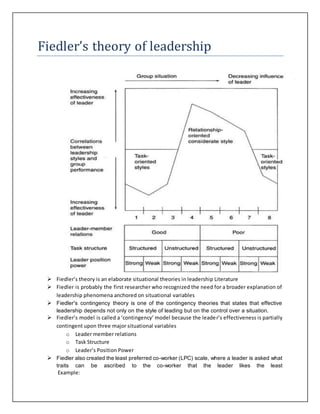
Thus, on the high and low categories of these situational variable, fiedlers developed eight 
possible combination ranging from highly favorable to unfavorable situation as ment ioned in 
figure
Leader Orientation 
Relationship Orientated: (LPC score of 73 and above) 
Generally, high LPC leaders are more concerned with personal relations, more sensitive to the 
feelings of others, and better off at heading off conflict. They use their good relations with the 
group to get the job done. They are better able to deal with the complex issues in making 
decisions. 
 In high control situations, they tend to become bored and are no longer challenged. They may 
seek approval from their superiors ignoring their subordinates, or they may try to reorganize the 
task. As a result, they often become inconsiderate toward their subordinates, more punishing, 
and more concerned with performance of the task. 
 In moderate control situations, they focus on group relations. They reduce the anxiety and 
tension of group members, and thus reduce conflict. They handle creative decision making 
groups well. They see this situation as challenging and interesting and perform well in it. 
 In low control situations, they become absorbed in obtaining group support often at the 
expense of the task. Under extremely stressful situations, they may also withdraw from the 
leadership role, failing to direct the group’s work. 
Task Oriented: (LPC score of 64 and below) 
Generally, low LPC leaders are more concerned with the task, and less dependent on group support. 
They tend to be eager and impatient to get on with the work. They quickly organize the job and have a 
no-nonsense attitude about getting the work done. 
 In moderate control situations, they tend to be anxious and less effective. This situation is often 
characterized by group conflict, which low LPC leaders do not like to handle. They become 
absorbed in the task and pay little attention to personal relations in the group. They tend to be 
insensitive to the feelings of their group members, and the group resents the lack of concern 
 In high control situations, they tend to relax and to develop pleasant relations with 
subordinates. They are easy to get along with. As the work gets done, they do not interfere with 
the group or expect interference from their superiors. 
 In low control situations, they devote themselves to their challenging task. They organize and 
drive the group to task completion. They also tend to control the group tightly and maintain 
strict discipline. Group members often respect low LPC leaders for enabling them to reach the 
group’s goals in difficult situations.
Verdict: 
A favorable situation is where the leader member relations are good, the task is highl y 
structured and the leader has enormous power to exert influence on the subordinates. When 
the situation is highly favorable or highly unfavorable , a task oriented style produces the 
desired performance.

Fiedler

  • 1.
    Fiedler’s theory ofleadership  Fiedler’s theory is an elaborate situational theories in leadership Literature  Fiedler is probably the first researcher who recognized the need for a broader explanation of leadership phenomena anchored on situational variables  Fiedler's contingency theory is one of the contingency theories that states that effective leadership depends not only on the style of leading but on the control over a situation.  Fiedler’s model is called a ‘contingency’ model because the leade r’s effectiveness is partially contingent upon three major situational variables o Leader member relations o Task Structure o Leader’s Position Power  Fiedler also created the least preferred co-worker (LPC) scale, where a leader is asked what traits can be ascribed to the co-worker that the leader likes the least Example:
  • 2.
    Situational Parameters a)Leader member relations  It refers to the degree of confidence, trust and respect followers have in the leader  It indicates the degree to which group members like the leader and are willing to accept the leader’s behavior, as an influence on them  If followers are willing to follow because `of charisma, expertise, competence or mutual respect, the leader has little need to depend on task structure or position power b) Task Structure  It measures the extent to which the task performed by subordinates in routine or non-routine.  Task structure refers to the degree to which the task requirements are clearly defined the correctness of a decision can be easily Verified and there are alternative solutions to task problems  In other words task structure refers to how routine and predictable the work group’s task is c) Leader’s Position Power  The most obvious manner in which the leader secures power is by accepting and performi ng the leadership role.  Position power in the contingency model refers to the power inherent in the leader’s organizational position  It refers to the degree to which the leader at his disposal various rewards and sanctions, his authority over group’s members and the degree to which this authority Is supported by the organization Thus, on the high and low categories of these situational variable, fiedlers developed eight possible combination ranging from highly favorable to unfavorable situation as ment ioned in figure
  • 3.
    Leader Orientation RelationshipOrientated: (LPC score of 73 and above) Generally, high LPC leaders are more concerned with personal relations, more sensitive to the feelings of others, and better off at heading off conflict. They use their good relations with the group to get the job done. They are better able to deal with the complex issues in making decisions.  In high control situations, they tend to become bored and are no longer challenged. They may seek approval from their superiors ignoring their subordinates, or they may try to reorganize the task. As a result, they often become inconsiderate toward their subordinates, more punishing, and more concerned with performance of the task.  In moderate control situations, they focus on group relations. They reduce the anxiety and tension of group members, and thus reduce conflict. They handle creative decision making groups well. They see this situation as challenging and interesting and perform well in it.  In low control situations, they become absorbed in obtaining group support often at the expense of the task. Under extremely stressful situations, they may also withdraw from the leadership role, failing to direct the group’s work. Task Oriented: (LPC score of 64 and below) Generally, low LPC leaders are more concerned with the task, and less dependent on group support. They tend to be eager and impatient to get on with the work. They quickly organize the job and have a no-nonsense attitude about getting the work done.  In moderate control situations, they tend to be anxious and less effective. This situation is often characterized by group conflict, which low LPC leaders do not like to handle. They become absorbed in the task and pay little attention to personal relations in the group. They tend to be insensitive to the feelings of their group members, and the group resents the lack of concern  In high control situations, they tend to relax and to develop pleasant relations with subordinates. They are easy to get along with. As the work gets done, they do not interfere with the group or expect interference from their superiors.  In low control situations, they devote themselves to their challenging task. They organize and drive the group to task completion. They also tend to control the group tightly and maintain strict discipline. Group members often respect low LPC leaders for enabling them to reach the group’s goals in difficult situations.
  • 4.
    Verdict: A favorablesituation is where the leader member relations are good, the task is highl y structured and the leader has enormous power to exert influence on the subordinates. When the situation is highly favorable or highly unfavorable , a task oriented style produces the desired performance.